
All Items 10% Off


Tron & Berthet Ideale 70 Speciale Competition Vintage Dark Brown Leather Saddle
£63.75 £75.00
✓ Original saddle - in production from the 1960s to the 1970s
✓ Suitable for historic cycling events such as L'Eroica
✓ Thoroughly checked & photographed in detail
✓ Worldwide shipping
Tron & Berthet Ideale 70 saddle, hailing from France and in production from the 1960s to the 1970s. Made from leather/steel material and weighing in at 520 grams. A fine choice for keeping your vintage bike authentic, but also great for any other compatible bike.
If you're taking part in L'Eroica or a similar vintage event, this is fully compliant - so rest assured, the pre-1987 police won't lock you up for having the wrong saddle!
The saddle's been checked over and graded as good condition, but do take a good look at the detailed photos so you can see the cosmetic condition before you buy.OVERVIEW
Condition Notes - One rivet missing
Production Era - 1960s & 1970s
Country - French
Material - Leather / Steel
Weight - 520 g
Stock Code - U-SA199V
TECHNICAL INFO
Colour* - Dark Brown
Cover Material - Leather
Length - 270 mm
Width (Widest Point) - 150 mm
*The colour description is just a guide, please check the photos to get a good idea of the colour too, as we make sure these are as close to the true colour as possible.
-
▼SHIPPING, TAXES & RETURNS
-
We've been safely sending orders around the world since 2010. Orders are carefully packed, sent with tracking & insurance, and normally collected around midday on Tuesdays and Fridays. Larger items may occasionally require an extra day or two to prepare.
We accept returns, please notify us within 14 days and ensure the item arrives back with us no later than 30 days after the order was received.
EU orders under €150 (excluding shipping) - import VAT and the new €3 customs duty are paid as part of your order, so there's nothing further to pay on delivery.
EU orders over €150 (excluding shipping) - import fees are payable to the carrier before delivery, with nothing collected at checkout.
USA orders - import fees are collected at checkout for all orders to the USA, so there won’t be any surprise charges when your order arrives.
Other international orders - local import fees may apply and are not collected by us. Please check your country's import rules before purchasing.


Selle Italia Sprint Vintage Black Leather Saddle
£55.25 £65.00
✓ Original saddle - in production from the 1970s to the 1980s
✓ Suitable for historic cycling events such as L'Eroica
✓ Thoroughly checked & photographed in detail
✓ Worldwide shipping
Selle Italia Sprint saddle, hailing from Italy and in production from the 1970s to the 1980s. Made from leather/steel material and weighing in at 382 grams. A fine choice for keeping your vintage bike authentic, but also great for any other compatible bike.
If you're taking part in L'Eroica or a similar vintage event, this is fully compliant - so rest assured, the pre-1987 police won't lock you up for having the wrong saddle!
The saddle's been checked over and graded as very good condition, but do take a good look at the detailed photos so you can see the cosmetic condition before you buy.OVERVIEW
Production Era - 1970s & 1980s
Country - Italian
Material - Leather / Steel
Weight - 382 g
Stock Code - U-SA198V
TECHNICAL INFO
Colour* - Black
Cover Material - Leather (Suede)
Length - 275 mm
Width (Widest Point) - 140 mm
*The colour description is just a guide, please check the photos to get a good idea of the colour too, as we make sure these are as close to the true colour as possible.
-
▼SHIPPING, TAXES & RETURNS
-
We've been safely sending orders around the world since 2010. Orders are carefully packed, sent with tracking & insurance, and normally collected around midday on Tuesdays and Fridays. Larger items may occasionally require an extra day or two to prepare.
We accept returns, please notify us within 14 days and ensure the item arrives back with us no later than 30 days after the order was received.
EU orders under €150 (excluding shipping) - import VAT and the new €3 customs duty are paid as part of your order, so there's nothing further to pay on delivery.
EU orders over €150 (excluding shipping) - import fees are payable to the carrier before delivery, with nothing collected at checkout.
USA orders - import fees are collected at checkout for all orders to the USA, so there won’t be any surprise charges when your order arrives.
Other international orders - local import fees may apply and are not collected by us. Please check your country's import rules before purchasing.


Vintage Chesini Branded Brown Leather Saddle
£72.25 £85.00
✓ Original saddle - produced in the 1970s
✓ Suitable for historic cycling events such as L'Eroica
✓ Thoroughly checked & photographed in detail
✓ Worldwide shipping
Unbranded vintage saddle, most likely in production during the 1970s. Made from leather/steel material and weighing in at 397 grams. A fine choice for keeping your vintage bike authentic, but also great for any other compatible bike.
If you're taking part in L'Eroica or a similar vintage event, this is fully compliant - so rest assured, the pre-1987 police won't lock you up for having the wrong saddle!
The saddle's been checked over and graded as good condition, but do take a good look at the detailed photos so you can see the cosmetic condition before you buy.OVERVIEW
Production Era - 1970s
Material - Leather / Steel
Weight - 397 g
Stock Code - U-SA197V
NB - Seems to be a Selle Italia Sprint but Chesini branded
TECHNICAL INFO
Colour* - Brown
Cover Material - Leather (Suede)
Length - 275 mm
Width (Widest Point) - 150 mm
*The colour description is just a guide, please check the photos too as we make sure these are as close to the true colour as possible.
-
▼SHIPPING, TAXES & RETURNS
-
We've been safely sending orders around the world since 2010. Orders are carefully packed, sent with tracking & insurance, and normally collected around midday on Tuesdays and Fridays. Larger items may occasionally require an extra day or two to prepare.
We accept returns, please notify us within 14 days and ensure the item arrives back with us no later than 30 days after the order was received.
EU orders under €150 (excluding shipping) - import VAT and the new €3 customs duty are paid as part of your order, so there's nothing further to pay on delivery.
EU orders over €150 (excluding shipping) - import fees are payable to the carrier before delivery, with nothing collected at checkout.
USA orders - import fees are collected at checkout for all orders to the USA, so there won’t be any surprise charges when your order arrives.
Other international orders - local import fees may apply and are not collected by us. Please check your country's import rules before purchasing.


Vintage Kids NOS Black Saddle
£26.25 £35.00
✓ Original saddle - in production from the 1970s to the 1980s
✓ New old stock! Still unused after all these years
✓ Suitable for historic cycling events such as L'Eroica
✓ Worldwide shipping
Unbranded vintage saddle, most likely in production from the 1970s to the 1980s (yet still new & unused after all this time!). Made from plastic/steel material and weighing in at 316 grams. A fine choice for keeping your vintage bike authentic, but also great for any other compatible bike.
If you're taking part in L'Eroica or a similar vintage event, this is fully compliant - so rest assured, the pre-1987 police won't lock you up for having the wrong saddle!
OVERVIEW
Production Era - 1970s & 1980s
Material - Plastic / Steel
Weight - 316 g
Stock Code - D-SA196V
*New old stock items may have marks from storage over the years, and as we often have multiples they can vary from piece to piece, but they are always genuine new & unused items.
TECHNICAL INFO
Colour* - Black
Cover Material - Plastic
Length - 250 mm
Width (Widest Point) - 125 mm
*The colour description is just a guide, please check the photos to get a good idea of the colour too, as we make sure these are as close to the true colour as possible.
-
▼SHIPPING, TAXES & RETURNS
-
We've been safely sending orders around the world since 2010. Orders are carefully packed, sent with tracking & insurance, and normally collected around midday on Tuesdays and Fridays. Larger items may occasionally require an extra day or two to prepare.
We accept returns, please notify us within 14 days and ensure the item arrives back with us no later than 30 days after the order was received.
EU orders under €150 (excluding shipping) - import VAT and the new €3 customs duty are paid as part of your order, so there's nothing further to pay on delivery.
EU orders over €150 (excluding shipping) - import fees are payable to the carrier before delivery, with nothing collected at checkout.
USA orders - import fees are collected at checkout for all orders to the USA, so there won’t be any surprise charges when your order arrives.
Other international orders - local import fees may apply and are not collected by us. Please check your country's import rules before purchasing.


Vetta Transverse AT c.1995 Classic Brown Leather Saddle
£25.50 £30.00
✓ Original saddle - produced in the 1990s
✓ Thoroughly checked & photographed in detail
✓ Worldwide shipping
Vetta Transverse AT saddle, hailing from Italy and dating back to 1995. Made from leather/steel material and weighing in at 291 grams. A fine choice for keeping your classic bike authentic, but also great for any other compatible bike.
The saddle's been checked over and graded as OK condition, but do take a good look at the detailed photos so you can see the cosmetic condition before you buy.OVERVIEW
Production Era - 1990s
Country - Italian
Material - Leather / Steel
Weight - 291 g
Stock Code - U-SA195C
TECHNICAL INFO
Colour* - Brown
Cover Material - Leather
Length - 275 mm
Width (Widest Point) - 130 mm
*The colour description is just a guide, please check the photos too as we make sure these are as close to the true colour as possible.
-
▼SHIPPING, TAXES & RETURNS
-
We've been safely sending orders around the world since 2010. Orders are carefully packed, sent with tracking & insurance, and normally collected around midday on Tuesdays and Fridays. Larger items may occasionally require an extra day or two to prepare.
We accept returns, please notify us within 14 days and ensure the item arrives back with us no later than 30 days after the order was received.
EU orders under €150 (excluding shipping) - import VAT and the new €3 customs duty are paid as part of your order, so there's nothing further to pay on delivery.
EU orders over €150 (excluding shipping) - import fees are payable to the carrier before delivery, with nothing collected at checkout.
USA orders - import fees are collected at checkout for all orders to the USA, so there won’t be any surprise charges when your order arrives.
Other international orders - local import fees may apply and are not collected by us. Please check your country's import rules before purchasing.


Velo Soffatti Riveted NOS Classic Black Saddle
£56.25 £75.00
✓ Original saddle - produced in the 1990s
✓ New old stock! Still unused after all these years
✓ Worldwide shipping
Velo Soffatti saddle, hailing from Taiwan and in production during the 1990s (yet still new & unused after all this time!). Made from synthetic/steel material and weighing in at 341 grams. A fine choice for keeping your classic bike authentic, but also great for any other compatible bike.
OVERVIEW
Production Era - 1990s
Country - Taiwanese
Material - Synthetic / Steel
Weight - 341 g
Stock Code - D-SA187C
*New old stock items may have marks from storage over the years, and as we often have multiples they can vary from piece to piece, but they are always genuine new & unused items.
TECHNICAL INFO
Colour* - Black
Cover Material - Synthetic
Length - 270 mm
Width (Widest Point) - 150 mm
*The colour description is just a guide, please check the photos to get a good idea of the colour too, as we make sure these are as close to the true colour as possible.
-
▼SHIPPING, TAXES & RETURNS
-
We've been safely sending orders around the world since 2010. Orders are carefully packed, sent with tracking & insurance, and normally collected around midday on Tuesdays and Fridays. Larger items may occasionally require an extra day or two to prepare.
We accept returns, please notify us within 14 days and ensure the item arrives back with us no later than 30 days after the order was received.
EU orders under €150 (excluding shipping) - import VAT and the new €3 customs duty are paid as part of your order, so there's nothing further to pay on delivery.
EU orders over €150 (excluding shipping) - import fees are payable to the carrier before delivery, with nothing collected at checkout.
USA orders - import fees are collected at checkout for all orders to the USA, so there won’t be any surprise charges when your order arrives.
Other international orders - local import fees may apply and are not collected by us. Please check your country's import rules before purchasing.


GES Soffatti Supra NOS Classic Black / Yellow Saddle
£56.25 £75.00
✓ Original saddle - produced in the 1990s
✓ New old stock! Still unused after all these years
✓ Worldwide shipping
GES Soffatti Supra saddle, hailing from Spain and in production during the 1990s (yet still new & unused after all this time!). Made from synthetic/plastic/steel material and weighing in at 318 grams. A fine choice for keeping your classic bike authentic, but also great for any other compatible bike.
OVERVIEW
Production Era - 1990s
Country - Spanish
Material - Synthetic / Plastic / Steel
Weight - 318 g
Stock Code - D-SA185C
*New old stock items may have marks from storage over the years, and as we often have multiples they can vary from piece to piece, but they are always genuine new & unused items.
TECHNICAL INFO
Colour* - Black / Yellow
Cover Material - Synthetic
Length - 270 mm
Width (Widest Point) - 130 mm
*The colour description is just a guide, please check the photos to get a good idea of the colour too, as we make sure these are as close to the true colour as possible.
-
▼SHIPPING, TAXES & RETURNS
-
We've been safely sending orders around the world since 2010. Orders are carefully packed, sent with tracking & insurance, and normally collected around midday on Tuesdays and Fridays. Larger items may occasionally require an extra day or two to prepare.
We accept returns, please notify us within 14 days and ensure the item arrives back with us no later than 30 days after the order was received.
EU orders under €150 (excluding shipping) - import VAT and the new €3 customs duty are paid as part of your order, so there's nothing further to pay on delivery.
EU orders over €150 (excluding shipping) - import fees are payable to the carrier before delivery, with nothing collected at checkout.
USA orders - import fees are collected at checkout for all orders to the USA, so there won’t be any surprise charges when your order arrives.
Other international orders - local import fees may apply and are not collected by us. Please check your country's import rules before purchasing.


Velo Soffatti Jet Perforated NOS Classic Black Saddle
£56.25 £75.00
✓ Original saddle - produced in the 1990s
✓ New old stock! Still unused after all these years
✓ Worldwide shipping
Velo Soffatti Jet saddle, hailing from Taiwan and in production during the 1990s (yet still new & unused after all this time!). Made from synthetic/steel material and weighing in at 271 grams. A fine choice for keeping your classic bike authentic, but also great for any other compatible bike.
OVERVIEW
Production Era - 1990s
Country - Taiwanese
Material - Synthetic / Steel
Weight - 271 g
Stock Code - D-SA183C
*New old stock items may have marks from storage over the years, and as we often have multiples they can vary from piece to piece, but they are always genuine new & unused items.
TECHNICAL INFO
Colour* - Black
Cover Material - Synthetic
Length - 260 mm
Width (Widest Point) - 140 mm
*The colour description is just a guide, please check the photos to get a good idea of the colour too, as we make sure these are as close to the true colour as possible.
-
▼SHIPPING, TAXES & RETURNS
-
We've been safely sending orders around the world since 2010. Orders are carefully packed, sent with tracking & insurance, and normally collected around midday on Tuesdays and Fridays. Larger items may occasionally require an extra day or two to prepare.
We accept returns, please notify us within 14 days and ensure the item arrives back with us no later than 30 days after the order was received.
EU orders under €150 (excluding shipping) - import VAT and the new €3 customs duty are paid as part of your order, so there's nothing further to pay on delivery.
EU orders over €150 (excluding shipping) - import fees are payable to the carrier before delivery, with nothing collected at checkout.
USA orders - import fees are collected at checkout for all orders to the USA, so there won’t be any surprise charges when your order arrives.
Other international orders - local import fees may apply and are not collected by us. Please check your country's import rules before purchasing.


Selle San Marco Concor Supercorsa Vintage Black Leather Saddle
£55.25 £65.00
✓ Original saddle - in production from the 1970s to the 1980s
✓ Suitable for historic cycling events such as L'Eroica
✓ Thoroughly checked & photographed in detail
✓ Worldwide shipping
Selle San Marco Concor Supercorsa saddle, hailing from Italy and in production from the 1970s to the 1980s. Made from leather/steel material and weighing in at 354 grams. A fine choice for keeping your vintage bike authentic, but also great for any other compatible bike.
If you're taking part in L'Eroica or a similar vintage event, this is fully compliant - so rest assured, the pre-1987 police won't lock you up for having the wrong saddle!
The saddle's been checked over and graded as very good condition, but do take a good look at the detailed photos so you can see the cosmetic condition before you buy.OVERVIEW
Condition Notes - One inch long nick in the top as pictured
Production Era - 1970s & 1980s
Country - Italian
Material - Leather / Steel
Weight - 354 g
Stock Code - U-SA178V
TECHNICAL INFO
Colour* - Black
Cover Material - Leather
Length - 250 mm
Width (Widest Point) - 140 mm
*The colour description is just a guide, please check the photos to get a good idea of the colour too, as we make sure these are as close to the true colour as possible.
-
▼SHIPPING, TAXES & RETURNS
-
We've been safely sending orders around the world since 2010. Orders are carefully packed, sent with tracking & insurance, and normally collected around midday on Tuesdays and Fridays. Larger items may occasionally require an extra day or two to prepare.
We accept returns, please notify us within 14 days and ensure the item arrives back with us no later than 30 days after the order was received.
EU orders under €150 (excluding shipping) - import VAT and the new €3 customs duty are paid as part of your order, so there's nothing further to pay on delivery.
EU orders over €150 (excluding shipping) - import fees are payable to the carrier before delivery, with nothing collected at checkout.
USA orders - import fees are collected at checkout for all orders to the USA, so there won’t be any surprise charges when your order arrives.
Other international orders - local import fees may apply and are not collected by us. Please check your country's import rules before purchasing.


GES Soffatti (XR-1) NOS Classic Black / Red Saddle
£48.75 £65.00
✓ Original saddle - produced in the 1990s
✓ New old stock! Still unused after all these years
✓ Worldwide shipping
GES Soffatti saddle, hailing from Spain and in production during the 1990s (yet still new & unused after all this time!). Made from synthetiic/plastic/steel material and weighing in at 365 grams. A fine choice for keeping your classic bike authentic, but also great for any other compatible bike.
OVERVIEW
Model ID - XR-1
Production Era - 1990s
Country - Spanish
Material - Synthetiic / Plastic / Steel
Weight - 365 g
Stock Code - D-SA176C
*New old stock items may have marks from storage over the years, and as we often have multiples they can vary from piece to piece, but they are always genuine new & unused items.
TECHNICAL INFO
Colour* - Black / Red
Cover Material - Synthetic
Length - 275 mm
Width (Widest Point) - 150 mm
*The colour description is just a guide, please check the photos to get a good idea of the colour too, as we make sure these are as close to the true colour as possible.
-
▼SHIPPING, TAXES & RETURNS
-
We've been safely sending orders around the world since 2010. Orders are carefully packed, sent with tracking & insurance, and normally collected around midday on Tuesdays and Fridays. Larger items may occasionally require an extra day or two to prepare.
We accept returns, please notify us within 14 days and ensure the item arrives back with us no later than 30 days after the order was received.
EU orders under €150 (excluding shipping) - import VAT and the new €3 customs duty are paid as part of your order, so there's nothing further to pay on delivery.
EU orders over €150 (excluding shipping) - import fees are payable to the carrier before delivery, with nothing collected at checkout.
USA orders - import fees are collected at checkout for all orders to the USA, so there won’t be any surprise charges when your order arrives.
Other international orders - local import fees may apply and are not collected by us. Please check your country's import rules before purchasing.


GES Soffatti (XR-1) NOS Classic Black / Red Saddle
£41.25 £55.00
✓ Original saddle - produced in the 1990s
✓ New old stock! Still unused after all these years
✓ Worldwide shipping
GES Soffatti saddle, hailing from Spain and in production during the 1990s (yet still new & unused after all this time!). Made from synthetiic/plastic/steel material and weighing in at 370 grams. A fine choice for keeping your classic bike authentic, but also great for any other compatible bike.
OVERVIEW
Condition Notes - Very small nick in the nose as pictured
Model ID - XR-1
Production Era - 1990s
Country - Spanish
Material - Synthetiic / Plastic / Steel
Weight - 370 g
Stock Code - D-SA175C
*New old stock items may have marks from storage over the years, and as we often have multiples they can vary from piece to piece, but they are always genuine new & unused items.
TECHNICAL INFO
Colour* - Black / Red
Cover Material - Synthetic
Length - 275 mm
Width (Widest Point) - 150 mm
*The colour description is just a guide, please check the photos to get a good idea of the colour too, as we make sure these are as close to the true colour as possible.
-
▼SHIPPING, TAXES & RETURNS
-
We've been safely sending orders around the world since 2010. Orders are carefully packed, sent with tracking & insurance, and normally collected around midday on Tuesdays and Fridays. Larger items may occasionally require an extra day or two to prepare.
We accept returns, please notify us within 14 days and ensure the item arrives back with us no later than 30 days after the order was received.
EU orders under €150 (excluding shipping) - import VAT and the new €3 customs duty are paid as part of your order, so there's nothing further to pay on delivery.
EU orders over €150 (excluding shipping) - import fees are payable to the carrier before delivery, with nothing collected at checkout.
USA orders - import fees are collected at checkout for all orders to the USA, so there won’t be any surprise charges when your order arrives.
Other international orders - local import fees may apply and are not collected by us. Please check your country's import rules before purchasing.


GES Huracan Crono NOS/NIB Vintage White / Grey / Black Striped Saddle
£82.50 £110.00
✓ Original saddle - produced in the 1980s
✓ New old stock & still in the original packaging!
✓ Suitable for historic cycling events such as L'Eroica
✓ Worldwide shipping
GES Huracan Crono saddle, hailing from Spain and in production during the 1980s (yet still new & unused after all this time!). Made from synthetic/steel material and weighing in at 380 grams. A fine choice for keeping your vintage bike authentic, but also great for any other compatible bike.
If you're taking part in L'Eroica or a similar vintage event, this is fully compliant - so rest assured, the pre-1987 police won't lock you up for having the wrong saddle!
OVERVIEW
Production Era - 1980s
Country - Spanish
Material - Synthetic / Steel
Weight - 380 g
Stock Code - D-SA174V
*New old stock items may have marks from storage over the years, and as we often have multiples they can vary from piece to piece, but they are always genuine new & unused items.
TECHNICAL INFO
Colour* - White / Grey / Black Striped
Cover Material - Synthetic
Length - 280 mm
Width (Widest Point) - 150 mm
*The colour description is just a guide, please check the photos to get a good idea of the colour too, as we make sure these are as close to the true colour as possible.
-
▼SHIPPING, TAXES & RETURNS
-
We've been safely sending orders around the world since 2010. Orders are carefully packed, sent with tracking & insurance, and normally collected around midday on Tuesdays and Fridays. Larger items may occasionally require an extra day or two to prepare.
We accept returns, please notify us within 14 days and ensure the item arrives back with us no later than 30 days after the order was received.
EU orders under €150 (excluding shipping) - import VAT and the new €3 customs duty are paid as part of your order, so there's nothing further to pay on delivery.
EU orders over €150 (excluding shipping) - import fees are payable to the carrier before delivery, with nothing collected at checkout.
USA orders - import fees are collected at checkout for all orders to the USA, so there won’t be any surprise charges when your order arrives.
Other international orders - local import fees may apply and are not collected by us. Please check your country's import rules before purchasing.


GES Huracan Crono NOS/NIB Vintage Green / White / Black Striped Saddle
£82.50 £110.00
✓ Original saddle - produced in the 1980s
✓ New old stock & still in the original packaging!
✓ Suitable for historic cycling events such as L'Eroica
✓ Worldwide shipping
GES Huracan Crono saddle, hailing from Spain and in production during the 1980s (yet still new & unused after all this time!). Made from synthetic/steel material and weighing in at 373 grams. A fine choice for keeping your vintage bike authentic, but also great for any other compatible bike.
If you're taking part in L'Eroica or a similar vintage event, this is fully compliant - so rest assured, the pre-1987 police won't lock you up for having the wrong saddle!
OVERVIEW
Production Era - 1980s
Country - Spanish
Material - Synthetic / Steel
Weight - 373 g
Stock Code - D-SA173V
*New old stock items may have marks from storage over the years, and as we often have multiples they can vary from piece to piece, but they are always genuine new & unused items.
TECHNICAL INFO
Colour* - Green / White / Black Striped
Cover Material - Synthetic
Length - 280 mm
Width (Widest Point) - 150 mm
*The colour description is just a guide, please check the photos to get a good idea of the colour too, as we make sure these are as close to the true colour as possible.
-
▼SHIPPING, TAXES & RETURNS
-
We've been safely sending orders around the world since 2010. Orders are carefully packed, sent with tracking & insurance, and normally collected around midday on Tuesdays and Fridays. Larger items may occasionally require an extra day or two to prepare.
We accept returns, please notify us within 14 days and ensure the item arrives back with us no later than 30 days after the order was received.
EU orders under €150 (excluding shipping) - import VAT and the new €3 customs duty are paid as part of your order, so there's nothing further to pay on delivery.
EU orders over €150 (excluding shipping) - import fees are payable to the carrier before delivery, with nothing collected at checkout.
USA orders - import fees are collected at checkout for all orders to the USA, so there won’t be any surprise charges when your order arrives.
Other international orders - local import fees may apply and are not collected by us. Please check your country's import rules before purchasing.


GES Huracan Crono NOS/NIB Vintage Yellow / White / Black Striped Saddle
£82.50 £110.00
✓ Original saddle - produced in the 1980s
✓ New old stock & still in the original packaging!
✓ Suitable for historic cycling events such as L'Eroica
✓ Worldwide shipping
GES Huracan Crono saddle, hailing from Spain and in production during the 1980s (yet still new & unused after all this time!). Made from synthetic/steel material and weighing in at 395 grams. A fine choice for keeping your vintage bike authentic, but also great for any other compatible bike.
If you're taking part in L'Eroica or a similar vintage event, this is fully compliant - so rest assured, the pre-1987 police won't lock you up for having the wrong saddle!
OVERVIEW
Production Era - 1980s
Country - Spanish
Material - Synthetic / Steel
Weight - 395 g
Stock Code - D-SA172V
*New old stock items may have marks from storage over the years, and as we often have multiples they can vary from piece to piece, but they are always genuine new & unused items.
TECHNICAL INFO
Colour* - Yellow / White / Black Striped
Cover Material - Synthetic
Length - 280 mm
Width (Widest Point) - 150 mm
*The colour description is just a guide, please check the photos to get a good idea of the colour too, as we make sure these are as close to the true colour as possible.
-
▼SHIPPING, TAXES & RETURNS
-
We've been safely sending orders around the world since 2010. Orders are carefully packed, sent with tracking & insurance, and normally collected around midday on Tuesdays and Fridays. Larger items may occasionally require an extra day or two to prepare.
We accept returns, please notify us within 14 days and ensure the item arrives back with us no later than 30 days after the order was received.
EU orders under €150 (excluding shipping) - import VAT and the new €3 customs duty are paid as part of your order, so there's nothing further to pay on delivery.
EU orders over €150 (excluding shipping) - import fees are payable to the carrier before delivery, with nothing collected at checkout.
USA orders - import fees are collected at checkout for all orders to the USA, so there won’t be any surprise charges when your order arrives.
Other international orders - local import fees may apply and are not collected by us. Please check your country's import rules before purchasing.


GES Huracan NOS Vintage Green / White / Black Striped Saddle
£45.00 £60.00
✓ Original saddle - produced in the 1980s
✓ New old stock! Still unused after all these years
✓ Suitable for historic cycling events such as L'Eroica
✓ Worldwide shipping
GES Huracan saddle, hailing from Spain and in production during the 1980s (yet still new & unused after all this time!). Made from synthetic/steel material and weighing in at 275 grams. A fine choice for keeping your vintage bike authentic, but also great for any other compatible bike.
If you're taking part in L'Eroica or a similar vintage event, this is fully compliant - so rest assured, the pre-1987 police won't lock you up for having the wrong saddle!
OVERVIEW
Production Era - 1980s
Country - Spanish
Material - Synthetic / Steel
Weight - 275 g
Stock Code - D-SA171V
*New old stock items may have marks from storage over the years, and as we often have multiples they can vary from piece to piece, but they are always genuine new & unused items.
TECHNICAL INFO
Colour* - Green / White / Black Striped
Cover Material - Synthetic
Length - 270 mm
Width (Widest Point) - 145 mm
*The colour description is just a guide, please check the photos to get a good idea of the colour too, as we make sure these are as close to the true colour as possible.
-
▼SHIPPING, TAXES & RETURNS
-
We've been safely sending orders around the world since 2010. Orders are carefully packed, sent with tracking & insurance, and normally collected around midday on Tuesdays and Fridays. Larger items may occasionally require an extra day or two to prepare.
We accept returns, please notify us within 14 days and ensure the item arrives back with us no later than 30 days after the order was received.
EU orders under €150 (excluding shipping) - import VAT and the new €3 customs duty are paid as part of your order, so there's nothing further to pay on delivery.
EU orders over €150 (excluding shipping) - import fees are payable to the carrier before delivery, with nothing collected at checkout.
USA orders - import fees are collected at checkout for all orders to the USA, so there won’t be any surprise charges when your order arrives.
Other international orders - local import fees may apply and are not collected by us. Please check your country's import rules before purchasing.


Classic Tamika Racing Embroidered NOS Black / Red Saddle
£22.50 £30.00
✓ Original saddle - produced in the 1990s
✓ New old stock! Still unused after all these years
✓ Worldwide shipping
Unbranded classic saddle, most likely in production during the 1990s (yet still new & unused after all this time!). Made from synthetic/steel material and weighing in at 317 grams. A fine choice for keeping your classic bike authentic, but also great for any other compatible bike.
OVERVIEW
Condition Notes - This has been installed but never used
Production Era - 1990s
Material - Synthetic / Steel
Weight - 317 g
Stock Code - D-SA164C
*New old stock items may have marks from storage over the years, and as we often have multiples they can vary from piece to piece, but they are always genuine new & unused items.
TECHNICAL INFO
Colour* - Black / Red
Cover Material - Synthetic
Length - 265 mm
Width (Widest Point) - 155 mm
*The colour description is just a guide, please check the photos to get a good idea of the colour too, as we make sure these are as close to the true colour as possible.
-
▼SHIPPING, TAXES & RETURNS
-
We've been safely sending orders around the world since 2010. Orders are carefully packed, sent with tracking & insurance, and normally collected around midday on Tuesdays and Fridays. Larger items may occasionally require an extra day or two to prepare.
We accept returns, please notify us within 14 days and ensure the item arrives back with us no later than 30 days after the order was received.
EU orders under €150 (excluding shipping) - import VAT and the new €3 customs duty are paid as part of your order, so there's nothing further to pay on delivery.
EU orders over €150 (excluding shipping) - import fees are payable to the carrier before delivery, with nothing collected at checkout.
USA orders - import fees are collected at checkout for all orders to the USA, so there won’t be any surprise charges when your order arrives.
Other international orders - local import fees may apply and are not collected by us. Please check your country's import rules before purchasing.


Campagnolo Nuovo Super Record (4051/1) Long Non-Fluted Last Gen NOS/NIB Vintage 26.6 mm Seatpost
£123.75 £165.00
✓ Original part - produced in the 1980s
✓ New old stock & still in the original packaging!
✓ Super lightweight for the era - only 205 grams!
✓ Suitable for historic cycling events such as L'Eroica
✓ Worldwide shipping
Campagnolo Nuovo Super Record seatpost, hailing from Italy and in production during the 1980s (yet still new & unused after all this time!). Made from aluminium/steel and weighing in at 205 grams - incredibly lightweight for seatposts at that time. A fine choice for keeping your vintage bike authentic, but also great for any other compatible bike.
If you're taking part in L'Eroica or a similar vintage event, this is fully compliant - so rest assured, the pre-1987 police won't lock you up for having the wrong seatpost!
Please note: Once inserted into a frame this cannot be returned, so please make sure to double check the diameter is correct before installing.OVERVIEW
Model ID - 4051/1
Production Era - 1980s
Country - Italian
Material - Aluminium / Steel
Weight - 205 g
Stock Code - D-SP186V
*New old stock items may have marks from storage over the years, and as we often have multiples they can vary from piece to piece, but they are always genuine new & unused items.
TECHNICAL INFO
Seatpost Diameter - 26.6 mm
Length (Centre of Rails to Base) - 205 mm
-
▼SHIPPING, TAXES & RETURNS
-
We've been safely sending orders around the world since 2010. Orders are carefully packed, sent with tracking & insurance, and normally collected around midday on Tuesdays and Fridays. Larger items may occasionally require an extra day or two to prepare.
We accept returns, please notify us within 14 days and ensure the item arrives back with us no later than 30 days after the order was received.
EU orders under €150 (excluding shipping) - import VAT and the new €3 customs duty are paid as part of your order, so there's nothing further to pay on delivery.
EU orders over €150 (excluding shipping) - import fees are payable to the carrier before delivery, with nothing collected at checkout.
USA orders - import fees are collected at checkout for all orders to the USA, so there won’t be any surprise charges when your order arrives.
Other international orders - local import fees may apply and are not collected by us. Please check your country's import rules before purchasing.
-
▼HELP SECTION
-
Seatpost Diameter - this needs to match the internal diameter of your frame’s seat tube closely, it should be possible to insert the seatpost without force but the fit should be tight enough so it doesn’t just drop in, with no play once inserted. If you have a post that fits the measurement should be stamped somewhere near the bottom, if not you’ll need to measure with a caliper or seatpost sizing tool as the sizes go up in 0.2 mm increments.
Length (Centre of Rails to Base) - measured from where the centre of the saddle rails will sit once installed, all the way to the bottom of the seatpost. Normally there’s a mark to tell you how much of the seatpost needs to be inserted in the frame, however this isn’t always the case so we’d recommend allowing a minimum of 6 cm.


Italmanubri (ITM) NOS Vintage 27.4 mm Seatpost
£37.50 £50.00
✓ Original part - produced in the 1980s
✓ New old stock! Still unused after all these years
✓ Suitable for historic cycling events such as L'Eroica
✓ Worldwide shipping
Italmanubri (ITM) seatpost, hailing from Italy and in production during the 1980s (yet still new & unused after all this time!). Made from aluminium and weighing in at 332 grams. A fine choice for keeping your vintage bike authentic, but also great for any other compatible bike.
If you're taking part in L'Eroica or a similar vintage event, this is fully compliant - so rest assured, the pre-1987 police won't lock you up for having the wrong seatpost!
Please note: Once inserted into a frame this cannot be returned, so please make sure to double check the diameter is correct before installing.OVERVIEW
Production Era - 1980s
Country - Italian
Material - Aluminium
Weight - 332 g
Stock Code - D-SP178V
*New old stock items may have marks from storage over the years, and as we often have multiples they can vary from piece to piece, but they are always genuine new & unused items.
TECHNICAL INFO
Seatpost Diameter - 27.4 mm
Length (Centre of Rails to Base) - 220 mm
-
▼SHIPPING, TAXES & RETURNS
-
We've been safely sending orders around the world since 2010. Orders are carefully packed, sent with tracking & insurance, and normally collected around midday on Tuesdays and Fridays. Larger items may occasionally require an extra day or two to prepare.
We accept returns, please notify us within 14 days and ensure the item arrives back with us no later than 30 days after the order was received.
EU orders under €150 (excluding shipping) - import VAT and the new €3 customs duty are paid as part of your order, so there's nothing further to pay on delivery.
EU orders over €150 (excluding shipping) - import fees are payable to the carrier before delivery, with nothing collected at checkout.
USA orders - import fees are collected at checkout for all orders to the USA, so there won’t be any surprise charges when your order arrives.
Other international orders - local import fees may apply and are not collected by us. Please check your country's import rules before purchasing.
-
▼HELP SECTION
-
Seatpost Diameter - this needs to match the internal diameter of your frame’s seat tube closely, it should be possible to insert the seatpost without force but the fit should be tight enough so it doesn’t just drop in, with no play once inserted. If you have a post that fits the measurement should be stamped somewhere near the bottom, if not you’ll need to measure with a caliper or seatpost sizing tool as the sizes go up in 0.2 mm increments.
Length (Centre of Rails to Base) - measured from where the centre of the saddle rails will sit once installed, all the way to the bottom of the seatpost. Normally there’s a mark to tell you how much of the seatpost needs to be inserted in the frame, however this isn’t always the case so we’d recommend allowing a minimum of 6 cm.


JPR (Jean Paul Routens) Extra Light Fluted NOS Vintage 26.6 mm Seatpost
£41.25 £55.00
✓ Original part - in production from the 1980s to the 1990s
✓ New old stock! Still unused after all these years
✓ Lightweight for the era - just 258 grams
✓ Suitable for historic cycling events such as L'Eroica
✓ Worldwide shipping
JPR (Jean Paul Routens) Extra Light seatpost, in production from the 1980s to the 1990s (yet still new & unused after all this time!). Made from aluminium and weighing in at 258 grams - pretty lightweight for seatposts at that time. A fine choice for keeping your vintage bike authentic, but also great for any other compatible bike.
If you're taking part in L'Eroica or a similar vintage event, this is fully compliant - so rest assured, the pre-1987 police won't lock you up for having the wrong seatpost!
Please note: Once inserted into a frame this cannot be returned, so please make sure to double check the diameter is correct before installing.OVERVIEW
Production Era - 1980s & 1990s
Material - Aluminium
Weight - 258 g
Stock Code - D-SP176V
*New old stock items may have marks from storage over the years, and as we often have multiples they can vary from piece to piece, but they are always genuine new & unused items.
TECHNICAL INFO
Seatpost Diameter - 26.6 mm
Length (Centre of Rails to Base) - 180 mm
-
▼SHIPPING, TAXES & RETURNS
-
We've been safely sending orders around the world since 2010. Orders are carefully packed, sent with tracking & insurance, and normally collected around midday on Tuesdays and Fridays. Larger items may occasionally require an extra day or two to prepare.
We accept returns, please notify us within 14 days and ensure the item arrives back with us no later than 30 days after the order was received.
EU orders under €150 (excluding shipping) - import VAT and the new €3 customs duty are paid as part of your order, so there's nothing further to pay on delivery.
EU orders over €150 (excluding shipping) - import fees are payable to the carrier before delivery, with nothing collected at checkout.
USA orders - import fees are collected at checkout for all orders to the USA, so there won’t be any surprise charges when your order arrives.
Other international orders - local import fees may apply and are not collected by us. Please check your country's import rules before purchasing.
-
▼HELP SECTION
-
Seatpost Diameter - this needs to match the internal diameter of your frame’s seat tube closely, it should be possible to insert the seatpost without force but the fit should be tight enough so it doesn’t just drop in, with no play once inserted. If you have a post that fits the measurement should be stamped somewhere near the bottom, if not you’ll need to measure with a caliper or seatpost sizing tool as the sizes go up in 0.2 mm increments.
Length (Centre of Rails to Base) - measured from where the centre of the saddle rails will sit once installed, all the way to the bottom of the seatpost. Normally there’s a mark to tell you how much of the seatpost needs to be inserted in the frame, however this isn’t always the case so we’d recommend allowing a minimum of 6 cm.


Shimano Deore XT (FD-M700) 'Deer Head' NOS Vintage Clamp-On 28.6 mm Front Derailleur
£82.50 £110.00
✓ Original part - produced in the 1980s
✓ New old stock! Still unused after all these years
✓ Worldwide shipping
Shimano Deore XT front derailleur, hailing from Japan and in production during the 1980s (yet still new & unused after all this time!). Made from steel/aluminium and weighing in at 118 grams. A fine choice for keeping your vintage bike authentic, but also great for any other compatible bike.
OVERVIEW
Model ID - FD-M700
Production Era - 1980s
Country - Japanese
Material - Steel / Aluminium
Weight - 118 g
Stock Code - D-FM179V
*New old stock items may have marks from storage over the years, and as we often have multiples they can vary from piece to piece, but they are always genuine new & unused items.
TECHNICAL INFO
Chainset Type - Triple
Frame Fixing - Clamp-On 28.6 mm
Pull Type - Bottom Pull
*See help section.
-
▼SHIPPING, TAXES & RETURNS
-
We've been safely sending orders around the world since 2010. Orders are carefully packed, sent with tracking & insurance, and normally collected around midday on Tuesdays and Fridays. Larger items may occasionally require an extra day or two to prepare.
We accept returns, please notify us within 14 days and ensure the item arrives back with us no later than 30 days after the order was received.
EU orders under €150 (excluding shipping) - import VAT and the new €3 customs duty are paid as part of your order, so there's nothing further to pay on delivery.
EU orders over €150 (excluding shipping) - import fees are payable to the carrier before delivery, with nothing collected at checkout.
USA orders - import fees are collected at checkout for all orders to the USA, so there won’t be any surprise charges when your order arrives.
Other international orders - local import fees may apply and are not collected by us. Please check your country's import rules before purchasing.
-
▼HELP SECTION
-
Chainset Type - the number of chainrings the derailleur was designed to work with. ‘Double’ derailleurs are actually capable of working on ‘triple’ chainsets but they may struggle when shifting, especially if there’s a big step down from the middle to inner ring, so it’s better to match these correctly.
Frame Fixing - the way the derailleur fixes to the frame, if you have a tab on your frame to mount the derailleur to you need braze-on. If there’s no tab then you require a clamp-on type (also referred to as band-on or clip-on), these come in different sizes to match the diameter of your seat tube.
Pull Type - the direction of which the cable needs to ‘pull’ the mech in order to shift. If your cable runs up to the derailleur from the bottom bracket area then you need bottom pull, if your cable comes down from above you need top pull. Some later derailleurs can be used for either setups, these are referred to as dual pull.
Designated Speed (9 Speed & Above) - the speed of the chain that the mech was designed to be used with. This only becomes relevant for mechs marketed as 9 speed or above when chains became narrower, as the derailleur cage plates became marginally narrower too. We refer to it as ‘designated’ speed as technically you can use (almost) any derailleur with any chain, however if you want optimum performance it’s best to stay close to the manufacturers recommendations.
Indexing System (Shimano Only) - this is only applicable when using Shimano shifters that have an indexed left shifter such as STI or Rapidfire. For the indexing to work correctly when using these shifters the derailleur and shifters must be of the same type, so Shimano drop bar shifters need to be matched with a Shimano ‘road’ derailleur, and Shimano flat bar shifters must be used with Shimano ‘MTB’ derailleurs.


Shimano Dura-Ace AX (FD-7300) NOS/NIB Vintage Clamp-On 28.6 mm Front Derailleur
£120.00 £160.00
✓ Original part - produced in the 1980s
✓ New old stock & still in the original packaging!
✓ Suitable for historic cycling events such as L'Eroica
✓ Worldwide shipping
Shimano Dura-Ace AX front derailleur, hailing from Japan and in production during the 1980s (yet still new & unused after all this time!). Made from aluminium/steel and weighing in at 97 grams. A fine choice for keeping your vintage bike authentic, but also great for any other compatible bike.
If you're taking part in L'Eroica or a similar vintage event, this is fully compliant - so rest assured, the pre-1987 police won't lock you up for having the wrong front mech!
OVERVIEW
Model ID - FD-7300
Production Era - 1980s
Country - Japanese
Material - Aluminium / Steel
Weight - 97 g
Stock Code - D-FM175V
*New old stock items may have marks from storage over the years, and as we often have multiples they can vary from piece to piece, but they are always genuine new & unused items.
TECHNICAL INFO
Chainset Type - Double
Frame Fixing - Clamp-On 28.6 mm
Pull Type - Bottom Pull
*See help section.
-
▼SHIPPING, TAXES & RETURNS
-
We've been safely sending orders around the world since 2010. Orders are carefully packed, sent with tracking & insurance, and normally collected around midday on Tuesdays and Fridays. Larger items may occasionally require an extra day or two to prepare.
We accept returns, please notify us within 14 days and ensure the item arrives back with us no later than 30 days after the order was received.
EU orders under €150 (excluding shipping) - import VAT and the new €3 customs duty are paid as part of your order, so there's nothing further to pay on delivery.
EU orders over €150 (excluding shipping) - import fees are payable to the carrier before delivery, with nothing collected at checkout.
USA orders - import fees are collected at checkout for all orders to the USA, so there won’t be any surprise charges when your order arrives.
Other international orders - local import fees may apply and are not collected by us. Please check your country's import rules before purchasing.
-
▼HELP SECTION
-
Chainset Type - the number of chainrings the derailleur was designed to work with. ‘Double’ derailleurs are actually capable of working on ‘triple’ chainsets but they may struggle when shifting, especially if there’s a big step down from the middle to inner ring, so it’s better to match these correctly.
Frame Fixing - the way the derailleur fixes to the frame, if you have a tab on your frame to mount the derailleur to you need braze-on. If there’s no tab then you require a clamp-on type (also referred to as band-on or clip-on), these come in different sizes to match the diameter of your seat tube.
Pull Type - the direction of which the cable needs to ‘pull’ the mech in order to shift. If your cable runs up to the derailleur from the bottom bracket area then you need bottom pull, if your cable comes down from above you need top pull. Some later derailleurs can be used for either setups, these are referred to as dual pull.
Designated Speed (9 Speed & Above) - the speed of the chain that the mech was designed to be used with. This only becomes relevant for mechs marketed as 9 speed or above when chains became narrower, as the derailleur cage plates became marginally narrower too. We refer to it as ‘designated’ speed as technically you can use (almost) any derailleur with any chain, however if you want optimum performance it’s best to stay close to the manufacturers recommendations.
Indexing System (Shimano Only) - this is only applicable when using Shimano shifters that have an indexed left shifter such as STI or Rapidfire. For the indexing to work correctly when using these shifters the derailleur and shifters must be of the same type, so Shimano drop bar shifters need to be matched with a Shimano ‘road’ derailleur, and Shimano flat bar shifters must be used with Shimano ‘MTB’ derailleurs.


Shimano Deore XT (FD-M737) NOS/NIB Classic MTB Clamp-On 31.8 mm Front Derailleur
£63.75 £85.00
✓ Original part - produced in the 1990s
✓ New old stock & still in the original packaging!
✓ Worldwide shipping
Shimano Deore XT front derailleur, hailing from Japan and in production during the 1990s (yet still new & unused after all this time!). Made from aluminium/steel and weighing in at 140 grams. A fine choice for keeping your classic bike authentic, but also great for any other compatible bike.
OVERVIEW
Model ID - FD-M737
Production Era - 1990s
Country - Japanese
Material - Aluminium / Steel
Weight - 140 g
Stock Code - D-FM174C
*New old stock items may have marks from storage over the years, and as we often have multiples they can vary from piece to piece, but they are always genuine new & unused items.
TECHNICAL INFO
Chainset Type - Triple
Frame Fixing - Clamp-On 31.8 mm
Pull Type - Top Pull
Indexing System* - MTB
*See help section.
-
▼SHIPPING, TAXES & RETURNS
-
We've been safely sending orders around the world since 2010. Orders are carefully packed, sent with tracking & insurance, and normally collected around midday on Tuesdays and Fridays. Larger items may occasionally require an extra day or two to prepare.
We accept returns, please notify us within 14 days and ensure the item arrives back with us no later than 30 days after the order was received.
EU orders under €150 (excluding shipping) - import VAT and the new €3 customs duty are paid as part of your order, so there's nothing further to pay on delivery.
EU orders over €150 (excluding shipping) - import fees are payable to the carrier before delivery, with nothing collected at checkout.
USA orders - import fees are collected at checkout for all orders to the USA, so there won’t be any surprise charges when your order arrives.
Other international orders - local import fees may apply and are not collected by us. Please check your country's import rules before purchasing.
-
▼HELP SECTION
-
Chainset Type - the number of chainrings the derailleur was designed to work with. ‘Double’ derailleurs are actually capable of working on ‘triple’ chainsets but they may struggle when shifting, especially if there’s a big step down from the middle to inner ring, so it’s better to match these correctly.
Frame Fixing - the way the derailleur fixes to the frame, if you have a tab on your frame to mount the derailleur to you need braze-on. If there’s no tab then you require a clamp-on type (also referred to as band-on or clip-on), these come in different sizes to match the diameter of your seat tube.
Pull Type - the direction of which the cable needs to ‘pull’ the mech in order to shift. If your cable runs up to the derailleur from the bottom bracket area then you need bottom pull, if your cable comes down from above you need top pull. Some later derailleurs can be used for either setups, these are referred to as dual pull.
Designated Speed (9 Speed & Above) - the speed of the chain that the mech was designed to be used with. This only becomes relevant for mechs marketed as 9 speed or above when chains became narrower, as the derailleur cage plates became marginally narrower too. We refer to it as ‘designated’ speed as technically you can use (almost) any derailleur with any chain, however if you want optimum performance it’s best to stay close to the manufacturers recommendations.
Indexing System (Shimano Only) - this is only applicable when using Shimano shifters that have an indexed left shifter such as STI or Rapidfire. For the indexing to work correctly when using these shifters the derailleur and shifters must be of the same type, so Shimano drop bar shifters need to be matched with a Shimano ‘road’ derailleur, and Shimano flat bar shifters must be used with Shimano ‘MTB’ derailleurs.


Shimano Dura-Ace EX (FD-7200) NOS/NIB Vintage Clamp-On 28.6 mm Front Derailleur
£93.75 £125.00
✓ Original part - in production from the 1970s to the 1980s
✓ New old stock & still in the original packaging!
✓ Suitable for historic cycling events such as L'Eroica
✓ Worldwide shipping
Shimano Dura-Ace EX front derailleur, hailing from Japan and in production from the 1970s to the 1980s (yet still new & unused after all this time!). Made from aluminium/steel and weighing in at 98 grams. A fine choice for keeping your vintage bike authentic, but also great for any other compatible bike.
If you're taking part in L'Eroica or a similar vintage event, this is fully compliant - so rest assured, the pre-1987 police won't lock you up for having the wrong front mech!
OVERVIEW
Model ID - FD-7200
Production Era - 1970s & 1980s
Country - Japanese
Material - Aluminium / Steel
Weight - 98 g
Stock Code - D-FM173V
*New old stock items may have marks from storage over the years, and as we often have multiples they can vary from piece to piece, but they are always genuine new & unused items.
TECHNICAL INFO
Chainset Type - Double
Frame Fixing - Clamp-On 28.6 mm
Pull Type - Bottom Pull
*See help section.
-
▼SHIPPING, TAXES & RETURNS
-
We've been safely sending orders around the world since 2010. Orders are carefully packed, sent with tracking & insurance, and normally collected around midday on Tuesdays and Fridays. Larger items may occasionally require an extra day or two to prepare.
We accept returns, please notify us within 14 days and ensure the item arrives back with us no later than 30 days after the order was received.
EU orders under €150 (excluding shipping) - import VAT and the new €3 customs duty are paid as part of your order, so there's nothing further to pay on delivery.
EU orders over €150 (excluding shipping) - import fees are payable to the carrier before delivery, with nothing collected at checkout.
USA orders - import fees are collected at checkout for all orders to the USA, so there won’t be any surprise charges when your order arrives.
Other international orders - local import fees may apply and are not collected by us. Please check your country's import rules before purchasing.
-
▼HELP SECTION
-
Chainset Type - the number of chainrings the derailleur was designed to work with. ‘Double’ derailleurs are actually capable of working on ‘triple’ chainsets but they may struggle when shifting, especially if there’s a big step down from the middle to inner ring, so it’s better to match these correctly.
Frame Fixing - the way the derailleur fixes to the frame, if you have a tab on your frame to mount the derailleur to you need braze-on. If there’s no tab then you require a clamp-on type (also referred to as band-on or clip-on), these come in different sizes to match the diameter of your seat tube.
Pull Type - the direction of which the cable needs to ‘pull’ the mech in order to shift. If your cable runs up to the derailleur from the bottom bracket area then you need bottom pull, if your cable comes down from above you need top pull. Some later derailleurs can be used for either setups, these are referred to as dual pull.
Designated Speed (9 Speed & Above) - the speed of the chain that the mech was designed to be used with. This only becomes relevant for mechs marketed as 9 speed or above when chains became narrower, as the derailleur cage plates became marginally narrower too. We refer to it as ‘designated’ speed as technically you can use (almost) any derailleur with any chain, however if you want optimum performance it’s best to stay close to the manufacturers recommendations.
Indexing System (Shimano Only) - this is only applicable when using Shimano shifters that have an indexed left shifter such as STI or Rapidfire. For the indexing to work correctly when using these shifters the derailleur and shifters must be of the same type, so Shimano drop bar shifters need to be matched with a Shimano ‘road’ derailleur, and Shimano flat bar shifters must be used with Shimano ‘MTB’ derailleurs.


Shimano Dura-Ace (FD-7410) NOS/NIB Classic Clamp-On 28.6 mm Front Derailleur
£112.50 £150.00
✓ Original part - produced in the 1990s
✓ New old stock & still in the original packaging!
✓ Worldwide shipping
Shimano Dura-Ace front derailleur, hailing from Japan and in production during the 1990s (yet still new & unused after all this time!). Made from aluminium/steel and weighing in at 97 grams. A fine choice for keeping your classic bike authentic, but also great for any other compatible bike.
OVERVIEW
Model ID - FD-7410
Production Era - 1990s
Country - Japanese
Material - Aluminium / Steel
Weight - 97 g
Stock Code - D-FM172C
*New old stock items may have marks from storage over the years, and as we often have multiples they can vary from piece to piece, but they are always genuine new & unused items.
TECHNICAL INFO
Chainset Type - Double
Frame Fixing - Clamp-On 28.6 mm
Pull Type - Bottom Pull
Indexing System* - Road
*See help section.
-
▼SHIPPING, TAXES & RETURNS
-
We've been safely sending orders around the world since 2010. Orders are carefully packed, sent with tracking & insurance, and normally collected around midday on Tuesdays and Fridays. Larger items may occasionally require an extra day or two to prepare.
We accept returns, please notify us within 14 days and ensure the item arrives back with us no later than 30 days after the order was received.
EU orders under €150 (excluding shipping) - import VAT and the new €3 customs duty are paid as part of your order, so there's nothing further to pay on delivery.
EU orders over €150 (excluding shipping) - import fees are payable to the carrier before delivery, with nothing collected at checkout.
USA orders - import fees are collected at checkout for all orders to the USA, so there won’t be any surprise charges when your order arrives.
Other international orders - local import fees may apply and are not collected by us. Please check your country's import rules before purchasing.
-
▼HELP SECTION
-
Chainset Type - the number of chainrings the derailleur was designed to work with. ‘Double’ derailleurs are actually capable of working on ‘triple’ chainsets but they may struggle when shifting, especially if there’s a big step down from the middle to inner ring, so it’s better to match these correctly.
Frame Fixing - the way the derailleur fixes to the frame, if you have a tab on your frame to mount the derailleur to you need braze-on. If there’s no tab then you require a clamp-on type (also referred to as band-on or clip-on), these come in different sizes to match the diameter of your seat tube.
Pull Type - the direction of which the cable needs to ‘pull’ the mech in order to shift. If your cable runs up to the derailleur from the bottom bracket area then you need bottom pull, if your cable comes down from above you need top pull. Some later derailleurs can be used for either setups, these are referred to as dual pull.
Designated Speed (9 Speed & Above) - the speed of the chain that the mech was designed to be used with. This only becomes relevant for mechs marketed as 9 speed or above when chains became narrower, as the derailleur cage plates became marginally narrower too. We refer to it as ‘designated’ speed as technically you can use (almost) any derailleur with any chain, however if you want optimum performance it’s best to stay close to the manufacturers recommendations.
Indexing System (Shimano Only) - this is only applicable when using Shimano shifters that have an indexed left shifter such as STI or Rapidfire. For the indexing to work correctly when using these shifters the derailleur and shifters must be of the same type, so Shimano drop bar shifters need to be matched with a Shimano ‘road’ derailleur, and Shimano flat bar shifters must be used with Shimano ‘MTB’ derailleurs.


Triplex Profesional NOS Vintage Braze-On Front Derailleur
£33.75 £45.00
✓ Original part - produced in the 1980s
✓ New old stock! Still unused after all these years
✓ Suitable for historic cycling events such as L'Eroica
✓ Worldwide shipping
Triplex Profesional front derailleur, hailing from Spain and in production during the 1980s (yet still new & unused after all this time!). Made from aluminium/steel and weighing in at 105 grams. A fine choice for keeping your vintage bike authentic, but also great for any other compatible bike.
If you're taking part in L'Eroica or a similar vintage event, this is fully compliant - so rest assured, the pre-1987 police won't lock you up for having the wrong front mech!
OVERVIEW
Production Era - 1980s
Country - Spanish
Material - Aluminium / Steel
Weight - 105 g
Stock Code - D-FM171V
*New old stock items may have marks from storage over the years, and as we often have multiples they can vary from piece to piece, but they are always genuine new & unused items.
TECHNICAL INFO
Chainset Type - Double
Frame Fixing - Braze-On
Pull Type - Bottom Pull
*See help section.
-
▼SHIPPING, TAXES & RETURNS
-
We've been safely sending orders around the world since 2010. Orders are carefully packed, sent with tracking & insurance, and normally collected around midday on Tuesdays and Fridays. Larger items may occasionally require an extra day or two to prepare.
We accept returns, please notify us within 14 days and ensure the item arrives back with us no later than 30 days after the order was received.
EU orders under €150 (excluding shipping) - import VAT and the new €3 customs duty are paid as part of your order, so there's nothing further to pay on delivery.
EU orders over €150 (excluding shipping) - import fees are payable to the carrier before delivery, with nothing collected at checkout.
USA orders - import fees are collected at checkout for all orders to the USA, so there won’t be any surprise charges when your order arrives.
Other international orders - local import fees may apply and are not collected by us. Please check your country's import rules before purchasing.
-
▼HELP SECTION
-
Chainset Type - the number of chainrings the derailleur was designed to work with. ‘Double’ derailleurs are actually capable of working on ‘triple’ chainsets but they may struggle when shifting, especially if there’s a big step down from the middle to inner ring, so it’s better to match these correctly.
Frame Fixing - the way the derailleur fixes to the frame, if you have a tab on your frame to mount the derailleur to you need braze-on. If there’s no tab then you require a clamp-on type (also referred to as band-on or clip-on), these come in different sizes to match the diameter of your seat tube.
Pull Type - the direction of which the cable needs to ‘pull’ the mech in order to shift. If your cable runs up to the derailleur from the bottom bracket area then you need bottom pull, if your cable comes down from above you need top pull. Some later derailleurs can be used for either setups, these are referred to as dual pull.
Designated Speed (9 Speed & Above) - the speed of the chain that the mech was designed to be used with. This only becomes relevant for mechs marketed as 9 speed or above when chains became narrower, as the derailleur cage plates became marginally narrower too. We refer to it as ‘designated’ speed as technically you can use (almost) any derailleur with any chain, however if you want optimum performance it’s best to stay close to the manufacturers recommendations.
Indexing System (Shimano Only) - this is only applicable when using Shimano shifters that have an indexed left shifter such as STI or Rapidfire. For the indexing to work correctly when using these shifters the derailleur and shifters must be of the same type, so Shimano drop bar shifters need to be matched with a Shimano ‘road’ derailleur, and Shimano flat bar shifters must be used with Shimano ‘MTB’ derailleurs.


Triplex NOS Vintage Clamp-On 28.6 mm Front Derailleur
£26.25 £35.00
✓ Original part - produced in the 1980s
✓ New old stock! Still unused after all these years
✓ Suitable for historic cycling events such as L'Eroica
✓ Worldwide shipping
Triplex front derailleur, hailing from Spain and in production during the 1980s (yet still new & unused after all this time!). Made from steel/plastic and weighing in at 114 grams. A fine choice for keeping your vintage bike authentic, but also great for any other compatible bike.
If you're taking part in L'Eroica or a similar vintage event, this is fully compliant - so rest assured, the pre-1987 police won't lock you up for having the wrong front mech!
OVERVIEW
Production Era - 1980s
Country - Spanish
Material - Aluminium / Steel
Weight - 114 g
Stock Code - D-FM170V
*New old stock items may have marks from storage over the years, and as we often have multiples they can vary from piece to piece, but they are always genuine new & unused items.
TECHNICAL INFO
Chainset Type - Double
Frame Fixing - Clamp-On 28.6 mm
Pull Type - Bottom Pull
*See help section.
-
▼SHIPPING, TAXES & RETURNS
-
We've been safely sending orders around the world since 2010. Orders are carefully packed, sent with tracking & insurance, and normally collected around midday on Tuesdays and Fridays. Larger items may occasionally require an extra day or two to prepare.
We accept returns, please notify us within 14 days and ensure the item arrives back with us no later than 30 days after the order was received.
EU orders under €150 (excluding shipping) - import VAT and the new €3 customs duty are paid as part of your order, so there's nothing further to pay on delivery.
EU orders over €150 (excluding shipping) - import fees are payable to the carrier before delivery, with nothing collected at checkout.
USA orders - import fees are collected at checkout for all orders to the USA, so there won’t be any surprise charges when your order arrives.
Other international orders - local import fees may apply and are not collected by us. Please check your country's import rules before purchasing.
-
▼HELP SECTION
-
Chainset Type - the number of chainrings the derailleur was designed to work with. ‘Double’ derailleurs are actually capable of working on ‘triple’ chainsets but they may struggle when shifting, especially if there’s a big step down from the middle to inner ring, so it’s better to match these correctly.
Frame Fixing - the way the derailleur fixes to the frame, if you have a tab on your frame to mount the derailleur to you need braze-on. If there’s no tab then you require a clamp-on type (also referred to as band-on or clip-on), these come in different sizes to match the diameter of your seat tube.
Pull Type - the direction of which the cable needs to ‘pull’ the mech in order to shift. If your cable runs up to the derailleur from the bottom bracket area then you need bottom pull, if your cable comes down from above you need top pull. Some later derailleurs can be used for either setups, these are referred to as dual pull.
Designated Speed (9 Speed & Above) - the speed of the chain that the mech was designed to be used with. This only becomes relevant for mechs marketed as 9 speed or above when chains became narrower, as the derailleur cage plates became marginally narrower too. We refer to it as ‘designated’ speed as technically you can use (almost) any derailleur with any chain, however if you want optimum performance it’s best to stay close to the manufacturers recommendations.
Indexing System (Shimano Only) - this is only applicable when using Shimano shifters that have an indexed left shifter such as STI or Rapidfire. For the indexing to work correctly when using these shifters the derailleur and shifters must be of the same type, so Shimano drop bar shifters need to be matched with a Shimano ‘road’ derailleur, and Shimano flat bar shifters must be used with Shimano ‘MTB’ derailleurs.


Campagnolo Veloce (FD01-VL2F32) 9 Speed NOS Classic Clamp-On 32.0 mm Front Derailleur
£48.75 £65.00
✓ Original part - produced in the 2000s
✓ New old stock! Still unused after all these years
✓ Worldwide shipping
Campagnolo Veloce front derailleur, hailing from Italy and in production during the 2000s. Made from aluminium/steel and weighing in at 109 grams. A fine choice for keeping your classic bike authentic, but also great for any other compatible bike.
OVERVIEW
Model ID - FD01-VL2F32
Production Era - 2000s
Country - Italian
Material - Aluminium / Steel
Weight - 109 g
Stock Code - D-FM167C
*New old stock items may have marks from storage over the years, and as we often have multiples they can vary from piece to piece, but they are always genuine new & unused items.
TECHNICAL INFO
Chainset Type - Double
Frame Fixing - Clamp-On 32.0 mm
Pull Type - Bottom Pull
Designated Speed* - 9 Speed
*See help section.
-
▼SHIPPING, TAXES & RETURNS
-
We've been safely sending orders around the world since 2010. Orders are carefully packed, sent with tracking & insurance, and normally collected around midday on Tuesdays and Fridays. Larger items may occasionally require an extra day or two to prepare.
We accept returns, please notify us within 14 days and ensure the item arrives back with us no later than 30 days after the order was received.
EU orders under €150 (excluding shipping) - import VAT and the new €3 customs duty are paid as part of your order, so there's nothing further to pay on delivery.
EU orders over €150 (excluding shipping) - import fees are payable to the carrier before delivery, with nothing collected at checkout.
USA orders - import fees are collected at checkout for all orders to the USA, so there won’t be any surprise charges when your order arrives.
Other international orders - local import fees may apply and are not collected by us. Please check your country's import rules before purchasing.
-
▼HELP SECTION
-
Chainset Type - the number of chainrings the derailleur was designed to work with. ‘Double’ derailleurs are actually capable of working on ‘triple’ chainsets but they may struggle when shifting, especially if there’s a big step down from the middle to inner ring, so it’s better to match these correctly.
Frame Fixing - the way the derailleur fixes to the frame, if you have a tab on your frame to mount the derailleur to you need braze-on. If there’s no tab then you require a clamp-on type (also referred to as band-on or clip-on), these come in different sizes to match the diameter of your seat tube.
Pull Type - the direction of which the cable needs to ‘pull’ the mech in order to shift. If your cable runs up to the derailleur from the bottom bracket area then you need bottom pull, if your cable comes down from above you need top pull. Some later derailleurs can be used for either setups, these are referred to as dual pull.
Designated Speed (9 Speed & Above) - the speed of the chain that the mech was designed to be used with. This only becomes relevant for mechs marketed as 9 speed or above when chains became narrower, as the derailleur cage plates became marginally narrower too. We refer to it as ‘designated’ speed as technically you can use (almost) any derailleur with any chain, however if you want optimum performance it’s best to stay close to the manufacturers recommendations.
Indexing System (Shimano Only) - this is only applicable when using Shimano shifters that have an indexed left shifter such as STI or Rapidfire. For the indexing to work correctly when using these shifters the derailleur and shifters must be of the same type, so Shimano drop bar shifters need to be matched with a Shimano ‘road’ derailleur, and Shimano flat bar shifters must be used with Shimano ‘MTB’ derailleurs.


Campagnolo Nuovo/Super Record (1052/NT) 8th Gen 4-Hole Vintage Clamp-On 28.6 mm Front Derailleur
£72.25 £85.00
✓ Original part - produced in the 1980s
✓ Suitable for historic cycling events such as L'Eroica
✓ Professionally checked & cleaned
✓ Worldwide shipping
Campagnolo Nuovo/Super Record front derailleur, hailing from Italy and in production during the 1980s. Made from aluminium/steel and weighing in at 92 grams. A fine choice for keeping your vintage bike authentic, but also great for any other compatible bike.
If you're taking part in L'Eroica or a similar vintage event, this is fully compliant - so rest assured, the pre-1987 police won't lock you up for having the wrong front mech!
The front derailleur's been carefully cleaned, thoroughly checked by one of our mechanics and graded as good condition, but do take a good look at the detailed photos so you can see the cosmetic condition before you buy.OVERVIEW
Model ID - 1052/NT
Production Era - 1980s
Country - Italian
Material - Aluminium / Steel
Weight - 92 g
Stock Code - U-FM143V
NB - The clamp is from an earlier generation without the circlip
TECHNICAL INFO
Chainset Type - Double
Frame Fixing - Clamp-On 28.6 mm
Pull Type - Bottom Pull
*See help section.
-
▼SHIPPING, TAXES & RETURNS
-
We've been safely sending orders around the world since 2010. Orders are carefully packed, sent with tracking & insurance, and normally collected around midday on Tuesdays and Fridays. Larger items may occasionally require an extra day or two to prepare.
We accept returns, please notify us within 14 days and ensure the item arrives back with us no later than 30 days after the order was received.
EU orders under €150 (excluding shipping) - import VAT and the new €3 customs duty are paid as part of your order, so there's nothing further to pay on delivery.
EU orders over €150 (excluding shipping) - import fees are payable to the carrier before delivery, with nothing collected at checkout.
USA orders - import fees are collected at checkout for all orders to the USA, so there won’t be any surprise charges when your order arrives.
Other international orders - local import fees may apply and are not collected by us. Please check your country's import rules before purchasing.
-
▼HELP SECTION
-
Chainset Type - the number of chainrings the derailleur was designed to work with. ‘Double’ derailleurs are actually capable of working on ‘triple’ chainsets but they may struggle when shifting, especially if there’s a big step down from the middle to inner ring, so it’s better to match these correctly.
Frame Fixing - the way the derailleur fixes to the frame, if you have a tab on your frame to mount the derailleur to you need braze-on. If there’s no tab then you require a clamp-on type (also referred to as band-on or clip-on), these come in different sizes to match the diameter of your seat tube.
Pull Type - the direction of which the cable needs to ‘pull’ the mech in order to shift. If your cable runs up to the derailleur from the bottom bracket area then you need bottom pull, if your cable comes down from above you need top pull. Some later derailleurs can be used for either setups, these are referred to as dual pull.
Designated Speed (9 Speed & Above) - the speed of the chain that the mech was designed to be used with. This only becomes relevant for mechs marketed as 9 speed or above when chains became narrower, as the derailleur cage plates became marginally narrower too. We refer to it as ‘designated’ speed as technically you can use (almost) any derailleur with any chain, however if you want optimum performance it’s best to stay close to the manufacturers recommendations.
Indexing System (Shimano Only) - this is only applicable when using Shimano shifters that have an indexed left shifter such as STI or Rapidfire. For the indexing to work correctly when using these shifters the derailleur and shifters must be of the same type, so Shimano drop bar shifters need to be matched with a Shimano ‘road’ derailleur, and Shimano flat bar shifters must be used with Shimano ‘MTB’ derailleurs.


Cinelli XA Aero NOS/NIB Vintage 130 mm 1" Quill Stem
£101.25 £135.00
✓ Original part - in production from the 1980s to the 1990s
✓ New old stock & still in the original packaging!
✓ Suitable for historic cycling events such as L'Eroica
✓ Worldwide shipping
Cinelli XA stem, hailing from Italy and in production from the 1980s to the 1990s (yet still new & unused after all this time!). Made from aluminium and weighing in at 317 grams. A fine choice for keeping your vintage bike authentic, but also great for any other compatible bike.
If you're taking part in L'Eroica or a similar vintage event, this is fully compliant - so rest assured, the pre-1987 police won't lock you up for having the wrong stem!
OVERVIEW
Condition Notes - Slightly heavier scratch on this one but it's below the minimum insertion line (see last pic).
Production Era - 1980s & 1990s
Country - Italian
Material - Aluminium
Weight - 317 g
Stock Code - D-ST218V
*New old stock items may have marks from storage over the years, and as we often have multiples they can vary from piece to piece, but they are always genuine new & unused items.
TECHNICAL INFO
Extension Length (ctc)* - 130 mm
Quill Size - 1"
Steerer Size (ID) - 22.2 mm (Standard)
Total Shaft Height - 135 mm
Clamp Size - 26.0 mm
*See help section.
-
▼SHIPPING, TAXES & RETURNS
-
We've been safely sending orders around the world since 2010. Orders are carefully packed, sent with tracking & insurance, and normally collected around midday on Tuesdays and Fridays. Larger items may occasionally require an extra day or two to prepare.
We accept returns, please notify us within 14 days and ensure the item arrives back with us no later than 30 days after the order was received.
EU orders under €150 (excluding shipping) - import VAT and the new €3 customs duty are paid as part of your order, so there's nothing further to pay on delivery.
EU orders over €150 (excluding shipping) - import fees are payable to the carrier before delivery, with nothing collected at checkout.
USA orders - import fees are collected at checkout for all orders to the USA, so there won’t be any surprise charges when your order arrives.
Other international orders - local import fees may apply and are not collected by us. Please check your country's import rules before purchasing.
-
▼HELP SECTION
-
Extension Length (ctc)* - we measure from the centre of the handlebar clamp to the centre of the shaft, to the point where the stem bolt passes through, to the nearest 5 mm. We always take this measurement in a straight line through middle of the extension, not along the top. In some cases the stem may be stamped with a different extension length as some manufacturers measured differently, but we always use our own measurement for consitency.
Quill Size - the most common size for classic and vintage road bikes is 1", this should be the same as the outside diameter of your fork's steerer column. Oversized steerers found on mountain bikes and later road bikes will be either 1 1/8" or 1 1/4".
Steerer Size (ID) - this is the most important measurement when checking the stem fits your bike. This should match the measurement of the inside of your fork's steerer column, where the stem will be inserted. The standard size for road quill stems was 22.2 mm, or 22.0 mm in France until the 1980s.
Total Shaft Height - measured from the top where the expander bolt head sits, to the bottom of the stem's shaft. To give you an idea of how high the stem can be set, there should be an absolute minimum of 50 mm inserted into the fork steerer, although most stems come with a 'minimum insertion line' to help with this.
Clamp Size - this should match the outside diameter of your handlebars and should be as close as possible to ensure a good and safe fit.


Cinelli Model 1A Winged C Logo Vintage 110 mm 1" Quill Stem
£55.25 £65.00
✓ Original part - in production from the 1970s to the 1980s
✓ Suitable for historic cycling events such as L'Eroica
✓ Checked & cleaned
✓ Worldwide shipping
Cinelli Model 1A stem, hailing from Italy and in production from the 1970s to the 1980s. Made from aluminium/steel and weighing in at 307 grams. A fine choice for keeping your vintage bike authentic, but also great for any other compatible bike.
If you're taking part in L'Eroica or a similar vintage event, this is fully compliant - so rest assured, the pre-1987 police won't lock you up for having the wrong stem!
The stem's been carefully cleaned, thoroughly checked and graded as very good condition, but do take a good look at the detailed photos so you can see the cosmetic condition before you buy.OVERVIEW
Production Era - 1970s & 1980s
Country - Italian
Material - Aluminium / Steel
Weight - 307 g
Stock Code - U-ST216V
TECHNICAL INFO
Extension Length (ctc)* - 110 mm
Quill Size - 1"
Steerer Size (ID) - 22.2 mm (Standard)
Total Shaft Height - 135 mm
Clamp Size - 26.4 mm
*See help section.
-
▼SHIPPING, TAXES & RETURNS
-
We've been safely sending orders around the world since 2010. Orders are carefully packed, sent with tracking & insurance, and normally collected around midday on Tuesdays and Fridays. Larger items may occasionally require an extra day or two to prepare.
We accept returns, please notify us within 14 days and ensure the item arrives back with us no later than 30 days after the order was received.
EU orders under €150 (excluding shipping) - import VAT and the new €3 customs duty are paid as part of your order, so there's nothing further to pay on delivery.
EU orders over €150 (excluding shipping) - import fees are payable to the carrier before delivery, with nothing collected at checkout.
USA orders - import fees are collected at checkout for all orders to the USA, so there won’t be any surprise charges when your order arrives.
Other international orders - local import fees may apply and are not collected by us. Please check your country's import rules before purchasing.
-
▼HELP SECTION
-
Extension Length (ctc)* - we measure from the centre of the handlebar clamp to the centre of the shaft, to the point where the stem bolt passes through, to the nearest 5 mm. We always take this measurement in a straight line through middle of the extension, not along the top. In some cases the stem may be stamped with a different extension length as some manufacturers measured differently, but we always use our own measurement for consitency.
Quill Size - the most common size for classic and vintage road bikes is 1", this should be the same as the outside diameter of your fork's steerer column. Oversized steerers found on mountain bikes and later road bikes will be either 1 1/8" or 1 1/4".
Steerer Size (ID) - this is the most important measurement when checking the stem fits your bike. This should match the measurement of the inside of your fork's steerer column, where the stem will be inserted. The standard size for road quill stems was 22.2 mm, or 22.0 mm in France until the 1980s.
Total Shaft Height - measured from the top where the expander bolt head sits, to the bottom of the stem's shaft. To give you an idea of how high the stem can be set, there should be an absolute minimum of 50 mm inserted into the fork steerer, although most stems come with a 'minimum insertion line' to help with this.
Clamp Size - this should match the outside diameter of your handlebars and should be as close as possible to ensure a good and safe fit.


Regina Extra America 1992 NOS/NIB Classic 7 Speed 13-21 Freewheel
£93.75 £125.00
✓ Original part - produced in the 1990s
✓ New old stock & still in the original packaging!
✓ Worldwide shipping
Regina Extra America 1992 freewheel, hailing from Italy and in production during the 1990s (yet still new & unused after all this time!). Made from steel and weighing in at 375 grams. A fine choice for keeping your classic bike authentic, but also great for any other compatible bike too.
OVERVIEW
Production Era - 1990s
Country - Italian
Material - Steel
Weight - 375 g
Stock Code - D-FW74C
*New old stock items may have marks from storage over the years, and as we often have multiples they can vary from piece to piece, but they are always genuine new & unused items.
TECHNICAL INFO
Speed - 7 Speed
Range - 13-21
Threading - English/ISO: 1.375 x 24 TPI
Stack Height - 35 mm
Chain Width - 3/32"
-
▼SHIPPING, TAXES & RETURNS
-
We've been safely sending orders around the world since 2010. Orders are carefully packed, sent with tracking & insurance, and normally collected around midday on Tuesdays and Fridays. Larger items may occasionally require an extra day or two to prepare.
We accept returns, please notify us within 14 days and ensure the item arrives back with us no later than 30 days after the order was received.
EU orders under €150 (excluding shipping) - import VAT and the new €3 customs duty are paid as part of your order, so there's nothing further to pay on delivery.
EU orders over €150 (excluding shipping) - import fees are payable to the carrier before delivery, with nothing collected at checkout.
USA orders - import fees are collected at checkout for all orders to the USA, so there won’t be any surprise charges when your order arrives.
Other international orders - local import fees may apply and are not collected by us. Please check your country's import rules before purchasing.


Cinelli Oyster Colnago Pantographed NOS/NIB Classic 140 mm 1" Quill Stem
£175.50 £195.00
✓ Original part - produced in the 1990s
✓ New old stock & still in the original packaging!
✓ Worldwide shipping
Cinelli Oyster stem, hailing from Italy and in production during the 1990s (yet still new & unused after all this time!). Made from aluminium and weighing in at 318 grams. A fine choice for keeping your classic bike authentic, but also great for any other compatible bike.
OVERVIEW
Condition Notes - The boxes of these have some paint splatters and loss of coating where some tape has been removed
Production Era - 1990s
Country - Italian
Material - Aluminium
Weight - 318 g
Stock Code - D-ST201C
*New old stock items may have marks from storage over the years, and as we often have multiples they can vary from piece to piece, but they are always genuine new & unused items.
TECHNICAL INFO
Extension Length (ctc)* - 140 mm
Quill Size - 1"
Steerer Size (ID) - 22.2 mm (Standard)
Total Shaft Height - 135 mm
Clamp Size - 26.4 mm
*See help section.
-
▼SHIPPING, TAXES & RETURNS
-
We've been safely sending orders around the world since 2010. Orders are carefully packed, sent with tracking & insurance, and normally collected around midday on Tuesdays and Fridays. Larger items may occasionally require an extra day or two to prepare.
We accept returns, please notify us within 14 days and ensure the item arrives back with us no later than 30 days after the order was received.
EU orders under €150 (excluding shipping) - import VAT and the new €3 customs duty are paid as part of your order, so there's nothing further to pay on delivery.
EU orders over €150 (excluding shipping) - import fees are payable to the carrier before delivery, with nothing collected at checkout.
USA orders - import fees are collected at checkout for all orders to the USA, so there won’t be any surprise charges when your order arrives.
Other international orders - local import fees may apply and are not collected by us. Please check your country's import rules before purchasing.
-
▼HELP SECTION
-
Extension Length (ctc)* - we measure from the centre of the handlebar clamp to the centre of the shaft, to the point where the stem bolt passes through, to the nearest 5 mm. We always take this measurement in a straight line through middle of the extension, not along the top. In some cases the stem may be stamped with a different extension length as some manufacturers measured differently, but we always use our own measurement for consitency.
Quill Size - the most common size for classic and vintage road bikes is 1", this should be the same as the outside diameter of your fork's steerer column. Oversized steerers found on mountain bikes and later road bikes will be either 1 1/8" or 1 1/4".
Steerer Size (ID) - this is the most important measurement when checking the stem fits your bike. This should match the measurement of the inside of your fork's steerer column, where the stem will be inserted. The standard size for road quill stems was 22.2 mm, or 22.0 mm in France until the 1980s.
Total Shaft Height - measured from the top where the expander bolt head sits, to the bottom of the stem's shaft. To give you an idea of how high the stem can be set, there should be an absolute minimum of 50 mm inserted into the fork steerer, although most stems come with a 'minimum insertion line' to help with this.
Clamp Size - this should match the outside diameter of your handlebars and should be as close as possible to ensure a good and safe fit.


Cinelli 101 NOS/NIB Classic 125 mm 1" Quill Stem
£90.00 £120.00
✓ Original part - produced in the 1990s
✓ New old stock & still in the original packaging!
✓ Lightweight for the era - just 290 grams
✓ Worldwide shipping
Cinelli 101 stem, hailing from Italy and in production during the 1990s (yet still new & unused after all this time!). Made from aluminium and weighing in at 290 grams - pretty lightweight for a stem at that time. A fine choice for keeping your classic bike authentic, but also great for any other compatible bike.
OVERVIEW
Production Era - 1990s
Country - Italian
Material - Aluminium
Weight - 290 g
Stock Code - D-ST196C
*New old stock items may have marks from storage over the years, and as we often have multiples they can vary from piece to piece, but they are always genuine new & unused items.
TECHNICAL INFO
Extension Length (ctc)* - 125 mm
Quill Size - 1"
Steerer Size (ID) - 22.2 mm (Standard)
Total Shaft Height - 135 mm
Clamp Size - 26.4 mm
*See help section.
-
▼SHIPPING, TAXES & RETURNS
-
We've been safely sending orders around the world since 2010. Orders are carefully packed, sent with tracking & insurance, and normally collected around midday on Tuesdays and Fridays. Larger items may occasionally require an extra day or two to prepare.
We accept returns, please notify us within 14 days and ensure the item arrives back with us no later than 30 days after the order was received.
EU orders under €150 (excluding shipping) - import VAT and the new €3 customs duty are paid as part of your order, so there's nothing further to pay on delivery.
EU orders over €150 (excluding shipping) - import fees are payable to the carrier before delivery, with nothing collected at checkout.
USA orders - import fees are collected at checkout for all orders to the USA, so there won’t be any surprise charges when your order arrives.
Other international orders - local import fees may apply and are not collected by us. Please check your country's import rules before purchasing.
-
▼HELP SECTION
-
Extension Length (ctc)* - we measure from the centre of the handlebar clamp to the centre of the shaft, to the point where the stem bolt passes through, to the nearest 5 mm. We always take this measurement in a straight line through middle of the extension, not along the top. In some cases the stem may be stamped with a different extension length as some manufacturers measured differently, but we always use our own measurement for consitency.
Quill Size - the most common size for classic and vintage road bikes is 1", this should be the same as the outside diameter of your fork's steerer column. Oversized steerers found on mountain bikes and later road bikes will be either 1 1/8" or 1 1/4".
Steerer Size (ID) - this is the most important measurement when checking the stem fits your bike. This should match the measurement of the inside of your fork's steerer column, where the stem will be inserted. The standard size for road quill stems was 22.2 mm, or 22.0 mm in France until the 1980s.
Total Shaft Height - measured from the top where the expander bolt head sits, to the bottom of the stem's shaft. To give you an idea of how high the stem can be set, there should be an absolute minimum of 50 mm inserted into the fork steerer, although most stems come with a 'minimum insertion line' to help with this.
Clamp Size - this should match the outside diameter of your handlebars and should be as close as possible to ensure a good and safe fit.


3TTT Status NOS/NIB Classic 140 mm 1" Quill Stem
£56.25 £75.00
✓ Original part - produced in the 1990s
✓ New old stock & still in the original packaging!
✓ Lightweight for the era - just 292 grams
✓ Worldwide shipping
3TTT Status stem, hailing from Italy and in production during the 1990s (yet still new & unused after all this time!). Made from aluminium and weighing in at 292 grams - pretty lightweight for a stem at that time. A fine choice for keeping your classic bike authentic, but also great for any other compatible bike.
OVERVIEW
Condition Notes - Box has tape around it as seen in photos
Production Era - 1990s
Country - Italian
Material - Aluminium
Weight - 292 g
Stock Code - D-ST195C
*New old stock items may have marks from storage over the years, and as we often have multiples they can vary from piece to piece, but they are always genuine new & unused items.
TECHNICAL INFO
Extension Length (ctc)* - 140 mm
Quill Size - 1"
Steerer Size (ID) - 22.2 mm (Standard)
Total Shaft Height - 145 mm
Clamp Size - 25.8 mm
*See help section.
-
▼SHIPPING, TAXES & RETURNS
-
We've been safely sending orders around the world since 2010. Orders are carefully packed, sent with tracking & insurance, and normally collected around midday on Tuesdays and Fridays. Larger items may occasionally require an extra day or two to prepare.
We accept returns, please notify us within 14 days and ensure the item arrives back with us no later than 30 days after the order was received.
EU orders under €150 (excluding shipping) - import VAT and the new €3 customs duty are paid as part of your order, so there's nothing further to pay on delivery.
EU orders over €150 (excluding shipping) - import fees are payable to the carrier before delivery, with nothing collected at checkout.
USA orders - import fees are collected at checkout for all orders to the USA, so there won’t be any surprise charges when your order arrives.
Other international orders - local import fees may apply and are not collected by us. Please check your country's import rules before purchasing.
-
▼HELP SECTION
-
Extension Length (ctc)* - we measure from the centre of the handlebar clamp to the centre of the shaft, to the point where the stem bolt passes through, to the nearest 5 mm. We always take this measurement in a straight line through middle of the extension, not along the top. In some cases the stem may be stamped with a different extension length as some manufacturers measured differently, but we always use our own measurement for consitency.
Quill Size - the most common size for classic and vintage road bikes is 1", this should be the same as the outside diameter of your fork's steerer column. Oversized steerers found on mountain bikes and later road bikes will be either 1 1/8" or 1 1/4".
Steerer Size (ID) - this is the most important measurement when checking the stem fits your bike. This should match the measurement of the inside of your fork's steerer column, where the stem will be inserted. The standard size for road quill stems was 22.2 mm, or 22.0 mm in France until the 1980s.
Total Shaft Height - measured from the top where the expander bolt head sits, to the bottom of the stem's shaft. To give you an idea of how high the stem can be set, there should be an absolute minimum of 50 mm inserted into the fork steerer, although most stems come with a 'minimum insertion line' to help with this.
Clamp Size - this should match the outside diameter of your handlebars and should be as close as possible to ensure a good and safe fit.


3TTT Status NOS/NIB Classic 125 mm 1" Quill Stem
£56.25 £75.00
✓ Original part - produced in the 1990s
✓ New old stock & still in the original packaging!
✓ Lightweight for the era - just 273 grams
✓ Worldwide shipping
3TTT Status stem, hailing from Italy and in production during the 1990s (yet still new & unused after all this time!). Made from aluminium and weighing in at 273 grams - pretty lightweight for a stem at that time. A fine choice for keeping your classic bike authentic, but also great for any other compatible bike.
OVERVIEW
Condition Notes - Box has sticker and writing as seen in photos
Production Era - 1990s
Country - Italian
Material - Aluminium
Weight - 273 g
Stock Code - D-ST187C
*New old stock items may have marks from storage over the years, and as we often have multiples they can vary from piece to piece, but they are always genuine new & unused items.
TECHNICAL INFO
Extension Length (ctc)* - 125 mm
Quill Size - 1"
Steerer Size (ID) - 22.2 mm (Standard)
Total Shaft Height - 145 mm
Clamp Size - 25.8 mm
*See help section.
-
▼SHIPPING, TAXES & RETURNS
-
We've been safely sending orders around the world since 2010. Orders are carefully packed, sent with tracking & insurance, and normally collected around midday on Tuesdays and Fridays. Larger items may occasionally require an extra day or two to prepare.
We accept returns, please notify us within 14 days and ensure the item arrives back with us no later than 30 days after the order was received.
EU orders under €150 (excluding shipping) - import VAT and the new €3 customs duty are paid as part of your order, so there's nothing further to pay on delivery.
EU orders over €150 (excluding shipping) - import fees are payable to the carrier before delivery, with nothing collected at checkout.
USA orders - import fees are collected at checkout for all orders to the USA, so there won’t be any surprise charges when your order arrives.
Other international orders - local import fees may apply and are not collected by us. Please check your country's import rules before purchasing.
-
▼HELP SECTION
-
Extension Length (ctc)* - we measure from the centre of the handlebar clamp to the centre of the shaft, to the point where the stem bolt passes through, to the nearest 5 mm. We always take this measurement in a straight line through middle of the extension, not along the top. In some cases the stem may be stamped with a different extension length as some manufacturers measured differently, but we always use our own measurement for consitency.
Quill Size - the most common size for classic and vintage road bikes is 1", this should be the same as the outside diameter of your fork's steerer column. Oversized steerers found on mountain bikes and later road bikes will be either 1 1/8" or 1 1/4".
Steerer Size (ID) - this is the most important measurement when checking the stem fits your bike. This should match the measurement of the inside of your fork's steerer column, where the stem will be inserted. The standard size for road quill stems was 22.2 mm, or 22.0 mm in France until the 1980s.
Total Shaft Height - measured from the top where the expander bolt head sits, to the bottom of the stem's shaft. To give you an idea of how high the stem can be set, there should be an absolute minimum of 50 mm inserted into the fork steerer, although most stems come with a 'minimum insertion line' to help with this.
Clamp Size - this should match the outside diameter of your handlebars and should be as close as possible to ensure a good and safe fit.


3TTT Quid NOS Classic 110 mm 1" Quill Stem
£41.25 £55.00
✓ Original part - in production from the 1990s to the 2000s
✓ New old stock! Still unused after all these years
✓ Lightweight for the era - just 290 grams
✓ Worldwide shipping
3TTT Quid stem, hailing from Italy and in production from the 1990s to the 2000s (yet still new & unused after all this time!). Made from aluminium/steel and weighing in at 290 grams - pretty lightweight for a stem at that time. A fine choice for keeping your classic bike authentic, but also great for any other compatible bike.
OVERVIEW
Production Era - 1990s & 2000s
Country - Italian
Material - Aluminium / Steel
Weight - 290 g
Stock Code - D-ST183C
*New old stock items may have marks from storage over the years, and as we often have multiples they can vary from piece to piece, but they are always genuine new & unused items.
TECHNICAL INFO
Extension Length (ctc)* - 110 mm
Quill Size - 1"
Steerer Size (ID) - 22.2 mm (Standard)
Total Shaft Height - 130 mm
Clamp Size - 25.8 mm
*See help section.
-
▼SHIPPING, TAXES & RETURNS
-
We've been safely sending orders around the world since 2010. Orders are carefully packed, sent with tracking & insurance, and normally collected around midday on Tuesdays and Fridays. Larger items may occasionally require an extra day or two to prepare.
We accept returns, please notify us within 14 days and ensure the item arrives back with us no later than 30 days after the order was received.
EU orders under €150 (excluding shipping) - import VAT and the new €3 customs duty are paid as part of your order, so there's nothing further to pay on delivery.
EU orders over €150 (excluding shipping) - import fees are payable to the carrier before delivery, with nothing collected at checkout.
USA orders - import fees are collected at checkout for all orders to the USA, so there won’t be any surprise charges when your order arrives.
Other international orders - local import fees may apply and are not collected by us. Please check your country's import rules before purchasing.
-
▼HELP SECTION
-
Extension Length (ctc)* - we measure from the centre of the handlebar clamp to the centre of the shaft, to the point where the stem bolt passes through, to the nearest 5 mm. We always take this measurement in a straight line through middle of the extension, not along the top. In some cases the stem may be stamped with a different extension length as some manufacturers measured differently, but we always use our own measurement for consitency.
Quill Size - the most common size for classic and vintage road bikes is 1", this should be the same as the outside diameter of your fork's steerer column. Oversized steerers found on mountain bikes and later road bikes will be either 1 1/8" or 1 1/4".
Steerer Size (ID) - this is the most important measurement when checking the stem fits your bike. This should match the measurement of the inside of your fork's steerer column, where the stem will be inserted. The standard size for road quill stems was 22.2 mm, or 22.0 mm in France until the 1980s.
Total Shaft Height - measured from the top where the expander bolt head sits, to the bottom of the stem's shaft. To give you an idea of how high the stem can be set, there should be an absolute minimum of 50 mm inserted into the fork steerer, although most stems come with a 'minimum insertion line' to help with this.
Clamp Size - this should match the outside diameter of your handlebars and should be as close as possible to ensure a good and safe fit.


Sakae/Ringyo (SR) The Tube Cr-Mo NOS Classic 130 mm 1 1/8" Quill Stem
£22.50 £30.00
✓ Original part - produced in the 1990s
✓ New old stock! Still unused after all these years
✓ Worldwide shipping
Sakae/Ringyo (SR) The Tube stem, hailing from Japan and in production during the 1990s (yet still new & unused after all this time!). Made from steel and weighing in at 502 grams. A fine choice for keeping your classic bike authentic, but also great for any other compatible bike.
OVERVIEW
Production Era - 1990s
Country - Japanese
Material - Steel
Weight - 502 g
Stock Code - D-ST169C
*New old stock items may have marks from storage over the years, and as we often have multiples they can vary from piece to piece, but they are always genuine new & unused items.
TECHNICAL INFO
Extension Length (ctc)* - 130 mm
Quill Size - 1 1/8"
Steerer Size (ID) - 25.4 mm (Standard 1 1/8")
Total Shaft Height - 125 mm
Clamp Size - 25.4 mm
*See help section.
-
▼SHIPPING, TAXES & RETURNS
-
We've been safely sending orders around the world since 2010. Orders are carefully packed, sent with tracking & insurance, and normally collected around midday on Tuesdays and Fridays. Larger items may occasionally require an extra day or two to prepare.
We accept returns, please notify us within 14 days and ensure the item arrives back with us no later than 30 days after the order was received.
EU orders under €150 (excluding shipping) - import VAT and the new €3 customs duty are paid as part of your order, so there's nothing further to pay on delivery.
EU orders over €150 (excluding shipping) - import fees are payable to the carrier before delivery, with nothing collected at checkout.
USA orders - import fees are collected at checkout for all orders to the USA, so there won’t be any surprise charges when your order arrives.
Other international orders - local import fees may apply and are not collected by us. Please check your country's import rules before purchasing.
-
▼HELP SECTION
-
Extension Length (ctc)* - we measure from the centre of the handlebar clamp to the centre of the shaft, to the point where the stem bolt passes through, to the nearest 5 mm. We always take this measurement in a straight line through middle of the extension, not along the top. In some cases the stem may be stamped with a different extension length as some manufacturers measured differently, but we always use our own measurement for consitency.
Quill Size - the most common size for classic and vintage road bikes is 1", this should be the same as the outside diameter of your fork's steerer column. Oversized steerers found on mountain bikes and later road bikes will be either 1 1/8" or 1 1/4".
Steerer Size (ID) - this is the most important measurement when checking the stem fits your bike. This should match the measurement of the inside of your fork's steerer column, where the stem will be inserted. The standard size for road quill stems was 22.2 mm, or 22.0 mm in France until the 1980s.
Total Shaft Height - measured from the top where the expander bolt head sits, to the bottom of the stem's shaft. To give you an idea of how high the stem can be set, there should be an absolute minimum of 50 mm inserted into the fork steerer, although most stems come with a 'minimum insertion line' to help with this.
Clamp Size - this should match the outside diameter of your handlebars and should be as close as possible to ensure a good and safe fit.

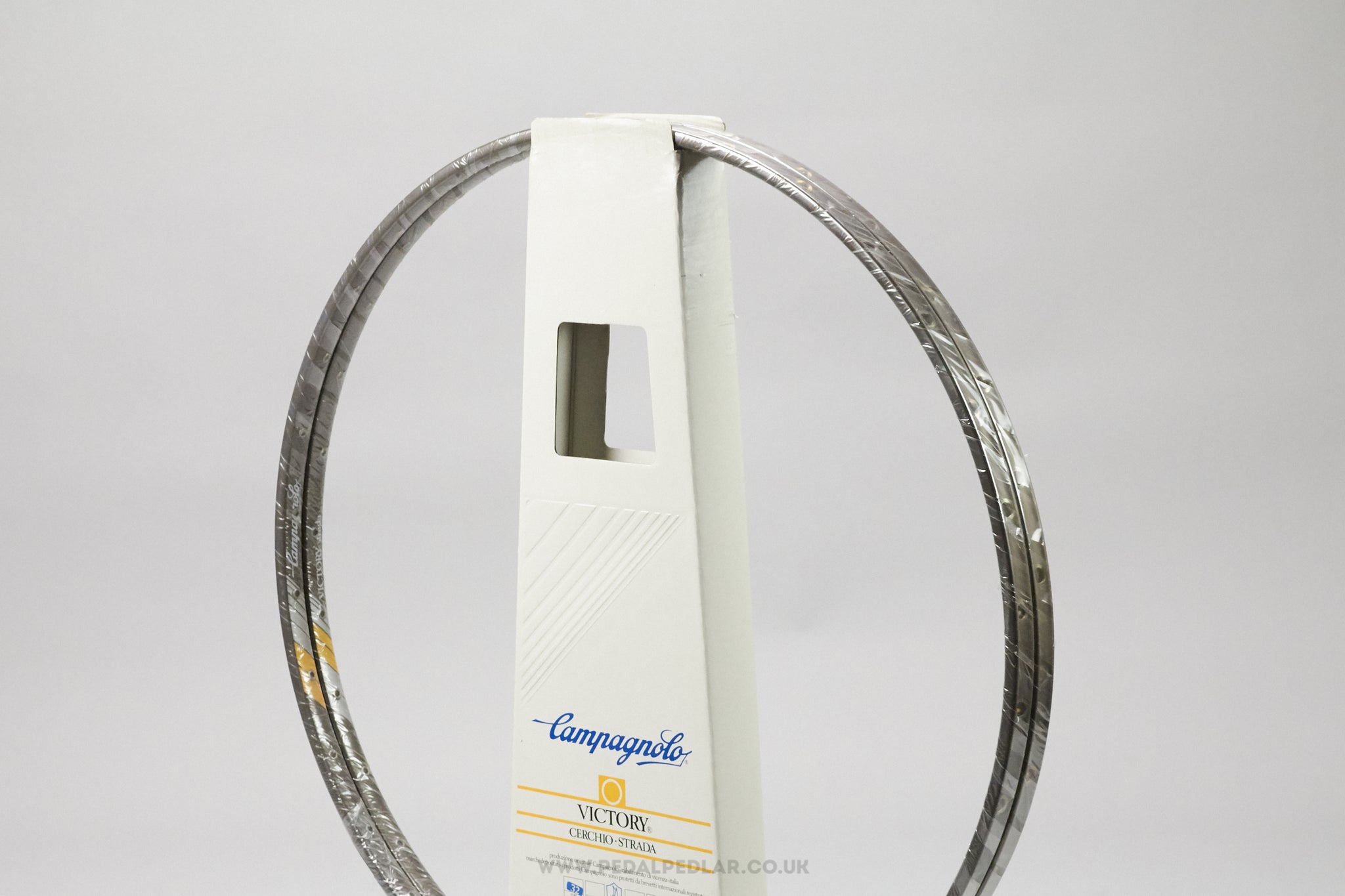


Campagnolo Victory Strada NOS/NIB Vintage 32h 28"/700c Tubular Rims
£165.00 £220.00
✓ Original parts - produced in the 1980s
✓ New old stock & still in the original packaging!
✓ Super lightweight for the era - only 732 grams (for the pair)!
✓ Suitable for historic cycling events such as L'Eroica
✓ Worldwide shipping
Campagnolo Victory Strada rims, hailing from Italy and in production during the 1980s (yet still new & unused after all this time!). Made from aluminium and weighing in at 732 grams (for the pair) - incredibly lightweight for a pair of rims at that time. A fine choice for keeping your vintage bike authentic, but also great for any other compatible bike too.
If you're taking part in L'Eroica or a similar vintage event, these are fully compliant - so rest assured, the pre-1987 police won't lock you up for having the wrong rims!
OVERVIEW
Production Era - 1980s
Country - Italian
Material - Aluminium
Weight - 732 grams (for the pair)
Stock Code - D-RP5V
*New old stock items may have marks from storage over the years, and as we often have multiples they can vary from piece to piece, but they are always genuine new & unused items.
TECHNICAL INFO
Drilling - 32 Hole
Rim Size - 28"/700c Tubular
ISO Diameter - 622 mm
Valve Type - Presta
Rim Width (OD) - 20 mm
Rim Height - 12 mm
-
▼SHIPPING, TAXES & RETURNS
-
We've been safely sending orders around the world since 2010. Orders are carefully packed, sent with tracking & insurance, and normally collected around midday on Tuesdays and Fridays. Larger items may occasionally require an extra day or two to prepare.
We accept returns, please notify us within 14 days and ensure the item arrives back with us no later than 30 days after the order was received.
EU orders under €150 (excluding shipping) - import VAT and the new €3 customs duty are paid as part of your order, so there's nothing further to pay on delivery.
EU orders over €150 (excluding shipping) - import fees are payable to the carrier before delivery, with nothing collected at checkout.
USA orders - import fees are collected at checkout for all orders to the USA, so there won’t be any surprise charges when your order arrives.
Other international orders - local import fees may apply and are not collected by us. Please check your country's import rules before purchasing.
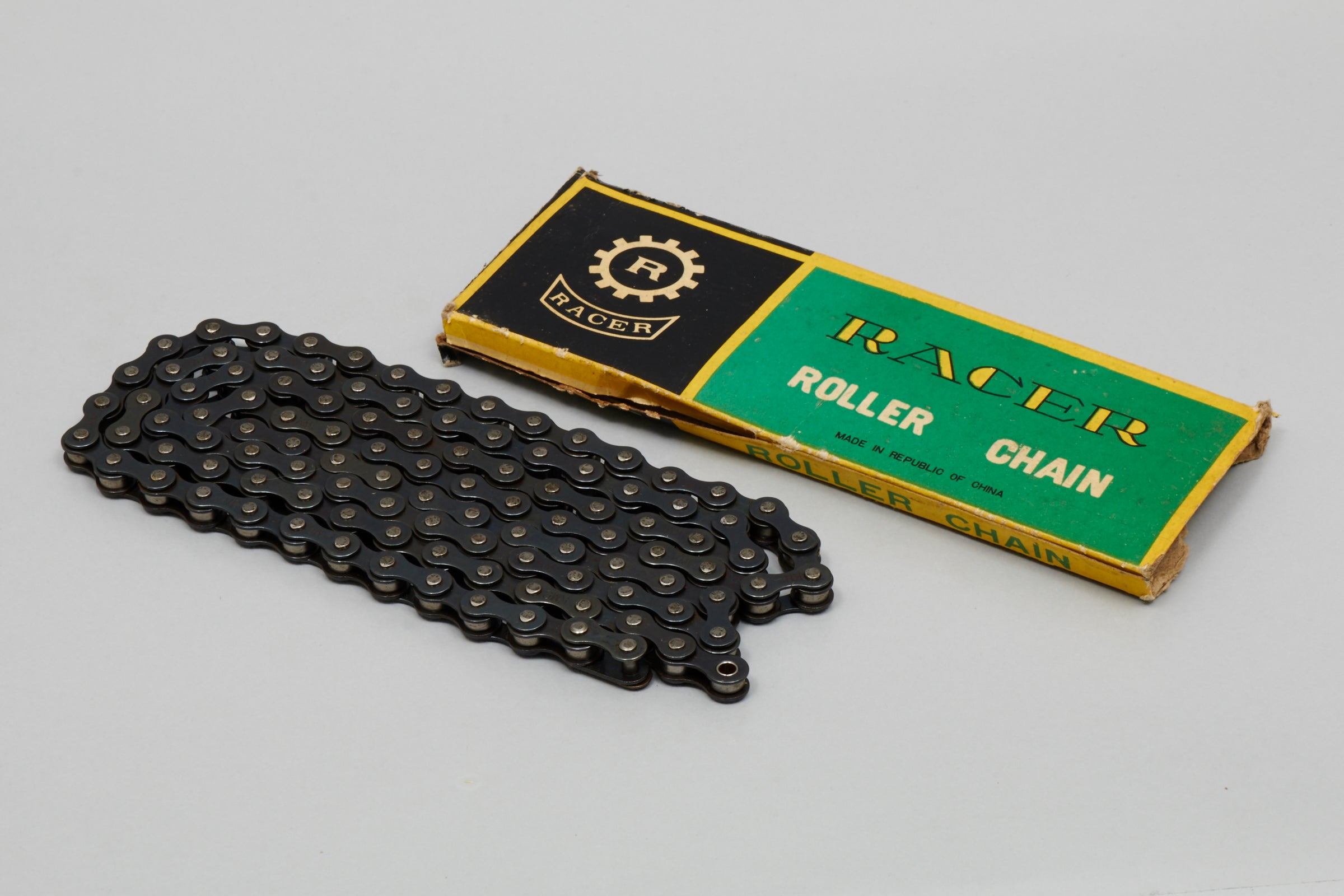


Racer NOS/NIB Vintage Single Speed/Track/BMX Chain
£18.75 £25.00
✓ Original part - produced in the 1970s
✓ New old stock & still in the original packaging!
✓ Worldwide shipping
Racer chain, from China in production during the 1970s (yet still new & unused after all this time!). Made from steel and weighing in at 400 grams. A fine choice for keeping your vintage bike authentic, but also great for any other compatible bike.
OVERVIEW
Production Era - 1970s
Country - 0
Material - Steel
Weight - 400 g
Stock Code - D-CHN40V
NB - Chain is made by and branded KMC
*New old stock items may have marks from storage over the years, and as we often have multiples they can vary from piece to piece, but they are always genuine new & unused items.
TECHNICAL INFO
Optimal Speed* - Single Speed (Up to 4 Speed for 1/8" Sprockets)
Outer Width - 9.5 mm
Cog Width - 1/8"
Pitch - 1/2" (Standard)
Number of Links - 108
*See help section.
-
▼SHIPPING, TAXES & RETURNS
-
We've been safely sending orders around the world since 2010. Orders are carefully packed, sent with tracking & insurance, and normally collected around midday on Tuesdays and Fridays. Larger items may occasionally require an extra day or two to prepare.
We accept returns, please notify us within 14 days and ensure the item arrives back with us no later than 30 days after the order was received.
EU orders under €150 (excluding shipping) - import VAT and the new €3 customs duty are paid as part of your order, so there's nothing further to pay on delivery.
EU orders over €150 (excluding shipping) - import fees are payable to the carrier before delivery, with nothing collected at checkout.
USA orders - import fees are collected at checkout for all orders to the USA, so there won’t be any surprise charges when your order arrives.
Other international orders - local import fees may apply and are not collected by us. Please check your country's import rules before purchasing.
-
▼HELP SECTION
-
Optimal Speed - the ideal number of rear cogs, based on the outer width of the chain and the cog width it was designed for. For 6 Speed Shimano Uniglide a 5/6 spd chain will perform best.
Shifting System(s) - indexed shifters 'click' when you change gear. For 9 speed upwards (or Suntour Accushift), to guarantee the best performance we recommend using the dedicated chain. Otherwise, for 8 speed and below, or any speed when using friction shifting (non-index), you just need the correct outer width.
Outer width - measured across the rivets at the widest point, these are the approximate widths for different speed setups (up to 4 speed is also dependent on cog width):
Speed Outer Width 2 to 4 Speed (1/8”) 8.5 to 9.5 mm Up to 6 Speed (3/32”) 7.8 to 8.0 mm 7 Speed / ‘Narrow’ 6 Speed 7.3 mm 8 Speed / ‘Narrow’ 7 Speed 7.0 to 7.3 mm 9 Speed 6.5 to 6.7 mm Cog Width - the gap between the inner plates allows for different rear cog/sprocket widths. 3/32" is the standard for 5 to 8 speed, above that it’s 11/128”. For 4 speed or less, 3/32” and 1/8” were both used, for the latter you will need a 1/8” chain. A wider 3/16" moped chain can be used as a heavy duty opton for single cog setups if required).
Chain pitch - the distance between the rivets/pins. All chains will be 1/2" with two exceptions; 3/16" (“inch pitch”) for very early track bikes, or Shimano's short lived 10 mm pitch system from the 70s/80s.
Number of links - if you're unsure how many you need, measure your old chain (each link has two rivets) or one with a similar setup to yours.
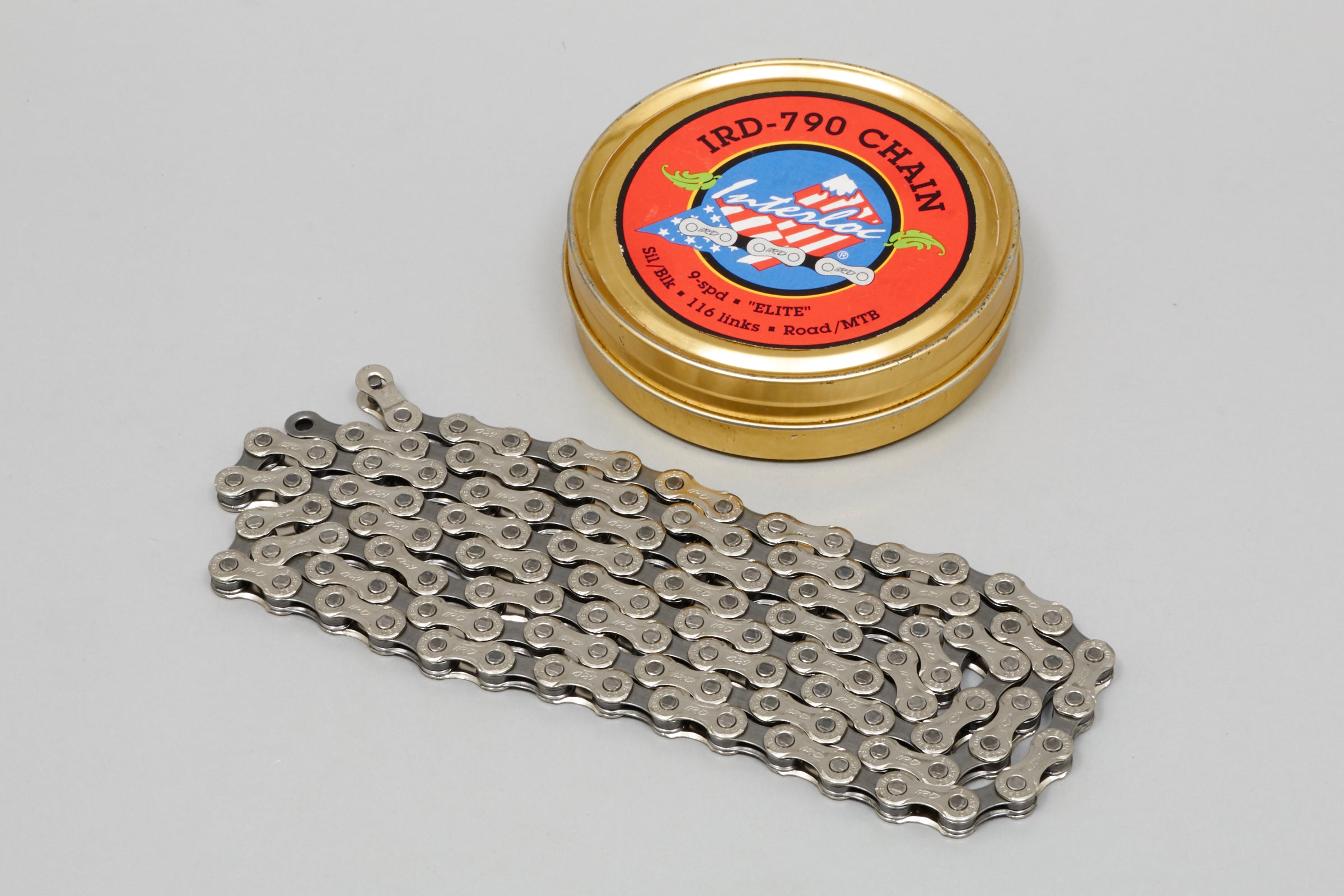


IRD 790 NOS/NIB Classic 9 Speed Chain
£26.25 £35.00
✓ Original part - produced in the 1990s
✓ New old stock & still in the original packaging!
✓ Worldwide shipping
IRD 790 chain, hailing from the United States and in production during the 1990s (yet still new & unused after all this time!). Made from steel and weighing in at 360 grams. A fine choice for keeping your classic bike authentic, but also great for any other compatible bike.
OVERVIEW
Production Era - 1990s
Country - American
Material - Steel
Weight - 360 g
Stock Code - D-CHN39C
*New old stock items may have marks from storage over the years, and as we often have multiples they can vary from piece to piece, but they are always genuine new & unused items.
TECHNICAL INFO
Optimal Speed* - 9 Speed
Shifting System(s) - All Systems (Indexed), Friction (Non-Index)
Outer Width - 6.7 mm
Cog Width - 11/128"
Pitch - 1/2" (Standard)
Number of Links - 116
*See help section.
-
▼SHIPPING, TAXES & RETURNS
-
We've been safely sending orders around the world since 2010. Orders are carefully packed, sent with tracking & insurance, and normally collected around midday on Tuesdays and Fridays. Larger items may occasionally require an extra day or two to prepare.
We accept returns, please notify us within 14 days and ensure the item arrives back with us no later than 30 days after the order was received.
EU orders under €150 (excluding shipping) - import VAT and the new €3 customs duty are paid as part of your order, so there's nothing further to pay on delivery.
EU orders over €150 (excluding shipping) - import fees are payable to the carrier before delivery, with nothing collected at checkout.
USA orders - import fees are collected at checkout for all orders to the USA, so there won’t be any surprise charges when your order arrives.
Other international orders - local import fees may apply and are not collected by us. Please check your country's import rules before purchasing.
-
▼HELP SECTION
-
Optimal Speed - the ideal number of rear cogs, based on the outer width of the chain and the cog width it was designed for. For 6 Speed Shimano Uniglide a 5/6 spd chain will perform best.
Shifting System(s) - indexed shifters 'click' when you change gear. For 9 speed upwards (or Suntour Accushift), to guarantee the best performance we recommend using the dedicated chain. Otherwise, for 8 speed and below, or any speed when using friction shifting (non-index), you just need the correct outer width.
Outer width - measured across the rivets at the widest point, these are the approximate widths for different speed setups (up to 4 speed is also dependent on cog width):
Speed Outer Width 2 to 4 Speed (1/8”) 8.5 to 9.5 mm Up to 6 Speed (3/32”) 7.8 to 8.0 mm 7 Speed / ‘Narrow’ 6 Speed 7.3 mm 8 Speed / ‘Narrow’ 7 Speed 7.0 to 7.3 mm 9 Speed 6.5 to 6.7 mm Cog Width - the gap between the inner plates allows for different rear cog/sprocket widths. 3/32" is the standard for 5 to 8 speed, above that it’s 11/128”. For 4 speed or less, 3/32” and 1/8” were both used, for the latter you will need a 1/8” chain. A wider 3/16" moped chain can be used as a heavy duty opton for single cog setups if required).
Chain pitch - the distance between the rivets/pins. All chains will be 1/2" with two exceptions; 3/16" (“inch pitch”) for very early track bikes, or Shimano's short lived 10 mm pitch system from the 70s/80s.
Number of links - if you're unsure how many you need, measure your old chain (each link has two rivets) or one with a similar setup to yours.
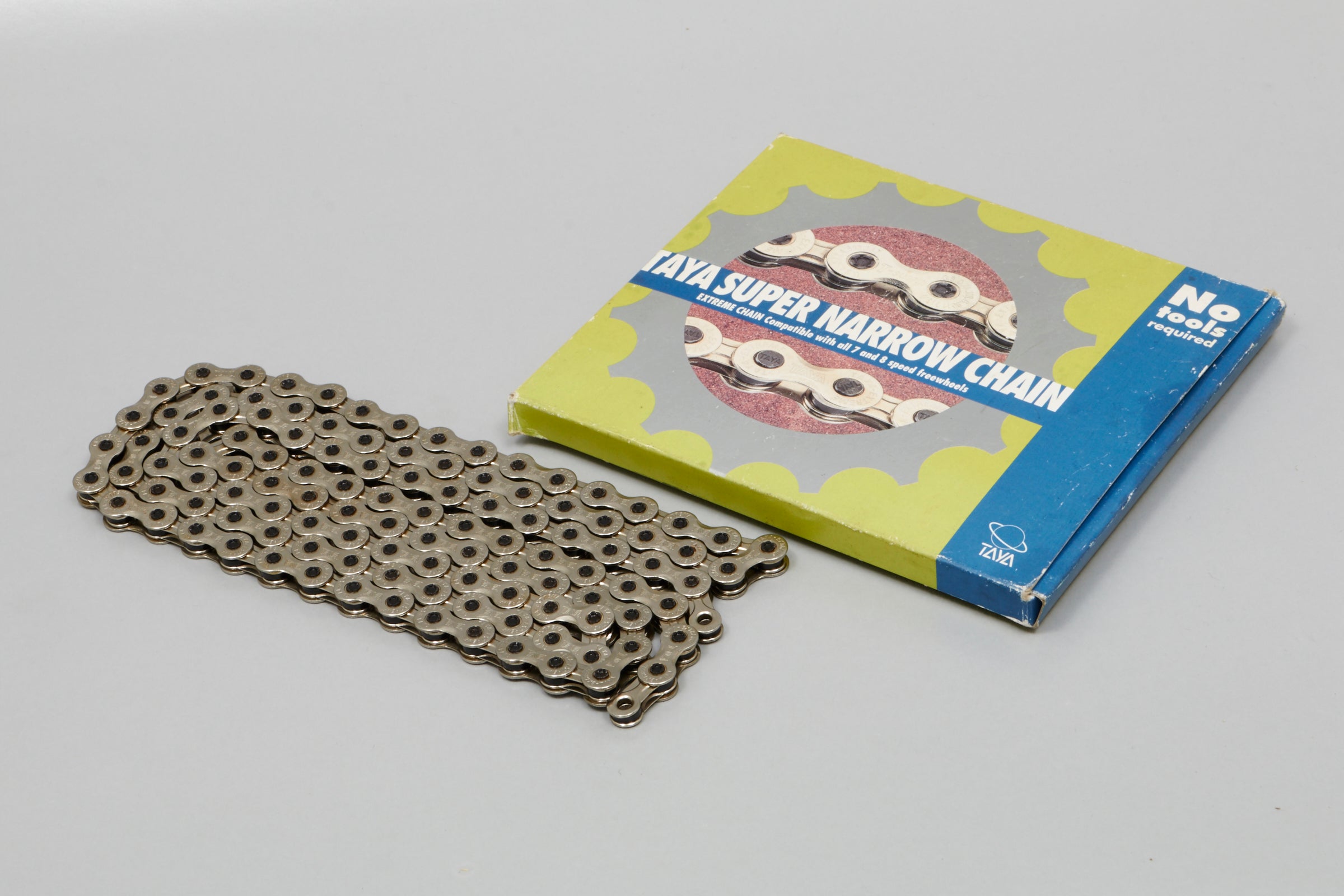


Taya Extreme Super Narrow NOS/NIB Classic 7/8 Speed Chain
£26.25 £35.00
✓ Original part - produced in the 1990s
✓ New old stock & still in the original packaging!
✓ Worldwide shipping
Taya Extreme chain, hailing from Taiwan and in production during the 1990s (yet still new & unused after all this time!). Made from steel and weighing in at 403 grams. A fine choice for keeping your classic bike authentic, but also great for any other compatible bike.
OVERVIEW
Production Era - 1990s
Country - Taiwanese
Material - Steel
Weight - 403 g
Stock Code - D-CHN38C
*New old stock items may have marks from storage over the years, and as we often have multiples they can vary from piece to piece, but they are always genuine new & unused items.
TECHNICAL INFO
Optimal Speed* - 7 Speed, 8 Speed
Shifting System(s) - All Systems (Indexed), Friction (Non-Index)
Outer Width - 7.2 mm
Cog Width - 3/32" (Standard)
Pitch - 1/2" (Standard)
Number of Links - 114
*See help section.
-
▼SHIPPING, TAXES & RETURNS
-
We've been safely sending orders around the world since 2010. Orders are carefully packed, sent with tracking & insurance, and normally collected around midday on Tuesdays and Fridays. Larger items may occasionally require an extra day or two to prepare.
We accept returns, please notify us within 14 days and ensure the item arrives back with us no later than 30 days after the order was received.
EU orders under €150 (excluding shipping) - import VAT and the new €3 customs duty are paid as part of your order, so there's nothing further to pay on delivery.
EU orders over €150 (excluding shipping) - import fees are payable to the carrier before delivery, with nothing collected at checkout.
USA orders - import fees are collected at checkout for all orders to the USA, so there won’t be any surprise charges when your order arrives.
Other international orders - local import fees may apply and are not collected by us. Please check your country's import rules before purchasing.
-
▼HELP SECTION
-
Optimal Speed - the ideal number of rear cogs, based on the outer width of the chain and the cog width it was designed for. For 6 Speed Shimano Uniglide a 5/6 spd chain will perform best.
Shifting System(s) - indexed shifters 'click' when you change gear. For 9 speed upwards (or Suntour Accushift), to guarantee the best performance we recommend using the dedicated chain. Otherwise, for 8 speed and below, or any speed when using friction shifting (non-index), you just need the correct outer width.
Outer width - measured across the rivets at the widest point, these are the approximate widths for different speed setups (up to 4 speed is also dependent on cog width):
Speed Outer Width 2 to 4 Speed (1/8”) 8.5 to 9.5 mm Up to 6 Speed (3/32”) 7.8 to 8.0 mm 7 Speed / ‘Narrow’ 6 Speed 7.3 mm 8 Speed / ‘Narrow’ 7 Speed 7.0 to 7.3 mm 9 Speed 6.5 to 6.7 mm Cog Width - the gap between the inner plates allows for different rear cog/sprocket widths. 3/32" is the standard for 5 to 8 speed, above that it’s 11/128”. For 4 speed or less, 3/32” and 1/8” were both used, for the latter you will need a 1/8” chain. A wider 3/16" moped chain can be used as a heavy duty opton for single cog setups if required).
Chain pitch - the distance between the rivets/pins. All chains will be 1/2" with two exceptions; 3/16" (“inch pitch”) for very early track bikes, or Shimano's short lived 10 mm pitch system from the 70s/80s.
Number of links - if you're unsure how many you need, measure your old chain (each link has two rivets) or one with a similar setup to yours.


O.M.A.S. Vintage Black Bottle Cage
£21.25 £25.00
✓ Original bottle cage - in production from the 1970s to the 1980s
✓ Suitable for historic cycling events such as L'Eroica
✓ Checked & cleaned
✓ Worldwide shipping
O.M.A.S. water bottle cage (or bidon holder if you prefer), hailing from Italy and in production from the 1970s to the 1980s. The perfect finishing touch for your vintage bike, but great for bikes of the non-vintage variety too of course!
If you're taking part in L'Eroica or a similar vintage event, this is of the correct era, so rest assured the pre-1987 police won't lock you up for having the wrong bottle carrier!
The bottle cage has been checked for damage, thoroughly cleaned and graded as good condition, but do take a good look at the detailed photos so you can see the shape & condition before you buy.OVERVIEW
Production Era - 1970s & 1980s
Country - Italian
Material - Aluminium
Weight - 46 g
Stock Code - U-CAG136V
TECHNICAL INFO
Cage Fixing - Frame Fit (Braze-On)
Colour* - Black
Bottle Size - 75 mm (Standard)
*The colour description is just a guide, please check the photos to get a good idea of the colour too, as we make sure these are as close to the true colour as possible.
-
▼SHIPPING, TAXES & RETURNS
-
We've been safely sending orders around the world since 2010. Orders are carefully packed, sent with tracking & insurance, and normally collected around midday on Tuesdays and Fridays. Larger items may occasionally require an extra day or two to prepare.
We accept returns, please notify us within 14 days and ensure the item arrives back with us no later than 30 days after the order was received.
EU orders under €150 (excluding shipping) - import VAT and the new €3 customs duty are paid as part of your order, so there's nothing further to pay on delivery.
EU orders over €150 (excluding shipping) - import fees are payable to the carrier before delivery, with nothing collected at checkout.
USA orders - import fees are collected at checkout for all orders to the USA, so there won’t be any surprise charges when your order arrives.
Other international orders - local import fees may apply and are not collected by us. Please check your country's import rules before purchasing.
-
▼HELP SECTION
-
Cage Fixing - most bottle cages will be designed to fix to the frame, although some rare older ones mount to the handlebars and/or stem. If your frame doesn't have any bottle cage braze-ons to fix to you'll need a clamp-on bottle cage.
Bottle Size - almost all cycling bottles measure just under 75 mm in diameter so this is the standard bottle cage size, the only rather rare exceptions are some old Elite bottles that require a 66 mm cage, the more recent oversized ones and of course the funny shaped aero ones that only accept the bottle they were made for.


Specialites T.A. Sierra NOS Classic White Bottle Cage
£15.00 £20.00
✓ Original bottle cage - produced in the 1990s
✓ New old stock! Still unused after all these years
✓ Worldwide shipping
Specialites T.A. Sierra water bottle cage (or bidon holder if you prefer), hailing from France and in production during the 1990s (yet still new & unused after all this time!). The perfect finishing touch for your classic bike, but great for bikes of the non-classic variety too of course!
OVERVIEW
Production Era - 1990s
Country - French
Material - Aluminium/Plastic
Weight - 66 g
Stock Code - D-CAG129C
*New old stock items may have marks from storage over the years, and as we often have multiples they can vary from piece to piece, but they are always genuine new & unused items.
TECHNICAL INFO
Cage Fixing - Frame Fit (Braze-On)
Colour* - White
Bottle Size - 75 mm (Standard)
*The colour description is just a guide, please check the photos to get a good idea of the colour too, as we make sure these are as close to the true colour as possible.
-
▼SHIPPING, TAXES & RETURNS
-
We've been safely sending orders around the world since 2010. Orders are carefully packed, sent with tracking & insurance, and normally collected around midday on Tuesdays and Fridays. Larger items may occasionally require an extra day or two to prepare.
We accept returns, please notify us within 14 days and ensure the item arrives back with us no later than 30 days after the order was received.
EU orders under €150 (excluding shipping) - import VAT and the new €3 customs duty are paid as part of your order, so there's nothing further to pay on delivery.
EU orders over €150 (excluding shipping) - import fees are payable to the carrier before delivery, with nothing collected at checkout.
USA orders - import fees are collected at checkout for all orders to the USA, so there won’t be any surprise charges when your order arrives.
Other international orders - local import fees may apply and are not collected by us. Please check your country's import rules before purchasing.
-
▼HELP SECTION
-
Cage Fixing - most bottle cages will be designed to fix to the frame, although some rare older ones mount to the handlebars and/or stem. If your frame doesn't have any bottle cage braze-ons to fix to you'll need a clamp-on bottle cage.
Bottle Size - almost all cycling bottles measure just under 75 mm in diameter so this is the standard bottle cage size, the only rather rare exceptions are some old Elite bottles that require a 66 mm cage, the more recent oversized ones and of course the funny shaped aero ones that only accept the bottle they were made for.


Vintage Expanding Quill Type 22.0 mm Bullet Nose Seatpost
£25.50 £30.00
✓ Original part - in production from the 1950s to the 1960s
✓ Suitable for historic cycling events such as L'Eroica
✓ Professionally checked & cleaned
✓ Worldwide shipping
Unbranded vintage bullet nose (or candlestick if you prefer) seatpost, most likely in production from the 1950s to the 1960s. Made from steel and weighing in at 278 grams. A fine choice for keeping your vintage bike authentic, but also great for any other compatible bike.
If you're taking part in L'Eroica or a similar vintage event, this is fully compliant - so rest assured, the pre-1987 police won't lock you up for having the wrong seatpost!
The seatpost's been carefully cleaned, thoroughly checked by one of our mechanics and graded as OK condition, but do take a good look at the detailed photos so you can see the cosmetic condition before you buy.OVERVIEW
Production Era - 1950s & 1960s
Material - Steel
Weight - 278 g
Stock Code - U-SPB16V
TECHNICAL INFO
Seatpost Diameter - 22.0 mm
Length (Top to Bottom) - 190 mm
-
▼SHIPPING, TAXES & RETURNS
-
We've been safely sending orders around the world since 2010. Orders are carefully packed, sent with tracking & insurance, and normally collected around midday on Tuesdays and Fridays. Larger items may occasionally require an extra day or two to prepare.
We accept returns, please notify us within 14 days and ensure the item arrives back with us no later than 30 days after the order was received.
EU orders under €150 (excluding shipping) - import VAT and the new €3 customs duty are paid as part of your order, so there's nothing further to pay on delivery.
EU orders over €150 (excluding shipping) - import fees are payable to the carrier before delivery, with nothing collected at checkout.
USA orders - import fees are collected at checkout for all orders to the USA, so there won’t be any surprise charges when your order arrives.
Other international orders - local import fees may apply and are not collected by us. Please check your country's import rules before purchasing.
-
▼HELP SECTION
-
Seatpost Diameter - this needs to match the internal diameter of your frame’s seat tube closely, it should be possible to insert the seatpost without force but the fit should be tight enough so it doesn’t just drop in, with no play once inserted. If you have a post that fits the measurement should be stamped somewhere near the bottom, if not you’ll need to measure with a caliper or seatpost sizing tool as the sizes go up in 0.2 mm increments.
Length (Top to Bottom) - measured from the top to the bottom of the seatpost. Normally there’s a mark to tell you how much of the seatpost needs to be inserted in the frame, however this isn’t always the case so we’d recommend allowing a minimum of 6 cm.


Vintage 25.4 mm Bullet Nose Seatpost
£12.75 £15.00
✓ Original part - in production from the 1960s to the 1980s
✓ Suitable for historic cycling events such as L'Eroica
✓ Professionally checked & cleaned
✓ Worldwide shipping
Unbranded vintage bullet nose (or candlestick if you prefer) seatpost, most likely in production from the 1960s to the 1980s. Made from steel and weighing in at 133 grams. A fine choice for keeping your vintage bike authentic, but also great for any other compatible bike.
If you're taking part in L'Eroica or a similar vintage event, this is fully compliant - so rest assured, the pre-1987 police won't lock you up for having the wrong seatpost!
The seatpost's been carefully cleaned, thoroughly checked by one of our mechanics and graded as good condition, but do take a good look at the detailed photos so you can see the cosmetic condition before you buy.OVERVIEW
Production Era - 1960s - 1980s
Material - Steel
Weight - 133 g
Stock Code - U-SPB14V
TECHNICAL INFO
Seatpost Diameter - 25.4 mm
Length (Top to Bottom) - 180 mm
-
▼SHIPPING, TAXES & RETURNS
-
We've been safely sending orders around the world since 2010. Orders are carefully packed, sent with tracking & insurance, and normally collected around midday on Tuesdays and Fridays. Larger items may occasionally require an extra day or two to prepare.
We accept returns, please notify us within 14 days and ensure the item arrives back with us no later than 30 days after the order was received.
EU orders under €150 (excluding shipping) - import VAT and the new €3 customs duty are paid as part of your order, so there's nothing further to pay on delivery.
EU orders over €150 (excluding shipping) - import fees are payable to the carrier before delivery, with nothing collected at checkout.
USA orders - import fees are collected at checkout for all orders to the USA, so there won’t be any surprise charges when your order arrives.
Other international orders - local import fees may apply and are not collected by us. Please check your country's import rules before purchasing.
-
▼HELP SECTION
-
Seatpost Diameter - this needs to match the internal diameter of your frame’s seat tube closely, it should be possible to insert the seatpost without force but the fit should be tight enough so it doesn’t just drop in, with no play once inserted. If you have a post that fits the measurement should be stamped somewhere near the bottom, if not you’ll need to measure with a caliper or seatpost sizing tool as the sizes go up in 0.2 mm increments.
Length (Top to Bottom) - measured from the top to the bottom of the seatpost. Normally there’s a mark to tell you how much of the seatpost needs to be inserted in the frame, however this isn’t always the case so we’d recommend allowing a minimum of 6 cm.


Vintage NOS 25.8 mm Bullet Nose Seatpost
£15.00 £20.00
✓ Original part - in production from the 1970s to the 1980s
✓ New old stock! Still unused after all these years
✓ Suitable for historic cycling events such as L'Eroica
✓ Worldwide shipping
Unbranded vintage bullet nose (or candlestick if you prefer) seatpost, most likely in production from the 1970s to the 1980s (yet still new & unused after all this time!). Made from steel and weighing in at 157 grams. A fine choice for keeping your vintage bike authentic, but also great for any other compatible bike.
If you're taking part in L'Eroica or a similar vintage event, this is fully compliant - so rest assured, the pre-1987 police won't lock you up for having the wrong seatpost!
Please note: Once inserted into a frame this cannot be returned, so please make sure to double check the diameter is correct before installing.OVERVIEW
Production Era - 1970s & 1980s
Material - Steel
Weight - 157 g
Stock Code - D-SPB11V
*New old stock items may have marks from storage over the years, and as we often have multiples they can vary from piece to piece, but they are always genuine new & unused items.
TECHNICAL INFO
Seatpost Diameter - 25.8 mm
Length (Top to Bottom) - 215 mm
-
▼SHIPPING, TAXES & RETURNS
-
We've been safely sending orders around the world since 2010. Orders are carefully packed, sent with tracking & insurance, and normally collected around midday on Tuesdays and Fridays. Larger items may occasionally require an extra day or two to prepare.
We accept returns, please notify us within 14 days and ensure the item arrives back with us no later than 30 days after the order was received.
EU orders under €150 (excluding shipping) - import VAT and the new €3 customs duty are paid as part of your order, so there's nothing further to pay on delivery.
EU orders over €150 (excluding shipping) - import fees are payable to the carrier before delivery, with nothing collected at checkout.
USA orders - import fees are collected at checkout for all orders to the USA, so there won’t be any surprise charges when your order arrives.
Other international orders - local import fees may apply and are not collected by us. Please check your country's import rules before purchasing.
-
▼HELP SECTION
-
Seatpost Diameter - this needs to match the internal diameter of your frame’s seat tube closely, it should be possible to insert the seatpost without force but the fit should be tight enough so it doesn’t just drop in, with no play once inserted. If you have a post that fits the measurement should be stamped somewhere near the bottom, if not you’ll need to measure with a caliper or seatpost sizing tool as the sizes go up in 0.2 mm increments.
Length (Top to Bottom) - measured from the top to the bottom of the seatpost. Normally there’s a mark to tell you how much of the seatpost needs to be inserted in the frame, however this isn’t always the case so we’d recommend allowing a minimum of 6 cm.


Kalloy Fluted NOS Vintage 26.8 mm Bullet Nose Seatpost
£15.00 £20.00
✓ Original part - in production from the 1980s to the 1990s
✓ New old stock! Still unused after all these years
✓ Worldwide shipping
Kalloy bullet nose (or candlestick if you prefer) seatpost, hailing from Taiwan and in production from the 1980s to the 1990s (yet still new & unused after all this time!). Made from aluminium and weighing in at 88 grams. A fine choice for keeping your vintage bike authentic, but also great for any other compatible bike.
Please note: Once inserted into a frame this cannot be returned, so please make sure to double check the diameter is correct before installing.OVERVIEW
Production Era - 1980s & 1990s
Country - Taiwanese
Material - Aluminium
Weight - 88 g
Stock Code - D-SPB10V
*New old stock items may have marks from storage over the years, and as we often have multiples they can vary from piece to piece, but they are always genuine new & unused items.
TECHNICAL INFO
Seatpost Diameter - 26.8 mm
Length (Top to Bottom) - 190 mm
-
▼SHIPPING, TAXES & RETURNS
-
We've been safely sending orders around the world since 2010. Orders are carefully packed, sent with tracking & insurance, and normally collected around midday on Tuesdays and Fridays. Larger items may occasionally require an extra day or two to prepare.
We accept returns, please notify us within 14 days and ensure the item arrives back with us no later than 30 days after the order was received.
EU orders under €150 (excluding shipping) - import VAT and the new €3 customs duty are paid as part of your order, so there's nothing further to pay on delivery.
EU orders over €150 (excluding shipping) - import fees are payable to the carrier before delivery, with nothing collected at checkout.
USA orders - import fees are collected at checkout for all orders to the USA, so there won’t be any surprise charges when your order arrives.
Other international orders - local import fees may apply and are not collected by us. Please check your country's import rules before purchasing.
-
▼HELP SECTION
-
Seatpost Diameter - this needs to match the internal diameter of your frame’s seat tube closely, it should be possible to insert the seatpost without force but the fit should be tight enough so it doesn’t just drop in, with no play once inserted. If you have a post that fits the measurement should be stamped somewhere near the bottom, if not you’ll need to measure with a caliper or seatpost sizing tool as the sizes go up in 0.2 mm increments.
Length (Top to Bottom) - measured from the top to the bottom of the seatpost. Normally there’s a mark to tell you how much of the seatpost needs to be inserted in the frame, however this isn’t always the case so we’d recommend allowing a minimum of 6 cm.


Campagnolo Nuovo Super Record (4051/1) Non-Fluted Last Gen NOS/NIB Vintage 26.2 mm Seatpost
£123.75 £165.00
✓ Original part - produced in the 1980s
✓ New old stock & still in the original packaging!
✓ Super lightweight for the era - only 210 grams!
✓ Suitable for historic cycling events such as L'Eroica
✓ Worldwide shipping
Campagnolo Nuovo Super Record seatpost, hailing from Italy and in production during the 1980s (yet still new & unused after all this time!). Made from aluminium/steel and weighing in at 210 grams - incredibly lightweight for seatposts at that time. A fine choice for keeping your vintage bike authentic, but also great for any other compatible bike.
If you're taking part in L'Eroica or a similar vintage event, this is fully compliant - so rest assured, the pre-1987 police won't lock you up for having the wrong seatpost!
Please note: Once inserted into a frame this cannot be returned, so please make sure to double check the diameter is correct before installing.OVERVIEW
Model ID - 4051/1
Production Era - 1980s
Country - Italian
Material - Aluminium / Steel
Weight - 210 g
Stock Code - D-SP170V
*New old stock items may have marks from storage over the years, and as we often have multiples they can vary from piece to piece, but they are always genuine new & unused items.
TECHNICAL INFO
Seatpost Diameter - 26.2 mm
Length (Centre of Rails to Base) - 180 mm
-
▼SHIPPING, TAXES & RETURNS
-
We've been safely sending orders around the world since 2010. Orders are carefully packed, sent with tracking & insurance, and normally collected around midday on Tuesdays and Fridays. Larger items may occasionally require an extra day or two to prepare.
We accept returns, please notify us within 14 days and ensure the item arrives back with us no later than 30 days after the order was received.
EU orders under €150 (excluding shipping) - import VAT and the new €3 customs duty are paid as part of your order, so there's nothing further to pay on delivery.
EU orders over €150 (excluding shipping) - import fees are payable to the carrier before delivery, with nothing collected at checkout.
USA orders - import fees are collected at checkout for all orders to the USA, so there won’t be any surprise charges when your order arrives.
Other international orders - local import fees may apply and are not collected by us. Please check your country's import rules before purchasing.
-
▼HELP SECTION
-
Seatpost Diameter - this needs to match the internal diameter of your frame’s seat tube closely, it should be possible to insert the seatpost without force but the fit should be tight enough so it doesn’t just drop in, with no play once inserted. If you have a post that fits the measurement should be stamped somewhere near the bottom, if not you’ll need to measure with a caliper or seatpost sizing tool as the sizes go up in 0.2 mm increments.
Length (Centre of Rails to Base) - measured from where the centre of the saddle rails will sit once installed, all the way to the bottom of the seatpost. Normally there’s a mark to tell you how much of the seatpost needs to be inserted in the frame, however this isn’t always the case so we’d recommend allowing a minimum of 6 cm.


Campagnolo Nuovo Super Record (4051/1) Fluted 4th Gen NOS/NIB Vintage 25.0 mm Seatpost
£131.25 £175.00
✓ Original part - produced in the 1980s
✓ New old stock & still in the original packaging!
✓ Super lightweight for the era - only 205 grams!
✓ Suitable for historic cycling events such as L'Eroica
✓ Worldwide shipping
Campagnolo Nuovo Super Record seatpost, hailing from Italy and in production during the 1980s (yet still new & unused after all this time!). Made from aluminium/steel and weighing in at 205 grams - incredibly lightweight for seatposts at that time. A fine choice for keeping your vintage bike authentic, but also great for any other compatible bike.
If you're taking part in L'Eroica or a similar vintage event, this is fully compliant - so rest assured, the pre-1987 police won't lock you up for having the wrong seatpost!
Please note: Once inserted into a frame this cannot be returned, so please make sure to double check the diameter is correct before installing.OVERVIEW
Model ID - 4051/1
Production Era - 1980s
Country - Italian
Material - Aluminium / Steel
Weight - 205 g
Stock Code - D-SP169V
*New old stock items may have marks from storage over the years, and as we often have multiples they can vary from piece to piece, but they are always genuine new & unused items.
TECHNICAL INFO
Seatpost Diameter - 25.0 mm
Length (Centre of Rails to Base) - 210 mm
-
▼SHIPPING, TAXES & RETURNS
-
We've been safely sending orders around the world since 2010. Orders are carefully packed, sent with tracking & insurance, and normally collected around midday on Tuesdays and Fridays. Larger items may occasionally require an extra day or two to prepare.
We accept returns, please notify us within 14 days and ensure the item arrives back with us no later than 30 days after the order was received.
EU orders under €150 (excluding shipping) - import VAT and the new €3 customs duty are paid as part of your order, so there's nothing further to pay on delivery.
EU orders over €150 (excluding shipping) - import fees are payable to the carrier before delivery, with nothing collected at checkout.
USA orders - import fees are collected at checkout for all orders to the USA, so there won’t be any surprise charges when your order arrives.
Other international orders - local import fees may apply and are not collected by us. Please check your country's import rules before purchasing.
-
▼HELP SECTION
-
Seatpost Diameter - this needs to match the internal diameter of your frame’s seat tube closely, it should be possible to insert the seatpost without force but the fit should be tight enough so it doesn’t just drop in, with no play once inserted. If you have a post that fits the measurement should be stamped somewhere near the bottom, if not you’ll need to measure with a caliper or seatpost sizing tool as the sizes go up in 0.2 mm increments.
Length (Centre of Rails to Base) - measured from where the centre of the saddle rails will sit once installed, all the way to the bottom of the seatpost. Normally there’s a mark to tell you how much of the seatpost needs to be inserted in the frame, however this isn’t always the case so we’d recommend allowing a minimum of 6 cm.


Sakae/Ringyo (SR) Custom-P3 (CT-P3) NOS Vintage 26.6 mm Seatpost
£37.50 £50.00
✓ Original part - produced in the 1980s
✓ New old stock! Still unused after all these years
✓ Suitable for historic cycling events such as L'Eroica
✓ Worldwide shipping
Sakae/Ringyo (SR) Custom-P3 seatpost, hailing from Japan and in production during the 1980s (yet still new & unused after all this time!). Made from aluminium and weighing in at 302 grams. A fine choice for keeping your vintage bike authentic, but also great for any other compatible bike.
If you're taking part in L'Eroica or a similar vintage event, this is fully compliant - so rest assured, the pre-1987 police won't lock you up for having the wrong seatpost!
Please note: Once inserted into a frame this cannot be returned, so please make sure to double check the diameter is correct before installing.OVERVIEW
Model ID - CT-P3
Production Era - 1980s
Country - Japanese
Material - Aluminium
Weight - 302 g
Stock Code - D-SP159V
*New old stock items may have marks from storage over the years, and as we often have multiples they can vary from piece to piece, but they are always genuine new & unused items.
TECHNICAL INFO
Seatpost Diameter - 26.6 mm
Length (Centre of Rails to Base) - 185 mm
-
▼SHIPPING, TAXES & RETURNS
-
We've been safely sending orders around the world since 2010. Orders are carefully packed, sent with tracking & insurance, and normally collected around midday on Tuesdays and Fridays. Larger items may occasionally require an extra day or two to prepare.
We accept returns, please notify us within 14 days and ensure the item arrives back with us no later than 30 days after the order was received.
EU orders under €150 (excluding shipping) - import VAT and the new €3 customs duty are paid as part of your order, so there's nothing further to pay on delivery.
EU orders over €150 (excluding shipping) - import fees are payable to the carrier before delivery, with nothing collected at checkout.
USA orders - import fees are collected at checkout for all orders to the USA, so there won’t be any surprise charges when your order arrives.
Other international orders - local import fees may apply and are not collected by us. Please check your country's import rules before purchasing.
-
▼HELP SECTION
-
Seatpost Diameter - this needs to match the internal diameter of your frame’s seat tube closely, it should be possible to insert the seatpost without force but the fit should be tight enough so it doesn’t just drop in, with no play once inserted. If you have a post that fits the measurement should be stamped somewhere near the bottom, if not you’ll need to measure with a caliper or seatpost sizing tool as the sizes go up in 0.2 mm increments.
Length (Centre of Rails to Base) - measured from where the centre of the saddle rails will sit once installed, all the way to the bottom of the seatpost. Normally there’s a mark to tell you how much of the seatpost needs to be inserted in the frame, however this isn’t always the case so we’d recommend allowing a minimum of 6 cm.