
All Sale Items


Philippe (ATAX) Professionnel NOS Vintage 40 cm Drop Handlebars
£41.25 £55.00
✓ Original bars - in production from the 1970s to the 1980s
✓ New old stock! Still unused after all these years
✓ Suitable for historic cycling events such as L'Eroica
✓ Worldwide shipping
Philippe (ATAX) Professionnel drop handlebars, hailing from France and in production from the 1970s to the 1980s (yet still new & unused after all this time!). Made from aluminium and weighing in at 295 grams. A fine choice for keeping your vintage bike authentic, but also great for any other compatible bike.
If you're taking part in L'Eroica or a similar vintage event, these are fully compliant - so rest assured, the pre-1987 police won't lock you up for having the wrong bars!
OVERVIEW
Condition Notes - Small ding at clamp area right in the centre, as seen in photos.
Production Era - 1970s & 1980s
Country - French
Material - Aluminium
Weight - 295 g
Stock Code - D-HB171V
*New old stock items may have marks from storage over the years, and as we often have multiples they can vary from piece to piece, but they are always genuine new & unused items.
TECHNICAL INFO
Width (ctc) - 40 cm
Shape - Classic
Clamp Size - 25.4 mm
Drop (ctc) - 137 mm
Reach (ctc) - 107 mm
Cable Groove - None
-
▼SHIPPING, TAXES & RETURNS
-
We've been safely sending orders around the world since 2010. Orders are carefully packed, sent with tracking & insurance, and normally collected around midday on Tuesdays and Fridays. Larger items may occasionally require an extra day or two to prepare.
We accept returns, please notify us within 14 days and ensure the item arrives back with us no later than 30 days after the order was received.
EU orders under €150 (excluding shipping) - import VAT and the new €3 customs duty are paid as part of your order, so there's nothing further to pay on delivery.
EU orders over €150 (excluding shipping) - import fees are payable to the carrier before delivery, with nothing collected at checkout.
USA orders - import fees are collected at checkout for all orders to the USA, so there won’t be any surprise charges when your order arrives.
Other international orders - local import fees may apply and are not collected by us. Please check your country's import rules before purchasing.
-
▼HELP SECTION
-
Width (ctc)* - measured at the ends of the drops, from the centre of one side to the other (ctc), to the nearest cm. In some cases the bars may display a different width as some brands measure outside to outside rather than ctc, but we always use this measurement for consistency.
Shape - Classic' drops have a smooth curve, 'anatomic' have multiple angles for different hand positions, 'compact' are short reach with a shallow drop and randonneur bars are usually classic in shape but rise up then flare out at the drops.
Clamp Size - this should match the internal diameter of your handlebar stem clamp, and should be as close as possible to ensure a good and safe fit.
Drop (ctc) - from the top flat section to the bottom of the drops, measured from the centre of one to the other with the flat part at the end of the drops parrallel to the ground.
Reach (ctc) - measured from the centre of the top section to the centre of the 'curve' at its furthest point, giving you the maximum reach. We measure this with the flat part at the end of of the drops parrallel to the ground.
Cable Groove - these allow you to run your cables neatly underneath the handlebar tape, if your setup requires this.


Philippe (ATAX) Professionnel NOS Vintage 40 cm Drop Handlebars
£41.25 £55.00
✓ Original bars - in production from the 1970s to the 1980s
✓ New old stock! Still unused after all these years
✓ Suitable for historic cycling events such as L'Eroica
✓ Worldwide shipping
Philippe (ATAX) Professionnel drop handlebars, hailing from France and in production from the 1970s to the 1980s (yet still new & unused after all this time!). Made from aluminium and weighing in at 295 grams. A fine choice for keeping your vintage bike authentic, but also great for any other compatible bike.
If you're taking part in L'Eroica or a similar vintage event, these are fully compliant - so rest assured, the pre-1987 police won't lock you up for having the wrong bars!
OVERVIEW
Condition Notes - These have quite a few marks as seen in the photos but are new & unused
Production Era - 1970s & 1980s
Country - French
Material - Aluminium
Weight - 295 g
Stock Code - D-HB172V
*New old stock items may have marks from storage over the years, and as we often have multiples they can vary from piece to piece, but they are always genuine new & unused items.
TECHNICAL INFO
Width (ctc) - 40 cm
Shape - Classic
Clamp Size - 25.4 mm
Drop (ctc) - 137 mm
Reach (ctc) - 107 mm
Cable Groove - None
-
▼SHIPPING, TAXES & RETURNS
-
We've been safely sending orders around the world since 2010. Orders are carefully packed, sent with tracking & insurance, and normally collected around midday on Tuesdays and Fridays. Larger items may occasionally require an extra day or two to prepare.
We accept returns, please notify us within 14 days and ensure the item arrives back with us no later than 30 days after the order was received.
EU orders under €150 (excluding shipping) - import VAT and the new €3 customs duty are paid as part of your order, so there's nothing further to pay on delivery.
EU orders over €150 (excluding shipping) - import fees are payable to the carrier before delivery, with nothing collected at checkout.
USA orders - import fees are collected at checkout for all orders to the USA, so there won’t be any surprise charges when your order arrives.
Other international orders - local import fees may apply and are not collected by us. Please check your country's import rules before purchasing.
-
▼HELP SECTION
-
Width (ctc)* - measured at the ends of the drops, from the centre of one side to the other (ctc), to the nearest cm. In some cases the bars may display a different width as some brands measure outside to outside rather than ctc, but we always use this measurement for consistency.
Shape - Classic' drops have a smooth curve, 'anatomic' have multiple angles for different hand positions, 'compact' are short reach with a shallow drop and randonneur bars are usually classic in shape but rise up then flare out at the drops.
Clamp Size - this should match the internal diameter of your handlebar stem clamp, and should be as close as possible to ensure a good and safe fit.
Drop (ctc) - from the top flat section to the bottom of the drops, measured from the centre of one to the other with the flat part at the end of the drops parrallel to the ground.
Reach (ctc) - measured from the centre of the top section to the centre of the 'curve' at its furthest point, giving you the maximum reach. We measure this with the flat part at the end of of the drops parrallel to the ground.
Cable Groove - these allow you to run your cables neatly underneath the handlebar tape, if your setup requires this.


Philippe (ATAX) Franco Italia (D352) NOS Vintage 38 cm Drop Handlebars
£33.75 £45.00
✓ Original bars - in production from the 1970s to the 1980s
✓ New old stock! Still unused after all these years
✓ Suitable for historic cycling events such as L'Eroica
✓ Worldwide shipping
Philippe (ATAX) Franco Italia drop handlebars, hailing from France and in production from the 1970s to the 1980s (yet still new & unused after all this time!). Made from aluminium and weighing in at 380 grams. A fine choice for keeping your vintage bike authentic, but also great for any other compatible bike.
If you're taking part in L'Eroica or a similar vintage event, these are fully compliant - so rest assured, the pre-1987 police won't lock you up for having the wrong bars!
OVERVIEW
Condition Notes - One end of the drops sits a around 5 mm higher than the other (can be seen in the photos) but these are new & unused
Model ID - D352
Production Era - 1970s & 1980s
Country - French
Material - Aluminium
Weight - 380 g
Stock Code - D-HB173V
*New old stock items may have marks from storage over the years, and as we often have multiples they can vary from piece to piece, but they are always genuine new & unused items.
TECHNICAL INFO
Width (ctc) - 38 cm
Shape - Classic
Clamp Size - 25.4 mm
Drop (ctc) - 145 mm
Reach (ctc) - 87 mm
Cable Groove - None
-
▼SHIPPING, TAXES & RETURNS
-
We've been safely sending orders around the world since 2010. Orders are carefully packed, sent with tracking & insurance, and normally collected around midday on Tuesdays and Fridays. Larger items may occasionally require an extra day or two to prepare.
We accept returns, please notify us within 14 days and ensure the item arrives back with us no later than 30 days after the order was received.
EU orders under €150 (excluding shipping) - import VAT and the new €3 customs duty are paid as part of your order, so there's nothing further to pay on delivery.
EU orders over €150 (excluding shipping) - import fees are payable to the carrier before delivery, with nothing collected at checkout.
USA orders - import fees are collected at checkout for all orders to the USA, so there won’t be any surprise charges when your order arrives.
Other international orders - local import fees may apply and are not collected by us. Please check your country's import rules before purchasing.
-
▼HELP SECTION
-
Width (ctc)* - measured at the ends of the drops, from the centre of one side to the other (ctc), to the nearest cm. In some cases the bars may display a different width as some brands measure outside to outside rather than ctc, but we always use this measurement for consistency.
Shape - Classic' drops have a smooth curve, 'anatomic' have multiple angles for different hand positions, 'compact' are short reach with a shallow drop and randonneur bars are usually classic in shape but rise up then flare out at the drops.
Clamp Size - this should match the internal diameter of your handlebar stem clamp, and should be as close as possible to ensure a good and safe fit.
Drop (ctc) - from the top flat section to the bottom of the drops, measured from the centre of one to the other with the flat part at the end of the drops parrallel to the ground.
Reach (ctc) - measured from the centre of the top section to the centre of the 'curve' at its furthest point, giving you the maximum reach. We measure this with the flat part at the end of of the drops parrallel to the ground.
Cable Groove - these allow you to run your cables neatly underneath the handlebar tape, if your setup requires this.


Philippe (ATAX) Franco America (D358) NOS Vintage 40 cm Drop Handlebars
£48.75 £65.00
✓ Original bars - produced in the 1980s
✓ New old stock! Still unused after all these years
✓ Worldwide shipping
Philippe (ATAX) Franco America drop handlebars, hailing from France and in production during the 1980s (yet still new & unused after all this time!). Made from aluminium and weighing in at 350 grams. A fine choice for keeping your vintage bike authentic, but also great for any other compatible bike.
OVERVIEW
Model ID - D358
Production Era - 1980s
Country - French
Material - Aluminium
Weight - 350 g
Stock Code - D-HB175V
*New old stock items may have marks from storage over the years, and as we often have multiples they can vary from piece to piece, but they are always genuine new & unused items.
TECHNICAL INFO
Width (ctc) - 40 cm
Shape - Classic
Clamp Size - 25.4 mm
Drop (ctc) - 154 mm
Reach (ctc) - 104 mm
Cable Groove - Single
-
▼SHIPPING, TAXES & RETURNS
-
We've been safely sending orders around the world since 2010. Orders are carefully packed, sent with tracking & insurance, and normally collected around midday on Tuesdays and Fridays. Larger items may occasionally require an extra day or two to prepare.
We accept returns, please notify us within 14 days and ensure the item arrives back with us no later than 30 days after the order was received.
EU orders under €150 (excluding shipping) - import VAT and the new €3 customs duty are paid as part of your order, so there's nothing further to pay on delivery.
EU orders over €150 (excluding shipping) - import fees are payable to the carrier before delivery, with nothing collected at checkout.
USA orders - import fees are collected at checkout for all orders to the USA, so there won’t be any surprise charges when your order arrives.
Other international orders - local import fees may apply and are not collected by us. Please check your country's import rules before purchasing.
-
▼HELP SECTION
-
Width (ctc)* - measured at the ends of the drops, from the centre of one side to the other (ctc), to the nearest cm. In some cases the bars may display a different width as some brands measure outside to outside rather than ctc, but we always use this measurement for consistency.
Shape - Classic' drops have a smooth curve, 'anatomic' have multiple angles for different hand positions, 'compact' are short reach with a shallow drop and randonneur bars are usually classic in shape but rise up then flare out at the drops.
Clamp Size - this should match the internal diameter of your handlebar stem clamp, and should be as close as possible to ensure a good and safe fit.
Drop (ctc) - from the top flat section to the bottom of the drops, measured from the centre of one to the other with the flat part at the end of the drops parrallel to the ground.
Reach (ctc) - measured from the centre of the top section to the centre of the 'curve' at its furthest point, giving you the maximum reach. We measure this with the flat part at the end of of the drops parrallel to the ground.
Cable Groove - these allow you to run your cables neatly underneath the handlebar tape, if your setup requires this.


Philippe (ATAX) Franco America (D358) NOS Vintage 38 cm Drop Handlebars
£48.75 £65.00
✓ Original bars - produced in the 1980s
✓ New old stock! Still unused after all these years
✓ Worldwide shipping
Philippe (ATAX) Franco America drop handlebars, hailing from France and in production during the 1980s (yet still new & unused after all this time!). Made from aluminium and weighing in at 450 grams. A fine choice for keeping your vintage bike authentic, but also great for any other compatible bike.
OVERVIEW
Model ID - D358
Production Era - 1980s
Country - French
Material - Aluminium
Weight - 450 g
Stock Code - D-HB177V
*New old stock items may have marks from storage over the years, and as we often have multiples they can vary from piece to piece, but they are always genuine new & unused items.
TECHNICAL INFO
Width (ctc) - 38 cm
Shape - Classic
Clamp Size - 25.4 mm
Drop (ctc) - 156 mm
Reach (ctc) - 106 mm
Cable Groove - Single
-
▼SHIPPING, TAXES & RETURNS
-
We've been safely sending orders around the world since 2010. Orders are carefully packed, sent with tracking & insurance, and normally collected around midday on Tuesdays and Fridays. Larger items may occasionally require an extra day or two to prepare.
We accept returns, please notify us within 14 days and ensure the item arrives back with us no later than 30 days after the order was received.
EU orders under €150 (excluding shipping) - import VAT and the new €3 customs duty are paid as part of your order, so there's nothing further to pay on delivery.
EU orders over €150 (excluding shipping) - import fees are payable to the carrier before delivery, with nothing collected at checkout.
USA orders - import fees are collected at checkout for all orders to the USA, so there won’t be any surprise charges when your order arrives.
Other international orders - local import fees may apply and are not collected by us. Please check your country's import rules before purchasing.
-
▼HELP SECTION
-
Width (ctc)* - measured at the ends of the drops, from the centre of one side to the other (ctc), to the nearest cm. In some cases the bars may display a different width as some brands measure outside to outside rather than ctc, but we always use this measurement for consistency.
Shape - Classic' drops have a smooth curve, 'anatomic' have multiple angles for different hand positions, 'compact' are short reach with a shallow drop and randonneur bars are usually classic in shape but rise up then flare out at the drops.
Clamp Size - this should match the internal diameter of your handlebar stem clamp, and should be as close as possible to ensure a good and safe fit.
Drop (ctc) - from the top flat section to the bottom of the drops, measured from the centre of one to the other with the flat part at the end of the drops parrallel to the ground.
Reach (ctc) - measured from the centre of the top section to the centre of the 'curve' at its furthest point, giving you the maximum reach. We measure this with the flat part at the end of of the drops parrallel to the ground.
Cable Groove - these allow you to run your cables neatly underneath the handlebar tape, if your setup requires this.


3TTT Competizione Gimondi Later Version Vintage 41 cm Drop Handlebars
£42.50 £50.00
✓ Original bars - in production from the 1980s to the 1990s
✓ Checked, cleaned & tape residue removed
✓ Worldwide shipping
3TTT Competizione drop handlebars, hailing from Italy and in production from the 1980s to the 1990s. Made from aluminium and weighing in at 325 grams. A fine choice for keeping your vintage bike authentic, but also great for any other compatible bike.
The bars have been checked, handlebar tape residue removed and graded as good condition, but do take a good look at the detailed photos so you can see the cosmetic condition before you buy.OVERVIEW
Production Era - 1980s & 1990s
Country - Italian
Material - Aluminium
Weight - 325 g
Stock Code - U-HB178V
TECHNICAL INFO
Width (ctc) - 41 cm
Shape - Classic
Clamp Size - 26.0 mm
Drop (ctc) - 153 mm
Reach (ctc) - 90 mm
Cable Groove - Single
-
▼SHIPPING, TAXES & RETURNS
-
We've been safely sending orders around the world since 2010. Orders are carefully packed, sent with tracking & insurance, and normally collected around midday on Tuesdays and Fridays. Larger items may occasionally require an extra day or two to prepare.
We accept returns, please notify us within 14 days and ensure the item arrives back with us no later than 30 days after the order was received.
EU orders under €150 (excluding shipping) - import VAT and the new €3 customs duty are paid as part of your order, so there's nothing further to pay on delivery.
EU orders over €150 (excluding shipping) - import fees are payable to the carrier before delivery, with nothing collected at checkout.
USA orders - import fees are collected at checkout for all orders to the USA, so there won’t be any surprise charges when your order arrives.
Other international orders - local import fees may apply and are not collected by us. Please check your country's import rules before purchasing.
-
▼HELP SECTION
-
Width (ctc)* - measured at the ends of the drops, from the centre of one side to the other (ctc), to the nearest cm. In some cases the bars may display a different width as some brands measure outside to outside rather than ctc, but we always use this measurement for consistency.
Shape - Classic' drops have a smooth curve, 'anatomic' have multiple angles for different hand positions, 'compact' are short reach with a shallow drop and randonneur bars are usually classic in shape but rise up then flare out at the drops.
Clamp Size - this should match the internal diameter of your handlebar stem clamp, and should be as close as possible to ensure a good and safe fit.
Drop (ctc) - from the top flat section to the bottom of the drops, measured from the centre of one to the other with the flat part at the end of the drops parrallel to the ground.
Reach (ctc) - measured from the centre of the top section to the centre of the 'curve' at its furthest point, giving you the maximum reach. We measure this with the flat part at the end of of the drops parrallel to the ground.
Cable Groove - these allow you to run your cables neatly underneath the handlebar tape, if your setup requires this.


Sakae/Ringyo (SR) Custom Road Champion Vintage 39 cm Drop Handlebars
£34.00 £40.00
✓ Original bars - in production from the 1970s to the 1980s
✓ Suitable for historic cycling events such as L'Eroica
✓ Checked, cleaned & tape residue removed
✓ Worldwide shipping
Sakae/Ringyo (SR) Custom Road Champion drop handlebars, hailing from Japan and in production from the 1970s to the 1980s. Made from aluminium and weighing in at 275 grams. A fine choice for keeping your vintage bike authentic, but also great for any other compatible bike.
If you're taking part in L'Eroica or a similar vintage event, these are fully compliant - so rest assured, the pre-1987 police won't lock you up for having the wrong bars!
The bars have been checked, handlebar tape residue removed and graded as good condition, but do take a good look at the detailed photos so you can see the cosmetic condition before you buy.OVERVIEW
Production Era - 1970s & 1980s
Country - Japanese
Material - Aluminium
Weight - 275 g
Stock Code - U-HB181V
TECHNICAL INFO
Width (ctc) - 39 cm
Shape - Classic
Clamp Size - 25.4 mm
Drop (ctc) - 150 mm
Reach (ctc) - 100 mm
Cable Groove - None
-
▼SHIPPING, TAXES & RETURNS
-
We've been safely sending orders around the world since 2010. Orders are carefully packed, sent with tracking & insurance, and normally collected around midday on Tuesdays and Fridays. Larger items may occasionally require an extra day or two to prepare.
We accept returns, please notify us within 14 days and ensure the item arrives back with us no later than 30 days after the order was received.
EU orders under €150 (excluding shipping) - import VAT and the new €3 customs duty are paid as part of your order, so there's nothing further to pay on delivery.
EU orders over €150 (excluding shipping) - import fees are payable to the carrier before delivery, with nothing collected at checkout.
USA orders - import fees are collected at checkout for all orders to the USA, so there won’t be any surprise charges when your order arrives.
Other international orders - local import fees may apply and are not collected by us. Please check your country's import rules before purchasing.
-
▼HELP SECTION
-
Width (ctc)* - measured at the ends of the drops, from the centre of one side to the other (ctc), to the nearest cm. In some cases the bars may display a different width as some brands measure outside to outside rather than ctc, but we always use this measurement for consistency.
Shape - Classic' drops have a smooth curve, 'anatomic' have multiple angles for different hand positions, 'compact' are short reach with a shallow drop and randonneur bars are usually classic in shape but rise up then flare out at the drops.
Clamp Size - this should match the internal diameter of your handlebar stem clamp, and should be as close as possible to ensure a good and safe fit.
Drop (ctc) - from the top flat section to the bottom of the drops, measured from the centre of one to the other with the flat part at the end of the drops parrallel to the ground.
Reach (ctc) - measured from the centre of the top section to the centre of the 'curve' at its furthest point, giving you the maximum reach. We measure this with the flat part at the end of of the drops parrallel to the ground.
Cable Groove - these allow you to run your cables neatly underneath the handlebar tape, if your setup requires this.


Modolo Raid Alloy Gold NOS Classic 580 mm Flat/Straight Handlebars
£26.25 £35.00
✓ Original bars - produced in the 1990s
✓ New old stock! Still unused after all these years
✓ Worldwide shipping
Modolo Raid handlebars, hailing from Italy and in production during the 1990s (yet still new & unused after all this time!). Made from aluminium and weighing in at 131 grams. A fine choice for keeping your classic bike authentic, but also great for any other compatible bike.
OVERVIEW
Production Era - 1990s
Country - Italian
Material - Aluminium
Weight - 131 g
Stock Code - D-HBF47C
*New old stock items may have marks from storage over the years, and as we often have multiples they can vary from piece to piece, but they are always genuine new & unused items.
TECHNICAL INFO
Width (outside to outside) - 580 mm
Bar Type - Flat/Straight
Clamp Size - 25.4 mm
Grip Diameter - 22.2 mm
-
▼SHIPPING, TAXES & RETURNS
-
We've been safely sending orders around the world since 2010. Orders are carefully packed, sent with tracking & insurance, and normally collected around midday on Tuesdays and Fridays. Larger items may occasionally require an extra day or two to prepare.
We accept returns, please notify us within 14 days and ensure the item arrives back with us no later than 30 days after the order was received.
EU orders under €150 (excluding shipping) - import VAT and the new €3 customs duty are paid as part of your order, so there's nothing further to pay on delivery.
EU orders over €150 (excluding shipping) - import fees are payable to the carrier before delivery, with nothing collected at checkout.
USA orders - import fees are collected at checkout for all orders to the USA, so there won’t be any surprise charges when your order arrives.
Other international orders - local import fees may apply and are not collected by us. Please check your country's import rules before purchasing.
-
▼HELP SECTION
-
Width - the total width at its widest point, from end to end, rounded to the nearest cm.
Clamp Size - this should match the internal diameter of your handlebar stem clamp, and should be as close as possible to ensure a good and safe fit.
Grip Diameter - the outside diameter of the area where handlebar grips are fitted, this determines not only what grips will fit but brake levers too so it's important to check if you have a specific setup in mind.
Rise/Drop - we measure this at the end of the bars, from the centre point of the clamp area to the centre of the end. This measurent can change when the bar is rotated so there is a bit of tolerance here, please use this as an approximate measurement only.


Rito Purple Anodised NOS Classic 560 mm Flat/Straight Handlebars
£37.50 £50.00
✓ Original bars - produced in the 1990s
✓ New old stock! Still unused after all these years
✓ Worldwide shipping
Rito handlebars, in production during the 1990s (yet still new & unused after all this time!). Made from aluminium and weighing in at 176 grams. A fine choice for keeping your classic bike authentic, but also great for any other compatible bike.
OVERVIEW
Production Era - 1990s
Material - Aluminium
Weight - 176 g
Stock Code - D-HBF51C
*New old stock items may have marks from storage over the years, and as we often have multiples they can vary from piece to piece, but they are always genuine new & unused items.
TECHNICAL INFO
Width (outside to outside) - 560 mm
Bar Type - Flat/Straight
Clamp Size - 25.4 mm
Grip Diameter - 22.2 mm
-
▼SHIPPING, TAXES & RETURNS
-
We've been safely sending orders around the world since 2010. Orders are carefully packed, sent with tracking & insurance, and normally collected around midday on Tuesdays and Fridays. Larger items may occasionally require an extra day or two to prepare.
We accept returns, please notify us within 14 days and ensure the item arrives back with us no later than 30 days after the order was received.
EU orders under €150 (excluding shipping) - import VAT and the new €3 customs duty are paid as part of your order, so there's nothing further to pay on delivery.
EU orders over €150 (excluding shipping) - import fees are payable to the carrier before delivery, with nothing collected at checkout.
USA orders - import fees are collected at checkout for all orders to the USA, so there won’t be any surprise charges when your order arrives.
Other international orders - local import fees may apply and are not collected by us. Please check your country's import rules before purchasing.
-
▼HELP SECTION
-
Width - the total width at its widest point, from end to end, rounded to the nearest cm.
Clamp Size - this should match the internal diameter of your handlebar stem clamp, and should be as close as possible to ensure a good and safe fit.
Grip Diameter - the outside diameter of the area where handlebar grips are fitted, this determines not only what grips will fit but brake levers too so it's important to check if you have a specific setup in mind.
Rise/Drop - we measure this at the end of the bars, from the centre point of the clamp area to the centre of the end. This measurent can change when the bar is rotated so there is a bit of tolerance here, please use this as an approximate measurement only.


Simplex Prestige (S 3952) Later Version NOS Vintage Clamp-On Downtube Shifters
£33.75 £45.00
✓ Original shifters - in production from the 1970s to the 1980s
✓ New old stock! Still unused after all these years
✓ Suitable for historic cycling events such as L'Eroica
✓ Worldwide shipping
Simplex Prestige downtube shifters, hailing from France and in production from the 1970s to the 1980s (yet still new & unused after all this time!). Made from plastic/steel and weighing in at 93 grams. A fine choice for keeping your vintage bike authentic, but also great for any other compatible bike.
If you're taking part in L'Eroica or a similar vintage event, these are fully compliant - so rest assured, the pre-1987 police won't lock you up for having the wrong shifters!
OVERVIEW
Model ID - S 3952
Production Era - 1970s & 1980s
Country - French
Material - Plastic / Steel
Weight - 93 g
Stock Code - D-S-B131V
NB - Complete with original Simplex gear cables
*New old stock items may have marks from storage over the years, and as we often have multiples they can vary from piece to piece, but they are always genuine new & unused items.
TECHNICAL INFO
Fixing Type - Clamp-On (Band-On)
Shift Type - Friction
Speed* - 5 Speed, 6 Speed
*See help section.
-
▼SHIPPING, TAXES & RETURNS
-
We've been safely sending orders around the world since 2010. Orders are carefully packed, sent with tracking & insurance, and normally collected around midday on Tuesdays and Fridays. Larger items may occasionally require an extra day or two to prepare.
We accept returns, please notify us within 14 days and ensure the item arrives back with us no later than 30 days after the order was received.
EU orders under €150 (excluding shipping) - import VAT and the new €3 customs duty are paid as part of your order, so there's nothing further to pay on delivery.
EU orders over €150 (excluding shipping) - import fees are payable to the carrier before delivery, with nothing collected at checkout.
USA orders - import fees are collected at checkout for all orders to the USA, so there won’t be any surprise charges when your order arrives.
Other international orders - local import fees may apply and are not collected by us. Please check your country's import rules before purchasing.
-
▼HELP SECTION
-
Fixing Type - if you have small mounts on either side of the frame’s down tube you need braze-on shifters, if there are no mounts you’ll need clamp-on (sometimes referred to as band-on). Some 'aero' frames have mounts fixed to the top of the down tube, for these frames you require top mount shifters for the correct boss type (see below). There are also 'Clamp-Over' shifters that allow front & rear shifters to be used on a frame that only has a single braze-on.
Shift Type - friction shifters don't click into gear when you change, when they do click it's referred to as indexed shifting. For this to work correctly you must use the same system as your rear derailleur, if you're using friction levers you can mix and match. You don't need to worry about the front derailleur as left downtube shifters aren't indexed.
Speed - the number of cogs at the back the right shifter is designed to be used with. This is important with indexed shifting but with friction shifters you can in theory run any shifters with any speed setup, although the right lever will need to be pulled back further to shift into the larger cogs.
Shifter Boss Type - the shape of the mount (for braze-on fixings only). Campagnolo / ISO is standard and easily identified by the flat sections on either side, usually combined with a square base for the backing stop plates to fit. There are also Shimano ones with a keyhole shaped base and much less common French ones that are round with no flat sections.
Boss Thread Size - M5 (5 mm) is standard for Campagnolo / ISO bosses, but Shimano bosses will often have M4.5 (4.5 mm) threads and the French bosses would likely have 5 x 1 mm threads.


Shimano 600 EX / Deore XT (CR-BP15) Biopace NOS/NIB Vintage 28T 74 BCD Inner Chainring
£29.75 £35.00
✓ Original part - produced in the 1980s
✓ New old stock & still in the original packaging!
✓ Lightweight for the era - just 32 grams
✓ Worldwide shipping
Shimano 600 EX / Deore XT chainring, hailing from Japan and in production during the 1980s (yet still new & unused after all this time!). Made from steel and weighing in at 32 grams - pretty lightweight for an inner chainring at that time. A fine choice for keeping your vintage bike authentic, but also great for any other compatible bike.
OVERVIEW
Model ID - CR-BP15
Production Era - 1980s
Country - Japanese
Material - Steel
Weight - 32 g
Stock Code - D-CRI39V
*New old stock items may have marks from storage over the years, and as we often have multiples they can vary from piece to piece, but they are always genuine new & unused items.
TECHNICAL INFO
Tooth Count - 28
Between Adjacent Bolt Holes - 43.5 mm
BCD - 74 BCD
Bolt Count - 5-Bolt
Chain Width - 3/32" (Standard)
Intended Speed* - 5 Speed, 6 Speed, 7 Speed
-
▼SHIPPING, TAXES & RETURNS
-
We've been safely sending orders around the world since 2010. Orders are carefully packed, sent with tracking & insurance, and normally collected around midday on Tuesdays and Fridays. Larger items may occasionally require an extra day or two to prepare.
We accept returns, please notify us within 14 days and ensure the item arrives back with us no later than 30 days after the order was received.
EU orders under €150 (excluding shipping) - import VAT and the new €3 customs duty are paid as part of your order, so there's nothing further to pay on delivery.
EU orders over €150 (excluding shipping) - import fees are payable to the carrier before delivery, with nothing collected at checkout.
USA orders - import fees are collected at checkout for all orders to the USA, so there won’t be any surprise charges when your order arrives.
Other international orders - local import fees may apply and are not collected by us. Please check your country's import rules before purchasing.
-
▼HELP SECTION
-
Tooth Count - the number of teeth on the chainring, the higher the number the harder the gear.
Between Adjacent Bolt Holes - the measurement from the centre of any bolt hole to the centre of an adjacent one, if this measurement is the same as that of your crankset and the bolt count is the same then the chainring should fit.
BCD - stands for Bolt Circle Diameter (sometimes referred to as PCD - Pitch Circle Diameter) and is the technical way to determine whether the chainring fits your crankset. To calculate, multiply the distance between adjacent holes (in mm) by 1.709 (you’ll likely need to round the resulting number up or down a little).
Bolt Count - the number of bolts securing the chainring to the chainset. As with the BCD, this must be the same as your chainset.
Chain Width - 3/32” is the standard width for double and triple chainsets, wherease 1/8” chainrings are only found on single ring chainsets, generally for track / singlespeed use and can only be used with a wide 1/8" chain.
Intended Speed - the number of cogs at the back the chainring was designed to be used with. We refer to it as ‘intended’ speed as most double and triple chainsets will actually work with different speeds than originally intended, but the further away you get from the intended speed the more likely you are to experience minor setup issues. The exception being some chainrings intended for 10 speed use or higher, with these it’s better to stick to the intended speed.


Ofmega Competizione Red Vintage 53T 144 BCD Outer Chainring
£31.50 £35.00
✓ Original part - produced in the 1980s
✓ Suitable for historic cycling events such as L'Eroica
✓ Professionally checked & cleaned
✓ Worldwide shipping
Ofmega Competizione chainring, hailing from Italy and in production during the 1980s. Made from aluminium and weighing in at 88 grams. A fine choice for keeping your vintage bike authentic, but also great for any other compatible bike.
If you're taking part in L'Eroica, Anjou Velo, Velo Retro or another similar vintage cycling event, this is fully compliant - so rest assured, the pre-1987 police won't lock you up for having the wrong chainring!
The chainring's been carefully cleaned, thoroughly checked by one of our mechanics and graded as very good condition, but do take a good look at the detailed photos so you can see the cosmetic condition before you buy.OVERVIEW
Production Era - 1980s
Country - Italian
Material - Aluminium
Weight - 88 g
Stock Code - U-CRO53V
TECHNICAL INFO
Tooth Count - 53
Between Adjacent Bolt Holes - 84.6 mm
BCD - 144 BCD
Bolt Count - 5-Bolt
Chain Width - 3/32" (Standard)
Intended Speed* - 6 Speed, 7 Speed
-
▼SHIPPING, TAXES & RETURNS
-
We've been safely sending orders around the world since 2010. Orders are carefully packed, sent with tracking & insurance, and normally collected around midday on Tuesdays and Fridays. Larger items may occasionally require an extra day or two to prepare.
We accept returns, please notify us within 14 days and ensure the item arrives back with us no later than 30 days after the order was received.
EU orders under €150 (excluding shipping) - import VAT and the new €3 customs duty are paid as part of your order, so there's nothing further to pay on delivery.
EU orders over €150 (excluding shipping) - import fees are payable to the carrier before delivery, with nothing collected at checkout.
USA orders - import fees are collected at checkout for all orders to the USA, so there won’t be any surprise charges when your order arrives.
Other international orders - local import fees may apply and are not collected by us. Please check your country's import rules before purchasing.
-
▼HELP SECTION
-
Tooth Count - the number of teeth on the chainring, the higher the number the harder the gear.
Between Adjacent Bolt Holes - the measurement from the centre of any bolt hole to the centre of an adjacent one, if this measurement is the same as that of your crankset and the bolt count is the same then the chainring should fit.
BCD - stands for Bolt Circle Diameter (sometimes referred to as PCD - Pitch Circle Diameter) and is the technical way to determine whether the chainring fits your crankset. To calculate, multiply the distance between adjacent holes (in mm) by 1.709 (you’ll likely need to round the resulting number up or down a little).
Bolt Count - the number of bolts securing the chainring to the chainset. As with the BCD, this must be the same as your chainset.
Chain Width - 3/32” is the standard width for double and triple chainsets, wherease 1/8” chainrings are only found on single ring chainsets, generally for track / singlespeed use and can only be used with a wide 1/8" chain.
Intended Speed - the number of cogs at the back the chainring was designed to be used with. We refer to it as ‘intended’ speed as most double and triple chainsets will actually work with different speeds than originally intended, but the further away you get from the intended speed the more likely you are to experience minor setup issues. The exception being some chainrings intended for 10 speed use or higher, with these it’s better to stick to the intended speed.


Campagnolo Super Record (753/A) 'Patent' Vintage 51T 144 BCD Outer Chainring
£49.50 £55.00
✓ Original part - produced in the 1970s
✓ Suitable for historic cycling events such as L'Eroica
✓ Professionally checked & cleaned
✓ Worldwide shipping
Campagnolo Super Record chainring, hailing from Italy and in production during the 1970s. Made from aluminium and weighing in at 83 grams. A fine choice for keeping your vintage bike authentic, but also great for any other compatible bike.
If you're taking part in L'Eroica, Anjou Velo, Velo Retro or another similar vintage cycling event, this is fully compliant - so rest assured, the pre-1987 police won't lock you up for having the wrong chainring!
The chainring's been carefully cleaned, thoroughly checked by one of our mechanics and graded as good condition, but do take a good look at the detailed photos so you can see the cosmetic condition before you buy.OVERVIEW
Model ID - 753/A
Production Era - 1970s
Country - Italian
Material - Aluminium
Weight - 83 g
Stock Code - U-CRO54V
TECHNICAL INFO
Tooth Count - 51
Between Adjacent Bolt Holes - 84.6 mm
BCD - 144 BCD
Bolt Count - 5-Bolt
Chain Width - 3/32" (Standard)
Intended Speed* - 5 Speed, 6 Speed, 7 Speed
-
▼SHIPPING, TAXES & RETURNS
-
We've been safely sending orders around the world since 2010. Orders are carefully packed, sent with tracking & insurance, and normally collected around midday on Tuesdays and Fridays. Larger items may occasionally require an extra day or two to prepare.
We accept returns, please notify us within 14 days and ensure the item arrives back with us no later than 30 days after the order was received.
EU orders under €150 (excluding shipping) - import VAT and the new €3 customs duty are paid as part of your order, so there's nothing further to pay on delivery.
EU orders over €150 (excluding shipping) - import fees are payable to the carrier before delivery, with nothing collected at checkout.
USA orders - import fees are collected at checkout for all orders to the USA, so there won’t be any surprise charges when your order arrives.
Other international orders - local import fees may apply and are not collected by us. Please check your country's import rules before purchasing.
-
▼HELP SECTION
-
Tooth Count - the number of teeth on the chainring, the higher the number the harder the gear.
Between Adjacent Bolt Holes - the measurement from the centre of any bolt hole to the centre of an adjacent one, if this measurement is the same as that of your crankset and the bolt count is the same then the chainring should fit.
BCD - stands for Bolt Circle Diameter (sometimes referred to as PCD - Pitch Circle Diameter) and is the technical way to determine whether the chainring fits your crankset. To calculate, multiply the distance between adjacent holes (in mm) by 1.709 (you’ll likely need to round the resulting number up or down a little).
Bolt Count - the number of bolts securing the chainring to the chainset. As with the BCD, this must be the same as your chainset.
Chain Width - 3/32” is the standard width for double and triple chainsets, wherease 1/8” chainrings are only found on single ring chainsets, generally for track / singlespeed use and can only be used with a wide 1/8" chain.
Intended Speed - the number of cogs at the back the chainring was designed to be used with. We refer to it as ‘intended’ speed as most double and triple chainsets will actually work with different speeds than originally intended, but the further away you get from the intended speed the more likely you are to experience minor setup issues. The exception being some chainrings intended for 10 speed use or higher, with these it’s better to stick to the intended speed.


Campagnolo Veloce (BR9-VL8) Black NOS/NIB Classic Dual Pivot Brake Calipers
£48.75 £65.00
✓ Original parts - produced in the 2000s
✓ New old stock & still in the original packaging!
✓ Lightweight for the era - just 342 grams
✓ Worldwide shipping
Campagnolo Veloce brake calipers, hailing from Italy and in production during the 2000s. Made from aluminium and weighing in at 342 grams - pretty lightweight for a pair of brake calipers at that time. A fine choice for keeping your classic bike authentic, but also great for any other compatible bike.
OVERVIEW
Model ID - BR9-VL8
Production Era - 2000s
Country - Italian
Material - Aluminium
Weight - 342 g
Stock Code - D-CP121C
*New old stock items may have marks from storage over the years, and as we often have multiples they can vary from piece to piece, but they are always genuine new & unused items.
TECHNICAL INFO
Caliper Type - Dual Pivot (Side Pull)
Front Brake Drop - 40 mm - 52 mm
Rear Brake Drop - 40 mm - 52 mm
Brake Fixing - Recessed Allen Key
-
▼SHIPPING, TAXES & RETURNS
-
We've been safely sending orders around the world since 2010. Orders are carefully packed, sent with tracking & insurance, and normally collected around midday on Tuesdays and Fridays. Larger items may occasionally require an extra day or two to prepare.
We accept returns, please notify us within 14 days and ensure the item arrives back with us no later than 30 days after the order was received.
EU orders under €150 (excluding shipping) - import VAT and the new €3 customs duty are paid as part of your order, so there's nothing further to pay on delivery.
EU orders over €150 (excluding shipping) - import fees are payable to the carrier before delivery, with nothing collected at checkout.
USA orders - import fees are collected at checkout for all orders to the USA, so there won’t be any surprise charges when your order arrives.
Other international orders - local import fees may apply and are not collected by us. Please check your country's import rules before purchasing.
-
▼HELP SECTION
-
Caliper Type - side pull calipers (single or dual pivot) require nothing more than a brake hole to fix them to as the cable feeds straight into one of the arms, whereas centre pull calipers require a brazed-on or fitted cable hanger to allow the cable to be pulled from the centre.
Brake Drop - measured from the centre of the brake mounting hole to the centre of the wheel rim in a straight line. Your measurement must be well within the range of the caliper's given brake drop to allow the brakes to have good contact with the rim's braking surface.
Brake Fixing - this refers to the way the brake is secured to the bike. For recessed allen key fixings the hole to the rear of the the fork crown/brake bridge should measure around 8mm, allowing the allen key head to be inserted and fixed to the brake bolt. External hex nut fixings require a hole of around 6mm, the hex nut is fixed to the protruding part of the brake bolt.
For a more detailed guide on getting the right brakes check out our journal.


Campagnolo Record (C9) 9 Speed NOS Classic 32T 74 BCD Inner Chainring
£34.00 £40.00
✓ Original part - produced in the 1990s
✓ New old stock! Still unused after all these years
✓ Worldwide shipping
Campagnolo Record chainring, hailing from Italy and in production during the 1990s (yet still new & unused after all this time!). Made from aluminium and weighing in at 43 grams. A fine choice for keeping your classic bike authentic, but also great for any other compatible bike.
OVERVIEW
Condition Notes - These look like they've been installed but never used
Model ID - C9
Production Era - 1990s
Country - Italian
Material - Aluminium
Weight - 43 g
Stock Code - D-CRI44C
*New old stock items may have marks from storage over the years, and as we often have multiples they can vary from piece to piece, but they are always genuine new & unused items.
TECHNICAL INFO
Tooth Count - 32
Between Adjacent Bolt Holes - 43.5 mm
BCD - 74 BCD
Bolt Count - 5-Bolt
Chain Width - Standard (3/32")
Intended Speed* - 9 Speed
-
▼SHIPPING, TAXES & RETURNS
-
We've been safely sending orders around the world since 2010. Orders are carefully packed, sent with tracking & insurance, and normally collected around midday on Tuesdays and Fridays. Larger items may occasionally require an extra day or two to prepare.
We accept returns, please notify us within 14 days and ensure the item arrives back with us no later than 30 days after the order was received.
EU orders under €150 (excluding shipping) - import VAT and the new €3 customs duty are paid as part of your order, so there's nothing further to pay on delivery.
EU orders over €150 (excluding shipping) - import fees are payable to the carrier before delivery, with nothing collected at checkout.
USA orders - import fees are collected at checkout for all orders to the USA, so there won’t be any surprise charges when your order arrives.
Other international orders - local import fees may apply and are not collected by us. Please check your country's import rules before purchasing.
-
▼HELP SECTION
-
Tooth Count - the number of teeth on the chainring, the higher the number the harder the gear.
Between Adjacent Bolt Holes - the measurement from the centre of any bolt hole to the centre of an adjacent one, if this measurement is the same as that of your crankset and the bolt count is the same then the chainring should fit.
BCD - stands for Bolt Circle Diameter (sometimes referred to as PCD - Pitch Circle Diameter) and is the technical way to determine whether the chainring fits your crankset. To calculate, multiply the distance between adjacent holes (in mm) by 1.709 (you’ll likely need to round the resulting number up or down a little).
Bolt Count - the number of bolts securing the chainring to the chainset. As with the BCD, this must be the same as your chainset.
Chain Width - 3/32” is the standard width for double and triple chainsets, wherease 1/8” chainrings are only found on single ring chainsets, generally for track / singlespeed use and can only be used with a wide 1/8" chain.
Intended Speed - the number of cogs at the back the chainring was designed to be used with. We refer to it as ‘intended’ speed as most double and triple chainsets will actually work with different speeds than originally intended, but the further away you get from the intended speed the more likely you are to experience minor setup issues. The exception being some chainrings intended for 10 speed use or higher, with these it’s better to stick to the intended speed.


Eddy Merckx Podio Classic Clipless Pedals
£46.75 £55.00
✓ Original pedals - produced in the 1990s
✓ Professionally checked & cleaned
✓ Worldwide shipping
Eddy Merckx Podio pedals, hailing from Belgium and in production during the 1990s. Made from aluminium/steel and weighing in at 458 grams. A fine choice for keeping your classic bike authentic, but also great for any other compatible bike.
The pedals have been carefully cleaned, thoroughly checked by one of our mechanics and graded as good condition, but do take a good look at the detailed photos so you can see the cosmetic condition before you buy.OVERVIEW
Bearing/Race Condition - Very Good
Production Era - 1990s
Country - Belgian
Material - Aluminium / Steel
Weight - 458 g
Stock Code - U-PD-C30C
TECHNICAL INFO
Compatible Cleats - Eddy Merckx Podio
Pedal Threads - Standard (9/16" x 20 TPI)
-
▼SHIPPING, TAXES & RETURNS
-
We've been safely sending orders around the world since 2010. Orders are carefully packed, sent with tracking & insurance, and normally collected around midday on Tuesdays and Fridays. Larger items may occasionally require an extra day or two to prepare.
We accept returns, please notify us within 14 days and ensure the item arrives back with us no later than 30 days after the order was received.
EU orders under €150 (excluding shipping) - import VAT and the new €3 customs duty are paid as part of your order, so there's nothing further to pay on delivery.
EU orders over €150 (excluding shipping) - import fees are payable to the carrier before delivery, with nothing collected at checkout.
USA orders - import fees are collected at checkout for all orders to the USA, so there won’t be any surprise charges when your order arrives.
Other international orders - local import fees may apply and are not collected by us. Please check your country's import rules before purchasing.
-
▼HELP SECTION
-
Cleat System - the cleat the pedals were designed to fit. The brand of cleats doesn't have to match, as long as they were designed for the same system.
Pedal Threads - this must match the thread on your cranks. Sometimes it's stamped on the end of the crank arm, but most bikes use a standard thread of 9/16” x 20 tpi. The exceptions being older French bikes, bikes with cheaper one-piece type chainsets and Shimano’s Dyna Drive system (easily identifiable as the pedal holes are about an inch wide!).
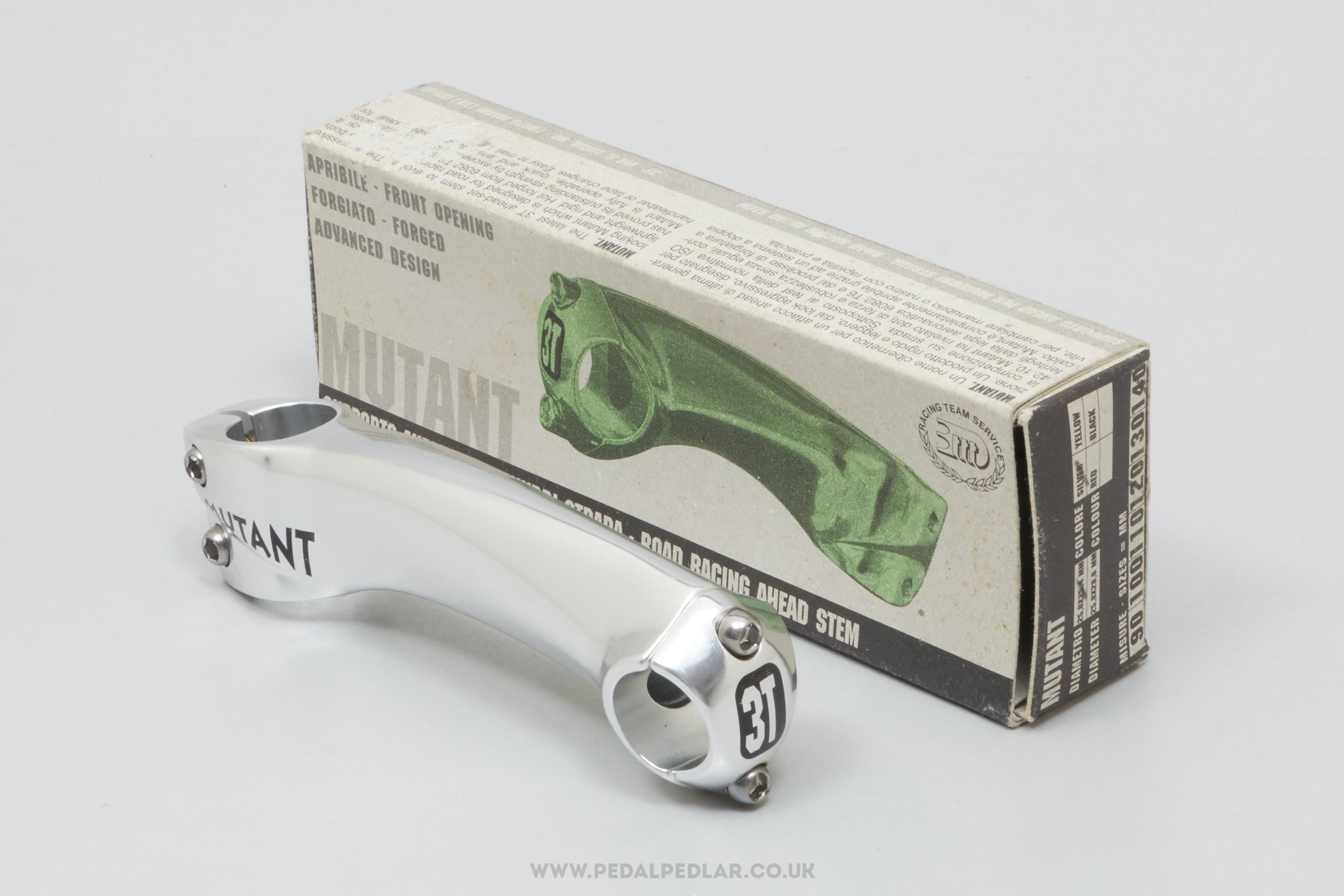


3TTT Mutant Silver NOS/NIB Classic 140 mm 1" A-Head Stem
£30.00 £40.00
✓ Original part - produced in the 1990s
✓ New old stock & still in the original packaging!
✓ Worldwide shipping
3TTT Mutant ahead handlebar stem, hailing from Italy and in production during the 1990s (yet still new & unused after all this time!). Made from aluminium and weighing in at 259 grams. A fine choice for keeping your classic bike authentic, but also great for any other compatible bike.
OVERVIEW
Production Era - 1990s
Country - Italian
Material - Aluminium
Weight - 259 g
Stock Code - D-STA1C
*New old stock items may have marks from storage over the years, and as we often have multiples they can vary from piece to piece, but they are always genuine new & unused items.
TECHNICAL INFO
Extension Length (ctc)* - 140 mm
Steerer Size (OD) - 1" (25.4 mm)
Bar Clamp Size - 25.8 mm / 26.0 mm
Stack Height - 40 mm
Angle - 80 Degrees
*See help section.
-
▼SHIPPING, TAXES & RETURNS
-
We've been safely sending orders around the world since 2010. Orders are carefully packed, sent with tracking & insurance, and normally collected around midday on Tuesdays and Fridays. Larger items may occasionally require an extra day or two to prepare.
We accept returns, please notify us within 14 days and ensure the item arrives back with us no later than 30 days after the order was received.
EU orders under €150 (excluding shipping) - import VAT and the new €3 customs duty are paid as part of your order, so there's nothing further to pay on delivery.
EU orders over €150 (excluding shipping) - import fees are payable to the carrier before delivery, with nothing collected at checkout.
USA orders - import fees are collected at checkout for all orders to the USA, so there won’t be any surprise charges when your order arrives.
Other international orders - local import fees may apply and are not collected by us. Please check your country's import rules before purchasing.
-
▼HELP SECTION
-
Extension Length (ctc)* - measured from the centre of the handlebar clamp to the centre of the steerer clamp, to the nearest 5 mm. This measurement is taken through the middle of the extension, not along the top or bottom.
Steerer Size (OD) - OD means outside diameter, this is the most important measurement when checking the stem fits your bike. This should match the measurement of the outside of your fork's steerer column, where the stem will be clamped.
Bar Clamp Size - this should match the outside diameter of your handlebars and should be as close as possible to ensure a good and safe fit.
Stack Height - the height of the part that clamps to the forks. This is the minimum amount of space you will need on the fork's steerer column for the stem to fit (minus a few mm as the top of the steerer tube needs to sit just below the top of the stem).
Angle - the angle of the stem's extension in relation to the the fork steerer. Bear in mind the steerer sits at the same angle as the head tube, so a 90 degree stem would not be parallel to the ground. Some manufacturers refer to this as rise or drop, in which case an 80 degree stem would drop 10 degrees from a right angle. Most a-head stems can be flipped although it does depend on the design.
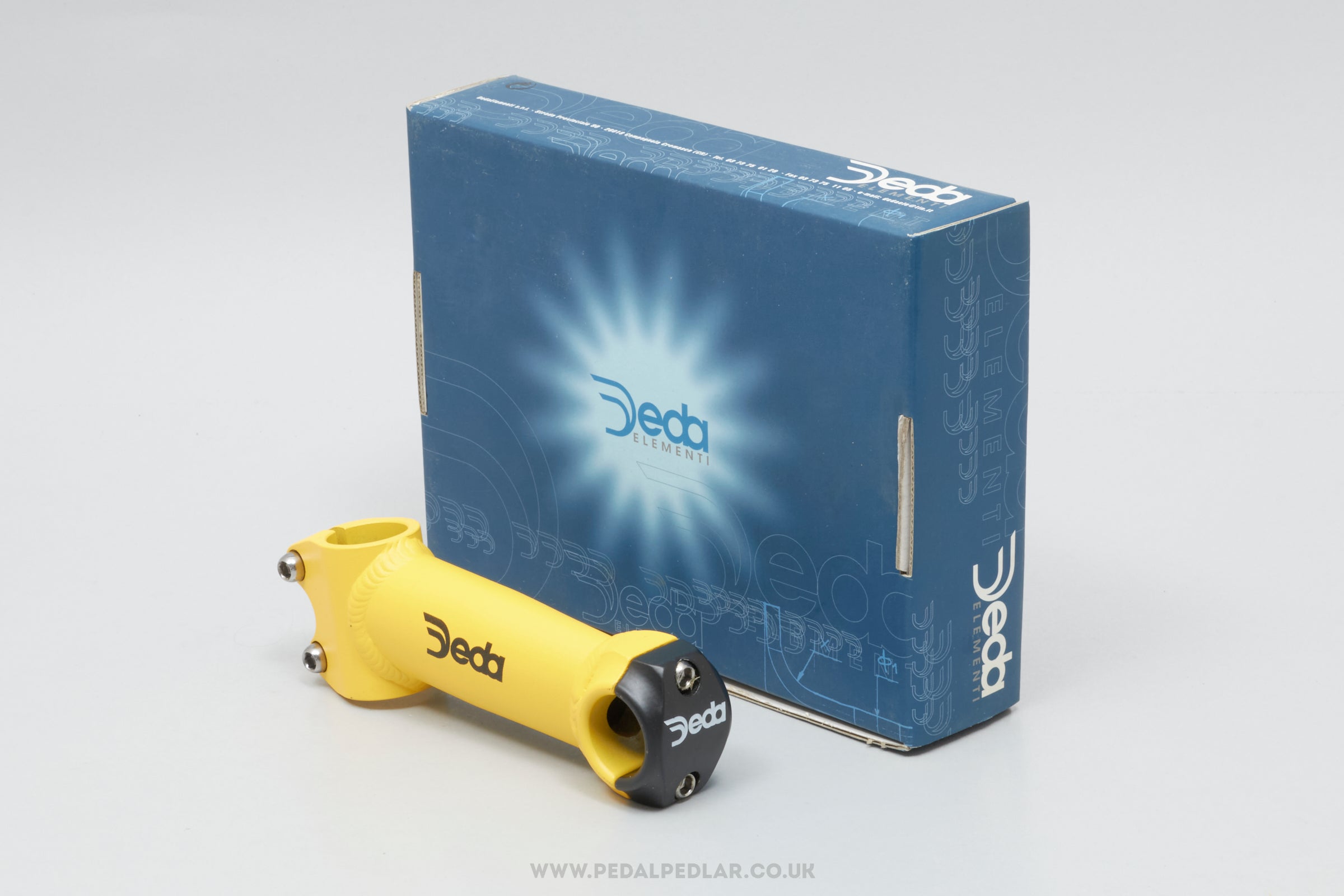


Deda Elementi Lynx Yellow NOS/NIB Classic 120 mm 1" A-Head Stem
£45.00 £60.00
✓ Original part - produced in the 1990s
✓ New old stock & still in the original packaging!
✓ Worldwide shipping
Deda Elementi Lynx ahead handlebar stem, hailing from Italy and in production during the 1990s (yet still new & unused after all this time!). Made from aluminium and weighing in at 208 grams. A fine choice for keeping your classic bike authentic, but also great for any other compatible bike.
OVERVIEW
Production Era - 1990s
Country - Italian
Material - Aluminium
Weight - 208 g
Stock Code - D-STA2C
*New old stock items may have marks from storage over the years, and as we often have multiples they can vary from piece to piece, but they are always genuine new & unused items.
TECHNICAL INFO
Extension Length (ctc)* - 120 mm
Steerer Size (OD) - 1" (25.4 mm)
Bar Clamp Size - 26.0 mm
Stack Height - 50 mm
Angle - 78 Degrees
*See help section.
-
▼SHIPPING, TAXES & RETURNS
-
We've been safely sending orders around the world since 2010. Orders are carefully packed, sent with tracking & insurance, and normally collected around midday on Tuesdays and Fridays. Larger items may occasionally require an extra day or two to prepare.
We accept returns, please notify us within 14 days and ensure the item arrives back with us no later than 30 days after the order was received.
EU orders under €150 (excluding shipping) - import VAT and the new €3 customs duty are paid as part of your order, so there's nothing further to pay on delivery.
EU orders over €150 (excluding shipping) - import fees are payable to the carrier before delivery, with nothing collected at checkout.
USA orders - import fees are collected at checkout for all orders to the USA, so there won’t be any surprise charges when your order arrives.
Other international orders - local import fees may apply and are not collected by us. Please check your country's import rules before purchasing.
-
▼HELP SECTION
-
Extension Length (ctc)* - measured from the centre of the handlebar clamp to the centre of the steerer clamp, to the nearest 5 mm. This measurement is taken through the middle of the extension, not along the top or bottom.
Steerer Size (OD) - OD means outside diameter, this is the most important measurement when checking the stem fits your bike. This should match the measurement of the outside of your fork's steerer column, where the stem will be clamped.
Bar Clamp Size - this should match the outside diameter of your handlebars and should be as close as possible to ensure a good and safe fit.
Stack Height - the height of the part that clamps to the forks. This is the minimum amount of space you will need on the fork's steerer column for the stem to fit (minus a few mm as the top of the steerer tube needs to sit just below the top of the stem).
Angle - the angle of the stem's extension in relation to the the fork steerer. Bear in mind the steerer sits at the same angle as the head tube, so a 90 degree stem would not be parallel to the ground. Some manufacturers refer to this as rise or drop, in which case an 80 degree stem would drop 10 degrees from a right angle. Most a-head stems can be flipped although it does depend on the design.
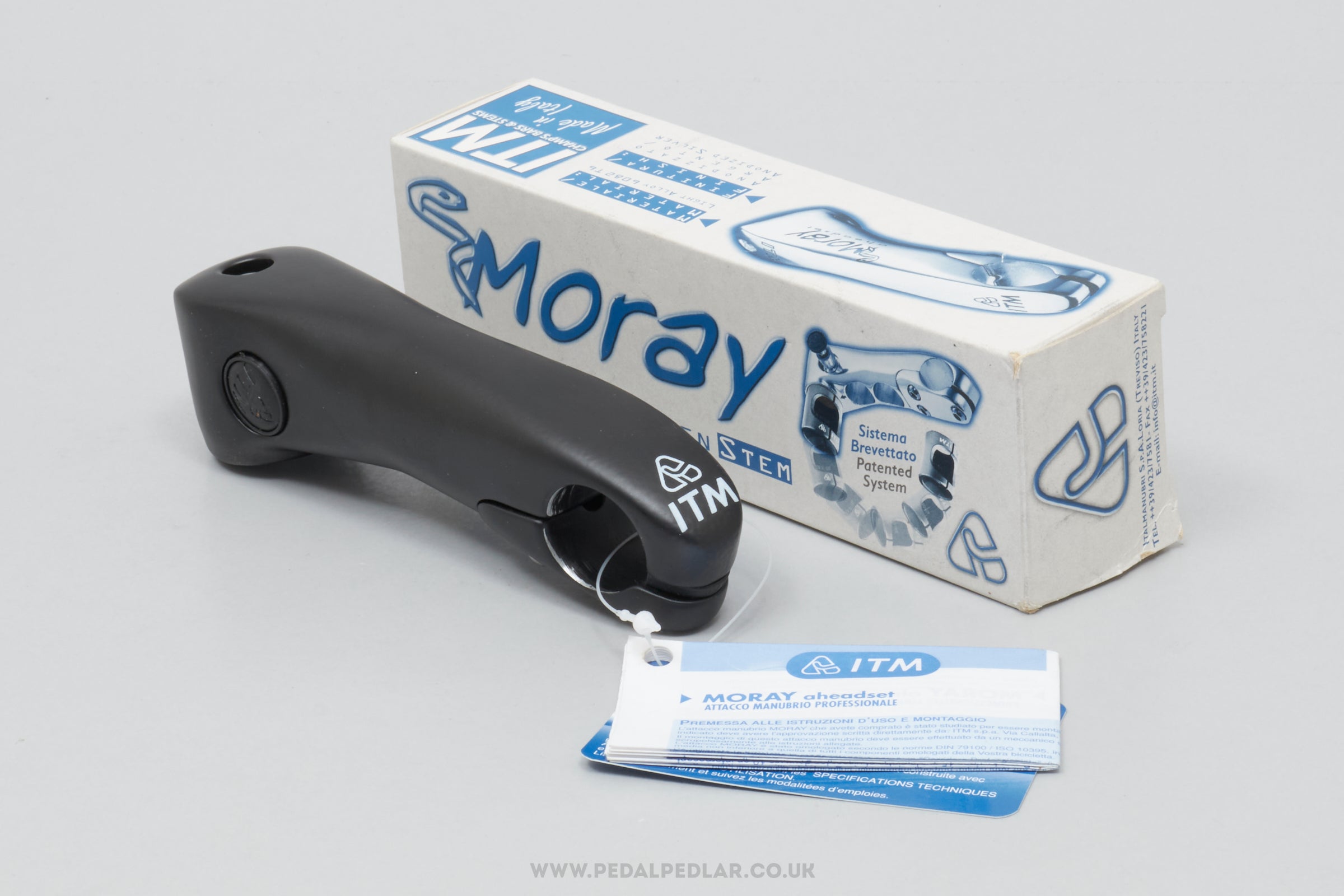


ITM Moray Black NOS/NIB Classic 120 mm 1" A-Head Stem
£30.00 £40.00
✓ Original part - produced in the 1990s
✓ New old stock & still in the original packaging!
✓ Worldwide shipping
ITM Moray ahead handlebar stem, hailing from Italy and in production during the 1990s (yet still new & unused after all this time!). Made from aluminium and weighing in at 310 grams. A fine choice for keeping your classic bike authentic, but also great for any other compatible bike.
OVERVIEW
Production Era - 1990s
Country - Italian
Material - Aluminium
Weight - 310 g
Stock Code - D-STA4C
*New old stock items may have marks from storage over the years, and as we often have multiples they can vary from piece to piece, but they are always genuine new & unused items.
TECHNICAL INFO
Extension Length (ctc)* - 120 mm
Steerer Size (OD) - 1" (25.4 mm)
Bar Clamp Size - 25.8 mm
Stack Height - 44 mm
Angle - 75 Degrees / 80 Degrees (Adjustable)
*See help section.
-
▼SHIPPING, TAXES & RETURNS
-
We've been safely sending orders around the world since 2010. Orders are carefully packed, sent with tracking & insurance, and normally collected around midday on Tuesdays and Fridays. Larger items may occasionally require an extra day or two to prepare.
We accept returns, please notify us within 14 days and ensure the item arrives back with us no later than 30 days after the order was received.
EU orders under €150 (excluding shipping) - import VAT and the new €3 customs duty are paid as part of your order, so there's nothing further to pay on delivery.
EU orders over €150 (excluding shipping) - import fees are payable to the carrier before delivery, with nothing collected at checkout.
USA orders - import fees are collected at checkout for all orders to the USA, so there won’t be any surprise charges when your order arrives.
Other international orders - local import fees may apply and are not collected by us. Please check your country's import rules before purchasing.
-
▼HELP SECTION
-
Extension Length (ctc)* - measured from the centre of the handlebar clamp to the centre of the steerer clamp, to the nearest 5 mm. This measurement is taken through the middle of the extension, not along the top or bottom.
Steerer Size (OD) - OD means outside diameter, this is the most important measurement when checking the stem fits your bike. This should match the measurement of the outside of your fork's steerer column, where the stem will be clamped.
Bar Clamp Size - this should match the outside diameter of your handlebars and should be as close as possible to ensure a good and safe fit.
Stack Height - the height of the part that clamps to the forks. This is the minimum amount of space you will need on the fork's steerer column for the stem to fit (minus a few mm as the top of the steerer tube needs to sit just below the top of the stem).
Angle - the angle of the stem's extension in relation to the the fork steerer. Bear in mind the steerer sits at the same angle as the head tube, so a 90 degree stem would not be parallel to the ground. Some manufacturers refer to this as rise or drop, in which case an 80 degree stem would drop 10 degrees from a right angle. Most a-head stems can be flipped although it does depend on the design.
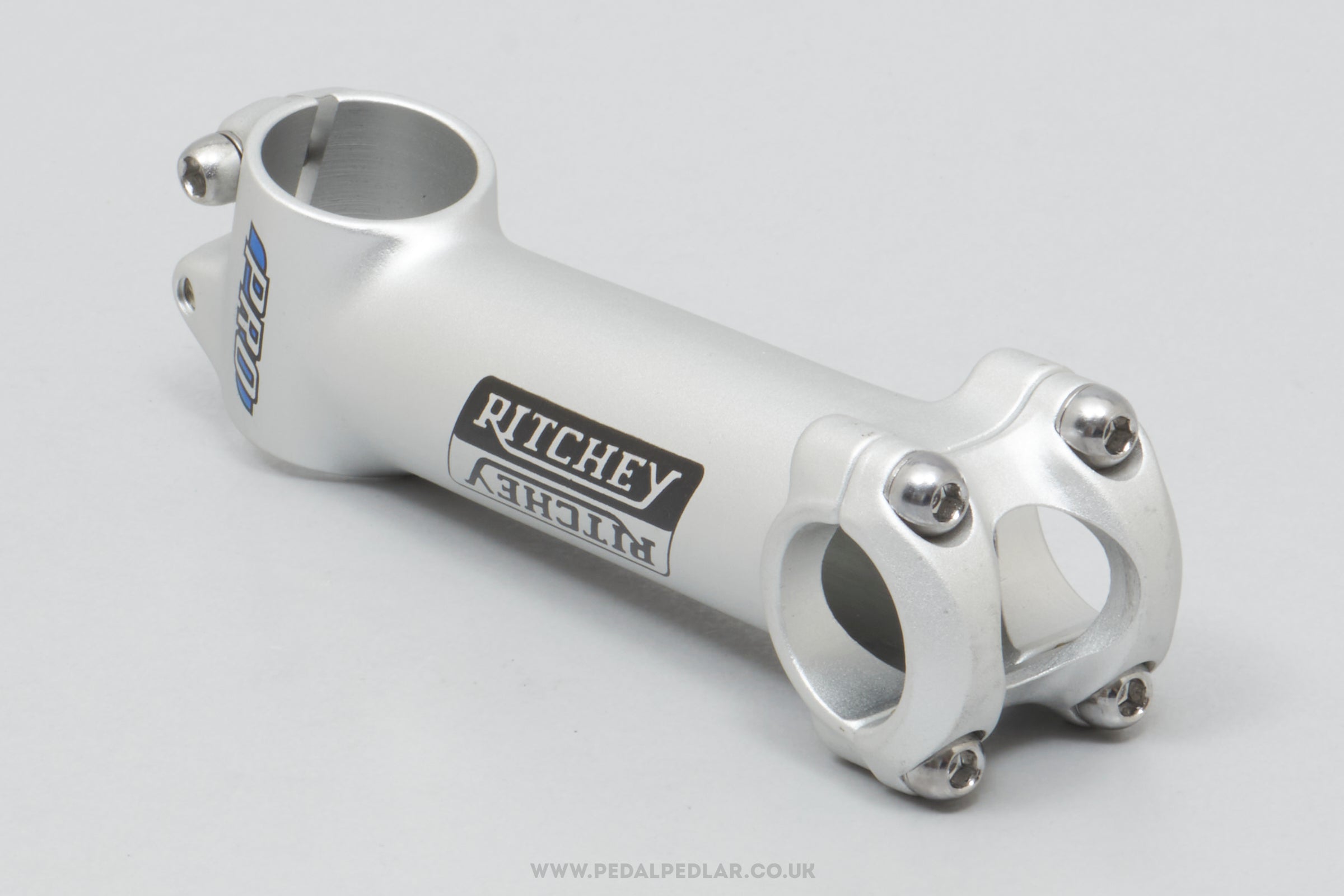


Ritchey Pro Silver NOS Classic 130 mm 1 1/8" A-Head Stem
£26.25 £35.00
✓ Original part - produced in the 1990s
✓ New old stock! Still unused after all these years
✓ Worldwide shipping
Ritchey Pro ahead handlebar stem, hailing from the United States and in production during the 1990s (yet still new & unused after all this time!). Made from aluminium and weighing in at 160 grams. A fine choice for keeping your classic bike authentic, but also great for any other compatible bike.
OVERVIEW
Production Era - 1990s
Country - American
Material - Aluminium
Weight - 160 g
Stock Code - D-STA5C
*New old stock items may have marks from storage over the years, and as we often have multiples they can vary from piece to piece, but they are always genuine new & unused items.
TECHNICAL INFO
Extension Length (ctc)* - 130 mm
Steerer Size (OD) - 1 1/8" (28.6 mm)
Bar Clamp Size - 25.4 mm
Stack Height - 40 mm
*See help section.
-
▼SHIPPING, TAXES & RETURNS
-
We've been safely sending orders around the world since 2010. Orders are carefully packed, sent with tracking & insurance, and normally collected around midday on Tuesdays and Fridays. Larger items may occasionally require an extra day or two to prepare.
We accept returns, please notify us within 14 days and ensure the item arrives back with us no later than 30 days after the order was received.
EU orders under €150 (excluding shipping) - import VAT and the new €3 customs duty are paid as part of your order, so there's nothing further to pay on delivery.
EU orders over €150 (excluding shipping) - import fees are payable to the carrier before delivery, with nothing collected at checkout.
USA orders - import fees are collected at checkout for all orders to the USA, so there won’t be any surprise charges when your order arrives.
Other international orders - local import fees may apply and are not collected by us. Please check your country's import rules before purchasing.
-
▼HELP SECTION
-
Extension Length (ctc)* - measured from the centre of the handlebar clamp to the centre of the steerer clamp, to the nearest 5 mm. This measurement is taken through the middle of the extension, not along the top or bottom.
Steerer Size (OD) - OD means outside diameter, this is the most important measurement when checking the stem fits your bike. This should match the measurement of the outside of your fork's steerer column, where the stem will be clamped.
Bar Clamp Size - this should match the outside diameter of your handlebars and should be as close as possible to ensure a good and safe fit.
Stack Height - the height of the part that clamps to the forks. This is the minimum amount of space you will need on the fork's steerer column for the stem to fit (minus a few mm as the top of the steerer tube needs to sit just below the top of the stem).
Angle - the angle of the stem's extension in relation to the the fork steerer. Bear in mind the steerer sits at the same angle as the head tube, so a 90 degree stem would not be parallel to the ground. Some manufacturers refer to this as rise or drop, in which case an 80 degree stem would drop 10 degrees from a right angle. Most a-head stems can be flipped although it does depend on the design.
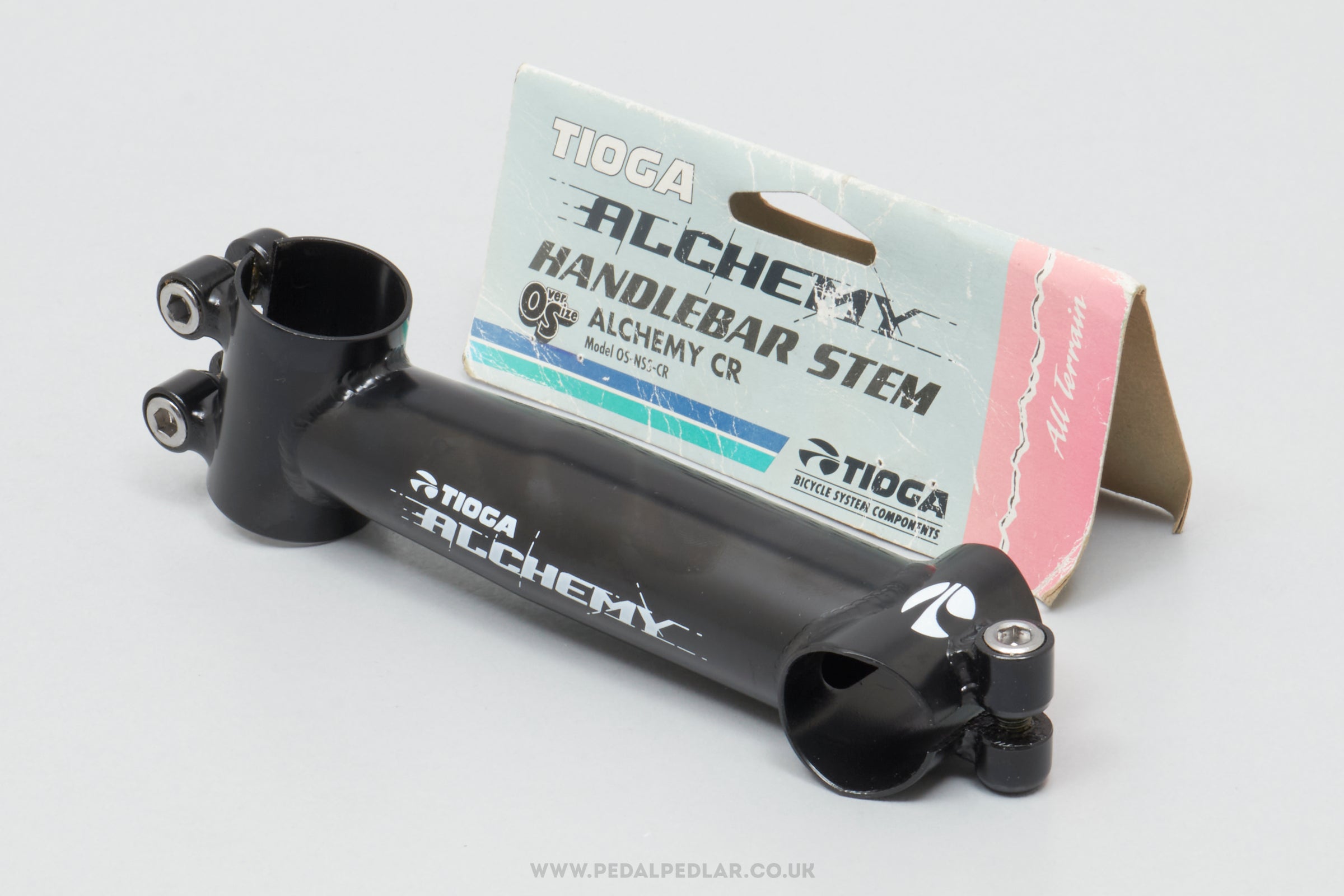


Tioga Alchemy CR (OS-NSS-CR) Black NOS/NIB Classic 135 mm 1 1/8" A-Head Stem
£26.25 £35.00
✓ Original part - produced in the 1990s
✓ New old stock & still in the original packaging!
✓ Worldwide shipping
Tioga Alchemy CR ahead handlebar stem, hailing from the United States and in production during the 1990s (yet still new & unused after all this time!). Made from steel and weighing in at 217 grams. A fine choice for keeping your classic bike authentic, but also great for any other compatible bike.
OVERVIEW
Model ID - OS-NSS-CR
Production Era - 1990s
Country - American
Material - Steel
Weight - 217 g
Stock Code - D-STA8C
*New old stock items may have marks from storage over the years, and as we often have multiples they can vary from piece to piece, but they are always genuine new & unused items.
TECHNICAL INFO
Extension Length (ctc)* - 135 mm
Steerer Size (OD) - 1 1/8" (28.6 mm)
Bar Clamp Size - 25.4 mm
Stack Height - 45 mm
Angle - 100 Degrees
*See help section.
-
▼SHIPPING, TAXES & RETURNS
-
We've been safely sending orders around the world since 2010. Orders are carefully packed, sent with tracking & insurance, and normally collected around midday on Tuesdays and Fridays. Larger items may occasionally require an extra day or two to prepare.
We accept returns, please notify us within 14 days and ensure the item arrives back with us no later than 30 days after the order was received.
EU orders under €150 (excluding shipping) - import VAT and the new €3 customs duty are paid as part of your order, so there's nothing further to pay on delivery.
EU orders over €150 (excluding shipping) - import fees are payable to the carrier before delivery, with nothing collected at checkout.
USA orders - import fees are collected at checkout for all orders to the USA, so there won’t be any surprise charges when your order arrives.
Other international orders - local import fees may apply and are not collected by us. Please check your country's import rules before purchasing.
-
▼HELP SECTION
-
Extension Length (ctc)* - measured from the centre of the handlebar clamp to the centre of the steerer clamp, to the nearest 5 mm. This measurement is taken through the middle of the extension, not along the top or bottom.
Steerer Size (OD) - OD means outside diameter, this is the most important measurement when checking the stem fits your bike. This should match the measurement of the outside of your fork's steerer column, where the stem will be clamped.
Bar Clamp Size - this should match the outside diameter of your handlebars and should be as close as possible to ensure a good and safe fit.
Stack Height - the height of the part that clamps to the forks. This is the minimum amount of space you will need on the fork's steerer column for the stem to fit (minus a few mm as the top of the steerer tube needs to sit just below the top of the stem).
Angle - the angle of the stem's extension in relation to the the fork steerer. Bear in mind the steerer sits at the same angle as the head tube, so a 90 degree stem would not be parallel to the ground. Some manufacturers refer to this as rise or drop, in which case an 80 degree stem would drop 10 degrees from a right angle. Most a-head stems can be flipped although it does depend on the design.
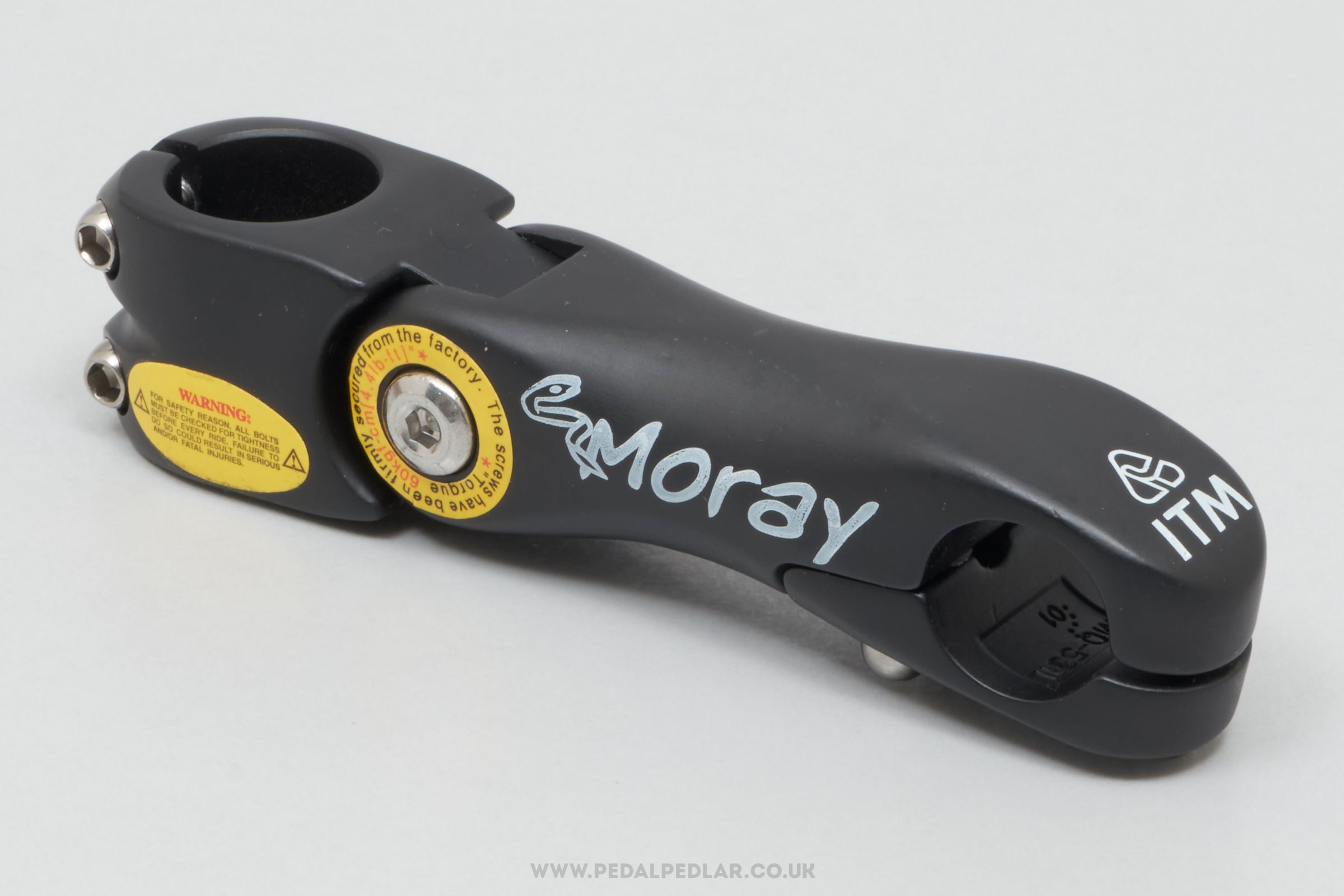


ITM Moray Adjustable NOS Classic 130 mm 1 1/8" A-Head Stem
£41.25 £55.00
✓ Original part - produced in the 1990s
✓ New old stock! Still unused after all these years
✓ Worldwide shipping
ITM Moray ahead handlebar stem, hailing from Italy and in production during the 1990s (yet still new & unused after all this time!). Made from aluminium and weighing in at 431 grams. A fine choice for keeping your classic bike authentic, but also great for any other compatible bike.
OVERVIEW
Production Era - 1990s
Country - Italian
Material - Aluminium
Weight - 431 g
Stock Code - D-STA20C
*New old stock items may have marks from storage over the years, and as we often have multiples they can vary from piece to piece, but they are always genuine new & unused items.
TECHNICAL INFO
Extension Length (ctc)* - 130 mm
Steerer Size (OD) - 1 1/8" (28.6 mm)
Bar Clamp Size - 25.4 mm
Stack Height - 40 mm
Angle - Adjustable
*See help section.
-
▼SHIPPING, TAXES & RETURNS
-
We've been safely sending orders around the world since 2010. Orders are carefully packed, sent with tracking & insurance, and normally collected around midday on Tuesdays and Fridays. Larger items may occasionally require an extra day or two to prepare.
We accept returns, please notify us within 14 days and ensure the item arrives back with us no later than 30 days after the order was received.
EU orders under €150 (excluding shipping) - import VAT and the new €3 customs duty are paid as part of your order, so there's nothing further to pay on delivery.
EU orders over €150 (excluding shipping) - import fees are payable to the carrier before delivery, with nothing collected at checkout.
USA orders - import fees are collected at checkout for all orders to the USA, so there won’t be any surprise charges when your order arrives.
Other international orders - local import fees may apply and are not collected by us. Please check your country's import rules before purchasing.
-
▼HELP SECTION
-
Extension Length (ctc)* - measured from the centre of the handlebar clamp to the centre of the steerer clamp, to the nearest 5 mm. This measurement is taken through the middle of the extension, not along the top or bottom.
Steerer Size (OD) - OD means outside diameter, this is the most important measurement when checking the stem fits your bike. This should match the measurement of the outside of your fork's steerer column, where the stem will be clamped.
Bar Clamp Size - this should match the outside diameter of your handlebars and should be as close as possible to ensure a good and safe fit.
Stack Height - the height of the part that clamps to the forks. This is the minimum amount of space you will need on the fork's steerer column for the stem to fit (minus a few mm as the top of the steerer tube needs to sit just below the top of the stem).
Angle - the angle of the stem's extension in relation to the the fork steerer. Bear in mind the steerer sits at the same angle as the head tube, so a 90 degree stem would not be parallel to the ground. Some manufacturers refer to this as rise or drop, in which case an 80 degree stem would drop 10 degrees from a right angle. Most a-head stems can be flipped although it does depend on the design.
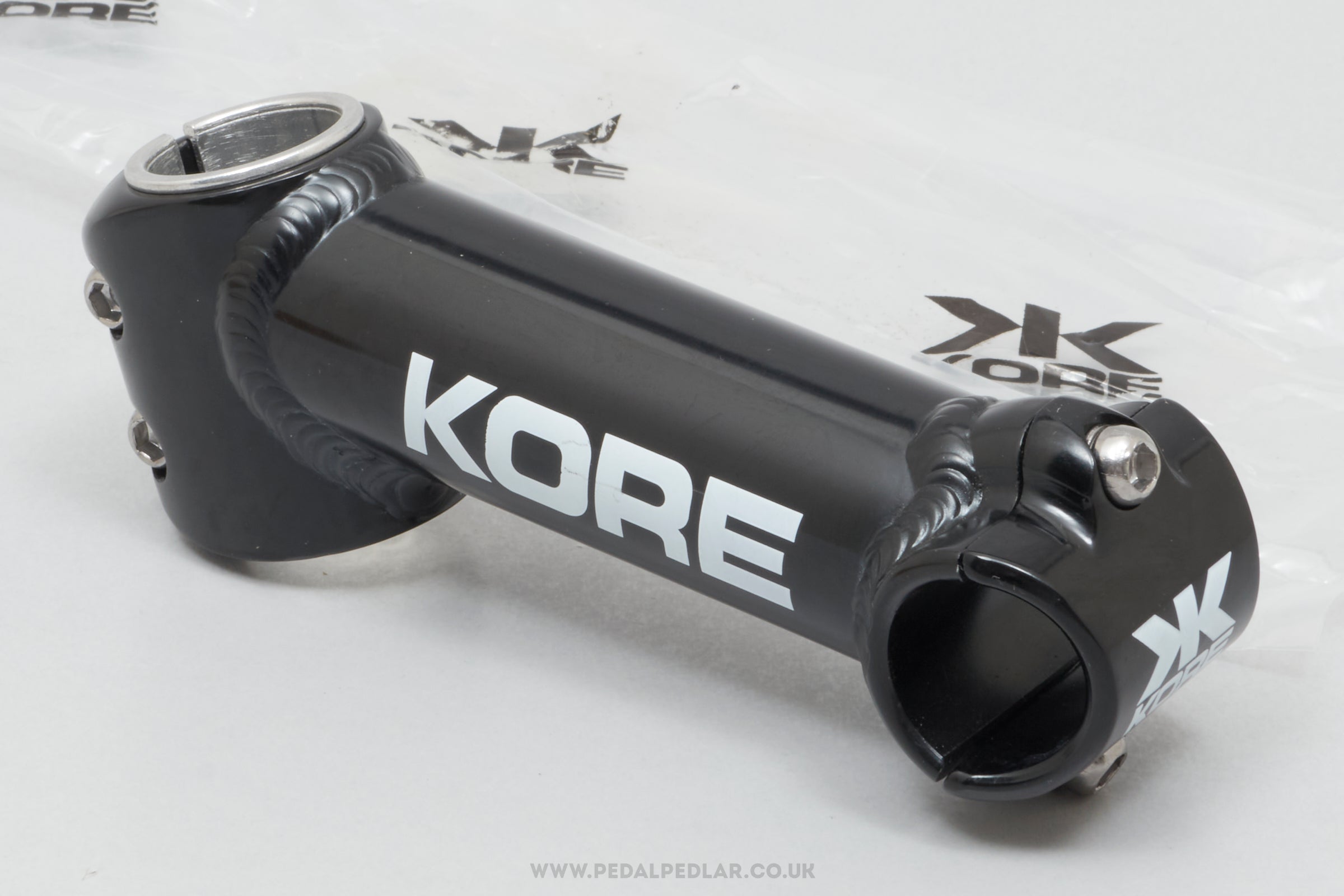


Kore Road NOS Classic 120 mm 1" or 1 1/8" A-Head Stem
£33.75 £45.00
✓ Original part - produced in the 1990s
✓ New old stock! Still unused after all these years
✓ Worldwide shipping
Kore ahead handlebar stem, hailing from Taiwan and in production during the 1990s (yet still new & unused after all this time!). Made from aluminium and weighing in at 206 grams. A fine choice for keeping your classic bike authentic, but also great for any other compatible bike.
OVERVIEW
Production Era - 1990s
Country - Taiwanese
Material - Aluminium
Weight - 206 g
Stock Code - D-STA21C
NB - Includes shim reducer to fit 1" steerer
*New old stock items may have marks from storage over the years, and as we often have multiples they can vary from piece to piece, but they are always genuine new & unused items.
TECHNICAL INFO
Extension Length (ctc)* - 120 mm
Steerer Size (OD) - 1" or 1 1/8" (25.4mm / 28.6 mm)
Bar Clamp Size - 26.0 mm
Stack Height - 50 mm
Angle - 73 Degrees
*See help section.
-
▼SHIPPING, TAXES & RETURNS
-
We've been safely sending orders around the world since 2010. Orders are carefully packed, sent with tracking & insurance, and normally collected around midday on Tuesdays and Fridays. Larger items may occasionally require an extra day or two to prepare.
We accept returns, please notify us within 14 days and ensure the item arrives back with us no later than 30 days after the order was received.
EU orders under €150 (excluding shipping) - import VAT and the new €3 customs duty are paid as part of your order, so there's nothing further to pay on delivery.
EU orders over €150 (excluding shipping) - import fees are payable to the carrier before delivery, with nothing collected at checkout.
USA orders - import fees are collected at checkout for all orders to the USA, so there won’t be any surprise charges when your order arrives.
Other international orders - local import fees may apply and are not collected by us. Please check your country's import rules before purchasing.
-
▼HELP SECTION
-
Extension Length (ctc)* - measured from the centre of the handlebar clamp to the centre of the steerer clamp, to the nearest 5 mm. This measurement is taken through the middle of the extension, not along the top or bottom.
Steerer Size (OD) - OD means outside diameter, this is the most important measurement when checking the stem fits your bike. This should match the measurement of the outside of your fork's steerer column, where the stem will be clamped.
Bar Clamp Size - this should match the outside diameter of your handlebars and should be as close as possible to ensure a good and safe fit.
Stack Height - the height of the part that clamps to the forks. This is the minimum amount of space you will need on the fork's steerer column for the stem to fit (minus a few mm as the top of the steerer tube needs to sit just below the top of the stem).
Angle - the angle of the stem's extension in relation to the the fork steerer. Bear in mind the steerer sits at the same angle as the head tube, so a 90 degree stem would not be parallel to the ground. Some manufacturers refer to this as rise or drop, in which case an 80 degree stem would drop 10 degrees from a right angle. Most a-head stems can be flipped although it does depend on the design.
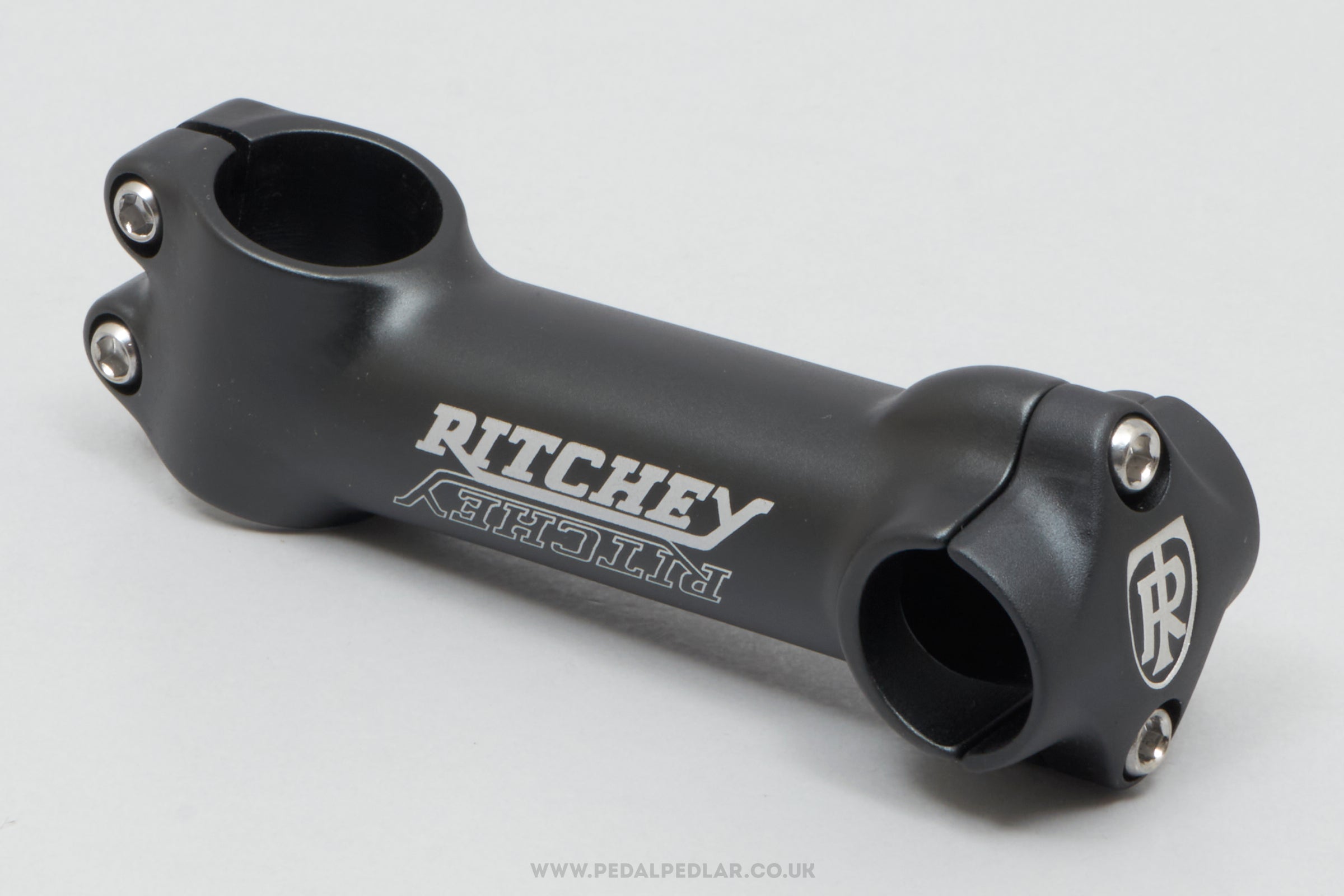


Ritchey Road Pro Black NOS Classic 120 mm 1" or 1 1/8" A-Head Stem
£30.00 £40.00
✓ Original part - produced in the 1990s
✓ New old stock! Still unused after all these years
✓ Worldwide shipping
Ritchey Road Pro ahead handlebar stem, hailing from the United States and in production during the 1990s (yet still new & unused after all this time!). Made from aluminium and weighing in at 185 grams. A fine choice for keeping your classic bike authentic, but also great for any other compatible bike.
OVERVIEW
Production Era - 1990s
Country - American
Material - Aluminium
Weight - 185 g
Stock Code - D-STA22C
NB - Includes shim reducer to fit 1" steerer
*New old stock items may have marks from storage over the years, and as we often have multiples they can vary from piece to piece, but they are always genuine new & unused items.
TECHNICAL INFO
Extension Length (ctc)* - 120 mm
Steerer Size (OD) - 1" or 1 1/8" (25.4mm / 28.6 mm)
Bar Clamp Size - 26.0 mm
Stack Height - 40 mm
Angle - 73 Degrees
*See help section.
-
▼SHIPPING, TAXES & RETURNS
-
We've been safely sending orders around the world since 2010. Orders are carefully packed, sent with tracking & insurance, and normally collected around midday on Tuesdays and Fridays. Larger items may occasionally require an extra day or two to prepare.
We accept returns, please notify us within 14 days and ensure the item arrives back with us no later than 30 days after the order was received.
EU orders under €150 (excluding shipping) - import VAT and the new €3 customs duty are paid as part of your order, so there's nothing further to pay on delivery.
EU orders over €150 (excluding shipping) - import fees are payable to the carrier before delivery, with nothing collected at checkout.
USA orders - import fees are collected at checkout for all orders to the USA, so there won’t be any surprise charges when your order arrives.
Other international orders - local import fees may apply and are not collected by us. Please check your country's import rules before purchasing.
-
▼HELP SECTION
-
Extension Length (ctc)* - measured from the centre of the handlebar clamp to the centre of the steerer clamp, to the nearest 5 mm. This measurement is taken through the middle of the extension, not along the top or bottom.
Steerer Size (OD) - OD means outside diameter, this is the most important measurement when checking the stem fits your bike. This should match the measurement of the outside of your fork's steerer column, where the stem will be clamped.
Bar Clamp Size - this should match the outside diameter of your handlebars and should be as close as possible to ensure a good and safe fit.
Stack Height - the height of the part that clamps to the forks. This is the minimum amount of space you will need on the fork's steerer column for the stem to fit (minus a few mm as the top of the steerer tube needs to sit just below the top of the stem).
Angle - the angle of the stem's extension in relation to the the fork steerer. Bear in mind the steerer sits at the same angle as the head tube, so a 90 degree stem would not be parallel to the ground. Some manufacturers refer to this as rise or drop, in which case an 80 degree stem would drop 10 degrees from a right angle. Most a-head stems can be flipped although it does depend on the design.
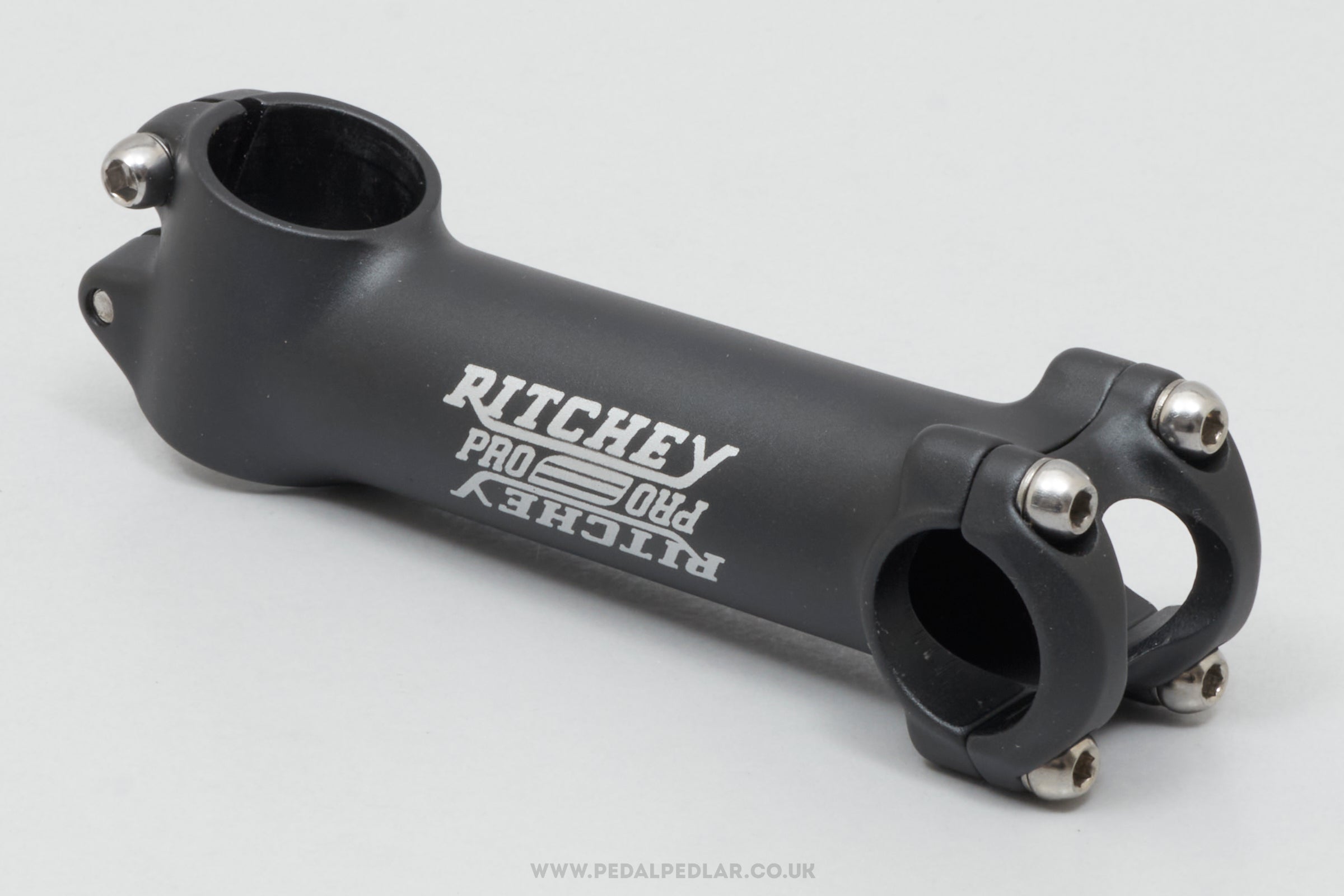


Ritchey Road Pro Black NOS Classic 130 mm 1 1/8" A-Head Stem
£30.00 £40.00
✓ Original part - produced in the 2000s
✓ New old stock! Still unused after all these years
✓ Worldwide shipping
Ritchey Road Pro ahead handlebar stem, hailing from the United States and in production during the 2000s. Made from aluminium and weighing in at 156 grams. A fine choice for keeping your classic bike authentic, but also great for any other compatible bike.
OVERVIEW
Production Era - 2000s
Country - American
Material - Aluminium
Weight - 156 g
Stock Code - D-STA23C
*New old stock items may have marks from storage over the years, and as we often have multiples they can vary from piece to piece, but they are always genuine new & unused items.
TECHNICAL INFO
Extension Length (ctc)* - 130 mm
Steerer Size (OD) - 1 1/8" (28.6 mm)
Bar Clamp Size - 26.0 mm
Stack Height - 40 mm
Angle - 73 Degrees
*See help section.
-
▼SHIPPING, TAXES & RETURNS
-
We've been safely sending orders around the world since 2010. Orders are carefully packed, sent with tracking & insurance, and normally collected around midday on Tuesdays and Fridays. Larger items may occasionally require an extra day or two to prepare.
We accept returns, please notify us within 14 days and ensure the item arrives back with us no later than 30 days after the order was received.
EU orders under €150 (excluding shipping) - import VAT and the new €3 customs duty are paid as part of your order, so there's nothing further to pay on delivery.
EU orders over €150 (excluding shipping) - import fees are payable to the carrier before delivery, with nothing collected at checkout.
USA orders - import fees are collected at checkout for all orders to the USA, so there won’t be any surprise charges when your order arrives.
Other international orders - local import fees may apply and are not collected by us. Please check your country's import rules before purchasing.
-
▼HELP SECTION
-
Extension Length (ctc)* - measured from the centre of the handlebar clamp to the centre of the steerer clamp, to the nearest 5 mm. This measurement is taken through the middle of the extension, not along the top or bottom.
Steerer Size (OD) - OD means outside diameter, this is the most important measurement when checking the stem fits your bike. This should match the measurement of the outside of your fork's steerer column, where the stem will be clamped.
Bar Clamp Size - this should match the outside diameter of your handlebars and should be as close as possible to ensure a good and safe fit.
Stack Height - the height of the part that clamps to the forks. This is the minimum amount of space you will need on the fork's steerer column for the stem to fit (minus a few mm as the top of the steerer tube needs to sit just below the top of the stem).
Angle - the angle of the stem's extension in relation to the the fork steerer. Bear in mind the steerer sits at the same angle as the head tube, so a 90 degree stem would not be parallel to the ground. Some manufacturers refer to this as rise or drop, in which case an 80 degree stem would drop 10 degrees from a right angle. Most a-head stems can be flipped although it does depend on the design.
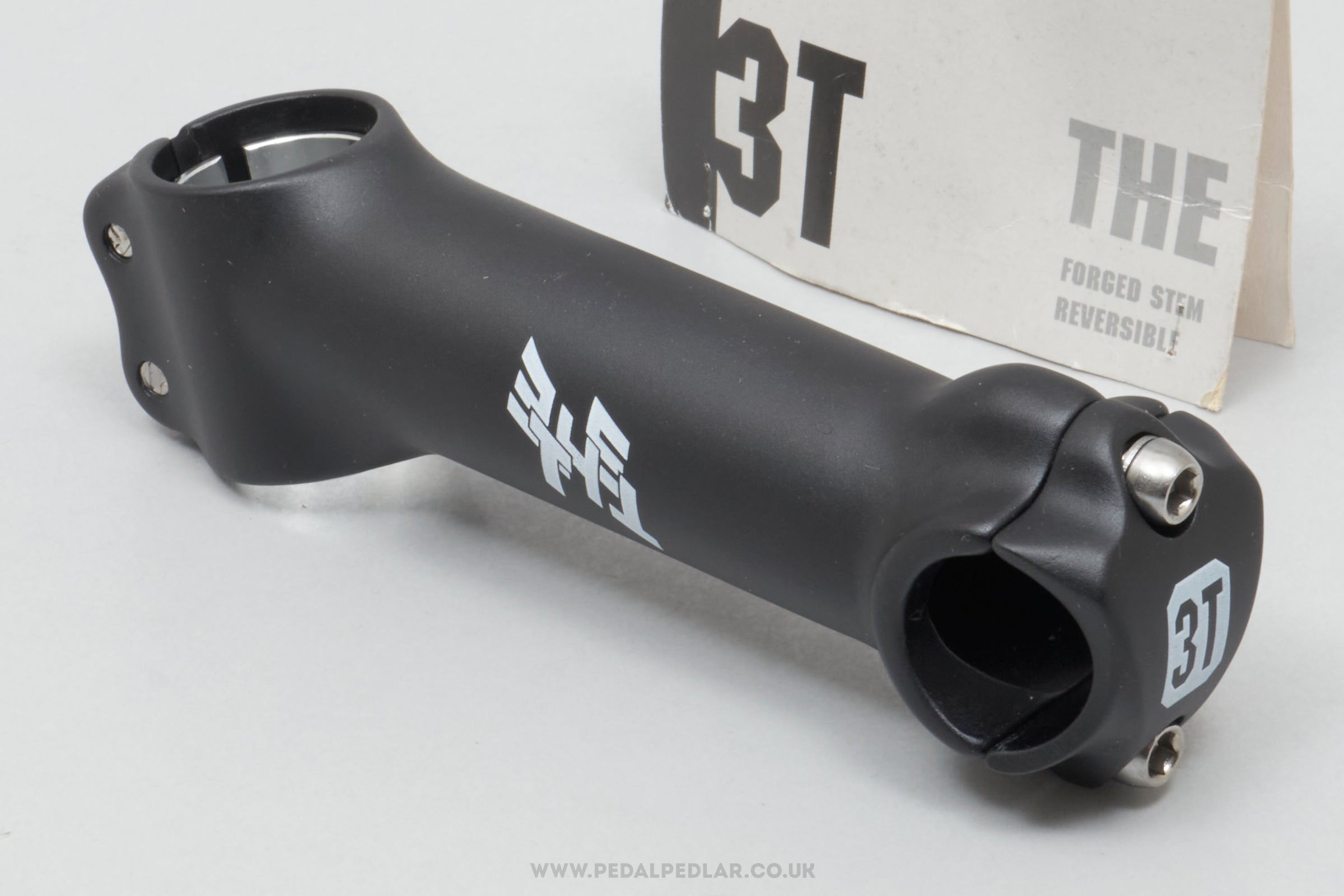


3TTT THE NOS/NIB Classic 120 mm 1" or 1 1/8" A-Head Stem
£26.25 £35.00
✓ Original part - produced in the 2000s
✓ New old stock & still in the original packaging!
✓ Worldwide shipping
3TTT THE ahead handlebar stem, hailing from Italy and in production during the 2000s. Made from aluminium and weighing in at 222 grams. A fine choice for keeping your classic bike authentic, but also great for any other compatible bike.
OVERVIEW
Production Era - 2000s
Country - Italian
Material - Aluminium
Weight - 222 g
Stock Code - D-STA24C
NB - Includes shim reducer to fit 1" steerer
*New old stock items may have marks from storage over the years, and as we often have multiples they can vary from piece to piece, but they are always genuine new & unused items.
TECHNICAL INFO
Extension Length (ctc)* - 120 mm
Steerer Size (OD) - 1" or 1 1/8" (25.4mm / 28.6 mm)
Bar Clamp Size - 26.0 mm
Stack Height - 40 mm
Angle - 73 Degrees
*See help section.
-
▼SHIPPING, TAXES & RETURNS
-
We've been safely sending orders around the world since 2010. Orders are carefully packed, sent with tracking & insurance, and normally collected around midday on Tuesdays and Fridays. Larger items may occasionally require an extra day or two to prepare.
We accept returns, please notify us within 14 days and ensure the item arrives back with us no later than 30 days after the order was received.
EU orders under €150 (excluding shipping) - import VAT and the new €3 customs duty are paid as part of your order, so there's nothing further to pay on delivery.
EU orders over €150 (excluding shipping) - import fees are payable to the carrier before delivery, with nothing collected at checkout.
USA orders - import fees are collected at checkout for all orders to the USA, so there won’t be any surprise charges when your order arrives.
Other international orders - local import fees may apply and are not collected by us. Please check your country's import rules before purchasing.
-
▼HELP SECTION
-
Extension Length (ctc)* - measured from the centre of the handlebar clamp to the centre of the steerer clamp, to the nearest 5 mm. This measurement is taken through the middle of the extension, not along the top or bottom.
Steerer Size (OD) - OD means outside diameter, this is the most important measurement when checking the stem fits your bike. This should match the measurement of the outside of your fork's steerer column, where the stem will be clamped.
Bar Clamp Size - this should match the outside diameter of your handlebars and should be as close as possible to ensure a good and safe fit.
Stack Height - the height of the part that clamps to the forks. This is the minimum amount of space you will need on the fork's steerer column for the stem to fit (minus a few mm as the top of the steerer tube needs to sit just below the top of the stem).
Angle - the angle of the stem's extension in relation to the the fork steerer. Bear in mind the steerer sits at the same angle as the head tube, so a 90 degree stem would not be parallel to the ground. Some manufacturers refer to this as rise or drop, in which case an 80 degree stem would drop 10 degrees from a right angle. Most a-head stems can be flipped although it does depend on the design.
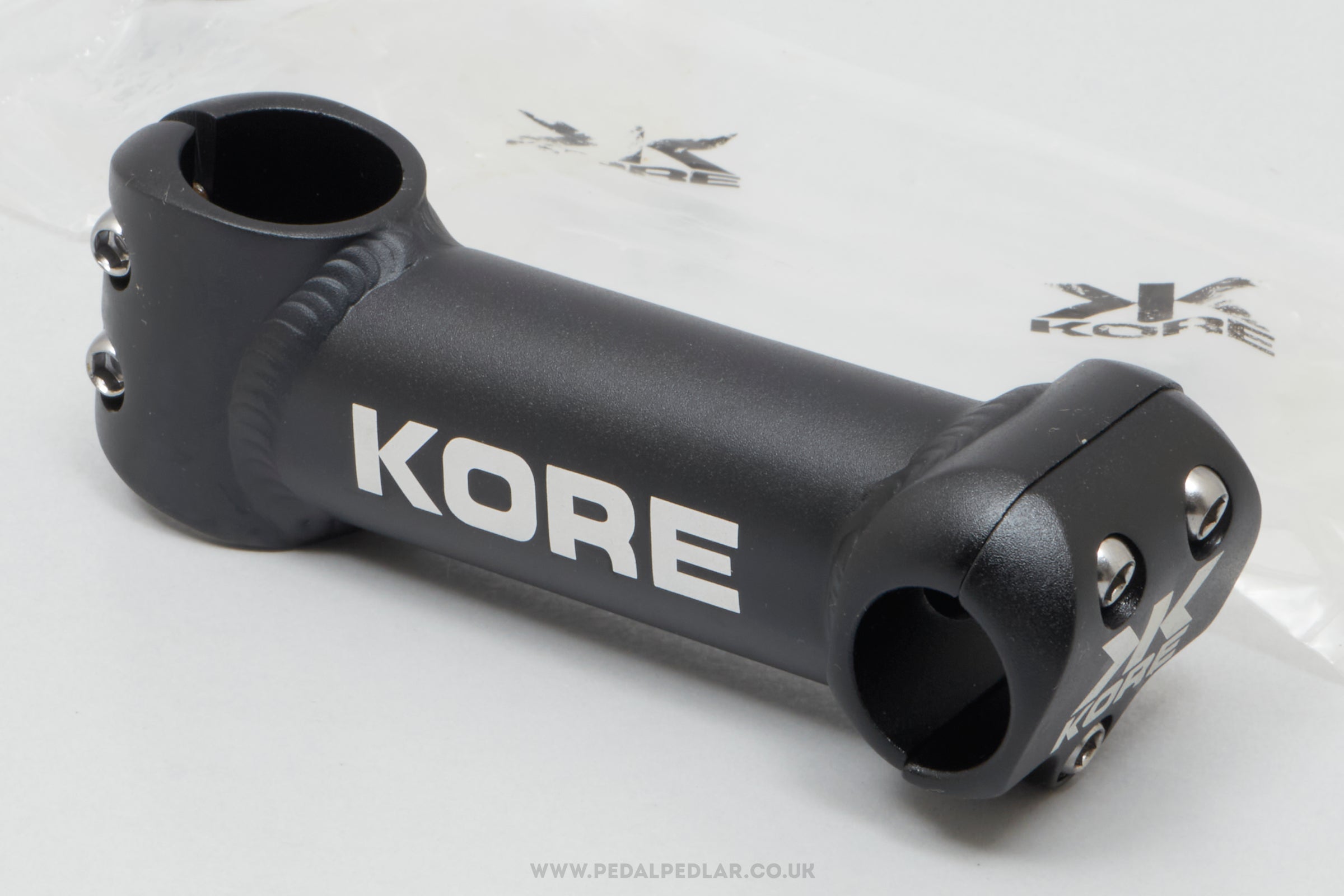


Kore Lite 3 Black NOS Classic 125 mm 1 1/8" A-Head Stem
£42.50 £50.00
✓ Original part - produced in the 1990s
✓ New old stock! Still unused after all these years
✓ Worldwide shipping
Kore Lite 3 ahead handlebar stem, hailing from Taiwan and in production during the 1990s (yet still new & unused after all this time!). Made from aluminium and weighing in at 224 grams. A fine choice for keeping your classic bike authentic, but also great for any other compatible bike.
OVERVIEW
Production Era - 1990s
Country - Taiwanese
Material - Aluminium
Weight - 224 g
Stock Code - D-STA26C
*New old stock items may have marks from storage over the years, and as we often have multiples they can vary from piece to piece, but they are always genuine new & unused items.
TECHNICAL INFO
Extension Length (ctc)* - 125 mm
Steerer Size (OD) - 1 1/8" (28.6 mm)
Bar Clamp Size - 25.4 mm
Stack Height - 50 mm
Angle - 100 Degrees
*See help section.
-
▼SHIPPING, TAXES & RETURNS
-
We've been safely sending orders around the world since 2010. Orders are carefully packed, sent with tracking & insurance, and normally collected around midday on Tuesdays and Fridays. Larger items may occasionally require an extra day or two to prepare.
We accept returns, please notify us within 14 days and ensure the item arrives back with us no later than 30 days after the order was received.
EU orders under €150 (excluding shipping) - import VAT and the new €3 customs duty are paid as part of your order, so there's nothing further to pay on delivery.
EU orders over €150 (excluding shipping) - import fees are payable to the carrier before delivery, with nothing collected at checkout.
USA orders - import fees are collected at checkout for all orders to the USA, so there won’t be any surprise charges when your order arrives.
Other international orders - local import fees may apply and are not collected by us. Please check your country's import rules before purchasing.
-
▼HELP SECTION
-
Extension Length (ctc)* - measured from the centre of the handlebar clamp to the centre of the steerer clamp, to the nearest 5 mm. This measurement is taken through the middle of the extension, not along the top or bottom.
Steerer Size (OD) - OD means outside diameter, this is the most important measurement when checking the stem fits your bike. This should match the measurement of the outside of your fork's steerer column, where the stem will be clamped.
Bar Clamp Size - this should match the outside diameter of your handlebars and should be as close as possible to ensure a good and safe fit.
Stack Height - the height of the part that clamps to the forks. This is the minimum amount of space you will need on the fork's steerer column for the stem to fit (minus a few mm as the top of the steerer tube needs to sit just below the top of the stem).
Angle - the angle of the stem's extension in relation to the the fork steerer. Bear in mind the steerer sits at the same angle as the head tube, so a 90 degree stem would not be parallel to the ground. Some manufacturers refer to this as rise or drop, in which case an 80 degree stem would drop 10 degrees from a right angle. Most a-head stems can be flipped although it does depend on the design.
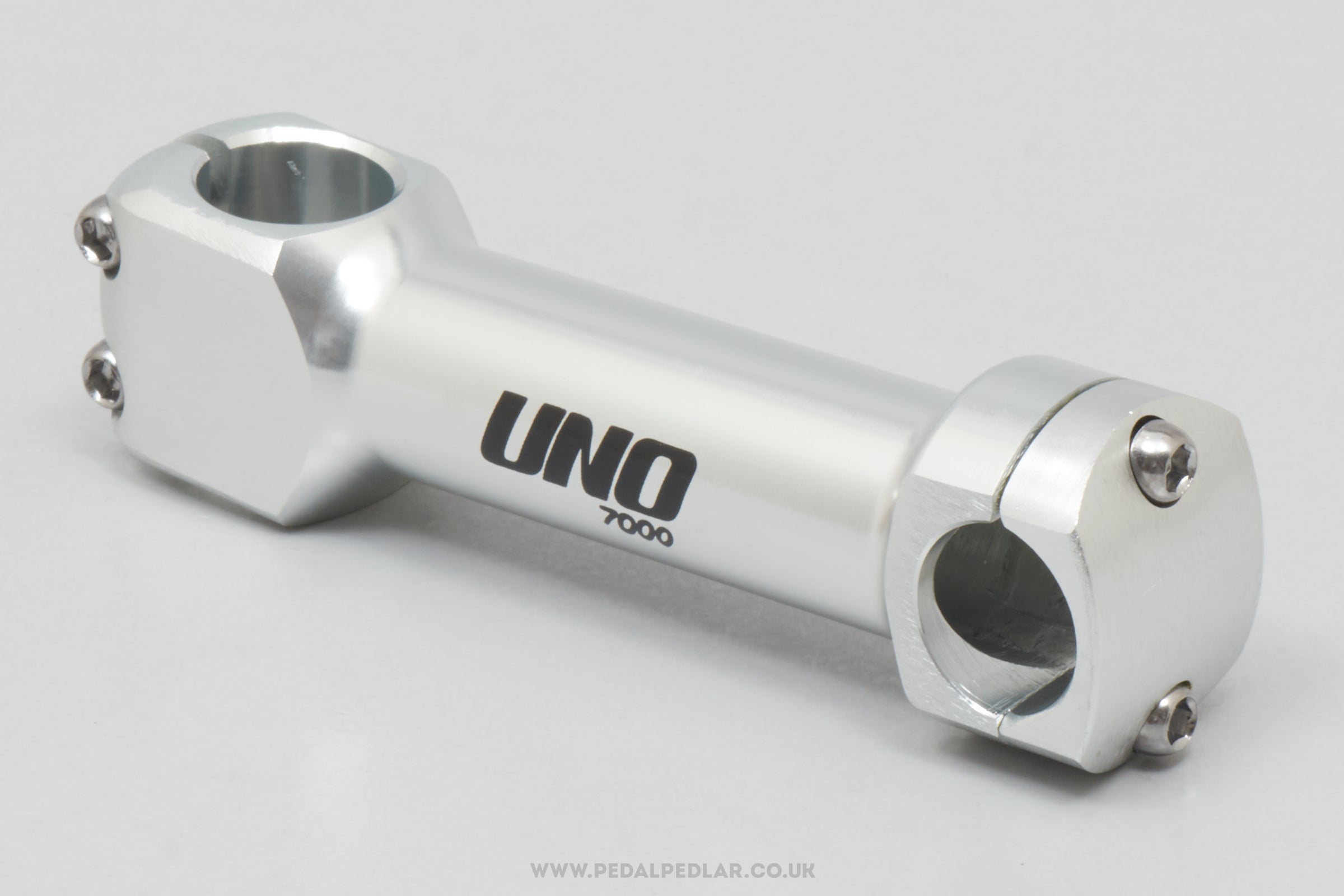


Kalloy Uno 7000 NOS Classic 130 mm 1" A-Head Stem
£26.25 £35.00
✓ Original part - produced in the 1990s
✓ New old stock! Still unused after all these years
✓ Worldwide shipping
Kalloy Uno ahead handlebar stem, hailing from Taiwan and in production during the 1990s (yet still new & unused after all this time!). Made from aluminium and weighing in at 209 grams. A fine choice for keeping your classic bike authentic, but also great for any other compatible bike.
OVERVIEW
Production Era - 1990s
Country - Taiwanese
Material - Aluminium
Weight - 209 g
Stock Code - D-STA28C
*New old stock items may have marks from storage over the years, and as we often have multiples they can vary from piece to piece, but they are always genuine new & unused items.
TECHNICAL INFO
Extension Length (ctc)* - 130 mm
Steerer Size (OD) - 1" (25.4 mm)
Bar Clamp Size - 25.4 mm
Stack Height - 40 mm
Angle - 95 Degrees
*See help section.
-
▼SHIPPING, TAXES & RETURNS
-
We've been safely sending orders around the world since 2010. Orders are carefully packed, sent with tracking & insurance, and normally collected around midday on Tuesdays and Fridays. Larger items may occasionally require an extra day or two to prepare.
We accept returns, please notify us within 14 days and ensure the item arrives back with us no later than 30 days after the order was received.
EU orders under €150 (excluding shipping) - import VAT and the new €3 customs duty are paid as part of your order, so there's nothing further to pay on delivery.
EU orders over €150 (excluding shipping) - import fees are payable to the carrier before delivery, with nothing collected at checkout.
USA orders - import fees are collected at checkout for all orders to the USA, so there won’t be any surprise charges when your order arrives.
Other international orders - local import fees may apply and are not collected by us. Please check your country's import rules before purchasing.
-
▼HELP SECTION
-
Extension Length (ctc)* - measured from the centre of the handlebar clamp to the centre of the steerer clamp, to the nearest 5 mm. This measurement is taken through the middle of the extension, not along the top or bottom.
Steerer Size (OD) - OD means outside diameter, this is the most important measurement when checking the stem fits your bike. This should match the measurement of the outside of your fork's steerer column, where the stem will be clamped.
Bar Clamp Size - this should match the outside diameter of your handlebars and should be as close as possible to ensure a good and safe fit.
Stack Height - the height of the part that clamps to the forks. This is the minimum amount of space you will need on the fork's steerer column for the stem to fit (minus a few mm as the top of the steerer tube needs to sit just below the top of the stem).
Angle - the angle of the stem's extension in relation to the the fork steerer. Bear in mind the steerer sits at the same angle as the head tube, so a 90 degree stem would not be parallel to the ground. Some manufacturers refer to this as rise or drop, in which case an 80 degree stem would drop 10 degrees from a right angle. Most a-head stems can be flipped although it does depend on the design.
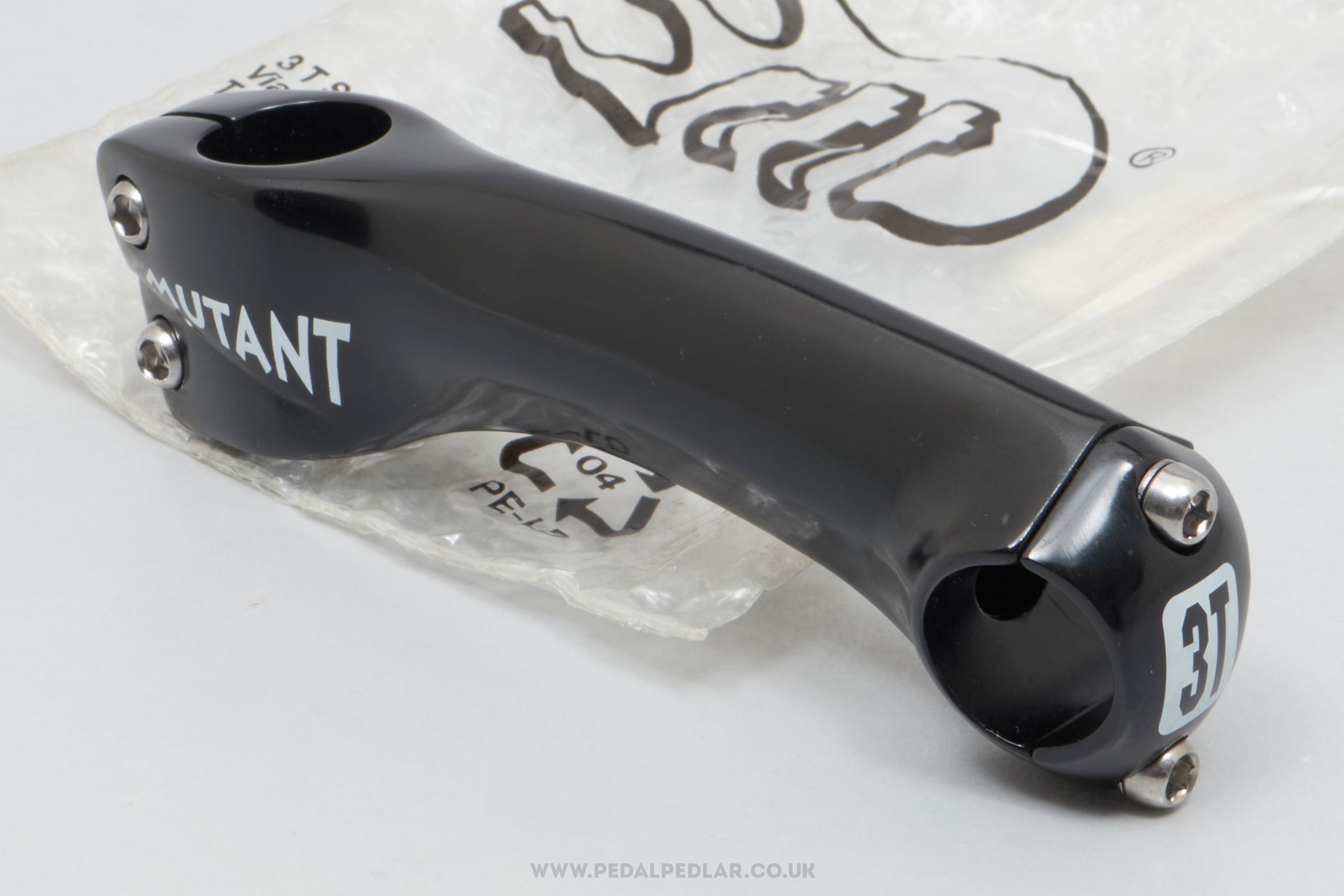


3TTT Mutant Black NOS/NIB Classic 130 mm 1" A-Head Stem
£30.00 £40.00
✓ Original part - produced in the 1990s
✓ New old stock & still in the original packaging!
✓ Worldwide shipping
3TTT Mutant ahead handlebar stem, hailing from Italy and in production during the 1990s (yet still new & unused after all this time!). Made from aluminium and weighing in at 264 grams. A fine choice for keeping your classic bike authentic, but also great for any other compatible bike.
OVERVIEW
Production Era - 1990s
Country - Italian
Material - Aluminium
Weight - 264 g
Stock Code - D-STA31C
*New old stock items may have marks from storage over the years, and as we often have multiples they can vary from piece to piece, but they are always genuine new & unused items.
TECHNICAL INFO
Extension Length (ctc)* - 130 mm
Steerer Size (OD) - 1" (25.4 mm)
Bar Clamp Size - 25.8 mm
Stack Height - 40 mm
Angle - 80 Degrees
*See help section.
-
▼SHIPPING, TAXES & RETURNS
-
We've been safely sending orders around the world since 2010. Orders are carefully packed, sent with tracking & insurance, and normally collected around midday on Tuesdays and Fridays. Larger items may occasionally require an extra day or two to prepare.
We accept returns, please notify us within 14 days and ensure the item arrives back with us no later than 30 days after the order was received.
EU orders under €150 (excluding shipping) - import VAT and the new €3 customs duty are paid as part of your order, so there's nothing further to pay on delivery.
EU orders over €150 (excluding shipping) - import fees are payable to the carrier before delivery, with nothing collected at checkout.
USA orders - import fees are collected at checkout for all orders to the USA, so there won’t be any surprise charges when your order arrives.
Other international orders - local import fees may apply and are not collected by us. Please check your country's import rules before purchasing.
-
▼HELP SECTION
-
Extension Length (ctc)* - measured from the centre of the handlebar clamp to the centre of the steerer clamp, to the nearest 5 mm. This measurement is taken through the middle of the extension, not along the top or bottom.
Steerer Size (OD) - OD means outside diameter, this is the most important measurement when checking the stem fits your bike. This should match the measurement of the outside of your fork's steerer column, where the stem will be clamped.
Bar Clamp Size - this should match the outside diameter of your handlebars and should be as close as possible to ensure a good and safe fit.
Stack Height - the height of the part that clamps to the forks. This is the minimum amount of space you will need on the fork's steerer column for the stem to fit (minus a few mm as the top of the steerer tube needs to sit just below the top of the stem).
Angle - the angle of the stem's extension in relation to the the fork steerer. Bear in mind the steerer sits at the same angle as the head tube, so a 90 degree stem would not be parallel to the ground. Some manufacturers refer to this as rise or drop, in which case an 80 degree stem would drop 10 degrees from a right angle. Most a-head stems can be flipped although it does depend on the design.
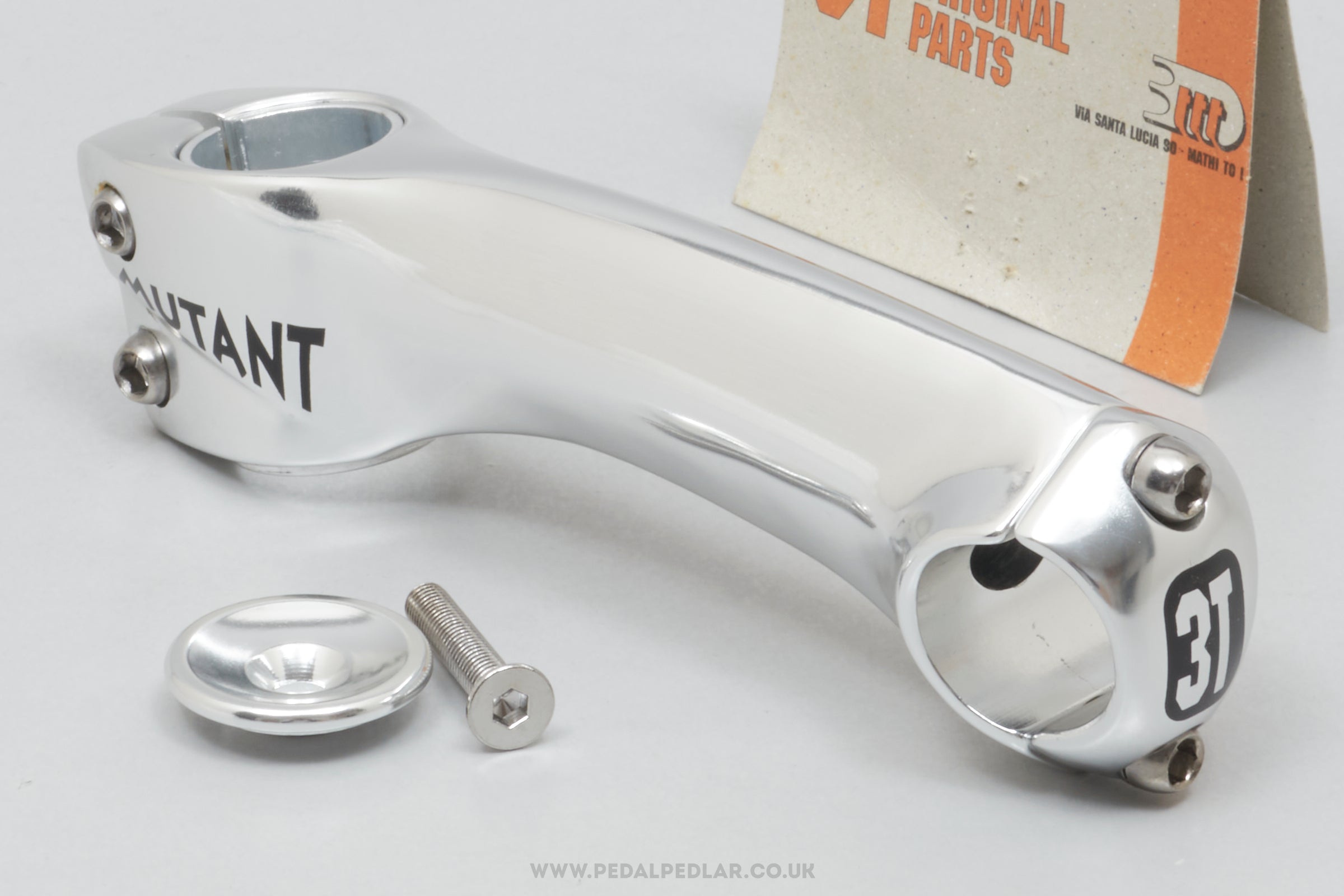


3TTT Mutant Silver NOS/NIB Classic 130 mm 1" or 1 1/8" A-Head Stem
£37.50 £50.00
✓ Original part - produced in the 1990s
✓ New old stock & still in the original packaging!
✓ Worldwide shipping
3TTT Mutant ahead handlebar stem, hailing from Italy and in production during the 1990s (yet still new & unused after all this time!). Made from aluminium and weighing in at 272 grams. A fine choice for keeping your classic bike authentic, but also great for any other compatible bike.
OVERVIEW
Production Era - 1990s
Country - Italian
Material - Aluminium
Weight - 272 g
Stock Code - D-STA32C
NB - Includes shim reducer to fit 1" steerer
*New old stock items may have marks from storage over the years, and as we often have multiples they can vary from piece to piece, but they are always genuine new & unused items.
TECHNICAL INFO
Extension Length (ctc)* - 130 mm
Steerer Size (OD) - 1" or 1 1/8" (25.4mm / 28.6 mm)
Bar Clamp Size - 25.8 mm
Stack Height - 40 mm
Angle - 80 Degrees
*See help section.
-
▼SHIPPING, TAXES & RETURNS
-
We've been safely sending orders around the world since 2010. Orders are carefully packed, sent with tracking & insurance, and normally collected around midday on Tuesdays and Fridays. Larger items may occasionally require an extra day or two to prepare.
We accept returns, please notify us within 14 days and ensure the item arrives back with us no later than 30 days after the order was received.
EU orders under €150 (excluding shipping) - import VAT and the new €3 customs duty are paid as part of your order, so there's nothing further to pay on delivery.
EU orders over €150 (excluding shipping) - import fees are payable to the carrier before delivery, with nothing collected at checkout.
USA orders - import fees are collected at checkout for all orders to the USA, so there won’t be any surprise charges when your order arrives.
Other international orders - local import fees may apply and are not collected by us. Please check your country's import rules before purchasing.
-
▼HELP SECTION
-
Extension Length (ctc)* - measured from the centre of the handlebar clamp to the centre of the steerer clamp, to the nearest 5 mm. This measurement is taken through the middle of the extension, not along the top or bottom.
Steerer Size (OD) - OD means outside diameter, this is the most important measurement when checking the stem fits your bike. This should match the measurement of the outside of your fork's steerer column, where the stem will be clamped.
Bar Clamp Size - this should match the outside diameter of your handlebars and should be as close as possible to ensure a good and safe fit.
Stack Height - the height of the part that clamps to the forks. This is the minimum amount of space you will need on the fork's steerer column for the stem to fit (minus a few mm as the top of the steerer tube needs to sit just below the top of the stem).
Angle - the angle of the stem's extension in relation to the the fork steerer. Bear in mind the steerer sits at the same angle as the head tube, so a 90 degree stem would not be parallel to the ground. Some manufacturers refer to this as rise or drop, in which case an 80 degree stem would drop 10 degrees from a right angle. Most a-head stems can be flipped although it does depend on the design.
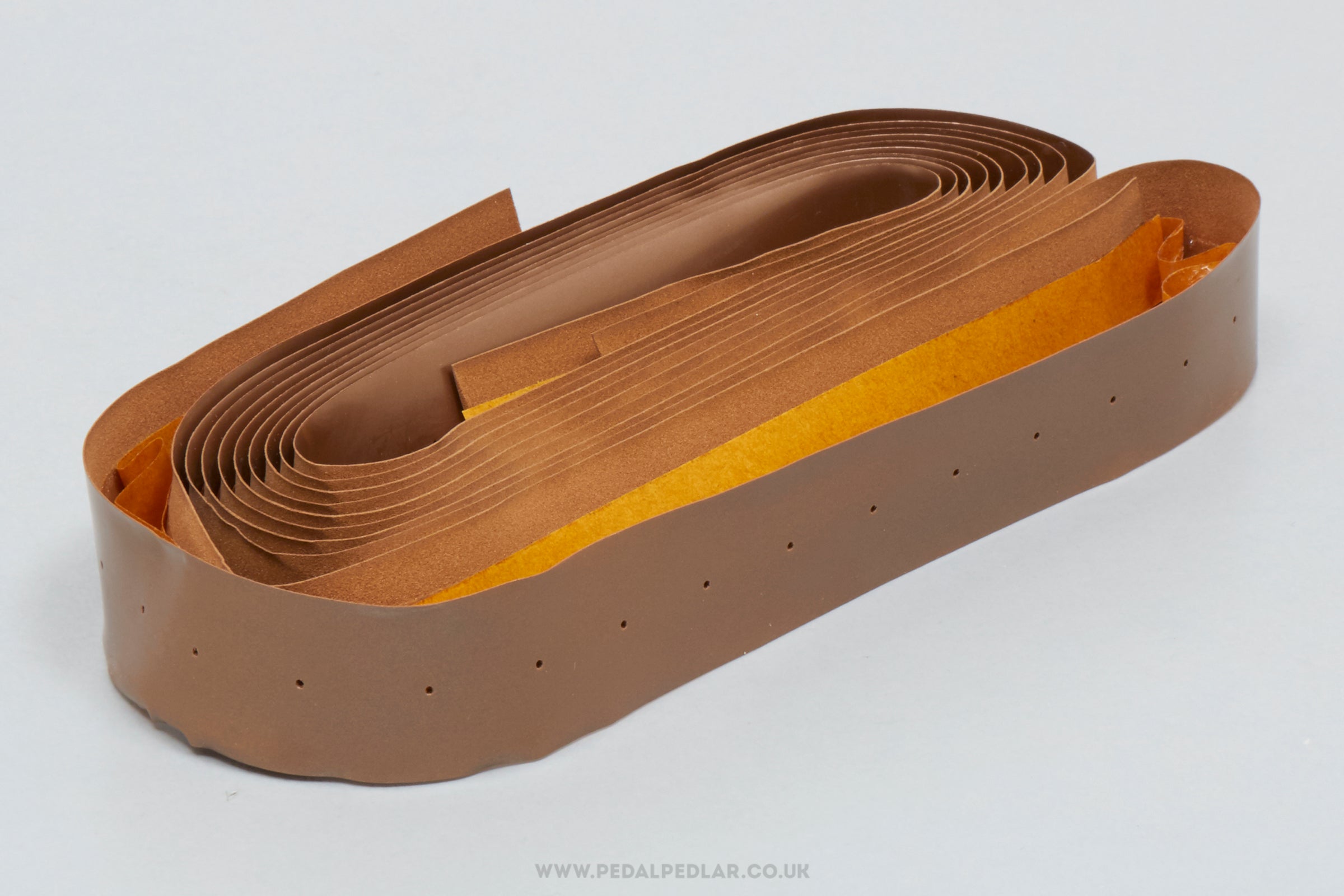


Ambrosio Bike Ribbon Supermetallizzato NOS/NIB Vintage Bronze Vinyl Handlebar Tape
£26.25 £35.00
✓ Original bar tape - produced in the 1980s
✓ New old stock & still in the original packaging!
✓ Suitable for historic cycling events such as L'Eroica
✓ Worldwide shipping
Ambrosio Bike Ribbon bar tape (or grip, or wrap if you prefer), hailing from Italy and in production during the 1980s (yet still new & unused after all this time!). Supplied as shown in the photos, enough tape to cover a set of drop bars. The perfect finishing touch for your vintage bike, but great for bikes of the non-vintage variety too!
If you're taking part in L'Eroica or a similar vintage event, this is of the correct era, so rest assured the pre-1987 police won't lock you up for having the wrong handlebar grip!
OVERVIEW
Production Era - 1980s
Country - Italian
Stock Code - D-BT5V
*New old stock items may have marks from storage over the years, and as we often have multiples they can vary from piece to piece, but they are always genuine new & unused items.
TECHNICAL INFO
Colour* - Bronze
Tape Style - Vinyl (PVC Perforated)
*The colour description is just a guide, please check the photos too as we make sure these are as close to the true colour as possible.
-
▼SHIPPING, TAXES & RETURNS
-
We've been safely sending orders around the world since 2010. Orders are carefully packed, sent with tracking & insurance, and normally collected around midday on Tuesdays and Fridays. Larger items may occasionally require an extra day or two to prepare.
We accept returns, please notify us within 14 days and ensure the item arrives back with us no later than 30 days after the order was received.
EU orders under €150 (excluding shipping) - import VAT and the new €3 customs duty are paid as part of your order, so there's nothing further to pay on delivery.
EU orders over €150 (excluding shipping) - import fees are payable to the carrier before delivery, with nothing collected at checkout.
USA orders - import fees are collected at checkout for all orders to the USA, so there won’t be any surprise charges when your order arrives.
Other international orders - local import fees may apply and are not collected by us. Please check your country's import rules before purchasing.
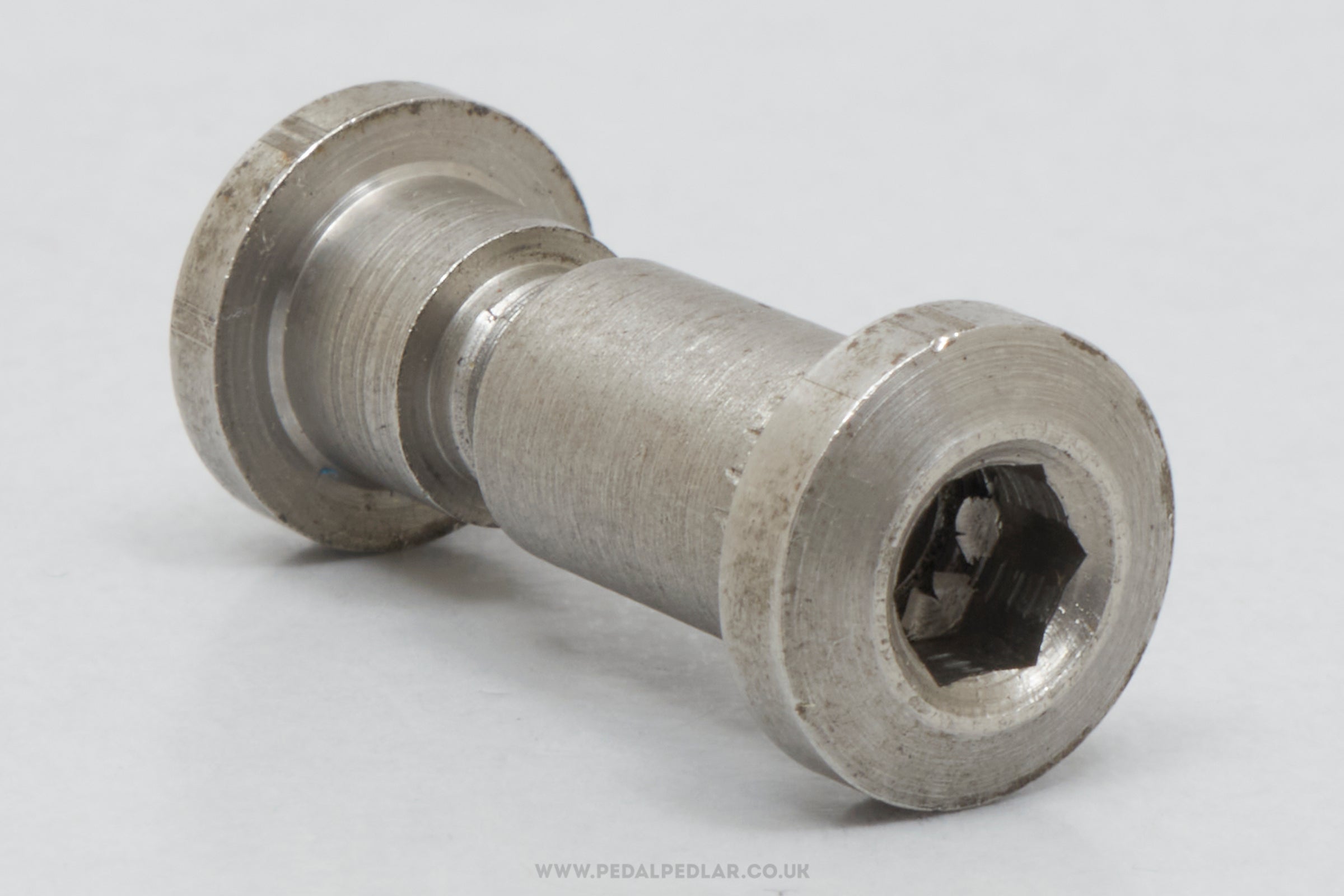


Silva Inox NOS Vintage 18-20 mm Seatpost Binder Bolt
£29.75 £35.00
✓ Original part - in production from the 1980s to the 1990s
✓ New old stock! Still unused after all these years
✓ Worldwide shipping
Silva seat post binder bolt (to clamp the frame around the seat pin), hailing from Italy and in production from the 1980s to the 1990s (yet still new & unused after all this time!). Made from stainless steel and weighing in at 10 grams. A fine choice for keeping your vintage bike authentic, but also great for any other compatible bike.
OVERVIEW
Production Era - 1980s & 1990s
Country - Italian
Material - Stainless Steel
Weight - 10 g
Stock Code - D-SBB26V
*New old stock items may have marks from storage over the years, and as we often have multiples they can vary from piece to piece, but they are always genuine new & unused items.
TECHNICAL INFO
Clamp Opening (Min-Max) - 18-20 mm
Outer Diameter - 8 mm
Bolt Fixing Type - Allen Key (Both Sides - No 'Key' Locator)
-
▼SHIPPING, TAXES & RETURNS
-
We've been safely sending orders around the world since 2010. Orders are carefully packed, sent with tracking & insurance, and normally collected around midday on Tuesdays and Fridays. Larger items may occasionally require an extra day or two to prepare.
We accept returns, please notify us within 14 days and ensure the item arrives back with us no later than 30 days after the order was received.
EU orders under €150 (excluding shipping) - import VAT and the new €3 customs duty are paid as part of your order, so there's nothing further to pay on delivery.
EU orders over €150 (excluding shipping) - import fees are payable to the carrier before delivery, with nothing collected at checkout.
USA orders - import fees are collected at checkout for all orders to the USA, so there won’t be any surprise charges when your order arrives.
Other international orders - local import fees may apply and are not collected by us. Please check your country's import rules before purchasing.
-
▼HELP SECTION
-
Clamp Opening - the minimum and maximum distance between the inside of the nut and bolt heads. The minimum is measured with the bolt tightened as much as possible (for hex head types this may mean the bolt end will stick quite far out of the nut). For the maximum opening we ensure 5-6 mm of thread remainis in the nut for a secure fixing.
Outer Diameter - the part that goes through the frame, most steel frames will take an 8 mm bolt whereas early lugged aluminium frames often have a larger hole that takes a 10 mm bolt diameter.
Bolt Fixing Type - some binder bolts have tightening mechanisms on both sides to secure the seatpost in the frame. Single sided bolts need something else to help; some have knurled parts that grip the inside of the bolt hole, others have a small notched 'key' locator that lines up with a cut-out in the frame (if you have one).


Specialites T.A. 31 NOS Vintage Crank Arm Dust Caps Set
£34.00 £40.00
✓ Original parts - in production from the 1970s to the 1980s
✓ New old stock! Still unused after all these years
✓ Suitable for historic cycling events such as L'Eroica
✓ Worldwide shipping
Specialites T.A. 31 crankset dust caps (or bolt covers if you prefer), hailing from France and in production from the 1970s to the 1980s (yet still new & unused after all this time!). Made from steel and weighing in at 17 grams (for the pair). A fine choice for keeping your vintage bike authentic, but also great for any other compatible bike.
If you're taking part in L'Eroica or a similar vintage event, these are fully compliant - so rest assured, the pre-1987 police won't lock you up for having the wrong dust covers!
OVERVIEW
Model ID - 31
Production Era - 1970s & 1980s
Country - French
Material - Steel
Weight - 17 g
Stock Code - D-CDC57V
*New old stock items may have marks from storage over the years, and as we often have multiples they can vary from piece to piece, but they are always genuine new & unused items.
TECHNICAL INFO
Crank Thread - 23 mm (T.A. Specialites)
-
▼SHIPPING, TAXES & RETURNS
-
We've been safely sending orders around the world since 2010. Orders are carefully packed, sent with tracking & insurance, and normally collected around midday on Tuesdays and Fridays. Larger items may occasionally require an extra day or two to prepare.
We accept returns, please notify us within 14 days and ensure the item arrives back with us no later than 30 days after the order was received.
EU orders under €150 (excluding shipping) - import VAT and the new €3 customs duty are paid as part of your order, so there's nothing further to pay on delivery.
EU orders over €150 (excluding shipping) - import fees are payable to the carrier before delivery, with nothing collected at checkout.
USA orders - import fees are collected at checkout for all orders to the USA, so there won’t be any surprise charges when your order arrives.
Other international orders - local import fees may apply and are not collected by us. Please check your country's import rules before purchasing.
-
▼HELP SECTION
-
Crank Thread - 22 mm is the standard thread for almost all cotterless crank arms, the only exceptions are some Stronglight cranks made up until the early 1980s, and Specialites T.A. Campagnolo produced some self-extracting crank bolts with covers that had a reverse thread.
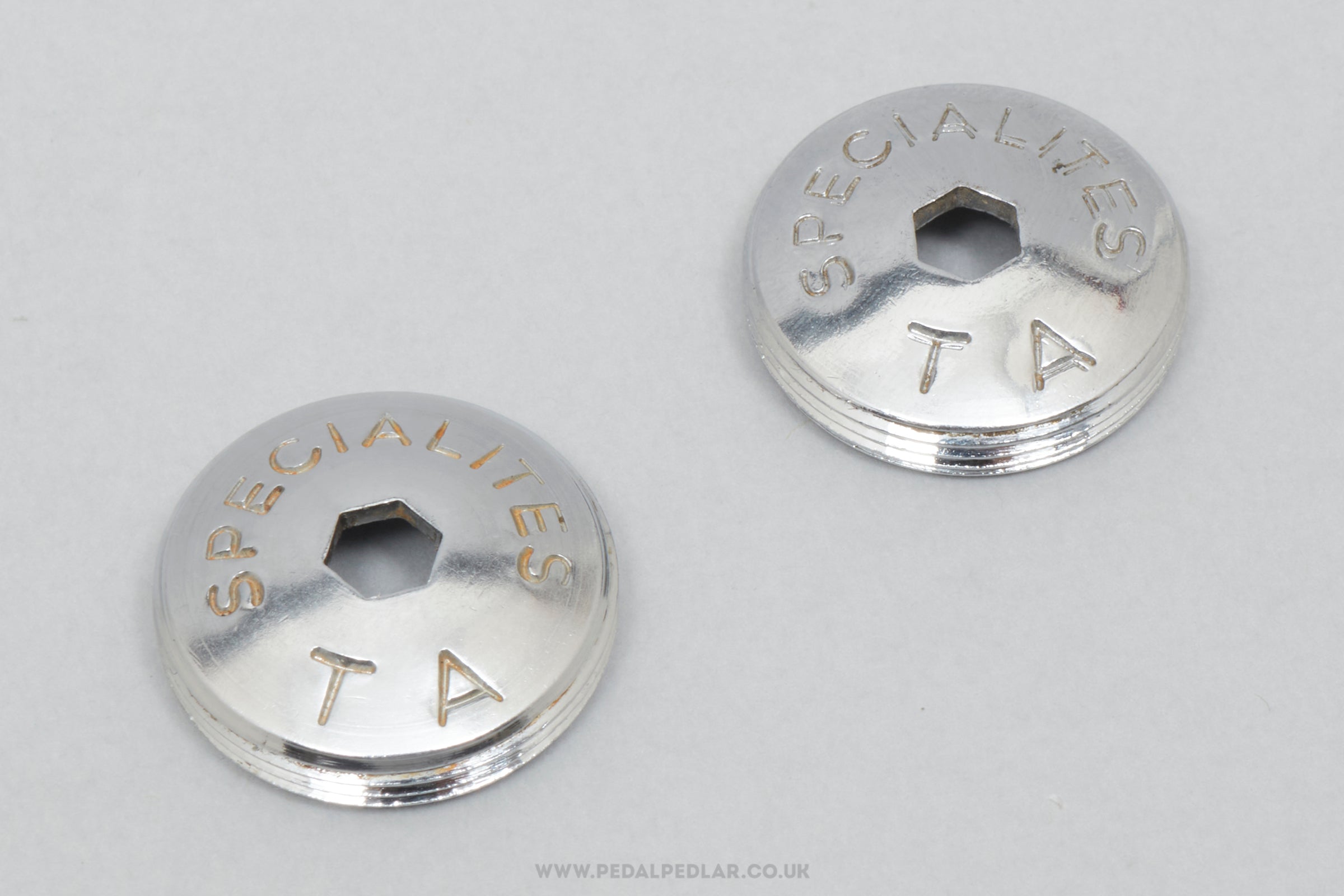


Specialites T.A. 31 NOS Vintage Crank Arm Dust Caps Set
£36.00 £40.00
✓ Original parts - in production from the 1970s to the 1980s
✓ New old stock! Still unused after all these years
✓ Suitable for historic cycling events such as L'Eroica
✓ Worldwide shipping
Specialites T.A. 31 crankset dust caps (or bolt covers if you prefer), hailing from France and in production from the 1970s to the 1980s (yet still new & unused after all this time!). Made from steel and weighing in at 14 grams (for the pair). A fine choice for keeping your vintage bike authentic, but also great for any other compatible bike.
If you're taking part in L'Eroica or a similar vintage event, these are fully compliant - so rest assured, the pre-1987 police won't lock you up for having the wrong dust covers!
OVERVIEW
Model ID - 31
Production Era - 1970s & 1980s
Country - French
Material - Steel
Weight - 14 g
Stock Code - D-CDC58V
*New old stock items may have marks from storage over the years, and as we often have multiples they can vary from piece to piece, but they are always genuine new & unused items.
TECHNICAL INFO
Crank Thread - 23 mm (T.A. Specialites)
-
▼SHIPPING, TAXES & RETURNS
-
We've been safely sending orders around the world since 2010. Orders are carefully packed, sent with tracking & insurance, and normally collected around midday on Tuesdays and Fridays. Larger items may occasionally require an extra day or two to prepare.
We accept returns, please notify us within 14 days and ensure the item arrives back with us no later than 30 days after the order was received.
EU orders under €150 (excluding shipping) - import VAT and the new €3 customs duty are paid as part of your order, so there's nothing further to pay on delivery.
EU orders over €150 (excluding shipping) - import fees are payable to the carrier before delivery, with nothing collected at checkout.
USA orders - import fees are collected at checkout for all orders to the USA, so there won’t be any surprise charges when your order arrives.
Other international orders - local import fees may apply and are not collected by us. Please check your country's import rules before purchasing.
-
▼HELP SECTION
-
Crank Thread - 22 mm is the standard thread for almost all cotterless crank arms, the only exceptions are some Stronglight cranks made up until the early 1980s, and Specialites T.A. Campagnolo produced some self-extracting crank bolts with covers that had a reverse thread.
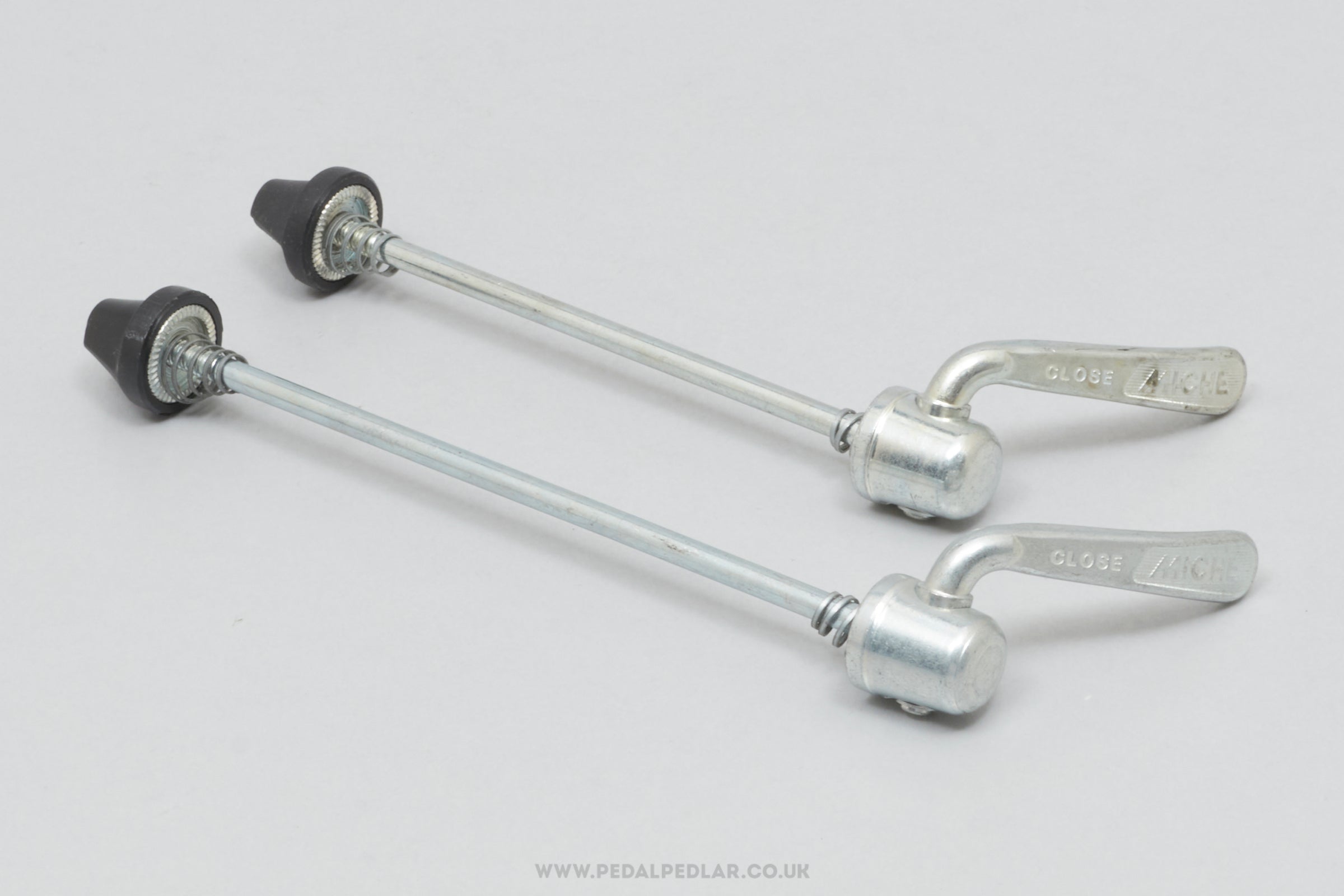


Miche NOS Vintage Quick Release Skewers
£34.00 £40.00
✓ Original skewers - produced in the 1980s
✓ New old stock! Still unused after all these years
✓ Suitable for historic cycling events such as L'Eroica
✓ Worldwide shipping
Miche a pair of wheel skewers (or hub spindles if you prefer), hailing from Italy and in production during the 1980s (yet still new & unused after all this time!). Made from steel/plastic and weighing in at 155 grams. A fine choice for keeping your vintage bike authentic, but also great for any other compatible bike.
If you're taking part in L'Eroica or any other vintage event, these are fully compliant - so rest assured, the pre-1987 police won't lock you up for having the wrong skewers!
OVERVIEW
Production Era - 1980s
Country - Italian
Material - Steel / Plastic
Weight - 155 g
Stock Code - D-SKW36V
*New old stock items may have marks from storage over the years, and as we often have multiples they can vary from piece to piece, but they are always genuine new & unused items.
TECHNICAL INFO
Skewer Type - Quick Release
Spacing* (F / R) ie: 110 mm / 130 mm - 110 / 144 mm
Threaded Section - 25 mm
End Nut Length - 18 mm
*See help section.
-
▼SHIPPING, TAXES & RETURNS
-
We've been safely sending orders around the world since 2010. Orders are carefully packed, sent with tracking & insurance, and normally collected around midday on Tuesdays and Fridays. Larger items may occasionally require an extra day or two to prepare.
We accept returns, please notify us within 14 days and ensure the item arrives back with us no later than 30 days after the order was received.
EU orders under €150 (excluding shipping) - import VAT and the new €3 customs duty are paid as part of your order, so there's nothing further to pay on delivery.
EU orders over €150 (excluding shipping) - import fees are payable to the carrier before delivery, with nothing collected at checkout.
USA orders - import fees are collected at checkout for all orders to the USA, so there won’t be any surprise charges when your order arrives.
Other international orders - local import fees may apply and are not collected by us. Please check your country's import rules before purchasing.
-
▼HELP SECTION
-
Skewer type - quick release skewers allow you to remove the wheel without any tools, whereas allen key and security skewers require a tool to allow the wheel to be removed.
*Spacing - this should be within a few milimetres of your frame & fork's outer dropout spacing (measured from the outside where the skewers clamp down). The measurement provided was taken with the exiting hole of the end nut flush with the end of the skewer. There will be some wiggle room to allow a narrower or wider dropout spacing to fit, we've provided the threaded section and end nut measurements to give you an indication of how much.
Threaded section - the amount of thread on the skewers for the end nut to be threaded onto.
End nut length - the total length of the nut from end to end.
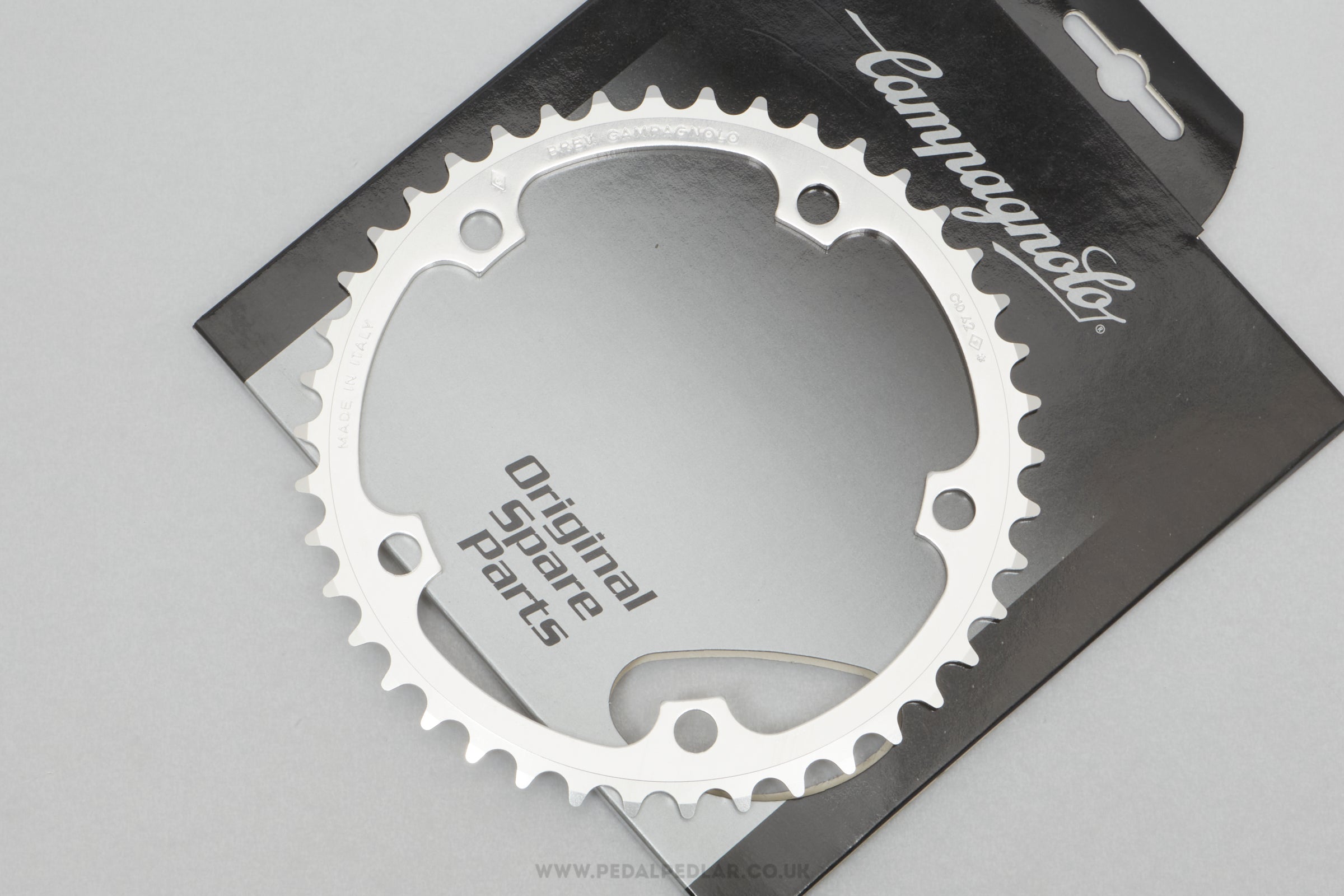


Campagnolo Record (FC-RE142) 10 Speed NOS/NIB Classic 42T 135 BCD Inner Chainring
£42.50 £50.00
✓ Original part - produced in the 2000s
✓ New old stock & still in the original packaging!
✓ Worldwide shipping
Campagnolo Record chainring (or chainwheel if you prefer), hailing from Italy and in production during the 2000s. Made from aluminium and weighing in at 51 grams. A fine choice for keeping your classic bike authentic, but also great for any other compatible bike.
OVERVIEW
Model ID - FC-RE142
Production Era - 2000s
Country - Italian
Material - Aluminium
Weight - 51 g
Stock Code - D-CRI45C
*New old stock items may have marks from storage over the years, and as we often have multiples they can vary from piece to piece, but they are always genuine new & unused items.
TECHNICAL INFO
Tooth Count - 42
Between Adjacent Bolt Holes - 79.4 mm
BCD - 135 BCD
Bolt Count - 5-Bolt
Chain Width - 11/128"
Intended Speed* - 10 Speed
-
▼SHIPPING, TAXES & RETURNS
-
We've been safely sending orders around the world since 2010. Orders are carefully packed, sent with tracking & insurance, and normally collected around midday on Tuesdays and Fridays. Larger items may occasionally require an extra day or two to prepare.
We accept returns, please notify us within 14 days and ensure the item arrives back with us no later than 30 days after the order was received.
EU orders under €150 (excluding shipping) - import VAT and the new €3 customs duty are paid as part of your order, so there's nothing further to pay on delivery.
EU orders over €150 (excluding shipping) - import fees are payable to the carrier before delivery, with nothing collected at checkout.
USA orders - import fees are collected at checkout for all orders to the USA, so there won’t be any surprise charges when your order arrives.
Other international orders - local import fees may apply and are not collected by us. Please check your country's import rules before purchasing.
-
▼HELP SECTION
-
Tooth Count - the number of teeth on the chainring, the higher the number the harder the gear.
Between Adjacent Bolt Holes - the measurement from the centre of any bolt hole to the centre of an adjacent one, if this measurement is the same as that of your crankset and the bolt count is the same then the chainring should fit.
BCD - stands for Bolt Circle Diameter (sometimes referred to as PCD - Pitch Circle Diameter) and is the technical way to determine whether the chainring fits your crankset. To calculate, multiply the distance between adjacent holes (in mm) by 1.709 (you’ll likely need to round the resulting number up or down a little).
Bolt Count - the number of bolts securing the chainring to the chainset. As with the BCD, this must be the same as your chainset.
Chain Width - 3/32” is the standard inner chain width for 5 to 8 speed, above that requires a slightly narrower 11/128” chain. 1/8” chainrings are only found on single ring chainsets, generally for track / singlespeed use and can only be used with a wide 1/8" chain.
Intended Speed - the number of cogs at the back the chainring was designed to be used with. We refer to it as ‘intended’ speed as most double and triple chainsets will actually work with different speeds than originally intended, but the further away you get from the intended speed the more likely you are to experience minor setup issues. The exception being some chainrings intended for 10 speed use or higher, with these it’s better to stick to the intended speed.
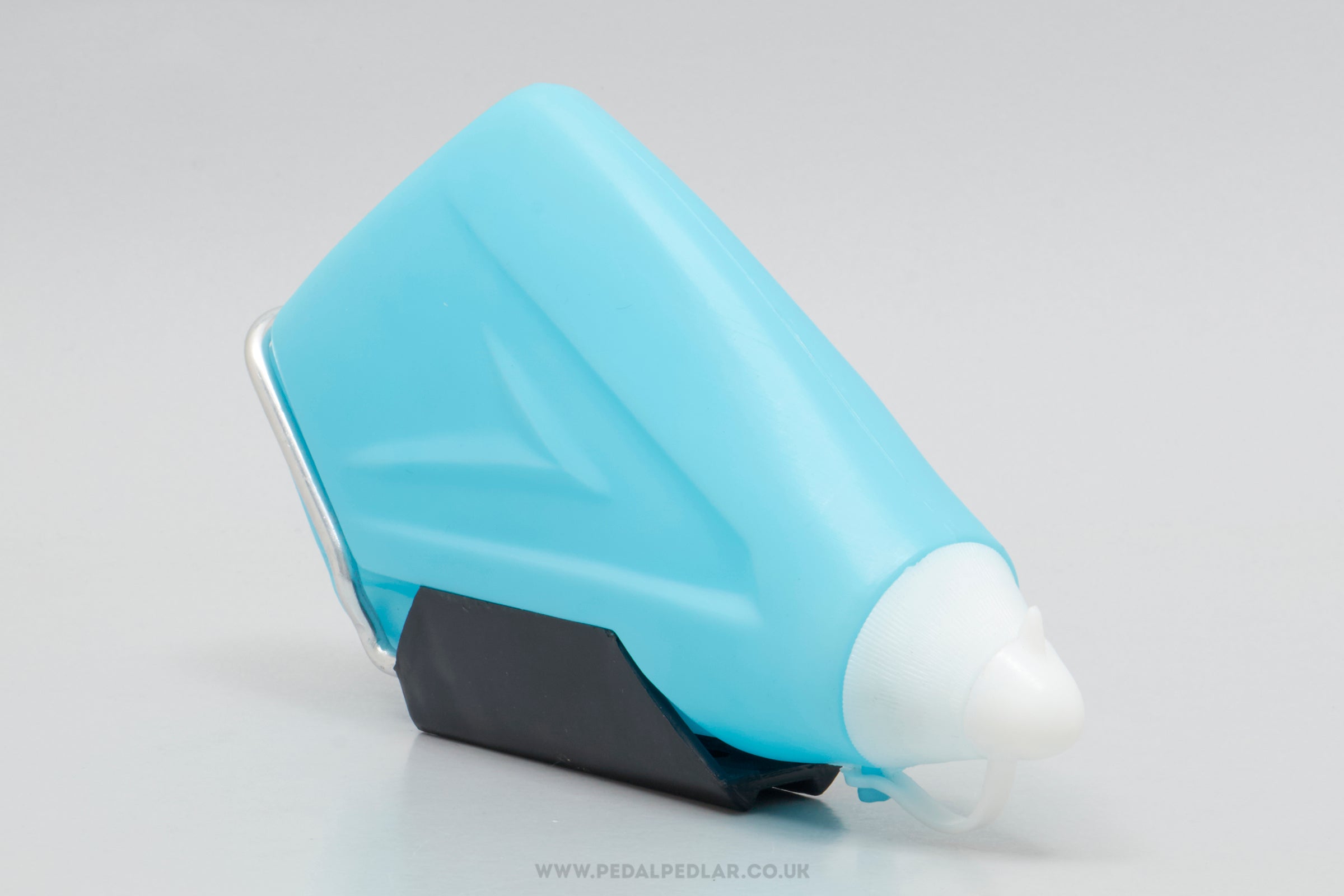


Vintage Blue Shimano AX Style Aero NOS 400 ml Bottle & Cage
£30.00 £40.00
✓ Original bottle & cage - in production from the 1970s to the 1980s
✓ New old stock! Still unused after all these years
✓ Suitable for historic cycling events such as L'Eroica
✓ Worldwide shipping
Unbranded vintage drinks bottle & cage set, most likely in production from the 1970s to the 1980s (yet still new & unused after all this time!). The perfect finishing touch for your vintage bike, but great for bikes of the non-vintage variety too!
If you're taking part in L'Eroica or a similar vintage event, this is of the correct era, so rest assured the pre-1987 police won't lock you up for having the wrong bottle & cage!
OVERVIEW
Production Era - 1970s & 1980s
Material - Plastic / Steel
Weight - 124 g
Stock Code - D-BC4V
NB - These are not the famous Shimano ones, but similar in design to the Dura-Ace / 600 AX (SM-BT10) ones.
*New old stock items may have marks from storage over the years, and as we often have multiples they can vary from piece to piece, but they are always genuine new & unused items.
TECHNICAL INFO
Cage Fixing - Frame Fit (Braze-On/Clamp-On)
Capacity - 400 ml
-
▼SHIPPING, TAXES & RETURNS
-
We've been safely sending orders around the world since 2010. Orders are carefully packed, sent with tracking & insurance, and normally collected around midday on Tuesdays and Fridays. Larger items may occasionally require an extra day or two to prepare.
We accept returns, please notify us within 14 days and ensure the item arrives back with us no later than 30 days after the order was received.
EU orders under €150 (excluding shipping) - import VAT and the new €3 customs duty are paid as part of your order, so there's nothing further to pay on delivery.
EU orders over €150 (excluding shipping) - import fees are payable to the carrier before delivery, with nothing collected at checkout.
USA orders - import fees are collected at checkout for all orders to the USA, so there won’t be any surprise charges when your order arrives.
Other international orders - local import fees may apply and are not collected by us. Please check your country's import rules before purchasing.
-
▼HELP SECTION
-
Cage Fixing - most bottle cages will be designed to fix to the frame, although some rare older ones mount to the handlebars and/or stem. If your frame doesn't have any bottle cage braze-ons to fix to you'll need a clamp-on bottle cage.
Capacity - 500ml used to be the standard sized bottle, but the taller modern versions tend to be 750ml.


Campagnolo Nuovo Record (2030) 1st Gen Short Reach Vintage Brake Lever
£46.75 £55.00
✓ Original lever - in production from the 1960s to the 1970s
✓ Suitable for historic cycling events such as L'Eroica
✓ Thoroughly checked & cleaned
✓ Worldwide shipping
Campagnolo Nuovo Record drop bar brake lever (or handle if you prefer), hailing from Italy and in production from the 1960s to the 1970s. Made from aluminium/rubber and weighing in at 112 grams. A fine choice for keeping your vintage bike authentic, but also great for any other compatible bike.
If you're taking part in L'Eroica or any other vintage event, this is fully compliant - so rest assured, the pre-1987 police won't lock you up for having the wrong brake lever!
The brake lever has been cleaned, checked by one of our mechanics and graded as OK condition, but do take a good look at the detailed photos so you can see the cosmetic condition before you buy.OVERVIEW
Model ID - 2030
Production Era - 1960s & 1970s
Country - Italian
Material - Aluminium / Rubber
Weight - 112 g
Stock Code - U-LEV-DS18V
NB - Replacement AME hoods
TECHNICAL INFO
Intended Side - Left or Right
Cable Routing - Non-Aero
Bar Clamp Size - 23.8 mm
-
▼SHIPPING, TAXES & RETURNS
-
We've been safely sending orders around the world since 2010. Orders are carefully packed, sent with tracking & insurance, and normally collected around midday on Tuesdays and Fridays. Larger items may occasionally require an extra day or two to prepare.
We accept returns, please notify us within 14 days and ensure the item arrives back with us no later than 30 days after the order was received.
EU orders under €150 (excluding shipping) - import VAT and the new €3 customs duty are paid as part of your order, so there's nothing further to pay on delivery.
EU orders over €150 (excluding shipping) - import fees are payable to the carrier before delivery, with nothing collected at checkout.
USA orders - import fees are collected at checkout for all orders to the USA, so there won’t be any surprise charges when your order arrives.
Other international orders - local import fees may apply and are not collected by us. Please check your country's import rules before purchasing.
-
▼HELP SECTION
-
Intended Side - some brake levers have a designated side to go on, although most can be used on either the left or right.
Cable Routing - non-aero means the cables come out at the top of the brake lever, meaning the cables are on show. With aero levers the cable comes out of a small hole by the handlebar, allowing the cables to be hidden under the handlebar tape.
Bar Clamp Size - this should be close to the outside diameter of your handlebars at the point the brake levers will be fitted. This will rarely present a problem with drop bars as 23.8 mm is standard, and a 24.2 mm clamp will fit just fine as they do have a little adjustment in them. There are some older sizes to watch out for but these will be noticeably different.
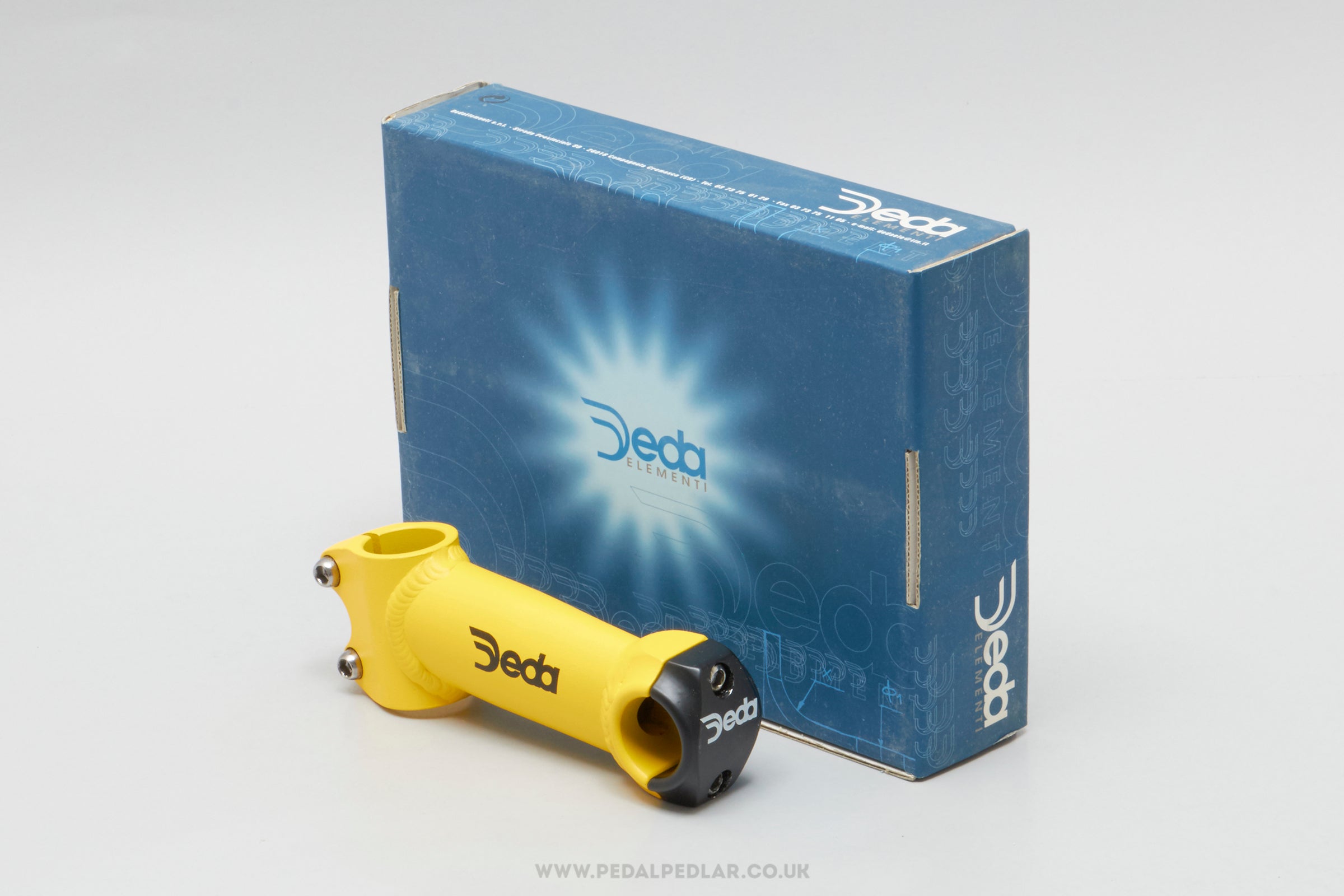


Deda Elementi Lynx Yellow NOS/NIB Classic 110 mm 1" A-Head Stem
£45.00 £60.00
✓ Original part - produced in the 1990s
✓ New old stock & still in the original packaging!
✓ Worldwide shipping
Deda Elementi Lynx ahead handlebar stem, hailing from Italy and in production during the 1990s (yet still new & unused after all this time!). Made from aluminium and weighing in at 201 grams. A fine choice for keeping your classic bike authentic, but also great for any other compatible bike.
OVERVIEW
Production Era - 1990s
Country - Italian
Material - Aluminium
Weight - 201 g
Stock Code - D-STA39C
*New old stock items may have marks from storage over the years, and as we often have multiples they can vary from piece to piece, but they are always genuine new & unused items.
TECHNICAL INFO
Extension Length (ctc)* - 110 mm
Steerer Size (OD) - 1" (25.4 mm)
Bar Clamp Size - 26.0 mm
Stack Height - 50 mm
Angle - 78 Degrees
*See help section.
-
▼SHIPPING, TAXES & RETURNS
-
We've been safely sending orders around the world since 2010. Orders are carefully packed, sent with tracking & insurance, and normally collected around midday on Tuesdays and Fridays. Larger items may occasionally require an extra day or two to prepare.
We accept returns, please notify us within 14 days and ensure the item arrives back with us no later than 30 days after the order was received.
EU orders under €150 (excluding shipping) - import VAT and the new €3 customs duty are paid as part of your order, so there's nothing further to pay on delivery.
EU orders over €150 (excluding shipping) - import fees are payable to the carrier before delivery, with nothing collected at checkout.
USA orders - import fees are collected at checkout for all orders to the USA, so there won’t be any surprise charges when your order arrives.
Other international orders - local import fees may apply and are not collected by us. Please check your country's import rules before purchasing.
-
▼HELP SECTION
-
Extension Length (ctc)* - measured from the centre of the handlebar clamp to the centre of the steerer clamp, to the nearest 5 mm. This measurement is taken through the middle of the extension, not along the top or bottom.
Steerer Size (OD) - OD means outside diameter, this is the most important measurement when checking the stem fits your bike. This should match the measurement of the outside of your fork's steerer column, where the stem will be clamped.
Bar Clamp Size - this should match the outside diameter of your handlebars and should be as close as possible to ensure a good and safe fit.
Stack Height - the height of the part that clamps to the forks. This is the minimum amount of space you will need on the fork's steerer column for the stem to fit (minus a few mm as the top of the steerer tube needs to sit just below the top of the stem).
Angle - the angle of the stem's extension in relation to the the fork steerer. Bear in mind the steerer sits at the same angle as the head tube, so a 90 degree stem would not be parallel to the ground. Some manufacturers refer to this as rise or drop, in which case an 80 degree stem would drop 10 degrees from a right angle. Most a-head stems can be flipped although it does depend on the design.
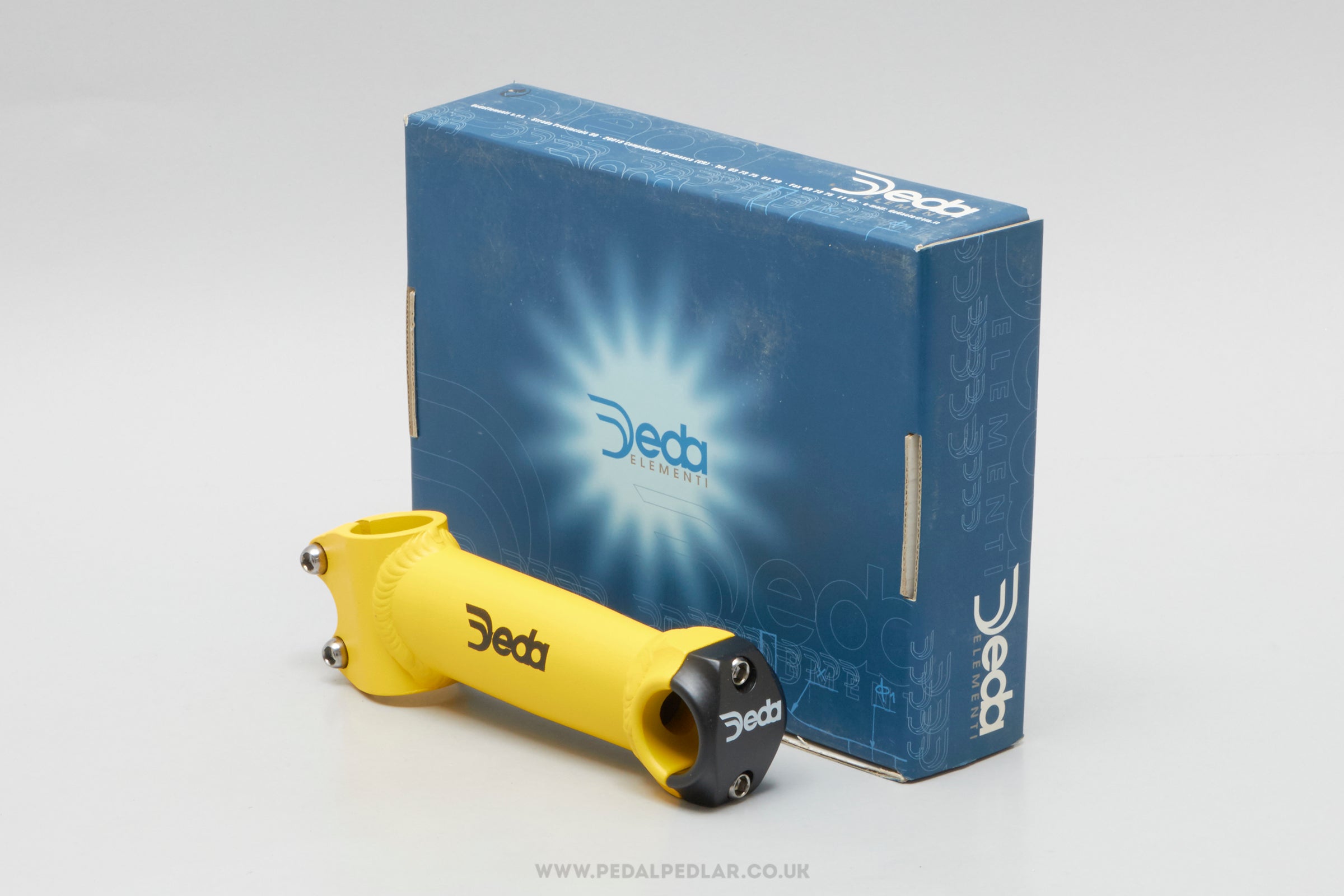


Deda Elementi Lynx Yellow NOS/NIB Classic 130 mm 1" A-Head Stem
£45.00 £60.00
✓ Original part - produced in the 1990s
✓ New old stock & still in the original packaging!
✓ Worldwide shipping
Deda Elementi Lynx ahead handlebar stem, hailing from Italy and in production during the 1990s (yet still new & unused after all this time!). Made from aluminium and weighing in at 215 grams. A fine choice for keeping your classic bike authentic, but also great for any other compatible bike.
OVERVIEW
Production Era - 1990s
Country - Italian
Material - Aluminium
Weight - 215 g
Stock Code - D-STA40C
*New old stock items may have marks from storage over the years, and as we often have multiples they can vary from piece to piece, but they are always genuine new & unused items.
TECHNICAL INFO
Extension Length (ctc)* - 130 mm
Steerer Size (OD) - 1" (25.4 mm)
Bar Clamp Size - 26.0 mm
Stack Height - 50 mm
Angle - 78 Degrees
*See help section.
-
▼SHIPPING, TAXES & RETURNS
-
We've been safely sending orders around the world since 2010. Orders are carefully packed, sent with tracking & insurance, and normally collected around midday on Tuesdays and Fridays. Larger items may occasionally require an extra day or two to prepare.
We accept returns, please notify us within 14 days and ensure the item arrives back with us no later than 30 days after the order was received.
EU orders under €150 (excluding shipping) - import VAT and the new €3 customs duty are paid as part of your order, so there's nothing further to pay on delivery.
EU orders over €150 (excluding shipping) - import fees are payable to the carrier before delivery, with nothing collected at checkout.
USA orders - import fees are collected at checkout for all orders to the USA, so there won’t be any surprise charges when your order arrives.
Other international orders - local import fees may apply and are not collected by us. Please check your country's import rules before purchasing.
-
▼HELP SECTION
-
Extension Length (ctc)* - measured from the centre of the handlebar clamp to the centre of the steerer clamp, to the nearest 5 mm. This measurement is taken through the middle of the extension, not along the top or bottom.
Steerer Size (OD) - OD means outside diameter, this is the most important measurement when checking the stem fits your bike. This should match the measurement of the outside of your fork's steerer column, where the stem will be clamped.
Bar Clamp Size - this should match the outside diameter of your handlebars and should be as close as possible to ensure a good and safe fit.
Stack Height - the height of the part that clamps to the forks. This is the minimum amount of space you will need on the fork's steerer column for the stem to fit (minus a few mm as the top of the steerer tube needs to sit just below the top of the stem).
Angle - the angle of the stem's extension in relation to the the fork steerer. Bear in mind the steerer sits at the same angle as the head tube, so a 90 degree stem would not be parallel to the ground. Some manufacturers refer to this as rise or drop, in which case an 80 degree stem would drop 10 degrees from a right angle. Most a-head stems can be flipped although it does depend on the design.


Suntour New Winner (NW-6500) c.1984 Vintage 6 Speed 13-18 Freewheel
£29.75 £50.00
✓ Original part - in production from the 1970s to the 1980s
✓ Suitable for historic cycling events such as L'Eroica
✓ Professionally checked & carefully cleaned
✓ Worldwide shipping
Suntour New Winner freewheel, hailing from Japan and dating back to 1984. Made from steel and weighing in at 328 grams. A fine choice for keeping your vintage bike authentic, but also great for any other compatible bike.
If you're taking part in L'Eroica or a similar vintage event, this is fully compliant - so rest assured, the pre-1987 police won't lock you up for having the wrong freewheel!
The freewheel's been carefully cleaned, thoroughly checked by one of our mechanics and graded as good condition, but do take a good look at the detailed photos so you can see the cosmetic condition before you buy, and please consider that freewheels wear with chains, so used freewheels can occasionally skip when partnered with new (and some used) chains. This can usually be avoided by using a compatible used chain of similar age, but there is no way for us to confirm which chain will work with which freewheel.OVERVIEW
Model ID - NW-6500
Production Era - 1970s & 1980s
Country - Japanese
Material - Steel
Weight - 328 g
Stock Code - U-FW169V
TECHNICAL INFO
Speed - 6 Speed
Range - 13-18
Threading - English/ISO: 1.375 x 24 TPI
Stack Height - 30 mm
Cog Width - 3/32" (Standard)
-
▼SHIPPING, TAXES & RETURNS
-
We've been safely sending orders around the world since 2010. Orders are carefully packed, sent with tracking & insurance, and normally collected around midday on Tuesdays and Fridays. Larger items may occasionally require an extra day or two to prepare.
We accept returns, please notify us within 14 days and ensure the item arrives back with us no later than 30 days after the order was received.
EU orders under €150 (excluding shipping) - import VAT and the new €3 customs duty are paid as part of your order, so there's nothing further to pay on delivery.
EU orders over €150 (excluding shipping) - import fees are payable to the carrier before delivery, with nothing collected at checkout.
USA orders - import fees are collected at checkout for all orders to the USA, so there won’t be any surprise charges when your order arrives.
Other international orders - local import fees may apply and are not collected by us. Please check your country's import rules before purchasing.
-
▼HELP SECTION
-
Speed - the number of cogs on the freewheel.
Range - the number of teeth on the smalles and largest cogs, this gives you an indication of how hard or easy the gearing will be, the lower the number the harder the gears. The tooth count of the cogs inbetween are usually evenly spaced, ie: a 6 speed 14-24 freewheel would likely have cog sizes 14, 16, 18, 20, 22 & 24.
Threading - this needs to match the thread of your rear hub. ISO is the modern standard and is almost exactly the same as older English/British and Italian thread, allowing you to mix and match between these thread types as long as it's not going to be under extreme force, in which case it's best to stick to an exact match. Hubs with a French thread must be used with a French threaded freewheel.
Stack Height - the total height (or width if you're looking at it when installed) of the freewheel, this is measured from the base (back of the largest cog) to the top (front of the smallest cog).
Cog width - this is mainly relevant for singlespeed and some older 3 or 4 speed freewheels - if this is ⅛” then you must use a ⅛” chain, but most freewheels (especially multiple speed ones) will use a standard 3/32” chain.


Suntour Winner c.1991 Classic 6 Speed 13-18 Freewheel
£29.75 £35.00
✓ Original part - produced in the 1990s
✓ Professionally checked & carefully cleaned
✓ Worldwide shipping
Suntour Winner freewheel, hailing from Japan and dating back to 1991. Made from steel and weighing in at 328 grams. A fine choice for keeping your classic bike authentic, but also great for any other compatible bike.
The freewheel's been carefully cleaned, thoroughly checked by one of our mechanics and graded as good condition, but do take a good look at the detailed photos so you can see the cosmetic condition before you buy, and please consider that freewheels wear with chains, so used freewheels can occasionally skip when partnered with new (and some used) chains. This can usually be avoided by using a compatible used chain of similar age, but there is no way for us to confirm which chain will work with which freewheel.OVERVIEW
Production Era - 1990s
Country - Japanese
Material - Steel
Weight - 328 g
Stock Code - U-FW171C
TECHNICAL INFO
Speed - 6 Speed
Range - 13-18
Threading - English/ISO: 1.375 x 24 TPI
Stack Height - 32 mm
Cog Width - 3/32" (Standard)
-
▼SHIPPING, TAXES & RETURNS
-
We've been safely sending orders around the world since 2010. Orders are carefully packed, sent with tracking & insurance, and normally collected around midday on Tuesdays and Fridays. Larger items may occasionally require an extra day or two to prepare.
We accept returns, please notify us within 14 days and ensure the item arrives back with us no later than 30 days after the order was received.
EU orders under €150 (excluding shipping) - import VAT and the new €3 customs duty are paid as part of your order, so there's nothing further to pay on delivery.
EU orders over €150 (excluding shipping) - import fees are payable to the carrier before delivery, with nothing collected at checkout.
USA orders - import fees are collected at checkout for all orders to the USA, so there won’t be any surprise charges when your order arrives.
Other international orders - local import fees may apply and are not collected by us. Please check your country's import rules before purchasing.
-
▼HELP SECTION
-
Speed - the number of cogs on the freewheel.
Range - the number of teeth on the smalles and largest cogs, this gives you an indication of how hard or easy the gearing will be, the lower the number the harder the gears. The tooth count of the cogs inbetween are usually evenly spaced, ie: a 6 speed 14-24 freewheel would likely have cog sizes 14, 16, 18, 20, 22 & 24.
Threading - this needs to match the thread of your rear hub. ISO is the modern standard and is almost exactly the same as older English/British and Italian thread, allowing you to mix and match between these thread types as long as it's not going to be under extreme force, in which case it's best to stick to an exact match. Hubs with a French thread must be used with a French threaded freewheel.
Stack Height - the total height (or width if you're looking at it when installed) of the freewheel, this is measured from the base (back of the largest cog) to the top (front of the smallest cog).
Cog width - this is mainly relevant for singlespeed and some older 3 or 4 speed freewheels - if this is ⅛” then you must use a ⅛” chain, but most freewheels (especially multiple speed ones) will use a standard 3/32” chain.
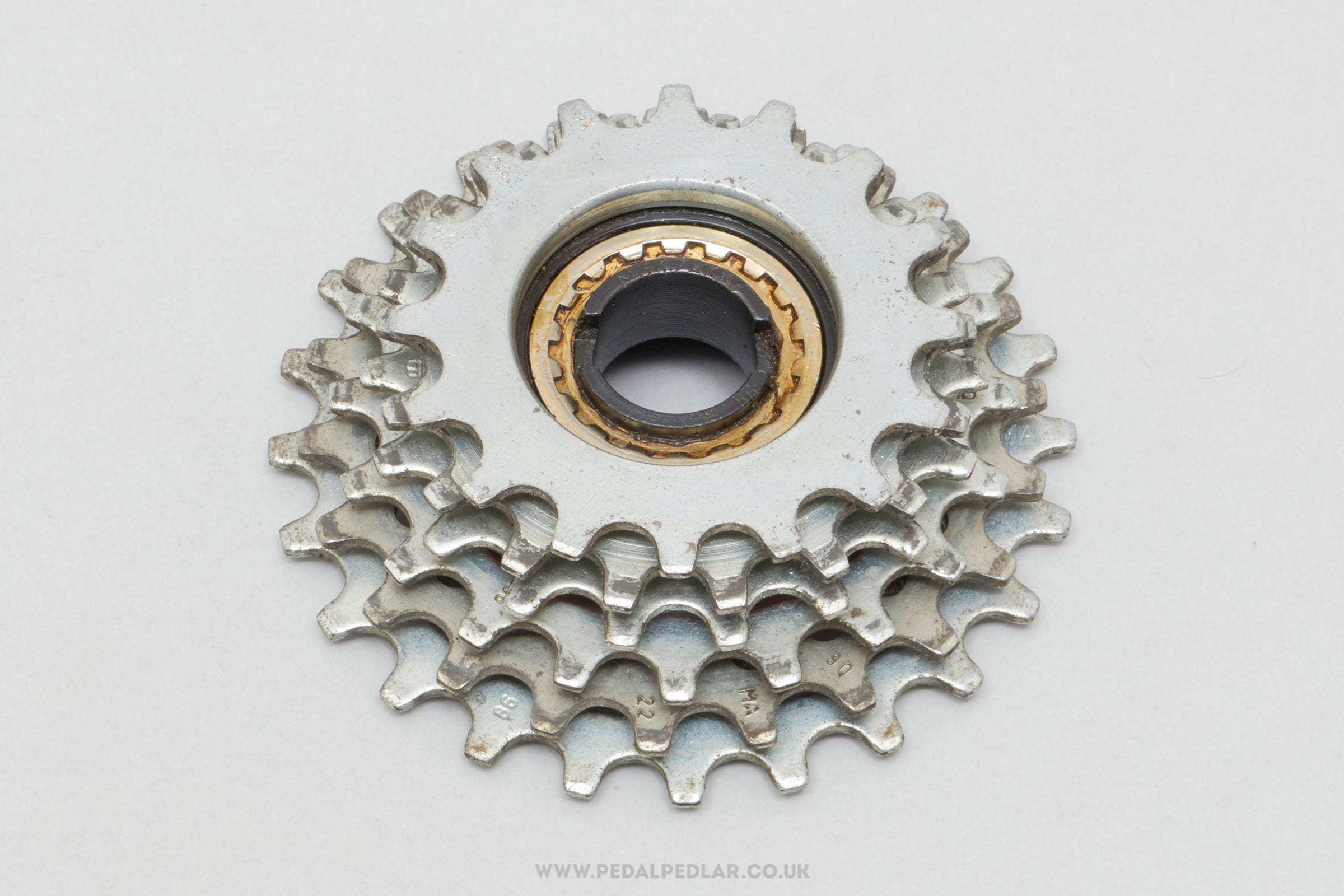


Maillard 700 Course Super c.1986 Vintage 6 Speed 16-24 Freewheel
£34.00 £40.00
✓ Original part - in production from the 1970s to the 1980s
✓ Suitable for historic cycling events such as L'Eroica
✓ Professionally checked & carefully cleaned
✓ Worldwide shipping
Maillard 700 Course freewheel, hailing from France and dating back to 1986. Made from steel and weighing in at 465 grams. A fine choice for keeping your vintage bike authentic, but also great for any other compatible bike.
If you're taking part in L'Eroica or a similar vintage event, this is fully compliant - so rest assured, the pre-1987 police won't lock you up for having the wrong freewheel!
The freewheel's been carefully cleaned, thoroughly checked by one of our mechanics and graded as good condition, but do take a good look at the detailed photos so you can see the cosmetic condition before you buy, and please consider that freewheels wear with chains, so used freewheels can occasionally skip when partnered with new (and some used) chains. This can usually be avoided by using a compatible used chain of similar age, but there is no way for us to confirm which chain will work with which freewheel.OVERVIEW
Production Era - 1970s & 1980s
Country - French
Material - Steel
Weight - 465 g
Stock Code - U-FW177V
TECHNICAL INFO
Speed - 6 Speed
Range - 16-24
Threading - French: 1.366 x 25.4 TPI
Stack Height - 32 mm
Cog Width - 3/32" (Standard)
-
▼SHIPPING, TAXES & RETURNS
-
We've been safely sending orders around the world since 2010. Orders are carefully packed, sent with tracking & insurance, and normally collected around midday on Tuesdays and Fridays. Larger items may occasionally require an extra day or two to prepare.
We accept returns, please notify us within 14 days and ensure the item arrives back with us no later than 30 days after the order was received.
EU orders under €150 (excluding shipping) - import VAT and the new €3 customs duty are paid as part of your order, so there's nothing further to pay on delivery.
EU orders over €150 (excluding shipping) - import fees are payable to the carrier before delivery, with nothing collected at checkout.
USA orders - import fees are collected at checkout for all orders to the USA, so there won’t be any surprise charges when your order arrives.
Other international orders - local import fees may apply and are not collected by us. Please check your country's import rules before purchasing.
-
▼HELP SECTION
-
Speed - the number of cogs on the freewheel.
Range - the number of teeth on the smalles and largest cogs, this gives you an indication of how hard or easy the gearing will be, the lower the number the harder the gears. The tooth count of the cogs inbetween are usually evenly spaced, ie: a 6 speed 14-24 freewheel would likely have cog sizes 14, 16, 18, 20, 22 & 24.
Threading - this needs to match the thread of your rear hub. ISO is the modern standard and is almost exactly the same as older English/British and Italian thread, allowing you to mix and match between these thread types as long as it's not going to be under extreme force, in which case it's best to stick to an exact match. Hubs with a French thread must be used with a French threaded freewheel.
Stack Height - the total height (or width if you're looking at it when installed) of the freewheel, this is measured from the base (back of the largest cog) to the top (front of the smallest cog).
Cog width - this is mainly relevant for singlespeed and some older 3 or 4 speed freewheels - if this is ⅛” then you must use a ⅛” chain, but most freewheels (especially multiple speed ones) will use a standard 3/32” chain.



Ciclolinea 'Colnago' NOS/NIB Vintage Cycling Headband
£27.00 £30.00
✓ Original vintage headband - 1980s style!
✓ New old stock & still in the original packaging!
✓ Suitable for historic cycling events such as L'Eroica
✓ Worldwide shipping
Ciclolinea headband (or sweat band if you prefer), likely made in the 1980s given the style (yet still new & unused after all this time!). An excellent choice for wearing on your vintage bike (or any occasion you fancy of course), and also a great alternative to buying brand new cycling kit!
If you're taking part in L'Eroica or any other vintage event, this is fully compliant - so rest assured, the pre-1987 police won't lock you up for having the wrong headband!
OVERVIEW
Production Era - 1980s
Stock Code - D-HBD4V
*New old stock items may have marks from storage over the years, and as we often have multiples they can vary from piece to piece, but they are always genuine new & unused items.
DETAIL & MEASUREMENTS
Head Size - One Size (Elasticated)
Colour* - White / Black
*The colour description is just a guide, please check the photos too as we make sure these are as close to the true colour as possible.
-
▼SHIPPING, TAXES & RETURNS
-
We've been safely sending orders around the world since 2010. Orders are carefully packed, sent with tracking & insurance, and normally collected around midday on Tuesdays and Fridays. Larger items may occasionally require an extra day or two to prepare.
We accept returns, please notify us within 14 days and ensure the item arrives back with us no later than 30 days after the order was received.
EU orders under €150 (excluding shipping) - import VAT and the new €3 customs duty are paid as part of your order, so there's nothing further to pay on delivery.
EU orders over €150 (excluding shipping) - import fees are payable to the carrier before delivery, with nothing collected at checkout.
USA orders - import fees are collected at checkout for all orders to the USA, so there won’t be any surprise charges when your order arrives.
Other international orders - local import fees may apply and are not collected by us. Please check your country's import rules before purchasing.
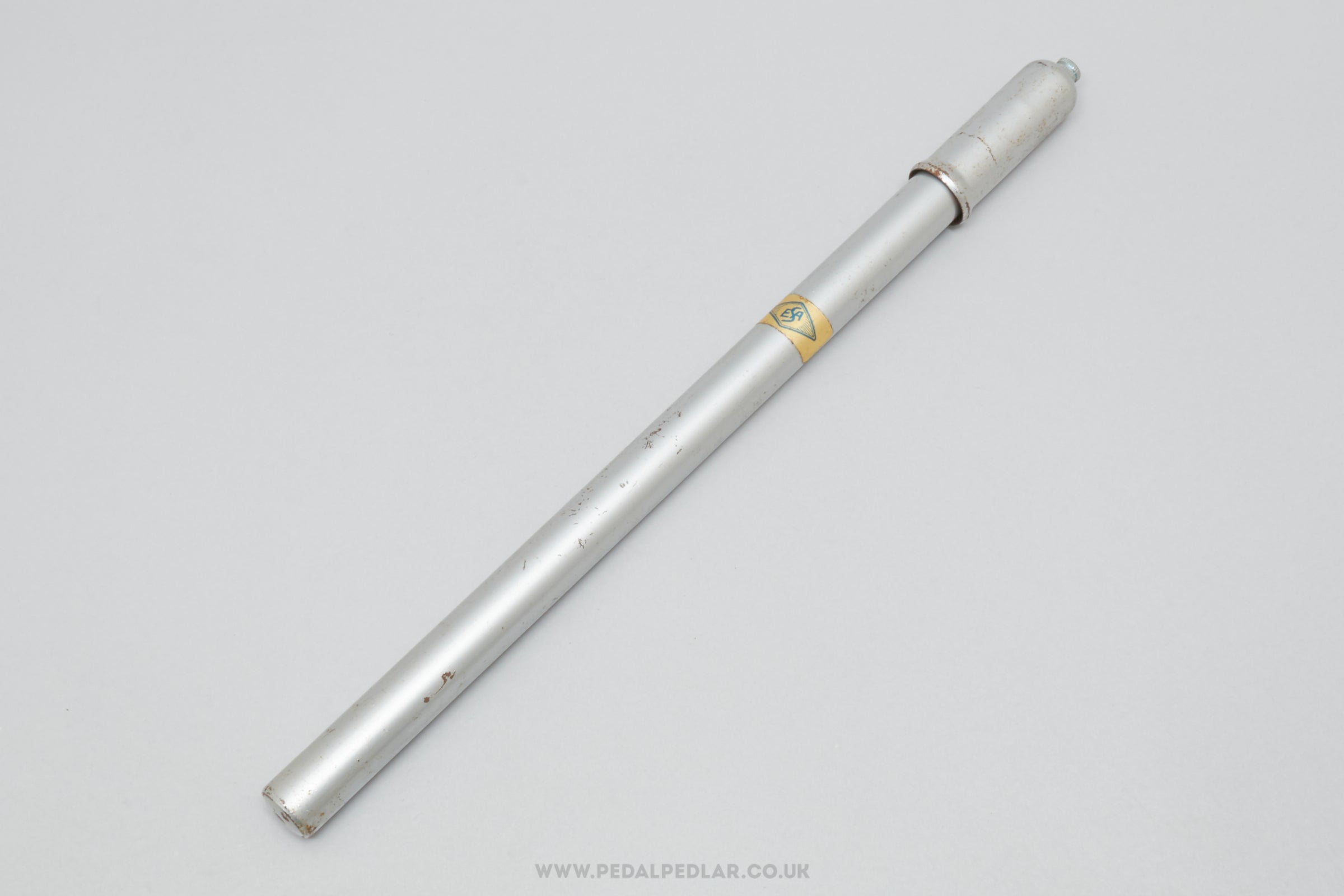


ESA Vintage Silver 38 - 40 cm Frame Peg Fit Bike Pump
£36.00 £40.00
✓ Original pump - in production from the 1960s to the 1970s
✓ Suitable for historic cycling events such as L'Eroica
✓ Checked & tested
✓ Worldwide shipping
ESA bicycle pump, in production from the 1960s to the 1970s. An excellent choice for vintage cycling enthusiasts, but great for cyclists of the non-vintage variety too!
If you're taking part in L'Eroica or any other vintage event, this is fully compliant - so rest assured, the pre-1987 police won't lock you up for having the wrong pump!
The pump's been thoroughly checked, tested and graded as good condition, but do take a good look at the detailed photos so you can see the cosmetic condition before you buy.OVERVIEW
Production Era - 1960s & 1970s
Country - 0
Material - Steel
Weight - 195 g
Stock Code - U-PM-F22V
TECHNICAL INFO
Colour* - Silver
Valve Type - Hose Connector (Presta/Woods Supplied)
Pump Mount Type - Peg / Clip Fit (Needs Retaining Both Ends)
Mount Location** - Peg / Clip Dependent
Length (Min-Max) - 38 - 40 cm
*The colour description is just a guide, please check the photos too as we make sure these are as close to the true colour as possible.
**See help section.
-
▼SHIPPING, TAXES & RETURNS
-
We've been safely sending orders around the world since 2010. Orders are carefully packed, sent with tracking & insurance, and normally collected around midday on Tuesdays and Fridays. Larger items may occasionally require an extra day or two to prepare.
We accept returns, please notify us within 14 days and ensure the item arrives back with us no later than 30 days after the order was received.
EU orders under €150 (excluding shipping) - import VAT and the new €3 customs duty are paid as part of your order, so there's nothing further to pay on delivery.
EU orders over €150 (excluding shipping) - import fees are payable to the carrier before delivery, with nothing collected at checkout.
USA orders - import fees are collected at checkout for all orders to the USA, so there won’t be any surprise charges when your order arrives.
Other international orders - local import fees may apply and are not collected by us. Please check your country's import rules before purchasing.
-
▼HELP SECTION
-
Valve Type - there are 3 types of valves; Presta are thin with a little knurled nut on the end, Schrader are wider (the same as you would find on a car), and the less common Woods (aka "Dunlop"). Pumps designed for Presta valves can be used on Woods valves. Some pumps use hose connectors, these are available for all valve types.
Pump Mount Type - 'peg fit' pumps require pump pegs or 'umbrella' clips to fit to the frame, 'frame fit 'pumps are designed with curved ends to mount between two tubes (although these often have holes for pegs too). If mounting directly you'll need the correct length to fit your frame, or a clip/peg to hold one end.
Mount Location - frame fit pumps usually mount to the seat tube with the ends compressed between the top and down tube, they can however be mounted on other tubes as long as there's something supporting the handle end. Some head tubes have a little nipple or a small enough gap for under top tube mounting (this can be replcated with a simple strap or cable tie), and of course pump pegs or clips can be fitted anywhere!
Length (Min-Max) - the length of the pump fully compressed and uncompressed, measured at the points of support. The space you to intend to mount the pump should be within 1 cm of the minimum or maximum length to allow the pump to be securely mounted and dismounted.
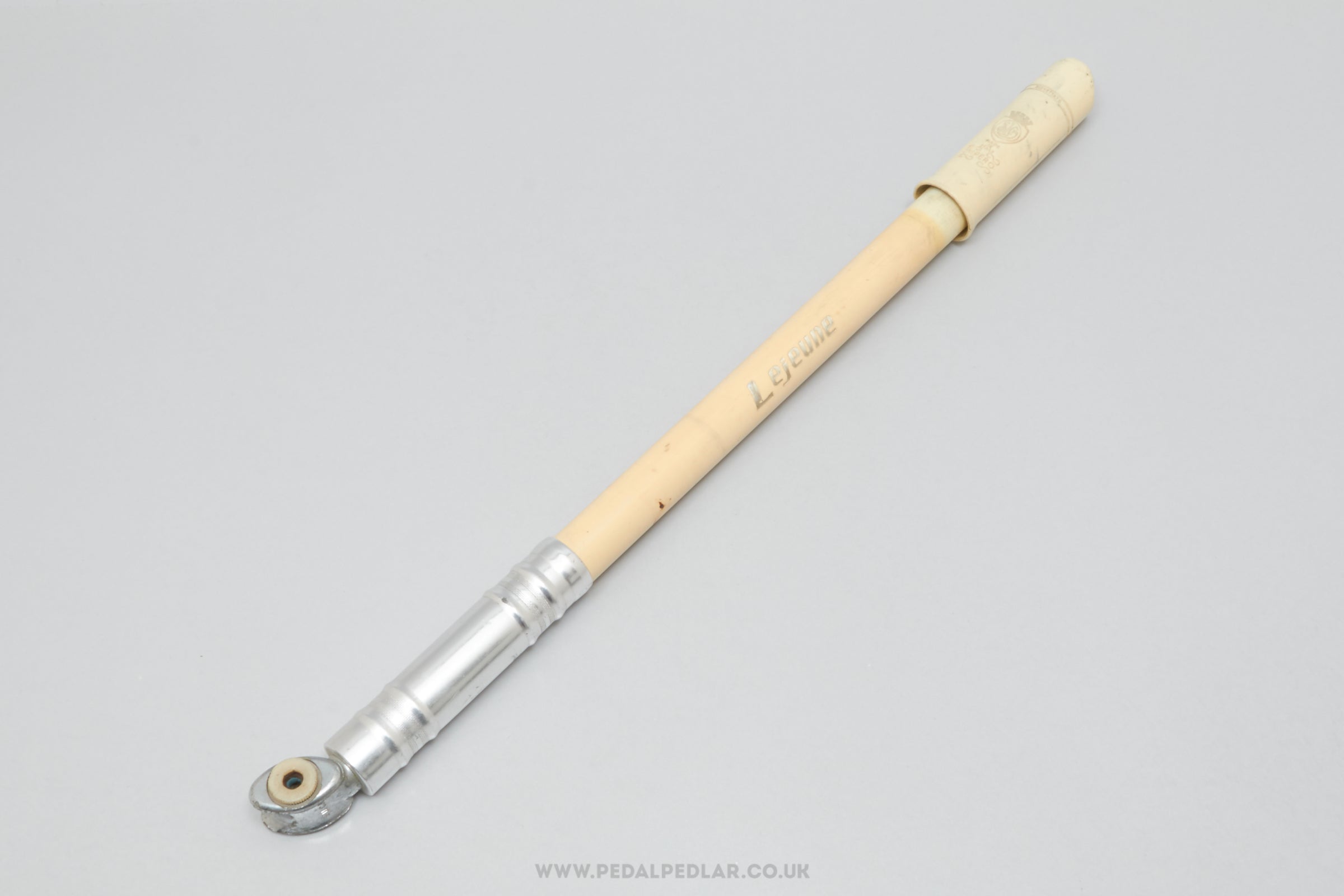


Silca Impero Le Jeune Vintage Off White 44 - 48 cm Frame Fit Bike Pump
£40.50 £45.00
✓ Original pump - produced in the 1980s
✓ Suitable for historic cycling events such as L'Eroica
✓ Checked & tested
✓ Worldwide shipping
Silca Impero bicycle pump, hailing from Italy and in production during the 1980s. An excellent choice for vintage cycling enthusiasts, but great for cyclists of the non-vintage variety too!
If you're taking part in L'Eroica or any other vintage event, this is fully compliant - so rest assured, the pre-1987 police won't lock you up for having the wrong pump!
The pump's been thoroughly checked, tested and graded as good condition, but do take a good look at the detailed photos so you can see the cosmetic condition before you buy.OVERVIEW
Production Era - 1980s
Country - Italian
Material - Plastic
Weight - 131 g
Stock Code - U-PM-F26V
TECHNICAL INFO
Colour* - Off White
Valve Type - Presta
Pump Mount Type - Frame Fit (With Peg Hole at Handle End)
Mount Location** - Seat Tube
Length (Min-Max) - 44 - 48 cm
*The colour description is just a guide, please check the photos too as we make sure these are as close to the true colour as possible.
**See help section.
-
▼SHIPPING, TAXES & RETURNS
-
We've been safely sending orders around the world since 2010. Orders are carefully packed, sent with tracking & insurance, and normally collected around midday on Tuesdays and Fridays. Larger items may occasionally require an extra day or two to prepare.
We accept returns, please notify us within 14 days and ensure the item arrives back with us no later than 30 days after the order was received.
EU orders under €150 (excluding shipping) - import VAT and the new €3 customs duty are paid as part of your order, so there's nothing further to pay on delivery.
EU orders over €150 (excluding shipping) - import fees are payable to the carrier before delivery, with nothing collected at checkout.
USA orders - import fees are collected at checkout for all orders to the USA, so there won’t be any surprise charges when your order arrives.
Other international orders - local import fees may apply and are not collected by us. Please check your country's import rules before purchasing.
-
▼HELP SECTION
-
Valve Type - there are 3 types of valves; Presta are thin with a little knurled nut on the end, Schrader are wider (the same as you would find on a car), and the less common Woods (aka "Dunlop"). Pumps designed for Presta valves can be used on Woods valves. Some pumps use hose connectors, these are available for all valve types.
Pump Mount Type - 'peg fit' pumps require pump pegs or 'umbrella' clips to fit to the frame, 'frame fit 'pumps are designed with curved ends to mount between two tubes (although these often have holes for pegs too). If mounting directly you'll need the correct length to fit your frame, or a clip/peg to hold one end.
Mount Location - frame fit pumps usually mount to the seat tube with the ends compressed between the top and down tube, they can however be mounted on other tubes as long as there's something supporting the handle end. Some head tubes have a little nipple or a small enough gap for under top tube mounting (this can be replcated with a simple strap or cable tie), and of course pump pegs or clips can be fitted anywhere!
Length (Min-Max) - the length of the pump fully compressed and uncompressed, measured at the points of support. The space you to intend to mount the pump should be within 1 cm of the minimum or maximum length to allow the pump to be securely mounted and dismounted.


Zefal MT. Plus (79) MTB NOS/NIB Classic Neon Orange 39 - 45 cm Frame Fit Bike Pump
£34.00 £40.00
✓ Original pump - produced in the 1990s
✓ New old stock & still in the original packaging!
✓ Worldwide shipping
Zefal MT. Plus bicycle pump, hailing from France and in production during the 1990s (yet still new & unused after all this time!). An excellent choice for classic cycling enthusiasts, but great for cyclists of the non-classic variety too!
OVERVIEW
Model ID - 79
Production Era - 1990s
Country - French
Material - Plastic
Weight - 179 g
Stock Code - D-PM-F37C
NB - Supplied with adjustable pump pegs
*New old stock items may have marks from storage over the years, and as we often have multiples they can vary from piece to piece, but they are always genuine new & unused items.
TECHNICAL INFO
Colour* - Neon Orange
Valve Type - Presta/Schrader
Pump Mount Type - Frame Fit (With Peg Holes Both Ends)
Mount Location** - Seat Tube
Length (Min-Max) - 39 - 45 cm
*The colour description is just a guide, please check the photos too as we make sure these are as close to the true colour as possible.
**See help section.
-
▼SHIPPING, TAXES & RETURNS
-
We've been safely sending orders around the world since 2010. Orders are carefully packed, sent with tracking & insurance, and normally collected around midday on Tuesdays and Fridays. Larger items may occasionally require an extra day or two to prepare.
We accept returns, please notify us within 14 days and ensure the item arrives back with us no later than 30 days after the order was received.
EU orders under €150 (excluding shipping) - import VAT and the new €3 customs duty are paid as part of your order, so there's nothing further to pay on delivery.
EU orders over €150 (excluding shipping) - import fees are payable to the carrier before delivery, with nothing collected at checkout.
USA orders - import fees are collected at checkout for all orders to the USA, so there won’t be any surprise charges when your order arrives.
Other international orders - local import fees may apply and are not collected by us. Please check your country's import rules before purchasing.
-
▼HELP SECTION
-
Valve Type - there are 3 types of valves; Presta are thin with a little knurled nut on the end, Schrader are wider (the same as you would find on a car), and the less common Woods (aka "Dunlop"). Pumps designed for Presta valves can be used on Woods valves. Some pumps use hose connectors, these are available for all valve types.
Pump Mount Type - 'peg fit' pumps require pump pegs or 'umbrella' clips to fit to the frame, 'frame fit 'pumps are designed with curved ends to mount between two tubes (although these often have holes for pegs too). If mounting directly you'll need the correct length to fit your frame, or a clip/peg to hold one end.
Mount Location - frame fit pumps usually mount to the seat tube with the ends compressed between the top and down tube, they can however be mounted on other tubes as long as there's something supporting the handle end. Some head tubes have a little nipple or a small enough gap for under top tube mounting (this can be replcated with a simple strap or cable tie), and of course pump pegs or clips can be fitted anywhere!
Length (Min-Max) - the length of the pump fully compressed and uncompressed, measured at the points of support. The space you to intend to mount the pump should be within 1 cm of the minimum or maximum length to allow the pump to be securely mounted and dismounted.
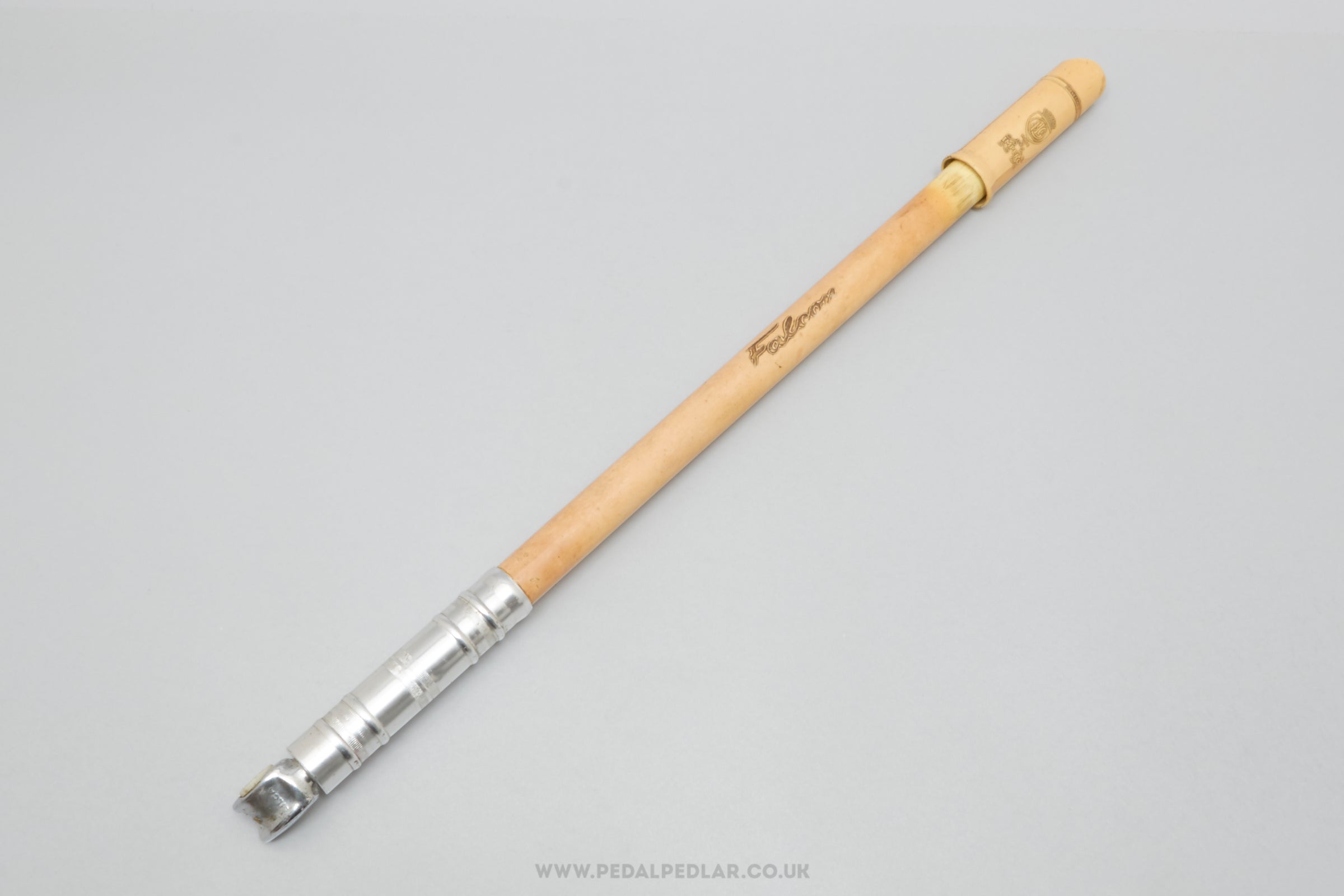


Silca Impero Falcon Vintage Caramel 52.5 - 56 cm Frame Fit Bike Pump
£49.50 £55.00
✓ Original pump - produced in the 1980s
✓ Suitable for historic cycling events such as L'Eroica
✓ Checked & tested
✓ Worldwide shipping
Silca Impero bicycle pump, hailing from Italy and in production during the 1980s. An excellent choice for vintage cycling enthusiasts, but great for cyclists of the non-vintage variety too!
If you're taking part in L'Eroica or any other vintage event, this is fully compliant - so rest assured, the pre-1987 police won't lock you up for having the wrong pump!
The pump's been thoroughly checked, tested and graded as good condition, but do take a good look at the detailed photos so you can see the cosmetic condition before you buy.OVERVIEW
Production Era - 1980s
Country - Italian
Material - Plastic
Weight - 150 g
Stock Code - U-PM-F30V
TECHNICAL INFO
Colour* - Caramel
Valve Type - Presta
Pump Mount Type - Frame Fit (With Peg Hole at Handle End)
Mount Location** - Seat Tube
Length (Min-Max) - 52.5 - 56 cm
*The colour description is just a guide, please check the photos too as we make sure these are as close to the true colour as possible.
**See help section.
-
▼SHIPPING, TAXES & RETURNS
-
We've been safely sending orders around the world since 2010. Orders are carefully packed, sent with tracking & insurance, and normally collected around midday on Tuesdays and Fridays. Larger items may occasionally require an extra day or two to prepare.
We accept returns, please notify us within 14 days and ensure the item arrives back with us no later than 30 days after the order was received.
EU orders under €150 (excluding shipping) - import VAT and the new €3 customs duty are paid as part of your order, so there's nothing further to pay on delivery.
EU orders over €150 (excluding shipping) - import fees are payable to the carrier before delivery, with nothing collected at checkout.
USA orders - import fees are collected at checkout for all orders to the USA, so there won’t be any surprise charges when your order arrives.
Other international orders - local import fees may apply and are not collected by us. Please check your country's import rules before purchasing.
-
▼HELP SECTION
-
Valve Type - there are 3 types of valves; Presta are thin with a little knurled nut on the end, Schrader are wider (the same as you would find on a car), and the less common Woods (aka "Dunlop"). Pumps designed for Presta valves can be used on Woods valves. Some pumps use hose connectors, these are available for all valve types.
Pump Mount Type - 'peg fit' pumps require pump pegs or 'umbrella' clips to fit to the frame, 'frame fit 'pumps are designed with curved ends to mount between two tubes (although these often have holes for pegs too). If mounting directly you'll need the correct length to fit your frame, or a clip/peg to hold one end.
Mount Location - frame fit pumps usually mount to the seat tube with the ends compressed between the top and down tube, they can however be mounted on other tubes as long as there's something supporting the handle end. Some head tubes have a little nipple or a small enough gap for under top tube mounting (this can be replcated with a simple strap or cable tie), and of course pump pegs or clips can be fitted anywhere!
Length (Min-Max) - the length of the pump fully compressed and uncompressed, measured at the points of support. The space you to intend to mount the pump should be within 1 cm of the minimum or maximum length to allow the pump to be securely mounted and dismounted.
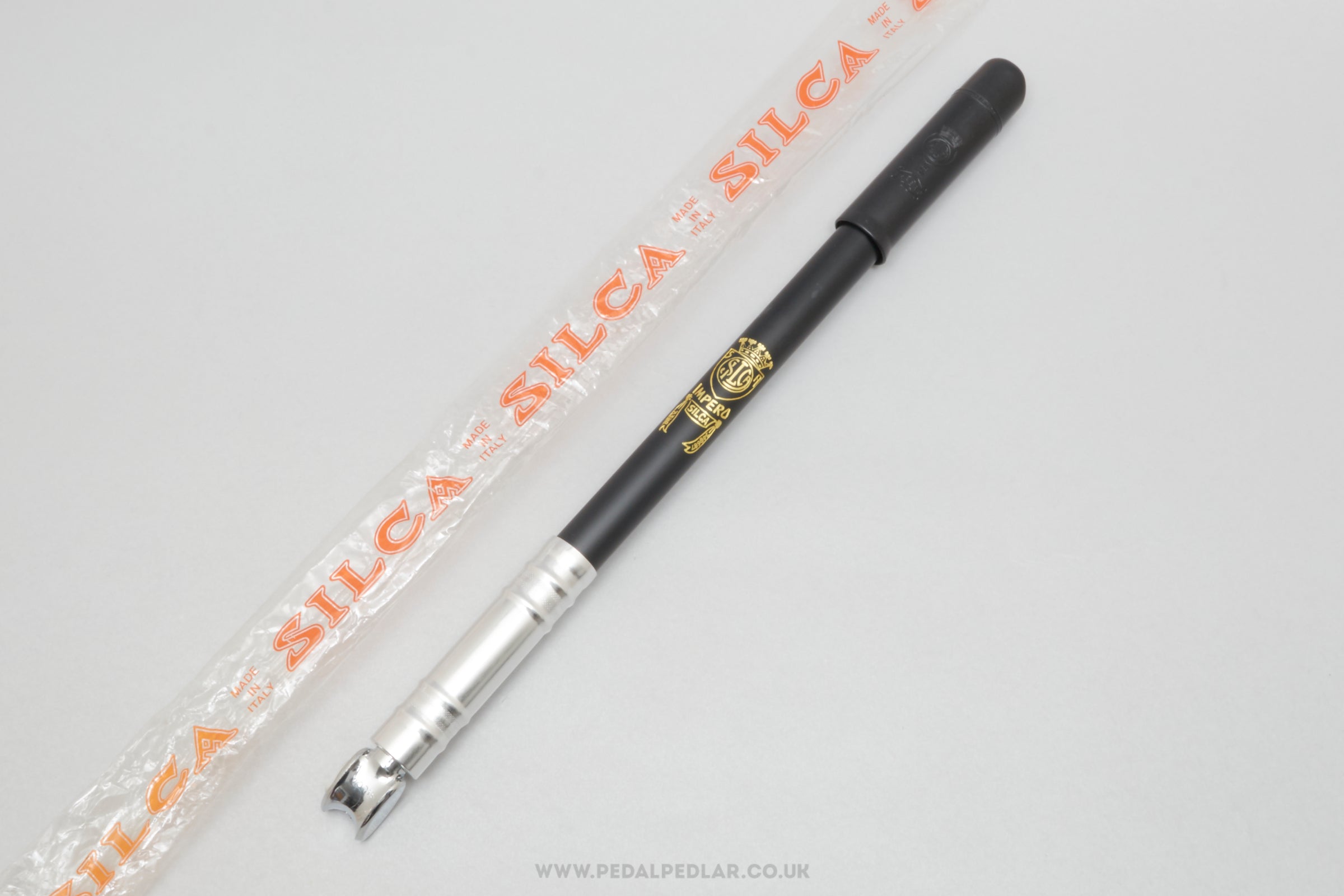


Silca Impero NOS Vintage Black 41 - 45.5 cm Frame Fit Bike Pump
£46.75 £55.00
✓ Original pump - produced in the 1980s
✓ New old stock! Still unused after all these years
✓ Suitable for historic cycling events such as L'Eroica
✓ Worldwide shipping
Silca Impero bicycle pump, hailing from Italy and in production during the 1980s (yet still new & unused after all this time!). An excellent choice for vintage cycling enthusiasts, but great for cyclists of the non-vintage variety too!
If you're taking part in L'Eroica or any other vintage event, this is fully compliant - so rest assured, the pre-1987 police won't lock you up for having the wrong pump!
OVERVIEW
Production Era - 1980s
Country - Italian
Material - Plastic
Weight - 124 g
Stock Code - D-PM-F48V
*New old stock items may have marks from storage over the years, and as we often have multiples they can vary from piece to piece, but they are always genuine new & unused items.
TECHNICAL INFO
Colour* - Black
Valve Type - Presta
Pump Mount Type - Frame Fit (With Peg Hole at Handle End)
Mount Location** - Seat Tube
Length (Min-Max) - 41 - 45.5 cm
*The colour description is just a guide, please check the photos too as we make sure these are as close to the true colour as possible.
**See help section.
-
▼SHIPPING, TAXES & RETURNS
-
We've been safely sending orders around the world since 2010. Orders are carefully packed, sent with tracking & insurance, and normally collected around midday on Tuesdays and Fridays. Larger items may occasionally require an extra day or two to prepare.
We accept returns, please notify us within 14 days and ensure the item arrives back with us no later than 30 days after the order was received.
EU orders under €150 (excluding shipping) - import VAT and the new €3 customs duty are paid as part of your order, so there's nothing further to pay on delivery.
EU orders over €150 (excluding shipping) - import fees are payable to the carrier before delivery, with nothing collected at checkout.
USA orders - import fees are collected at checkout for all orders to the USA, so there won’t be any surprise charges when your order arrives.
Other international orders - local import fees may apply and are not collected by us. Please check your country's import rules before purchasing.
-
▼HELP SECTION
-
Valve Type - there are 3 types of valves; Presta are thin with a little knurled nut on the end, Schrader are wider (the same as you would find on a car), and the less common Woods (aka "Dunlop"). Pumps designed for Presta valves can be used on Woods valves. Some pumps use hose connectors, these are available for all valve types.
Pump Mount Type - 'peg fit' pumps require pump pegs or 'umbrella' clips to fit to the frame, 'frame fit 'pumps are designed with curved ends to mount between two tubes (although these often have holes for pegs too). If mounting directly you'll need the correct length to fit your frame, or a clip/peg to hold one end.
Mount Location - frame fit pumps usually mount to the seat tube with the ends compressed between the top and down tube, they can however be mounted on other tubes as long as there's something supporting the handle end. Some head tubes have a little nipple or a small enough gap for under top tube mounting (this can be replcated with a simple strap or cable tie), and of course pump pegs or clips can be fitted anywhere!
Length (Min-Max) - the length of the pump fully compressed and uncompressed, measured at the points of support. The space you to intend to mount the pump should be within 1 cm of the minimum or maximum length to allow the pump to be securely mounted and dismounted.
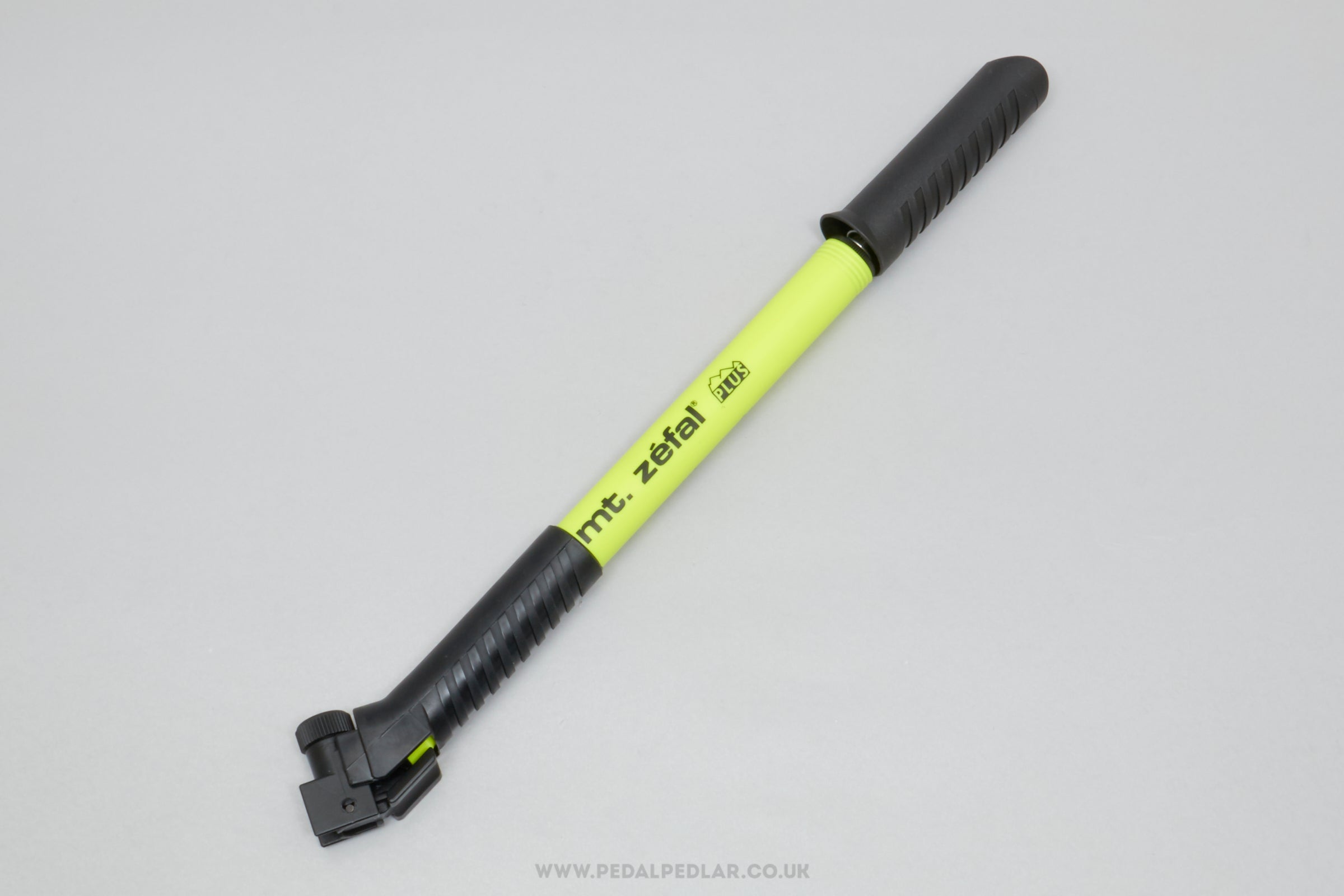


Zefal MT. Plus (79) MTB NOS/NIB Classic Neon Yellow 38.5 - 44 cm Frame Fit Bike Pump
£34.00 £40.00
✓ Original pump - produced in the 1990s
✓ New old stock & still in the original packaging!
✓ Worldwide shipping
Zefal MT. Plus bicycle pump, hailing from France and in production during the 1990s (yet still new & unused after all this time!). An excellent choice for classic cycling enthusiasts, but great for cyclists of the non-classic variety too!
OVERVIEW
Model ID - 79
Production Era - 1990s
Country - French
Material - Plastic
Weight - 185 g
Stock Code - D-PM-F59C
NB - Supplied with adjustable pump pegs
*New old stock items may have marks from storage over the years, and as we often have multiples they can vary from piece to piece, but they are always genuine new & unused items.
TECHNICAL INFO
Colour* - Neon Yellow
Valve Type - Presta/Schrader
Pump Mount Type - Frame Fit (With Peg Holes Both Ends)
Mount Location** - Seat Tube
Length (Min-Max) - 38.5 - 44 cm
*The colour description is just a guide, please check the photos too as we make sure these are as close to the true colour as possible.
**See help section.
-
▼SHIPPING, TAXES & RETURNS
-
We've been safely sending orders around the world since 2010. Orders are carefully packed, sent with tracking & insurance, and normally collected around midday on Tuesdays and Fridays. Larger items may occasionally require an extra day or two to prepare.
We accept returns, please notify us within 14 days and ensure the item arrives back with us no later than 30 days after the order was received.
EU orders under €150 (excluding shipping) - import VAT and the new €3 customs duty are paid as part of your order, so there's nothing further to pay on delivery.
EU orders over €150 (excluding shipping) - import fees are payable to the carrier before delivery, with nothing collected at checkout.
USA orders - import fees are collected at checkout for all orders to the USA, so there won’t be any surprise charges when your order arrives.
Other international orders - local import fees may apply and are not collected by us. Please check your country's import rules before purchasing.
-
▼HELP SECTION
-
Valve Type - there are 3 types of valves; Presta are thin with a little knurled nut on the end, Schrader are wider (the same as you would find on a car), and the less common Woods (aka "Dunlop"). Pumps designed for Presta valves can be used on Woods valves. Some pumps use hose connectors, these are available for all valve types.
Pump Mount Type - 'peg fit' pumps require pump pegs or 'umbrella' clips to fit to the frame, 'frame fit 'pumps are designed with curved ends to mount between two tubes (although these often have holes for pegs too). If mounting directly you'll need the correct length to fit your frame, or a clip/peg to hold one end.
Mount Location - frame fit pumps usually mount to the seat tube with the ends compressed between the top and down tube, they can however be mounted on other tubes as long as there's something supporting the handle end. Some head tubes have a little nipple or a small enough gap for under top tube mounting (this can be replcated with a simple strap or cable tie), and of course pump pegs or clips can be fitted anywhere!
Length (Min-Max) - the length of the pump fully compressed and uncompressed, measured at the points of support. The space you to intend to mount the pump should be within 1 cm of the minimum or maximum length to allow the pump to be securely mounted and dismounted.