
All Sale Items
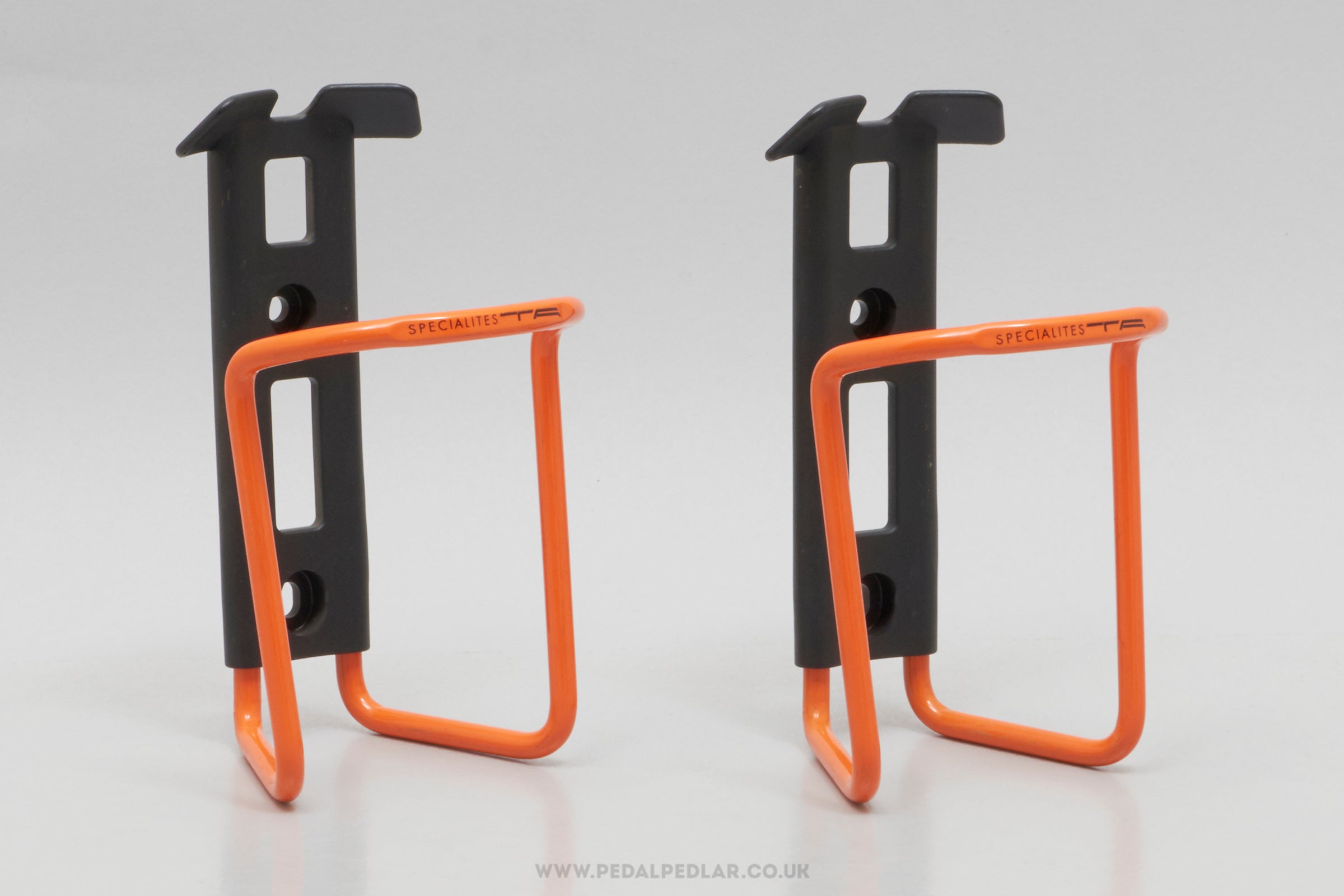


Specialites T.A. Sierra NOS Classic Orange Bottle Cages
£29.75 £35.00
✓ Original pair of bottle cages - produced in the 1990s
✓ New old stock! Still unused after all these years
✓ Worldwide shipping
Specialites T.A. Sierra water bottle cages (or bidon holders if you prefer), hailing from France and in production during the 1990s (yet still new & unused after all this time!). Made from aluminium/plastic and weighing in at 128 grams (the weight and price displayed are for a pair of cages). The perfect finishing touch for your classic bike, but great for bikes of the non-classic variety too!
OVERVIEW
Condition Notes - Some storage marks
Production Era - 1990s
Country - French
Material - Aluminium / Plastic
Weight - 128 g
Stock Code - D-CAG-P9C
*New old stock items may have marks from storage over the years, and as we often have multiples they can vary from piece to piece, but they are always genuine new & unused items.
TECHNICAL INFO
Cage Fixing - Frame Fit (Braze-On)
Colour* - Orange
Bottle Fit - Standard
*The colour description is just a guide, please check the photos too as we make sure these are as close to the true colour as possible.
-
▼SHIPPING, TAXES & RETURNS
-
We've been safely sending orders around the world since 2010. Orders are carefully packed, sent with tracking & insurance, and normally collected around midday on Tuesdays and Fridays. Larger items may occasionally require an extra day or two to prepare.
We accept returns, please notify us within 14 days and ensure the item arrives back with us no later than 30 days after the order was received.
EU orders under €150 (excluding shipping) - import VAT and the new €3 customs duty are paid as part of your order, so there's nothing further to pay on delivery.
EU orders over €150 (excluding shipping) - import fees are payable to the carrier before delivery, with nothing collected at checkout.
USA orders - import fees are collected at checkout for all orders to the USA, so there won’t be any surprise charges when your order arrives.
Other international orders - local import fees may apply and are not collected by us. Please check your country's import rules before purchasing.
-
▼HELP SECTION
-
Cage Fixing - most bottle cages will be designed to fix to the frame, although some rare older ones mount to the handlebars and/or stem. If your frame doesn't have any bottle cage braze-ons to fix to you'll need clamp-on bottle cages.
Bottle Fit - almost all cycling bottles measure between 70 - 75 mm in diameter so this is the standard bottle cage size, the only rather rare exceptions are some old Elite bottles that require a 66 mm cage, the more recent oversized ones and of course the funny shaped aero ones that only accept the bottle they were made for.
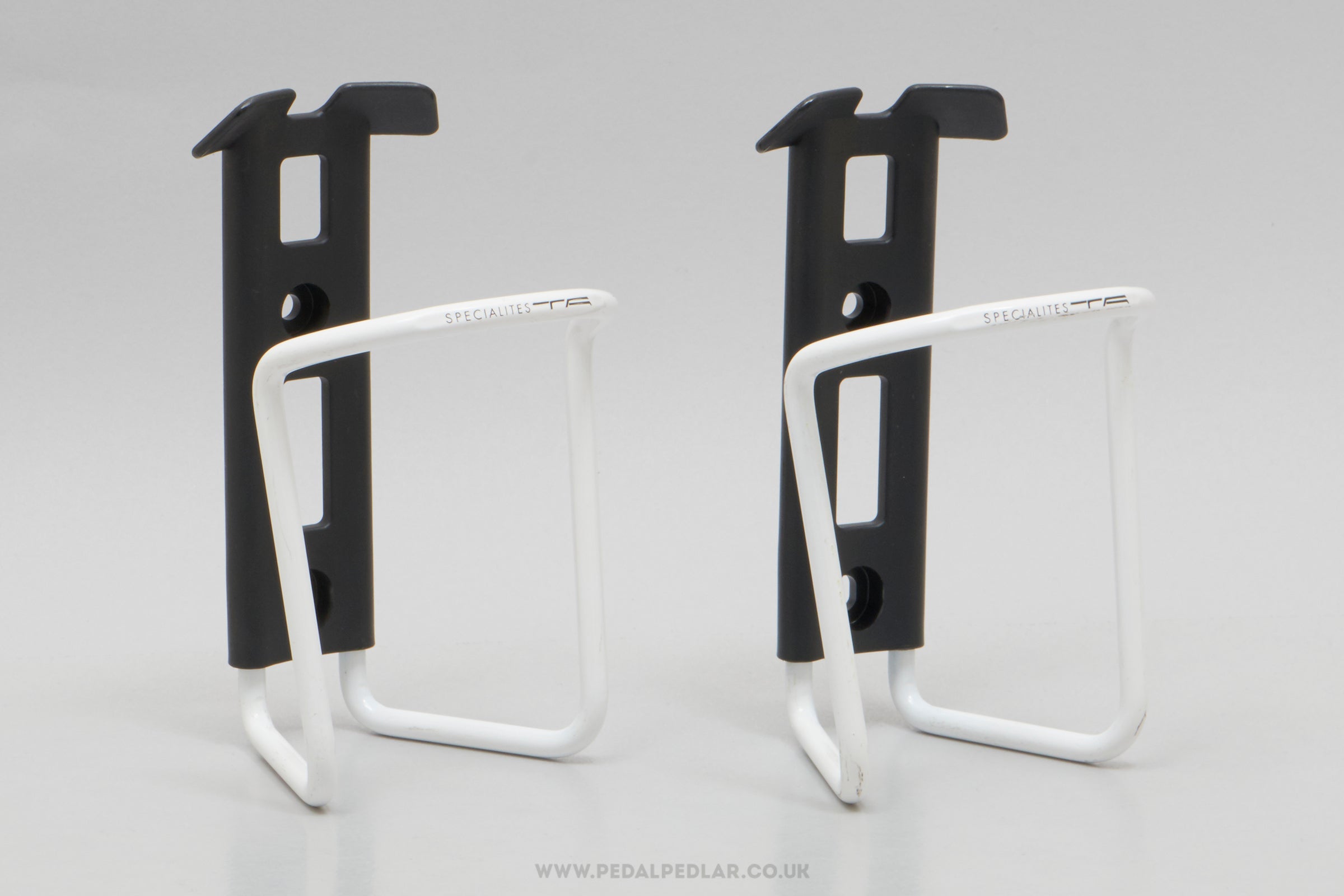


Specialites T.A. Sierra NOS Classic White Bottle Cages
£29.75 £35.00
✓ Original pair of bottle cages - produced in the 1990s
✓ New old stock! Still unused after all these years
✓ Worldwide shipping
Specialites T.A. Sierra water bottle cages (or bidon holders if you prefer), hailing from France and in production during the 1990s (yet still new & unused after all this time!). Made from aluminium/plastic and weighing in at 132 grams (the weight and price displayed are for a pair of cages). The perfect finishing touch for your classic bike, but great for bikes of the non-classic variety too!
OVERVIEW
Condition Notes - Some storage marks
Production Era - 1990s
Country - French
Material - Aluminium / Plastic
Weight - 132 g
Stock Code - D-CAG-P10C
*New old stock items may have marks from storage over the years, and as we often have multiples they can vary from piece to piece, but they are always genuine new & unused items.
TECHNICAL INFO
Cage Fixing - Frame Fit (Braze-On)
Colour* - White
Bottle Fit - Standard
*The colour description is just a guide, please check the photos too as we make sure these are as close to the true colour as possible.
-
▼SHIPPING, TAXES & RETURNS
-
We've been safely sending orders around the world since 2010. Orders are carefully packed, sent with tracking & insurance, and normally collected around midday on Tuesdays and Fridays. Larger items may occasionally require an extra day or two to prepare.
We accept returns, please notify us within 14 days and ensure the item arrives back with us no later than 30 days after the order was received.
EU orders under €150 (excluding shipping) - import VAT and the new €3 customs duty are paid as part of your order, so there's nothing further to pay on delivery.
EU orders over €150 (excluding shipping) - import fees are payable to the carrier before delivery, with nothing collected at checkout.
USA orders - import fees are collected at checkout for all orders to the USA, so there won’t be any surprise charges when your order arrives.
Other international orders - local import fees may apply and are not collected by us. Please check your country's import rules before purchasing.
-
▼HELP SECTION
-
Cage Fixing - most bottle cages will be designed to fix to the frame, although some rare older ones mount to the handlebars and/or stem. If your frame doesn't have any bottle cage braze-ons to fix to you'll need clamp-on bottle cages.
Bottle Fit - almost all cycling bottles measure between 70 - 75 mm in diameter so this is the standard bottle cage size, the only rather rare exceptions are some old Elite bottles that require a 66 mm cage, the more recent oversized ones and of course the funny shaped aero ones that only accept the bottle they were made for.
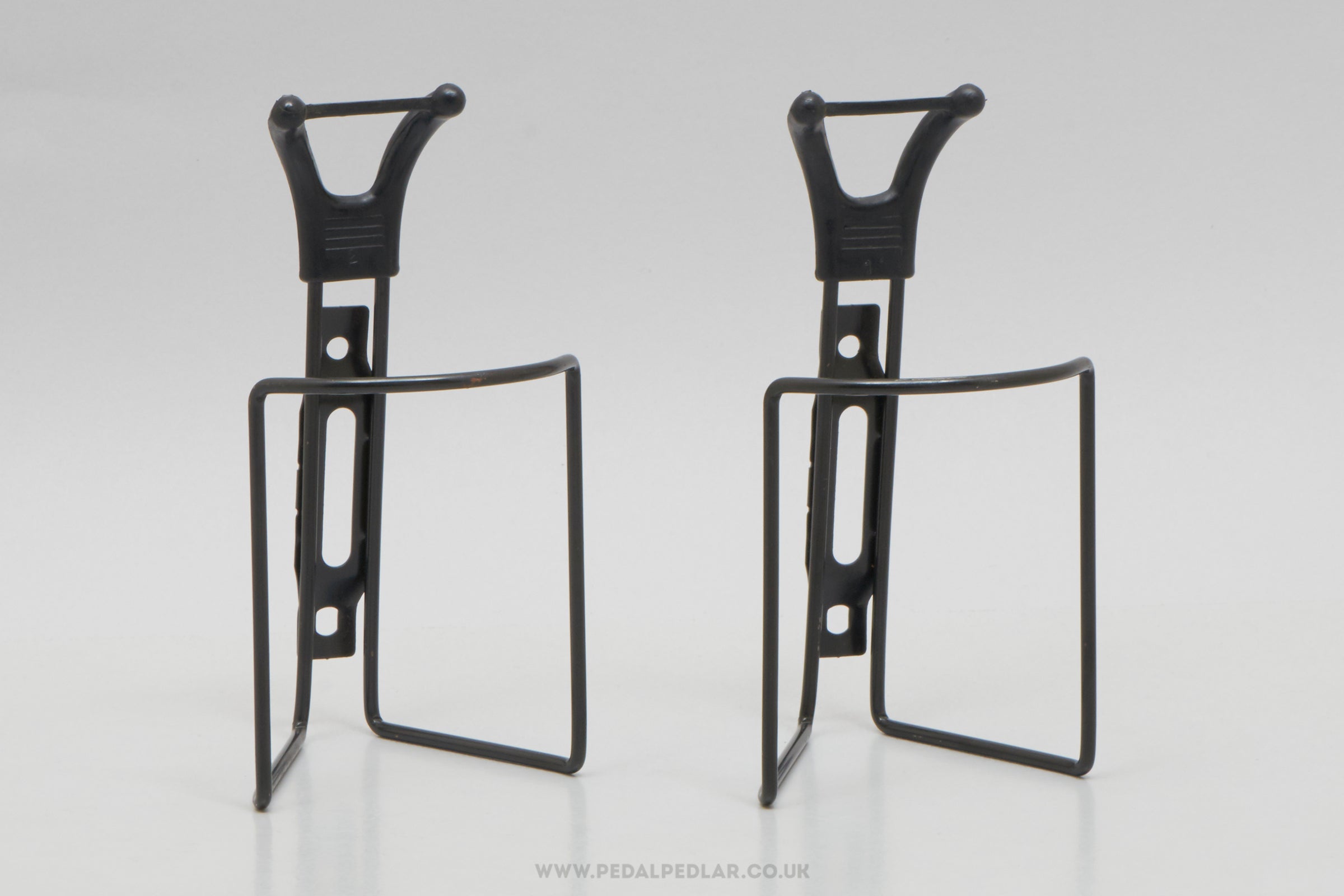


Vintage Early TA Style NOS Steel Black Bottle Cages
£12.75 £15.00
✓ Original pair of bottle cages - in production from the 1970s to the 1980s
✓ New old stock! Still unused after all these years
✓ Suitable for historic cycling events such as L'Eroica
✓ Worldwide shipping
Unbranded vintage water bottle cages (or bidon holders if you prefer), most likely in production from the 1970s to the 1980s (yet still new & unused after all this time!). Made from steel/plastic and weighing in at 122 grams (the weight and price displayed are for a pair of cages). The perfect finishing touch for your vintage bike, but great for bikes of the non-vintage variety too!
If you're taking part in L'Eroica or a similar vintage event, these are of the correct era, so rest assured the pre-1987 police won't lock you up for having the wrong bottle carriers!
OVERVIEW
Production Era - 1970s & 1980s
Material - Steel / Plastic
Weight - 122 g
Stock Code - D-CAG-P12V
*New old stock items may have marks from storage over the years, and as we often have multiples they can vary from piece to piece, but they are always genuine new & unused items.
TECHNICAL INFO
Cage Fixing - Frame Fit (Braze-On)
Colour* - Black
Bottle Fit - Standard
*The colour description is just a guide, please check the photos too as we make sure these are as close to the true colour as possible.
-
▼SHIPPING, TAXES & RETURNS
-
We've been safely sending orders around the world since 2010. Orders are carefully packed, sent with tracking & insurance, and normally collected around midday on Tuesdays and Fridays. Larger items may occasionally require an extra day or two to prepare.
We accept returns, please notify us within 14 days and ensure the item arrives back with us no later than 30 days after the order was received.
EU orders under €150 (excluding shipping) - import VAT and the new €3 customs duty are paid as part of your order, so there's nothing further to pay on delivery.
EU orders over €150 (excluding shipping) - import fees are payable to the carrier before delivery, with nothing collected at checkout.
USA orders - import fees are collected at checkout for all orders to the USA, so there won’t be any surprise charges when your order arrives.
Other international orders - local import fees may apply and are not collected by us. Please check your country's import rules before purchasing.
-
▼HELP SECTION
-
Cage Fixing - most bottle cages will be designed to fix to the frame, although some rare older ones mount to the handlebars and/or stem. If your frame doesn't have any bottle cage braze-ons to fix to you'll need clamp-on bottle cages.
Bottle Fit - almost all cycling bottles measure between 70 - 75 mm in diameter so this is the standard bottle cage size, the only rather rare exceptions are some old Elite bottles that require a 66 mm cage, the more recent oversized ones and of course the funny shaped aero ones that only accept the bottle they were made for.
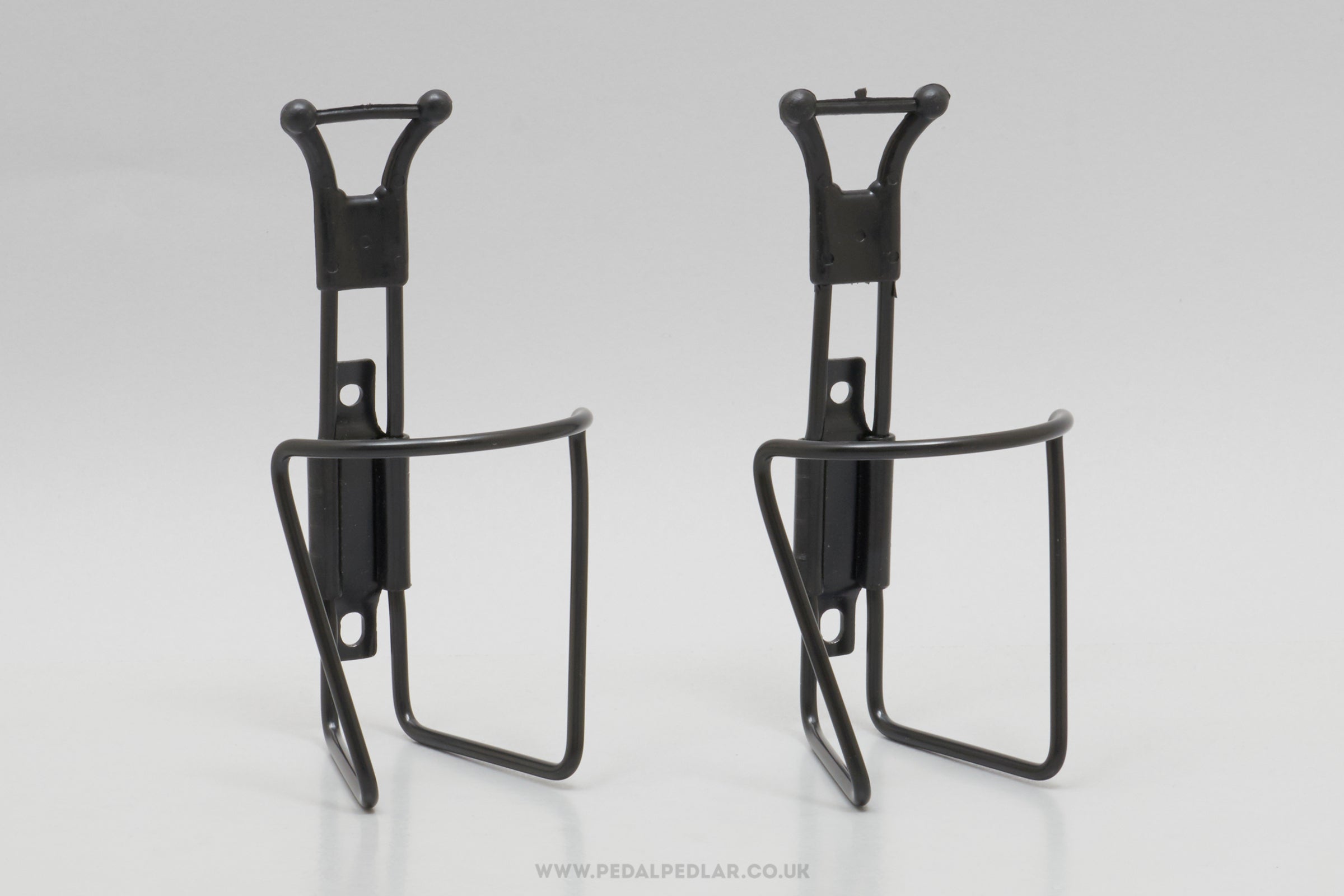


Vintage TA Style NOS Black Bottle Cages
£19.13 £23.00
✓ Original pair of bottle cages - in production from the 1970s to the 1980s
✓ New old stock! Still unused after all these years
✓ Suitable for historic cycling events such as L'Eroica
✓ Worldwide shipping
Unbranded vintage water bottle cages (or bidon holders if you prefer), most likely in production from the 1970s to the 1980s (yet still new & unused after all this time!). Made from aluminium/plastic and weighing in at 90 grams (the weight and price displayed are for a pair of cages). The perfect finishing touch for your vintage bike, but great for bikes of the non-vintage variety too!
If you're taking part in L'Eroica or a similar vintage event, these are of the correct era, so rest assured the pre-1987 police won't lock you up for having the wrong bottle carriers!
OVERVIEW
Production Era - 1970s & 1980s
Material - Aluminium / Plastic
Weight - 90 g
Stock Code - D-CAG-P15V
*New old stock items may have marks from storage over the years, and as we often have multiples they can vary from piece to piece, but they are always genuine new & unused items.
TECHNICAL INFO
Cage Fixing - Frame Fit (Braze-On)
Colour* - Black
Bottle Fit - Standard
*The colour description is just a guide, please check the photos too as we make sure these are as close to the true colour as possible.
-
▼SHIPPING, TAXES & RETURNS
-
We've been safely sending orders around the world since 2010. Orders are carefully packed, sent with tracking & insurance, and normally collected around midday on Tuesdays and Fridays. Larger items may occasionally require an extra day or two to prepare.
We accept returns, please notify us within 14 days and ensure the item arrives back with us no later than 30 days after the order was received.
EU orders under €150 (excluding shipping) - import VAT and the new €3 customs duty are paid as part of your order, so there's nothing further to pay on delivery.
EU orders over €150 (excluding shipping) - import fees are payable to the carrier before delivery, with nothing collected at checkout.
USA orders - import fees are collected at checkout for all orders to the USA, so there won’t be any surprise charges when your order arrives.
Other international orders - local import fees may apply and are not collected by us. Please check your country's import rules before purchasing.
-
▼HELP SECTION
-
Cage Fixing - most bottle cages will be designed to fix to the frame, although some rare older ones mount to the handlebars and/or stem. If your frame doesn't have any bottle cage braze-ons to fix to you'll need clamp-on bottle cages.
Bottle Fit - almost all cycling bottles measure between 70 - 75 mm in diameter so this is the standard bottle cage size, the only rather rare exceptions are some old Elite bottles that require a 66 mm cage, the more recent oversized ones and of course the funny shaped aero ones that only accept the bottle they were made for.
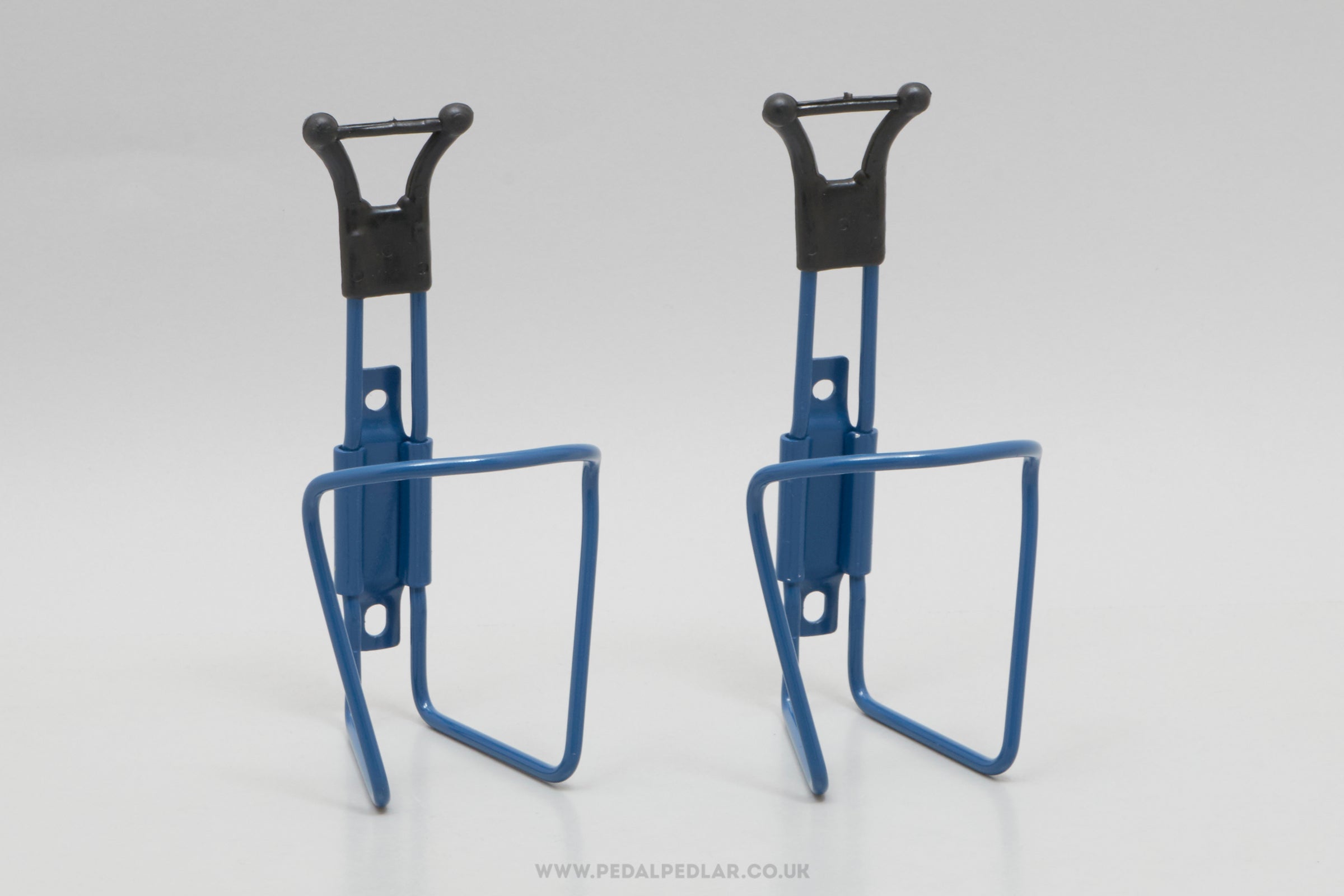


Vintage TA Style NOS Blue Bottle Cages
£19.13 £23.00
✓ Original pair of bottle cages - in production from the 1970s to the 1980s
✓ New old stock! Still unused after all these years
✓ Suitable for historic cycling events such as L'Eroica
✓ Worldwide shipping
Unbranded vintage water bottle cages (or bidon holders if you prefer), most likely in production from the 1970s to the 1980s (yet still new & unused after all this time!). Made from aluminium/plastic and weighing in at 130 grams (the weight and price displayed are for a pair of cages). The perfect finishing touch for your vintage bike, but great for bikes of the non-vintage variety too!
If you're taking part in L'Eroica or a similar vintage event, these are of the correct era, so rest assured the pre-1987 police won't lock you up for having the wrong bottle carriers!
OVERVIEW
Production Era - 1970s & 1980s
Material - Aluminium / Plastic
Weight - 130 g
Stock Code - D-CAG-P17V
*New old stock items may have marks from storage over the years, and as we often have multiples they can vary from piece to piece, but they are always genuine new & unused items.
TECHNICAL INFO
Cage Fixing - Frame Fit (Braze-On)
Colour* - Blue
Bottle Fit - Standard
*The colour description is just a guide, please check the photos too as we make sure these are as close to the true colour as possible.
-
▼SHIPPING, TAXES & RETURNS
-
We've been safely sending orders around the world since 2010. Orders are carefully packed, sent with tracking & insurance, and normally collected around midday on Tuesdays and Fridays. Larger items may occasionally require an extra day or two to prepare.
We accept returns, please notify us within 14 days and ensure the item arrives back with us no later than 30 days after the order was received.
EU orders under €150 (excluding shipping) - import VAT and the new €3 customs duty are paid as part of your order, so there's nothing further to pay on delivery.
EU orders over €150 (excluding shipping) - import fees are payable to the carrier before delivery, with nothing collected at checkout.
USA orders - import fees are collected at checkout for all orders to the USA, so there won’t be any surprise charges when your order arrives.
Other international orders - local import fees may apply and are not collected by us. Please check your country's import rules before purchasing.
-
▼HELP SECTION
-
Cage Fixing - most bottle cages will be designed to fix to the frame, although some rare older ones mount to the handlebars and/or stem. If your frame doesn't have any bottle cage braze-ons to fix to you'll need clamp-on bottle cages.
Bottle Fit - almost all cycling bottles measure between 70 - 75 mm in diameter so this is the standard bottle cage size, the only rather rare exceptions are some old Elite bottles that require a 66 mm cage, the more recent oversized ones and of course the funny shaped aero ones that only accept the bottle they were made for.
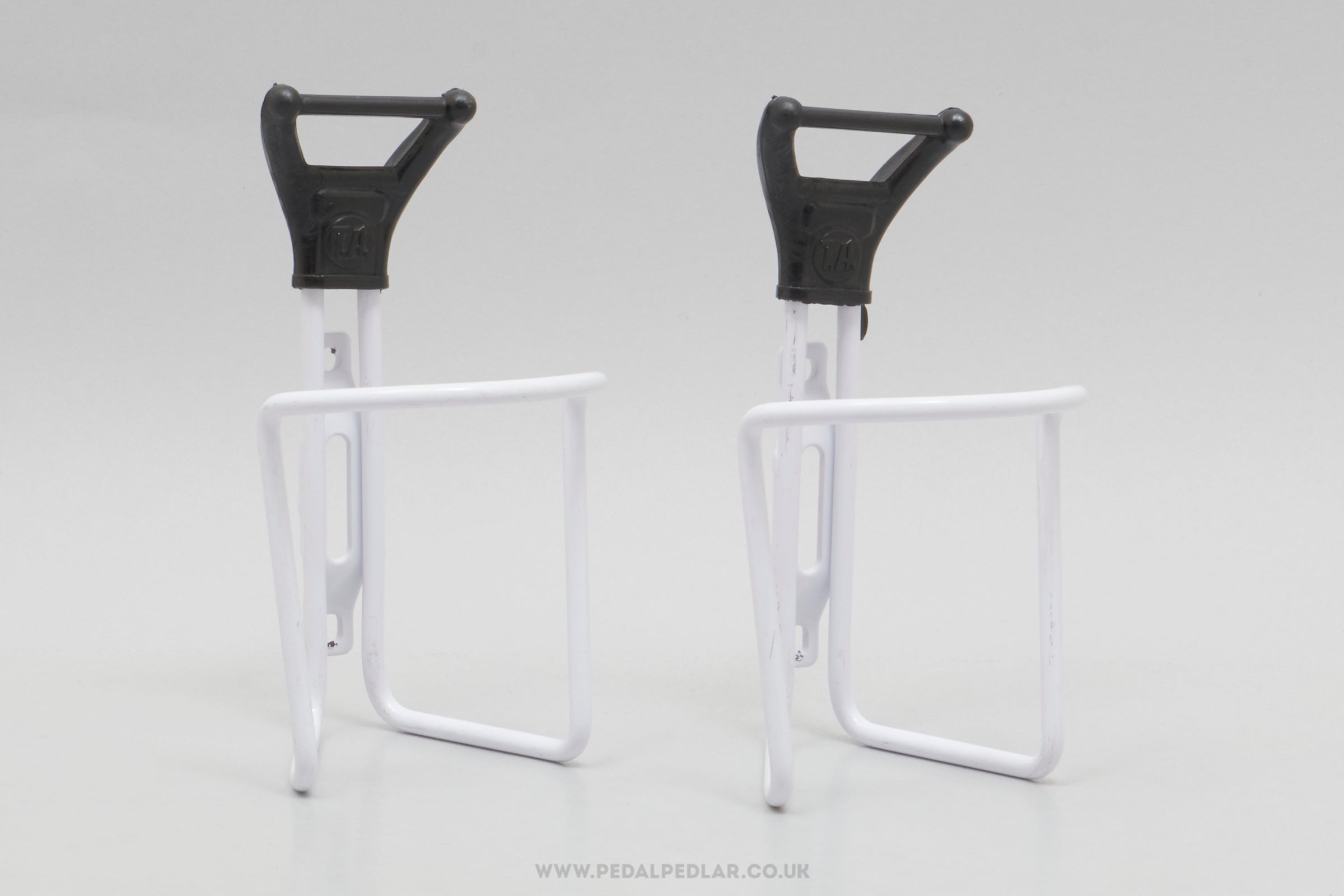


Specialites T.A. 'Plum' (417) NOS Vintage White Bottle Cages
£27.00 £30.00
✓ Original pair of bottle cages - produced in the 1980s
✓ New old stock! Still unused after all these years
✓ Suitable for historic cycling events such as L'Eroica
✓ Worldwide shipping
Specialites T.A. 'Plum' water bottle cages (or bidon holders if you prefer), hailing from France and in production during the 1980s (yet still new & unused after all this time!). Made from aluminium/plastic and weighing in at 102 grams (the weight and price displayed are for a pair of cages). The perfect finishing touch for your vintage bike, but great for bikes of the non-vintage variety too!
First introduced in the 1970s and originally available in black & silver only, these versions of the Plum lightweight bottle cage feature the exposed welded construction favoured for its strength and durability. The later T.A. logo on the black plastic tab was introduced in the 1980s when it became available in a choice of colours.
If you're taking part in L'Eroica or a similar vintage event, these are of the correct era, so rest assured the pre-1987 police won't lock you up for having the wrong bottle carriers!
OVERVIEW
Model ID - 417
Production Era - 1980s
Country - French
Material - Aluminium / Plastic
Weight - 102 g
Stock Code - D-CAG-P22V
*New old stock items may have marks from storage over the years, and as we often have multiples they can vary from piece to piece, but they are always genuine new & unused items.
TECHNICAL INFO
Cage Fixing - Frame Fit (Braze-On)
Colour* - White
Bottle Fit - Standard
*The colour description is just a guide, please check the photos too as we make sure these are as close to the true colour as possible.
-
▼SHIPPING, TAXES & RETURNS
-
We've been safely sending orders around the world since 2010. Orders are carefully packed, sent with tracking & insurance, and normally collected around midday on Tuesdays and Fridays. Larger items may occasionally require an extra day or two to prepare.
We accept returns, please notify us within 14 days and ensure the item arrives back with us no later than 30 days after the order was received.
EU orders under €150 (excluding shipping) - import VAT and the new €3 customs duty are paid as part of your order, so there's nothing further to pay on delivery.
EU orders over €150 (excluding shipping) - import fees are payable to the carrier before delivery, with nothing collected at checkout.
USA orders - import fees are collected at checkout for all orders to the USA, so there won’t be any surprise charges when your order arrives.
Other international orders - local import fees may apply and are not collected by us. Please check your country's import rules before purchasing.
-
▼HELP SECTION
-
Cage Fixing - most bottle cages will be designed to fix to the frame, although some rare older ones mount to the handlebars and/or stem. If your frame doesn't have any bottle cage braze-ons to fix to you'll need clamp-on bottle cages.
Bottle Fit - almost all cycling bottles measure between 70 - 75 mm in diameter so this is the standard bottle cage size, the only rather rare exceptions are some old Elite bottles that require a 66 mm cage, the more recent oversized ones and of course the funny shaped aero ones that only accept the bottle they were made for.
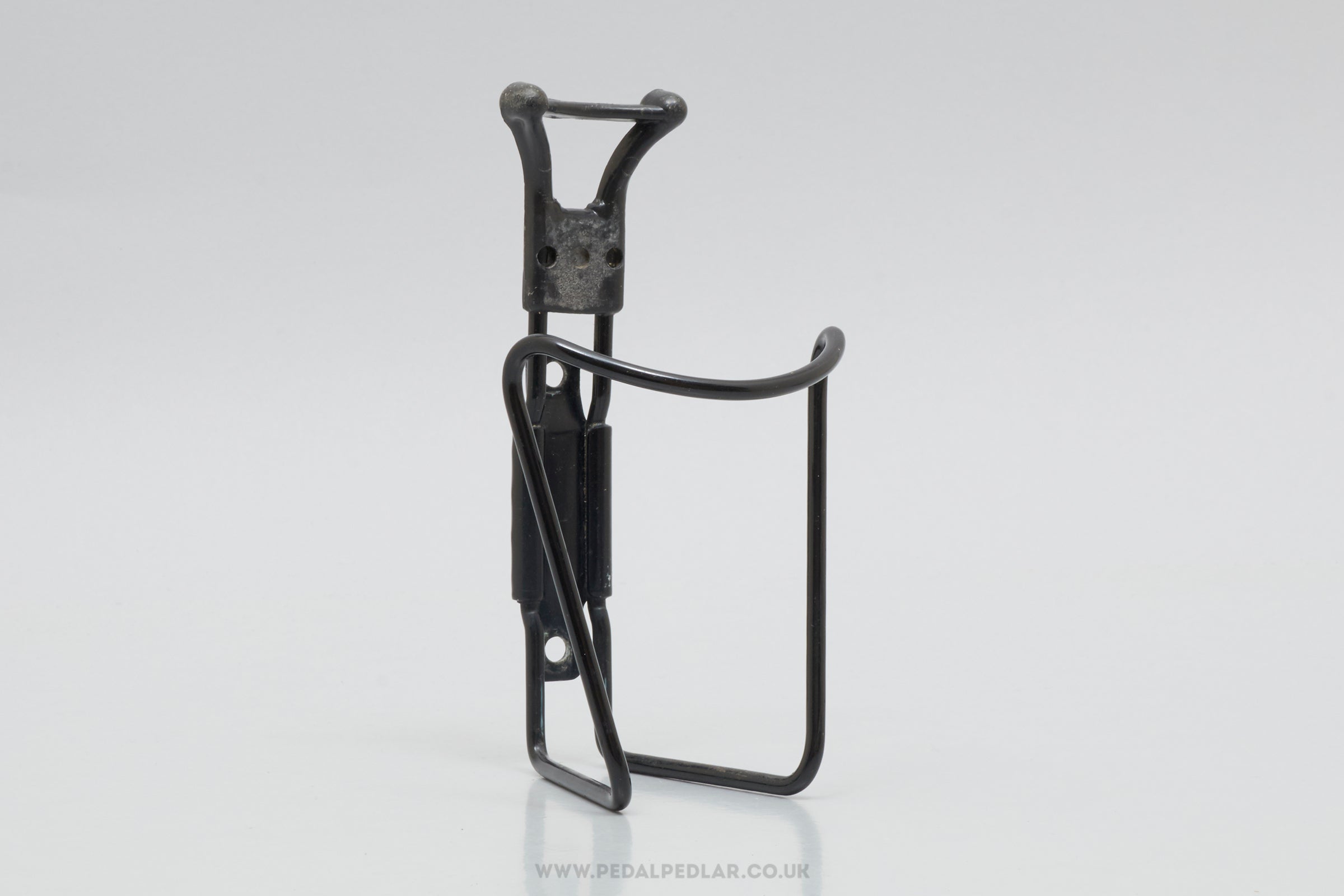


Emmepi TA Style Vintage Black Bottle Cage
£22.50 £25.00
✓ Original bottle cage - in production from the 1970s to the 1980s
✓ Suitable for historic cycling events such as L'Eroica
✓ Checked & cleaned
✓ Worldwide shipping
Emmepi water bottle cage (or bidon holder if you prefer), hailing from Italy and in production from the 1970s to the 1980s. Made from aluminium and weighing in at 44 grams. The perfect finishing touch for your vintage bike, but great for bikes of the non-vintage variety too!
If you're taking part in L'Eroica or a similar vintage event, this is of the correct era, so rest assured the pre-1987 police won't lock you up for having the wrong bottle carrier!
The bottle cage has been checked for damage, thoroughly cleaned and graded as good condition, but do take a good look at the detailed photos so you can see the shape & condition before you buy.OVERVIEW
Production Era - 1970s & 1980s
Country - Italian
Material - Aluminium
Weight - 44 g
Stock Code - U-CAG149V
TECHNICAL INFO
Cage Fixing - Frame Fit (Braze-On)
Colour* - Black
Bottle Fit - Standard
*The colour description is just a guide, please check the photos too as we make sure these are as close to the true colour as possible.
-
▼SHIPPING, TAXES & RETURNS
-
We've been safely sending orders around the world since 2010. Orders are carefully packed, sent with tracking & insurance, and normally collected around midday on Tuesdays and Fridays. Larger items may occasionally require an extra day or two to prepare.
We accept returns, please notify us within 14 days and ensure the item arrives back with us no later than 30 days after the order was received.
EU orders under €150 (excluding shipping) - import VAT and the new €3 customs duty are paid as part of your order, so there's nothing further to pay on delivery.
EU orders over €150 (excluding shipping) - import fees are payable to the carrier before delivery, with nothing collected at checkout.
USA orders - import fees are collected at checkout for all orders to the USA, so there won’t be any surprise charges when your order arrives.
Other international orders - local import fees may apply and are not collected by us. Please check your country's import rules before purchasing.
-
▼HELP SECTION
-
Cage Fixing - most bottle cages will be designed to fix to the frame, although some rare older ones mount to the handlebars and/or stem. If your frame doesn't have any bottle cage braze-ons to fix to you'll need a clamp-on bottle cage.
Bottle Fit - almost all cycling bottles measure between 70 - 75 mm in diameter so this is the standard bottle cage size, the only rather rare exceptions are some old Elite bottles that require a 66 mm cage, the more recent oversized ones and of course the funny shaped aero ones that only accept the bottle they were made for.
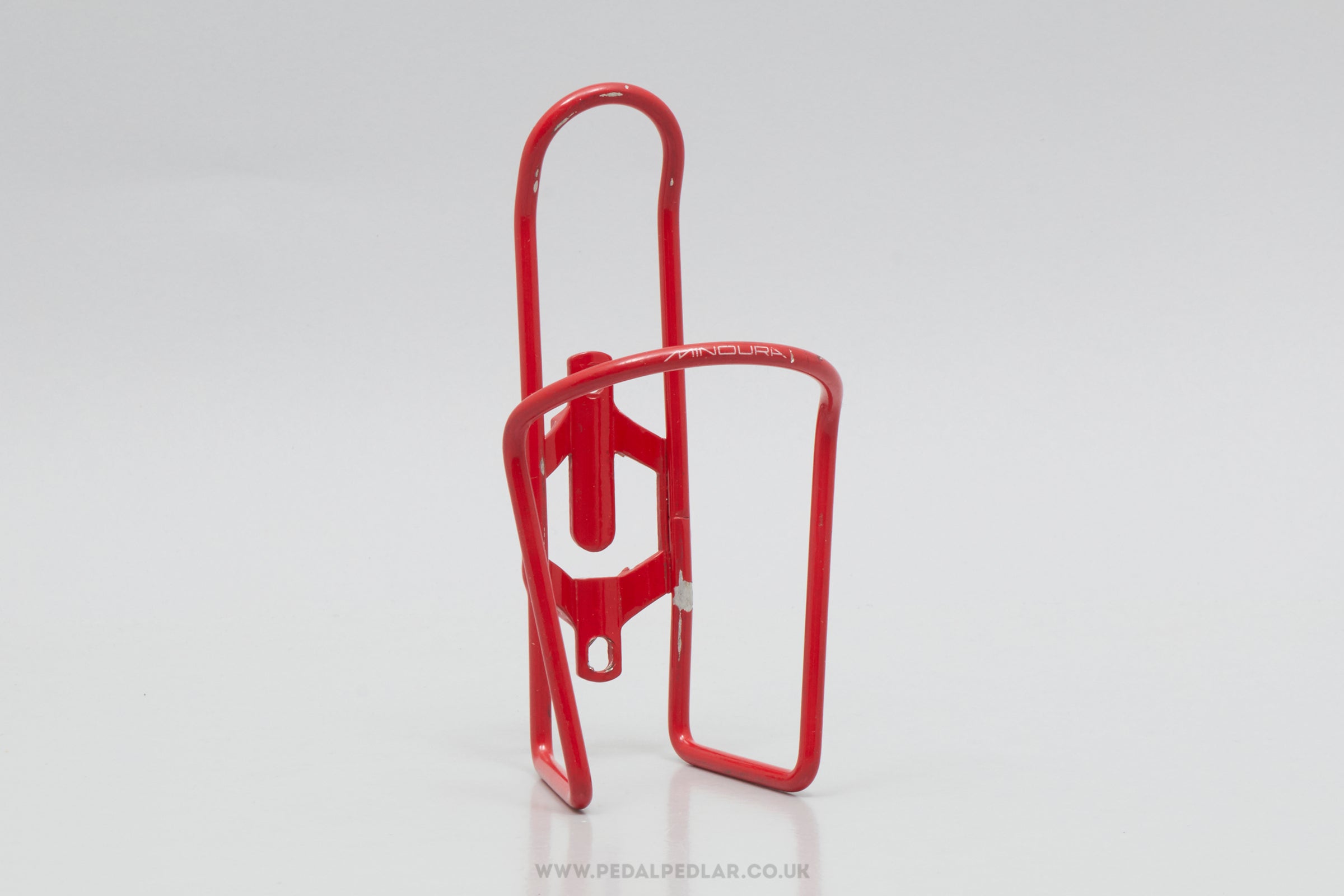


Minoura Classic Red Bottle Cage
£9.00 £10.00
✓ Original bottle cage - produced in the 1990s
✓ Checked & cleaned
✓ Worldwide shipping
Minoura water bottle cage (or bidon holder if you prefer), hailing from Japan and in production during the 1990s. Made from aluminium and weighing in at 49 grams. The perfect finishing touch for your classic bike, but great for bikes of the non-classic variety too!
The bottle cage has been checked for damage, thoroughly cleaned and graded as good condition, but do take a good look at the detailed photos so you can see the shape & condition before you buy.OVERVIEW
Production Era - 1990s
Country - Japanese
Material - Aluminium
Weight - 49 g
Stock Code - U-CAG151C
TECHNICAL INFO
Cage Fixing - Frame Fit (Braze-On)
Colour* - Red
Bottle Fit - Standard
*The colour description is just a guide, please check the photos too as we make sure these are as close to the true colour as possible.
-
▼SHIPPING, TAXES & RETURNS
-
We've been safely sending orders around the world since 2010. Orders are carefully packed, sent with tracking & insurance, and normally collected around midday on Tuesdays and Fridays. Larger items may occasionally require an extra day or two to prepare.
We accept returns, please notify us within 14 days and ensure the item arrives back with us no later than 30 days after the order was received.
EU orders under €150 (excluding shipping) - import VAT and the new €3 customs duty are paid as part of your order, so there's nothing further to pay on delivery.
EU orders over €150 (excluding shipping) - import fees are payable to the carrier before delivery, with nothing collected at checkout.
USA orders - import fees are collected at checkout for all orders to the USA, so there won’t be any surprise charges when your order arrives.
Other international orders - local import fees may apply and are not collected by us. Please check your country's import rules before purchasing.
-
▼HELP SECTION
-
Cage Fixing - most bottle cages will be designed to fix to the frame, although some rare older ones mount to the handlebars and/or stem. If your frame doesn't have any bottle cage braze-ons to fix to you'll need a clamp-on bottle cage.
Bottle Fit - almost all cycling bottles measure between 70 - 75 mm in diameter so this is the standard bottle cage size, the only rather rare exceptions are some old Elite bottles that require a 66 mm cage, the more recent oversized ones and of course the funny shaped aero ones that only accept the bottle they were made for.
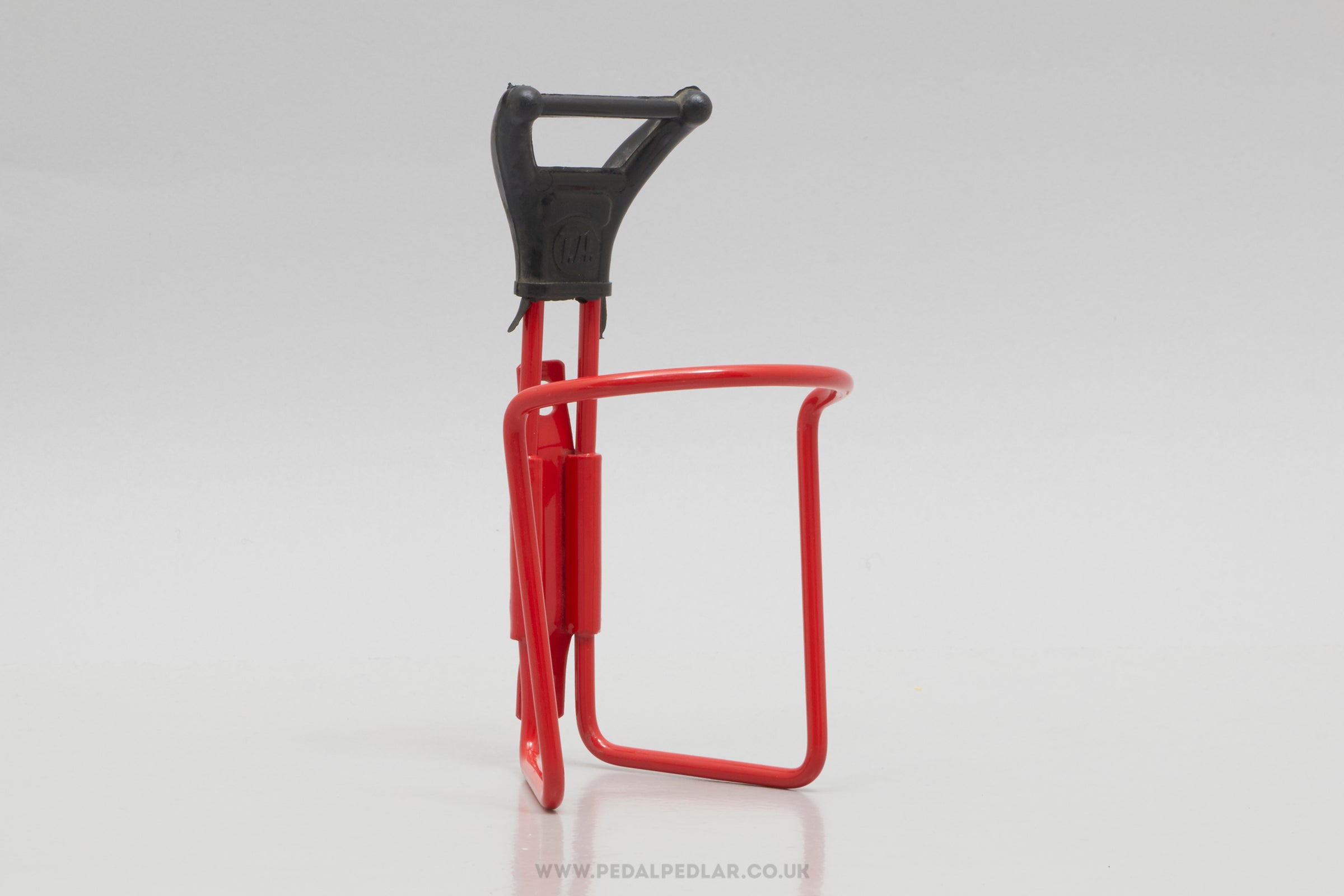


Specialites T.A. 'Plum' (417) NOS Vintage Red Bottle Cage
£19.13 £23.00
✓ Original bottle cage - in production from the 1980s to the 1990s
✓ New old stock! Still unused after all these years
✓ Suitable for historic cycling events such as L'Eroica
✓ Worldwide shipping
Specialites T.A. 'Plum' water bottle cage (or bidon holder if you prefer), hailing from France and in production from the 1980s to the 1990s (yet still new & unused after all this time!). Made from aluminium/plastic and weighing in at 47 grams (the weight and price displayed are for one cage, if we have more in stock you'll be able to add them to your basket). The perfect finishing touch for your vintage bike, but great for bikes of the non-vintage variety too!
This is the final version of the Plum lightweight bottle cage, featuring wrap-around 'sleeves' and punched dimples on the rear of the frame mount, replacing the exposed welded construction of the previous design.
If you're taking part in L'Eroica or a similar vintage event, this is of the correct era, so rest assured the pre-1987 police won't lock you up for having the wrong bottle carrier!
OVERVIEW
Model ID - 417
Production Era - 1980s & 1990s
Country - French
Material - Aluminium / Plastic
Weight - 47 g
Stock Code - D-CAG153V
*New old stock items may have marks from storage over the years, and as we often have multiples they can vary from piece to piece, but they are always genuine new & unused items.
TECHNICAL INFO
Cage Fixing - Frame Fit (Braze-On)
Colour* - Red
Bottle Fit - Standard
*The colour description is just a guide, please check the photos too as we make sure these are as close to the true colour as possible.
-
▼SHIPPING, TAXES & RETURNS
-
We've been safely sending orders around the world since 2010. Orders are carefully packed, sent with tracking & insurance, and normally collected around midday on Tuesdays and Fridays. Larger items may occasionally require an extra day or two to prepare.
We accept returns, please notify us within 14 days and ensure the item arrives back with us no later than 30 days after the order was received.
EU orders under €150 (excluding shipping) - import VAT and the new €3 customs duty are paid as part of your order, so there's nothing further to pay on delivery.
EU orders over €150 (excluding shipping) - import fees are payable to the carrier before delivery, with nothing collected at checkout.
USA orders - import fees are collected at checkout for all orders to the USA, so there won’t be any surprise charges when your order arrives.
Other international orders - local import fees may apply and are not collected by us. Please check your country's import rules before purchasing.
-
▼HELP SECTION
-
Cage Fixing - most bottle cages will be designed to fix to the frame, although some rare older ones mount to the handlebars and/or stem. If your frame doesn't have any bottle cage braze-ons to fix to you'll need a clamp-on bottle cage.
Bottle Fit - almost all cycling bottles measure between 70 - 75 mm in diameter so this is the standard bottle cage size, the only rather rare exceptions are some old Elite bottles that require a 66 mm cage, the more recent oversized ones and of course the funny shaped aero ones that only accept the bottle they were made for.
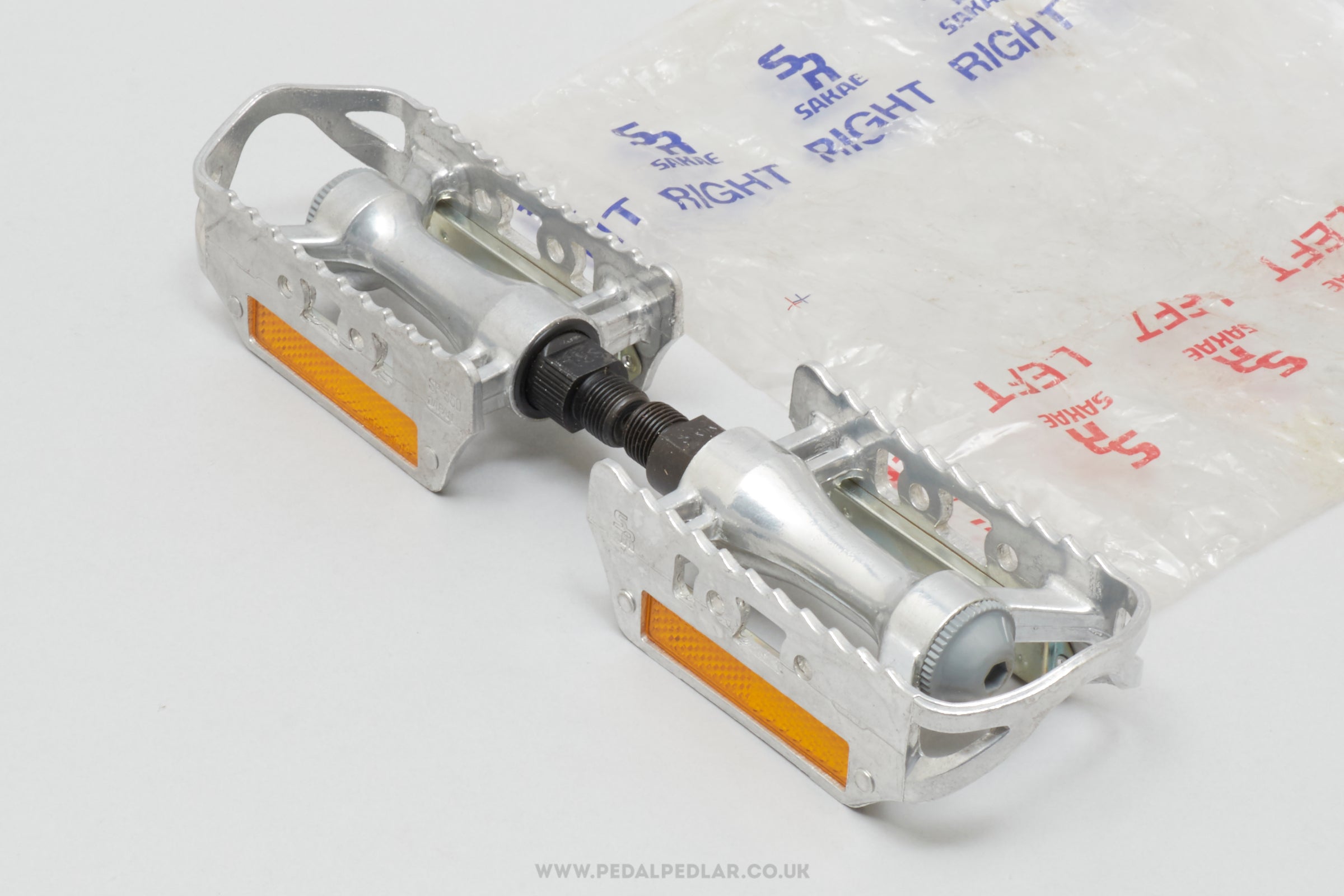


Sakae/Ringyo (SR) Silstar 350 (SP-350) NOS/NIB Vintage Town/City Pedals
£38.25 £45.00
✓ Original pedals - produced in the 1970s
✓ New old stock & still in the original packaging!
✓ Suitable for historic cycling events such as L'Eroica
✓ Worldwide shipping
Sakae/Ringyo (SR) Silstar 350 pedals, hailing from Japan and in production during the 1970s (yet still new & unused after all this time!). Made from aluminium and weighing in at 448 grams. A fine choice for keeping your vintage bike authentic, but also great for any other compatible bike.
If you're taking part in L'Eroica, Anjou Velo, Velo Retro or another similar vintage cycling event, this is fully compliant - so rest assured, the pre-1987 police won't lock you up for having the wrong pedals!
OVERVIEW
Bearing/Race Condition - New Old Stock*
Model ID - SP-350
Production Era - 1970s
Country - Japanese
Material - Aluminium
Weight - 448 g
Stock Code - D-PD95V
*New old stock items may have marks from storage over the years, and as we often have multiples they can vary from piece to piece, but they are always genuine new & unused items.
TECHNICAL INFO
Pedal Type - Town/City
Pedal Threads - Standard (9/16" x 20 TPI)
-
▼SHIPPING, TAXES & RETURNS
-
We've been safely sending orders around the world since 2010. Orders are carefully packed, sent with tracking & insurance, and normally collected around midday on Tuesdays and Fridays. Larger items may occasionally require an extra day or two to prepare.
We accept returns, please notify us within 14 days and ensure the item arrives back with us no later than 30 days after the order was received.
EU orders under €150 (excluding shipping) - import VAT and the new €3 customs duty are paid as part of your order, so there's nothing further to pay on delivery.
EU orders over €150 (excluding shipping) - import fees are payable to the carrier before delivery, with nothing collected at checkout.
USA orders - import fees are collected at checkout for all orders to the USA, so there won’t be any surprise charges when your order arrives.
Other international orders - local import fees may apply and are not collected by us. Please check your country's import rules before purchasing.
-
▼HELP SECTION
-
Pedal Type - this is just a guide to give you an idea of the pedal type, but any pedal can technically be used for any purpose. Track pedals are designed without the pointed 'quill' for safety though, so it's best to only use track pedals for this purpose. Most track pedals, along with quill & aero road pedals are designed to be used with toe clips & straps for best performance.
Pedal Threads - this must match the thread on your cranks. Sometimes it's stamped on the end of the crank arm, but most bikes use a standard thread of 9/16” x 20 tpi. The exceptions being older French bikes, bikes with cheaper one-piece type chainsets and Shimano’s Dyna Drive system (easily identifiable as the pedal holes are about an inch wide!).
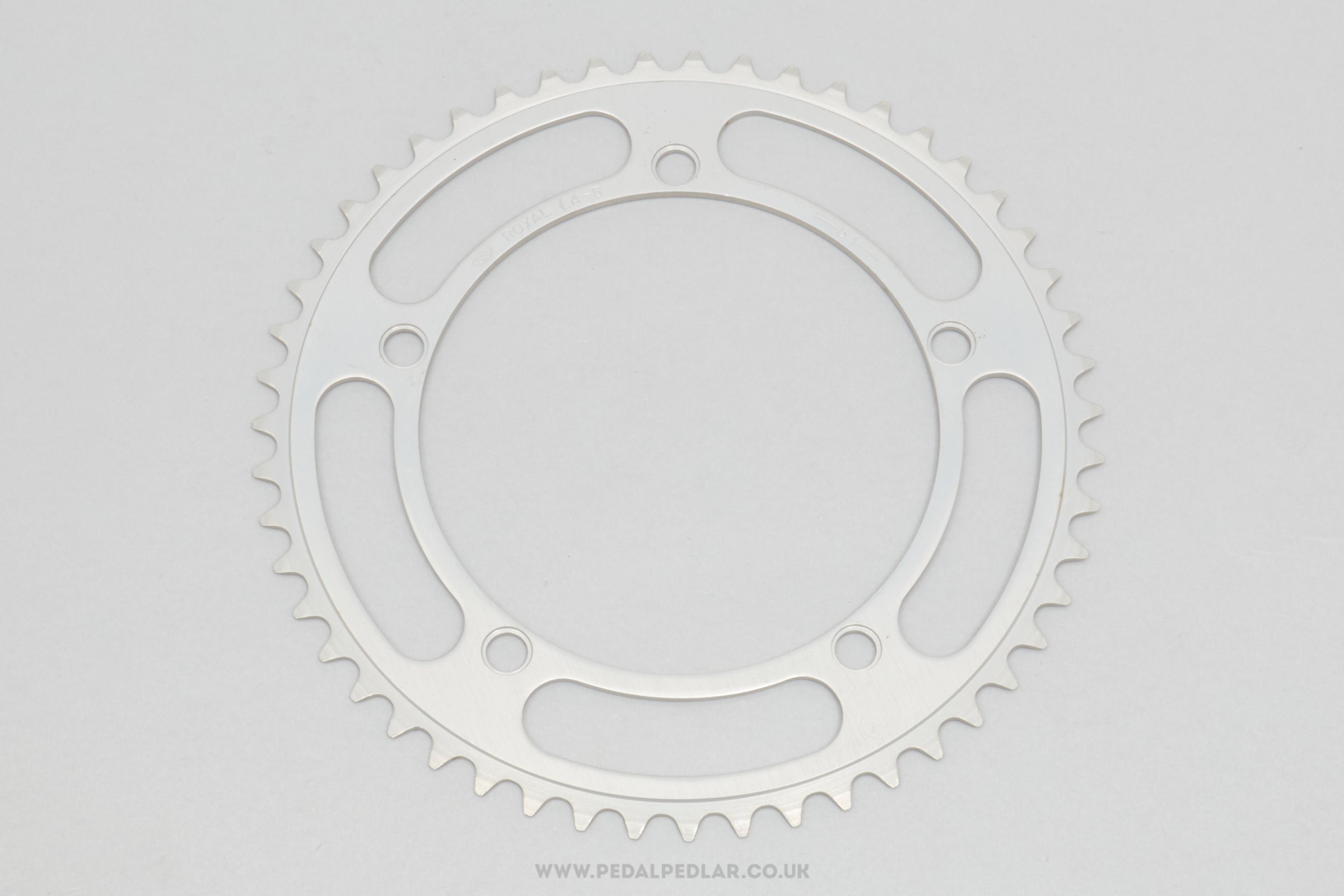


Sakae/Ringyo (SR) Royal (LA-5) NOS Vintage 51T 144 BCD Outer Chainring
£40.50 £45.00
✓ Original part - in production from the 1970s to the 1980s
✓ New old stock! Still unused after all these years
✓ Suitable for historic cycling events such as L'Eroica
✓ Worldwide shipping
Sakae/Ringyo (SR) Royal chainring (or chainwheel if you prefer), hailing from Japan and in production from the 1970s to the 1980s (yet still new & unused after all this time!). Made from aluminium and weighing in at 97 grams. A fine choice for keeping your vintage bike authentic, but also great for any other compatible bike.
If you're taking part in L'Eroica, Anjou Velo, Velo Retro or another similar vintage cycling event, this is fully compliant - so rest assured, the pre-1987 police won't lock you up for having the wrong chainring!
OVERVIEW
Model ID - LA-5
Production Era - 1970s & 1980s
Country - Japanese
Material - Aluminium
Weight - 97 g
Stock Code - D-CRO60V
*New old stock items may have marks from storage over the years, and as we often have multiples they can vary from piece to piece, but they are always genuine new & unused items.
TECHNICAL INFO
Tooth Count - 51
Between Adjacent Bolt Holes - 84.6 mm
BCD - 144 BCD
Bolt Count - 5-Bolt
Chain Width - 3/32" (Standard)
Intended Speed* - 5 Speed, 6 Speed, 7 Speed
-
▼SHIPPING, TAXES & RETURNS
-
We've been safely sending orders around the world since 2010. Orders are carefully packed, sent with tracking & insurance, and normally collected around midday on Tuesdays and Fridays. Larger items may occasionally require an extra day or two to prepare.
We accept returns, please notify us within 14 days and ensure the item arrives back with us no later than 30 days after the order was received.
EU orders under €150 (excluding shipping) - import VAT and the new €3 customs duty are paid as part of your order, so there's nothing further to pay on delivery.
EU orders over €150 (excluding shipping) - import fees are payable to the carrier before delivery, with nothing collected at checkout.
USA orders - import fees are collected at checkout for all orders to the USA, so there won’t be any surprise charges when your order arrives.
Other international orders - local import fees may apply and are not collected by us. Please check your country's import rules before purchasing.
-
▼HELP SECTION
-
Tooth Count - the number of teeth on the chainring, the higher the number the harder the gear.
Between Adjacent Bolt Holes - the measurement from the centre of any bolt hole to the centre of an adjacent one, if this measurement is the same as that of your crankset and the bolt count is the same then the chainring should fit.
BCD - stands for Bolt Circle Diameter (sometimes referred to as PCD - Pitch Circle Diameter) and is the technical way to determine whether the chainring fits your crankset. To calculate, multiply the distance between adjacent holes (in mm) by 1.709 (you’ll likely need to round the resulting number up or down a little).
Bolt Count - the number of bolts securing the chainring to the chainset. As with the BCD, this must be the same as your chainset.
Chain Width - 3/32” is the standard width for double and triple chainsets, wherease 1/8” chainrings are only found on single ring chainsets, generally for track / singlespeed use and can only be used with a wide 1/8" chain.
Intended Speed - the number of cogs at the back the chainring was designed to be used with. We refer to it as ‘intended’ speed as most double and triple chainsets will actually work with different speeds than originally intended, but the further away you get from the intended speed the more likely you are to experience minor setup issues. The exception being some chainrings intended for 10 speed use or higher, with these it’s better to stick to the intended speed.
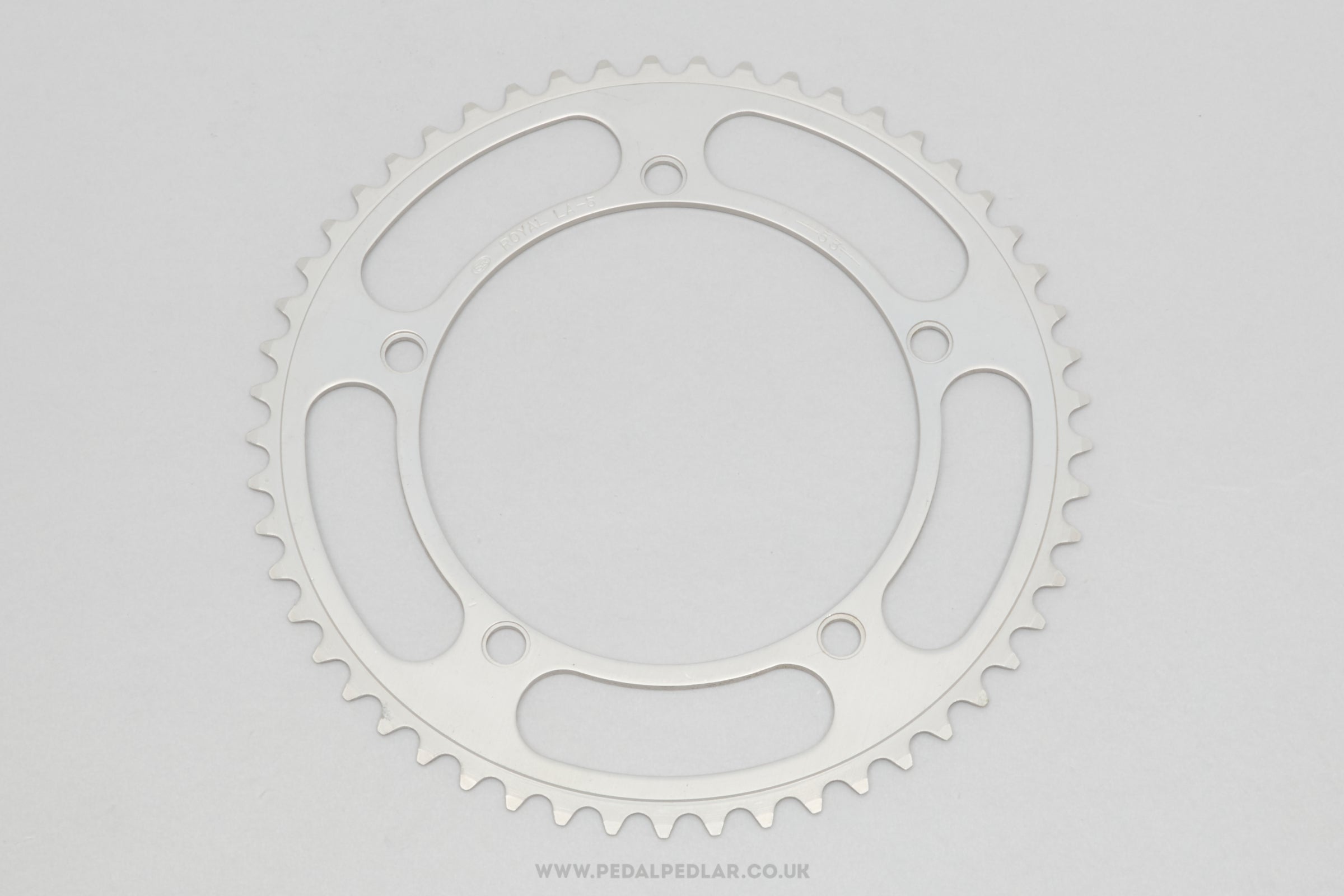


Sakae/Ringyo (SR) Royal (LA-5) NOS Vintage 53T 144 BCD Outer Chainring
£45.00 £50.00
✓ Original part - in production from the 1970s to the 1980s
✓ New old stock! Still unused after all these years
✓ Suitable for historic cycling events such as L'Eroica
✓ Worldwide shipping
Sakae/Ringyo (SR) Royal chainring (or chainwheel if you prefer), hailing from Japan and in production from the 1970s to the 1980s (yet still new & unused after all this time!). Made from aluminium and weighing in at 104 grams. A fine choice for keeping your vintage bike authentic, but also great for any other compatible bike.
If you're taking part in L'Eroica, Anjou Velo, Velo Retro or another similar vintage cycling event, this is fully compliant - so rest assured, the pre-1987 police won't lock you up for having the wrong chainring!
OVERVIEW
Model ID - LA-5
Production Era - 1970s & 1980s
Country - Japanese
Material - Aluminium
Weight - 104 g
Stock Code - D-CRO61V
*New old stock items may have marks from storage over the years, and as we often have multiples they can vary from piece to piece, but they are always genuine new & unused items.
TECHNICAL INFO
Tooth Count - 53
Between Adjacent Bolt Holes - 84.6 mm
BCD - 144 BCD
Bolt Count - 5-Bolt
Chain Width - 3/32" (Standard)
Intended Speed* - 5 Speed, 6 Speed, 7 Speed
-
▼SHIPPING, TAXES & RETURNS
-
We've been safely sending orders around the world since 2010. Orders are carefully packed, sent with tracking & insurance, and normally collected around midday on Tuesdays and Fridays. Larger items may occasionally require an extra day or two to prepare.
We accept returns, please notify us within 14 days and ensure the item arrives back with us no later than 30 days after the order was received.
EU orders under €150 (excluding shipping) - import VAT and the new €3 customs duty are paid as part of your order, so there's nothing further to pay on delivery.
EU orders over €150 (excluding shipping) - import fees are payable to the carrier before delivery, with nothing collected at checkout.
USA orders - import fees are collected at checkout for all orders to the USA, so there won’t be any surprise charges when your order arrives.
Other international orders - local import fees may apply and are not collected by us. Please check your country's import rules before purchasing.
-
▼HELP SECTION
-
Tooth Count - the number of teeth on the chainring, the higher the number the harder the gear.
Between Adjacent Bolt Holes - the measurement from the centre of any bolt hole to the centre of an adjacent one, if this measurement is the same as that of your crankset and the bolt count is the same then the chainring should fit.
BCD - stands for Bolt Circle Diameter (sometimes referred to as PCD - Pitch Circle Diameter) and is the technical way to determine whether the chainring fits your crankset. To calculate, multiply the distance between adjacent holes (in mm) by 1.709 (you’ll likely need to round the resulting number up or down a little).
Bolt Count - the number of bolts securing the chainring to the chainset. As with the BCD, this must be the same as your chainset.
Chain Width - 3/32” is the standard width for double and triple chainsets, wherease 1/8” chainrings are only found on single ring chainsets, generally for track / singlespeed use and can only be used with a wide 1/8" chain.
Intended Speed - the number of cogs at the back the chainring was designed to be used with. We refer to it as ‘intended’ speed as most double and triple chainsets will actually work with different speeds than originally intended, but the further away you get from the intended speed the more likely you are to experience minor setup issues. The exception being some chainrings intended for 10 speed use or higher, with these it’s better to stick to the intended speed.
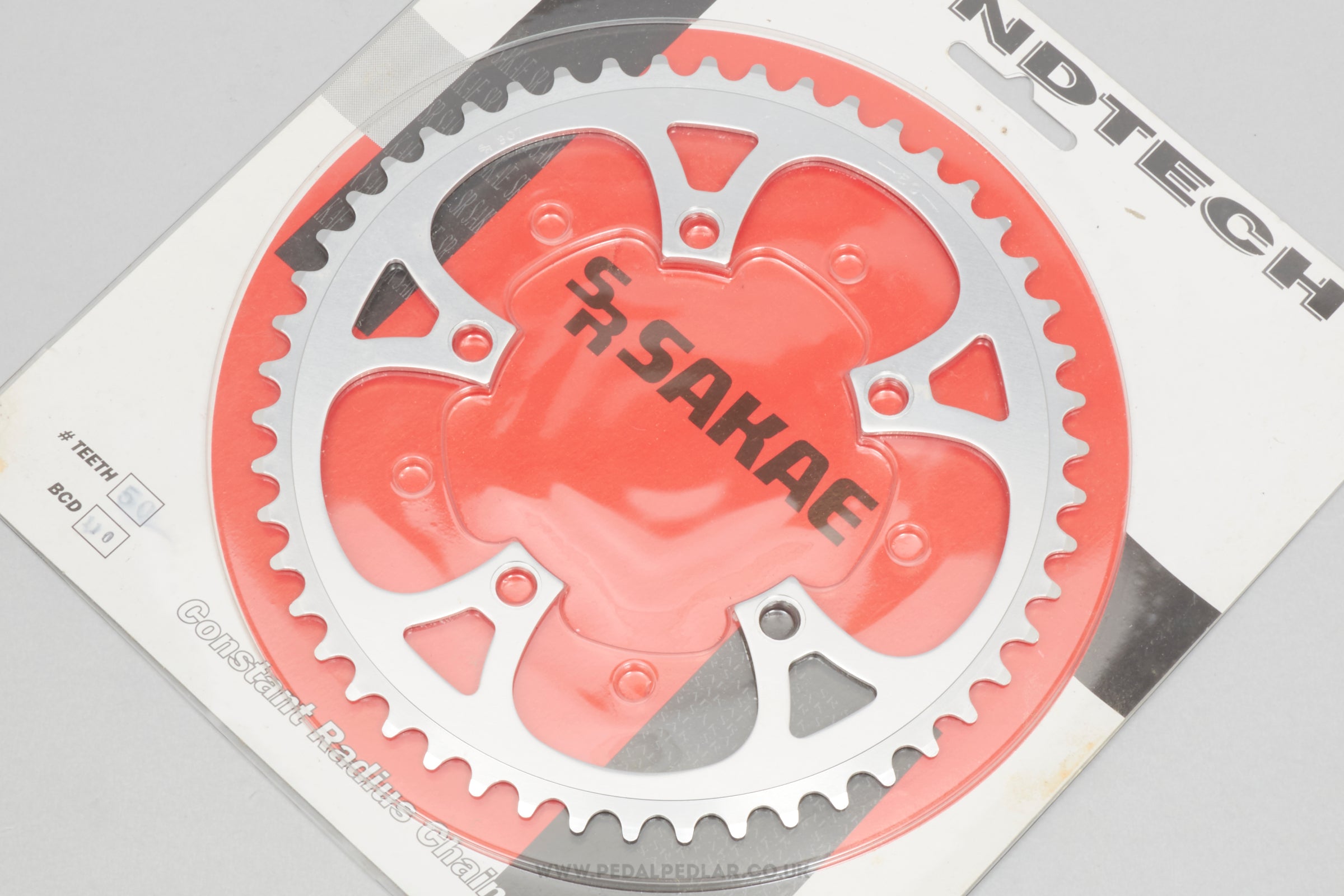


Sakae/Ringyo (SR) Roundtech (SR-307) NOS/NIB Vintage 50T 110 BCD Outer Chainring
£36.00 £40.00
✓ Original part - produced in the 1980s
✓ New old stock & still in the original packaging!
✓ Suitable for historic cycling events such as L'Eroica
✓ Worldwide shipping
Sakae/Ringyo (SR) Roundtech chainring (or chainwheel if you prefer), hailing from Japan and in production during the 1980s (yet still new & unused after all this time!). Made from aluminium and weighing in at 154 grams. A fine choice for keeping your vintage bike authentic, but also great for any other compatible bike.
If you're taking part in L'Eroica, Anjou Velo, Velo Retro or another similar vintage cycling event, this is fully compliant - so rest assured, the pre-1987 police won't lock you up for having the wrong chainring!
OVERVIEW
Model ID - SR-307
Production Era - 1980s
Country - Japanese
Material - Aluminium
Weight - 154 g
Stock Code - D-CRO63V
*New old stock items may have marks from storage over the years, and as we often have multiples they can vary from piece to piece, but they are always genuine new & unused items.
TECHNICAL INFO
Tooth Count - 50
Between Adjacent Bolt Holes - 64.7 mm
BCD - 110 BCD
Bolt Count - 5-Bolt
Chain Width - 3/32" (Standard)
Intended Speed* - 5 Speed, 6 Speed, 7 Speed
-
▼SHIPPING, TAXES & RETURNS
-
We've been safely sending orders around the world since 2010. Orders are carefully packed, sent with tracking & insurance, and normally collected around midday on Tuesdays and Fridays. Larger items may occasionally require an extra day or two to prepare.
We accept returns, please notify us within 14 days and ensure the item arrives back with us no later than 30 days after the order was received.
EU orders under €150 (excluding shipping) - import VAT and the new €3 customs duty are paid as part of your order, so there's nothing further to pay on delivery.
EU orders over €150 (excluding shipping) - import fees are payable to the carrier before delivery, with nothing collected at checkout.
USA orders - import fees are collected at checkout for all orders to the USA, so there won’t be any surprise charges when your order arrives.
Other international orders - local import fees may apply and are not collected by us. Please check your country's import rules before purchasing.
-
▼HELP SECTION
-
Tooth Count - the number of teeth on the chainring, the higher the number the harder the gear.
Between Adjacent Bolt Holes - the measurement from the centre of any bolt hole to the centre of an adjacent one, if this measurement is the same as that of your crankset and the bolt count is the same then the chainring should fit.
BCD - stands for Bolt Circle Diameter (sometimes referred to as PCD - Pitch Circle Diameter) and is the technical way to determine whether the chainring fits your crankset. To calculate, multiply the distance between adjacent holes (in mm) by 1.709 (you’ll likely need to round the resulting number up or down a little).
Bolt Count - the number of bolts securing the chainring to the chainset. As with the BCD, this must be the same as your chainset.
Chain Width - 3/32” is the standard width for double and triple chainsets, wherease 1/8” chainrings are only found on single ring chainsets, generally for track / singlespeed use and can only be used with a wide 1/8" chain.
Intended Speed - the number of cogs at the back the chainring was designed to be used with. We refer to it as ‘intended’ speed as most double and triple chainsets will actually work with different speeds than originally intended, but the further away you get from the intended speed the more likely you are to experience minor setup issues. The exception being some chainrings intended for 10 speed use or higher, with these it’s better to stick to the intended speed.
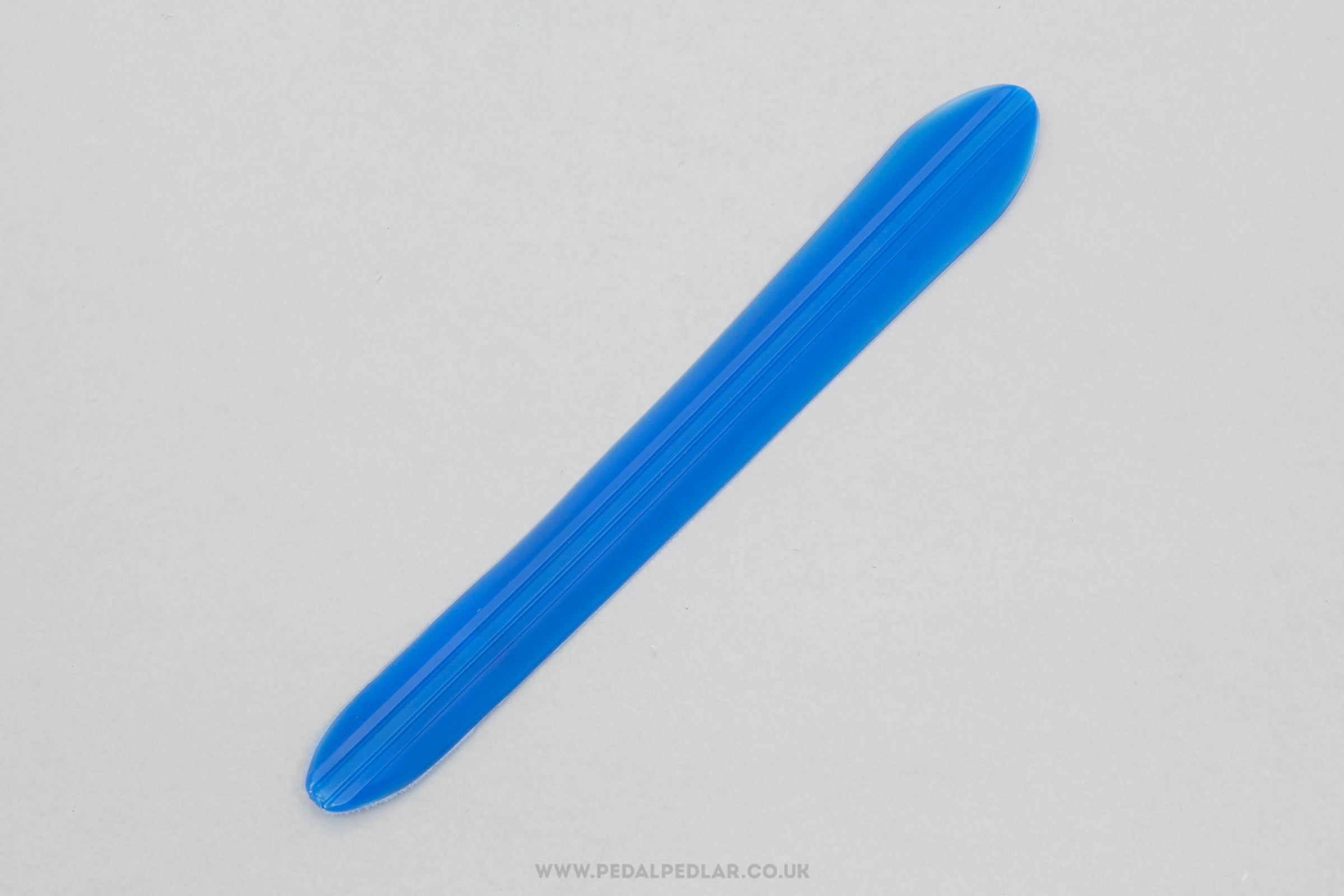


Minoura Chain Plate NOS/NIB Classic Blue Chainstay Frame Protector
£9.00 £10.00
✓ Original frame protection - produced in the 1990s
✓ New old stock & still in the original packaging!
✓ Worldwide shipping
Minoura Chain Plate chainstay protector, hailing from Japan and in production during the 1990s (yet still new & unused after all this time!). An excellent choice for classic cycling enthusiasts, but great for cyclists of the non-classic variety too!
OVERVIEW
Production Era - 1990s
Country - Japanese
Material - Plastic
Weight - 8 g
Stock Code - D-PRC5C
*New old stock items may have marks from storage over the years, and as we often have multiples they can vary from piece to piece, but they are always genuine new & unused items.
TECHNICAL INFO
Colour* - Blue
Length - 16.5 cm
Backing - Adhesive
-
▼SHIPPING, TAXES & RETURNS
-
We've been safely sending orders around the world since 2010. Orders are carefully packed, sent with tracking & insurance, and normally collected around midday on Tuesdays and Fridays. Larger items may occasionally require an extra day or two to prepare.
We accept returns, please notify us within 14 days and ensure the item arrives back with us no later than 30 days after the order was received.
EU orders under €150 (excluding shipping) - import VAT and the new €3 customs duty are paid as part of your order, so there's nothing further to pay on delivery.
EU orders over €150 (excluding shipping) - import fees are payable to the carrier before delivery, with nothing collected at checkout.
USA orders - import fees are collected at checkout for all orders to the USA, so there won’t be any surprise charges when your order arrives.
Other international orders - local import fees may apply and are not collected by us. Please check your country's import rules before purchasing.
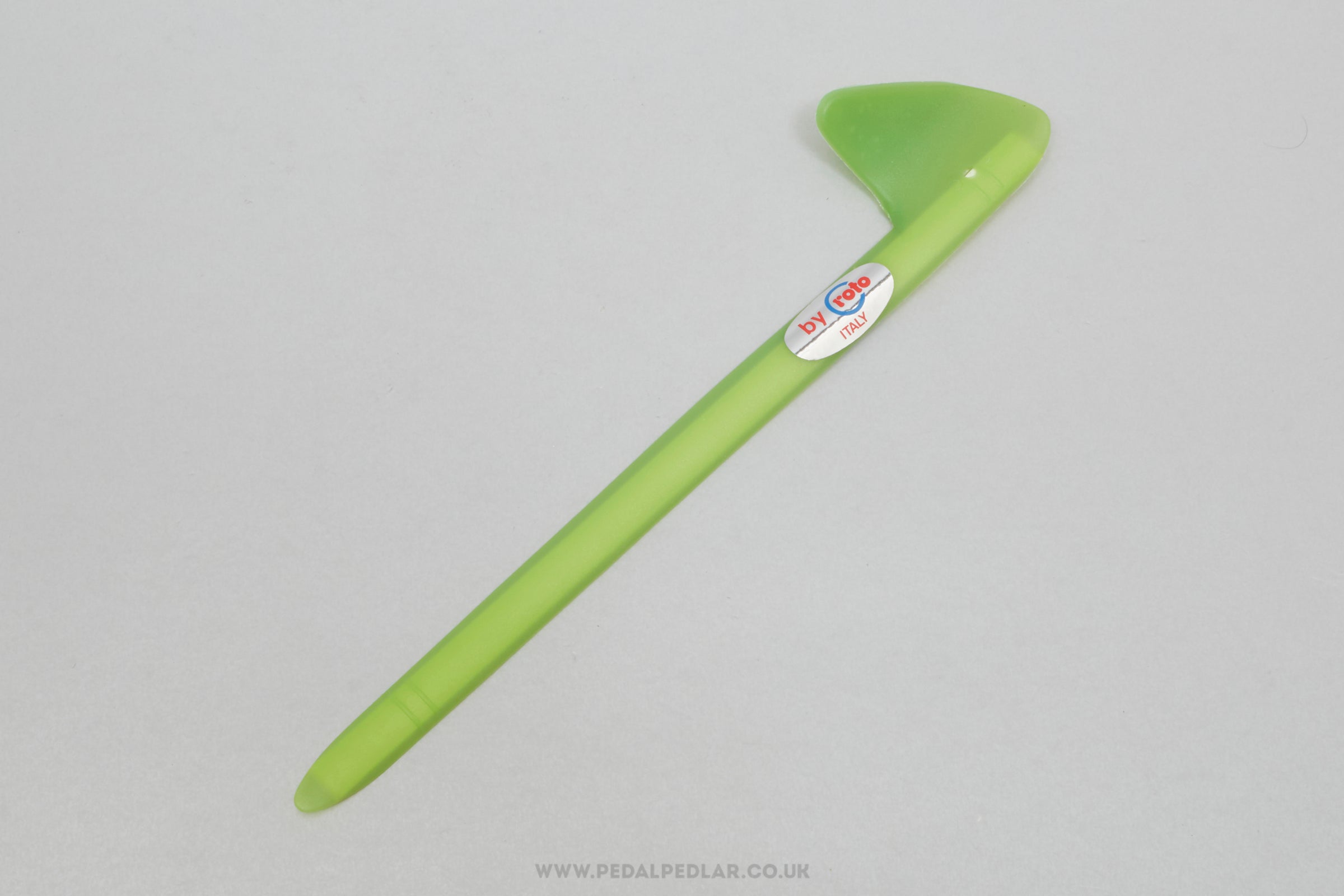


Roto Shark Fin NOS/NIB Classic Neon Green Chainstay Frame Protector
£13.50 £15.00
✓ Original chain stay protection - produced in the 1990s
✓ New old stock & still in the original packaging!
✓ Worldwide shipping
Roto chainstay protector (or frame guard if you prefer), hailing from Italy and in production during the 1990s (yet still new & unused after all this time!). An excellent choice for classic cycling enthusiasts, but great for cyclists of the non-classic variety too!
OVERVIEW
Production Era - 1990s
Country - Italian
Material - Plastic
Weight - 16 g
Stock Code - D-PRC7C
*New old stock items may have marks from storage over the years, and as we often have multiples they can vary from piece to piece, but they are always genuine new & unused items.
TECHNICAL INFO
Colour* - Neon Green
Length - 23.5 cm
Backing - Adhesive
-
▼SHIPPING, TAXES & RETURNS
-
We've been safely sending orders around the world since 2010. Orders are carefully packed, sent with tracking & insurance, and normally collected around midday on Tuesdays and Fridays. Larger items may occasionally require an extra day or two to prepare.
We accept returns, please notify us within 14 days and ensure the item arrives back with us no later than 30 days after the order was received.
EU orders under €150 (excluding shipping) - import VAT and the new €3 customs duty are paid as part of your order, so there's nothing further to pay on delivery.
EU orders over €150 (excluding shipping) - import fees are payable to the carrier before delivery, with nothing collected at checkout.
USA orders - import fees are collected at checkout for all orders to the USA, so there won’t be any surprise charges when your order arrives.
Other international orders - local import fees may apply and are not collected by us. Please check your country's import rules before purchasing.
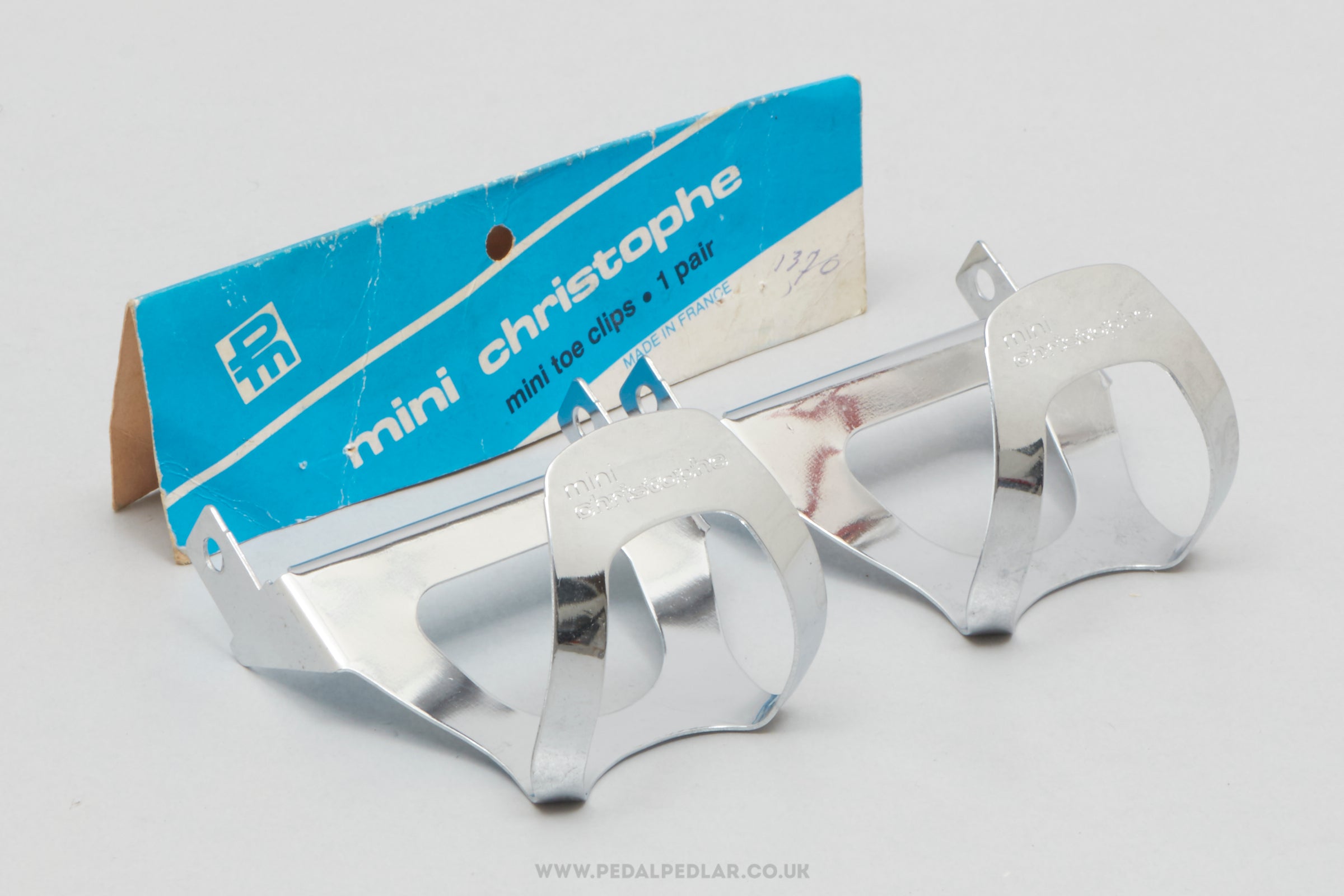


Christophe 47 M Mini NOS/NIB Size M Vintage Side Fixing Steel Toe Clips
£25.50 £30.00
✓ Original toe clips - in production from the 1980s to the 1990s
✓ New old stock & still in the original packaging!
✓ Suitable for historic cycling events such as L'Eroica
✓ Worldwide shipping
Christophe 47 M toe clips (or pedal cages if you prefer), hailing from France and in production from the 1980s to the 1990s (yet still new & unused after all this time!). Made from steel and weighing in at 115 grams. A fine choice for keeping your vintage bike authentic, but also great for any other compatible bike.
If you're taking part in L'Eroica or any other vintage event, these are fully compliant - so rest assured, the pre-1987 police won't lock you up for having the wrong toe clips!
OVERVIEW
Condition - New Old Stock - In Original Packaging*
Production Era - 1980s & 1990s
Material - Steel
Weight - 115 g
Stock Code - D-TC84V
*New old stock items may have marks from storage over the years, and as we often have multiples they can vary from piece to piece, but they are always genuine new & unused items.
**This is a guide based on traditional toe clip sizing for cycling shoes of the time, if you ride with chunkier shoes then we'd recommend going for a larger size. Please use this as a guide only and if possible use the length measurement provided to compare with toe clips you know fit well.
TECHNICAL INFO
Toe Clip Size - M
Pedal Fixing - Side Fixing
Length (Fixing End to Toe End)* - 5.5 cm
Distance Between Fixing Bolts (ctc) - 67 mm
-
▼SHIPPING, TAXES & RETURNS
-
We've been safely sending orders around the world since 2010. Orders are carefully packed, sent with tracking & insurance, and normally collected around midday on Tuesdays and Fridays. Larger items may occasionally require an extra day or two to prepare.
We accept returns, please notify us within 14 days and ensure the item arrives back with us no later than 30 days after the order was received.
EU orders under €150 (excluding shipping) - import VAT and the new €3 customs duty are paid as part of your order, so there's nothing further to pay on delivery.
EU orders over €150 (excluding shipping) - import fees are payable to the carrier before delivery, with nothing collected at checkout.
USA orders - import fees are collected at checkout for all orders to the USA, so there won’t be any surprise charges when your order arrives.
Other international orders - local import fees may apply and are not collected by us. Please check your country's import rules before purchasing.
-
▼HELP SECTION
-
Pedal Fixing - 'standard' toe clips fix to the front of the pedals, most will be of this type and work with both quill & platform pedals providing they have mounting holes in the correct place. There are also 'aero' ones that attach to the top, and side fixing versions too. 'Wide platform' fixings are similar to standard ones but the fixing holes are almost 3 inches apart.
Toe Strap Fit - most toe clips are designed to accept a single toe strap, but there are some less common ones that allow two toe straps to be fitted.
Length - this is measured from the fixing end to the toe end at the most extreme points, the same way the manufacturers measure and we use this to recommend the fit if there's no size stamped on them. All length measurements are rounded to the nearest 0.5 cm.
Distance Between Fixing Bolts - we measure this distance from the centre of one hole to the next (ctc), this usually only needs to be close, not exact, providing the holes on the toe clips are oblong shaped to allow a decent amount of wiggle room (most toe clips are made this way).
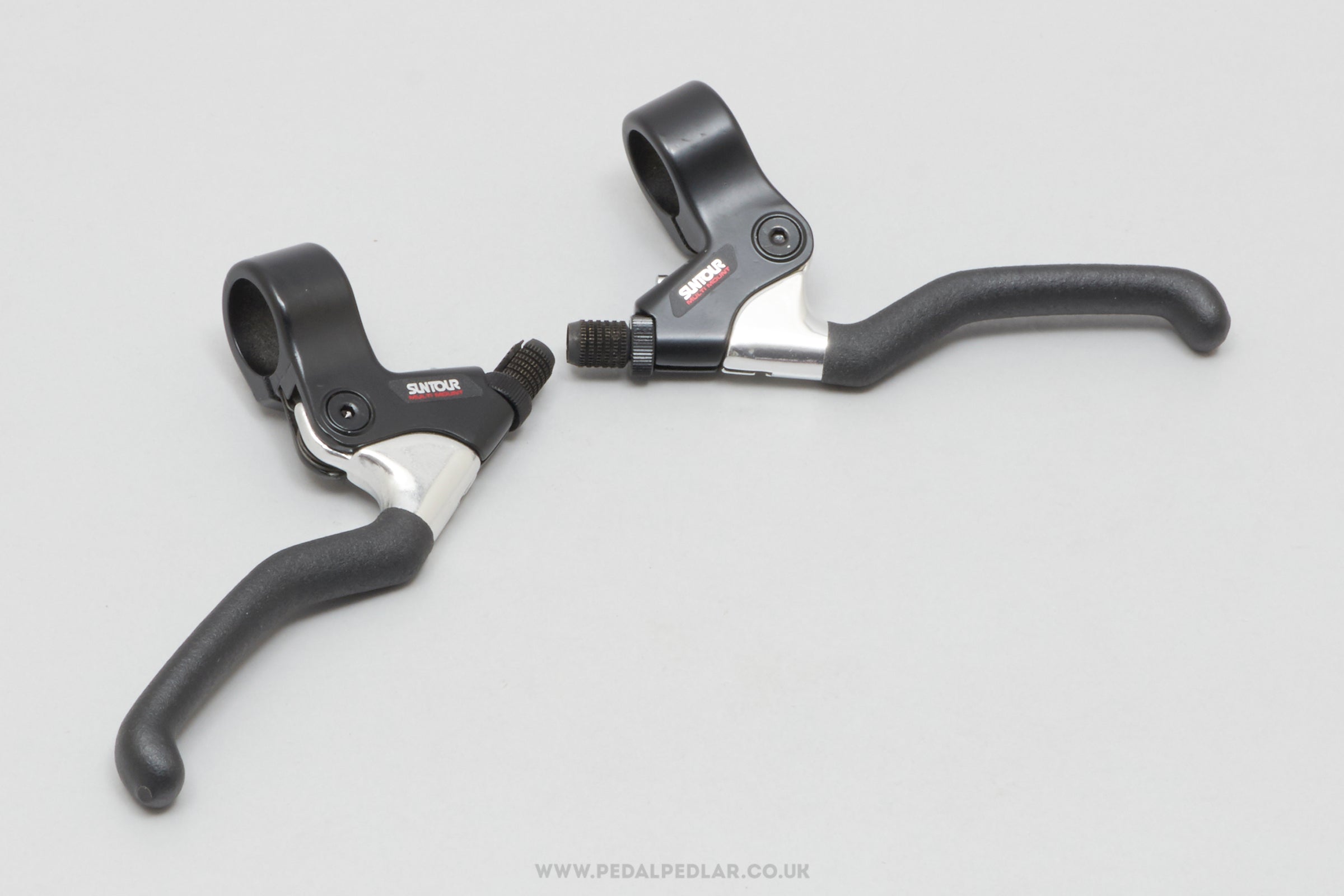


Suntour XCD (BL-XD10-S) Multi Mount NOS Vintage MTB Brake Levers
£72.25 £85.00
✓ Original levers - in production from the 1980s to the 1990s
✓ New old stock! Still unused after all these years
✓ Worldwide shipping
Suntour XCD flat bar brake levers (or handles if you prefer), hailing from Japan and in production from the 1980s to the 1990s (yet still new & unused after all this time!). Made from aluminium/rubber and weighing in at 222 grams. A fine choice for keeping your vintage bike authentic, but also great for any other compatible bike.
OVERVIEW
Model ID - BL-XD10-S
Production Era - 1980s & 1990s
Country - Japanese
Material - Aluminium / Rubber
Weight - 222 g
Stock Code - D-LEV-F11V
*New old stock items may have marks from storage over the years, and as we often have multiples they can vary from piece to piece, but they are always genuine new & unused items.
TECHNICAL INFO
Bike Type - MTB
Brake Type - Cantilevers
Bar Clamp Size - 22.2 mm
-
▼SHIPPING, TAXES & RETURNS
-
We've been safely sending orders around the world since 2010. Orders are carefully packed, sent with tracking & insurance, and normally collected around midday on Tuesdays and Fridays. Larger items may occasionally require an extra day or two to prepare.
We accept returns, please notify us within 14 days and ensure the item arrives back with us no later than 30 days after the order was received.
EU orders under €150 (excluding shipping) - import VAT and the new €3 customs duty are paid as part of your order, so there's nothing further to pay on delivery.
EU orders over €150 (excluding shipping) - import fees are payable to the carrier before delivery, with nothing collected at checkout.
USA orders - import fees are collected at checkout for all orders to the USA, so there won’t be any surprise charges when your order arrives.
Other international orders - local import fees may apply and are not collected by us. Please check your country's import rules before purchasing.
-
▼HELP SECTION
-
Bike Type - this is just a guide, any brake levers can technically be used on any bike as long as everything's compatible.
Brake Type - if you’re running direct pull cantilevers (V-Brakes), you’ll need compatible brake levers. For calipers, cantilevers and mini V-brakes you’ll need levers designed to be used with these as the cable pull is different.
Bar Clamp Size - this should be close to the outside diameter of your handlebars at the point the brake levers will be fitted. 23.8 mm is standard for drop bars and 22.2 mm is standard for 'flat' bars (including risers & swept-back types), but they can differ so this should be checked.


Mafac Ville (715 / VDA B) Vintage Randonneur Brake Levers
£40.50 £45.00
✓ Original levers - in production from the 1970s to the 1980s
✓ Suitable for historic cycling events such as L'Eroica
✓ Professionally checked & cleaned
✓ Worldwide shipping
Mafac Ville flat bar brake levers (or handles if you prefer), hailing from France and in production from the 1970s to the 1980s. Made from aluminium/resin and weighing in at 148 grams. A fine choice for keeping your vintage bike authentic, but also great for any other compatible bike.
If you're taking part in L'Eroica or any other vintage event, these are fully compliant - so rest assured, the pre-1987 police won't lock you up for having the wrong brake levers!
The brake levers have been cleaned, checked by one of our mechanics and graded as good condition, but do take a good look at the detailed photos so you can see the cosmetic condition before you buy.OVERVIEW
Model ID - 715 / VDA B
Production Era - 1970s & 1980s
Country - French
Material - Aluminium / Resin
Weight - 148 g
Stock Code - U-LEV-F14V
TECHNICAL INFO
Bike Type - Randonneur
Brake Type - Calipers
Bar Clamp Size - 23.8 mm
-
▼SHIPPING, TAXES & RETURNS
-
We've been safely sending orders around the world since 2010. Orders are carefully packed, sent with tracking & insurance, and normally collected around midday on Tuesdays and Fridays. Larger items may occasionally require an extra day or two to prepare.
We accept returns, please notify us within 14 days and ensure the item arrives back with us no later than 30 days after the order was received.
EU orders under €150 (excluding shipping) - import VAT and the new €3 customs duty are paid as part of your order, so there's nothing further to pay on delivery.
EU orders over €150 (excluding shipping) - import fees are payable to the carrier before delivery, with nothing collected at checkout.
USA orders - import fees are collected at checkout for all orders to the USA, so there won’t be any surprise charges when your order arrives.
Other international orders - local import fees may apply and are not collected by us. Please check your country's import rules before purchasing.
-
▼HELP SECTION
-
Bike Type - this is just a guide, any brake levers can technically be used on any bike as long as everything's compatible.
Brake Type - if you’re running direct pull cantilevers (V-Brakes), you’ll need compatible brake levers. For calipers, cantilevers and mini V-brakes you’ll need levers designed to be used with these as the cable pull is different.
Bar Clamp Size - this should be close to the outside diameter of your handlebars at the point the brake levers will be fitted. 23.8 mm is standard for drop bars and 22.2 mm is standard for 'flat' bars (including risers & swept-back types), but they can differ so this should be checked.


Tektro Classic MTB / BMX Brake Levers
£22.50 £25.00
✓ Original levers - produced in the 1990s
✓ Professionally checked & cleaned
✓ Worldwide shipping
Tektro flat bar brake levers (or handles if you prefer), hailing from Taiwan and in production during the 1990s. Made from aluminium and weighing in at 192 grams. A fine choice for keeping your classic bike authentic, but also great for any other compatible bike.
The brake levers have been cleaned, checked by one of our mechanics and graded as good condition, but do take a good look at the detailed photos so you can see the cosmetic condition before you buy.OVERVIEW
Production Era - 1990s
Country - Taiwanese
Material - Aluminium
Weight - 192 g
Stock Code - U-LEV-F16C
TECHNICAL INFO
Bike Type - MTB / BMX
Brake Type - Calipers, Cantilevers, Mini V-Brakes
Bar Clamp Size - 22.2 mm
-
▼SHIPPING, TAXES & RETURNS
-
We've been safely sending orders around the world since 2010. Orders are carefully packed, sent with tracking & insurance, and normally collected around midday on Tuesdays and Fridays. Larger items may occasionally require an extra day or two to prepare.
We accept returns, please notify us within 14 days and ensure the item arrives back with us no later than 30 days after the order was received.
EU orders under €150 (excluding shipping) - import VAT and the new €3 customs duty are paid as part of your order, so there's nothing further to pay on delivery.
EU orders over €150 (excluding shipping) - import fees are payable to the carrier before delivery, with nothing collected at checkout.
USA orders - import fees are collected at checkout for all orders to the USA, so there won’t be any surprise charges when your order arrives.
Other international orders - local import fees may apply and are not collected by us. Please check your country's import rules before purchasing.
-
▼HELP SECTION
-
Bike Type - this is just a guide, any brake levers can technically be used on any bike as long as everything's compatible.
Brake Type - if you’re running direct pull cantilevers (V-Brakes), you’ll need compatible brake levers. For calipers, cantilevers and mini V-brakes you’ll need levers designed to be used with these as the cable pull is different.
Bar Clamp Size - this should be close to the outside diameter of your handlebars at the point the brake levers will be fitted. 23.8 mm is standard for drop bars and 22.2 mm is standard for 'flat' bars (including risers & swept-back types), but they can differ so this should be checked.


Vintage Randonneur Brake Levers
£67.50 £75.00
✓ Original levers - in production from the 1940s to the 1950s
✓ Professionally checked & cleaned
✓ Worldwide shipping
Unbranded vintage flat bar brake levers (or handles if you prefer), most likely in production from the 1940s to the 1950s. Made from aluminium and weighing in at 145 grams. A fine choice for keeping your vintage bike authentic, but also great for any other compatible bike.
The brake levers have been cleaned, checked by one of our mechanics and graded as good condition, but do take a good look at the detailed photos so you can see the cosmetic condition before you buy.OVERVIEW
Production Era - 1940s & 1950s
Material - Aluminium
Weight - 145 g
Stock Code - U-LEV-F18V
TECHNICAL INFO
Bike Type - Randonneur
Brake Type - Calipers, Cantilevers, Mini V-Brakes
Bar Clamp Size - 23.5 mm
-
▼SHIPPING, TAXES & RETURNS
-
We've been safely sending orders around the world since 2010. Orders are carefully packed, sent with tracking & insurance, and normally collected around midday on Tuesdays and Fridays. Larger items may occasionally require an extra day or two to prepare.
We accept returns, please notify us within 14 days and ensure the item arrives back with us no later than 30 days after the order was received.
EU orders under €150 (excluding shipping) - import VAT and the new €3 customs duty are paid as part of your order, so there's nothing further to pay on delivery.
EU orders over €150 (excluding shipping) - import fees are payable to the carrier before delivery, with nothing collected at checkout.
USA orders - import fees are collected at checkout for all orders to the USA, so there won’t be any surprise charges when your order arrives.
Other international orders - local import fees may apply and are not collected by us. Please check your country's import rules before purchasing.
-
▼HELP SECTION
-
Bike Type - this is just a guide, any brake levers can technically be used on any bike as long as everything's compatible.
Brake Type - if you’re running direct pull cantilevers (V-Brakes), you’ll need compatible brake levers. For calipers, cantilevers and mini V-brakes you’ll need levers designed to be used with these as the cable pull is different.
Bar Clamp Size - this should be close to the outside diameter of your handlebars at the point the brake levers will be fitted. 23.8 mm is standard for drop bars and 22.2 mm is standard for 'flat' bars (including risers & swept-back types), but they can differ so this should be checked.


CLB Route Speciale 'Ville' Vintage Randonneur Brake Levers
£58.50 £65.00
✓ Original levers - in production from the 1960s to the 1970s
✓ Suitable for historic cycling events such as L'Eroica
✓ Professionally checked & cleaned
✓ Worldwide shipping
CLB Route Speciale flat bar brake levers (or handles if you prefer), hailing from France and in production from the 1960s to the 1970s. Made from aluminium and weighing in at 182 grams. A fine choice for keeping your vintage bike authentic, but also great for any other compatible bike.
If you're taking part in L'Eroica or any other vintage event, these are fully compliant - so rest assured, the pre-1987 police won't lock you up for having the wrong brake levers!
The brake levers have been cleaned, checked by one of our mechanics and graded as good condition, but do take a good look at the detailed photos so you can see the cosmetic condition before you buy.OVERVIEW
Production Era - 1960s & 1970s
Country - French
Material - Aluminium
Weight - 182 g
Stock Code - U-LEV-F20V
NB - One pivot bolt not original.
TECHNICAL INFO
Bike Type - Randonneur
Brake Type - Calipers, Cantilevers, Mini V-Brakes
Bar Clamp Size - 23.5 mm
-
▼SHIPPING, TAXES & RETURNS
-
We've been safely sending orders around the world since 2010. Orders are carefully packed, sent with tracking & insurance, and normally collected around midday on Tuesdays and Fridays. Larger items may occasionally require an extra day or two to prepare.
We accept returns, please notify us within 14 days and ensure the item arrives back with us no later than 30 days after the order was received.
EU orders under €150 (excluding shipping) - import VAT and the new €3 customs duty are paid as part of your order, so there's nothing further to pay on delivery.
EU orders over €150 (excluding shipping) - import fees are payable to the carrier before delivery, with nothing collected at checkout.
USA orders - import fees are collected at checkout for all orders to the USA, so there won’t be any surprise charges when your order arrives.
Other international orders - local import fees may apply and are not collected by us. Please check your country's import rules before purchasing.
-
▼HELP SECTION
-
Bike Type - this is just a guide, any brake levers can technically be used on any bike as long as everything's compatible.
Brake Type - if you’re running direct pull cantilevers (V-Brakes), you’ll need compatible brake levers. For calipers, cantilevers and mini V-brakes you’ll need levers designed to be used with these as the cable pull is different.
Bar Clamp Size - this should be close to the outside diameter of your handlebars at the point the brake levers will be fitted. 23.8 mm is standard for drop bars and 22.2 mm is standard for 'flat' bars (including risers & swept-back types), but they can differ so this should be checked.


CLB Route Speciale 'Ville' Vintage Randonneur Brake Levers
£67.50 £75.00
✓ Original levers - in production from the 1960s to the 1970s
✓ Suitable for historic cycling events such as L'Eroica
✓ Professionally checked & cleaned
✓ Worldwide shipping
CLB Route Speciale flat bar brake levers (or handles if you prefer), hailing from France and in production from the 1960s to the 1970s. Made from aluminium and weighing in at 139 grams. A fine choice for keeping your vintage bike authentic, but also great for any other compatible bike.
If you're taking part in L'Eroica or any other vintage event, these are fully compliant - so rest assured, the pre-1987 police won't lock you up for having the wrong brake levers!
The brake levers have been cleaned, checked by one of our mechanics and graded as good condition, but do take a good look at the detailed photos so you can see the cosmetic condition before you buy.OVERVIEW
Production Era - 1960s & 1970s
Country - French
Material - Aluminium
Weight - 139 g
Stock Code - U-LEV-F21V
TECHNICAL INFO
Bike Type - Randonneur
Brake Type - Calipers, Cantilevers, Mini V-Brakes
Bar Clamp Size - 23.5 mm
-
▼SHIPPING, TAXES & RETURNS
-
We've been safely sending orders around the world since 2010. Orders are carefully packed, sent with tracking & insurance, and normally collected around midday on Tuesdays and Fridays. Larger items may occasionally require an extra day or two to prepare.
We accept returns, please notify us within 14 days and ensure the item arrives back with us no later than 30 days after the order was received.
EU orders under €150 (excluding shipping) - import VAT and the new €3 customs duty are paid as part of your order, so there's nothing further to pay on delivery.
EU orders over €150 (excluding shipping) - import fees are payable to the carrier before delivery, with nothing collected at checkout.
USA orders - import fees are collected at checkout for all orders to the USA, so there won’t be any surprise charges when your order arrives.
Other international orders - local import fees may apply and are not collected by us. Please check your country's import rules before purchasing.
-
▼HELP SECTION
-
Bike Type - this is just a guide, any brake levers can technically be used on any bike as long as everything's compatible.
Brake Type - if you’re running direct pull cantilevers (V-Brakes), you’ll need compatible brake levers. For calipers, cantilevers and mini V-brakes you’ll need levers designed to be used with these as the cable pull is different.
Bar Clamp Size - this should be close to the outside diameter of your handlebars at the point the brake levers will be fitted. 23.8 mm is standard for drop bars and 22.2 mm is standard for 'flat' bars (including risers & swept-back types), but they can differ so this should be checked.


CLB Route Speciale 'Ville' Vintage Randonneur Brake Levers
£76.50 £85.00
✓ Original levers - in production from the 1950s to the 1960s
✓ Suitable for historic cycling events such as L'Eroica
✓ Professionally checked & cleaned
✓ Worldwide shipping
CLB Route Speciale flat bar brake levers (or handles if you prefer), hailing from France and in production from the 1950s to the 1960s. Made from aluminium and weighing in at 139 grams. A fine choice for keeping your vintage bike authentic, but also great for any other compatible bike.
If you're taking part in L'Eroica or any other vintage event, these are fully compliant - so rest assured, the pre-1987 police won't lock you up for having the wrong brake levers!
The brake levers have been cleaned, checked by one of our mechanics and graded as good condition, but do take a good look at the detailed photos so you can see the cosmetic condition before you buy.OVERVIEW
Production Era - 1950s & 1960s
Country - French
Material - Aluminium
Weight - 139 g
Stock Code - U-LEV-F22V
TECHNICAL INFO
Bike Type - Randonneur
Brake Type - Calipers, Cantilevers, Mini V-Brakes
Bar Clamp Size - 23.5 mm
-
▼SHIPPING, TAXES & RETURNS
-
We've been safely sending orders around the world since 2010. Orders are carefully packed, sent with tracking & insurance, and normally collected around midday on Tuesdays and Fridays. Larger items may occasionally require an extra day or two to prepare.
We accept returns, please notify us within 14 days and ensure the item arrives back with us no later than 30 days after the order was received.
EU orders under €150 (excluding shipping) - import VAT and the new €3 customs duty are paid as part of your order, so there's nothing further to pay on delivery.
EU orders over €150 (excluding shipping) - import fees are payable to the carrier before delivery, with nothing collected at checkout.
USA orders - import fees are collected at checkout for all orders to the USA, so there won’t be any surprise charges when your order arrives.
Other international orders - local import fees may apply and are not collected by us. Please check your country's import rules before purchasing.
-
▼HELP SECTION
-
Bike Type - this is just a guide, any brake levers can technically be used on any bike as long as everything's compatible.
Brake Type - if you’re running direct pull cantilevers (V-Brakes), you’ll need compatible brake levers. For calipers, cantilevers and mini V-brakes you’ll need levers designed to be used with these as the cable pull is different.
Bar Clamp Size - this should be close to the outside diameter of your handlebars at the point the brake levers will be fitted. 23.8 mm is standard for drop bars and 22.2 mm is standard for 'flat' bars (including risers & swept-back types), but they can differ so this should be checked.


Shimano Deore XT (BL-M730) Vintage MTB Brake Levers
£45.00 £50.00
✓ Original levers - produced in the 1980s
✓ Professionally checked & cleaned
✓ Worldwide shipping
Shimano Deore XT flat bar brake levers (or handles if you prefer), hailing from Japan and in production during the 1980s. Made from aluminium/steel and weighing in at 312 grams. A fine choice for keeping your vintage bike authentic, but also great for any other compatible bike.
The brake levers have been cleaned, checked by one of our mechanics and graded as good condition, but do take a good look at the detailed photos so you can see the cosmetic condition before you buy.OVERVIEW
Model ID - BL-M730
Production Era - 1980s
Country - Japanese
Material - Aluminium / Steel
Weight - 312 g
Stock Code - U-LEV-F23V
TECHNICAL INFO
Bike Type - MTB
Brake Type - Cantilevers
Bar Clamp Size - 22.2 mm
-
▼SHIPPING, TAXES & RETURNS
-
We've been safely sending orders around the world since 2010. Orders are carefully packed, sent with tracking & insurance, and normally collected around midday on Tuesdays and Fridays. Larger items may occasionally require an extra day or two to prepare.
We accept returns, please notify us within 14 days and ensure the item arrives back with us no later than 30 days after the order was received.
EU orders under €150 (excluding shipping) - import VAT and the new €3 customs duty are paid as part of your order, so there's nothing further to pay on delivery.
EU orders over €150 (excluding shipping) - import fees are payable to the carrier before delivery, with nothing collected at checkout.
USA orders - import fees are collected at checkout for all orders to the USA, so there won’t be any surprise charges when your order arrives.
Other international orders - local import fees may apply and are not collected by us. Please check your country's import rules before purchasing.
-
▼HELP SECTION
-
Bike Type - this is just a guide, any brake levers can technically be used on any bike as long as everything's compatible.
Brake Type - if you’re running direct pull cantilevers (V-Brakes), you’ll need compatible brake levers. For calipers, cantilevers and mini V-brakes you’ll need levers designed to be used with these as the cable pull is different.
Bar Clamp Size - this should be close to the outside diameter of your handlebars at the point the brake levers will be fitted. 23.8 mm is standard for drop bars and 22.2 mm is standard for 'flat' bars (including risers & swept-back types), but they can differ so this should be checked.


Tektro 361A Red NOS/NIB Classic MTB Brake Levers
£21.25 £25.00
✓ Original levers - produced in the 1990s
✓ New old stock & still in the original packaging!
✓ Worldwide shipping
Tektro 361A flat bar brake levers (or handles if you prefer), hailing from Taiwan and in production during the 1990s (yet still new & unused after all this time!). Made from aluminium and weighing in at 179 grams. A fine choice for keeping your classic bike authentic, but also great for any other compatible bike.
OVERVIEW
Production Era - 1990s
Country - Taiwanese
Material - Aluminium
Weight - 179 g
Stock Code - D-LEV-F24C
*New old stock items may have marks from storage over the years, and as we often have multiples they can vary from piece to piece, but they are always genuine new & unused items.
TECHNICAL INFO
Bike Type - MTB
Brake Type - Cantilevers
Bar Clamp Size - 22.2 mm
-
▼SHIPPING, TAXES & RETURNS
-
We've been safely sending orders around the world since 2010. Orders are carefully packed, sent with tracking & insurance, and normally collected around midday on Tuesdays and Fridays. Larger items may occasionally require an extra day or two to prepare.
We accept returns, please notify us within 14 days and ensure the item arrives back with us no later than 30 days after the order was received.
EU orders under €150 (excluding shipping) - import VAT and the new €3 customs duty are paid as part of your order, so there's nothing further to pay on delivery.
EU orders over €150 (excluding shipping) - import fees are payable to the carrier before delivery, with nothing collected at checkout.
USA orders - import fees are collected at checkout for all orders to the USA, so there won’t be any surprise charges when your order arrives.
Other international orders - local import fees may apply and are not collected by us. Please check your country's import rules before purchasing.
-
▼HELP SECTION
-
Bike Type - this is just a guide, any brake levers can technically be used on any bike as long as everything's compatible.
Brake Type - if you’re running direct pull cantilevers (V-Brakes), you’ll need compatible brake levers. For calipers, cantilevers and mini V-brakes you’ll need levers designed to be used with these as the cable pull is different.
Bar Clamp Size - this should be close to the outside diameter of your handlebars at the point the brake levers will be fitted. 23.8 mm is standard for drop bars and 22.2 mm is standard for 'flat' bars (including risers & swept-back types), but they can differ so this should be checked.


Zefal Kola (711) NOS/NIB Classic Black / Silver Saddle Bag
£21.25 £25.00
✓ Original saddle bag - produced in the 2000s
✓ New old stock & still in the original packaging!
✓ Worldwide shipping
Zefal Kola saddle bag (or seat pack if you prefer), hailing from France and in production during the 2000s. An excellent choice for classic bikes, but great for bikes of the non-classic variety too!
OVERVIEW
Model ID - 711
Production Era - 2000s
Country - French
Material - Polyester / Plastic
Weight - 76 g
Stock Code - D-BAG-S6C
*New old stock items may have marks from storage over the years, and as we often have multiples they can vary from piece to piece, but they are always genuine new & unused items.
TECHNICAL INFO
Colour* - Black / Silver
Dimensions (L x W x D) - 13 x 8 x 5.5 cm
Volume - 0.5 Litres
*The colour description is just a guide, please check the photos too as we make sure these are as close to the true colour as possible.
-
▼SHIPPING, TAXES & RETURNS
-
We've been safely sending orders around the world since 2010. Orders are carefully packed, sent with tracking & insurance, and normally collected around midday on Tuesdays and Fridays. Larger items may occasionally require an extra day or two to prepare.
We accept returns, please notify us within 14 days and ensure the item arrives back with us no later than 30 days after the order was received.
EU orders under €150 (excluding shipping) - import VAT and the new €3 customs duty are paid as part of your order, so there's nothing further to pay on delivery.
EU orders over €150 (excluding shipping) - import fees are payable to the carrier before delivery, with nothing collected at checkout.
USA orders - import fees are collected at checkout for all orders to the USA, so there won’t be any surprise charges when your order arrives.
Other international orders - local import fees may apply and are not collected by us. Please check your country's import rules before purchasing.


Zefal Kanga (714) NOS/NIB Classic Black / Silver Saddle Bag
£25.50 £30.00
✓ Original saddle bag - produced in the 2000s
✓ New old stock & still in the original packaging!
✓ Worldwide shipping
Zefal Kanga saddle bag (or seat pack if you prefer), hailing from France and in production during the 2000s. An excellent choice for classic bikes, but great for bikes of the non-classic variety too!
OVERVIEW
Model ID - 714
Production Era - 2000s
Country - French
Material - Polyester / Plastic
Weight - 128 g
Stock Code - D-BAG-S7C
*New old stock items may have marks from storage over the years, and as we often have multiples they can vary from piece to piece, but they are always genuine new & unused items.
TECHNICAL INFO
Colour* - Black / Silver
Dimensions (L x W x D) - 15 x 11 x 10 cm
Volume - 1.3 Litres
*The colour description is just a guide, please check the photos too as we make sure these are as close to the true colour as possible.
-
▼SHIPPING, TAXES & RETURNS
-
We've been safely sending orders around the world since 2010. Orders are carefully packed, sent with tracking & insurance, and normally collected around midday on Tuesdays and Fridays. Larger items may occasionally require an extra day or two to prepare.
We accept returns, please notify us within 14 days and ensure the item arrives back with us no later than 30 days after the order was received.
EU orders under €150 (excluding shipping) - import VAT and the new €3 customs duty are paid as part of your order, so there's nothing further to pay on delivery.
EU orders over €150 (excluding shipping) - import fees are payable to the carrier before delivery, with nothing collected at checkout.
USA orders - import fees are collected at checkout for all orders to the USA, so there won’t be any surprise charges when your order arrives.
Other international orders - local import fees may apply and are not collected by us. Please check your country's import rules before purchasing.


Radsport Fink Double Pocket NOS Classic White Saddle Bag
£17.00 £20.00
✓ Original saddle bag - produced in the 1990s
✓ New old stock! Still unused after all these years
✓ Worldwide shipping
Radsport Fink saddle bag (or seat pack if you prefer), hailing from Germany and in production during the 1990s (yet still new & unused after all this time). An excellent choice for classic bikes, but great for bikes of the non-classic variety too!
OVERVIEW
Production Era - 1990s
Country - German
Material - Nylon
Weight - 64 g
Stock Code - D-BAG-S18C
*New old stock items may have marks from storage over the years, and as we often have multiples they can vary from piece to piece, but they are always genuine new & unused items.
TECHNICAL INFO
Colour* - White
Dimensions (L x W x D) - 22.5 x 13 x 9 cm
*The colour description is just a guide, please check the photos too as we make sure these are as close to the true colour as possible.
-
▼SHIPPING, TAXES & RETURNS
-
We've been safely sending orders around the world since 2010. Orders are carefully packed, sent with tracking & insurance, and normally collected around midday on Tuesdays and Fridays. Larger items may occasionally require an extra day or two to prepare.
We accept returns, please notify us within 14 days and ensure the item arrives back with us no later than 30 days after the order was received.
EU orders under €150 (excluding shipping) - import VAT and the new €3 customs duty are paid as part of your order, so there's nothing further to pay on delivery.
EU orders over €150 (excluding shipping) - import fees are payable to the carrier before delivery, with nothing collected at checkout.
USA orders - import fees are collected at checkout for all orders to the USA, so there won’t be any surprise charges when your order arrives.
Other international orders - local import fees may apply and are not collected by us. Please check your country's import rules before purchasing.


Outback 1025 NOS Classic Black Saddle Bag
£19.00 £20.00
✓ Original saddle bag - produced in the 1990s
✓ New old stock! Still unused after all these years
✓ Worldwide shipping
Outback 1025 saddle bag (or seat pack if you prefer), hailing from Taiwan and in production during the 1990s (yet still new & unused after all this time). An excellent choice for classic bikes, but great for bikes of the non-classic variety too!
OVERVIEW
Model ID - 1025
Production Era - 1990s
Country - Taiwanese
Material - Nylon / Plastic
Weight - 156 g
Stock Code - D-BAG-S25C
*New old stock items may have marks from storage over the years, and as we often have multiples they can vary from piece to piece, but they are always genuine new & unused items.
TECHNICAL INFO
Colour* - Black
Fixing Type - Quick Release (Supplied)
Dimensions (L x W x D) - 16.5 x 11 x 6 cm
*The colour description is just a guide, please check the photos too as we make sure these are as close to the true colour as possible.
-
▼SHIPPING, TAXES & RETURNS
-
We've been safely sending orders around the world since 2010. Orders are carefully packed, sent with tracking & insurance, and normally collected around midday on Tuesdays and Fridays. Larger items may occasionally require an extra day or two to prepare.
We accept returns, please notify us within 14 days and ensure the item arrives back with us no later than 30 days after the order was received.
EU orders under €150 (excluding shipping) - import VAT and the new €3 customs duty are paid as part of your order, so there's nothing further to pay on delivery.
EU orders over €150 (excluding shipping) - import fees are payable to the carrier before delivery, with nothing collected at checkout.
USA orders - import fees are collected at checkout for all orders to the USA, so there won’t be any surprise charges when your order arrives.
Other international orders - local import fees may apply and are not collected by us. Please check your country's import rules before purchasing.
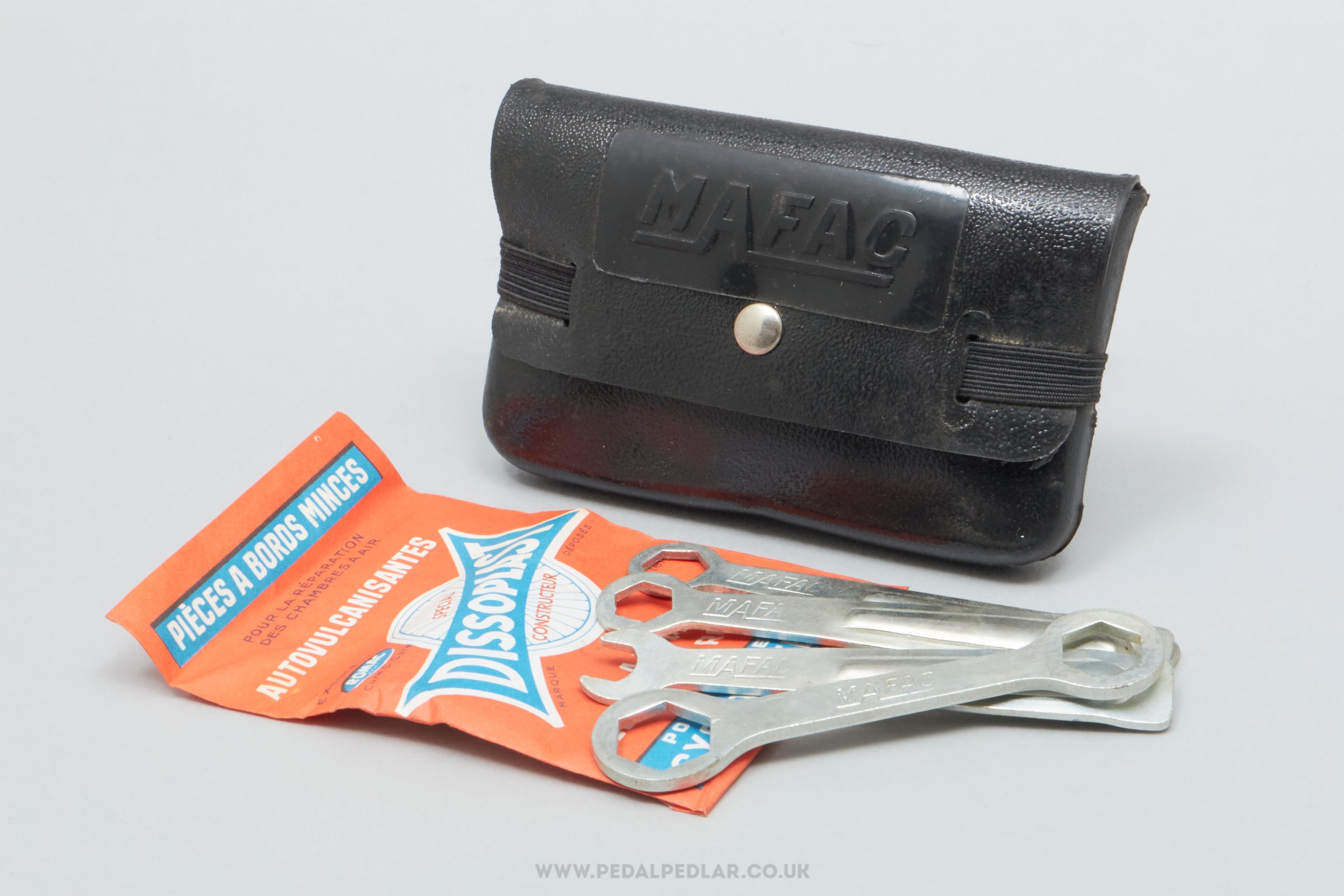


Mafac 5 Piece Tool Kit NOS Vintage Black Saddle Bag
£34.00 £40.00
✓ Original saddle bag - produced in the 1970s
✓ New old stock! Still unused after all these years
✓ Worldwide shipping
Mafac saddle bag (or seat pack if you prefer), hailing from France and in production during the 1970s (yet still new & unused after all this time). An excellent choice for vintage bikes, but great for bikes of the non-vintage variety too!
OVERVIEW
Production Era - 1970s
Country - French
Material - Plastic / Steel
Weight - 114 g
Stock Code - D-BAG-S28V
NB - Includes: Patch in packet; set of steel spanners
*New old stock items may have marks from storage over the years, and as we often have multiples they can vary from piece to piece, but they are always genuine new & unused items.
TECHNICAL INFO
Colour* - Black
Dimensions (L x W x D) - 11 x 6.5 x 2 cm
*The colour description is just a guide, please check the photos too as we make sure these are as close to the true colour as possible.
-
▼SHIPPING, TAXES & RETURNS
-
We've been safely sending orders around the world since 2010. Orders are carefully packed, sent with tracking & insurance, and normally collected around midday on Tuesdays and Fridays. Larger items may occasionally require an extra day or two to prepare.
We accept returns, please notify us within 14 days and ensure the item arrives back with us no later than 30 days after the order was received.
EU orders under €150 (excluding shipping) - import VAT and the new €3 customs duty are paid as part of your order, so there's nothing further to pay on delivery.
EU orders over €150 (excluding shipping) - import fees are payable to the carrier before delivery, with nothing collected at checkout.
USA orders - import fees are collected at checkout for all orders to the USA, so there won’t be any surprise charges when your order arrives.
Other international orders - local import fees may apply and are not collected by us. Please check your country's import rules before purchasing.


Reydel 3 Piece Tool Kit NOS Vintage Black Saddle Bag
£31.88 £38.00
✓ Original saddle bag - produced in the 1970s
✓ New old stock! Still unused after all these years
✓ Worldwide shipping
Reydel saddle bag (or seat pack if you prefer), hailing from France and in production during the 1970s (yet still new & unused after all this time). An excellent choice for vintage bikes, but great for bikes of the non-vintage variety too!
OVERVIEW
Production Era - 1970s
Country - French
Material - Plastic / Steel
Weight - 202 g
Stock Code - D-BAG-S29V
NB - Includes: Patch in packet; set of three steel tyre levers; steel multi-tool
*New old stock items may have marks from storage over the years, and as we often have multiples they can vary from piece to piece, but they are always genuine new & unused items.
TECHNICAL INFO
Colour* - Black
Fixing Type - Saddle Loops (Required)
Dimensions (L x W x D) - 14 x 8 x 3 cm
*The colour description is just a guide, please check the photos too as we make sure these are as close to the true colour as possible.
-
▼SHIPPING, TAXES & RETURNS
-
We've been safely sending orders around the world since 2010. Orders are carefully packed, sent with tracking & insurance, and normally collected around midday on Tuesdays and Fridays. Larger items may occasionally require an extra day or two to prepare.
We accept returns, please notify us within 14 days and ensure the item arrives back with us no later than 30 days after the order was received.
EU orders under €150 (excluding shipping) - import VAT and the new €3 customs duty are paid as part of your order, so there's nothing further to pay on delivery.
EU orders over €150 (excluding shipping) - import fees are payable to the carrier before delivery, with nothing collected at checkout.
USA orders - import fees are collected at checkout for all orders to the USA, so there won’t be any surprise charges when your order arrives.
Other international orders - local import fees may apply and are not collected by us. Please check your country's import rules before purchasing.


Roto Shoulder Mount NOS/NIB Vintage Neon Yellow Frame Bag
£14.88 £18.00
✓ Original frame bag - produced in the 1980s
✓ New old stock & still in the original packaging!
✓ Worldwide shipping
Roto triangle frame bag, hailing from Italy and in production during the 1980s (yet still new & unused after all this time). An excellent choice for vintage bikes, but great for bikes of the non-vintage variety too!
OVERVIEW
Production Era - 1980s
Country - Italian
Material - Polyester / Plastic
Weight - 112 g
Stock Code - D-BAG-F3V
*New old stock items may have marks from storage over the years, and as we often have multiples they can vary from piece to piece, but they are always genuine new & unused items.
TECHNICAL INFO
Colour* - Neon Yellow
Dimensions (L x W x D) - 19 x 13 x 4 cm
*The colour description is just a guide, please check the photos too as we make sure these are as close to the true colour as possible.
-
▼SHIPPING, TAXES & RETURNS
-
We've been safely sending orders around the world since 2010. Orders are carefully packed, sent with tracking & insurance, and normally collected around midday on Tuesdays and Fridays. Larger items may occasionally require an extra day or two to prepare.
We accept returns, please notify us within 14 days and ensure the item arrives back with us no later than 30 days after the order was received.
EU orders under €150 (excluding shipping) - import VAT and the new €3 customs duty are paid as part of your order, so there's nothing further to pay on delivery.
EU orders over €150 (excluding shipping) - import fees are payable to the carrier before delivery, with nothing collected at checkout.
USA orders - import fees are collected at checkout for all orders to the USA, so there won’t be any surprise charges when your order arrives.
Other international orders - local import fees may apply and are not collected by us. Please check your country's import rules before purchasing.


Eddy Merckx Vintage Blue / Yellow Holdall Kit Bag
£112.50 £125.00
✓ Original holdall - in production from the 1980s to the 1990s
✓ Checked over & photographed in detail
✓ Worldwide shipping
Eddy Merckx cycling kit bag (or duffle, or travel bag), hailing from Belgium and in production from the 1980s to the 1990s. An excellent choice for vintage cycling enthusiasts, but great for cyclists of the non-vintage variety too!
The bag's been checked over and graded as excellent condition, but do take a good look at the detailed photos so you can see the cosmetic condition before you buy.OVERVIEW
Condition Notes - One stud missing from base
Production Era - 1980s & 1990s
Country - Belgian
Material - Nylon
Weight - 640 g
Stock Code - U-BAG-H1V
TECHNICAL INFO
Colour* - Blue / Yellow
Dimensions (L x W x D) - 53 x 33 x 28 cm
-
▼SHIPPING, TAXES & RETURNS
-
We've been safely sending orders around the world since 2010. Orders are carefully packed, sent with tracking & insurance, and normally collected around midday on Tuesdays and Fridays. Larger items may occasionally require an extra day or two to prepare.
We accept returns, please notify us within 14 days and ensure the item arrives back with us no later than 30 days after the order was received.
EU orders under €150 (excluding shipping) - import VAT and the new €3 customs duty are paid as part of your order, so there's nothing further to pay on delivery.
EU orders over €150 (excluding shipping) - import fees are payable to the carrier before delivery, with nothing collected at checkout.
USA orders - import fees are collected at checkout for all orders to the USA, so there won’t be any surprise charges when your order arrives.
Other international orders - local import fees may apply and are not collected by us. Please check your country's import rules before purchasing.


Sidi Classic Blue / Purple Holdall Kit Bag
£67.50 £75.00
✓ Original holdall - produced in the 1990s
✓ Checked over & photographed in detail
✓ Worldwide shipping
Sidi cycling kit bag (or duffle, or travel bag), hailing from Italy and in production during the 1990s. An excellent choice for classic cycling enthusiasts, but great for cyclists of the non-classic variety too!
The bag's been checked over and graded as very good condition, but do take a good look at the detailed photos so you can see the cosmetic condition before you buy.OVERVIEW
Production Era - 1990s
Country - Italian
Material - Nylon
Weight - 710 g
Stock Code - U-BAG-H3C
TECHNICAL INFO
Colour* - Blue / Purple
Dimensions (L x W x D) - 91 x 52 x 26 cm
-
▼SHIPPING, TAXES & RETURNS
-
We've been safely sending orders around the world since 2010. Orders are carefully packed, sent with tracking & insurance, and normally collected around midday on Tuesdays and Fridays. Larger items may occasionally require an extra day or two to prepare.
We accept returns, please notify us within 14 days and ensure the item arrives back with us no later than 30 days after the order was received.
EU orders under €150 (excluding shipping) - import VAT and the new €3 customs duty are paid as part of your order, so there's nothing further to pay on delivery.
EU orders over €150 (excluding shipping) - import fees are payable to the carrier before delivery, with nothing collected at checkout.
USA orders - import fees are collected at checkout for all orders to the USA, so there won’t be any surprise charges when your order arrives.
Other international orders - local import fees may apply and are not collected by us. Please check your country's import rules before purchasing.


Rigida NOS Vintage Black Wheel Bag
£21.25 £25.00
✓ Original wheel bag - in production from the 1980s to the 1990s
✓ New old stock! Still unused after all these years
✓ Worldwide shipping
Rigida wheel bag (or carrier if you prefer), hailing from France and in production from the 1980s to the 1990s (yet still new & unused after all this time). An excellent choice for classic cycling enthusiasts, but great for cyclists of the non-classic variety too!
OVERVIEW
Production Era - 1980s & 1990s
Country - French
Material - Polyester
Weight - 380 g
Stock Code - D-BAG-W1V
*New old stock items may have marks from storage over the years, and as we often have multiples they can vary from piece to piece, but they are always genuine new & unused items.
TECHNICAL INFO
Colour* - Black
Wheel Capacity - Single (Road or MTB)
Dimensions (L x W) - 70 x 70 cm
*The colour description is just a guide, please check the photos too as we make sure these are as close to the true colour as possible.
-
▼SHIPPING, TAXES & RETURNS
-
We've been safely sending orders around the world since 2010. Orders are carefully packed, sent with tracking & insurance, and normally collected around midday on Tuesdays and Fridays. Larger items may occasionally require an extra day or two to prepare.
We accept returns, please notify us within 14 days and ensure the item arrives back with us no later than 30 days after the order was received.
EU orders under €150 (excluding shipping) - import VAT and the new €3 customs duty are paid as part of your order, so there's nothing further to pay on delivery.
EU orders over €150 (excluding shipping) - import fees are payable to the carrier before delivery, with nothing collected at checkout.
USA orders - import fees are collected at checkout for all orders to the USA, so there won’t be any surprise charges when your order arrives.
Other international orders - local import fees may apply and are not collected by us. Please check your country's import rules before purchasing.


Campagnolo NOS Classic Black Wheel Bag
£25.50 £30.00
✓ Original wheel bag - in production from the 1990s to the 2000s
✓ New old stock! Still unused after all these years
✓ Worldwide shipping
Campagnolo wheel bag (or carrier if you prefer), hailing from Italy and in production from the 1990s to the 2000s (yet still new & unused after all this time). An excellent choice for classic cycling enthusiasts, but great for cyclists of the non-classic variety too!
OVERVIEW
Production Era - 1990s & 2000s
Country - Italian
Material - Polyester
Weight - 460 g
Stock Code - D-BAG-W4C
*New old stock items may have marks from storage over the years, and as we often have multiples they can vary from piece to piece, but they are always genuine new & unused items.
TECHNICAL INFO
Colour* - Black
Wheel Capacity - Single (Road or MTB)
Dimensions (L x W) - 72.5 x 72.5 cm
*The colour description is just a guide, please check the photos too as we make sure these are as close to the true colour as possible.
-
▼SHIPPING, TAXES & RETURNS
-
We've been safely sending orders around the world since 2010. Orders are carefully packed, sent with tracking & insurance, and normally collected around midday on Tuesdays and Fridays. Larger items may occasionally require an extra day or two to prepare.
We accept returns, please notify us within 14 days and ensure the item arrives back with us no later than 30 days after the order was received.
EU orders under €150 (excluding shipping) - import VAT and the new €3 customs duty are paid as part of your order, so there's nothing further to pay on delivery.
EU orders over €150 (excluding shipping) - import fees are payable to the carrier before delivery, with nothing collected at checkout.
USA orders - import fees are collected at checkout for all orders to the USA, so there won’t be any surprise charges when your order arrives.
Other international orders - local import fees may apply and are not collected by us. Please check your country's import rules before purchasing.


Campagnolo 'Racing Wheels' NOS Classic Black Wheel Bag
£34.00 £40.00
✓ Original wheel bag - in production from the 1990s to the 2000s
✓ New old stock! Still unused after all these years
✓ Worldwide shipping
Campagnolo wheel bag (or carrier if you prefer), hailing from Italy and in production from the 1990s to the 2000s (yet still new & unused after all this time). An excellent choice for classic cycling enthusiasts, but great for cyclists of the non-classic variety too!
OVERVIEW
Production Era - 1990s & 2000s
Country - Italian
Material - Polyester / Rubber
Weight - 660 g
Stock Code - D-BAG-W5C
*New old stock items may have marks from storage over the years, and as we often have multiples they can vary from piece to piece, but they are always genuine new & unused items.
TECHNICAL INFO
Colour* - Black
Wheel Capacity - Single (Road or MTB)
Dimensions (L x W) - 71.5 x 71.5 cm
*The colour description is just a guide, please check the photos too as we make sure these are as close to the true colour as possible.
-
▼SHIPPING, TAXES & RETURNS
-
We've been safely sending orders around the world since 2010. Orders are carefully packed, sent with tracking & insurance, and normally collected around midday on Tuesdays and Fridays. Larger items may occasionally require an extra day or two to prepare.
We accept returns, please notify us within 14 days and ensure the item arrives back with us no later than 30 days after the order was received.
EU orders under €150 (excluding shipping) - import VAT and the new €3 customs duty are paid as part of your order, so there's nothing further to pay on delivery.
EU orders over €150 (excluding shipping) - import fees are payable to the carrier before delivery, with nothing collected at checkout.
USA orders - import fees are collected at checkout for all orders to the USA, so there won’t be any surprise charges when your order arrives.
Other international orders - local import fees may apply and are not collected by us. Please check your country's import rules before purchasing.


Modolo Sport Tech NOS Classic Red Double Wheel Bag
£80.75 £95.00
✓ Original wheel bag - produced in the 1990s
✓ New old stock! Still unused after all these years
✓ Worldwide shipping
Modolo wheel bag (or carrier if you prefer), hailing from Italy and in production during the 1990s (yet still new & unused after all this time). An excellent choice for classic cycling enthusiasts, but great for cyclists of the non-classic variety too!
OVERVIEW
Production Era - 1990s
Country - Italian
Material - Nylon
Weight - 1790 g
Stock Code - D-BAG-W6C
*New old stock items may have marks from storage over the years, and as we often have multiples they can vary from piece to piece, but they are always genuine new & unused items.
TECHNICAL INFO
Colour* - Red
Wheel Capacity - Double (Road or MTB)
Dimensions (L x W) - 74 x 74 cm
*The colour description is just a guide, please check the photos too as we make sure these are as close to the true colour as possible.
-
▼SHIPPING, TAXES & RETURNS
-
We've been safely sending orders around the world since 2010. Orders are carefully packed, sent with tracking & insurance, and normally collected around midday on Tuesdays and Fridays. Larger items may occasionally require an extra day or two to prepare.
We accept returns, please notify us within 14 days and ensure the item arrives back with us no later than 30 days after the order was received.
EU orders under €150 (excluding shipping) - import VAT and the new €3 customs duty are paid as part of your order, so there's nothing further to pay on delivery.
EU orders over €150 (excluding shipping) - import fees are payable to the carrier before delivery, with nothing collected at checkout.
USA orders - import fees are collected at checkout for all orders to the USA, so there won’t be any surprise charges when your order arrives.
Other international orders - local import fees may apply and are not collected by us. Please check your country's import rules before purchasing.


Miche NOS Classic Black Wheel Bag
£21.25 £25.00
✓ Original wheel bag - in production from the 1990s to the 2000s
✓ New old stock! Still unused after all these years
✓ Worldwide shipping
Miche wheel bag (or carrier if you prefer), hailing from Italy and in production from the 1990s to the 2000s (yet still new & unused after all this time). An excellent choice for vintage cycling enthusiasts, but great for cyclists of the non-vintage variety too!
OVERVIEW
Production Era - 1990s & 2000s
Country - Italian
Material - Nylon
Weight - 545 g
Stock Code - D-BAG-W7C
*New old stock items may have marks from storage over the years, and as we often have multiples they can vary from piece to piece, but they are always genuine new & unused items.
TECHNICAL INFO
Colour* - Black
Wheel Capacity - Single (Road or MTB)
Dimensions (L x W) - 72 x 72 cm
*The colour description is just a guide, please check the photos too as we make sure these are as close to the true colour as possible.
-
▼SHIPPING, TAXES & RETURNS
-
We've been safely sending orders around the world since 2010. Orders are carefully packed, sent with tracking & insurance, and normally collected around midday on Tuesdays and Fridays. Larger items may occasionally require an extra day or two to prepare.
We accept returns, please notify us within 14 days and ensure the item arrives back with us no later than 30 days after the order was received.
EU orders under €150 (excluding shipping) - import VAT and the new €3 customs duty are paid as part of your order, so there's nothing further to pay on delivery.
EU orders over €150 (excluding shipping) - import fees are payable to the carrier before delivery, with nothing collected at checkout.
USA orders - import fees are collected at checkout for all orders to the USA, so there won’t be any surprise charges when your order arrives.
Other international orders - local import fees may apply and are not collected by us. Please check your country's import rules before purchasing.


Campagnolo 'Racing Wheels' Classic Grey Wheel Bag
£22.50 £25.00
✓ Original wheel bag - produced in the 1990s
✓ Checked over & photographed in detail
✓ Worldwide shipping
Campagnolo wheel bag (or carrier if you prefer), hailing from Italy and in production during the 1990s. An excellent choice for classic cycling enthusiasts, but great for cyclists of the non-classic variety too!
The bag's been checked over and graded as very good condition, but do take a good look at the detailed photos so you can see the cosmetic condition before you buy.OVERVIEW
Production Era - 1990s
Country - Italian
Material - Nylon
Weight - 500 g
Stock Code - U-BAG-W8C
TECHNICAL INFO
Colour* - Grey
Wheel Capacity - Single (Road or MTB)
Dimensions (L x W) - 72 x 72 cm
*The colour description is just a guide, please check the photos too as we make sure these are as close to the true colour as possible.
-
▼SHIPPING, TAXES & RETURNS
-
We've been safely sending orders around the world since 2010. Orders are carefully packed, sent with tracking & insurance, and normally collected around midday on Tuesdays and Fridays. Larger items may occasionally require an extra day or two to prepare.
We accept returns, please notify us within 14 days and ensure the item arrives back with us no later than 30 days after the order was received.
EU orders under €150 (excluding shipping) - import VAT and the new €3 customs duty are paid as part of your order, so there's nothing further to pay on delivery.
EU orders over €150 (excluding shipping) - import fees are payable to the carrier before delivery, with nothing collected at checkout.
USA orders - import fees are collected at checkout for all orders to the USA, so there won’t be any surprise charges when your order arrives.
Other international orders - local import fees may apply and are not collected by us. Please check your country's import rules before purchasing.


Panasonic Tour de Suisse 1991 Classic Black Drawstring Cycling Kit Bag
£31.50 £35.00
✓ Original kit bag - produced in the 1990s
✓ Checked over & photographed in detail
✓ Worldwide shipping
Panasonic Tour de Suisse 1991 kit bag (or gym sack if you prefer), hailing from Japan and in production during the 1990s. An excellent choice for classic cycling enthusiasts, but great for cyclists of the non-classic variety too!
The bag's been checked over and graded as good condition, but do take a good look at the detailed photos so you can see the cosmetic condition before you buy.OVERVIEW
Production Era - 1990s
Country - Japanese
Material - Polyester
Weight - 37 g
Stock Code - U-BAG-G1C
TECHNICAL INFO
Colour* - Black
Enclosure - Drawstring
Dimensions (L x W) - 39 x 25 cm
-
▼SHIPPING, TAXES & RETURNS
-
We've been safely sending orders around the world since 2010. Orders are carefully packed, sent with tracking & insurance, and normally collected around midday on Tuesdays and Fridays. Larger items may occasionally require an extra day or two to prepare.
We accept returns, please notify us within 14 days and ensure the item arrives back with us no later than 30 days after the order was received.
EU orders under €150 (excluding shipping) - import VAT and the new €3 customs duty are paid as part of your order, so there's nothing further to pay on delivery.
EU orders over €150 (excluding shipping) - import fees are payable to the carrier before delivery, with nothing collected at checkout.
USA orders - import fees are collected at checkout for all orders to the USA, so there won’t be any surprise charges when your order arrives.
Other international orders - local import fees may apply and are not collected by us. Please check your country's import rules before purchasing.


Classic Rabobank Orange/Blue Musette Bag
£22.50 £25.00
✓ Original musette bag - produced in the 1990s
✓ Checked over & photographed in detail
✓ Worldwide shipping
Classic Rabobank musette (or feed bag if you prefer), most likely in production during the 1990s. An excellent choice for classic cycling enthusiasts, but great for cyclists of the non-classic variety too!
The bag's been checked over and graded as very good condition, but do take a good look at the detailed photos so you can see the cosmetic condition before you buy.OVERVIEW
Production Era - 1990s
Material - Cotton
Weight - 52 g
Stock Code - U-BAG-MU3C
TECHNICAL INFO
Colour* - Orange / Blue
Dimensions (L x W) - 37 x 27 cm
*The colour description is just a guide, please check the photos too as we make sure these are as close to the true colour as possible.
-
▼SHIPPING, TAXES & RETURNS
-
We've been safely sending orders around the world since 2010. Orders are carefully packed, sent with tracking & insurance, and normally collected around midday on Tuesdays and Fridays. Larger items may occasionally require an extra day or two to prepare.
We accept returns, please notify us within 14 days and ensure the item arrives back with us no later than 30 days after the order was received.
EU orders under €150 (excluding shipping) - import VAT and the new €3 customs duty are paid as part of your order, so there's nothing further to pay on delivery.
EU orders over €150 (excluding shipping) - import fees are payable to the carrier before delivery, with nothing collected at checkout.
USA orders - import fees are collected at checkout for all orders to the USA, so there won’t be any surprise charges when your order arrives.
Other international orders - local import fees may apply and are not collected by us. Please check your country's import rules before purchasing.


Santini Maglificio Sportivo Classic White/Blue Musette Bag
£20.25 £23.00
✓ Original musette bag - produced in the 1990s
✓ Checked over & photographed in detail
✓ Worldwide shipping
Santini Maglificio Sportivo musette (or feed bag if you prefer), hailing from Italy and in production during the 1990s. An excellent choice for classic cycling enthusiasts, but great for cyclists of the non-classic variety too!
The bag's been checked over and graded as very good condition, but do take a good look at the detailed photos so you can see the cosmetic condition before you buy.OVERVIEW
Production Era - 1990s
Country - Italian
Material - Cotton
Weight - 39 g
Stock Code - U-BAG-MU4C
TECHNICAL INFO
Colour* - White / Blue
Dimensions (L x W) - 37 x 27 cm
*The colour description is just a guide, please check the photos too as we make sure these are as close to the true colour as possible.
-
▼SHIPPING, TAXES & RETURNS
-
We've been safely sending orders around the world since 2010. Orders are carefully packed, sent with tracking & insurance, and normally collected around midday on Tuesdays and Fridays. Larger items may occasionally require an extra day or two to prepare.
We accept returns, please notify us within 14 days and ensure the item arrives back with us no later than 30 days after the order was received.
EU orders under €150 (excluding shipping) - import VAT and the new €3 customs duty are paid as part of your order, so there's nothing further to pay on delivery.
EU orders over €150 (excluding shipping) - import fees are payable to the carrier before delivery, with nothing collected at checkout.
USA orders - import fees are collected at checkout for all orders to the USA, so there won’t be any surprise charges when your order arrives.
Other international orders - local import fees may apply and are not collected by us. Please check your country's import rules before purchasing.


Classic Rabobank 'Ronde van Midden Nederland' White Musette Bag
£18.00 £20.00
✓ Original musette bag - produced in the 1990s
✓ Checked over & photographed in detail
✓ Worldwide shipping
Classic Rabobank 'Ronde van Midden Nederland' musette (or feed bag if you prefer), most likely in production during the 1990s. An excellent choice for classic cycling enthusiasts, but great for cyclists of the non-classic variety too!
The bag's been checked over and graded as very good condition, but do take a good look at the detailed photos so you can see the cosmetic condition before you buy.OVERVIEW
Production Era - 1990s
Material - Cotton
Weight - 43 g
Stock Code - U-BAG-MU6C
TECHNICAL INFO
Colour* - White
Dimensions (L x W) - 37 x 25.5 cm
*The colour description is just a guide, please check the photos too as we make sure these are as close to the true colour as possible.
-
▼SHIPPING, TAXES & RETURNS
-
We've been safely sending orders around the world since 2010. Orders are carefully packed, sent with tracking & insurance, and normally collected around midday on Tuesdays and Fridays. Larger items may occasionally require an extra day or two to prepare.
We accept returns, please notify us within 14 days and ensure the item arrives back with us no later than 30 days after the order was received.
EU orders under €150 (excluding shipping) - import VAT and the new €3 customs duty are paid as part of your order, so there's nothing further to pay on delivery.
EU orders over €150 (excluding shipping) - import fees are payable to the carrier before delivery, with nothing collected at checkout.
USA orders - import fees are collected at checkout for all orders to the USA, so there won’t be any surprise charges when your order arrives.
Other international orders - local import fees may apply and are not collected by us. Please check your country's import rules before purchasing.


Vintage Cicli Concorde / Ultima Green Musette Bag
£31.50 £35.00
✓ Original musette bag - in production from the 1980s to the 1990s
✓ Checked over & photographed in detail
✓ Worldwide shipping
Vintage Cicli Concorde / Ultima musette (or feed bag if you prefer), most likely in production from the 1980s to the 1990s. An excellent choice for vintage cycling enthusiasts, but great for cyclists of the non-vintage variety too!
The bag's been checked over and graded as good condition, but do take a good look at the detailed photos so you can see the cosmetic condition before you buy.OVERVIEW
Production Era - 1980s & 1990s
Material - Cotton
Weight - 37 g
Stock Code - U-BAG-MU7V
TECHNICAL INFO
Colour* - Green
Dimensions (L x W) - 32 x 25 cm
*The colour description is just a guide, please check the photos too as we make sure these are as close to the true colour as possible.
-
▼SHIPPING, TAXES & RETURNS
-
We've been safely sending orders around the world since 2010. Orders are carefully packed, sent with tracking & insurance, and normally collected around midday on Tuesdays and Fridays. Larger items may occasionally require an extra day or two to prepare.
We accept returns, please notify us within 14 days and ensure the item arrives back with us no later than 30 days after the order was received.
EU orders under €150 (excluding shipping) - import VAT and the new €3 customs duty are paid as part of your order, so there's nothing further to pay on delivery.
EU orders over €150 (excluding shipping) - import fees are payable to the carrier before delivery, with nothing collected at checkout.
USA orders - import fees are collected at checkout for all orders to the USA, so there won’t be any surprise charges when your order arrives.
Other international orders - local import fees may apply and are not collected by us. Please check your country's import rules before purchasing.
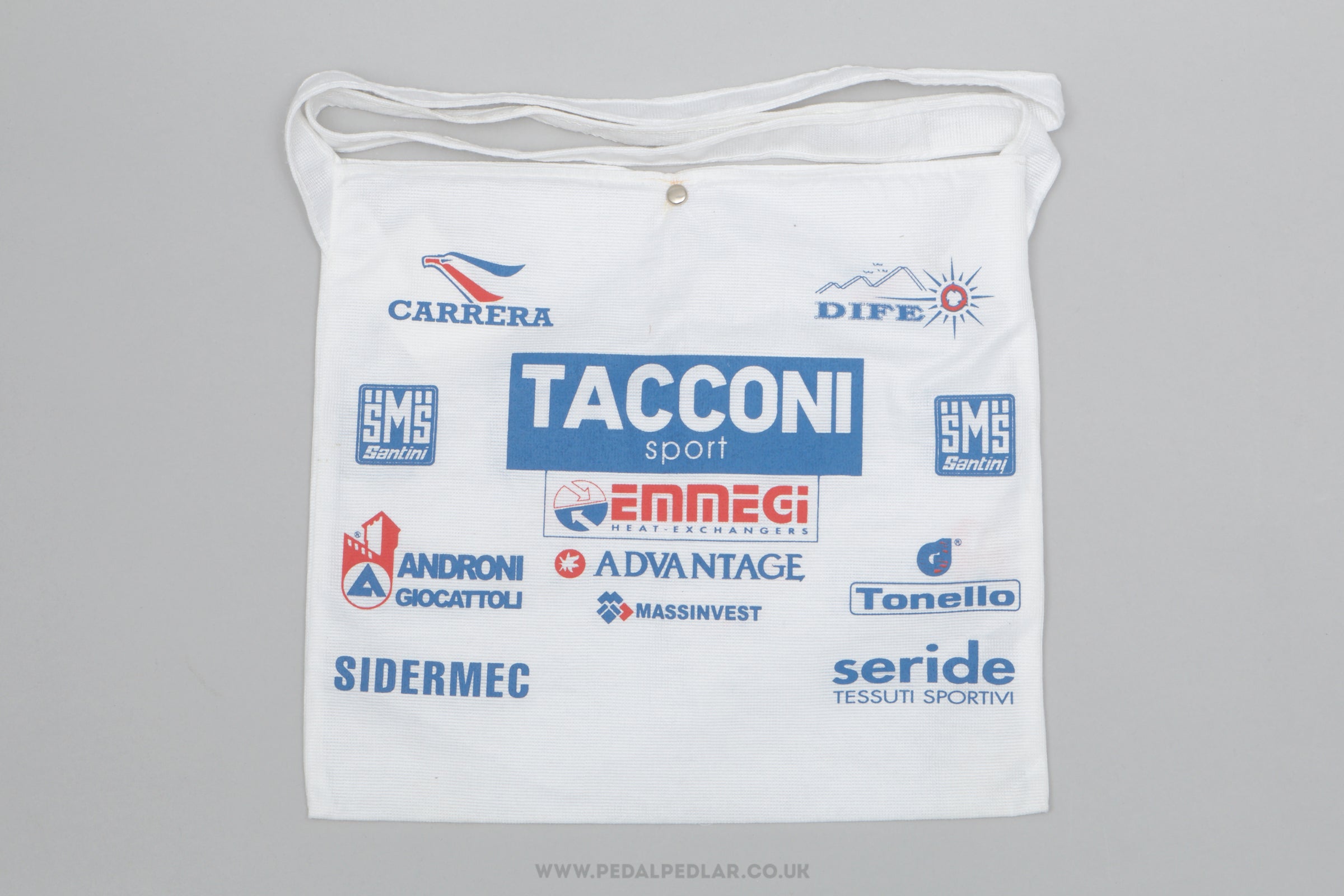


Classic Tacconi Sport / Carrera / Santini White Musette Bag
£18.00 £20.00
✓ Original musette bag - produced in the 1990s
✓ Checked over & photographed in detail
✓ Worldwide shipping
Classic Tacconi Sport / Carrera / Santini musette (or feed bag if you prefer), most likely in production during the 1990s. An excellent choice for classic cycling enthusiasts, but great for cyclists of the non-classic variety too!
The bag's been checked over and graded as good condition, but do take a good look at the detailed photos so you can see the cosmetic condition before you buy.OVERVIEW
Production Era - 1990s
Material - Polyester
Weight - 34 g
Stock Code - U-BAG-MU8C
TECHNICAL INFO
Colour* - White
Dimensions (L x W) - 30.5 x 27.5 cm
*The colour description is just a guide, please check the photos too as we make sure these are as close to the true colour as possible.
-
▼SHIPPING, TAXES & RETURNS
-
We've been safely sending orders around the world since 2010. Orders are carefully packed, sent with tracking & insurance, and normally collected around midday on Tuesdays and Fridays. Larger items may occasionally require an extra day or two to prepare.
We accept returns, please notify us within 14 days and ensure the item arrives back with us no later than 30 days after the order was received.
EU orders under €150 (excluding shipping) - import VAT and the new €3 customs duty are paid as part of your order, so there's nothing further to pay on delivery.
EU orders over €150 (excluding shipping) - import fees are payable to the carrier before delivery, with nothing collected at checkout.
USA orders - import fees are collected at checkout for all orders to the USA, so there won’t be any surprise charges when your order arrives.
Other international orders - local import fees may apply and are not collected by us. Please check your country's import rules before purchasing.


Wheeler NOS Classic Purple Musette Bag
£21.25 £25.00
✓ Original musette bag - produced in the 1990s
✓ New old stock! Still unused after all these years
✓ Worldwide shipping
Wheeler musette (or feed bag if you prefer), hailing from Taiwan and in production during the 1990s (yet still new & unused after all this time). An excellent choice for classic cycling enthusiasts, but great for cyclists of the non-classic variety too!
OVERVIEW
Production Era - 1990s
Country - Taiwanese
Material - Polyester
Weight - 64 g
Stock Code - D-BAG-MU10C
*New old stock items may have marks from storage over the years, and as we often have multiples they can vary from piece to piece, but they are always genuine new & unused items.
TECHNICAL INFO
Colour* - Purple
Dimensions (L x W) - 32 x 25 x cm
*The colour description is just a guide, please check the photos too as we make sure these are as close to the true colour as possible.
-
▼SHIPPING, TAXES & RETURNS
-
We've been safely sending orders around the world since 2010. Orders are carefully packed, sent with tracking & insurance, and normally collected around midday on Tuesdays and Fridays. Larger items may occasionally require an extra day or two to prepare.
We accept returns, please notify us within 14 days and ensure the item arrives back with us no later than 30 days after the order was received.
EU orders under €150 (excluding shipping) - import VAT and the new €3 customs duty are paid as part of your order, so there's nothing further to pay on delivery.
EU orders over €150 (excluding shipping) - import fees are payable to the carrier before delivery, with nothing collected at checkout.
USA orders - import fees are collected at checkout for all orders to the USA, so there won’t be any surprise charges when your order arrives.
Other international orders - local import fees may apply and are not collected by us. Please check your country's import rules before purchasing.


Cinelli Ribbon NOS/NIB Classic Blue/Red Cork Handlebar Tape
£21.25 £25.00
✓ Original bar tape - produced in the 1990s
✓ New old stock & still in the original packaging!
Cinelli Ribbon bar tape (or grip, or wrap if you prefer), hailing from Italy and in production during the 1990s (yet still new & unused after all this time). The perfect finishing touch for your classic bike, but great for bikes of the non-classic variety too!
OVERVIEW
Production Era - 1990s
Country - Italian
Stock Code - D-BT98C
*New old stock items may have marks from storage over the years, and as we often have multiples they can vary from piece to piece, but they are always genuine new & unused items.
TECHNICAL INFO
Colour* - Blue / Red
Tape Style - Cork
*The colour description is just a guide, please check the photos too as we make sure these are as close to the true colour as possible.
-
▼SHIPPING, TAXES & RETURNS
-
We've been safely sending orders around the world since 2010. Orders are carefully packed, sent with tracking & insurance, and normally collected around midday on Tuesdays and Fridays. Larger items may occasionally require an extra day or two to prepare.
We accept returns, please notify us within 14 days and ensure the item arrives back with us no later than 30 days after the order was received.
EU orders under €150 (excluding shipping) - import VAT and the new €3 customs duty are paid as part of your order, so there's nothing further to pay on delivery.
EU orders over €150 (excluding shipping) - import fees are payable to the carrier before delivery, with nothing collected at checkout.
USA orders - import fees are collected at checkout for all orders to the USA, so there won’t be any surprise charges when your order arrives.
Other international orders - local import fees may apply and are not collected by us. Please check your country's import rules before purchasing.


3TTT Ribbon Splash NOS/NIB Classic Yellow/Blue Cork Handlebar Tape
£21.25 £25.00
✓ Original bar tape - in production from the 1990s to the 2000s
✓ New old stock & still in the original packaging!
✓ Worldwide shipping
3TTT Ribbon bar tape (or grip, or wrap if you prefer), hailing from Italy and in production from the 1990s to the 2000s (yet still new & unused after all this time). The perfect finishing touch for your classic bike, but great for bikes of the non-classic variety too!
OVERVIEW
Production Era - 1990s & 2000s
Country - Italian
Stock Code - D-BT101C
*New old stock items may have marks from storage over the years, and as we often have multiples they can vary from piece to piece, but they are always genuine new & unused items.
TECHNICAL INFO
Colour* - Yellow / Blue
Tape Style - Cork
*The colour description is just a guide, please check the photos too as we make sure these are as close to the true colour as possible.
-
▼SHIPPING, TAXES & RETURNS
-
We've been safely sending orders around the world since 2010. Orders are carefully packed, sent with tracking & insurance, and normally collected around midday on Tuesdays and Fridays. Larger items may occasionally require an extra day or two to prepare.
We accept returns, please notify us within 14 days and ensure the item arrives back with us no later than 30 days after the order was received.
EU orders under €150 (excluding shipping) - import VAT and the new €3 customs duty are paid as part of your order, so there's nothing further to pay on delivery.
EU orders over €150 (excluding shipping) - import fees are payable to the carrier before delivery, with nothing collected at checkout.
USA orders - import fees are collected at checkout for all orders to the USA, so there won’t be any surprise charges when your order arrives.
Other international orders - local import fees may apply and are not collected by us. Please check your country's import rules before purchasing.


Silva Splash NOS/NIB Classic White/Black Cork Handlebar Tape
£21.25 £25.00
✓ Original bar tape - produced in the 1990s
✓ New old stock & still in the original packaging!
✓ Worldwide shipping
Silva Splash bar tape (or grip, or wrap if you prefer), hailing from Italy and in production during the 1990s (yet still new & unused after all this time). The perfect finishing touch for your classic bike, but great for bikes of the non-classic variety too!
OVERVIEW
Production Era - 1990s
Country - Italian
Stock Code - D-BT104C
*New old stock items may have marks from storage over the years, and as we often have multiples they can vary from piece to piece, but they are always genuine new & unused items.
TECHNICAL INFO
Colour* - White / Black
Tape Style - Cork
*The colour description is just a guide, please check the photos too as we make sure these are as close to the true colour as possible.
-
▼SHIPPING, TAXES & RETURNS
-
We've been safely sending orders around the world since 2010. Orders are carefully packed, sent with tracking & insurance, and normally collected around midday on Tuesdays and Fridays. Larger items may occasionally require an extra day or two to prepare.
We accept returns, please notify us within 14 days and ensure the item arrives back with us no later than 30 days after the order was received.
EU orders under €150 (excluding shipping) - import VAT and the new €3 customs duty are paid as part of your order, so there's nothing further to pay on delivery.
EU orders over €150 (excluding shipping) - import fees are payable to the carrier before delivery, with nothing collected at checkout.
USA orders - import fees are collected at checkout for all orders to the USA, so there won’t be any surprise charges when your order arrives.
Other international orders - local import fees may apply and are not collected by us. Please check your country's import rules before purchasing.