
All Sale Items


Specialized F6 107-68 NOS Vintage 107.5 mm Bottom Bracket Axle
£28.50 £30.00
✓ Original part - produced in the 1980s
✓ New old stock! Still unused after all these years
✓ Suitable for historic cycling events such as L'Eroica
✓ Worldwide shipping
Specialized F6 bottom bracket axle (or BB spindle if you prefer), hailing from the United States and in production during the 1980s (yet still new & unused after all this time). Made from steel and weighing in at 138 grams. A fine choice for keeping your vintage bike authentic, but also great for any other compatible bike.
If you're taking part in L'Eroica or any other vintage event, this is fully compliant - so rest assured, the pre-1987 police won't lock you up for having the wrong axle!
OVERVIEW
Condition Notes - Some storage marks
Production Era - 1980s
Country - American
Material - Steel
Weight - 138 g
Stock Code - D-BB-AS9V
*New old stock items may have marks from storage over the years, and as we often have multiples they can vary from piece to piece, but they are always genuine new & unused items.
TECHNICAL INFO
Axle Type - Square Taper
Axle Markings - 107-68
Axle Length (D) - 107.5 mm
Axle Centre (B) - 50.5 mm
Axle Drive Side (C) - 28.5 mm
Axle Non-Drive Side (A) - 28.5 mm
Shell Width - 68 mm
NB: Check the help section to see how we take these measurements.
-
▼SHIPPING, TAXES & RETURNS
-
We've been safely sending orders around the world since 2010. Orders are carefully packed, sent with tracking & insurance, and normally collected around midday on Tuesdays and Fridays. Larger items may occasionally require an extra day or two to prepare.
We accept returns, please notify us within 14 days and ensure the item arrives back with us no later than 30 days after the order was received.
EU orders under €150 (excluding shipping) - import VAT and the new €3 customs duty are paid as part of your order, so there's nothing further to pay on delivery.
EU orders over €150 (excluding shipping) - import fees are payable to the carrier before delivery, with nothing collected at checkout.
USA orders - import fees are collected at checkout for all orders to the USA, so there won’t be any surprise charges when your order arrives.
Other international orders - local import fees may apply and are not collected by us. Please check your country's import rules before purchasing.
-
▼HELP SECTION
- We've provided reference below to illustrate how we take the measurements.
Axle Type - for square tapers, the ISO introduced a standard for European makers in the early 90s, JIS then did the same in Asia. Before then it was not so simple, and although there is a degree of interchangeability, the best way to make sure you have the right axle is to stick to the same brand from the same era, ideally the proprietary model.
Axle Length (D) - your crankset dictates the axle length you need and the recommendation should be used to avoid issues with chainline. If you're replacing an axle that works perfectly then this can be matched, otherwise you'll need to check the manufacturers spec, a good resource for older bikes is Velobase.
Centre (B) - measured from the outside of the 'shoulders' of the bearing races, as seen in the diagram.
Drive Side (C) - the right side (with any logos etc on the axle facing you), your right crank and chainrings will mount to this side.
Non-Drive Side (A) - the left side, where the left crank arm will be mounted.
Shell Width - the width of the bottom bracket shell the axle was designed to fit, measured at its widest point.


Campagnolo Record (RD-RE600) 9 Speed NOS/NIB Classic 10T Jockey Wheels
£33.25 £35.00
✓ Original jockey wheels - in production from the 1990s to the 2000s
✓ New old stock & still in the original packaging!
✓ Worldwide shipping
Campagnolo Record jockey wheels (or derailleur pulleys if you prefer), hailing from Italy and in production from the 1990s to the 2000s (yet still new & unused after all this time). Made from plastic and weighing in at 32 grams. A fine choice for keeping your classic bike authentic, but also great for any other compatible bike.
These work with all Campagnolo 9 speed rear derailleurs, including Chorus, Racing-T, Veloce etc. They also work with 10 speed Campagnolo Record models from 2004.
OVERVIEW
Model ID - RD-RE600
Production Era - 1990s & 2000s
Country - Italian
Material - Plastic
Weight - 32 g
Stock Code - D-JCK2C
*New old stock items may have marks from storage over the years, and as we often have multiples they can vary from piece to piece, but they are always genuine new & unused items.
TECHNICAL INFO
Teeth - 10
Compatible Speed* - 9 Speed
Diameter (OD) - 38.5 mm
Thickness - 8.8 mm
Centre Hole (ID) - 5.05 mm
*See help section.
-
▼SHIPPING, TAXES & RETURNS
-
We've been safely sending orders around the world since 2010. Orders are carefully packed, sent with tracking & insurance, and normally collected around midday on Tuesdays and Fridays. Larger items may occasionally require an extra day or two to prepare.
We accept returns, please notify us within 14 days and ensure the item arrives back with us no later than 30 days after the order was received.
EU orders under €150 (excluding shipping) - import VAT and the new €3 customs duty are paid as part of your order, so there's nothing further to pay on delivery.
EU orders over €150 (excluding shipping) - import fees are payable to the carrier before delivery, with nothing collected at checkout.
USA orders - import fees are collected at checkout for all orders to the USA, so there won’t be any surprise charges when your order arrives.
Other international orders - local import fees may apply and are not collected by us. Please check your country's import rules before purchasing.
-
▼HELP SECTION
-
Teeth - the tooth count has increased with the introduction of more gears, but this happened very gradually so 10 tooth jockey wheels were standard for a very long time.
*Compatible Speed - the number of cogs the jockey wheels were designed to be used with. When using derailleurs for indexed shifting it's important to stick to this, but friction shifting is much more forgiving so you're unlikely to have any problems using the next speed up or down, providing all the measurements are correct.
Diameter (OD) - the diameter of the jockey wheels, from the outside edge of the teeth. It’s important to stay close to the ones you're replacing to ensure they fit.
Thickness - measured at the widest point, by the centre hole. The spacing has generally become narrower over the years to accommodate more gears.
Centre Hole (ID) - the inside diameter (usually inside the bushing/spacer if present). This rarely presents a problem, but some older jockey wheels have a different diameter so it's worth double checking.


Shimano Crane DB100 Dura-Ace 1st Gen NOS Vintage 9T Jockey Wheels
£19.00 £20.00
✓ Original jockey wheels - produced in the 1970s
✓ New old stock! Still unused after all these years
✓ Suitable for historic cycling events such as L'Eroica
✓ Worldwide shipping
Shimano Crane jockey wheels (or derailleur pulleys if you prefer), hailing from Japan and in production during the 1970s (yet still new & unused after all this time). Made from steel and weighing in at 39 grams. A fine choice for keeping your vintage bike authentic, but also great for any other compatible bike.
If you're taking part in L'Eroica or a similar vintage event, this is fully compliant - so rest assured, the pre-1987 police won't lock you up for having the jockey wheels!
OVERVIEW
Production Era - 1970s
Country - Japanese
Material - Steel
Weight - 39 g
Stock Code - D-JCK4V
NB - Wheels only as pictured, no spacers or covers. Dura-Ace card is from the bulk packaging, this is not supplied.
*New old stock items may have marks from storage over the years, and as we often have multiples they can vary from piece to piece, but they are always genuine new & unused items.
TECHNICAL INFO
Teeth - 9
Compatible Speed* - 5 Speed, 6 Speed, 7 Speed
Diameter (OD) - 34 mm
Thickness - 9 mm (Without Spacers / Covers)
Centre Hole (ID) - 8 mm (Without Spacers / Covers)
*See help section.
-
▼SHIPPING, TAXES & RETURNS
-
We've been safely sending orders around the world since 2010. Orders are carefully packed, sent with tracking & insurance, and normally collected around midday on Tuesdays and Fridays. Larger items may occasionally require an extra day or two to prepare.
We accept returns, please notify us within 14 days and ensure the item arrives back with us no later than 30 days after the order was received.
EU orders under €150 (excluding shipping) - import VAT and the new €3 customs duty are paid as part of your order, so there's nothing further to pay on delivery.
EU orders over €150 (excluding shipping) - import fees are payable to the carrier before delivery, with nothing collected at checkout.
USA orders - import fees are collected at checkout for all orders to the USA, so there won’t be any surprise charges when your order arrives.
Other international orders - local import fees may apply and are not collected by us. Please check your country's import rules before purchasing.
-
▼HELP SECTION
-
Teeth - the tooth count has increased with the introduction of more gears, but this happened very gradually so 10 tooth jockey wheels were standard for a very long time.
*Compatible Speed - the number of cogs the jockey wheels were designed to be used with. When using derailleurs for indexed shifting it's important to stick to this, but friction shifting is much more forgiving so you're unlikely to have any problems using the next speed up or down, providing all the measurements are correct.
Diameter (OD) - the diameter of the jockey wheels, from the outside edge of the teeth. It’s important to stay close to the ones you're replacing to ensure they fit.
Thickness - measured at the widest point, by the centre hole. The spacing has generally become narrower over the years to accommodate more gears.
Centre Hole (ID) - the inside diameter (usually inside the bushing/spacer if present). This rarely presents a problem, but some older jockey wheels have a different diameter so it's worth double checking.


Tacx T4000.25 Stainless Bearings NOS/NIB Classic 10T Jockey Wheels
£33.25 £35.00
✓ Original jockey wheels - produced in the 2000s
✓ New old stock & still in the original packaging!
✓ Worldwide shipping
Tacx T4000.25 jockey wheels (or derailleur pulleys if you prefer), hailing from The Netherlands and in production during the 2000s. Made from plastic/steel and weighing in at 19 grams. A fine choice for keeping your classic bike authentic, but also great for any other compatible bike.
OVERVIEW
Model ID - T4000.25
Production Era - 2000s
Country - Dutch
Material - Plastic / Steel
Weight - 19 g
Stock Code - D-JCK6C
NB - Multiple spacers supplied to fit Shimano, Campagnolo & SRAM
*New old stock items may have marks from storage over the years, and as we often have multiples they can vary from piece to piece, but they are always genuine new & unused items.
TECHNICAL INFO
Teeth - 10
Compatible Speed* - 7 Speed, 8 Speed / 8 Speed, 9 Speed, 10 Speed (Shimano / Campagnolo)
Diameter (OD) - 38 mm
Thickness - 7.1 mm (Without Spacers)
Centre Hole (ID) - 7 mm (Without Spacers)
*See help section.
-
▼SHIPPING, TAXES & RETURNS
-
We've been safely sending orders around the world since 2010. Orders are carefully packed, sent with tracking & insurance, and normally collected around midday on Tuesdays and Fridays. Larger items may occasionally require an extra day or two to prepare.
We accept returns, please notify us within 14 days and ensure the item arrives back with us no later than 30 days after the order was received.
EU orders under €150 (excluding shipping) - import VAT and the new €3 customs duty are paid as part of your order, so there's nothing further to pay on delivery.
EU orders over €150 (excluding shipping) - import fees are payable to the carrier before delivery, with nothing collected at checkout.
USA orders - import fees are collected at checkout for all orders to the USA, so there won’t be any surprise charges when your order arrives.
Other international orders - local import fees may apply and are not collected by us. Please check your country's import rules before purchasing.
-
▼HELP SECTION
-
Teeth - the tooth count has increased with the introduction of more gears, but this happened very gradually so 10 tooth jockey wheels were standard for a very long time.
*Compatible Speed - the number of cogs the jockey wheels were designed to be used with. When using derailleurs for indexed shifting it's important to stick to this, but friction shifting is much more forgiving so you're unlikely to have any problems using the next speed up or down, providing all the measurements are correct.
Diameter (OD) - the diameter of the jockey wheels, from the outside edge of the teeth. It’s important to stay close to the ones you're replacing to ensure they fit.
Thickness - measured at the widest point, by the centre hole. The spacing has generally become narrower over the years to accommodate more gears.
Centre Hole (ID) - the inside diameter (usually inside the bushing/spacer if present). This rarely presents a problem, but some older jockey wheels have a different diameter so it's worth double checking.


Campagnolo C-Record White / Grey NOS Vintage 10T Jockey Wheels
£38.00 £40.00
✓ Original jockey wheels - produced in the 1980s
✓ New old stock! Still unused after all these years
✓ Suitable for historic cycling events such as L'Eroica
✓ Worldwide shipping
Campagnolo C-Record jockey wheels (or derailleur pulleys if you prefer), hailing from Italy and in production during the 1980s (yet still new & unused after all this time). Made from plastic and weighing in at 12 grams. A fine choice for keeping your vintage bike authentic, but also great for any other compatible bike.
These work with all Campagnolo 7/8 speed rear derailleurs from the same era, including Croce D'Aune, Chorus, Athena etc.
If you're taking part in L'Eroica or a similar vintage event, this is fully compliant - so rest assured, the pre-1987 police won't lock you up for having the jockey wheels!
OVERVIEW
Production Era - 1980s
Country - Italian
Material - Plastic
Weight - 12 g
Stock Code - D-JCK10V
NB - Wheels only as pictured, no bearings or covers provided
*New old stock items may have marks from storage over the years, and as we often have multiples they can vary from piece to piece, but they are always genuine new & unused items.
TECHNICAL INFO
Teeth - 10
Compatible Speed* - 7 Speed, 8 Speed
Diameter (OD) - 38 mm
Thickness - 6 mm (Without Bearings / Covers)
Centre Hole (ID) - 14 mm (Without Bearings / Covers)
*See help section.
-
▼SHIPPING, TAXES & RETURNS
-
We've been safely sending orders around the world since 2010. Orders are carefully packed, sent with tracking & insurance, and normally collected around midday on Tuesdays and Fridays. Larger items may occasionally require an extra day or two to prepare.
We accept returns, please notify us within 14 days and ensure the item arrives back with us no later than 30 days after the order was received.
EU orders under €150 (excluding shipping) - import VAT and the new €3 customs duty are paid as part of your order, so there's nothing further to pay on delivery.
EU orders over €150 (excluding shipping) - import fees are payable to the carrier before delivery, with nothing collected at checkout.
USA orders - import fees are collected at checkout for all orders to the USA, so there won’t be any surprise charges when your order arrives.
Other international orders - local import fees may apply and are not collected by us. Please check your country's import rules before purchasing.
-
▼HELP SECTION
-
Teeth - the tooth count has increased with the introduction of more gears, but this happened very gradually so 10 tooth jockey wheels were standard for a very long time.
*Compatible Speed - the number of cogs the jockey wheels were designed to be used with. When using derailleurs for indexed shifting it's important to stick to this, but friction shifting is much more forgiving so you're unlikely to have any problems using the next speed up or down, providing all the measurements are correct.
Diameter (OD) - the diameter of the jockey wheels, from the outside edge of the teeth. It’s important to stay close to the ones you're replacing to ensure they fit.
Thickness - measured at the widest point, by the centre hole. The spacing has generally become narrower over the years to accommodate more gears.
Centre Hole (ID) - the inside diameter (usually inside the bushing/spacer if present). This rarely presents a problem, but some older jockey wheels have a different diameter so it's worth double checking.


Tacx T4025 Ceramic Bearings NOS/NIB Classic 10T Jockey Wheels
£47.50 £50.00
✓ Original jockey wheels - in production from the 1990s to the 2000s
✓ New old stock & still in the original packaging!
✓ Worldwide shipping
Tacx T4025 jockey wheels (or derailleur pulleys if you prefer), hailing from The Netherlands and in production from the 1990s to the 2000s (yet still new & unused after all this time). Made from plastic and weighing in at 38 grams. A fine choice for keeping your classic bike authentic, but also great for any other compatible bike.
OVERVIEW
Model ID - T4025
Production Era - 1990s & 2000s
Country - Dutch
Material - Plastic
Weight - 38 g
Stock Code - D-JCK5C
NB - Multiple spacers supplied to fit Shimano, Campagnolo & SRAM
*New old stock items may have marks from storage over the years, and as we often have multiples they can vary from piece to piece, but they are always genuine new & unused items.
TECHNICAL INFO
Teeth - 10
Compatible Speed* - 7 Speed, 8 Speed / 8 Speed, 9 Speed, 10 Speed (Shimano / Campagnolo)
Diameter (OD) - 38 mm
Thickness - 7.1 mm (Without Spacers)
Centre Hole (ID) - 7 mm (Without Spacers)
*See help section.
-
▼SHIPPING, TAXES & RETURNS
-
We've been safely sending orders around the world since 2010. Orders are carefully packed, sent with tracking & insurance, and normally collected around midday on Tuesdays and Fridays. Larger items may occasionally require an extra day or two to prepare.
We accept returns, please notify us within 14 days and ensure the item arrives back with us no later than 30 days after the order was received.
EU orders under €150 (excluding shipping) - import VAT and the new €3 customs duty are paid as part of your order, so there's nothing further to pay on delivery.
EU orders over €150 (excluding shipping) - import fees are payable to the carrier before delivery, with nothing collected at checkout.
USA orders - import fees are collected at checkout for all orders to the USA, so there won’t be any surprise charges when your order arrives.
Other international orders - local import fees may apply and are not collected by us. Please check your country's import rules before purchasing.
-
▼HELP SECTION
-
Teeth - the tooth count has increased with the introduction of more gears, but this happened very gradually so 10 tooth jockey wheels were standard for a very long time.
*Compatible Speed - the number of cogs the jockey wheels were designed to be used with. When using derailleurs for indexed shifting it's important to stick to this, but friction shifting is much more forgiving so you're unlikely to have any problems using the next speed up or down, providing all the measurements are correct.
Diameter (OD) - the diameter of the jockey wheels, from the outside edge of the teeth. It’s important to stay close to the ones you're replacing to ensure they fit.
Thickness - measured at the widest point, by the centre hole. The spacing has generally become narrower over the years to accommodate more gears.
Centre Hole (ID) - the inside diameter (usually inside the bushing/spacer if present). This rarely presents a problem, but some older jockey wheels have a different diameter so it's worth double checking.


50cm Specialized HardRock c.1987 Vintage American Steel Mountain Bike Frame Set
£328.50 £365.00
✓ Original vintage frame - built in the 1980s
✓ Thoroughly checked over & photographed in detail
✓ Worldwide shipping
Specialized began in the mid 70s when Mike Sinyard began importing hard to find Italian bike parts into the USA, their first branded product was a touring tyre and their first bike range in 1981 included a touring bike, a road bike and the first production mountain bike, the StumpJumper. Being first to mass produce the MTB proved to be a master stroke and the business grew rapidly as the niche sport came to dominate worldwide cycle sales through the 80s and 90s. As one of the first companies to mass produce and develop carbon fibre as a frame material, Specialized began to dominate the road market too, their successes across road, MTB and Cross racing is unparalleled.
Introduced in 1987, the HardRock was Specialized's foray into the entry level mountain bike market. Having been the first brand to mass produce mountain bikes they went on to lead the race scene with the StumpJumper Team and then offered the more affordable range of RockHopper bikes, and the HardRock used the DNA from these bikes at a lower price point. With frames made to their design and some Specialized branded parts made in Taiwan rather than Japan to keep the cost down, the HardRock sold extremely well and is still a staple of the Specialized MTB line-up now.
In original condition with '80s graphics over the red paint, this 1987 model was made in Taiwan with a custom-gauge steel frame that offers comfort and strength. With a full complement of braze-ons for mudguards and racks, and two sets of bottle cage bosses, this is ideal for repurposing as a touring or commuter bike.
The frame's been carefully checked by one of our mechanics to confirm the alignment's correct and there's no damage to the threads. If there are any minor issues worth noting we will do so in the overview section below. Please take a good look at the detailed photos so you can see the cosmetic condition of the frame before you buy.OVERVIEW
Era - 1980s
Country - American
Frame Material - Steel
Tubing - Custom Gauge CrMo
Weight - 3.53 kg
Stock Code - U-F-M9V
SIZING
Size Guide* - 0
Seat Tube (ctc) - 50 cm
Top Tube (ctc) - 57 cm
Head Tube - 109 mm
Chainstay Length - 44.5 cm
Wheelbase - 107.5 cm
*This is just a guide, not a guarantee the frame will fit as every rider is different. If you're unsure of your size we'd always recommend trying out a bike with similar frame dimensions first.
TECHNICAL INFO
Rear Spacing - 130 mm
Front Spacing - 100 mm
Seatpost Diameter - 26.4 mm
Wheel Size - 26"
Brake Fixing - Cantilever / V-Brake (U-Brake Rear)
Bottom Bracket Thread - English/British/ISO Thread
Headset Thread - Standard ISO (24 TPI - British/Italian)
Headset Stack Height - 36 mm
Fork Crown Race - 27.0 mm (JIS)
Headtube Internal Diameter - 30.0 mm
Steerer Internal Diameter - 22.2 mm (Standard)
-
▼SHIPPING, TAXES & RETURNS
-
We've been safely sending orders around the world since 2010. Orders are carefully packed, sent with tracking & insurance, and normally collected around midday on Tuesdays and Fridays. Larger items may occasionally require an extra day or two to prepare.
We accept returns, please notify us within 14 days and ensure the item arrives back with us no later than 30 days after the order was received.
EU orders under €150 (excluding shipping) - import VAT and the new €3 customs duty are paid as part of your order, so there's nothing further to pay on delivery.
EU orders over €150 (excluding shipping) - import fees are payable to the carrier before delivery, with nothing collected at checkout.
USA orders - import fees are collected at checkout for all orders to the USA, so there won’t be any surprise charges when your order arrives.
Other international orders - local import fees may apply and are not collected by us. Please check your country's import rules before purchasing.
-
▼HELP SECTION
-
Seat Tube (ctc) - we measure from the centre of the bottom bracket shell up to the centre line of the top tube to give a consistent measurement regardless of frame design (ctc means centre to centre).
Top Tube (ctc) - this is measured from the centre of the head tube to the centre of the seat tube, along the centre of the top tube.
Chainstay Length - measured from the centre of the bottom bracket shell to the centre point of the rear dropout.
Wheelbase - measured from the centre of the front fork dropout to the centre point of the rear dropout.
Front & Rear Spacing - measured from the inside of one dropout to the other. The dropouts on steel frames can be stretched or squeezed a few mm but it's always best to avoid this if possible, aluminium or carbon frames should never be stretched.


55.5cm Hetchins Italia c.1975 Vintage British Steel Road Bike Frame Set
£535.50 £595.00
✓ Original vintage frame - built in the 1970s
✓ Suitable for historic cycling events such as L'Eroica
✓ Thoroughly checked over & photographed in detail
✓ Worldwide shipping
Perhaps one of the best-known of all British classic lightweight builders, Hetchins constructed their instantly recognised, elaborately lugged frames for over 60 years. Hyman Hetchins had a gramophone and cycle accessories shop in Tottenham in the 1920s, and by the 1930s, he was producing frames bearing the shop’s name. At this point, a partnership with one of his frame-builders, Jack Denny, was started, and a patent for vibrant rear stays was applied for. The curved shape of the rear stays was said to improve comfort on Britain’s rough roads; it also had the benefit of being easily distinguishable as a Hetchins-built frame, even from a distance. As well as the vibrant (or curly) rear end, Hetchins offered a huge range of frames, often with highly ornamental, heavily modified lugs, all with the option to further customise the final frame. The brand received further coverage with a successful export business into the burgeoning US market, where they are now highly collectible.
Though lacking the ornate lugs or shaped stays that other Hetchins sport, the Italia was a very finely made road frame designed to compete with the best Italian builders of the time. There were two versions of the Italia produced, with some made by a contractor in Italy from Columbus tubes, but the majority made in the Hetchins workshop from Reynolds 531. Built with shaped and filed Prugnat lugs and lightweight tubes, the frames normally featured the Italianate-style seat stay/seat tube junction and a more continental-style fork crown rather than Hetchins' twin-plate design. Like all hand-built, custom-order frames coming out of the Hetchins workshop, though, anything was possible, and there are many small variations and special features even on this supposedly simple frame.
This mid-1970s model Italia was probably built just after the shop moved to Southend, though it still sports the Tottenham address on the decals. Though less showy than some of the intricately lugged frames that were coming out of the workshop at the time, this frame still features carefully cut Prugnat lugs and a fork crown. This is a made-in-the-UK Reynolds 531 version of the Italia, which we believe still has its original paint and decals. Likely designed as a winter or training bike, the frame set has mudguard braze-ons and rear brake routing designed for a centre-pull brake.
If you're taking part in L'Eroica or a similar vintage event, this frame is of the correct age, so you won't be disqualified for being a rule breaker!
The frame's been carefully checked by one of our mechanics to confirm the alignment's correct and there's no damage to the threads. If there are any minor issues worth noting we will do so in the overview section below. Please take a good look at the detailed photos so you can see the cosmetic condition of the frame before you buy.OVERVIEW
Era - 1970s
Country - British
Frame Material - Steel
Tubing - Reynolds 531
Weight - 2.75 kg
Stock Code - U-F-R103V
SIZING
Size Guide* - Medium (Approx 32 1/2" Inside Leg)
Seat Tube (ctc) - 55.5 cm
Top Tube (ctc) - 56 cm
Head Tube - 137 mm
Chainstay Length - 42 cm
Wheelbase - 99.5 cm
*This is just a guide, not a guarantee the frame will fit as every rider is different. If you're unsure of your size we'd always recommend trying out a bike with similar frame dimensions first.
TECHNICAL INFO
Rear Spacing - 121 mm
Front Spacing - 100 mm
Seatpost Diameter - 27.2 mm
Wheel Size - 700c/28"
Brake Fixing - External Hex Nut
Front Brake Drop - 56 mm
Rear Brake Drop - 49 mm
Bottom Bracket Thread - English/British/ISO Thread
Headset Thread - Standard ISO (24 TPI - British/Italian)
Headset Stack Height - 32 mm
Fork Crown Race - 26.5 mm
Shifter Fittings - Downtube Band-On
Headtube Internal Diameter - 30.2 mm
Steerer Internal Diameter - 22.2 mm (Standard)
-
▼SHIPPING, TAXES & RETURNS
-
We've been safely sending orders around the world since 2010. Orders are carefully packed, sent with tracking & insurance, and normally collected around midday on Tuesdays and Fridays. Larger items may occasionally require an extra day or two to prepare.
We accept returns, please notify us within 14 days and ensure the item arrives back with us no later than 30 days after the order was received.
EU orders under €150 (excluding shipping) - import VAT and the new €3 customs duty are paid as part of your order, so there's nothing further to pay on delivery.
EU orders over €150 (excluding shipping) - import fees are payable to the carrier before delivery, with nothing collected at checkout.
USA orders - import fees are collected at checkout for all orders to the USA, so there won’t be any surprise charges when your order arrives.
Other international orders - local import fees may apply and are not collected by us. Please check your country's import rules before purchasing.
-
▼HELP SECTION
-
Seat Tube (ctc) - we measure from the centre of the bottom bracket shell up to the centre line of the top tube to give a consistent measurement regardless of frame design (ctc means centre to centre).
Top Tube (ctc) - this is measured from the centre of the head tube to the centre of the seat tube, along the centre of the top tube.
Chainstay Length - measured from the centre of the bottom bracket shell to the centre point of the rear dropout.
Wheelbase - measured from the centre of the front fork dropout to the centre point of the rear dropout.
Front & Rear Spacing - measured from the inside of one dropout to the other. The dropouts on steel frames can be stretched or squeezed a few mm but it's always best to avoid this if possible, aluminium or carbon frames should never be stretched.
Brake Drop - measured using wheels of the relevant size for the frame, as stated in the technical info section.
Headset Threads - although it's generally recommended to match threaded parts exactly, with headsets you can technically mix and match, unless you have French or the obscure old Raleigh threads, in which case you need to stick to that type.


49cm Daccordi Mitico Classic Italian Steel Road Bike Frame Set
£355.50 £395.00
✓ Original classic frame - built in the 1990s
✓ Thoroughly checked over & photographed in detail
✓ Worldwide shipping
Daccordi are a bicycle company with a long history of building bikes but a relatively short one as a brand. Having started in 1937, the business only built frames bearing other companies' names. Focusing on high-end road bikes from the mid-1940s, they made frames for the likes of Viner and Bertoni into the 1980s before building their first eponymous frames in 1981. Daccordi quickly found success with sponsored race teams, and their small-batch, meticulously built frames started to become highly desirable, particularly the high-end Turbo, Mitico, and Griffe models. One of the few Italian thoroughbred constructors still building in Italy today, Daccordi have constantly innovated with titanium, aluminium, and now carbon frames.
Only available from 1991 to 1993, the Mitico was the top-of-the-range frame for the brand during this period, coupling super-light tube sets with lugless construction. Built with Columbus EL and EL OS tubing and fillet brazed, this was a very light and stiff frame made for racing. The unicrown fork was cutting-edge for the time, and in line with its status, the frames were built to order and painted in-house in whatever colourway the customer desired.
Though we suspect this Mitico frame has been refinished, it is in great condition with a bright pillar-box red paint job and contrasting white decals. The unicrown fork, internal cable routing, and quality fillet brazing mark it out as a top-end early '90s bike, built for racing. Though the frame is fairly small, it is super light at just over 2.3 kg for the frame and fork.
The frame's been carefully checked by one of our mechanics to confirm the alignment's correct and there's no damage to the threads. If there are any minor issues worth noting we will do so in the overview section below. Please take a good look at the detailed photos so you can see the cosmetic condition of the frame before you buy.OVERVIEW
Era - 1990s
Country - Italian
Frame Material - Steel
Tubing - Columbus EL
Weight - 2.34 kg
Stock Code - U-F-R104C
SIZING
Size Guide* - XS/Small (Approx 29" Inside Leg)
Seat Tube (ctc) - 49 cm
Top Tube (ctc) - 53 cm
Head Tube - 90 mm
Chainstay Length - 40 cm
Wheelbase - 97 cm
*This is just a guide, not a guarantee the frame will fit as every rider is different. If you're unsure of your size we'd always recommend trying out a bike with similar frame dimensions first.
TECHNICAL INFO
Rear Spacing - 130 mm
Front Spacing - 100 mm
Seatpost Diameter - 27.2 mm
Wheel Size - 700c/28"
Brake Fixing - Recessed Allen Key
Front Brake Drop - 45 mm
Rear Brake Drop - 42 mm
Bottom Bracket Thread - Italian Thread
Headset Thread - Standard ISO (24 TPI - British/Italian)
Headset Stack Height - 40 mm
Fork Crown Race - 26.4 mm (ISO)
Shifter Fittings - Downtube Braze-On
Headtube Internal Diameter - 30.2 mm
Steerer Internal Diameter - 22.2 mm (Standard)
-
▼SHIPPING, TAXES & RETURNS
-
We've been safely sending orders around the world since 2010. Orders are carefully packed, sent with tracking & insurance, and normally collected around midday on Tuesdays and Fridays. Larger items may occasionally require an extra day or two to prepare.
We accept returns, please notify us within 14 days and ensure the item arrives back with us no later than 30 days after the order was received.
EU orders under €150 (excluding shipping) - import VAT and the new €3 customs duty are paid as part of your order, so there's nothing further to pay on delivery.
EU orders over €150 (excluding shipping) - import fees are payable to the carrier before delivery, with nothing collected at checkout.
USA orders - import fees are collected at checkout for all orders to the USA, so there won’t be any surprise charges when your order arrives.
Other international orders - local import fees may apply and are not collected by us. Please check your country's import rules before purchasing.
-
▼HELP SECTION
-
Seat Tube (ctc) - we measure from the centre of the bottom bracket shell up to the centre line of the top tube to give a consistent measurement regardless of frame design (ctc means centre to centre).
Top Tube (ctc) - this is measured from the centre of the head tube to the centre of the seat tube, along the centre of the top tube.
Chainstay Length - measured from the centre of the bottom bracket shell to the centre point of the rear dropout.
Wheelbase - measured from the centre of the front fork dropout to the centre point of the rear dropout.
Front & Rear Spacing - measured from the inside of one dropout to the other. The dropouts on steel frames can be stretched or squeezed a few mm but it's always best to avoid this if possible, aluminium or carbon frames should never be stretched.
Brake Drop - measured using wheels of the relevant size for the frame, as stated in the technical info section.
Headset Threads - although it's generally recommended to match threaded parts exactly, with headsets you can technically mix and match, unless you have French or the obscure old Raleigh threads, in which case you need to stick to that type.


55cm Edison Vintage British Steel Road Bike Frame Set
£328.50 £365.00
✓ Original vintage frame - built in the 1980s
✓ Suitable for historic cycling events such as L'Eroica
✓ Thoroughly checked over & photographed in detail
✓ Worldwide shipping
Former Carlton frame-builders Eddie and Chris Hazlehurst were not widely known outside of their native Derbyshire but built a small quantity of quality frames through the '80s and '90s. The name Edison came from 'Eddie and son,' and though there are not many surviving examples of their work built at their shop in Clowne, those that remain are well regarded.
This rare 1980s Edison frame is of lovely quality and built from Reynolds 531c lightweight tubing and long-point lugs with Carlton-esque semi-wrapped seat stays. Very light at just over 2.5 kg for a 55cm frame, this would have been a top-end custom bike in its day. With a striking blue-to-white-to-red fade paint job over chromed dropouts, it is in great condition and ready to be built up and ridden.
If you're taking part in L'Eroica or a similar vintage event, this frame is of the correct age, so you won't be disqualified for being a rule breaker!
The frame's been carefully checked by one of our mechanics to confirm the alignment's correct and there's no damage to the threads. If there are any minor issues worth noting we will do so in the overview section below. Please take a good look at the detailed photos so you can see the cosmetic condition of the frame before you buy.OVERVIEW
Condition Notes - Fork steerer has been cut down at a slight angle
Era - 1980s
Country - British
Frame Material - Steel
Tubing - Reynolds 531C
Weight - 2.55 kg
Stock Code - U-F-R108V
SIZING
Size Guide* - Medium (Approx 32 1/2" Inside Leg)
Seat Tube (ctc) - 55 cm
Top Tube (ctc) - 55 cm
Head Tube - 148 mm
Chainstay Length - 40.5 cm
Wheelbase - 97.5 cm
*This is just a guide, not a guarantee the frame will fit as every rider is different. If you're unsure of your size we'd always recommend trying out a bike with similar frame dimensions first.
TECHNICAL INFO
Fork Tubing (if different) - Reynolds 531
Rear Spacing - 126 mm
Front Spacing - 101 mm
Seatpost Diameter - 27.2 mm
Wheel Size - 700c/28"
Brake Fixing - Recessed Allen Key
Front Brake Drop - 45 mm
Rear Brake Drop - 45 mm
Bottom Bracket Thread - English/British/ISO Thread
Headset Thread - Standard ISO (24 TPI - British/Italian)
Headset Stack Height - 38 mm
Fork Crown Race - 26.4 mm (ISO)
Shifter Fittings - Downtube Braze-On
Headtube Internal Diameter - 30.2 mm
Steerer Internal Diameter - 22.2 mm (Standard)
-
▼SHIPPING, TAXES & RETURNS
-
We've been safely sending orders around the world since 2010. Orders are carefully packed, sent with tracking & insurance, and normally collected around midday on Tuesdays and Fridays. Larger items may occasionally require an extra day or two to prepare.
We accept returns, please notify us within 14 days and ensure the item arrives back with us no later than 30 days after the order was received.
EU orders under €150 (excluding shipping) - import VAT and the new €3 customs duty are paid as part of your order, so there's nothing further to pay on delivery.
EU orders over €150 (excluding shipping) - import fees are payable to the carrier before delivery, with nothing collected at checkout.
USA orders - import fees are collected at checkout for all orders to the USA, so there won’t be any surprise charges when your order arrives.
Other international orders - local import fees may apply and are not collected by us. Please check your country's import rules before purchasing.
-
▼HELP SECTION
-
Seat Tube (ctc) - we measure from the centre of the bottom bracket shell up to the centre line of the top tube to give a consistent measurement regardless of frame design (ctc means centre to centre).
Top Tube (ctc) - this is measured from the centre of the head tube to the centre of the seat tube, along the centre of the top tube.
Chainstay Length - measured from the centre of the bottom bracket shell to the centre point of the rear dropout.
Wheelbase - measured from the centre of the front fork dropout to the centre point of the rear dropout.
Front & Rear Spacing - measured from the inside of one dropout to the other. The dropouts on steel frames can be stretched or squeezed a few mm but it's always best to avoid this if possible, aluminium or carbon frames should never be stretched.
Brake Drop - measured using wheels of the relevant size for the frame, as stated in the technical info section.
Headset Threads - although it's generally recommended to match threaded parts exactly, with headsets you can technically mix and match, unless you have French or the obscure old Raleigh threads, in which case you need to stick to that type.
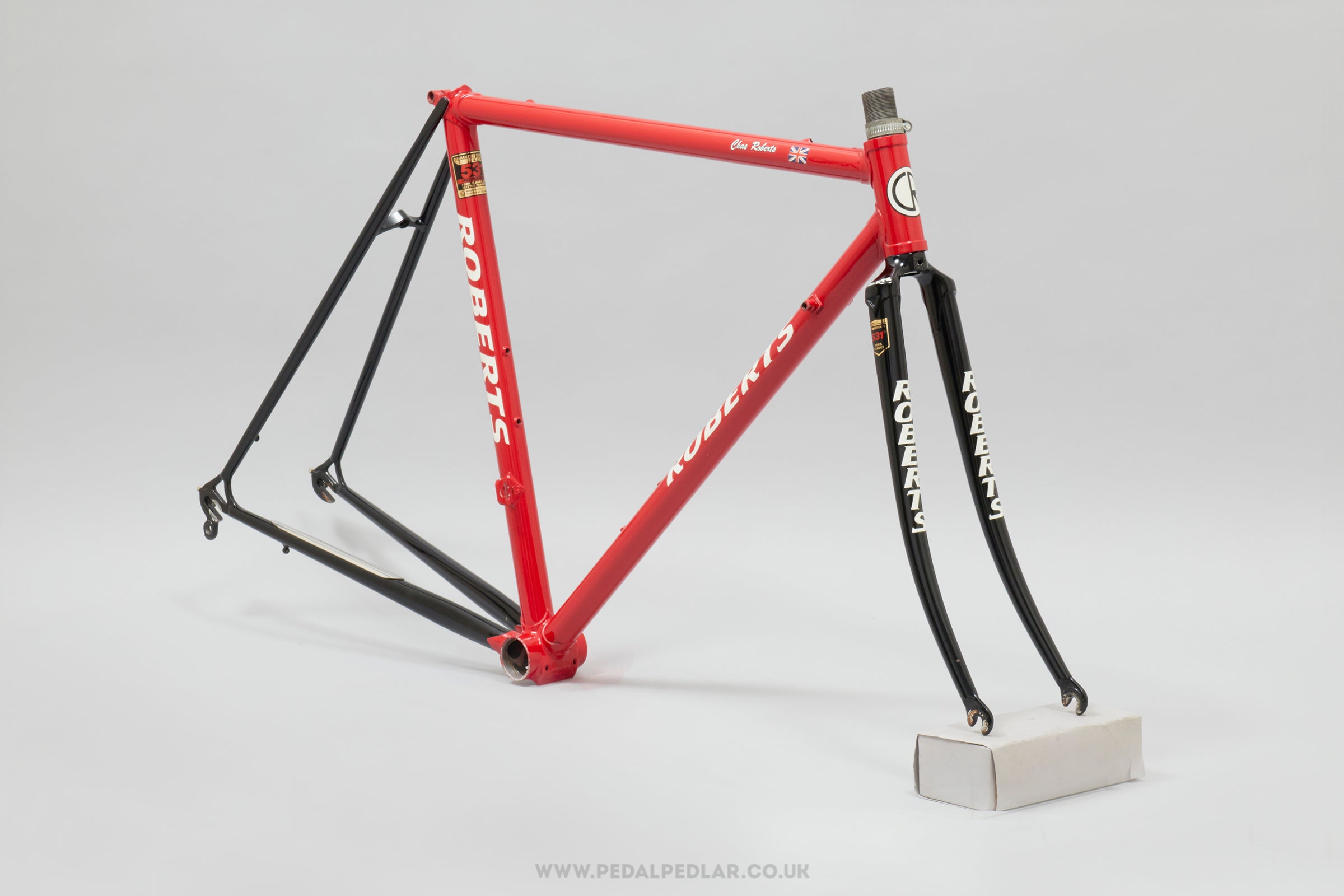

49cm Chas Roberts c.1991 Classic British Steel Road Bike Frame Set
£535.50 £595.00
✓ Original classic frame - built in the 1990s
✓ Thoroughly checked over & photographed in detail
✓ Worldwide shipping
South London's finest, Roberts Cycles are known the world over but have a particular cache as a classy frame-builder in the UK. Charlie Roberts honed his craft building frames post-war for various London brands, including Claud Butler and Holdsworth, but decided to strike out on his own in the 1960s. Later, his sons Chas and Geoff were passed the torch. With Charlie's passing in the late '70s, Chas took over the management of the company, and Geoff built alongside Derek Bailey, producing more and more custom road, track, pursuit, and touring frames to an increasing number of admirers. In the early '80s, Winston Vaz joined and spearheaded the production of their mountain bike frames, notably the White Spider and D.O.G.S B.O.L.L.O.X. The brand is now highly sought after by collectors.
This lightweight 1991-built frame is a lovely example of the restrained but well-made custom frames coming out of Roberts' workshop at the time. Made from Reynolds 531 Professional, Reynolds' lightest version of the 531 tube set, it was recommended for racing only due to its thin walls. As was the fashion at the time, the frame has an internally routed rear brake cable, close clearances, and a Cinelli 'spoiler' BB. We suspect the frame has had a fairly recent repaint, as it is in lovely condition with a nice contrasting black and red colour scheme.
The frame's been carefully checked by one of our mechanics to confirm the alignment's correct and there's no damage to the threads. If there are any minor issues worth noting we will do so in the overview section below. Please take a good look at the detailed photos so you can see the cosmetic condition of the frame before you buy.OVERVIEW
Era - 1990s
Country - British
Frame Material - Steel
Tubing - Reynolds 531 Professional
Weight - 2.625 kg
Stock Code - U-F-R114C
SIZING
Size Guide* - XS/Small (Approx 29" Inside Leg)
Seat Tube (ctc) - 49 cm
Top Tube (ctc) - 51.5 cm
Head Tube - 91 mm
Chainstay Length - 40.5 cm
Wheelbase - 97 cm
*This is just a guide, not a guarantee the frame will fit as every rider is different. If you're unsure of your size we'd always recommend trying out a bike with similar frame dimensions first.
TECHNICAL INFO
Rear Spacing - 128 mm
Front Spacing - 100 mm
Seatpost Diameter - 27.2 mm
Wheel Size - 700c/28"
Brake Fixing - Recessed Allen Key
Front Brake Drop - 42 mm
Rear Brake Drop - 41 mm
Bottom Bracket Thread - Italian Thread
Headset Thread - Standard ISO (24 TPI - British/Italian)
Headset Stack Height - 37 mm
Fork Crown Race - 26.4
Shifter Fittings - Downtube Braze-On
Headtube Internal Diameter - 30.2 mm
Steerer Internal Diameter - 22.2 mm (Standard)
-
▼SHIPPING, TAXES & RETURNS
-
We've been safely sending orders around the world since 2010. Orders are carefully packed, sent with tracking & insurance, and normally collected around midday on Tuesdays and Fridays. Larger items may occasionally require an extra day or two to prepare.
We accept returns, please notify us within 14 days and ensure the item arrives back with us no later than 30 days after the order was received.
EU orders under €150 (excluding shipping) - import VAT and the new €3 customs duty are paid as part of your order, so there's nothing further to pay on delivery.
EU orders over €150 (excluding shipping) - import fees are payable to the carrier before delivery, with nothing collected at checkout.
USA orders - import fees are collected at checkout for all orders to the USA, so there won’t be any surprise charges when your order arrives.
Other international orders - local import fees may apply and are not collected by us. Please check your country's import rules before purchasing.
-
▼HELP SECTION
-
Seat Tube (ctc) - we measure from the centre of the bottom bracket shell up to the centre line of the top tube to give a consistent measurement regardless of frame design (ctc means centre to centre).
Top Tube (ctc) - this is measured from the centre of the head tube to the centre of the seat tube, along the centre of the top tube.
Chainstay Length - measured from the centre of the bottom bracket shell to the centre point of the rear dropout.
Wheelbase - measured from the centre of the front fork dropout to the centre point of the rear dropout.
Front & Rear Spacing - measured from the inside of one dropout to the other. The dropouts on steel frames can be stretched or squeezed a few mm but it's always best to avoid this if possible, aluminium or carbon frames should never be stretched.
Brake Drop - measured using wheels of the relevant size for the frame, as stated in the technical info section.
Headset Threads - although it's generally recommended to match threaded parts exactly, with headsets you can technically mix and match, unless you have French or the obscure old Raleigh threads, in which case you need to stick to that type.


54cm Fanini Super Vintage Italian Steel Road Bike Frame Set
£405.00 £450.00
✓ Original vintage frame - built in the 1970s
✓ Suitable for historic cycling events such as L'Eroica
✓ Thoroughly checked over & photographed in detail
✓ Worldwide shipping
Fanini are a true cycling family: promotors; sponsors; team owners; sales reps; manufacturers, and amongst all of this they produced some magnificent hand built bikes. Often equal parts work of art to pure performance, Fanini built bikes that showed what Italian craftsmanship and flair could achieve. Frequently sporting Campagnolo's top end groupsets and a red paintjob, Fanini were built in low numbers throughout the 70s and 80s and are now rather rare to find.
A beautifully understated 1970s lightweight road frame from Fanini, probably made with Columbus SL tubes. Finely detailed hand-cut lugs and a slotted bottom bracket were typical of the artisanal approach to frame-building at Fanini and helped keep the weight down. The metallic burgundy paint job looks to have newer decals applied over the clear coat, and aside from some marks, is in lovely usable condition.
If you're taking part in L'Eroica or a similar vintage event, this frame is of the correct age, so you won't be disqualified for being a rule breaker!
The frame's been carefully checked by one of our mechanics to confirm the alignment's correct and there's no damage to the threads. If there are any minor issues worth noting we will do so in the overview section below. Please take a good look at the detailed photos so you can see the cosmetic condition of the frame before you buy.OVERVIEW
Era - 1970s
Country - Italian
Frame Material - Steel
Tubing - Columbus
Weight - 2.545 kg
Stock Code - U-F-R117V
SIZING
Size Guide* - Medium (Approx 32" Inside Leg)
Seat Tube (ctc) - 54 cm
Top Tube (ctc) - 54 cm
Head Tube - 133 mm
Chainstay Length - 40.5 cm
Wheelbase - 98.5 cm
*This is just a guide, not a guarantee the frame will fit as every rider is different. If you're unsure of your size we'd always recommend trying out a bike with similar frame dimensions first.
TECHNICAL INFO
Rear Spacing - 124 mm
Front Spacing - 102 mm
Seatpost Diameter - 27.0 mm
Wheel Size - 700c/28"
Brake Fixing - Recessed Allen Key
Front Brake Drop - 47 mm
Rear Brake Drop - 43 mm
Bottom Bracket Thread - Italian Thread
Headset Thread - Standard ISO (24 TPI - British/Italian)
Headset Stack Height - 38 mm
Fork Crown Race - 26.4 mm (ISO)
Shifter Fittings - Downtube Braze-On
Headtube Internal Diameter - 30.2 mm
Steerer Internal Diameter - 22.2 mm (Standard)
-
▼SHIPPING, TAXES & RETURNS
-
We've been safely sending orders around the world since 2010. Orders are carefully packed, sent with tracking & insurance, and normally collected around midday on Tuesdays and Fridays. Larger items may occasionally require an extra day or two to prepare.
We accept returns, please notify us within 14 days and ensure the item arrives back with us no later than 30 days after the order was received.
EU orders under €150 (excluding shipping) - import VAT and the new €3 customs duty are paid as part of your order, so there's nothing further to pay on delivery.
EU orders over €150 (excluding shipping) - import fees are payable to the carrier before delivery, with nothing collected at checkout.
USA orders - import fees are collected at checkout for all orders to the USA, so there won’t be any surprise charges when your order arrives.
Other international orders - local import fees may apply and are not collected by us. Please check your country's import rules before purchasing.
-
▼HELP SECTION
-
Seat Tube (ctc) - we measure from the centre of the bottom bracket shell up to the centre line of the top tube to give a consistent measurement regardless of frame design (ctc means centre to centre).
Top Tube (ctc) - this is measured from the centre of the head tube to the centre of the seat tube, along the centre of the top tube.
Chainstay Length - measured from the centre of the bottom bracket shell to the centre point of the rear dropout.
Wheelbase - measured from the centre of the front fork dropout to the centre point of the rear dropout.
Front & Rear Spacing - measured from the inside of one dropout to the other. The dropouts on steel frames can be stretched or squeezed a few mm but it's always best to avoid this if possible, aluminium or carbon frames should never be stretched.
Brake Drop - measured using wheels of the relevant size for the frame, as stated in the technical info section.
Headset Threads - although it's generally recommended to match threaded parts exactly, with headsets you can technically mix and match, unless you have French or the obscure old Raleigh threads, in which case you need to stick to that type.


Tioga BB-501 Sealed NOS/NIB Classic English Bottom Bracket Cups
£47.50 £50.00
✓ Original parts - produced in the 1990s
✓ New old stock & still in the original packaging!
✓ Worldwide shipping
Tioga BB-501 left and right bottom bracket cup set, hailing from the United States and in production during the 1990s (yet still new & unused after all this time). Made from steel and weighing in at 149 grams (for the pair). A fine choice for keeping your classic bike authentic, but also great for any other compatible bike.
OVERVIEW
Model ID - BB-501
Production Era - 1990s
Country - American
Material - Steel
Weight - 149 g
Stock Code - D-G3-BB-CS1C
*New old stock items may have marks from storage over the years, and as we often have multiples they can vary from piece to piece, but they are always genuine new & unused items.
TECHNICAL INFO
Bottom Bracket Type - Square Taper
Thread Type - English Thread (British/ISO 1.37" x 24 TPI)
-
▼SHIPPING, TAXES & RETURNS
-
We've been safely sending orders around the world since 2010. Orders are carefully packed, sent with tracking & insurance, and normally collected around midday on Tuesdays and Fridays. Larger items may occasionally require an extra day or two to prepare.
We accept returns, please notify us within 14 days and ensure the item arrives back with us no later than 30 days after the order was received.
EU orders under €150 (excluding shipping) - import VAT and the new €3 customs duty are paid as part of your order, so there's nothing further to pay on delivery.
EU orders over €150 (excluding shipping) - import fees are payable to the carrier before delivery, with nothing collected at checkout.
USA orders - import fees are collected at checkout for all orders to the USA, so there won’t be any surprise charges when your order arrives.
Other international orders - local import fees may apply and are not collected by us. Please check your country's import rules before purchasing.
-
▼SAFETY & COMPLIANCE
- This product complies with the EU General Product Safety Regulation (GPSR). Professional installation and regular inspections are recommended. Due to the product's age, extra care should be taken during use.
EU Authorised Representative - Global Trade Department NI Ltd, Office 834, Unit 6, 100 Lisburn Road, Belfast BT9 6AG, Northern Ireland
-
▼HELP SECTION
-
Bottom Bracket Type - ‘square taper’, as the name suggests have square shaped axle ends that slot into the chainset and ‘cottered’ axles are round and secured by pins - pretty much every bike up until the 1990s would use one of these, cottered being the much earlier system.
Thread Type - this must match the bottom bracket thread on your frame. The 3 common thread types on classic and vintage bikes are English (also known as British or ISO), Italian & French, and are usually (not always!) found on frames built in their respective countries. If you're replacing cups, they often have the thread type stamped on one of them, if not there are a couple of things to look at; bottom bracket shell width (English & French = 68 mm, Italian = 70 mm) & drive side cup thread direction (English = left, Italian & French = right). The only curveball to watch out for here, although pretty uncommon, are Swiss threads (also found on some French frames, Motobecanes being one) which will have the same shell width & thread direction as an English thread frame but the actual thread pitch will be different. If none of the above matches what you have, there are a few lesser known varieties that will require some further research.


Campagnolo Centaur / Euclid / Olympus ATB NOS Vintage English Bottom Bracket Cups
£61.75 £65.00
✓ Original parts - in production from the 1980s to the 1990s
✓ New old stock! Still unused after all these years
✓ Worldwide shipping
Campagnolo Centaur / Euclid / Olympus left and right bottom bracket cup set, hailing from Italy and in production from the 1980s to the 1990s (yet still new & unused after all this time). Made from steel and weighing in at 97 grams (for the pair). A fine choice for keeping your vintage bike authentic, but also great for any other compatible bike.
OVERVIEW
Production Era - 1980s & 1990s
Country - Italian
Material - Steel
Weight - 97 g
Stock Code - D-G3-BB-CS2V
*New old stock items may have marks from storage over the years, and as we often have multiples they can vary from piece to piece, but they are always genuine new & unused items.
TECHNICAL INFO
Bottom Bracket Type - Square Taper
Thread Type - English Thread (British/ISO 1.37" x 24 TPI)
-
▼SHIPPING, TAXES & RETURNS
-
We've been safely sending orders around the world since 2010. Orders are carefully packed, sent with tracking & insurance, and normally collected around midday on Tuesdays and Fridays. Larger items may occasionally require an extra day or two to prepare.
We accept returns, please notify us within 14 days and ensure the item arrives back with us no later than 30 days after the order was received.
EU orders under €150 (excluding shipping) - import VAT and the new €3 customs duty are paid as part of your order, so there's nothing further to pay on delivery.
EU orders over €150 (excluding shipping) - import fees are payable to the carrier before delivery, with nothing collected at checkout.
USA orders - import fees are collected at checkout for all orders to the USA, so there won’t be any surprise charges when your order arrives.
Other international orders - local import fees may apply and are not collected by us. Please check your country's import rules before purchasing.
-
▼SAFETY & COMPLIANCE
- This product complies with the EU General Product Safety Regulation (GPSR). Professional installation and regular inspections are recommended. Due to the product's age, extra care should be taken during use.
Product Manufacturer - CAMPAGNOLO Srl, Via della Chimica 4, 36100, Vicenza, Italy
EU Authorised Representative - Global Trade Department NI Ltd, Office 834, Unit 6, 100 Lisburn Road, Belfast BT9 6AG, Northern Ireland
-
▼HELP SECTION
-
Bottom Bracket Type - ‘square taper’, as the name suggests have square shaped axle ends that slot into the chainset and ‘cottered’ axles are round and secured by pins - pretty much every bike up until the 1990s would use one of these, cottered being the much earlier system.
Thread Type - this must match the bottom bracket thread on your frame. The 3 common thread types on classic and vintage bikes are English (also known as British or ISO), Italian & French, and are usually (not always!) found on frames built in their respective countries. If you're replacing cups, they often have the thread type stamped on one of them, if not there are a couple of things to look at; bottom bracket shell width (English & French = 68 mm, Italian = 70 mm) & drive side cup thread direction (English = left, Italian & French = right). The only curveball to watch out for here, although pretty uncommon, are Swiss threads (also found on some French frames, Motobecanes being one) which will have the same shell width & thread direction as an English thread frame but the actual thread pitch will be different. If none of the above matches what you have, there are a few lesser known varieties that will require some further research.


Tange NA NOS Vintage English Bottom Bracket Cups
£28.50 £30.00
✓ Original parts - produced in the 1980s
✓ New old stock! Still unused after all these years
✓ Suitable for historic cycling events such as L'Eroica
✓ Worldwide shipping
Tange left and right bottom bracket cup set, hailing from Japan and in production during the 1980s (yet still new & unused after all this time). Made from steel and weighing in at 112 grams (for the pair). A fine choice for keeping your vintage bike authentic, but also great for any other compatible bike.
If you're taking part in L'Eroica or any other vintage event, these are fully compliant - so rest assured, the pre-1987 police won't lock you up for having the wrong BB cups!
OVERVIEW
Production Era - 1980s
Country - Japanese
Material - Steel
Weight - 112 g
Stock Code - D-G3-BB-CS3V
*New old stock items may have marks from storage over the years, and as we often have multiples they can vary from piece to piece, but they are always genuine new & unused items.
TECHNICAL INFO
Bottom Bracket Type - Square Taper
Thread Type - English Thread (British/ISO 1.37" x 24 TPI)
-
▼SHIPPING, TAXES & RETURNS
-
We've been safely sending orders around the world since 2010. Orders are carefully packed, sent with tracking & insurance, and normally collected around midday on Tuesdays and Fridays. Larger items may occasionally require an extra day or two to prepare.
We accept returns, please notify us within 14 days and ensure the item arrives back with us no later than 30 days after the order was received.
EU orders under €150 (excluding shipping) - import VAT and the new €3 customs duty are paid as part of your order, so there's nothing further to pay on delivery.
EU orders over €150 (excluding shipping) - import fees are payable to the carrier before delivery, with nothing collected at checkout.
USA orders - import fees are collected at checkout for all orders to the USA, so there won’t be any surprise charges when your order arrives.
Other international orders - local import fees may apply and are not collected by us. Please check your country's import rules before purchasing.
-
▼SAFETY & COMPLIANCE
- This product complies with the EU General Product Safety Regulation (GPSR). Professional installation and regular inspections are recommended. Due to the product's age, extra care should be taken during use.
Product Manufacturer - TANGE International Co. Ltd, No.483, Minyi St, Xiushui Township, Changhua County 50444,Taiwan
EU Authorised Representative - Global Trade Department NI Ltd, Office 834, Unit 6, 100 Lisburn Road, Belfast BT9 6AG, Northern Ireland
-
▼HELP SECTION
-
Bottom Bracket Type - ‘square taper’, as the name suggests have square shaped axle ends that slot into the chainset and ‘cottered’ axles are round and secured by pins - pretty much every bike up until the 1990s would use one of these, cottered being the much earlier system.
Thread Type - this must match the bottom bracket thread on your frame. The 3 common thread types on classic and vintage bikes are English (also known as British or ISO), Italian & French, and are usually (not always!) found on frames built in their respective countries. If you're replacing cups, they often have the thread type stamped on one of them, if not there are a couple of things to look at; bottom bracket shell width (English & French = 68 mm, Italian = 70 mm) & drive side cup thread direction (English = left, Italian & French = right). The only curveball to watch out for here, although pretty uncommon, are Swiss threads (also found on some French frames, Motobecanes being one) which will have the same shell width & thread direction as an English thread frame but the actual thread pitch will be different. If none of the above matches what you have, there are a few lesser known varieties that will require some further research.


Panaracer Dart Classic Front Black/Skin NOS Classic 26 x 2.1" MTB Tyre
£34.00 £40.00
✓ Original tyre - produced in the 1990s
✓ New old stock! Still unused after all these years
✓ Worldwide shipping
Panaracer Dart Classic tyre, hailing from Japan and in production during the 1990s (yet still new & unused after all this time). Made from rubber and weighing in at 665 grams (the weight and price displayed are for one tyre, if we have more in stock you'll be able to add them to your basket). A fine choice for keeping your classic bike authentic, but also great for any other compatible bike.
NB: If mounted in the photos this is for illustrative purpose only, any wheels or rims shown are not included.OVERVIEW
Production Era - 1990s
Country - Japanese
Material - Rubber
Weight - 665 g
Stock Code - D-G4-TY-R57C
*New old stock items may have marks from storage over the years, and as we often have multiples they can vary from piece to piece, but they are always genuine new & unused items.
TECHNICAL INFO
Size - 26 x 2.1"
Bike Type - MTB
ISO Diameter - 559 mm (26")
-
▼SHIPPING, TAXES & RETURNS
-
We've been safely sending orders around the world since 2010. Orders are carefully packed, sent with tracking & insurance, and normally collected around midday on Tuesdays and Fridays. Larger items may occasionally require an extra day or two to prepare.
We accept returns, please notify us within 14 days and ensure the item arrives back with us no later than 30 days after the order was received.
EU orders under €150 (excluding shipping) - import VAT and the new €3 customs duty are paid as part of your order, so there's nothing further to pay on delivery.
EU orders over €150 (excluding shipping) - import fees are payable to the carrier before delivery, with nothing collected at checkout.
USA orders - import fees are collected at checkout for all orders to the USA, so there won’t be any surprise charges when your order arrives.
Other international orders - local import fees may apply and are not collected by us. Please check your country's import rules before purchasing.
-
▼SAFETY & COMPLIANCE
- This product complies with the EU General Product Safety Regulation (GPSR). Professional installation and regular inspections are recommended. Due to the product's age, extra care should be taken during use.
Product Manufacturer - Panaracer Corporation, 250 Isou, Hikami-cho, Tamba City, Hyogo 6693464, Japan
EU Authorised Representative - Global Trade Department NI Ltd, Office 834, Unit 6, 100 Lisburn Road, Belfast BT9 6AG, Northern Ireland
-
▼HELP SECTION
-
Size - this is the manufacturer’s sizing and must match the size or your wheel. This can be confusing as tyres have had different sizing systems over the years, and there are many (sometimes conflicting) sizes available. For this reason it’s important to check the ISO diameter too for clarification, especially for 26” wheels.
Bike Type - the type of bike the tyre was designed to be used on. Road tyres will generally be narrow with minimal tread, touring tyres wider with a bit more grip in the tread, and cyclocross & MTB tyres wider still (especially the latter), with a much more pronounced tread pattern.
ISO Diameter - this relates to the diameter of the wheel rim at the point where the tyre is seated (bead seat diameter). This is a universal measurement, often displayed on tyres as 28-622 or similar, 28 referring to the tyre width and 622 being the ISO diameter in millimetres.
TPI - stands for threads per inch and refers to the thread count of the tyre casing. A high thread count usually means a more supple and lighter tyre, this can be anything as high as 320 tpi. We can’t always provide this information however, as it’s not always possible to know for sure.


Panaracer Duster Pro Compe Front Black/Skin NOS/NIB Classic 26 x 1.95" MTB Folding Tyre
£29.25 £32.50
✓ Original tyre - produced in the 1990s
✓ New old stock & still in the original packaging!
✓ Worldwide shipping
Panaracer Duster Pro Compe folding tyre, hailing from Japan and in production during the 1990s (yet still new & unused after all this time). Made from rubber/kevlar and weighing in at 540 grams (the weight and price displayed are for one tyre, if we have more in stock you'll be able to add them to your basket). A fine choice for keeping your classic bike authentic, but also great for any other compatible bike.
NB: If mounted in the photos this is for illustrative purpose only, any wheels or rims shown are not included.OVERVIEW
Production Era - 1990s
Country - Japanese
Material - Rubber / Kevlar
Weight - 540 g
Stock Code - D-G4-TY-F27C
*New old stock items may have marks from storage over the years, and as we often have multiples they can vary from piece to piece, but they are always genuine new & unused items.
TECHNICAL INFO
Size - 26 x 1.95"
Bike Type - MTB
ISO Diameter - 559 mm (26")
-
▼SHIPPING, TAXES & RETURNS
-
We've been safely sending orders around the world since 2010. Orders are carefully packed, sent with tracking & insurance, and normally collected around midday on Tuesdays and Fridays. Larger items may occasionally require an extra day or two to prepare.
We accept returns, please notify us within 14 days and ensure the item arrives back with us no later than 30 days after the order was received.
EU orders under €150 (excluding shipping) - import VAT and the new €3 customs duty are paid as part of your order, so there's nothing further to pay on delivery.
EU orders over €150 (excluding shipping) - import fees are payable to the carrier before delivery, with nothing collected at checkout.
USA orders - import fees are collected at checkout for all orders to the USA, so there won’t be any surprise charges when your order arrives.
Other international orders - local import fees may apply and are not collected by us. Please check your country's import rules before purchasing.
-
▼SAFETY & COMPLIANCE
- This product complies with the EU General Product Safety Regulation (GPSR). Professional installation and regular inspections are recommended. Due to the product's age, extra care should be taken during use.
Product Manufacturer - Panaracer Corporation, 250 Isou, Hikami-cho, Tamba City, Hyogo 6693464, Japan
EU Authorised Representative - Global Trade Department NI Ltd, Office 834, Unit 6, 100 Lisburn Road, Belfast BT9 6AG, Northern Ireland
-
▼HELP SECTION
-
Size - this is the manufacturer’s sizing and must match the size or your wheel. This can be confusing as tyres have had different sizing systems over the years, and there are many (sometimes conflicting) sizes available. For this reason it’s important to check the ISO diameter too for clarification, especially for 26” wheels.
Bike Type - the type of bike the tyre was designed to be used on. Road tyres will generally be narrow with minimal tread, touring tyres wider with a bit more grip in the tread, and cyclocross & MTB tyres wider still (especially the latter), with a much more pronounced tread pattern.
ISO Diameter - this relates to the diameter of the wheel rim at the point where the tyre is seated (bead seat diameter). This is a universal measurement, often displayed on tyres as 28-622 or similar, 28 referring to the tyre width and 622 being the ISO diameter in millimetres.
TPI - stands for threads per inch and refers to the thread count of the tyre casing. A high thread count usually means a more supple and lighter tyre, this can be anything as high as 320 tpi. We can’t always provide this information however, as it’s not always possible to know for sure.


WTB Velociraptor Front Black/Skin NOS Classic 26 x 2.1" MTB Tyre
£25.50 £30.00
✓ Original tyre - produced in the 1990s
✓ New old stock! Still unused after all these years
✓ Worldwide shipping
WTB Velociraptor tyre, hailing from the United States and in production during the 1990s (yet still new & unused after all this time). Made from rubber and weighing in at 665 grams (the weight and price displayed are for one tyre, if we have more in stock you'll be able to add them to your basket). A fine choice for keeping your classic bike authentic, but also great for any other compatible bike.
NB: If mounted in the photos this is for illustrative purpose only, any wheels or rims shown are not included.OVERVIEW
Condition Notes - Some cracks on the tread area due to age and dis-colouration of the sidewalls (see last pic for example)
Production Era - 1990s
Country - American
Material - Rubber
Weight - 665 g
Stock Code - D-G4-TY-R58C
*New old stock items may have marks from storage over the years, and as we often have multiples they can vary from piece to piece, but they are always genuine new & unused items.
TECHNICAL INFO
Size - 26 x 2.1"
Bike Type - MTB
ISO Diameter - 559 mm (26")
-
▼SHIPPING, TAXES & RETURNS
-
We've been safely sending orders around the world since 2010. Orders are carefully packed, sent with tracking & insurance, and normally collected around midday on Tuesdays and Fridays. Larger items may occasionally require an extra day or two to prepare.
We accept returns, please notify us within 14 days and ensure the item arrives back with us no later than 30 days after the order was received.
EU orders under €150 (excluding shipping) - import VAT and the new €3 customs duty are paid as part of your order, so there's nothing further to pay on delivery.
EU orders over €150 (excluding shipping) - import fees are payable to the carrier before delivery, with nothing collected at checkout.
USA orders - import fees are collected at checkout for all orders to the USA, so there won’t be any surprise charges when your order arrives.
Other international orders - local import fees may apply and are not collected by us. Please check your country's import rules before purchasing.
-
▼SAFETY & COMPLIANCE
- This product complies with the EU General Product Safety Regulation (GPSR). Professional installation and regular inspections are recommended. Due to the product's age, extra care should be taken during use.
Product Manufacturer - WTB USA, 475 Miller Avenue, Mill Valley, CA 94941, USA
EU Authorised Representative - Global Trade Department NI Ltd, Office 834, Unit 6, 100 Lisburn Road, Belfast BT9 6AG, Northern Ireland
-
▼HELP SECTION
-
Size - this is the manufacturer’s sizing and must match the size or your wheel. This can be confusing as tyres have had different sizing systems over the years, and there are many (sometimes conflicting) sizes available. For this reason it’s important to check the ISO diameter too for clarification, especially for 26” wheels.
Bike Type - the type of bike the tyre was designed to be used on. Road tyres will generally be narrow with minimal tread, touring tyres wider with a bit more grip in the tread, and cyclocross & MTB tyres wider still (especially the latter), with a much more pronounced tread pattern.
ISO Diameter - this relates to the diameter of the wheel rim at the point where the tyre is seated (bead seat diameter). This is a universal measurement, often displayed on tyres as 28-622 or similar, 28 referring to the tyre width and 622 being the ISO diameter in millimetres.
TPI - stands for threads per inch and refers to the thread count of the tyre casing. A high thread count usually means a more supple and lighter tyre, this can be anything as high as 320 tpi. We can’t always provide this information however, as it’s not always possible to know for sure.


Vittoria Open Extreme Twin Tread Grey/Skin NOS/NIB Classic 700 x 20c Folding Tyres
£71.25 £75.00
✓ Original pair of tyres - produced in the 1990s
✓ New old stock & still in the original packaging!
✓ Worldwide shipping
Vittoria Open Extreme Twin Tread folding tyres, hailing from Italy and in production during the 1990s (yet still new & unused after all this time). Made from rubber/kevlar and weighing in at 535 grams (the weight and price displayed are for a pair of tyres). A fine choice for keeping your classic bike authentic, but also great for any other compatible bike.
NB: If mounted in the photos this is for illustrative purpose only, any wheels or rims shown are not included.OVERVIEW
Production Era - 1990s
Country - Italian
Material - Rubber / Kevlar
Weight - 535 g
Stock Code - D-G4-TYP-F25C
NB - Vittoria 'Pro-Team' model
*New old stock items may have marks from storage over the years, and as we often have multiples they can vary from piece to piece, but they are always genuine new & unused items.
TECHNICAL INFO
Size - 700 x 20c
Bike Type - Road
ISO Diameter - 622 mm (700c/28")
-
▼SHIPPING, TAXES & RETURNS
-
We've been safely sending orders around the world since 2010. Orders are carefully packed, sent with tracking & insurance, and normally collected around midday on Tuesdays and Fridays. Larger items may occasionally require an extra day or two to prepare.
We accept returns, please notify us within 14 days and ensure the item arrives back with us no later than 30 days after the order was received.
EU orders under €150 (excluding shipping) - import VAT and the new €3 customs duty are paid as part of your order, so there's nothing further to pay on delivery.
EU orders over €150 (excluding shipping) - import fees are payable to the carrier before delivery, with nothing collected at checkout.
USA orders - import fees are collected at checkout for all orders to the USA, so there won’t be any surprise charges when your order arrives.
Other international orders - local import fees may apply and are not collected by us. Please check your country's import rules before purchasing.
-
▼SAFETY & COMPLIANCE
- This product complies with the EU General Product Safety Regulation (GPSR). Professional installation and regular inspections are recommended. Due to the product's age, extra care should be taken during use.
Product Manufacturer - Vittoria S.p.A, Via Liguria, 8, 24041 Brembate (BG), Italy
EU Authorised Representative - Global Trade Department NI Ltd, Office 834, Unit 6, 100 Lisburn Road, Belfast BT9 6AG, Northern Ireland
-
▼HELP SECTION
-
Size - this is the manufacturer’s sizing and must match the size or your wheels. This can be confusing as tyres have had different sizing systems over the years, and there are many (sometimes conflicting) sizes available. For this reason it’s important to check the ISO diameter too for clarification, especially for 26” wheels.
Bike Type - the type of bike the tyres were designed to be used on. Road tyres will generally be narrow with minimal tread, touring tyres wider with a bit more grip in the tread, and cyclocross & MTB tyres wider still (especially the latter), with a much more pronounced tread pattern.
ISO Diameter - this relates to the diameter of the wheel rims at the point where the tyres are seated (bead seat diameter). This is a universal measurement, often displayed on tyres as 28-622 or similar, 28 referring to the tyre width and 622 being the ISO diameter in millimetres.
TPI - stands for threads per inch and refers to the thread count of the tyre casings. A high thread count usually means more supple and lighter tyres, this can be anything as high as 320 tpi. We can’t always provide this information however, as it’s not always possible to know for sure.


Campagnolo C-Record (1134019) 2nd Gen NOS/NIB Vintage 7/32" Steel Caged Bottom Bracket Bearings
£28.50 £30.00
✓ Original BB bearings - produced in the 1980s
✓ New old stock & still in the original packaging!
✓ Suitable for historic cycling events such as L'Eroica
✓ Worldwide shipping
Campagnolo C-Record caged bottom bracket bearing set (or ball races if you prefer), hailing from Italy and in production during the 1980s (yet still new & unused after all this time). The perfect finishing touch for your vintage bike, but great for bikes of the non-vintage variety too!
Initially, C-Record bottom brackets used 3/16” bearings like the earlier Super Record models, but they changed to these 7/32" ones in the late 1980s.
If you're taking part in L'Eroica or any other vintage event, these are fully compliant - so rest assured, the pre-1987 police won't lock you up for having the wrong bearings!
OVERVIEW
Model ID - 1134019
Production Era - 1980s
Country - Italian
Material - Steel
Weight - 25 g
Stock Code - D-G5-BB-B6V
*New old stock items may have marks from storage over the years, and as we often have multiples they can vary from piece to piece, but they are always genuine new & unused items.
TECHNICAL INFO
Bearing Size - 7/32"
Retainer - Steel Caged
Bearing Count - 12 + 12
-
▼SHIPPING, TAXES & RETURNS
-
We've been safely sending orders around the world since 2010. Orders are carefully packed, sent with tracking & insurance, and normally collected around midday on Tuesdays and Fridays. Larger items may occasionally require an extra day or two to prepare.
We accept returns, please notify us within 14 days and ensure the item arrives back with us no later than 30 days after the order was received.
EU orders under €150 (excluding shipping) - import VAT and the new €3 customs duty are paid as part of your order, so there's nothing further to pay on delivery.
EU orders over €150 (excluding shipping) - import fees are payable to the carrier before delivery, with nothing collected at checkout.
USA orders - import fees are collected at checkout for all orders to the USA, so there won’t be any surprise charges when your order arrives.
Other international orders - local import fees may apply and are not collected by us. Please check your country's import rules before purchasing.
-
▼SAFETY & COMPLIANCE
- This product complies with the EU General Product Safety Regulation (GPSR). Due to the product's age, extra care should be taken during installation and use.
Product Manufacturer - CAMPAGNOLO Srl, Via della Chimica 4, 36100, Vicenza, Italy
EU Authorised Representative - Global Trade Department NI Ltd, Office 834, Unit 6, 100 Lisburn Road, Belfast BT9 6AG, Northern Ireland
-
▼HELP SECTION
-
Bearing Size - most bottom brackets use 1/4" bearings, but there are some that use smaller sizes so it's advisable to measure your old ones or check with a local bike shop to be sure.
Retainer Type - you can use any type of retaining cage in any bottom bracket as long as the bearing sizes are correct.


Shimano Dura-Ace (BB-7400) NJS c.1987 Vintage English 112 mm Bottom Bracket
£137.75 £145.00
✓ Original part - in production from the 1980s to the 1990s
✓ Suitable for historic cycling events such as L'Eroica
✓ Professionally checked & cleaned
✓ Worldwide shipping
Shimano Dura-Ace bottom bracket (or BB for short), hailing from Japan and dating back to 1987. Made from steel and weighing in at 310 grams. A fine choice for keeping your vintage bike authentic, but also great for any other compatible bike.
If you're taking part in L'Eroica or a similar vintage event, this is fully compliant - so rest assured, the pre-1987 police won't lock you up for having the wrong bottom bracket!
The bottom bracket's been carefully cleaned, thoroughly checked by one of our mechanics and graded as excellent condition, but do take a good look at the detailed photos so you can see the cosmetic condition before you buy.OVERVIEW
Model ID - BB-7400
Production Era - 1980s & 1990s
Country - Japanese
Material - Steel
Weight - 310 g
Stock Code - U-G3-BB179V
TECHNICAL INFO
Thread Type - English Thread (British/ISO 1.37" x 24 TPI)
Axle Length - 112 mm
Axle Type - Square Taper
-
▼SHIPPING, TAXES & RETURNS
-
We've been safely sending orders around the world since 2010. Orders are carefully packed, sent with tracking & insurance, and normally collected around midday on Tuesdays and Fridays. Larger items may occasionally require an extra day or two to prepare.
We accept returns, please notify us within 14 days and ensure the item arrives back with us no later than 30 days after the order was received.
EU orders under €150 (excluding shipping) - import VAT and the new €3 customs duty are paid as part of your order, so there's nothing further to pay on delivery.
EU orders over €150 (excluding shipping) - import fees are payable to the carrier before delivery, with nothing collected at checkout.
USA orders - import fees are collected at checkout for all orders to the USA, so there won’t be any surprise charges when your order arrives.
Other international orders - local import fees may apply and are not collected by us. Please check your country's import rules before purchasing.
-
▼SAFETY & COMPLIANCE
- This product complies with the EU General Product Safety Regulation (GPSR). Professional installation and regular inspections are recommended. Due to the product's age, extra care should be taken during use.
Product Manufacturer - Shimano Inc. 3-77 Oimatsu-cho, Sakai-ku, Sakai-shi, Osaka 590-8577, Japan
EU Authorised Representative - Global Trade Department NI Ltd, Office 834, Unit 6, 100 Lisburn Road, Belfast BT9 6AG, Northern Ireland
-
▼HELP SECTION
-
Thread Type - this must match the bottom bracket thread on your frame. The 3 common thread types on classic and vintage bikes are English (also known as British or ISO), Italian & French, and are usually (not always!) found on frames built in their respective countries. If you're replacing a bottom bracket the cups should have the thread type stamped on one of them, if not there are a couple of things to look at; bottom bracket shell width (English & French = 68 mm, Italian = 70 mm) & drive side cup thread direction (English = left, Italian & French = right). The only curveball to watch out for here, although pretty uncommon, are Swiss threads (also found on some French frames, Motobecanes being one) which will have the same shell width & thread direction as an English thread frame but the actual thread pitch will be different. If none of the above matches what you have, there are a few lesser known varieties that will require some further research.
Axle Length - your crankset dictates the axle length you need and the recommendation should be used to avoid issues with chainline. If you're replacing a bottom bracket that works perfectly then this can be matched, otherwise you'll need to check the manufacturers spec, a good resource for older bikes is Velobase.
Axle Type - you can tell which type of axle you need by looking at the shape of the bottom bracket hole in your crankset. For square tapers, the ISO introduced a standard for European makers in the early 90s, JIS then did the same in Asia. Before then it was not so simple, and although there is a degree of interchangeability, the best way to make sure you have the right axle is to stick to the same brand from the same era, ideally the proprietary model.


Gipiemme Sprint (200DS) Strada Vintage Italian 113 mm Bottom Bracket
£38.00 £40.00
✓ Original part - produced in the 1980s
✓ Suitable for historic cycling events such as L'Eroica
✓ Professionally checked & cleaned
✓ Worldwide shipping
Gipiemme Sprint bottom bracket (or BB for short), hailing from Italy and in production during the 1980s. Made from steel and weighing in at 325 grams. A fine choice for keeping your vintage bike authentic, but also great for any other compatible bike.
If you're taking part in L'Eroica or a similar vintage event, this is fully compliant - so rest assured, the pre-1987 police won't lock you up for having the wrong bottom bracket!
The bottom bracket's been carefully cleaned, thoroughly checked by one of our mechanics and graded as OK condition, but do take a good look at the detailed photos so you can see the cosmetic condition before you buy.OVERVIEW
Model ID - 200DS
Production Era - 1980s
Country - Italian
Material - Steel
Weight - 325 g
Stock Code - U-G3-BB182V
TECHNICAL INFO
Thread Type - Italian Thread (ITA 36 mm x 24 TPI)
Axle Length - 113 mm
Axle Type - Square Taper
-
▼SHIPPING, TAXES & RETURNS
-
We've been safely sending orders around the world since 2010. Orders are carefully packed, sent with tracking & insurance, and normally collected around midday on Tuesdays and Fridays. Larger items may occasionally require an extra day or two to prepare.
We accept returns, please notify us within 14 days and ensure the item arrives back with us no later than 30 days after the order was received.
EU orders under €150 (excluding shipping) - import VAT and the new €3 customs duty are paid as part of your order, so there's nothing further to pay on delivery.
EU orders over €150 (excluding shipping) - import fees are payable to the carrier before delivery, with nothing collected at checkout.
USA orders - import fees are collected at checkout for all orders to the USA, so there won’t be any surprise charges when your order arrives.
Other international orders - local import fees may apply and are not collected by us. Please check your country's import rules before purchasing.
-
▼SAFETY & COMPLIANCE
- This product complies with the EU General Product Safety Regulation (GPSR). Professional installation and regular inspections are recommended. Due to the product's age, extra care should be taken during use.
EU Authorised Representative - Global Trade Department NI Ltd, Office 834, Unit 6, 100 Lisburn Road, Belfast BT9 6AG, Northern Ireland
-
▼HELP SECTION
-
Thread Type - this must match the bottom bracket thread on your frame. The 3 common thread types on classic and vintage bikes are English (also known as British or ISO), Italian & French, and are usually (not always!) found on frames built in their respective countries. If you're replacing a bottom bracket the cups should have the thread type stamped on one of them, if not there are a couple of things to look at; bottom bracket shell width (English & French = 68 mm, Italian = 70 mm) & drive side cup thread direction (English = left, Italian & French = right). The only curveball to watch out for here, although pretty uncommon, are Swiss threads (also found on some French frames, Motobecanes being one) which will have the same shell width & thread direction as an English thread frame but the actual thread pitch will be different. If none of the above matches what you have, there are a few lesser known varieties that will require some further research.
Axle Length - your crankset dictates the axle length you need and the recommendation should be used to avoid issues with chainline. If you're replacing a bottom bracket that works perfectly then this can be matched, otherwise you'll need to check the manufacturers spec, a good resource for older bikes is Velobase.
Axle Type - you can tell which type of axle you need by looking at the shape of the bottom bracket hole in your crankset. For square tapers, the ISO introduced a standard for European makers in the early 90s, JIS then did the same in Asia. Before then it was not so simple, and although there is a degree of interchangeability, the best way to make sure you have the right axle is to stick to the same brand from the same era, ideally the proprietary model.


Campagnolo Super Record (4001) 1st Gen c.1977 Vintage Rear Derailleur
£251.75 £265.00
✓ Original part - produced in the 1970s
✓ Suitable for historic cycling events such as L'Eroica
✓ Professionally checked & cleaned
✓ Worldwide shipping
Campagnolo Super Record rear derailleur (or mech if you prefer), hailing from Italy and dating back to 1977. Made from aluminium/steel/titanium and weighing in at 180 grams - incredibly lightweight for a rear derailleur at that time. A fine choice for keeping your vintage bike authentic, but also great for any other compatible bike.
If you're taking part in L'Eroica or a similar vintage event, this is fully compliant - so rest assured, the pre-1987 police won't lock you up for having the wrong rear mech!
The mech's been carefully cleaned, thoroughly checked by one of our mechanics and graded as very good condition, but do take a good look at the detailed photos so you can see the cosmetic condition before you buy.OVERVIEW
Jockey Wheel Condition - Good
Model ID - 4001
Production Era - 1970s
Country - Italian
Material - Aluminium / Steel / Titanium
Weight - 180 g
Stock Code - U-G3-RM137V
TECHNICAL INFO
Shifting System - Friction
Speed* - 5 Speed, 6 Speed, 7 Speed
Max Cog Size - 28 Teeth
Max Chain Wrap - 26
Chain Width - 3/32" (Standard)
*See help section.
-
▼SHIPPING, TAXES & RETURNS
-
We've been safely sending orders around the world since 2010. Orders are carefully packed, sent with tracking & insurance, and normally collected around midday on Tuesdays and Fridays. Larger items may occasionally require an extra day or two to prepare.
We accept returns, please notify us within 14 days and ensure the item arrives back with us no later than 30 days after the order was received.
EU orders under €150 (excluding shipping) - import VAT and the new €3 customs duty are paid as part of your order, so there's nothing further to pay on delivery.
EU orders over €150 (excluding shipping) - import fees are payable to the carrier before delivery, with nothing collected at checkout.
USA orders - import fees are collected at checkout for all orders to the USA, so there won’t be any surprise charges when your order arrives.
Other international orders - local import fees may apply and are not collected by us. Please check your country's import rules before purchasing.
-
▼SAFETY & COMPLIANCE
- This product complies with the EU General Product Safety Regulation (GPSR). Professional installation and regular inspections are recommended. Due to the product's age, extra care should be taken during use.
Product Manufacturer - CAMPAGNOLO Srl, Via della Chimica 4, 36100, Vicenza, Italy
EU Authorised Representative - Global Trade Department NI Ltd, Office 834, Unit 6, 100 Lisburn Road, Belfast BT9 6AG, Northern Ireland
-
▼HELP SECTION
-
Shifting system - friction means your gear levers don't click when you change gear, when they do click it's referred to as indexed shifting. If you have indexed gear levers they must use the same system as the rear derailleur, if you're using friction levers you can mix and match.
Speed - the number of cogs at the back the derailleur was designed to be used with. This is important with indexed shifting, but with friction shifters you can in theory run any rear mech with any number of cogs, but you are more likely to have issues running high numbers of cogs with mechs from earlier eras.
Max cog size - the amount of teeth on the largest cog of your freewheel/cassette can be no greater than this to work with this derailleur.
Chain wrap - subtract the size of your smallest rear cog from your biggest, then do the same with your chainrings, add the 2 numbers together and you have your chain wrap.
Chain width - generally speaking, derailleurs designed for more than 3 speed use will fit a standard 3/32'' chain, the exception being some Cyclo & Simplex models from around the mid 1900s.


Campagnolo Chorus (RD-11CH) Classic Rear Derailleur
£57.00 £60.00
✓ Original part - produced in the 1990s
✓ Professionally checked & cleaned
✓ Worldwide shipping
Campagnolo Chorus rear derailleur (or mech if you prefer), hailing from Italy and in production during the 1990s. Made from aluminium/steel and weighing in at 244 grams - pretty lightweight for a rear derailleur at that time. A fine choice for keeping your classic bike authentic, but also great for any other compatible bike.
The mech's been carefully cleaned, thoroughly checked by one of our mechanics and graded as good condition, but do take a good look at the detailed photos so you can see the cosmetic condition before you buy.OVERVIEW
Jockey Wheel Condition - OK
Model ID - RD-11CH
Production Era - 1990s
Country - Italian
Material - Aluminium / Steel
Weight - 244 g
Stock Code - U-G3-RM143C
TECHNICAL INFO
Shifting System - Campagnolo, Friction
Speed* - 8 Speed
Max Cog Size - 26 Teeth
Max Chain Wrap - 26
Chain Width - 3/32" (Standard)
*See help section.
-
▼SHIPPING, TAXES & RETURNS
-
We've been safely sending orders around the world since 2010. Orders are carefully packed, sent with tracking & insurance, and normally collected around midday on Tuesdays and Fridays. Larger items may occasionally require an extra day or two to prepare.
We accept returns, please notify us within 14 days and ensure the item arrives back with us no later than 30 days after the order was received.
EU orders under €150 (excluding shipping) - import VAT and the new €3 customs duty are paid as part of your order, so there's nothing further to pay on delivery.
EU orders over €150 (excluding shipping) - import fees are payable to the carrier before delivery, with nothing collected at checkout.
USA orders - import fees are collected at checkout for all orders to the USA, so there won’t be any surprise charges when your order arrives.
Other international orders - local import fees may apply and are not collected by us. Please check your country's import rules before purchasing.
-
▼SAFETY & COMPLIANCE
- This product complies with the EU General Product Safety Regulation (GPSR). Professional installation and regular inspections are recommended. Due to the product's age, extra care should be taken during use.
Product Manufacturer - CAMPAGNOLO Srl, Via della Chimica 4, 36100, Vicenza, Italy
EU Authorised Representative - Global Trade Department NI Ltd, Office 834, Unit 6, 100 Lisburn Road, Belfast BT9 6AG, Northern Ireland
-
▼HELP SECTION
-
Shifting system - friction means your gear levers don't click when you change gear, when they do click it's referred to as indexed shifting. If you have indexed gear levers they must use the same system as the rear derailleur, if you're using friction levers you can mix and match.
Speed - the number of cogs at the back the derailleur was designed to be used with. This is important with indexed shifting, but with friction shifters you can in theory run any rear mech with any number of cogs, but you are more likely to have issues running high numbers of cogs with mechs from earlier eras.
Max cog size - the amount of teeth on the largest cog of your freewheel/cassette can be no greater than this to work with this derailleur.
Chain wrap - subtract the size of your smallest rear cog from your biggest, then do the same with your chainrings, add the 2 numbers together and you have your chain wrap.
Chain width - generally speaking, derailleurs designed for more than 3 speed use will fit a standard 3/32'' chain, the exception being some Cyclo & Simplex models from around the mid 1900s.


Shimano Dura-Ace (RD-7400) c.1986 Vintage Rear Derailleur
£90.25 £95.00
✓ Original part - produced in the 1980s
✓ Suitable for historic cycling events such as L'Eroica
✓ Professionally checked & cleaned
✓ Worldwide shipping
Shimano Dura-Ace rear derailleur (or mech if you prefer), hailing from Japan and dating back to 1986. Made from aluminium/steel and weighing in at 200 grams - pretty lightweight for a rear derailleur at that time. A fine choice for keeping your vintage bike authentic, but also great for any other compatible bike.
If you're taking part in L'Eroica or a similar vintage event, this is fully compliant - so rest assured, the pre-1987 police won't lock you up for having the wrong rear mech!
The mech's been carefully cleaned, thoroughly checked by one of our mechanics and graded as very good condition, but do take a good look at the detailed photos so you can see the cosmetic condition before you buy.OVERVIEW
Jockey Wheel Condition - Excellent
Model ID - RD-7400
Production Era - 1980s
Country - Japanese
Material - Aluminium / Steel
Weight - 200 g
Stock Code - U-G3-RM146V
TECHNICAL INFO
Shifting System - Dura-Ace SIS, Dura-Ace STI, Friction
Speed* - 6 Speed
Max Cog Size - 26 Teeth
Max Chain Wrap - 28
Chain Width - 3/32" (Standard)
*See help section.
-
▼SHIPPING, TAXES & RETURNS
-
We've been safely sending orders around the world since 2010. Orders are carefully packed, sent with tracking & insurance, and normally collected around midday on Tuesdays and Fridays. Larger items may occasionally require an extra day or two to prepare.
We accept returns, please notify us within 14 days and ensure the item arrives back with us no later than 30 days after the order was received.
EU orders under €150 (excluding shipping) - import VAT and the new €3 customs duty are paid as part of your order, so there's nothing further to pay on delivery.
EU orders over €150 (excluding shipping) - import fees are payable to the carrier before delivery, with nothing collected at checkout.
USA orders - import fees are collected at checkout for all orders to the USA, so there won’t be any surprise charges when your order arrives.
Other international orders - local import fees may apply and are not collected by us. Please check your country's import rules before purchasing.
-
▼SAFETY & COMPLIANCE
- This product complies with the EU General Product Safety Regulation (GPSR). Professional installation and regular inspections are recommended. Due to the product's age, extra care should be taken during use.
Product Manufacturer - Shimano Inc. 3-77 Oimatsu-cho, Sakai-ku, Sakai-shi, Osaka 590-8577, Japan
EU Authorised Representative - Global Trade Department NI Ltd, Office 834, Unit 6, 100 Lisburn Road, Belfast BT9 6AG, Northern Ireland
-
▼HELP SECTION
-
Shifting system - friction means your gear levers don't click when you change gear, when they do click it's referred to as indexed shifting. If you have indexed gear levers they must use the same system as the rear derailleur, if you're using friction levers you can mix and match.
Speed - the number of cogs at the back the derailleur was designed to be used with. This is important with indexed shifting, but with friction shifters you can in theory run any rear mech with any number of cogs, but you are more likely to have issues running high numbers of cogs with mechs from earlier eras.
Max cog size - the amount of teeth on the largest cog of your freewheel/cassette can be no greater than this to work with this derailleur.
Chain wrap - subtract the size of your smallest rear cog from your biggest, then do the same with your chainrings, add the 2 numbers together and you have your chain wrap.
Chain width - generally speaking, derailleurs designed for more than 3 speed use will fit a standard 3/32'' chain, the exception being some Cyclo & Simplex models from around the mid 1900s.


Huret Duopar (Ref 2648) Titanium Vintage Rear Derailleur
£166.25 £175.00
✓ Original part - in production from the 1970s to the 1980s
✓ Suitable for historic cycling events such as L'Eroica
✓ Professionally checked & cleaned
✓ Worldwide shipping
Huret Duopar rear derailleur (or mech if you prefer), hailing from France and in production from the 1970s to the 1980s. Made from titanium/aluminium/ steel and weighing in at 256 grams. A fine choice for keeping your vintage bike authentic, but also great for any other compatible bike.
If you're taking part in L'Eroica or a similar vintage event, this is fully compliant - so rest assured, the pre-1987 police won't lock you up for having the wrong rear mech!
The mech's been carefully cleaned, thoroughly checked by one of our mechanics and graded as excellent condition, but do take a good look at the detailed photos so you can see the cosmetic condition before you buy.OVERVIEW
Jockey Wheel Condition - Very Good
Model ID - Ref 2648
Production Era - 1970s & 1980s
Country - French
Material - Titanium / Aluminium / Steel
Weight - 256 g
Stock Code - U-G3-RM148V
NB - Official release name was Duopar 'Titane'.
TECHNICAL INFO
Shifting System - Friction
Speed* - 5 Speed, 6 Speed, 7 Speed
Max Cog Size - 36 Teeth
Max Chain Wrap - 42
Chain Width - 3/32" (Standard)
*See help section.
-
▼SHIPPING, TAXES & RETURNS
-
We've been safely sending orders around the world since 2010. Orders are carefully packed, sent with tracking & insurance, and normally collected around midday on Tuesdays and Fridays. Larger items may occasionally require an extra day or two to prepare.
We accept returns, please notify us within 14 days and ensure the item arrives back with us no later than 30 days after the order was received.
EU orders under €150 (excluding shipping) - import VAT and the new €3 customs duty are paid as part of your order, so there's nothing further to pay on delivery.
EU orders over €150 (excluding shipping) - import fees are payable to the carrier before delivery, with nothing collected at checkout.
USA orders - import fees are collected at checkout for all orders to the USA, so there won’t be any surprise charges when your order arrives.
Other international orders - local import fees may apply and are not collected by us. Please check your country's import rules before purchasing.
-
▼SAFETY & COMPLIANCE
- This product complies with the EU General Product Safety Regulation (GPSR). Professional installation and regular inspections are recommended. Due to the product's age, extra care should be taken during use.
EU Authorised Representative - Global Trade Department NI Ltd, Office 834, Unit 6, 100 Lisburn Road, Belfast BT9 6AG, Northern Ireland
-
▼HELP SECTION
-
Shifting system - friction means your gear levers don't click when you change gear, when they do click it's referred to as indexed shifting. If you have indexed gear levers they must use the same system as the rear derailleur, if you're using friction levers you can mix and match.
Speed - the number of cogs at the back the derailleur was designed to be used with. This is important with indexed shifting, but with friction shifters you can in theory run any rear mech with any number of cogs, but you are more likely to have issues running high numbers of cogs with mechs from earlier eras.
Max cog size - the amount of teeth on the largest cog of your freewheel/cassette can be no greater than this to work with this derailleur.
Chain wrap - subtract the size of your smallest rear cog from your biggest, then do the same with your chainrings, add the 2 numbers together and you have your chain wrap.
Chain width - generally speaking, derailleurs designed for more than 3 speed use will fit a standard 3/32'' chain, the exception being some Cyclo & Simplex models from around the mid 1900s.


REG 320 NOS Vintage Bottom Bracket Dust Sleeve
£17.58 £18.50
✓ Original BB sleeve - in production from the 1970s to the 1980s
✓ New old stock! Still unused after all these years
✓ Suitable for historic cycling events such as L'Eroica
✓ Worldwide shipping
REG 320 BB barrel sleeve protector (or cover, or seal, or shield, or boot!), hailing from Italy and in production from the 1970s to the 1980s (yet still new & unused after all this time). A fine choice for keeping your vintage bike's bottom bracket free from dust and water, but great for all bikes with cup & cone BBs as the sleeves are all a standard size.
If you're taking part in L'Eroica or any other vintage event, these are fully compliant - so rest assured, the pre-1987 police won't lock you up for having the wrong BB sleeve!
OVERVIEW
Model ID - 320
Production Era - 1970s & 1980s
Country - Italian
Material - Plastic
Weight - 10 g
Stock Code - D-G6-BB-D3V
*New old stock items may have marks from storage over the years, and as we often have multiples they can vary from piece to piece, but they are always genuine new & unused items.
-
▼SHIPPING, TAXES & RETURNS
-
We've been safely sending orders around the world since 2010. Orders are carefully packed, sent with tracking & insurance, and normally collected around midday on Tuesdays and Fridays. Larger items may occasionally require an extra day or two to prepare.
We accept returns, please notify us within 14 days and ensure the item arrives back with us no later than 30 days after the order was received.
EU orders under €150 (excluding shipping) - import VAT and the new €3 customs duty are paid as part of your order, so there's nothing further to pay on delivery.
EU orders over €150 (excluding shipping) - import fees are payable to the carrier before delivery, with nothing collected at checkout.
USA orders - import fees are collected at checkout for all orders to the USA, so there won’t be any surprise charges when your order arrives.
Other international orders - local import fees may apply and are not collected by us. Please check your country's import rules before purchasing.
-
▼SAFETY & COMPLIANCE
- This product complies with the EU General Product Safety Regulation (GPSR).
EU Authorised Representative - Global Trade Department NI Ltd, Office 834, Unit 6, 100 Lisburn Road, Belfast BT9 6AG, Northern Ireland


Regina Extra CX NOS/NIB Vintage 6 Speed 13-23 Freewheel
£117.00 £130.00
✓ Original part - produced in the 1980s
✓ New old stock & still in the original packaging!
✓ Suitable for historic cycling events such as L'Eroica
✓ Worldwide shipping
Regina Extra CX freewheel, hailing from Italy and in production during the 1980s (yet still new & unused after all this time). Made from steel and weighing in at 412 grams. A fine choice for keeping your vintage bike authentic, but also great for any other compatible bike.
If you're taking part in L'Eroica or a similar vintage event, this is fully compliant - so rest assured, the pre-1987 police won't lock you up for having the wrong freewheel!
OVERVIEW
Production Era - 1980s
Country - Italian
Material - Steel
Weight - 412 g
Stock Code - D-FW201V
*New old stock items may have marks from storage over the years, and as we often have multiples they can vary from piece to piece, but they are always genuine new & unused items.
TECHNICAL INFO
Speed (No of Cogs) - 6 Speed
Range - 13-23
Threading - English/ISO: 1.375 x 24 TPI
Stack Height - 32 mm
Overall Cog Spacing - 30.5 mm
Chain Width - 3/32" (Standard)
-
▼SHIPPING, TAXES & RETURNS
-
We've been safely sending orders around the world since 2010. Orders are carefully packed, sent with tracking & insurance, and normally collected around midday on Tuesdays and Fridays. Larger items may occasionally require an extra day or two to prepare.
We accept returns, please notify us within 14 days and ensure the item arrives back with us no later than 30 days after the order was received.
EU orders under €150 (excluding shipping) - import VAT and the new €3 customs duty are paid as part of your order, so there's nothing further to pay on delivery.
EU orders over €150 (excluding shipping) - import fees are payable to the carrier before delivery, with nothing collected at checkout.
USA orders - import fees are collected at checkout for all orders to the USA, so there won’t be any surprise charges when your order arrives.
Other international orders - local import fees may apply and are not collected by us. Please check your country's import rules before purchasing.
-
▼SAFETY & COMPLIANCE
- This product complies with the EU General Product Safety Regulation (GPSR).
EU Authorised Representative - Global Trade Department NI Ltd, Office 834, Unit 6, 100 Lisburn Road, Belfast BT9 6AG, Northern Ireland
-
▼HELP SECTION
-
Speed - the number of cogs on the freewheel.
Range - the number of teeth on the smalles and largest cogs, this gives you an indication of how hard or easy the gearing will be, the lower the number the harder the gears. The tooth count of the cogs inbetween are usually evenly spaced, ie: a 6 speed 14-24 freewheel would likely have cog sizes 14, 16, 18, 20, 22 & 24.
Threading - this needs to match the thread of your rear hub. ISO is the modern standard and is almost exactly the same as older English/British and Italian thread, allowing you to mix and match between these thread types as long as it's not going to be under extreme force, in which case it's best to stick to an exact match. Hubs with a French thread must be used with a French threaded freewheel.
Stack Height - the total height (or width if you're looking at it when installed) that the freewheel will require once installed, including any protruding body parts such as base plates.
Overall Sprocket Spacing - this is measured from the outside of the first cog to the outside of the last cog.
Chain Width - this is mainly relevant for singlespeed and some older 3 or 4 speed freewheels - if this is ⅛” then you must use a ⅛” chain, but most freewheels (especially multiple speed ones) will use a standard 3/32” chain.


Shimano Dura-Ace (MF-7400) c.1987 Vintage 7 Speed 12-18 Freewheel
£71.25 £75.00
✓ Original part - produced in the 1980s
✓ Suitable for historic cycling events such as L'Eroica
✓ Professionally checked & carefully cleaned
✓ Worldwide shipping
Shimano Dura-Ace freewheel, hailing from Japan and dating back to 1987. Made from steel and weighing in at 334 grams. A fine choice for keeping your vintage bike authentic, but also great for any other compatible bike.
If you're taking part in L'Eroica or a similar vintage event, this is fully compliant - so rest assured, the pre-1987 police won't lock you up for having the wrong freewheel!
The freewheel's been carefully cleaned, thoroughly checked by one of our mechanics and graded as very good condition, but do take a good look at the detailed photos so you can see the cosmetic condition before you buy, and please consider that freewheels wear with chains, so used freewheels can occasionally skip when partnered with new (and some used) chains. This can usually be avoided by using a compatible used chain of similar age, but there is no way for us to confirm which chain will work with which freewheel.OVERVIEW
Model ID - MF-7400
Production Era - 1980s
Country - Japanese
Material - Steel
Weight - 334 g
Stock Code - U-FW203V
TECHNICAL INFO
Speed (No of Cogs) - 7 Speed
Range - 12-18
Threading - English/ISO: 1.375 x 24 TPI
Stack Height - 33 mm
Overall Cog Spacing - 32 mm
Chain Width - 3/32" (Standard)
-
▼SHIPPING, TAXES & RETURNS
-
We've been safely sending orders around the world since 2010. Orders are carefully packed, sent with tracking & insurance, and normally collected around midday on Tuesdays and Fridays. Larger items may occasionally require an extra day or two to prepare.
We accept returns, please notify us within 14 days and ensure the item arrives back with us no later than 30 days after the order was received.
EU orders under €150 (excluding shipping) - import VAT and the new €3 customs duty are paid as part of your order, so there's nothing further to pay on delivery.
EU orders over €150 (excluding shipping) - import fees are payable to the carrier before delivery, with nothing collected at checkout.
USA orders - import fees are collected at checkout for all orders to the USA, so there won’t be any surprise charges when your order arrives.
Other international orders - local import fees may apply and are not collected by us. Please check your country's import rules before purchasing.
-
▼SAFETY & COMPLIANCE
- This product complies with the EU General Product Safety Regulation (GPSR).
Product Manufacturer - Shimano Inc. 3-77 Oimatsu-cho, Sakai-ku, Sakai-shi, Osaka 590-8577, Japan
EU Authorised Representative - Global Trade Department NI Ltd, Office 834, Unit 6, 100 Lisburn Road, Belfast BT9 6AG, Northern Ireland
-
▼HELP SECTION
-
Speed - the number of cogs on the freewheel.
Range - the number of teeth on the smalles and largest cogs, this gives you an indication of how hard or easy the gearing will be, the lower the number the harder the gears. The tooth count of the cogs inbetween are usually evenly spaced, ie: a 6 speed 14-24 freewheel would likely have cog sizes 14, 16, 18, 20, 22 & 24.
Threading - this needs to match the thread of your rear hub. ISO is the modern standard and is almost exactly the same as older English/British and Italian thread, allowing you to mix and match between these thread types as long as it's not going to be under extreme force, in which case it's best to stick to an exact match. Hubs with a French thread must be used with a French threaded freewheel.
Stack Height - the total height (or width if you're looking at it when installed) that the freewheel will require once installed, including any protruding body parts such as base plates.
Overall Sprocket Spacing - this is measured from the outside of the first cog to the outside of the last cog.
Chain Width - this is mainly relevant for singlespeed and some older 3 or 4 speed freewheels - if this is ⅛” then you must use a ⅛” chain, but most freewheels (especially multiple speed ones) will use a standard 3/32” chain.
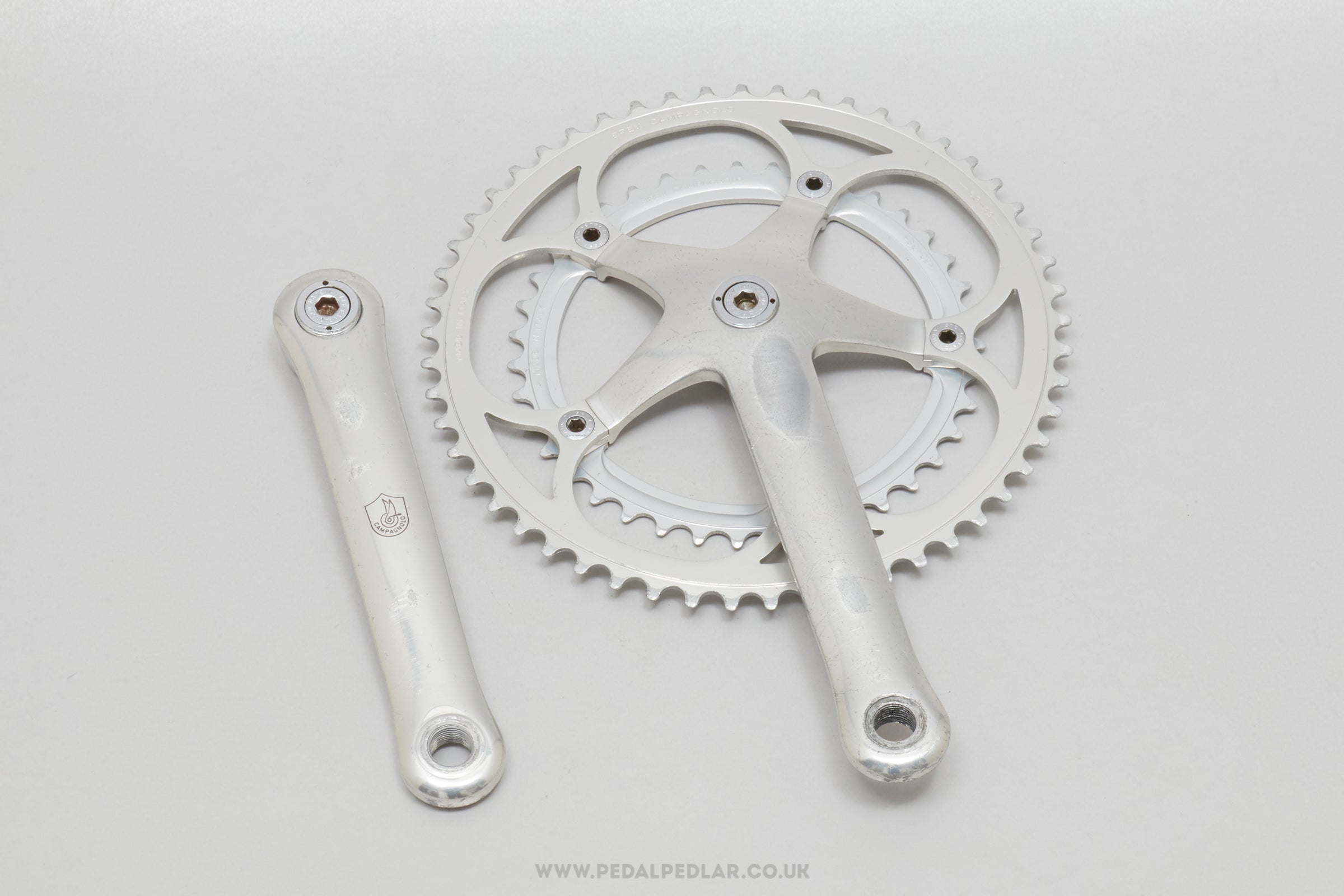

Campagnolo C-Record (A040) 2nd Type Vintage 170 mm Road Chainset
£166.25 £175.00
✓ Original part - in production from the 1980s to the 1990s
✓ Suitable for historic cycling events such as L'Eroica
✓ Professionally checked & cleaned
✓ Worldwide shipping
Campagnolo C-Record chainset (or crankset, if you prefer), hailing from Italy and in production from the 1980s to the 1990s. Made from aluminium and weighing in at 675 grams - pretty lightweight for a chainset at that time. A fine choice for keeping your vintage bike authentic, but also great for any other compatible bike.
If you're taking part in L'Eroica or a similar vintage event, this is fully compliant - so rest assured, the pre-1987 police won't lock you up for having the wrong chainset!
The chainset's been carefully cleaned, thoroughly checked by one of our mechanics and graded as OK condition, but do take a good look at the detailed photos so you can see the cosmetic condition before you buy.OVERVIEW
Chainring Condition - Good
Model ID - A040
Production Era - 1980s & 1990s
Country - Italian
Material - Aluminium
Weight - 675 g
Stock Code - U-G3-CS136V
TECHNICAL INFO
Chainring Count - Double
Tooth Count - 53 / 39
Bottom Bracket Type - Square Taper
BCD - 135 BCD
Crank Arm Length - 170 mm
Chain Width - 3/32" (Standard)
Pedal Threads - Standard (9/16" x 20 TPI)
Intended Speed* - 8 Speed
Bike Type* - Road
*See help section.
-
▼SHIPPING, TAXES & RETURNS
-
We've been safely sending orders around the world since 2010. Orders are carefully packed, sent with tracking & insurance, and normally collected around midday on Tuesdays and Fridays. Larger items may occasionally require an extra day or two to prepare.
We accept returns, please notify us within 14 days and ensure the item arrives back with us no later than 30 days after the order was received.
EU orders under €150 (excluding shipping) - import VAT and the new €3 customs duty are paid as part of your order, so there's nothing further to pay on delivery.
EU orders over €150 (excluding shipping) - import fees are payable to the carrier before delivery, with nothing collected at checkout.
USA orders - import fees are collected at checkout for all orders to the USA, so there won’t be any surprise charges when your order arrives.
Other international orders - local import fees may apply and are not collected by us. Please check your country's import rules before purchasing.
-
▼SAFETY & COMPLIANCE
- This product complies with the EU General Product Safety Regulation (GPSR). Professional installation and regular inspections are recommended. Due to the product's age, extra care should be taken during use.
Product Manufacturer - CAMPAGNOLO Srl, Via della Chimica 4, 36100, Vicenza, Italy
EU Authorised Representative - Global Trade Department NI Ltd, Office 834, Unit 6, 100 Lisburn Road, Belfast BT9 6AG, Northern Ireland
-
▼HELP SECTION
-
Chainring Count - the number of chainrings on the chainset. Fixed gear track bikes, single-speeds and some geared bikes use a single chainring, road bikes commonly use a double (two rings) and most touring bikes and mountain bikes will use a triple chainset (three rings).
Tooth Count - the number of teeth on the chainring(s), the higher the number the harder the gear.
Bottom Bracket Type - ‘square taper’, as the name suggests have a square shaped axle that slots into the chainset and ‘cottered’ axles are round and secured by pins - pretty much every bike up until the 1990s would use one of these, cottered being the much earlier system. Since then, different manufacturers have introduced their own systems that are not interchangeable so you must use a chainset that matches.
BCD - stands for Bolt Circle Diameter (sometimes referred to as PCD - Pitch Circle Diameter) and is only really needed when changing chainrings. To calculate the BCD, measure the distance in millimeters from the centre of any chainring bolt to the centre of an adjacent one and multiply it by 1.709 (you’ll likely need to round the resulting number up or down a little to get your BCD measurement).
Crank Arm Length - this is measured from the absolute centre of the bottom bracket hole to the centre of the hole for the pedal.
Chain Width - this is mostly only relevant for chainsets with a single chainring - if this is ⅛” then you must use a ⅛” chain. Almost all double and triple (and some single) ring chainsets will use a standard 3/32” chain, the only exception being old chainsets designed for 3 or 4 speed freewheels.
Pedal Threads - this must match the thread of your pedals and is usually stamped on the pedals themselves, most bikes use a standard thread of 9/16” x 20 tpi. The exceptions being older French bikes, bikes with cheaper one-piece type chainsets and Shimano’s Dyna Drive system (easily identifiable as the pedal holes are about an inch wide!).
*Intended Speed - the number of cogs at the back the chainset was designed to be used with. We refer to it as ‘intended’ speed as most double and triple chainsets will actually work with different speeds than originally intended, but the further away you get from the intended speed the more likely you are to experience minor setup issues. The exception being some chainsets intended for 10 speed use or higher, with these it’s better to stick to the intended speed.
*Bike Type - this is just a guide, any chainset can technically be used on any bike as long as everything's compatible.


Wellgo LU-987 U NOS/NIB Classic BMX Pedals
£27.00 £30.00
✓ Original pedals - produced in the 2000s
✓ New old stock & still in the original packaging!
✓ Worldwide shipping
Wellgo LU-987 U pedals, hailing from Taiwan and in production during the 2000s. Made from aluminium/steel and weighing in at 589 grams. A fine choice for keeping your classic bike authentic, but also great for any other compatible bike.
OVERVIEW
Bearing/Race Condition - New Old Stock*
Production Era - 2000s
Country - Taiwanese
Material - Aluminium / Steel
Weight - 589 g
Stock Code - D-G3-PD109C
*New old stock items may have marks from storage over the years, and as we often have multiples they can vary from piece to piece, but they are always genuine new & unused items.
TECHNICAL INFO
Pedal Type - BMX
Pedal Threads - One Piece American / BMX (1/2" x 20 TPI)
-
▼SHIPPING, TAXES & RETURNS
-
We've been safely sending orders around the world since 2010. Orders are carefully packed, sent with tracking & insurance, and normally collected around midday on Tuesdays and Fridays. Larger items may occasionally require an extra day or two to prepare.
We accept returns, please notify us within 14 days and ensure the item arrives back with us no later than 30 days after the order was received.
EU orders under €150 (excluding shipping) - import VAT and the new €3 customs duty are paid as part of your order, so there's nothing further to pay on delivery.
EU orders over €150 (excluding shipping) - import fees are payable to the carrier before delivery, with nothing collected at checkout.
USA orders - import fees are collected at checkout for all orders to the USA, so there won’t be any surprise charges when your order arrives.
Other international orders - local import fees may apply and are not collected by us. Please check your country's import rules before purchasing.
-
▼SAFETY & COMPLIANCE
- This product complies with the EU General Product Safety Regulation (GPSR). Professional installation and regular inspections are recommended. Due to the product's age, extra care should be taken during use.
Product Manufacturer - Wellgo Pedals Corp, No.3 Gong, 7th Rd Dajia Dist, Youth Ind. Park, Taichung City, 437 Taiwan.
EU Authorised Representative - Global Trade Department NI Ltd, Office 834, Unit 6, 100 Lisburn Road, Belfast BT9 6AG, Northern Ireland
-
▼HELP SECTION
-
Pedal Type - this is just a guide to give you an idea of the pedal type, but any pedal can technically be used for any purpose. Track pedals are designed without the pointed 'quill' for safety though, so it's best to only use track pedals for this purpose. Most track pedals, along with quill & aero road pedals are designed to be used with toe clips & straps for best performance.
Pedal Threads - this must match the thread on your cranks. Sometimes it's stamped on the end of the crank arm, but most bikes use a standard thread of 9/16” x 20 tpi. The exceptions being older French bikes, bikes with cheaper one-piece type chainsets and Shimano’s Dyna Drive system (easily identifiable as the pedal holes are about an inch wide!).


Campagnolo Record (1052/1) 3rd Gen Vintage Clamp-On 28.6 mm Front Derailleur
£118.75 £125.00
✓ Original part - in production from the 1960s to the 1970s
✓ Suitable for historic cycling events such as L'Eroica
✓ Professionally checked & cleaned
✓ Worldwide shipping
Campagnolo Record front derailleur (or mech, or changer if you prefer), hailing from Italy and in production from the 1960s to the 1970s. Made from aluminium/steel and weighing in at 93 grams. A fine choice for keeping your vintage bike authentic, but also great for any other compatible bike.
This is an unusal example of the Record front mech, with all the features of the 3rd gen version, but with the later triangular arms and circlip usually seen on the 6th gen Super Record era variation from the early 1970s.
If you're taking part in L'Eroica or a similar vintage event, this is fully compliant - so rest assured, the pre-1987 police won't lock you up for having the wrong front mech!
The derailleur's been carefully cleaned, thoroughly checked by one of our mechanics and graded as very good condition, but do take a good look at the detailed photos so you can see the cosmetic condition before you buy.OVERVIEW
Model ID - 1052/1
Production Era - 1960s & 1970s
Country - Italian
Material - Aluminium / Steel
Weight - 93 g
Stock Code - U-G3-FM200V
TECHNICAL INFO
Chainset Type - Double
Frame Fixing - Clamp-On 28.6 mm
Pull Type - Bottom Pull
*See help section.
-
▼SHIPPING, TAXES & RETURNS
-
We've been safely sending orders around the world since 2010. Orders are carefully packed, sent with tracking & insurance, and normally collected around midday on Tuesdays and Fridays. Larger items may occasionally require an extra day or two to prepare.
We accept returns, please notify us within 14 days and ensure the item arrives back with us no later than 30 days after the order was received.
EU orders under €150 (excluding shipping) - import VAT and the new €3 customs duty are paid as part of your order, so there's nothing further to pay on delivery.
EU orders over €150 (excluding shipping) - import fees are payable to the carrier before delivery, with nothing collected at checkout.
USA orders - import fees are collected at checkout for all orders to the USA, so there won’t be any surprise charges when your order arrives.
Other international orders - local import fees may apply and are not collected by us. Please check your country's import rules before purchasing.
-
▼SAFETY & COMPLIANCE
- This product complies with the EU General Product Safety Regulation (GPSR). Professional installation and regular inspections are recommended. Due to the product's age, extra care should be taken during use.
Product Manufacturer - CAMPAGNOLO Srl, Via della Chimica 4, 36100, Vicenza, Italy
EU Authorised Representative - Global Trade Department NI Ltd, Office 834, Unit 6, 100 Lisburn Road, Belfast BT9 6AG, Northern Ireland
-
▼HELP SECTION
-
Chainset Type - the number of chainrings the derailleur was designed to work with. ‘Double’ derailleurs are actually capable of working on ‘triple’ chainsets but they may struggle when shifting, especially if there’s a big step down from the middle to inner ring, so it’s better to match these correctly.
Frame Fixing - the way the derailleur fixes to the frame, if you have a tab on your frame to mount the derailleur to you need braze-on. If there’s no tab then you require a clamp-on type (also referred to as band-on or clip-on), these come in different sizes to match the diameter of your seat tube.
Pull Type - the direction of which the cable needs to ‘pull’ the mech in order to shift. If your cable runs up to the derailleur from the bottom bracket area then you need bottom pull, if your cable comes down from above you need top pull. Some later derailleurs can be used for either setups, these are referred to as dual pull.
Designated Speed (9 Speed & Above) - the speed of the chain that the mech was designed to be used with. This only becomes relevant for mechs marketed as 9 speed or above when chains became narrower, as the derailleur cage plates became marginally narrower too. We refer to it as ‘designated’ speed as technically you can use (almost) any derailleur with any chain, however if you want optimum performance it’s best to stay close to the manufacturers recommendations.
Indexing System (Shimano Only) - this is only applicable when using Shimano shifters that have an indexed left shifter such as STI or Rapidfire. For the indexing to work correctly when using these shifters the derailleur and shifters must be of the same type, so Shimano drop bar shifters need to be matched with a Shimano ‘road’ derailleur, and Shimano flat bar shifters must be used with Shimano ‘MTB’ derailleurs.


Campagnolo Record (1052/1) 3rd Gen v2 Vintage Clamp-On 28.6 mm Front Derailleur
£104.50 £110.00
✓ Original part - produced in the 1960s
✓ Suitable for historic cycling events such as L'Eroica
✓ Professionally checked & cleaned
✓ Worldwide shipping
Campagnolo Record front derailleur (or mech, or changer if you prefer), hailing from Italy and in production during the 1960s. Made from aluminium/steel and weighing in at 94 grams. A fine choice for keeping your vintage bike authentic, but also great for any other compatible bike.
If you're taking part in L'Eroica or a similar vintage event, this is fully compliant - so rest assured, the pre-1987 police won't lock you up for having the wrong front mech!
The derailleur's been carefully cleaned, thoroughly checked by one of our mechanics and graded as good condition, but do take a good look at the detailed photos so you can see the cosmetic condition before you buy.OVERVIEW
Model ID - 1052/1
Production Era - 1960s
Country - Italian
Material - Aluminium / Steel
Weight - 94 g
Stock Code - U-G3-FM201V
TECHNICAL INFO
Chainset Type - Double
Frame Fixing - Clamp-On 28.6 mm
Pull Type - Bottom Pull
*See help section.
-
▼SHIPPING, TAXES & RETURNS
-
We've been safely sending orders around the world since 2010. Orders are carefully packed, sent with tracking & insurance, and normally collected around midday on Tuesdays and Fridays. Larger items may occasionally require an extra day or two to prepare.
We accept returns, please notify us within 14 days and ensure the item arrives back with us no later than 30 days after the order was received.
EU orders under €150 (excluding shipping) - import VAT and the new €3 customs duty are paid as part of your order, so there's nothing further to pay on delivery.
EU orders over €150 (excluding shipping) - import fees are payable to the carrier before delivery, with nothing collected at checkout.
USA orders - import fees are collected at checkout for all orders to the USA, so there won’t be any surprise charges when your order arrives.
Other international orders - local import fees may apply and are not collected by us. Please check your country's import rules before purchasing.
-
▼SAFETY & COMPLIANCE
- This product complies with the EU General Product Safety Regulation (GPSR). Professional installation and regular inspections are recommended. Due to the product's age, extra care should be taken during use.
Product Manufacturer - CAMPAGNOLO Srl, Via della Chimica 4, 36100, Vicenza, Italy
EU Authorised Representative - Global Trade Department NI Ltd, Office 834, Unit 6, 100 Lisburn Road, Belfast BT9 6AG, Northern Ireland
-
▼HELP SECTION
-
Chainset Type - the number of chainrings the derailleur was designed to work with. ‘Double’ derailleurs are actually capable of working on ‘triple’ chainsets but they may struggle when shifting, especially if there’s a big step down from the middle to inner ring, so it’s better to match these correctly.
Frame Fixing - the way the derailleur fixes to the frame, if you have a tab on your frame to mount the derailleur to you need braze-on. If there’s no tab then you require a clamp-on type (also referred to as band-on or clip-on), these come in different sizes to match the diameter of your seat tube.
Pull Type - the direction of which the cable needs to ‘pull’ the mech in order to shift. If your cable runs up to the derailleur from the bottom bracket area then you need bottom pull, if your cable comes down from above you need top pull. Some later derailleurs can be used for either setups, these are referred to as dual pull.
Designated Speed (9 Speed & Above) - the speed of the chain that the mech was designed to be used with. This only becomes relevant for mechs marketed as 9 speed or above when chains became narrower, as the derailleur cage plates became marginally narrower too. We refer to it as ‘designated’ speed as technically you can use (almost) any derailleur with any chain, however if you want optimum performance it’s best to stay close to the manufacturers recommendations.
Indexing System (Shimano Only) - this is only applicable when using Shimano shifters that have an indexed left shifter such as STI or Rapidfire. For the indexing to work correctly when using these shifters the derailleur and shifters must be of the same type, so Shimano drop bar shifters need to be matched with a Shimano ‘road’ derailleur, and Shimano flat bar shifters must be used with Shimano ‘MTB’ derailleurs.


Campagnolo Record (1052/1) 3rd Gen v2 Vintage Clamp-On 28.6 mm Front Derailleur
£109.25 £115.00
✓ Original part - produced in the 1960s
✓ Suitable for historic cycling events such as L'Eroica
✓ Professionally checked & cleaned
✓ Worldwide shipping
Campagnolo Record front derailleur (or mech, or changer if you prefer), hailing from Italy and in production during the 1960s. Made from aluminium/steel and weighing in at 94 grams. A fine choice for keeping your vintage bike authentic, but also great for any other compatible bike.
If you're taking part in L'Eroica or a similar vintage event, this is fully compliant - so rest assured, the pre-1987 police won't lock you up for having the wrong front mech!
The derailleur's been carefully cleaned, thoroughly checked by one of our mechanics and graded as very good condition, but do take a good look at the detailed photos so you can see the cosmetic condition before you buy.OVERVIEW
Model ID - 1052/1
Production Era - 1960s
Country - Italian
Material - Aluminium / Steel
Weight - 94 g
Stock Code - U-G3-FM202V
TECHNICAL INFO
Chainset Type - Double
Frame Fixing - Clamp-On 28.6 mm
Pull Type - Bottom Pull
*See help section.
-
▼SHIPPING, TAXES & RETURNS
-
We've been safely sending orders around the world since 2010. Orders are carefully packed, sent with tracking & insurance, and normally collected around midday on Tuesdays and Fridays. Larger items may occasionally require an extra day or two to prepare.
We accept returns, please notify us within 14 days and ensure the item arrives back with us no later than 30 days after the order was received.
EU orders under €150 (excluding shipping) - import VAT and the new €3 customs duty are paid as part of your order, so there's nothing further to pay on delivery.
EU orders over €150 (excluding shipping) - import fees are payable to the carrier before delivery, with nothing collected at checkout.
USA orders - import fees are collected at checkout for all orders to the USA, so there won’t be any surprise charges when your order arrives.
Other international orders - local import fees may apply and are not collected by us. Please check your country's import rules before purchasing.
-
▼SAFETY & COMPLIANCE
- This product complies with the EU General Product Safety Regulation (GPSR). Professional installation and regular inspections are recommended. Due to the product's age, extra care should be taken during use.
Product Manufacturer - CAMPAGNOLO Srl, Via della Chimica 4, 36100, Vicenza, Italy
EU Authorised Representative - Global Trade Department NI Ltd, Office 834, Unit 6, 100 Lisburn Road, Belfast BT9 6AG, Northern Ireland
-
▼HELP SECTION
-
Chainset Type - the number of chainrings the derailleur was designed to work with. ‘Double’ derailleurs are actually capable of working on ‘triple’ chainsets but they may struggle when shifting, especially if there’s a big step down from the middle to inner ring, so it’s better to match these correctly.
Frame Fixing - the way the derailleur fixes to the frame, if you have a tab on your frame to mount the derailleur to you need braze-on. If there’s no tab then you require a clamp-on type (also referred to as band-on or clip-on), these come in different sizes to match the diameter of your seat tube.
Pull Type - the direction of which the cable needs to ‘pull’ the mech in order to shift. If your cable runs up to the derailleur from the bottom bracket area then you need bottom pull, if your cable comes down from above you need top pull. Some later derailleurs can be used for either setups, these are referred to as dual pull.
Designated Speed (9 Speed & Above) - the speed of the chain that the mech was designed to be used with. This only becomes relevant for mechs marketed as 9 speed or above when chains became narrower, as the derailleur cage plates became marginally narrower too. We refer to it as ‘designated’ speed as technically you can use (almost) any derailleur with any chain, however if you want optimum performance it’s best to stay close to the manufacturers recommendations.
Indexing System (Shimano Only) - this is only applicable when using Shimano shifters that have an indexed left shifter such as STI or Rapidfire. For the indexing to work correctly when using these shifters the derailleur and shifters must be of the same type, so Shimano drop bar shifters need to be matched with a Shimano ‘road’ derailleur, and Shimano flat bar shifters must be used with Shimano ‘MTB’ derailleurs.


Shimano 600 EX (FD-6207) c.1985 Vintage Clamp-On 28.6 mm Front Derailleur
£38.00 £40.00
✓ Original part - produced in the 1980s
✓ Suitable for historic cycling events such as L'Eroica
✓ Professionally checked & cleaned
✓ Worldwide shipping
Shimano 600 EX front derailleur (or mech, or changer if you prefer), hailing from Japan and dating back to 1985. Made from aluminium/steel and weighing in at 114 grams. A fine choice for keeping your vintage bike authentic, but also great for any other compatible bike.
If you're taking part in L'Eroica or a similar vintage event, this is fully compliant - so rest assured, the pre-1987 police won't lock you up for having the wrong front mech!
The derailleur's been carefully cleaned, thoroughly checked by one of our mechanics and graded as excellent condition, but do take a good look at the detailed photos so you can see the cosmetic condition before you buy.OVERVIEW
Model ID - FD-6207
Production Era - 1980s
Country - Japanese
Material - Aluminium / Steel
Weight - 114 g
Stock Code - U-G3-FM203V
TECHNICAL INFO
Chainset Type - Double
Frame Fixing - Clamp-On 28.6 mm
Pull Type - Bottom Pull
*See help section.
-
▼SHIPPING, TAXES & RETURNS
-
We've been safely sending orders around the world since 2010. Orders are carefully packed, sent with tracking & insurance, and normally collected around midday on Tuesdays and Fridays. Larger items may occasionally require an extra day or two to prepare.
We accept returns, please notify us within 14 days and ensure the item arrives back with us no later than 30 days after the order was received.
EU orders under €150 (excluding shipping) - import VAT and the new €3 customs duty are paid as part of your order, so there's nothing further to pay on delivery.
EU orders over €150 (excluding shipping) - import fees are payable to the carrier before delivery, with nothing collected at checkout.
USA orders - import fees are collected at checkout for all orders to the USA, so there won’t be any surprise charges when your order arrives.
Other international orders - local import fees may apply and are not collected by us. Please check your country's import rules before purchasing.
-
▼SAFETY & COMPLIANCE
- This product complies with the EU General Product Safety Regulation (GPSR). Professional installation and regular inspections are recommended. Due to the product's age, extra care should be taken during use.
Product Manufacturer - Shimano Inc. 3-77 Oimatsu-cho, Sakai-ku, Sakai-shi, Osaka 590-8577, Japan
EU Authorised Representative - Global Trade Department NI Ltd, Office 834, Unit 6, 100 Lisburn Road, Belfast BT9 6AG, Northern Ireland
-
▼HELP SECTION
-
Chainset Type - the number of chainrings the derailleur was designed to work with. ‘Double’ derailleurs are actually capable of working on ‘triple’ chainsets but they may struggle when shifting, especially if there’s a big step down from the middle to inner ring, so it’s better to match these correctly.
Frame Fixing - the way the derailleur fixes to the frame, if you have a tab on your frame to mount the derailleur to you need braze-on. If there’s no tab then you require a clamp-on type (also referred to as band-on or clip-on), these come in different sizes to match the diameter of your seat tube.
Pull Type - the direction of which the cable needs to ‘pull’ the mech in order to shift. If your cable runs up to the derailleur from the bottom bracket area then you need bottom pull, if your cable comes down from above you need top pull. Some later derailleurs can be used for either setups, these are referred to as dual pull.
Designated Speed (9 Speed & Above) - the speed of the chain that the mech was designed to be used with. This only becomes relevant for mechs marketed as 9 speed or above when chains became narrower, as the derailleur cage plates became marginally narrower too. We refer to it as ‘designated’ speed as technically you can use (almost) any derailleur with any chain, however if you want optimum performance it’s best to stay close to the manufacturers recommendations.
Indexing System (Shimano Only) - this is only applicable when using Shimano shifters that have an indexed left shifter such as STI or Rapidfire. For the indexing to work correctly when using these shifters the derailleur and shifters must be of the same type, so Shimano drop bar shifters need to be matched with a Shimano ‘road’ derailleur, and Shimano flat bar shifters must be used with Shimano ‘MTB’ derailleurs.


Shimano Dura-Ace (FD-7400) Vintage Clamp-On 28.6 mm Front Derailleur
£118.75 £125.00
✓ Original part - in production from the 1980s to the 1990s
✓ Suitable for historic cycling events such as L'Eroica
✓ Professionally checked & cleaned
✓ Worldwide shipping
Shimano Dura-Ace front derailleur (or mech, or changer if you prefer), hailing from Japan and in production from the 1980s to the 1990s. Made from aluminium/steel and weighing in at 95 grams. A fine choice for keeping your vintage bike authentic, but also great for any other compatible bike.
If you're taking part in L'Eroica or a similar vintage event, this is fully compliant - so rest assured, the pre-1987 police won't lock you up for having the wrong front mech!
The derailleur's been carefully cleaned, thoroughly checked by one of our mechanics and graded as excellent condition, but do take a good look at the detailed photos so you can see the cosmetic condition before you buy.OVERVIEW
Model ID - FD-7400
Production Era - 1980s & 1990s
Country - Japanese
Material - Aluminium / Steel
Weight - 95 g
Stock Code - U-G3-FM204V
NB - Comes with original box, but the derailleur has been used
TECHNICAL INFO
Chainset Type - Double
Frame Fixing - Clamp-On 28.6 mm
Pull Type - Bottom Pull
*See help section.
-
▼SHIPPING, TAXES & RETURNS
-
We've been safely sending orders around the world since 2010. Orders are carefully packed, sent with tracking & insurance, and normally collected around midday on Tuesdays and Fridays. Larger items may occasionally require an extra day or two to prepare.
We accept returns, please notify us within 14 days and ensure the item arrives back with us no later than 30 days after the order was received.
EU orders under €150 (excluding shipping) - import VAT and the new €3 customs duty are paid as part of your order, so there's nothing further to pay on delivery.
EU orders over €150 (excluding shipping) - import fees are payable to the carrier before delivery, with nothing collected at checkout.
USA orders - import fees are collected at checkout for all orders to the USA, so there won’t be any surprise charges when your order arrives.
Other international orders - local import fees may apply and are not collected by us. Please check your country's import rules before purchasing.
-
▼SAFETY & COMPLIANCE
- This product complies with the EU General Product Safety Regulation (GPSR). Professional installation and regular inspections are recommended. Due to the product's age, extra care should be taken during use.
Product Manufacturer - Shimano Inc. 3-77 Oimatsu-cho, Sakai-ku, Sakai-shi, Osaka 590-8577, Japan
EU Authorised Representative - Global Trade Department NI Ltd, Office 834, Unit 6, 100 Lisburn Road, Belfast BT9 6AG, Northern Ireland
-
▼HELP SECTION
-
Chainset Type - the number of chainrings the derailleur was designed to work with. ‘Double’ derailleurs are actually capable of working on ‘triple’ chainsets but they may struggle when shifting, especially if there’s a big step down from the middle to inner ring, so it’s better to match these correctly.
Frame Fixing - the way the derailleur fixes to the frame, if you have a tab on your frame to mount the derailleur to you need braze-on. If there’s no tab then you require a clamp-on type (also referred to as band-on or clip-on), these come in different sizes to match the diameter of your seat tube.
Pull Type - the direction of which the cable needs to ‘pull’ the mech in order to shift. If your cable runs up to the derailleur from the bottom bracket area then you need bottom pull, if your cable comes down from above you need top pull. Some later derailleurs can be used for either setups, these are referred to as dual pull.
Designated Speed (9 Speed & Above) - the speed of the chain that the mech was designed to be used with. This only becomes relevant for mechs marketed as 9 speed or above when chains became narrower, as the derailleur cage plates became marginally narrower too. We refer to it as ‘designated’ speed as technically you can use (almost) any derailleur with any chain, however if you want optimum performance it’s best to stay close to the manufacturers recommendations.
Indexing System (Shimano Only) - this is only applicable when using Shimano shifters that have an indexed left shifter such as STI or Rapidfire. For the indexing to work correctly when using these shifters the derailleur and shifters must be of the same type, so Shimano drop bar shifters need to be matched with a Shimano ‘road’ derailleur, and Shimano flat bar shifters must be used with Shimano ‘MTB’ derailleurs.


Campagnolo Chorus (FD-11SCH) Classic Braze-On Front Derailleur
£52.25 £55.00
✓ Original part - produced in the 1990s
✓ Professionally checked & cleaned
✓ Worldwide shipping
Campagnolo Chorus front derailleur (or mech, or changer if you prefer), hailing from Italy and in production during the 1990s. Made from aluminium/steel and weighing in at 97 grams. A fine choice for keeping your classic bike authentic, but also great for any other compatible bike.
The derailleur's been carefully cleaned, thoroughly checked by one of our mechanics and graded as very good condition, but do take a good look at the detailed photos so you can see the cosmetic condition before you buy.OVERVIEW
Model ID - FD-11SCH
Production Era - 1990s
Country - Italian
Material - Aluminium / Steel
Weight - 97 g
Stock Code - U-G3-FM205C
TECHNICAL INFO
Chainset Type - Double
Frame Fixing - Braze-On
Pull Type - Bottom Pull
*See help section.
-
▼SHIPPING, TAXES & RETURNS
-
We've been safely sending orders around the world since 2010. Orders are carefully packed, sent with tracking & insurance, and normally collected around midday on Tuesdays and Fridays. Larger items may occasionally require an extra day or two to prepare.
We accept returns, please notify us within 14 days and ensure the item arrives back with us no later than 30 days after the order was received.
EU orders under €150 (excluding shipping) - import VAT and the new €3 customs duty are paid as part of your order, so there's nothing further to pay on delivery.
EU orders over €150 (excluding shipping) - import fees are payable to the carrier before delivery, with nothing collected at checkout.
USA orders - import fees are collected at checkout for all orders to the USA, so there won’t be any surprise charges when your order arrives.
Other international orders - local import fees may apply and are not collected by us. Please check your country's import rules before purchasing.
-
▼SAFETY & COMPLIANCE
- This product complies with the EU General Product Safety Regulation (GPSR). Professional installation and regular inspections are recommended. Due to the product's age, extra care should be taken during use.
Product Manufacturer - CAMPAGNOLO Srl, Via della Chimica 4, 36100, Vicenza, Italy
EU Authorised Representative - Global Trade Department NI Ltd, Office 834, Unit 6, 100 Lisburn Road, Belfast BT9 6AG, Northern Ireland
-
▼HELP SECTION
-
Chainset Type - the number of chainrings the derailleur was designed to work with. ‘Double’ derailleurs are actually capable of working on ‘triple’ chainsets but they may struggle when shifting, especially if there’s a big step down from the middle to inner ring, so it’s better to match these correctly.
Frame Fixing - the way the derailleur fixes to the frame, if you have a tab on your frame to mount the derailleur to you need braze-on. If there’s no tab then you require a clamp-on type (also referred to as band-on or clip-on), these come in different sizes to match the diameter of your seat tube.
Pull Type - the direction of which the cable needs to ‘pull’ the mech in order to shift. If your cable runs up to the derailleur from the bottom bracket area then you need bottom pull, if your cable comes down from above you need top pull. Some later derailleurs can be used for either setups, these are referred to as dual pull.
Designated Speed (9 Speed & Above) - the speed of the chain that the mech was designed to be used with. This only becomes relevant for mechs marketed as 9 speed or above when chains became narrower, as the derailleur cage plates became marginally narrower too. We refer to it as ‘designated’ speed as technically you can use (almost) any derailleur with any chain, however if you want optimum performance it’s best to stay close to the manufacturers recommendations.
Indexing System (Shimano Only) - this is only applicable when using Shimano shifters that have an indexed left shifter such as STI or Rapidfire. For the indexing to work correctly when using these shifters the derailleur and shifters must be of the same type, so Shimano drop bar shifters need to be matched with a Shimano ‘road’ derailleur, and Shimano flat bar shifters must be used with Shimano ‘MTB’ derailleurs.


Campagnolo Super Record (1052/SR / 0104011) Vintage Braze-On Front Derailleur
£80.75 £85.00
✓ Original part - produced in the 1980s
✓ Suitable for historic cycling events such as L'Eroica
✓ Professionally checked & cleaned
✓ Worldwide shipping
Campagnolo Super Record front derailleur (or mech, or changer if you prefer), hailing from Italy and in production during the 1980s. Made from aluminium/steel and weighing in at 94 grams. A fine choice for keeping your vintage bike authentic, but also great for any other compatible bike.
If you're taking part in L'Eroica or a similar vintage event, this is fully compliant - so rest assured, the pre-1987 police won't lock you up for having the wrong front mech!
The derailleur's been carefully cleaned, thoroughly checked by one of our mechanics and graded as very good condition, but do take a good look at the detailed photos so you can see the cosmetic condition before you buy.OVERVIEW
Model ID - 1052/SR / 0104011
Production Era - 1980s
Country - Italian
Material - Aluminium / Steel
Weight - 94 g
Stock Code - U-G3-FM206V
TECHNICAL INFO
Chainset Type - Double
Frame Fixing - Braze-On
Pull Type - Bottom Pull
*See help section.
-
▼SHIPPING, TAXES & RETURNS
-
We've been safely sending orders around the world since 2010. Orders are carefully packed, sent with tracking & insurance, and normally collected around midday on Tuesdays and Fridays. Larger items may occasionally require an extra day or two to prepare.
We accept returns, please notify us within 14 days and ensure the item arrives back with us no later than 30 days after the order was received.
EU orders under €150 (excluding shipping) - import VAT and the new €3 customs duty are paid as part of your order, so there's nothing further to pay on delivery.
EU orders over €150 (excluding shipping) - import fees are payable to the carrier before delivery, with nothing collected at checkout.
USA orders - import fees are collected at checkout for all orders to the USA, so there won’t be any surprise charges when your order arrives.
Other international orders - local import fees may apply and are not collected by us. Please check your country's import rules before purchasing.
-
▼SAFETY & COMPLIANCE
- This product complies with the EU General Product Safety Regulation (GPSR). Professional installation and regular inspections are recommended. Due to the product's age, extra care should be taken during use.
Product Manufacturer - CAMPAGNOLO Srl, Via della Chimica 4, 36100, Vicenza, Italy
EU Authorised Representative - Global Trade Department NI Ltd, Office 834, Unit 6, 100 Lisburn Road, Belfast BT9 6AG, Northern Ireland
-
▼HELP SECTION
-
Chainset Type - the number of chainrings the derailleur was designed to work with. ‘Double’ derailleurs are actually capable of working on ‘triple’ chainsets but they may struggle when shifting, especially if there’s a big step down from the middle to inner ring, so it’s better to match these correctly.
Frame Fixing - the way the derailleur fixes to the frame, if you have a tab on your frame to mount the derailleur to you need braze-on. If there’s no tab then you require a clamp-on type (also referred to as band-on or clip-on), these come in different sizes to match the diameter of your seat tube.
Pull Type - the direction of which the cable needs to ‘pull’ the mech in order to shift. If your cable runs up to the derailleur from the bottom bracket area then you need bottom pull, if your cable comes down from above you need top pull. Some later derailleurs can be used for either setups, these are referred to as dual pull.
Designated Speed (9 Speed & Above) - the speed of the chain that the mech was designed to be used with. This only becomes relevant for mechs marketed as 9 speed or above when chains became narrower, as the derailleur cage plates became marginally narrower too. We refer to it as ‘designated’ speed as technically you can use (almost) any derailleur with any chain, however if you want optimum performance it’s best to stay close to the manufacturers recommendations.
Indexing System (Shimano Only) - this is only applicable when using Shimano shifters that have an indexed left shifter such as STI or Rapidfire. For the indexing to work correctly when using these shifters the derailleur and shifters must be of the same type, so Shimano drop bar shifters need to be matched with a Shimano ‘road’ derailleur, and Shimano flat bar shifters must be used with Shimano ‘MTB’ derailleurs.


Campagnolo Nuovo/Super Record (1052/BZ) 11th Gen Vintage Braze-On Front Derailleur
£71.25 £75.00
✓ Original part - produced in the 1980s
✓ Suitable for historic cycling events such as L'Eroica
✓ Professionally checked & cleaned
✓ Worldwide shipping
Campagnolo Nuovo/Super Record front derailleur (or mech, or changer if you prefer), hailing from Italy and in production during the 1980s. Made from aluminium/steel and weighing in at 92 grams. A fine choice for keeping your vintage bike authentic, but also great for any other compatible bike.
If you're taking part in L'Eroica or a similar vintage event, this is fully compliant - so rest assured, the pre-1987 police won't lock you up for having the wrong front mech!
The derailleur's been carefully cleaned, thoroughly checked by one of our mechanics and graded as excellent condition, but do take a good look at the detailed photos so you can see the cosmetic condition before you buy.OVERVIEW
Model ID - 1052/BZ
Production Era - 1980s
Country - Italian
Material - Aluminium / Steel
Weight - 92 g
Stock Code - U-G3-FM208V
TECHNICAL INFO
Chainset Type - Double
Frame Fixing - Braze-On
Pull Type - Bottom Pull
*See help section.
-
▼SHIPPING, TAXES & RETURNS
-
We've been safely sending orders around the world since 2010. Orders are carefully packed, sent with tracking & insurance, and normally collected around midday on Tuesdays and Fridays. Larger items may occasionally require an extra day or two to prepare.
We accept returns, please notify us within 14 days and ensure the item arrives back with us no later than 30 days after the order was received.
EU orders under €150 (excluding shipping) - import VAT and the new €3 customs duty are paid as part of your order, so there's nothing further to pay on delivery.
EU orders over €150 (excluding shipping) - import fees are payable to the carrier before delivery, with nothing collected at checkout.
USA orders - import fees are collected at checkout for all orders to the USA, so there won’t be any surprise charges when your order arrives.
Other international orders - local import fees may apply and are not collected by us. Please check your country's import rules before purchasing.
-
▼SAFETY & COMPLIANCE
- This product complies with the EU General Product Safety Regulation (GPSR). Professional installation and regular inspections are recommended. Due to the product's age, extra care should be taken during use.
Product Manufacturer - CAMPAGNOLO Srl, Via della Chimica 4, 36100, Vicenza, Italy
EU Authorised Representative - Global Trade Department NI Ltd, Office 834, Unit 6, 100 Lisburn Road, Belfast BT9 6AG, Northern Ireland
-
▼HELP SECTION
-
Chainset Type - the number of chainrings the derailleur was designed to work with. ‘Double’ derailleurs are actually capable of working on ‘triple’ chainsets but they may struggle when shifting, especially if there’s a big step down from the middle to inner ring, so it’s better to match these correctly.
Frame Fixing - the way the derailleur fixes to the frame, if you have a tab on your frame to mount the derailleur to you need braze-on. If there’s no tab then you require a clamp-on type (also referred to as band-on or clip-on), these come in different sizes to match the diameter of your seat tube.
Pull Type - the direction of which the cable needs to ‘pull’ the mech in order to shift. If your cable runs up to the derailleur from the bottom bracket area then you need bottom pull, if your cable comes down from above you need top pull. Some later derailleurs can be used for either setups, these are referred to as dual pull.
Designated Speed (9 Speed & Above) - the speed of the chain that the mech was designed to be used with. This only becomes relevant for mechs marketed as 9 speed or above when chains became narrower, as the derailleur cage plates became marginally narrower too. We refer to it as ‘designated’ speed as technically you can use (almost) any derailleur with any chain, however if you want optimum performance it’s best to stay close to the manufacturers recommendations.
Indexing System (Shimano Only) - this is only applicable when using Shimano shifters that have an indexed left shifter such as STI or Rapidfire. For the indexing to work correctly when using these shifters the derailleur and shifters must be of the same type, so Shimano drop bar shifters need to be matched with a Shimano ‘road’ derailleur, and Shimano flat bar shifters must be used with Shimano ‘MTB’ derailleurs.


Campagnolo Nuovo/Super Record (1052/BZ) 11th Gen Vintage Braze-On Front Derailleur
£61.75 £65.00
✓ Original part - produced in the 1980s
✓ Suitable for historic cycling events such as L'Eroica
✓ Professionally checked & cleaned
✓ Worldwide shipping
Campagnolo Nuovo/Super Record front derailleur (or mech, or changer if you prefer), hailing from Italy and in production during the 1980s. Made from aluminium/steel and weighing in at 94 grams. A fine choice for keeping your vintage bike authentic, but also great for any other compatible bike.
If you're taking part in L'Eroica or a similar vintage event, this is fully compliant - so rest assured, the pre-1987 police won't lock you up for having the wrong front mech!
The derailleur's been carefully cleaned, thoroughly checked by one of our mechanics and graded as very good condition, but do take a good look at the detailed photos so you can see the cosmetic condition before you buy.OVERVIEW
Model ID - 1052/BZ
Production Era - 1980s
Country - Italian
Material - Aluminium / Steel
Weight - 94 g
Stock Code - U-G3-FM209V
TECHNICAL INFO
Chainset Type - Double
Frame Fixing - Braze-On
Pull Type - Bottom Pull
*See help section.
-
▼SHIPPING, TAXES & RETURNS
-
We've been safely sending orders around the world since 2010. Orders are carefully packed, sent with tracking & insurance, and normally collected around midday on Tuesdays and Fridays. Larger items may occasionally require an extra day or two to prepare.
We accept returns, please notify us within 14 days and ensure the item arrives back with us no later than 30 days after the order was received.
EU orders under €150 (excluding shipping) - import VAT and the new €3 customs duty are paid as part of your order, so there's nothing further to pay on delivery.
EU orders over €150 (excluding shipping) - import fees are payable to the carrier before delivery, with nothing collected at checkout.
USA orders - import fees are collected at checkout for all orders to the USA, so there won’t be any surprise charges when your order arrives.
Other international orders - local import fees may apply and are not collected by us. Please check your country's import rules before purchasing.
-
▼SAFETY & COMPLIANCE
- This product complies with the EU General Product Safety Regulation (GPSR). Professional installation and regular inspections are recommended. Due to the product's age, extra care should be taken during use.
Product Manufacturer - CAMPAGNOLO Srl, Via della Chimica 4, 36100, Vicenza, Italy
EU Authorised Representative - Global Trade Department NI Ltd, Office 834, Unit 6, 100 Lisburn Road, Belfast BT9 6AG, Northern Ireland
-
▼HELP SECTION
-
Chainset Type - the number of chainrings the derailleur was designed to work with. ‘Double’ derailleurs are actually capable of working on ‘triple’ chainsets but they may struggle when shifting, especially if there’s a big step down from the middle to inner ring, so it’s better to match these correctly.
Frame Fixing - the way the derailleur fixes to the frame, if you have a tab on your frame to mount the derailleur to you need braze-on. If there’s no tab then you require a clamp-on type (also referred to as band-on or clip-on), these come in different sizes to match the diameter of your seat tube.
Pull Type - the direction of which the cable needs to ‘pull’ the mech in order to shift. If your cable runs up to the derailleur from the bottom bracket area then you need bottom pull, if your cable comes down from above you need top pull. Some later derailleurs can be used for either setups, these are referred to as dual pull.
Designated Speed (9 Speed & Above) - the speed of the chain that the mech was designed to be used with. This only becomes relevant for mechs marketed as 9 speed or above when chains became narrower, as the derailleur cage plates became marginally narrower too. We refer to it as ‘designated’ speed as technically you can use (almost) any derailleur with any chain, however if you want optimum performance it’s best to stay close to the manufacturers recommendations.
Indexing System (Shimano Only) - this is only applicable when using Shimano shifters that have an indexed left shifter such as STI or Rapidfire. For the indexing to work correctly when using these shifters the derailleur and shifters must be of the same type, so Shimano drop bar shifters need to be matched with a Shimano ‘road’ derailleur, and Shimano flat bar shifters must be used with Shimano ‘MTB’ derailleurs.


Campagnolo Nuovo/Super Record (1014) Vintage Clamp-On Downtube Shifters
£52.25 £55.00
✓ Original shifters - produced in the 1970s
✓ Suitable for historic cycling events such as L'Eroica
✓ Professionally checked & cleaned
✓ Worldwide shipping
Campagnolo Nuovo/Super Record down tube shifters (or gear levers if you prefer), hailing from Italy and in production during the 1970s. Made from aluminium/steel and weighing in at 69 grams. A fine choice for keeping your vintage bike authentic, but also great for any other compatible bike.
If you're taking part in L'Eroica or a similar vintage event, these are fully compliant - so rest assured, the pre-1987 police won't lock you up for having the wrong shifters!
The shifters have been carefully cleaned, thoroughly checked by one of our mechanics and graded as good condition, but do take a good look at the detailed photos so you can see the cosmetic condition before you buy.OVERVIEW
Model ID - 1014
Production Era - 1970s
Country - Italian
Material - Aluminium / Steel
Weight - 69 g
Stock Code - U-G3-S-B150V
TECHNICAL INFO
Fixing Type - Clamp-On (Band-On)
Shift Type - Friction
Speed* - 5 Speed, 6 Speed, 7 Speed
*See help section.
-
▼SHIPPING, TAXES & RETURNS
-
We've been safely sending orders around the world since 2010. Orders are carefully packed, sent with tracking & insurance, and normally collected around midday on Tuesdays and Fridays. Larger items may occasionally require an extra day or two to prepare.
We accept returns, please notify us within 14 days and ensure the item arrives back with us no later than 30 days after the order was received.
EU orders under €150 (excluding shipping) - import VAT and the new €3 customs duty are paid as part of your order, so there's nothing further to pay on delivery.
EU orders over €150 (excluding shipping) - import fees are payable to the carrier before delivery, with nothing collected at checkout.
USA orders - import fees are collected at checkout for all orders to the USA, so there won’t be any surprise charges when your order arrives.
Other international orders - local import fees may apply and are not collected by us. Please check your country's import rules before purchasing.
-
▼SAFETY & COMPLIANCE
- This product complies with the EU General Product Safety Regulation (GPSR). Professional installation and regular inspections are recommended. Due to the product's age, extra care should be taken during use.
Product Manufacturer - CAMPAGNOLO Srl, Via della Chimica 4, 36100, Vicenza, Italy
EU Authorised Representative - Global Trade Department NI Ltd, Office 834, Unit 6, 100 Lisburn Road, Belfast BT9 6AG, Northern Ireland
-
▼HELP SECTION
-
Fixing Type - if you have small mounts on either side of the frame’s down tube you need braze-on shifters, if there are no mounts you’ll need clamp-on (sometimes referred to as band-on). Some 'aero' frames have mounts fixed to the top of the down tube, for these frames you require top mount shifters for the correct boss type (see below). There are also 'Clamp-Over' shifters that allow front & rear shifters to be used on a frame that only has a single braze-on.
Shift Type - friction shifters don't click into gear when you change, when they do click it's referred to as indexed shifting. For this to work correctly you must use the same system as your rear derailleur, if you're using friction levers you can mix and match. You don't need to worry about the front derailleur as left downtube shifters aren't indexed.
Speed - the number of cogs at the back the right shifter is designed to be used with. This is important with indexed shifting but with friction shifters you can in theory run any shifters with any speed setup, although the right lever will need to be pulled back further to shift into the larger cogs.
Shifter Boss Type - the shape of the mount (for braze-on fixings only). Campagnolo / ISO is standard and easily identified by the flat sections on either side, usually combined with a square base for the backing stop plates to fit. There are also Shimano ones with a keyhole shaped base and much less common French ones that are round with no flat sections.
Boss Thread Size - M5 (5 mm) is standard for Campagnolo / ISO bosses, but Shimano bosses will often have M4.5 (4.5 mm) threads and the French bosses would likely have 5 x 1 mm threads.


Simplex Silver Range (SJ 6211) Touring Vintage Clamp-On Downtube Shifters
£33.25 £35.00
✓ Original shifters - produced in the 1980s
✓ Suitable for historic cycling events such as L'Eroica
✓ Professionally checked & cleaned
✓ Worldwide shipping
Simplex Silver Range down tube shifters (or gear levers if you prefer), hailing from France and in production during the 1980s. Made from aluminium/steel and weighing in at 110 grams. A fine choice for keeping your vintage bike authentic, but also great for any other compatible bike.
If you're taking part in L'Eroica or a similar vintage event, these are fully compliant - so rest assured, the pre-1987 police won't lock you up for having the wrong shifters!
The shifters have been carefully cleaned, thoroughly checked by one of our mechanics and graded as very good condition, but do take a good look at the detailed photos so you can see the cosmetic condition before you buy.OVERVIEW
Model ID - SJ 6211
Production Era - 1980s
Country - French
Material - Aluminium / Steel
Weight - 110 g
Stock Code - U-G3-S-B151V
TECHNICAL INFO
Fixing Type - Clamp-On (Band-On)
Shift Type - Friction
Speed* - 5 Speed, 6 Speed, 7 Speed
*See help section.
-
▼SHIPPING, TAXES & RETURNS
-
We've been safely sending orders around the world since 2010. Orders are carefully packed, sent with tracking & insurance, and normally collected around midday on Tuesdays and Fridays. Larger items may occasionally require an extra day or two to prepare.
We accept returns, please notify us within 14 days and ensure the item arrives back with us no later than 30 days after the order was received.
EU orders under €150 (excluding shipping) - import VAT and the new €3 customs duty are paid as part of your order, so there's nothing further to pay on delivery.
EU orders over €150 (excluding shipping) - import fees are payable to the carrier before delivery, with nothing collected at checkout.
USA orders - import fees are collected at checkout for all orders to the USA, so there won’t be any surprise charges when your order arrives.
Other international orders - local import fees may apply and are not collected by us. Please check your country's import rules before purchasing.
-
▼SAFETY & COMPLIANCE
- This product complies with the EU General Product Safety Regulation (GPSR). Professional installation and regular inspections are recommended. Due to the product's age, extra care should be taken during use.
EU Authorised Representative - Global Trade Department NI Ltd, Office 834, Unit 6, 100 Lisburn Road, Belfast BT9 6AG, Northern Ireland
-
▼HELP SECTION
-
Fixing Type - if you have small mounts on either side of the frame’s down tube you need braze-on shifters, if there are no mounts you’ll need clamp-on (sometimes referred to as band-on). Some 'aero' frames have mounts fixed to the top of the down tube, for these frames you require top mount shifters for the correct boss type (see below). There are also 'Clamp-Over' shifters that allow front & rear shifters to be used on a frame that only has a single braze-on.
Shift Type - friction shifters don't click into gear when you change, when they do click it's referred to as indexed shifting. For this to work correctly you must use the same system as your rear derailleur, if you're using friction levers you can mix and match. You don't need to worry about the front derailleur as left downtube shifters aren't indexed.
Speed - the number of cogs at the back the right shifter is designed to be used with. This is important with indexed shifting but with friction shifters you can in theory run any shifters with any speed setup, although the right lever will need to be pulled back further to shift into the larger cogs.
Shifter Boss Type - the shape of the mount (for braze-on fixings only). Campagnolo / ISO is standard and easily identified by the flat sections on either side, usually combined with a square base for the backing stop plates to fit. There are also Shimano ones with a keyhole shaped base and much less common French ones that are round with no flat sections.
Boss Thread Size - M5 (5 mm) is standard for Campagnolo / ISO bosses, but Shimano bosses will often have M4.5 (4.5 mm) threads and the French bosses would likely have 5 x 1 mm threads.


Campagnolo Nuovo/Super Record (1013/5N / 1013/6N) Vintage Braze-on Downtube Shifters
£52.25 £55.00
✓ Original shifters - produced in the 1980s
✓ Suitable for historic cycling events such as L'Eroica
✓ Professionally checked & cleaned
✓ Worldwide shipping
Campagnolo Nuovo/Super Record down tube shifters (or gear levers if you prefer), hailing from Italy and in production during the 1980s. Made from aluminium/steel and weighing in at 42 grams - incredibly lightweight for downtube shifters at that time. A fine choice for keeping your vintage bike authentic, but also great for any other compatible bike.
If you're taking part in L'Eroica or a similar vintage event, these are fully compliant - so rest assured, the pre-1987 police won't lock you up for having the wrong shifters!
The shifters have been carefully cleaned, thoroughly checked by one of our mechanics and graded as very good condition, but do take a good look at the detailed photos so you can see the cosmetic condition before you buy.OVERVIEW
Model ID - 1013/5N / 1013/6N
Production Era - 1980s
Country - Italian
Material - Aluminium / Steel
Weight - 42 g
Stock Code - U-G3-S-B154V
TECHNICAL INFO
Fixing Type - Braze-on
Shift Type - Friction
Speed* - 5 Speed, 6 Speed, 7 Speed
Shifter Boss Type - Standard (ISO / Campagnolo)
Boss Thread Size - M5 / 5 mm (Standard)
*See help section.
-
▼SHIPPING, TAXES & RETURNS
-
We've been safely sending orders around the world since 2010. Orders are carefully packed, sent with tracking & insurance, and normally collected around midday on Tuesdays and Fridays. Larger items may occasionally require an extra day or two to prepare.
We accept returns, please notify us within 14 days and ensure the item arrives back with us no later than 30 days after the order was received.
EU orders under €150 (excluding shipping) - import VAT and the new €3 customs duty are paid as part of your order, so there's nothing further to pay on delivery.
EU orders over €150 (excluding shipping) - import fees are payable to the carrier before delivery, with nothing collected at checkout.
USA orders - import fees are collected at checkout for all orders to the USA, so there won’t be any surprise charges when your order arrives.
Other international orders - local import fees may apply and are not collected by us. Please check your country's import rules before purchasing.
-
▼SAFETY & COMPLIANCE
- This product complies with the EU General Product Safety Regulation (GPSR). Professional installation and regular inspections are recommended. Due to the product's age, extra care should be taken during use.
Product Manufacturer - CAMPAGNOLO Srl, Via della Chimica 4, 36100, Vicenza, Italy
EU Authorised Representative - Global Trade Department NI Ltd, Office 834, Unit 6, 100 Lisburn Road, Belfast BT9 6AG, Northern Ireland
-
▼HELP SECTION
-
Fixing Type - if you have small mounts on either side of the frame’s down tube you need braze-on shifters, if there are no mounts you’ll need clamp-on (sometimes referred to as band-on). Some 'aero' frames have mounts fixed to the top of the down tube, for these frames you require top mount shifters for the correct boss type (see below). There are also 'Clamp-Over' shifters that allow front & rear shifters to be used on a frame that only has a single braze-on.
Shift Type - friction shifters don't click into gear when you change, when they do click it's referred to as indexed shifting. For this to work correctly you must use the same system as your rear derailleur, if you're using friction levers you can mix and match. You don't need to worry about the front derailleur as left downtube shifters aren't indexed.
Speed - the number of cogs at the back the right shifter is designed to be used with. This is important with indexed shifting but with friction shifters you can in theory run any shifters with any speed setup, although the right lever will need to be pulled back further to shift into the larger cogs.
Shifter Boss Type - the shape of the mount (for braze-on fixings only). Campagnolo / ISO is standard and easily identified by the flat sections on either side, usually combined with a square base for the backing stop plates to fit. There are also Shimano ones with a keyhole shaped base and much less common French ones that are round with no flat sections.
Boss Thread Size - M5 (5 mm) is standard for Campagnolo / ISO bosses, but Shimano bosses will often have M4.5 (4.5 mm) threads and the French bosses would likely have 5 x 1 mm threads.


Campagnolo Nuovo/Super Record (1013/5 / 1013/6) Vintage Braze-on Downtube Shifters
£47.50 £50.00
✓ Original shifters - in production from the 1970s to the 1980s
✓ Suitable for historic cycling events such as L'Eroica
✓ Professionally checked & cleaned
✓ Worldwide shipping
Campagnolo Nuovo/Super Record down tube shifters (or gear levers if you prefer), hailing from Italy and in production from the 1970s to the 1980s. Made from aluminium/steel and weighing in at 41 grams - incredibly lightweight for downtube shifters at that time. A fine choice for keeping your vintage bike authentic, but also great for any other compatible bike.
If you're taking part in L'Eroica or a similar vintage event, these are fully compliant - so rest assured, the pre-1987 police won't lock you up for having the wrong shifters!
The shifters have been carefully cleaned, thoroughly checked by one of our mechanics and graded as good condition, but do take a good look at the detailed photos so you can see the cosmetic condition before you buy.OVERVIEW
Model ID - 1013/5 / 1013/6
Production Era - 1970s & 1980s
Country - Italian
Material - Aluminium / Steel
Weight - 41 g
Stock Code - U-G3-S-B157V
TECHNICAL INFO
Fixing Type - Braze-on
Shift Type - Friction
Speed* - 5 Speed, 6 Speed, 7 Speed
Shifter Boss Type - Standard (ISO / Campagnolo)
Boss Thread Size - M5 / 5 mm (Standard)
*See help section.
-
▼SHIPPING, TAXES & RETURNS
-
We've been safely sending orders around the world since 2010. Orders are carefully packed, sent with tracking & insurance, and normally collected around midday on Tuesdays and Fridays. Larger items may occasionally require an extra day or two to prepare.
We accept returns, please notify us within 14 days and ensure the item arrives back with us no later than 30 days after the order was received.
EU orders under €150 (excluding shipping) - import VAT and the new €3 customs duty are paid as part of your order, so there's nothing further to pay on delivery.
EU orders over €150 (excluding shipping) - import fees are payable to the carrier before delivery, with nothing collected at checkout.
USA orders - import fees are collected at checkout for all orders to the USA, so there won’t be any surprise charges when your order arrives.
Other international orders - local import fees may apply and are not collected by us. Please check your country's import rules before purchasing.
-
▼SAFETY & COMPLIANCE
- This product complies with the EU General Product Safety Regulation (GPSR). Professional installation and regular inspections are recommended. Due to the product's age, extra care should be taken during use.
Product Manufacturer - CAMPAGNOLO Srl, Via della Chimica 4, 36100, Vicenza, Italy
EU Authorised Representative - Global Trade Department NI Ltd, Office 834, Unit 6, 100 Lisburn Road, Belfast BT9 6AG, Northern Ireland
-
▼HELP SECTION
-
Fixing Type - if you have small mounts on either side of the frame’s down tube you need braze-on shifters, if there are no mounts you’ll need clamp-on (sometimes referred to as band-on). Some 'aero' frames have mounts fixed to the top of the down tube, for these frames you require top mount shifters for the correct boss type (see below). There are also 'Clamp-Over' shifters that allow front & rear shifters to be used on a frame that only has a single braze-on.
Shift Type - friction shifters don't click into gear when you change, when they do click it's referred to as indexed shifting. For this to work correctly you must use the same system as your rear derailleur, if you're using friction levers you can mix and match. You don't need to worry about the front derailleur as left downtube shifters aren't indexed.
Speed - the number of cogs at the back the right shifter is designed to be used with. This is important with indexed shifting but with friction shifters you can in theory run any shifters with any speed setup, although the right lever will need to be pulled back further to shift into the larger cogs.
Shifter Boss Type - the shape of the mount (for braze-on fixings only). Campagnolo / ISO is standard and easily identified by the flat sections on either side, usually combined with a square base for the backing stop plates to fit. There are also Shimano ones with a keyhole shaped base and much less common French ones that are round with no flat sections.
Boss Thread Size - M5 (5 mm) is standard for Campagnolo / ISO bosses, but Shimano bosses will often have M4.5 (4.5 mm) threads and the French bosses would likely have 5 x 1 mm threads.


Campagnolo Record / Chorus (CS-18RE) Classic 8 Speed Exa-Drive 13-23 Cassette
£61.75 £65.00
✓ Original cassette - produced in the 1990s
✓ Professionally checked & cleaned
✓ Worldwide shipping
Campagnolo Record / Chorus cassette (or cog set, or sprockets if you prefer), hailing from Italy and in production during the 1990s. Made from steel and weighing in at 279 grams. A fine choice for keeping your classic bike authentic, but also great for any other compatible bike.
Introduced in 1994 (the final year of the C-Record era) and featuring the Exa-Drive spline pattern. The sprockets can be used on the earlier hubs with equally spaced notches on the freehub body.
The cassette (or cog set, or sprockets if you prefer)'s been carefully cleaned, thoroughly checked by one of our mechanics and graded as very good condition, but do take a good look at the detailed photos so you can see the cosmetic condition before you buy, and please consider that cassette (or cog set, or sprockets if you prefer)s wear with chains, so used cassette (or cog set, or sprockets if you prefer)s can occasionally skip when partnered with new (and some used) chains. This can usually be avoided by using a compatible used chain of similar age, but there is no way for us to confirm which chain will work with which cassette (or cog set, or sprockets if you prefer).OVERVIEW
Model ID - CS-18RE
Production Era - 1990s
Country - Italian
Material - Steel
Weight - 279 g
Stock Code - U-G3-CAS58C
TECHNICAL INFO
Speed - 8 Speed
Spline Pattern - Campagnolo Exa-Drive
Range - 13-23
-
▼SHIPPING, TAXES & RETURNS
-
We've been safely sending orders around the world since 2010. Orders are carefully packed, sent with tracking & insurance, and normally collected around midday on Tuesdays and Fridays. Larger items may occasionally require an extra day or two to prepare.
We accept returns, please notify us within 14 days and ensure the item arrives back with us no later than 30 days after the order was received.
EU orders under €150 (excluding shipping) - import VAT and the new €3 customs duty are paid as part of your order, so there's nothing further to pay on delivery.
EU orders over €150 (excluding shipping) - import fees are payable to the carrier before delivery, with nothing collected at checkout.
USA orders - import fees are collected at checkout for all orders to the USA, so there won’t be any surprise charges when your order arrives.
Other international orders - local import fees may apply and are not collected by us. Please check your country's import rules before purchasing.
-
▼SAFETY & COMPLIANCE
- This product complies with the EU General Product Safety Regulation (GPSR). Professional installation and regular inspections are recommended. Due to the product's age, extra care should be taken during use.
Product Manufacturer - CAMPAGNOLO Srl, Via della Chimica 4, 36100, Vicenza, Italy
EU Authorised Representative - Global Trade Department NI Ltd, Office 834, Unit 6, 100 Lisburn Road, Belfast BT9 6AG, Northern Ireland
-
▼HELP SECTION
-
Speed - the number of cogs on the cassette.
Spline Pattern - the shape of the cogs where they slide on to the freehub body, this must match the spline pattern of your hub to able to fit. In the 1980s Shimano introduced Uniglide cassettes that share the same spline pattern as their now standard Hyperglide, but the smallest sprocket threads on to the hub to secure it rather than using a conventional lockring, these will only fit hubs with a threaded section on the outside of the freehub body.
Range - the number of teeth on the smalles and largest cogs, this gives you an indication of how hard or easy the gearing will be, the lower the number the harder the gears. The tooth count of the cogs inbetween are usually evenly spaced, ie: a 6 speed 14-24 freewheel would likely have cog sizes 14, 16, 18, 20, 22 & 24.


Campagnolo Nuovo Record (2040/1) Short Reach Vintage Brake Calipers
£128.25 £135.00
✓ Original parts - in production from the 1970s to the 1980s
✓ Suitable for historic cycling events such as L'Eroica
✓ Professionally checked & cleaned
✓ Worldwide shipping
Campagnolo Nuovo Record brake calipers, hailing from Italy and in production from the 1970s to the 1980s. The design is of the ’post-CPSC’ era produced from around 1978 onwards. Made from aluminium/steel and weighing in at 382 grams (for the pair). A fine choice for keeping your vintage bike authentic, but also great for any other compatible bike.
If you're taking part in L'Eroica or a similar vintage event, these are fully compliant - so rest assured, the pre-1987 police won't lock you up for having the wrong brakes!
The brakes have been cleaned, thoroughly checked by one of our mechanics and graded as very good condition, but do take a good look at the detailed photos so you can see the cosmetic condition before you buy.OVERVIEW
Model ID - 2040/1
Production Era - 1970s & 1980s
Country - Italian
Material - Aluminium / Steel
Weight - 382 g
Stock Code - U-G2-CP135V
TECHNICAL INFO
Caliper Type - Single Pivot (Side Pull)
Front Brake Drop - 42 mm - 50 mm
Rear Brake Drop - 42 mm - 50 mm
Brake Fixing - Recessed Allen Key
-
▼SHIPPING, TAXES & RETURNS
-
We've been safely sending orders around the world since 2010. Orders are carefully packed, sent with tracking & insurance, and normally collected around midday on Tuesdays and Fridays. Larger items may occasionally require an extra day or two to prepare.
We accept returns, please notify us within 14 days and ensure the item arrives back with us no later than 30 days after the order was received.
EU orders under €150 (excluding shipping) - import VAT and the new €3 customs duty are paid as part of your order, so there's nothing further to pay on delivery.
EU orders over €150 (excluding shipping) - import fees are payable to the carrier before delivery, with nothing collected at checkout.
USA orders - import fees are collected at checkout for all orders to the USA, so there won’t be any surprise charges when your order arrives.
Other international orders - local import fees may apply and are not collected by us. Please check your country's import rules before purchasing.
-
▼SAFETY & COMPLIANCE
- This product complies with the EU General Product Safety Regulation (GPSR). Professional installation and regular inspections are strongly recommended. Due to the product's age, extra care should be taken during use.
Product Manufacturer - CAMPAGNOLO Srl, Via della Chimica 4, 36100, Vicenza, Italy
EU Authorised Representative - Global Trade Department NI Ltd, Office 834, Unit 6, 100 Lisburn Road, Belfast BT9 6AG, Northern Ireland
-
▼HELP SECTION
-
Caliper Type - side pull calipers (single or dual pivot) require nothing more than a brake hole to fix them to as the cable feeds straight into one of the arms, whereas centre pull calipers require a brazed-on or fitted cable hanger to allow the cable to be pulled from the centre.
Brake Drop - measured from the centre of the brake mounting hole to the centre of the wheel rim in a straight line. Your measurement must be well within the range of the caliper's given brake drop to allow the brakes to have good contact with the rim's braking surface.
Brake Fixing - this refers to the way the brake is secured to the bike. For recessed allen key fixings the hole to the rear of the the fork crown/brake bridge should measure around 8mm, allowing the allen key head to be inserted and fixed to the brake bolt. External hex nut fixings require a hole of around 6mm, the hex nut is fixed to the protruding part of the brake bolt.
For a more detailed guide on getting the right brakes check out our journal.


Campagnolo Record (BR-04RE) Classic Dual Pivot Brake Calipers
£104.50 £110.00
✓ Original parts - produced in the 1990s
✓ Professionally checked & cleaned
✓ Worldwide shipping
Campagnolo Record brake calipers, hailing from Italy and in production during the 1990s. Made from aluminium and weighing in at 413 grams (for the pair). A fine choice for keeping your classic bike authentic, but also great for any other compatible bike.
The brakes have been cleaned, thoroughly checked by one of our mechanics and graded as good condition, but do take a good look at the detailed photos so you can see the cosmetic condition before you buy.OVERVIEW
Model ID - BR-04RE
Production Era - 1990s
Country - Italian
Material - Aluminium
Weight - 413 g
Stock Code - U-G2-CP141C
TECHNICAL INFO
Caliper Type - Dual Pivot (Side Pull)
Front Brake Drop - 43 mm - 53 mm
Rear Brake Drop - 43 mm - 53 mm
Brake Fixing - Recessed Allen Key
-
▼SHIPPING, TAXES & RETURNS
-
We've been safely sending orders around the world since 2010. Orders are carefully packed, sent with tracking & insurance, and normally collected around midday on Tuesdays and Fridays. Larger items may occasionally require an extra day or two to prepare.
We accept returns, please notify us within 14 days and ensure the item arrives back with us no later than 30 days after the order was received.
EU orders under €150 (excluding shipping) - import VAT and the new €3 customs duty are paid as part of your order, so there's nothing further to pay on delivery.
EU orders over €150 (excluding shipping) - import fees are payable to the carrier before delivery, with nothing collected at checkout.
USA orders - import fees are collected at checkout for all orders to the USA, so there won’t be any surprise charges when your order arrives.
Other international orders - local import fees may apply and are not collected by us. Please check your country's import rules before purchasing.
-
▼SAFETY & COMPLIANCE
- This product complies with the EU General Product Safety Regulation (GPSR). Professional installation and regular inspections are strongly recommended. Due to the product's age, extra care should be taken during use.
Product Manufacturer - CAMPAGNOLO Srl, Via della Chimica 4, 36100, Vicenza, Italy
EU Authorised Representative - Global Trade Department NI Ltd, Office 834, Unit 6, 100 Lisburn Road, Belfast BT9 6AG, Northern Ireland
-
▼HELP SECTION
-
Caliper Type - side pull calipers (single or dual pivot) require nothing more than a brake hole to fix them to as the cable feeds straight into one of the arms, whereas centre pull calipers require a brazed-on or fitted cable hanger to allow the cable to be pulled from the centre.
Brake Drop - measured from the centre of the brake mounting hole to the centre of the wheel rim in a straight line. Your measurement must be well within the range of the caliper's given brake drop to allow the brakes to have good contact with the rim's braking surface.
Brake Fixing - this refers to the way the brake is secured to the bike. For recessed allen key fixings the hole to the rear of the the fork crown/brake bridge should measure around 8mm, allowing the allen key head to be inserted and fixed to the brake bolt. External hex nut fixings require a hole of around 6mm, the hex nut is fixed to the protruding part of the brake bolt.
For a more detailed guide on getting the right brakes check out our journal.


Campagnolo Record Long NOS/NIB Vintage M3 x 45 mm Dropout Adjuster Screws
£30.88 £32.50
✓ Original pair of dropout adjusters - in production from the 1970s to the 1980s
✓ New old stock & still in the original packaging!
✓ Suitable for historic cycling events such as L'Eroica
✓ Worldwide shipping
Campagnolo Record dropout adjuster set (or alignment adjusting screws if you prefer), hailing from Italy and in production from the 1970s to the 1980s (yet still new & unused after all this time). The perfect finishing touch for your vintage bike, but great for bikes of the non-vintage variety too!
If you're taking part in L'Eroica or any other vintage event, this is fully compliant - so rest assured, the pre-1987 police won't lock you up for having the wrong dropout adjusters!
OVERVIEW
Condition Notes - The packets on some of these have some discoloration, an example can be seen in the photos
Production Era - 1970s & 1980s
Country - Italian
Material - Steel
Weight - 6 g
Stock Code - D-G5-DA1V
*New old stock items may have marks from storage over the years, and as we often have multiples they can vary from piece to piece, but they are always genuine new & unused items.
TECHNICAL INFO
Thread Size - M3 / 3.0 x 0.5 mm (Standard)
Total Length - 45 mm
-
▼SHIPPING, TAXES & RETURNS
-
We've been safely sending orders around the world since 2010. Orders are carefully packed, sent with tracking & insurance, and normally collected around midday on Tuesdays and Fridays. Larger items may occasionally require an extra day or two to prepare.
We accept returns, please notify us within 14 days and ensure the item arrives back with us no later than 30 days after the order was received.
EU orders under €150 (excluding shipping) - import VAT and the new €3 customs duty are paid as part of your order, so there's nothing further to pay on delivery.
EU orders over €150 (excluding shipping) - import fees are payable to the carrier before delivery, with nothing collected at checkout.
USA orders - import fees are collected at checkout for all orders to the USA, so there won’t be any surprise charges when your order arrives.
Other international orders - local import fees may apply and are not collected by us. Please check your country's import rules before purchasing.
-
▼SAFETY & COMPLIANCE
- This product complies with the EU General Product Safety Regulation (GPSR). Due to the product's age, extra care should be taken during installation and use.
Product Manufacturer - CAMPAGNOLO Srl, Via della Chimica 4, 36100, Vicenza, Italy
EU Authorised Representative - Global Trade Department NI Ltd, Office 834, Unit 6, 100 Lisburn Road, Belfast BT9 6AG, Northern Ireland
-
▼HELP SECTION
-
Thread Size - this is almost always 3.0 x 0.5 mm, with just one exception found on Huret dropouts where the thread size required is 3.0 x 0.6 mm. These can be tapped to accept standard dropouts if required.
Total Length - from end to end, including the end nut and screw head.


Shimano Dura-Ace (HP-7400) Vintage 1" Threaded Headset
£118.75 £125.00
✓ Original part - in production from the 1980s to the 1990s
✓ Professionally checked & cleaned
✓ Worldwide shipping
Shimano Dura-Ace headset, hailing from Japan and in production from the 1980s to the 1990s. Made from aluminium/steel and weighing in at 132 grams. A fine choice for keeping your vintage bike authentic, but also great for any other compatible bike.
The headset's been carefully cleaned, thoroughly checked by one of our mechanics and graded as very good condition, but do take a good look at the detailed photos so you can see the cosmetic condition before you buy.OVERVIEW
Bearing / Race Condition - Very Good
Model ID - HP-7400
Production Era - 1980s & 1990s
Country - Japanese
Material - Aluminium / Steel
Weight - 132 g
Stock Code - U-G1-HS159V
TECHNICAL INFO
Headset Type - 1" Threaded (ISO Standard 24 TPI)
Cup Size (OD) - 30.2 mm
Crown Race (ID) - 26.4 mm
Stack Height - 41.5 mm
-
▼SHIPPING, TAXES & RETURNS
-
We've been safely sending orders around the world since 2010. Orders are carefully packed, sent with tracking & insurance, and normally collected around midday on Tuesdays and Fridays. Larger items may occasionally require an extra day or two to prepare.
We accept returns, please notify us within 14 days and ensure the item arrives back with us no later than 30 days after the order was received.
EU orders under €150 (excluding shipping) - import VAT and the new €3 customs duty are paid as part of your order, so there's nothing further to pay on delivery.
EU orders over €150 (excluding shipping) - import fees are payable to the carrier before delivery, with nothing collected at checkout.
USA orders - import fees are collected at checkout for all orders to the USA, so there won’t be any surprise charges when your order arrives.
Other international orders - local import fees may apply and are not collected by us. Please check your country's import rules before purchasing.
-
▼SAFETY & COMPLIANCE
- This product complies with the EU General Product Safety Regulation (GPSR). Professional installation and regular inspections are strongly recommended. Due to the product's age, extra care should be taken during use.
Product Manufacturer - Shimano Inc. 3-77 Oimatsu-cho, Sakai-ku, Sakai-shi, Osaka 590-8577, Japan
EU Authorised Representative - Global Trade Department NI Ltd, Office 834, Unit 6, 100 Lisburn Road, Belfast BT9 6AG, Northern Ireland
-
▼HELP SECTION
-
Headset Type - the 1" size relates to the outside diameter of your fork's steerer column which should measure 25.4 mm, if it's 25.0 mm your forks should be French threaded. Although it's generally recommended to match threaded parts exactly, with headsets you can technically mix and match, unless you have French or the obscure old Raleigh threads, in which case you need to stick to that type. If you're replacing an old headset the thread may be stamped on there. Oversized 1 1/8" & 1 1/4" sizes are easily identifiable due to their size and the threads are all standard. Headclip headsets were made to fit fork steerers with 1" or the reduced 31/32" size steerers, as well as 1 1/8" versions for tandems.
Cup Size (OD) - the outside diameter of the cups, this must match the inside diameter of your frame's headtube closely for a good fit. For 1" headsets this should be around 30.2 mm unless you require a JIS headset which will be 30.0 mm.
Crown Race (ID) - the inside diameter of the crown race where it sits on the fork steerer, this needs to be close to the outside diameter of your fork steerer at the base to ensure a proper fit.
Stack Height - the overall height of the headset. To check the minimum stack height you require, measure the length of your frame’s head tube & subtract this from the length of the fork steerer column. You can always add spacers if you have a little too much steerer tube but you can't fit a headset with a greater stack height than the space you have available.
For further help with 1" threaded headsets head to our journal.


Lightrace Steel Vintage 1" Threaded Headset
£38.00 £40.00
✓ Original part - produced in the 1970s
✓ Professionally checked & cleaned
✓ Worldwide shipping
Lightrace headset, hailing from France and in production during the 1970s. Made from steel and weighing in at 161 grams. A fine choice for keeping your vintage bike authentic, but also great for any other compatible bike.
The headset's been carefully cleaned, thoroughly checked by one of our mechanics and graded as excellent condition, but do take a good look at the detailed photos so you can see the cosmetic condition before you buy.OVERVIEW
Bearing / Race Condition - Very Good
Production Era - 1970s
Country - French
Material - Steel
Weight - 161 g
Stock Code - U-G1-HS160V
TECHNICAL INFO
Headset Type - 1" Threaded (ISO Standard 24 TPI)
Cup Size (OD) - 30.2 mm
Crown Race (ID) - 26.4 mm
Stack Height - 35.5 mm
-
▼SHIPPING, TAXES & RETURNS
-
We've been safely sending orders around the world since 2010. Orders are carefully packed, sent with tracking & insurance, and normally collected around midday on Tuesdays and Fridays. Larger items may occasionally require an extra day or two to prepare.
We accept returns, please notify us within 14 days and ensure the item arrives back with us no later than 30 days after the order was received.
EU orders under €150 (excluding shipping) - import VAT and the new €3 customs duty are paid as part of your order, so there's nothing further to pay on delivery.
EU orders over €150 (excluding shipping) - import fees are payable to the carrier before delivery, with nothing collected at checkout.
USA orders - import fees are collected at checkout for all orders to the USA, so there won’t be any surprise charges when your order arrives.
Other international orders - local import fees may apply and are not collected by us. Please check your country's import rules before purchasing.
-
▼SAFETY & COMPLIANCE
- This product complies with the EU General Product Safety Regulation (GPSR). Professional installation and regular inspections are strongly recommended. Due to the product's age, extra care should be taken during use.
EU Authorised Representative - Global Trade Department NI Ltd, Office 834, Unit 6, 100 Lisburn Road, Belfast BT9 6AG, Northern Ireland
-
▼HELP SECTION
-
Headset Type - the 1" size relates to the outside diameter of your fork's steerer column which should measure 25.4 mm, if it's 25.0 mm your forks should be French threaded. Although it's generally recommended to match threaded parts exactly, with headsets you can technically mix and match, unless you have French or the obscure old Raleigh threads, in which case you need to stick to that type. If you're replacing an old headset the thread may be stamped on there. Oversized 1 1/8" & 1 1/4" sizes are easily identifiable due to their size and the threads are all standard. Headclip headsets were made to fit fork steerers with 1" or the reduced 31/32" size steerers, as well as 1 1/8" versions for tandems.
Cup Size (OD) - the outside diameter of the cups, this must match the inside diameter of your frame's headtube closely for a good fit. For 1" headsets this should be around 30.2 mm unless you require a JIS headset which will be 30.0 mm.
Crown Race (ID) - the inside diameter of the crown race where it sits on the fork steerer, this needs to be close to the outside diameter of your fork steerer at the base to ensure a proper fit.
Stack Height - the overall height of the headset. To check the minimum stack height you require, measure the length of your frame’s head tube & subtract this from the length of the fork steerer column. You can always add spacers if you have a little too much steerer tube but you can't fit a headset with a greater stack height than the space you have available.
For further help with 1" threaded headsets head to our journal.