
All


Campagnolo Veloce (SL-01SVL CG) NOS Classic Braze-On Downtube Shifters
£93.75 £125.00
✓ Original shifters - produced in the 1990s
✓ New old stock! Still unused after all these years
✓ Worldwide shipping
Campagnolo Veloce downtube shifters, hailing from Italy and in production during the 1990s (yet still new & unused after all this time!). Made from aluminium/steel and weighing in at 77 grams. A fine choice for keeping your classic bike authentic, but also great for any other compatible bike too.
OVERVIEW
Model ID - SL-01SVL CG
Production Era - 1990s
Country - Italian
Material - Aluminium/Steel
Weight - 77 g
Stock Code - D-S-B84C
*New old stock items may have marks from storage over the years, and as we often have multiples they can vary from piece to piece, but they are always genuine new & unused items.
TECHNICAL INFO
Fixing Type - Braze-On
Shift Type - Indexed, Friction
Speed* - 8 Speed
Shifter Boss Type - Standard (ISO / Campagnolo)
Boss Thread Size - M5 / 5 mm (Standard)
*See help section.
-
▼SHIPPING, TAXES & RETURNS
-
We've been safely sending orders around the world since 2010. Orders are carefully packed, sent with tracking & insurance, and normally collected around midday on Tuesdays and Fridays. Larger items may occasionally require an extra day or two to prepare.
We accept returns, please notify us within 14 days and ensure the item arrives back with us no later than 30 days after the order was received.
EU orders under €150 (excluding shipping) - import VAT and the new €3 customs duty are paid as part of your order, so there's nothing further to pay on delivery.
EU orders over €150 (excluding shipping) - import fees are payable to the carrier before delivery, with nothing collected at checkout.
USA orders - import fees are collected at checkout for all orders to the USA, so there won’t be any surprise charges when your order arrives.
Other international orders - local import fees may apply and are not collected by us. Please check your country's import rules before purchasing.
-
▼HELP SECTION
-
Fixing Type - if you have small mounts on either side of the frame’s down tube you need braze-on shifters, if there are no mounts you’ll need clamp-on (sometimes referred to as band-on). Some 'aero' frames have mounts fixed to the top of the down tube, for these frames you require top mount shifters for the correct boss type (see below).
Shift Type - friction shifters don't click into gear when you change, when they do click it's referred to as indexed shifting. For this to work correctly you must use the same system as your rear derailleur, if you're using friction levers you can mix and match. You don't need to worry about the front derailleur as left downtube shifters aren't indexed.
Speed - the number of cogs at the back the right shifter is designed to be used with. This is important with indexed shifting but with friction shifters you can in theory run any shifters with any speed setup, although the right lever will need to be pulled back further to shift into the larger cogs.
Shifter Boss Type - the shape of the mount (for braze-on fixings only). Campagnolo / ISO is standard and easily identified by the flat sections on either side, usually combined with a square base for the backing stop plates to fit. There are also Shimano ones with a keyhole shaped base and much less common French ones that are round with no flat sections.
Boss Thread Size - M5 (5 mm) is standard for Campagnolo / ISO bosses, but Shimano bosses will often have M4.5 (4.5 mm) threads and the French bosses would likely have 5 x 1 mm threads.


Campagnolo Veloce NOS/NIB Classic Dual Pivot Brake Calipers
£75.00
✓ Original parts - produced in the 1990s
✓ New old stock & still in the original packaging!
✓ Worldwide shipping
Campagnolo Veloce brake calipers, hailing from Italy and in production during the 1990s (yet still new & unused after all this time!). Made from aluminium/steel and weighing in at 392 grams. A fine choice for keeping your classic bike authentic, but also great for any other compatible bike too.
OVERVIEW
Production Era - 1990s
Country - Italian
Material - Aluminium/Steel
Weight - 392 g
Stock Code - D-CP26C
*New old stock items may have marks from storage over the years, and as we often have multiples they can vary from piece to piece, but they are always genuine new & unused items.
TECHNICAL INFO
Caliper Type - Dual Pivot (Side Pull)
Brake Drop - 39 mm - 52 mm
Brake Fixing - Recessed Allen Key
-
▼SHIPPING, TAXES & RETURNS
-
We've been safely sending orders around the world since 2010. Orders are carefully packed, sent with tracking & insurance, and normally collected around midday on Tuesdays and Fridays. Larger items may occasionally require an extra day or two to prepare.
We accept returns, please notify us within 14 days and ensure the item arrives back with us no later than 30 days after the order was received.
EU orders under €150 (excluding shipping) - import VAT and the new €3 customs duty are paid as part of your order, so there's nothing further to pay on delivery.
EU orders over €150 (excluding shipping) - import fees are payable to the carrier before delivery, with nothing collected at checkout.
USA orders - import fees are collected at checkout for all orders to the USA, so there won’t be any surprise charges when your order arrives.
Other international orders - local import fees may apply and are not collected by us. Please check your country's import rules before purchasing.


Campagnolo Victory (0104020) Vintage Brake Levers
£67.50 £75.00
✓ Original levers - produced in the 1980s
✓ Suitable for historic cycling events such as L'Eroica
✓ Thoroughly checked & cleaned
✓ Worldwide shipping
Campagnolo Victory drop bar brake levers (or handles if you prefer), hailing from Italy and in production during the 1980s. Made from aluminium/rubber and weighing in at 231 grams. A fine choice for keeping your vintage bike authentic, but also great for any other compatible bike.
If you're taking part in L'Eroica or any other vintage event, these are fully compliant - so rest assured, the pre-1987 police won't lock you up for having the wrong brake levers!
The brake levers have been cleaned, checked by one of our mechanics and graded as OK condition, but do take a good look at the detailed photos so you can see the cosmetic condition before you buy.OVERVIEW
Model ID - 0104020
Production Era - 1980s
Country - Italian
Material - Aluminium / Rubber
Weight - 231 g
Stock Code - U-LEV-D119V
TECHNICAL INFO
Cable Routing - Non-Aero
Bar Clamp Size - 23.8 mm - 24.2 mm
-
▼SHIPPING, TAXES & RETURNS
-
We've been safely sending orders around the world since 2010. Orders are carefully packed, sent with tracking & insurance, and normally collected around midday on Tuesdays and Fridays. Larger items may occasionally require an extra day or two to prepare.
We accept returns, please notify us within 14 days and ensure the item arrives back with us no later than 30 days after the order was received.
EU orders under €150 (excluding shipping) - import VAT and the new €3 customs duty are paid as part of your order, so there's nothing further to pay on delivery.
EU orders over €150 (excluding shipping) - import fees are payable to the carrier before delivery, with nothing collected at checkout.
USA orders - import fees are collected at checkout for all orders to the USA, so there won’t be any surprise charges when your order arrives.
Other international orders - local import fees may apply and are not collected by us. Please check your country's import rules before purchasing.
-
▼HELP SECTION
-
Cable Routing - non-aero means the cables come out at the top of the brake levers, meaning the cables are on show. With aero levers the cable comes out of a small hole by the handlebar, allowing the cables to be hidden under the handlebar tape.
Bar Clamp Size - this should be close to the outside diameter of your handlebars at the point the brake levers will be fitted. This will rarely present a problem with drop bars as 23.8 mm is standard, and a 24.2 mm clamp will fit just fine as they do have a little adjustment in them. There are some older sizes to watch out for but these will be noticeably different.


Campagnolo Victory (415/000) Vintage Side Pull Brake Calipers
£85.50 £95.00
✓ Original parts - produced in the 1980s
✓ Lightweight for the era - just 347 grams
✓ Suitable for historic cycling events such as L'Eroica
✓ Professionally checked & cleaned
✓ Worldwide shipping
Campagnolo Victory brake calipers, hailing from Italy and in production during the 1980s. Made from aluminium/steel and weighing in at 347 grams (for the pair) - pretty lightweight for a pair of brake calipers at that time. A fine choice for keeping your vintage bike authentic, but also great for any other compatible bike.
If you're taking part in L'Eroica or a similar vintage event, these are fully compliant - so rest assured, the pre-1987 police won't lock you up for having the wrong brakes!
The brakes have been cleaned, thoroughly checked by one of our mechanics and graded as very good condition, but do take a good look at the detailed photos so you can see the cosmetic condition before you buy.OVERVIEW
Model ID - 415/000
Production Era - 1980s
Country - Italian
Material - Aluminium / Steel
Weight - 347 g
Stock Code - U-CP127V
TECHNICAL INFO
Caliper Type - Side Pull Single Pivot
Front Brake Drop - 39 mm - 49 mm
Rear Brake Drop - 39 mm - 49 mm
Brake Fixing - Recessed Allen Key
-
▼SHIPPING, TAXES & RETURNS
-
We've been safely sending orders around the world since 2010. Orders are carefully packed, sent with tracking & insurance, and normally collected around midday on Tuesdays and Fridays. Larger items may occasionally require an extra day or two to prepare.
We accept returns, please notify us within 14 days and ensure the item arrives back with us no later than 30 days after the order was received.
EU orders under €150 (excluding shipping) - import VAT and the new €3 customs duty are paid as part of your order, so there's nothing further to pay on delivery.
EU orders over €150 (excluding shipping) - import fees are payable to the carrier before delivery, with nothing collected at checkout.
USA orders - import fees are collected at checkout for all orders to the USA, so there won’t be any surprise charges when your order arrives.
Other international orders - local import fees may apply and are not collected by us. Please check your country's import rules before purchasing.
-
▼HELP SECTION
-
Caliper Type - side pull calipers (single or dual pivot) require nothing more than a brake hole to fix them to as the cable feeds straight into one of the arms, whereas centre pull calipers require a brazed-on or fitted cable hanger to allow the cable to be pulled from the centre.
Brake Drop - measured from the centre of the brake mounting hole to the centre of the wheel rim in a straight line. Your measurement must be well within the range of the caliper's given brake drop to allow the brakes to have good contact with the rim's braking surface.
Brake Fixing - this refers to the way the brake is secured to the bike. For recessed allen key fixings the hole to the rear of the the fork crown/brake bridge should measure around 8mm, allowing the allen key head to be inserted and fixed to the brake bolt. External hex nut fixings require a hole of around 6mm, the hex nut is fixed to the protruding part of the brake bolt.
For a more detailed guide on getting the right brakes check out our journal.


Campagnolo Victory (415/100) Vintage Brake Calipers
£63.75 £85.00
✓ Original parts - produced in the 1980s
✓ Lightweight for the era - just 329 grams
✓ Suitable for historic cycling events such as L'Eroica
✓ Professionally checked & cleaned
✓ Worldwide shipping
Campagnolo Victory brake calipers, hailing from Italy and in production during the 1980s. Made from aluminium and weighing in at 329 grams - pretty lightweight for a pair of brake calipers at that time. A fine choice for keeping your vintage bike authentic, but also great for any other compatible bike too.
If you're taking part in L'Eroica or a similar vintage event, these are fully compliant - so rest assured, the pre-1987 police won't lock you up for having the wrong brakes!
The brakes have been cleaned, thoroughly checked by one of our mechanics and graded as good condition, but do take a good look at the detailed photos so you can see the cosmetic condition before you buy.OVERVIEW
Model ID - 415/100
Production Era - 1980s
Country - Italian
Material - Aluminium
Weight - 329 g
Stock Code - U-CP70V
TECHNICAL INFO
Caliper Type - Single Pivot (Side Pull)
Front Brake Drop - 41 mm - 51 mm
Rear Brake Drop - 41 mm - 51 mm
Brake Fixing - Recessed Allen Key
-
▼SHIPPING, TAXES & RETURNS
-
We've been safely sending orders around the world since 2010. Orders are carefully packed, sent with tracking & insurance, and normally collected around midday on Tuesdays and Fridays. Larger items may occasionally require an extra day or two to prepare.
We accept returns, please notify us within 14 days and ensure the item arrives back with us no later than 30 days after the order was received.
EU orders under €150 (excluding shipping) - import VAT and the new €3 customs duty are paid as part of your order, so there's nothing further to pay on delivery.
EU orders over €150 (excluding shipping) - import fees are payable to the carrier before delivery, with nothing collected at checkout.
USA orders - import fees are collected at checkout for all orders to the USA, so there won’t be any surprise charges when your order arrives.
Other international orders - local import fees may apply and are not collected by us. Please check your country's import rules before purchasing.
-
▼HELP SECTION
-
Caliper Type - side pull calipers (single or dual pivot) require nothing more than a brake hole to fix them to as the cable feeds straight into one of the arms, whereas centre pull calipers require a brazed-on or fitted cable hanger to allow the cable to be pulled from the centre.
Brake Drop - measured from the centre of the brake mounting hole to the centre of the wheel rim, measured in a straight line. Your measurement must be within the range of the caliper's given brake drop.
Brake Fixing - this refers to the way the brake is secured to the bike. For recessed allen key fixings the hole to the rear of the the fork crown/brake bridge should measure around 8mm, allowing the allen key head to be inserted and fixed to the brake bolt. External hex nut fixings require a hole of around 6mm, the hex nut is fixed to the protruding part of the brake bolt.
For a more detailed guide on getting the right brakes check out our journal.


Campagnolo Victory / Triomphe (3327/GS) NOS Vintage 53T 116 BCD Outer Chainring
£54.00 £60.00
✓ Original part - produced in the 1980s
✓ New old stock! Still unused after all these years
✓ Suitable for historic cycling events such as L'Eroica
✓ Worldwide shipping
Campagnolo Victory / Triomphe chainring, hailing from Italy and in production during the 1980s (yet still new & unused after all this time!). Made from aluminium and weighing in at 125 grams. A fine choice for keeping your vintage bike authentic, but also great for any other compatible bike too.
If you're taking part in L'Eroica, Anjou Velo, Velo Retro or another similar vintage cycling event, this is fully compliant - so rest assured, the pre-1987 police won't lock you up for having the wrong chainring!
OVERVIEW
Model ID - 3327/GS
Production Era - 1980s
Country - Italian
Material - Aluminium
Weight - 125 g
Stock Code - D-CRO44V
*New old stock items may have marks from storage over the years, and as we often have multiples they can vary from piece to piece, but they are always genuine new & unused items.
TECHNICAL INFO
Tooth Count - 53
Between Adjacent Bolt Holes - 68.2 mm
BCD - 116 BCD
Bolt Count - 5-Bolt
Chain Width - 3/32" (Standard)
Intended Speed* - 5 Speed, 6 Speed, 7 Speed
-
▼SHIPPING, TAXES & RETURNS
-
We've been safely sending orders around the world since 2010. Orders are carefully packed, sent with tracking & insurance, and normally collected around midday on Tuesdays and Fridays. Larger items may occasionally require an extra day or two to prepare.
We accept returns, please notify us within 14 days and ensure the item arrives back with us no later than 30 days after the order was received.
EU orders under €150 (excluding shipping) - import VAT and the new €3 customs duty are paid as part of your order, so there's nothing further to pay on delivery.
EU orders over €150 (excluding shipping) - import fees are payable to the carrier before delivery, with nothing collected at checkout.
USA orders - import fees are collected at checkout for all orders to the USA, so there won’t be any surprise charges when your order arrives.
Other international orders - local import fees may apply and are not collected by us. Please check your country's import rules before purchasing.
-
▼HELP SECTION
-
Tooth Count - the number of teeth on the chainring, the higher the number the harder the gear.
Between Adjacent Bolt Holes - the measurement from the centre of any bolt hole to the centre of an adjacent one, if this measurement is the same as that of your crankset and the bolt count is the same then the chainring should fit.
BCD - stands for Bolt Circle Diameter (sometimes referred to as PCD - Pitch Circle Diameter) and is the technical way to determine whether the chainring fits your crankset. To calculate, multiply the distance between adjacent holes (in mm) by 1.709 (you’ll likely need to round the resulting number up or down a little).
Bolt Count - the number of bolts securing the chainring to the chainset. As with the BCD, this must be the same as your chainset.
Chain Width - 3/32” is the standard width for double and triple chainsets, wherease 1/8” chainrings are only found on single ring chainsets, generally for track / singlespeed use and can only be used with a wide 1/8" chain.
Intended Speed - the number of cogs at the back the chainring was designed to be used with. We refer to it as ‘intended’ speed as most double and triple chainsets will actually work with different speeds than originally intended, but the further away you get from the intended speed the more likely you are to experience minor setup issues. The exception being some chainrings intended for 10 speed use or higher, with these it’s better to stick to the intended speed.

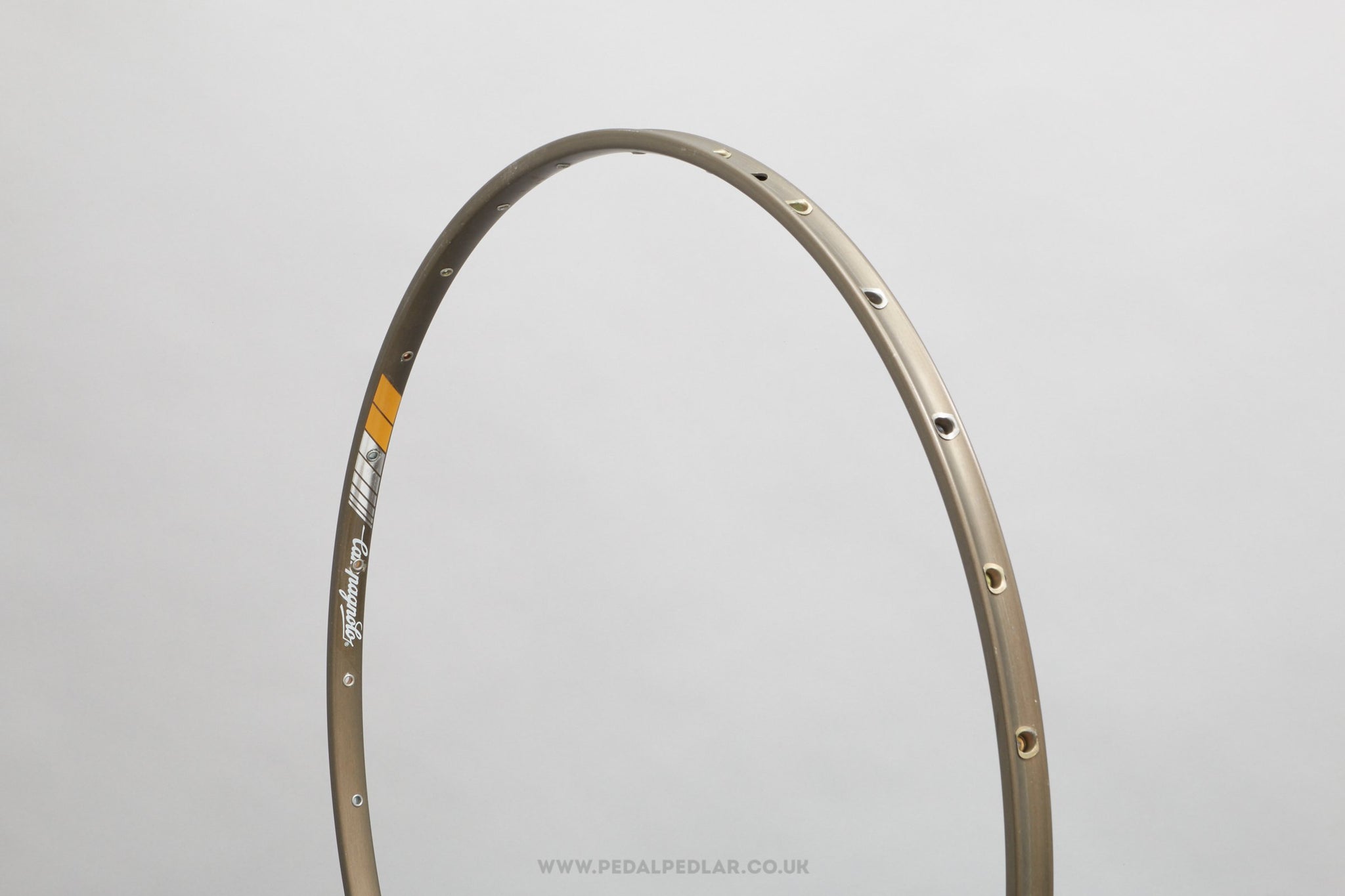


Campagnolo Victory Strada NOS Vintage 28h 28"/700c Tubular Rim
£71.25 £95.00
✓ Original part - produced in the 1980s
✓ New old stock! Still unused after all these years
✓ Super lightweight for the era - only 366 grams!
✓ Suitable for historic cycling events such as L'Eroica
✓ Worldwide shipping
Campagnolo Victory Strada rim, hailing from Italy and in production during the 1980s (yet still new & unused after all this time!). Made from aluminium and weighing in at 366 grams - incredibly lightweight for a rim at that time. A fine choice for keeping your vintage bike authentic, but also great for any other compatible bike too.
If you're taking part in L'Eroica or a similar vintage event, this is fully compliant - so rest assured, the pre-1987 police won't lock you up for having the wrong rim!
OVERVIEW
Production Era - 1980s
Country - Italian
Material - Aluminium
Weight - 366 grams
Stock Code - D-RS44V
*New old stock items may have marks from storage over the years, and as we often have multiples they can vary from piece to piece, but they are always genuine new & unused items.
TECHNICAL INFO
Drilling - 28 Hole
Rim Size - 28"/700c Tubular
ISO Diameter - 622 mm
Valve Type - Presta
Rim Width (OD) - 20 mm
Rim Height - 12 mm
-
▼SHIPPING, TAXES & RETURNS
-
We've been safely sending orders around the world since 2010. Orders are carefully packed, sent with tracking & insurance, and normally collected around midday on Tuesdays and Fridays. Larger items may occasionally require an extra day or two to prepare.
We accept returns, please notify us within 14 days and ensure the item arrives back with us no later than 30 days after the order was received.
EU orders under €150 (excluding shipping) - import VAT and the new €3 customs duty are paid as part of your order, so there's nothing further to pay on delivery.
EU orders over €150 (excluding shipping) - import fees are payable to the carrier before delivery, with nothing collected at checkout.
USA orders - import fees are collected at checkout for all orders to the USA, so there won’t be any surprise charges when your order arrives.
Other international orders - local import fees may apply and are not collected by us. Please check your country's import rules before purchasing.

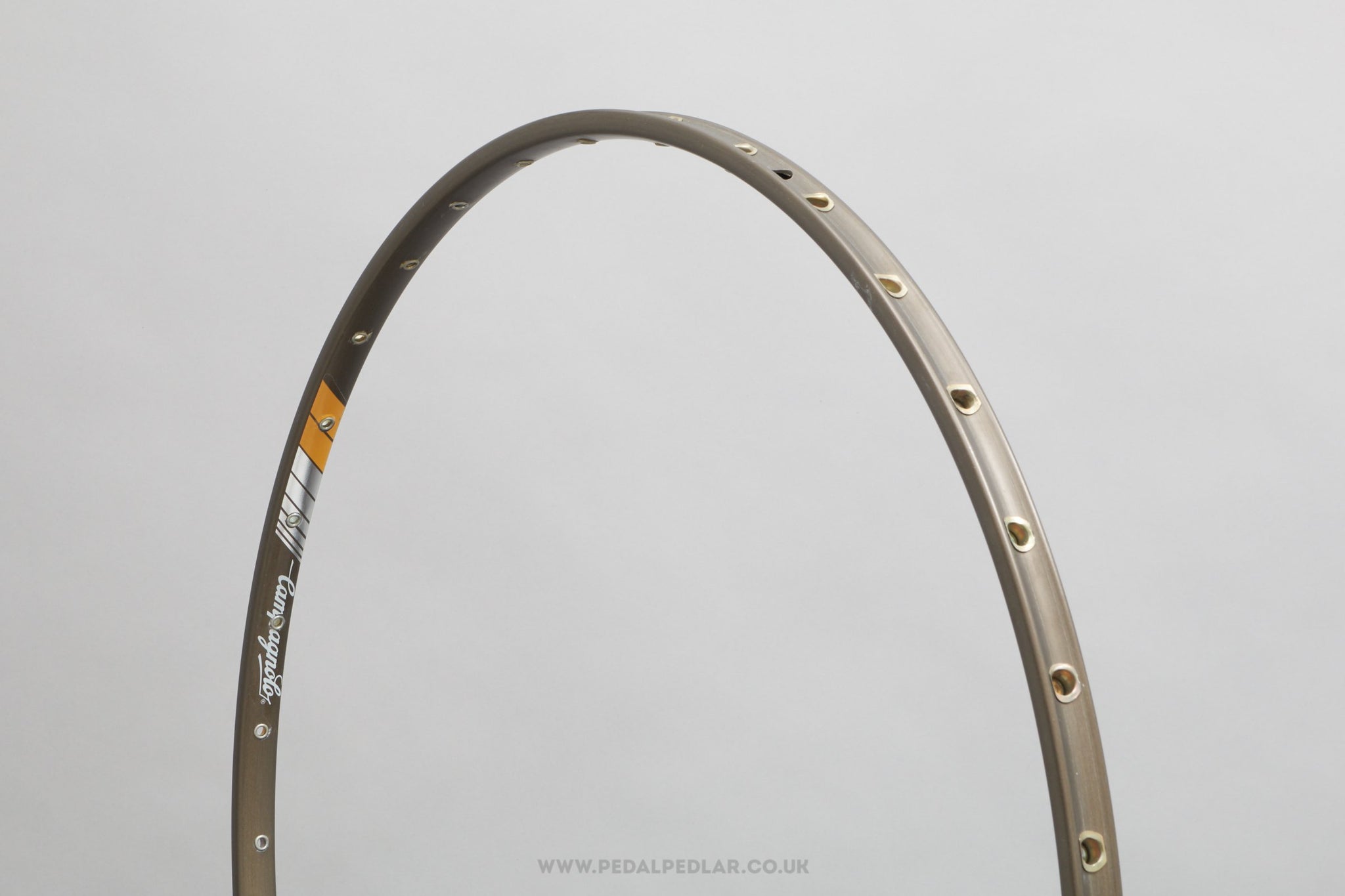


Campagnolo Victory Strada NOS Vintage 36h 28"/700c Tubular Rim
£71.25 £95.00
✓ Original part - produced in the 1980s
✓ New old stock! Still unused after all these years
✓ Super lightweight for the era - only 375 grams!
✓ Suitable for historic cycling events such as L'Eroica
✓ Worldwide shipping
Campagnolo Victory Strada rim, hailing from Italy and in production during the 1980s (yet still new & unused after all this time!). Made from aluminium and weighing in at 375 grams - incredibly lightweight for a rim at that time. A fine choice for keeping your vintage bike authentic, but also great for any other compatible bike too.
If you're taking part in L'Eroica or a similar vintage event, this is fully compliant - so rest assured, the pre-1987 police won't lock you up for having the wrong rim!
OVERVIEW
Production Era - 1980s
Country - Italian
Material - Aluminium
Weight - 375 grams
Stock Code - D-RS45V
*New old stock items may have marks from storage over the years, and as we often have multiples they can vary from piece to piece, but they are always genuine new & unused items.
TECHNICAL INFO
Drilling - 36 Hole
Rim Size - 28"/700c Tubular
ISO Diameter - 622 mm
Valve Type - Presta
Rim Width (OD) - 20 mm
Rim Height - 12 mm
-
▼SHIPPING, TAXES & RETURNS
-
We've been safely sending orders around the world since 2010. Orders are carefully packed, sent with tracking & insurance, and normally collected around midday on Tuesdays and Fridays. Larger items may occasionally require an extra day or two to prepare.
We accept returns, please notify us within 14 days and ensure the item arrives back with us no later than 30 days after the order was received.
EU orders under €150 (excluding shipping) - import VAT and the new €3 customs duty are paid as part of your order, so there's nothing further to pay on delivery.
EU orders over €150 (excluding shipping) - import fees are payable to the carrier before delivery, with nothing collected at checkout.
USA orders - import fees are collected at checkout for all orders to the USA, so there won’t be any surprise charges when your order arrives.
Other international orders - local import fees may apply and are not collected by us. Please check your country's import rules before purchasing.


Campagnolo Xenon (F010) NOS/NIB Classic Rear Mech
£85.00
✓ Original part - produced in the 1990s
✓ New old stock & still in the original packaging!
✓ Lightweight for the era - just 233 grams
✓ Worldwide shipping
Campagnolo Xenon rear mech, hailing from Italy and in production during the 1990s (yet still new & unused after all this time!). Made from aluminium/steel and weighing in at 233 grams - pretty lightweight for a rear derailleur at that time. A fine choice for keeping your classic bike authentic, but also great for any other compatible bike too.
OVERVIEW
Jockey Wheel Condition - New Old Stock*
Model ID - F010
Production Era - 1990s
Country - Italian
Material - Aluminium/Steel
Weight - 233 g
Stock Code - D-RM21C
*New old stock items may have marks from storage over the years, and as we often have multiples they can vary from piece to piece, but they are always genuine new & unused items.
TECHNICAL INFO
Shifting System - Campagnolo Syncro, Campagnolo Syncro II, Friction
Speed* - 5 Speed, 6 Speed, 7 Speed
Max Sprocket Size - 30 Teeth
Max Chain Wrap - 30
Chain Width - 3/32"
*See help section.
-
▼SHIPPING, TAXES & RETURNS
-
We've been safely sending orders around the world since 2010. Orders are carefully packed, sent with tracking & insurance, and normally collected around midday on Tuesdays and Fridays. Larger items may occasionally require an extra day or two to prepare.
We accept returns, please notify us within 14 days and ensure the item arrives back with us no later than 30 days after the order was received.
EU orders under €150 (excluding shipping) - import VAT and the new €3 customs duty are paid as part of your order, so there's nothing further to pay on delivery.
EU orders over €150 (excluding shipping) - import fees are payable to the carrier before delivery, with nothing collected at checkout.
USA orders - import fees are collected at checkout for all orders to the USA, so there won’t be any surprise charges when your order arrives.
Other international orders - local import fees may apply and are not collected by us. Please check your country's import rules before purchasing.
-
▼HELP SECTION
-
Shifting system - friction means your gear levers don't click when you change gear, when they do click it's referred to as indexed shifting. If you have indexed gear levers they must use the same system as the rear derailleur, if you're using friction levers you can mix and match.
*Speed - the number of cogs at the back the derailleur was designed to be used with. This is important with indexed shifting, but with friction shifters you can in theory run any rear mech with any number of cogs, but you are more likely to have issues running high numbers of cogs with mechs from earlier eras.
Max cog size - the amount of teeth on the largest cog of your freewheel/cassette can be no greater than this to work with this derailleur.
Chain wrap - subtract the size of your smallest rear cog from your biggest, then do the same with your chainrings, add the 2 numbers together and you have your chain wrap.
Chain width - generally speaking, derailleurs designed for more than 3 speed use will fit a standard 3/32'' chain, the exception being some Cyclo & Simplex models from around the mid 1900s.


Campagnolo Xenon (F300) Vintage 36h Rear Hub
£56.25 £75.00
✓ Original hub - in production from the 1980s to the 1990s
✓ Professionally checked, cleaned & serviced
✓ Worldwide shipping
Campagnolo Xenon rear hub, hailing from Italy and in production from the 1980s to the 1990s. Made from aluminium/steel and weighing in at 313 grams. A fine choice for keeping your vintage bike authentic, but also great for any other compatible bike too.
The hub's been carefully cleaned, thoroughly serviced by one of our mechanics and graded as very good condition, but do take a good look at the detailed photos so you can see the cosmetic condition before you buy.OVERVIEW
Bearing / Race Condition - Very Good
Model ID - F300
Production Era - 1980s & 1990s
Country - Italian
Material - Aluminium/Steel
Weight - 313 g
Stock Code - U-HU-R15V
TECHNICAL INFO
Drilling - 36 Hole
Spacing (O.L.D.) - 130 mm
Speed - 5 Speed, 6 Speed, 7 Speed
Sprocket Fitting - Screw On (English/ISO: 1.375 x 24 TPI)
-
▼SHIPPING, TAXES & RETURNS
-
We've been safely sending orders around the world since 2010. Orders are carefully packed, sent with tracking & insurance, and normally collected around midday on Tuesdays and Fridays. Larger items may occasionally require an extra day or two to prepare.
We accept returns, please notify us within 14 days and ensure the item arrives back with us no later than 30 days after the order was received.
EU orders under €150 (excluding shipping) - import VAT and the new €3 customs duty are paid as part of your order, so there's nothing further to pay on delivery.
EU orders over €150 (excluding shipping) - import fees are payable to the carrier before delivery, with nothing collected at checkout.
USA orders - import fees are collected at checkout for all orders to the USA, so there won’t be any surprise charges when your order arrives.
Other international orders - local import fees may apply and are not collected by us. Please check your country's import rules before purchasing.


Campagnolo Xenon Classic Italian Thread 109 mm Bottom Bracket
£86.25 £115.00
✓ Original part - produced in the 1990s
✓ Professionally checked & cleaned
✓ Worldwide shipping
Campagnolo Xenon bottom bracket, hailing from Italy and in production during the 1990s. Made from aluminium/steel and weighing in at 309 grams. A fine choice for keeping your classic bike authentic, but also great for any other compatible bike too.
The bottom bracket's been carefully cleaned, thoroughly checked by one of our mechanics and graded as mint condition, but do take a good look at the detailed photos so you can see the cosmetic condition before you buy.OVERVIEW
Condition Notes - Installed on a frame but never used, complete with original box & grease left on it.
Production Era - 1990s
Country - Italian
Material - Aluminium/Steel
Weight - 309 g
Stock Code - U-BB31C
TECHNICAL INFO
Thread Type - Italian Thread (ITA 36 mm x 24 TPI)
Axle Length - 109 mm
Axle Type - Square Taper ISO
-
▼SHIPPING, TAXES & RETURNS
-
We've been safely sending orders around the world since 2010. Orders are carefully packed, sent with tracking & insurance, and normally collected around midday on Tuesdays and Fridays. Larger items may occasionally require an extra day or two to prepare.
We accept returns, please notify us within 14 days and ensure the item arrives back with us no later than 30 days after the order was received.
EU orders under €150 (excluding shipping) - import VAT and the new €3 customs duty are paid as part of your order, so there's nothing further to pay on delivery.
EU orders over €150 (excluding shipping) - import fees are payable to the carrier before delivery, with nothing collected at checkout.
USA orders - import fees are collected at checkout for all orders to the USA, so there won’t be any surprise charges when your order arrives.
Other international orders - local import fees may apply and are not collected by us. Please check your country's import rules before purchasing.


Campitello Large Vintage Woollen Cycling Leggings/Tights
£56.25 £75.00
✓ Original vintage leggings - 1970s/80s style!
✓ Suitable for historic cycling events such as L'Eroica
✓ Thoroughly checked & honestly graded
✓ Great alternative to buying new
✓ Worldwide shipping
Campitello leggings, likely made in the 1970s/1980s given the style. An excellent choice for wearing on your vintage bike (or any occasion you fancy of course), and also a responsible alternative to buying brand new cycling kit!
If you're taking part in L'Eroica or a similar vintage event, these are fully compliant - so rest assured, the pre-1987 police won't lock you up for having the wrong leggings!
The leggings have been thoroughly checked over and graded as very good condition. If there are any issues worth noting we’ll do so in the overview section below, but please take a good look at the photos so you can see the condition yourself before you buy.OVERVIEW
Condition - Very Good
Material - Wool / Acrylic & Nylon Mix (53% / 47%)
Stock Code - U-LG14V
**This is just an estimate based on the waist measurement alone so please check the actual measurements before buying, the best way to get the right fit is to compare them with those of a garment that fits well, and please use all the measurements provided as some vintage leggings can have irregular sizing.
DETAIL & SIZING
Legging Type - Full Length
Seat Pad - Chamois Leather
Across Waist Band - 36 cm
Across Hips - 45 cm
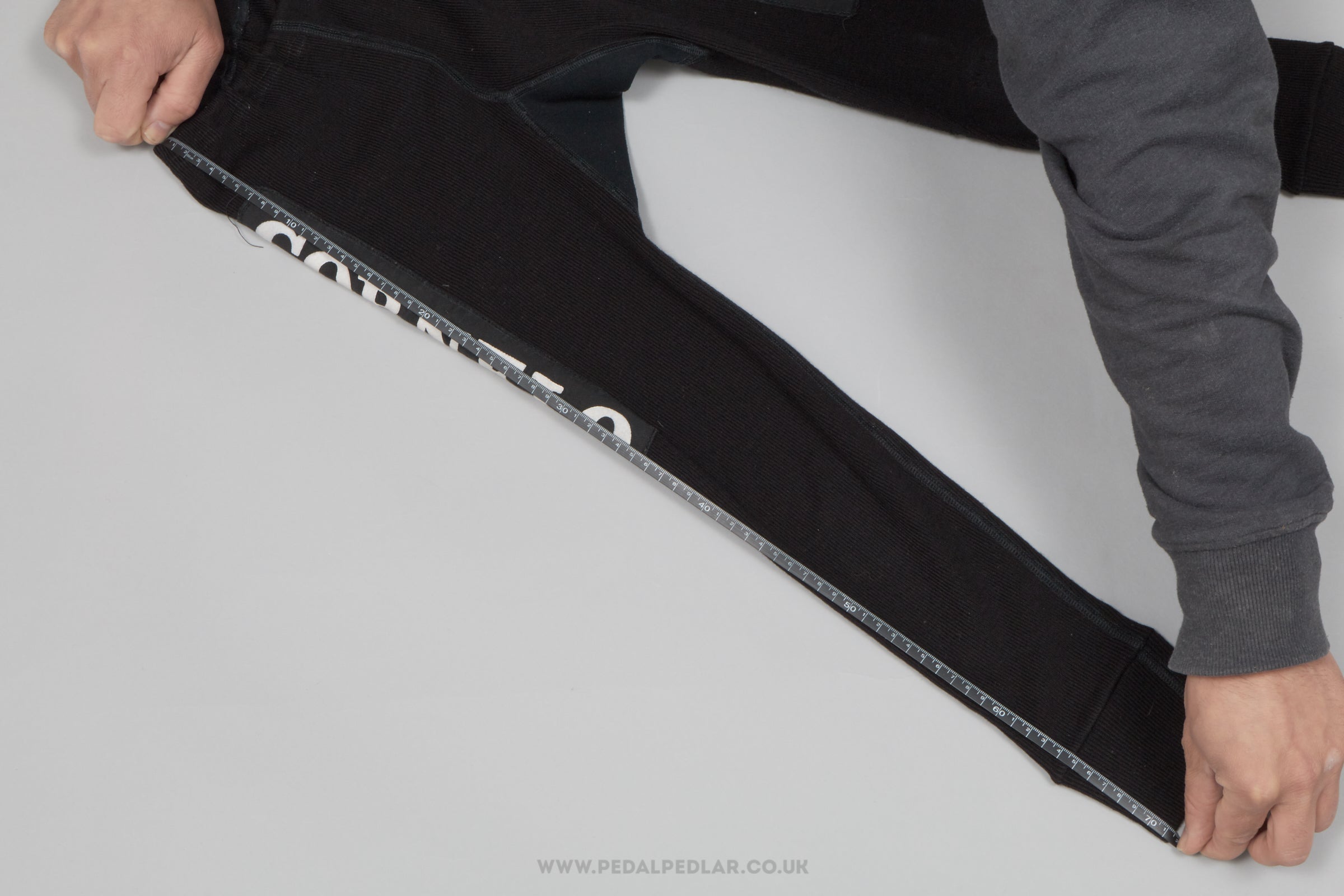
Full Length (Outside Leg) - 118 cm
Inside Leg - 86 cm
Across Quads - 22 cm
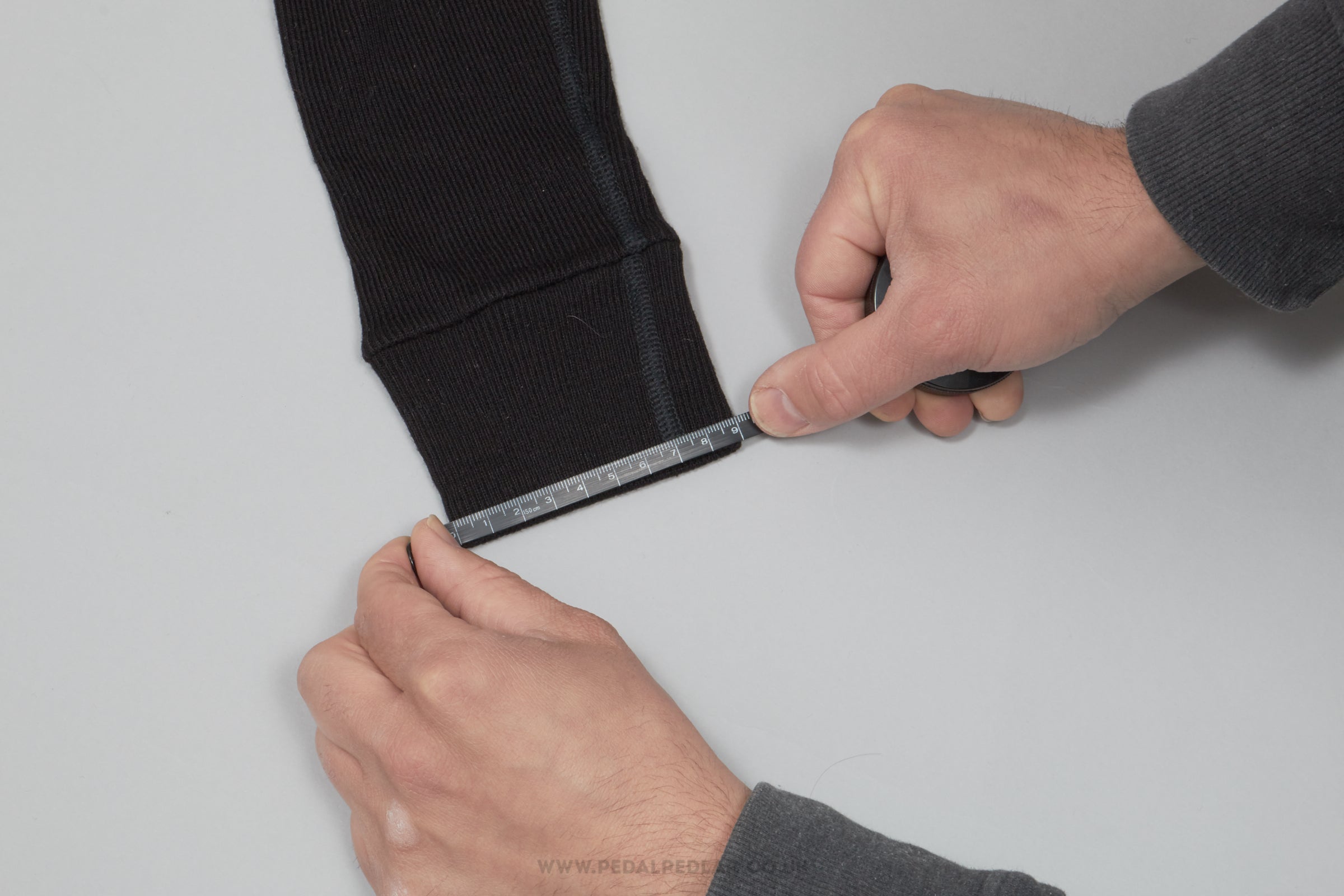
Across Bottom Hem - 10 cm
NB: Check the help section to see how we take these measurements, so you can get a good comparison to your own.
-
▼SHIPPING, TAXES & RETURNS
-
We've been safely sending orders around the world since 2010. Orders are carefully packed, sent with tracking & insurance, and normally collected around midday on Tuesdays and Fridays. Larger items may occasionally require an extra day or two to prepare.
We accept returns, please notify us within 14 days and ensure the item arrives back with us no later than 30 days after the order was received.
EU orders under €150 (excluding shipping) - import VAT and the new €3 customs duty are paid as part of your order, so there's nothing further to pay on delivery.
EU orders over €150 (excluding shipping) - import fees are payable to the carrier before delivery, with nothing collected at checkout.
USA orders - import fees are collected at checkout for all orders to the USA, so there won’t be any surprise charges when your order arrives.
Other international orders - local import fees may apply and are not collected by us. Please check your country's import rules before purchasing.
-
▼HELP SECTION
- We've also provided photographs below to illustrate how we take our measurements.
Across Waist Band - this measurement is taken across the waist band at the top of the leggings whilst laid flat, without stretching the elastic. To work out the waist circumference this measurement needs to be doubled.
Across Hips - some waist bands are quite high so we also measure around the hip area. This is taken across the leggings whilst laid flat without stretching the elastic, where we assume the hips to be. This is an approximate measurement provided as a guide only.
Full Length (Outside Leg) - measured from the top of the wasit band to the bottom of the hem, measured along the outside of the leg.
Inside Leg - measured from the centre of the crotch to the bottom of the hem, along the inside of the leg.
Across Quads - some leggings can have particularly tight or loose legs, so we also measure around the quad area to help with this. This is taken across the leggings whilst laid flat without stretching the elastic, where we assume the quads to be. This is an approximate measurement provided as a guide only.
Across Bottom Hem - taken across the bottom of one hem whilst laid flat, without stretching the elastic. To work out the hem circumference this measurement needs to be doubled.




Campitello Maxi - GB Small Vintage Cycling Jersey
£65.00
✓ Original vintage jersey - 1970s/80s style!
✓ Suitable for historic cycling events such as L'Eroica
✓ Thoroughly checked & honestly graded
✓ Great alternative to buying new
✓ Worldwide shipping
Campitello Maxi - GB cycling jersey, likely made in the 1970s/1980s given the style. An excellent choice for wearing on your vintage bike (or any occasion you fancy of course), and also a great alternative to buying brand new cycling kit!
If you're taking part in L'Eroica or a similar vintage event, this is compliant - so rest assured, the pre-1987 police won't lock you up for having the wrong jersey!
The jersey’s been thoroughly checked over and graded as very good condition. If there are any issues worth noting we’ll do so in the overview section below, but please take a good look at the photos so you can see the condition yourself before you buy.OVERVIEW
Condition - Very Good
Material - Acrylic
Stock Code - U-G6-JS174V
**This is just an estimate based on the chest measurement alone so please check the actual measurements before buying, the best way to get the right fit is to compare them with those of a garment that fits well. Please use all the measurements provided as some vintage jerseys can have irregular sizing, and we find that some of the orignal size labels can be very different to the actual size.
DETAIL & MEASUREMENTS
Pit to Pit (Laid Flat) - 46 cm
Top to Bottom (Front) - 65 cm
Top to Bottom (Back) - 74 cm
Shoulder Seam to Sleeve End (Oustide) - 22 cm
Across Neck (Laid Flat) - 19 cm
Across Sleeve End (Laid Flat) - 8 cm
NB: Check the help section to see how we take these measurements, so you can get a good comparison to your own.
-
▼SHIPPING, TAXES & RETURNS
-
We've been safely sending orders around the world since 2010. Orders are carefully packed, sent with tracking & insurance, and normally collected around midday on Tuesdays and Fridays. Larger items may occasionally require an extra day or two to prepare.
We accept returns, please notify us within 14 days and ensure the item arrives back with us no later than 30 days after the order was received.
EU orders under €150 (excluding shipping) - import VAT and the new €3 customs duty are paid as part of your order, so there's nothing further to pay on delivery.
EU orders over €150 (excluding shipping) - import fees are payable to the carrier before delivery, with nothing collected at checkout.
USA orders - import fees are collected at checkout for all orders to the USA, so there won’t be any surprise charges when your order arrives.
Other international orders - local import fees may apply and are not collected by us. Please check your country's import rules before purchasing.
-
▼SAFETY & COMPLIANCE
- This product complies with the EU General Product Safety Regulation (GPSR).
EU Authorised Representative - Global Trade Department NI Ltd, Office 834, Unit 6, 100 Lisburn Road, Belfast BT9 6AG, Northern Ireland
-
▼HELP SECTION
- We've provided reference below to illustrate how we take the measurements.
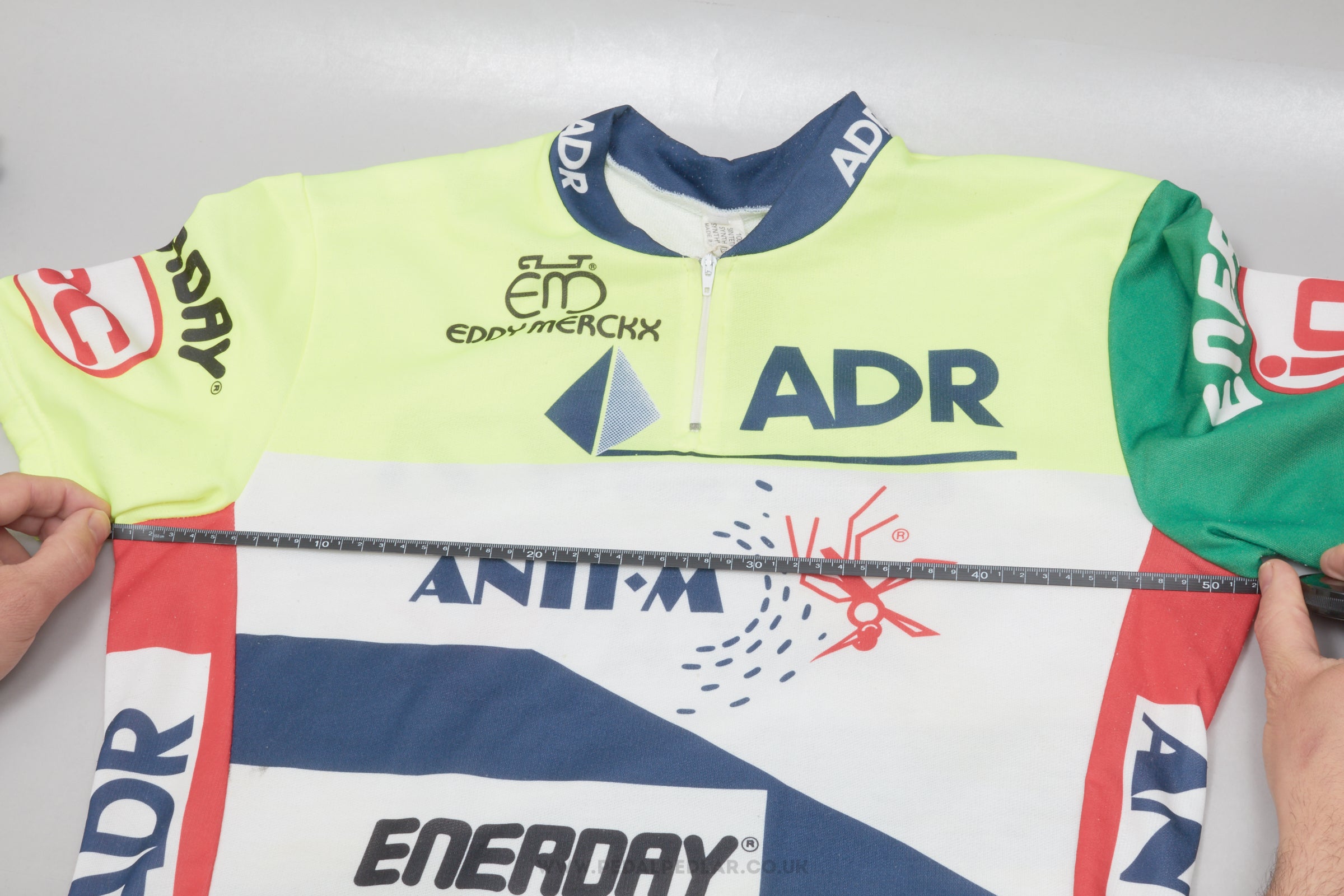
Pit to Pit - this measurement is taken from the centre of one armpit to the other, across the chest with the jersey laid flat.
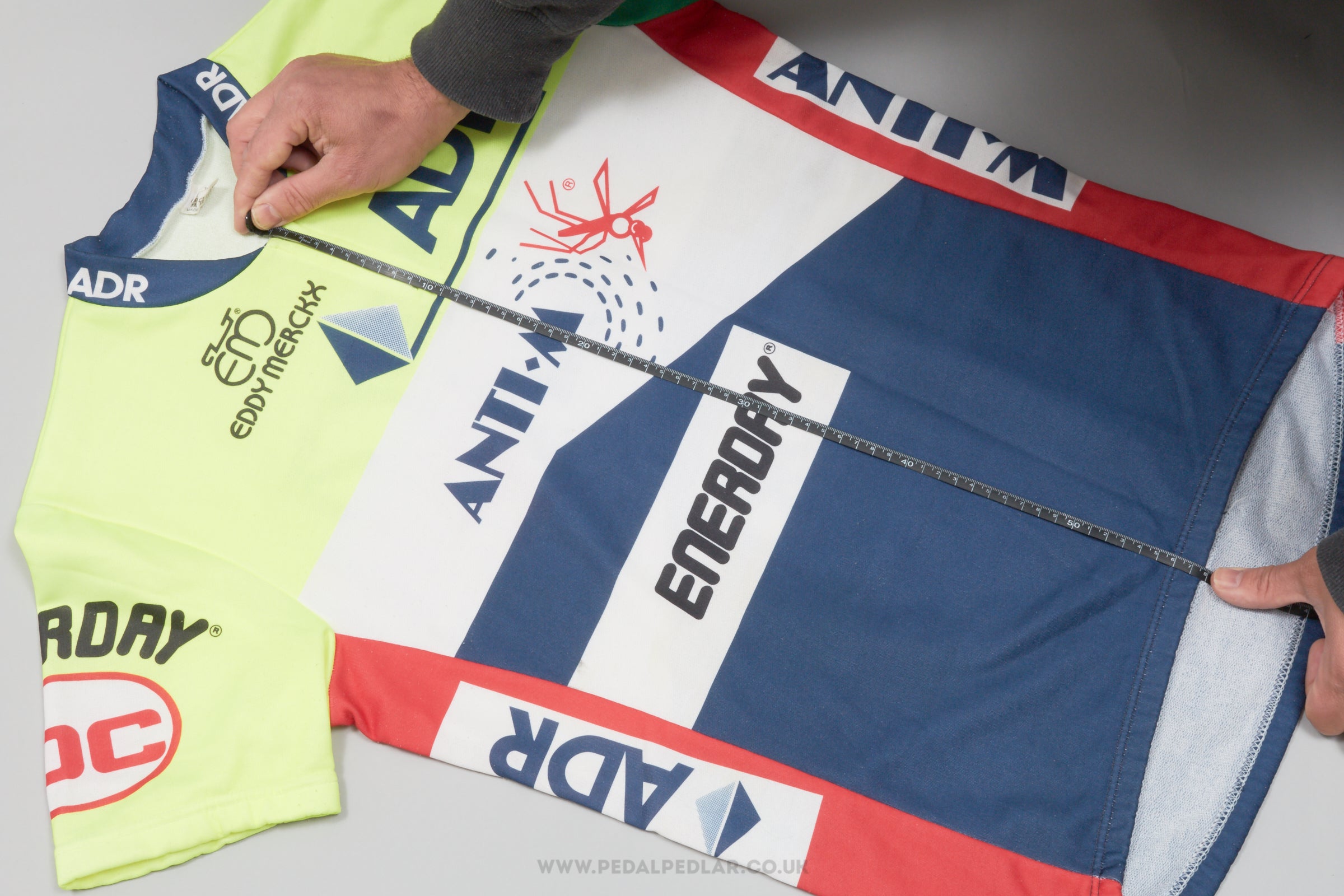
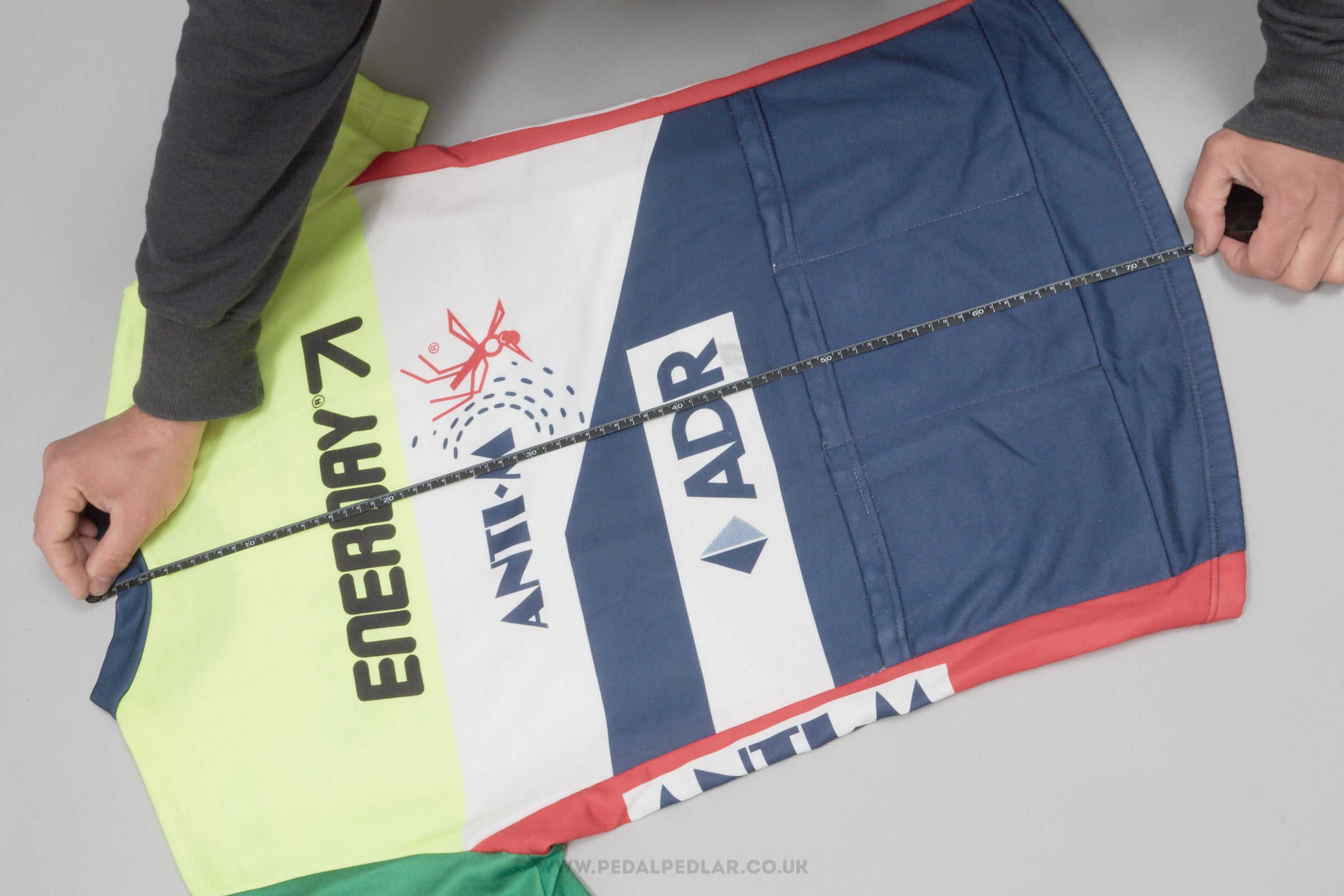
Top to Bottom - this will always be from the very top of the collar to the very bottom hem, we provide measurements for both the front and back, always taken with the jersey laid flat.
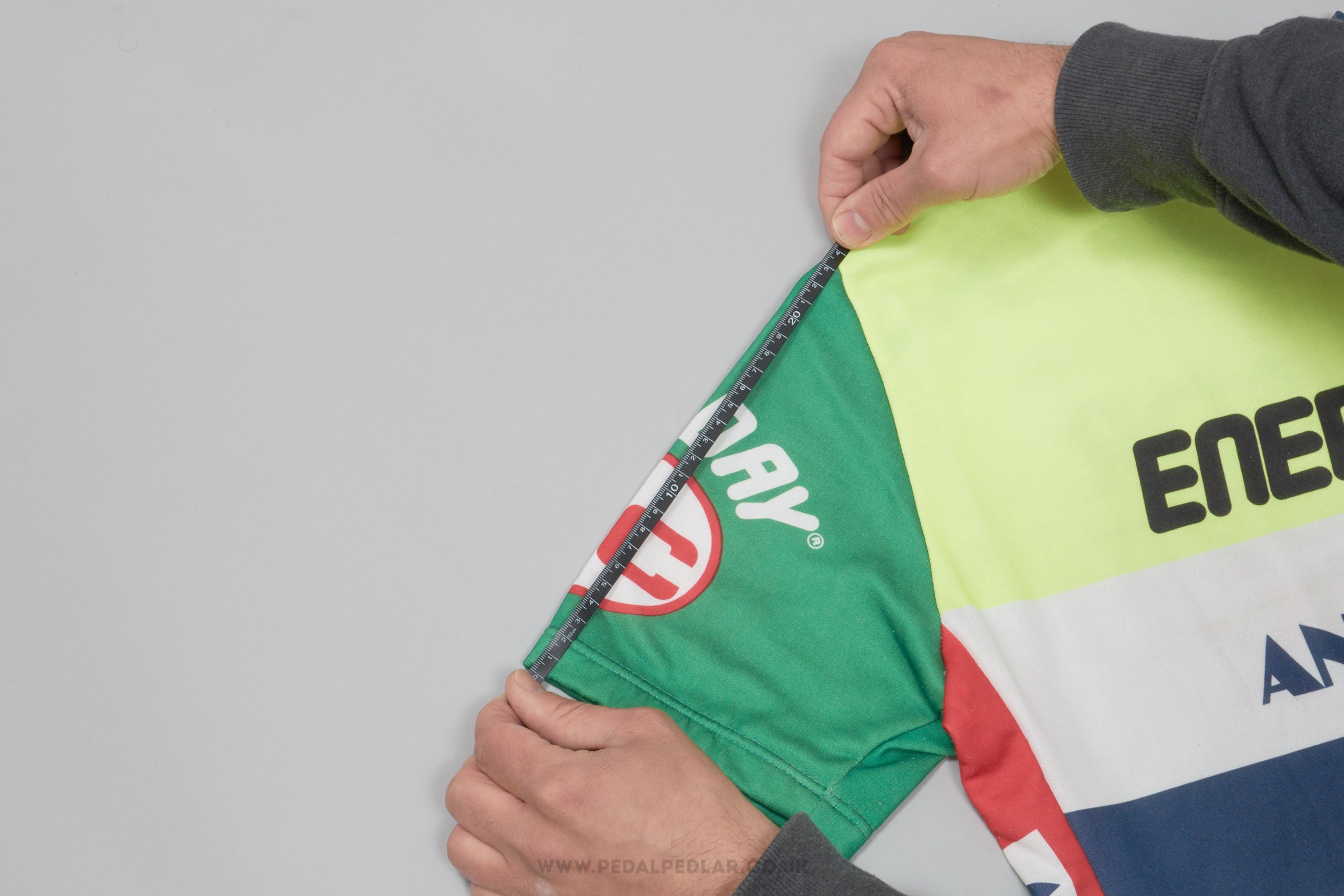
Shoulder Seam to Sleeve End - this measurement is taken from the shoulder seam down to the very end of the sleeve on the outside.
Across Neck - for consistency on all neck shapes we gather the front and back together and lay them flat, then measure across the stitching (as shown in the supporting photos).
Across Sleeve End - measured across the sleeve end, laid flat.


Caratti Blue w) World Champion Stripes Small NOS Vintage Cycling Jersey
£60.00
✓ Original vintage jersey - 1970s/80s style!
✓ New old stock! Still unused after all these years
✓ Suitable for historic cycling events such as L'Eroica
✓ Great alternative to buying new
✓ Worldwide shipping
Caratti cycling jersey, likely made in the 1970s/1980s given the style (yet still new & unused after all this time). An excellent choice for wearing on your vintage bike (or any occasion you fancy of course), and also a great alternative to buying brand new cycling kit!
If you're taking part in L'Eroica or a similar vintage event, this is compliant - so rest assured, the pre-1987 police won't lock you up for having the wrong jersey!
OVERVIEW
Condition - New Old Stock*
Material - Acrylic
Stock Code - D-G6-JS183V
*New old stock items may have marks from storage over the years, and as we often have multiples they can vary from piece to piece, but they are always genuine new & unused items.
**This is just an estimate based on the chest measurement alone so please check the actual measurements before buying, the best way to get the right fit is to compare them with those of a garment that fits well. Please use all the measurements provided as some vintage jerseys can have irregular sizing, and we find that some of the orignal size labels can be very different to the actual size.
DETAIL & MEASUREMENTS
Pit to Pit (Laid Flat) - 44 cm
Top to Bottom (Front) - 69 cm
Top to Bottom (Back) - 73 cm
Shoulder Seam to Sleeve End (Oustide) - 21 cm
Across Neck (Laid Flat) - 16 cm
Across Sleeve End (Laid Flat) - 8 cm
NB: Check the help section to see how we take these measurements, so you can get a good comparison to your own.
-
▼SHIPPING, TAXES & RETURNS
-
We've been safely sending orders around the world since 2010. Orders are carefully packed, sent with tracking & insurance, and normally collected around midday on Tuesdays and Fridays. Larger items may occasionally require an extra day or two to prepare.
We accept returns, please notify us within 14 days and ensure the item arrives back with us no later than 30 days after the order was received.
EU orders under €150 (excluding shipping) - import VAT and the new €3 customs duty are paid as part of your order, so there's nothing further to pay on delivery.
EU orders over €150 (excluding shipping) - import fees are payable to the carrier before delivery, with nothing collected at checkout.
USA orders - import fees are collected at checkout for all orders to the USA, so there won’t be any surprise charges when your order arrives.
Other international orders - local import fees may apply and are not collected by us. Please check your country's import rules before purchasing.
-
▼SAFETY & COMPLIANCE
- This product complies with the EU General Product Safety Regulation (GPSR).
Product Manufacturer - Caratti Ltd, 7 Chelsea Road, Bath, Gloucestershire, BA1 3DU, England, UK
EU Authorised Representative - Global Trade Department NI Ltd, Office 834, Unit 6, 100 Lisburn Road, Belfast BT9 6AG, Northern Ireland
-
▼HELP SECTION
- We've provided reference below to illustrate how we take the measurements.
Pit to Pit - this measurement is taken from the centre of one armpit to the other, across the chest with the jersey laid flat.
Top to Bottom - this will always be from the very top of the collar to the very bottom hem, we provide measurements for both the front and back, always taken with the jersey laid flat.
Shoulder Seam to Sleeve End - this measurement is taken from the shoulder seam down to the very end of the sleeve on the outside.
Across Neck - for consistency on all neck shapes we gather the front and back together and lay them flat, then measure across the stitching (as shown in the supporting photos).
Across Sleeve End - measured across the sleeve end, laid flat.


Caratti Dark & Light Blue XS NOS Vintage Long Sleeved Cycling Jersey
£65.00
✓ Original vintage jersey - 1980s style!
✓ New old stock! Still unused after all these years
✓ Suitable for historic cycling events such as L'Eroica
✓ Great alternative to buying new
✓ Worldwide shipping
Caratti long sleeved cycling jersey, likely made in the 1980s given the style (yet still new & unused after all this time). An excellent choice for wearing on your vintage bike (or any occasion you fancy of course), and also a great alternative to buying brand new cycling kit!
If you're taking part in L'Eroica or a similar vintage event, this is compliant - so rest assured, the pre-1987 police won't lock you up for having the wrong jersey!
OVERVIEW
Condition - New Old Stock*
Material - Acrylic
Stock Code - D-G6-JS171V
*New old stock items may have marks from storage over the years, and as we often have multiples they can vary from piece to piece, but they are always genuine new & unused items.
**This is just an estimate based on the chest measurement alone so please check the actual measurements before buying, the best way to get the right fit is to compare them with those of a garment that fits well. Please use all the measurements provided as some vintage jerseys can have irregular sizing, and we find that some of the orignal size labels can be very different to the actual size.
DETAIL & MEASUREMENTS
Pit to Pit (Laid Flat) - 41 cm
Top to Bottom (Front) - 66 cm
Top to Bottom (Back) - 71 cm
Shoulder Seam to Sleeve End (Oustide) - 58 cm
Across Neck (Laid Flat) - 15 cm
Across Sleeve End (Laid Flat) - 6.5 cm
NB: Check the help section to see how we take these measurements, so you can get a good comparison to your own.
-
▼SHIPPING, TAXES & RETURNS
-
We've been safely sending orders around the world since 2010. Orders are carefully packed, sent with tracking & insurance, and normally collected around midday on Tuesdays and Fridays. Larger items may occasionally require an extra day or two to prepare.
We accept returns, please notify us within 14 days and ensure the item arrives back with us no later than 30 days after the order was received.
EU orders under €150 (excluding shipping) - import VAT and the new €3 customs duty are paid as part of your order, so there's nothing further to pay on delivery.
EU orders over €150 (excluding shipping) - import fees are payable to the carrier before delivery, with nothing collected at checkout.
USA orders - import fees are collected at checkout for all orders to the USA, so there won’t be any surprise charges when your order arrives.
Other international orders - local import fees may apply and are not collected by us. Please check your country's import rules before purchasing.
-
▼SAFETY & COMPLIANCE
- This product complies with the EU General Product Safety Regulation (GPSR).
Product Manufacturer - Caratti Ltd, 7 Chelsea Road, Bath, Gloucestershire, BA1 3DU, England, UK
EU Authorised Representative - Global Trade Department NI Ltd, Office 834, Unit 6, 100 Lisburn Road, Belfast BT9 6AG, Northern Ireland
-
▼HELP SECTION
- We've provided reference below to illustrate how we take the measurements.
Pit to Pit - this measurement is taken from the centre of one armpit to the other, across the chest with the jersey laid flat.
Top to Bottom - this will always be from the very top of the collar to the very bottom hem, we provide measurements for both the front and back, always taken with the jersey laid flat.
Shoulder Seam to Sleeve End - this measurement is taken from the shoulder seam down to the very end of the sleeve on the outside.
Across Neck - for consistency on all neck shapes we gather the front and back together and lay them flat, then measure across the stitching (as shown in the supporting photos).
Across Sleeve End - measured across the sleeve end, laid flat.


Caratti Dark Blue & White w) World Champion Stripes XS NOS Vintage Long Sleeved Cycling Jersey
£65.00
✓ Original vintage jersey - 1970s/80s style!
✓ New old stock! Still unused after all these years
✓ Suitable for historic cycling events such as L'Eroica
✓ Great alternative to buying new
✓ Worldwide shipping
Caratti long sleeved cycling jersey, likely made in the 1970s/1980s given the style (yet still new & unused after all this time). An excellent choice for wearing on your vintage bike (or any occasion you fancy of course), and also a great alternative to buying brand new cycling kit!
If you're taking part in L'Eroica or a similar vintage event, this is compliant - so rest assured, the pre-1987 police won't lock you up for having the wrong jersey!
OVERVIEW
Condition - New Old Stock*
Material - Acrylic
Stock Code - D-G6-JS186V
*New old stock items may have marks from storage over the years, and as we often have multiples they can vary from piece to piece, but they are always genuine new & unused items.
**This is just an estimate based on the chest measurement alone so please check the actual measurements before buying, the best way to get the right fit is to compare them with those of a garment that fits well. Please use all the measurements provided as some vintage jerseys can have irregular sizing, and we find that some of the orignal size labels can be very different to the actual size.
DETAIL & MEASUREMENTS
Pit to Pit (Laid Flat) - 40 cm
Top to Bottom (Front) - 64 cm
Top to Bottom (Back) - 70 cm
Shoulder Seam to Sleeve End (Oustide) - 56 cm
Across Neck (Laid Flat) - 14 cm
Across Sleeve End (Laid Flat) - 6 cm
NB: Check the help section to see how we take these measurements, so you can get a good comparison to your own.
-
▼SHIPPING, TAXES & RETURNS
-
We've been safely sending orders around the world since 2010. Orders are carefully packed, sent with tracking & insurance, and normally collected around midday on Tuesdays and Fridays. Larger items may occasionally require an extra day or two to prepare.
We accept returns, please notify us within 14 days and ensure the item arrives back with us no later than 30 days after the order was received.
EU orders under €150 (excluding shipping) - import VAT and the new €3 customs duty are paid as part of your order, so there's nothing further to pay on delivery.
EU orders over €150 (excluding shipping) - import fees are payable to the carrier before delivery, with nothing collected at checkout.
USA orders - import fees are collected at checkout for all orders to the USA, so there won’t be any surprise charges when your order arrives.
Other international orders - local import fees may apply and are not collected by us. Please check your country's import rules before purchasing.
-
▼SAFETY & COMPLIANCE
- This product complies with the EU General Product Safety Regulation (GPSR).
Product Manufacturer - Caratti Ltd, 7 Chelsea Road, Bath, Gloucestershire, BA1 3DU, England, UK
EU Authorised Representative - Global Trade Department NI Ltd, Office 834, Unit 6, 100 Lisburn Road, Belfast BT9 6AG, Northern Ireland
-
▼HELP SECTION
- We've provided reference below to illustrate how we take the measurements.
Pit to Pit - this measurement is taken from the centre of one armpit to the other, across the chest with the jersey laid flat.
Top to Bottom - this will always be from the very top of the collar to the very bottom hem, we provide measurements for both the front and back, always taken with the jersey laid flat.
Shoulder Seam to Sleeve End - this measurement is taken from the shoulder seam down to the very end of the sleeve on the outside.
Across Neck - for consistency on all neck shapes we gather the front and back together and lay them flat, then measure across the stitching (as shown in the supporting photos).
Across Sleeve End - measured across the sleeve end, laid flat.


Caratti Prolite NOS/NIB Vintage Size EU 37 Road Cycling Shoes
£52.50 £70.00
✓ Original vintage cycling shoes - 1980s style!
✓ New old stock & still in the original packaging!
✓ Suitable for historic cycling events such as L'Eroica
✓ Worldwide shipping
Caratti Prolite cycling shoes in size EU 37, likely made in the 1980s given the style (yet still new & unused after all this time!). An excellent choice for wearing on your vintage bike (or any occasion you fancy of course), and also a responsible alternative to buying brand new cycling kit!
If you're taking part in L'Eroica or a similar vintage event, these are fully compliant - so rest assured, the pre-1987 police won't lock you up for having the wrong shoes!
OVERVIEW
Condition - New Old Stock - In Original Packaging*
Production Era - 1980s
Country - British
Stock Code - D-SH29V
*New old stock items may have marks from storage over the years, and as we often have multiples they can vary from piece to piece, but they are always genuine new & unused items.
**Most cycling shoes use European sizing but some brands do have conversion charts available. A good rule of thumb, especially with older European shoes is go for a size up as they often come up small. We also provide the length & width, check the help section to see how we measure these.
DETAIL & MEASUREMENTS
Colour* - Black / Green
Upper Material - Synthetic / Leather
Sole Material - Plastic
Shoe Type - Road
Fastening Type - Lace-Up
Cleat Type - Slotted
Length (Heel to Toe) - 23 cm
Width (At Widest Part) - 8 cm
*The colour description is just a guide, please check the photos to get a good idea of the colour too, as we make sure these are as close to the true colour as possible.
-
▼SHIPPING, TAXES & RETURNS
-
We've been safely sending orders around the world since 2010. Orders are carefully packed, sent with tracking & insurance, and normally collected around midday on Tuesdays and Fridays. Larger items may occasionally require an extra day or two to prepare.
We accept returns, please notify us within 14 days and ensure the item arrives back with us no later than 30 days after the order was received.
EU orders under €150 (excluding shipping) - import VAT and the new €3 customs duty are paid as part of your order, so there's nothing further to pay on delivery.
EU orders over €150 (excluding shipping) - import fees are payable to the carrier before delivery, with nothing collected at checkout.
USA orders - import fees are collected at checkout for all orders to the USA, so there won’t be any surprise charges when your order arrives.
Other international orders - local import fees may apply and are not collected by us. Please check your country's import rules before purchasing.
-
▼HELP SECTION
-
Cleat Type - slotted' cleats fit onto traditional pedal cages and the foot is secured with toe clips and straps, various fixings types exist and some are brand specific. Most cleats for clipless road pedals fit the 3 bolt fixing invented by Look in the 80s, the exceptions being the 4 bolt fixing for Time's TBT system (and later Speedplay), and the Podio specific fixings for Merckx shoes. Mountain bike (SPD type) cleats have a standard 2 bolt fixing, and some shoes are even designed to take more than one type of cleat!
Length (Heel to Toe) - measured from the very back of the heel to the front of the toes at their furthest points. We find this measurement useful if you have a similar shape shoe to compare to, and although there will be variation in design, when combined with the width it can be helpful in determining whether the shoes will be a close fit or not.
Width (At Widest Part) - measured across the metatarsal at the widest part of the shoe, on the outside, not the inside.
If you require any further measurements please get in touch.


Caratti Prolite NOS/NIB Vintage Size EU 38 Road Cycling Shoes
£52.50 £70.00
✓ Original vintage cycling shoes - 1980s style!
✓ New old stock & still in the original packaging!
✓ Suitable for historic cycling events such as L'Eroica
✓ Worldwide shipping
Caratti Prolite cycling shoes in size EU 38, likely made in the 1980s given the style (yet still new & unused after all this time!). An excellent choice for wearing on your vintage bike (or any occasion you fancy of course), and also a responsible alternative to buying brand new cycling kit!
If you're taking part in L'Eroica or a similar vintage event, these are fully compliant - so rest assured, the pre-1987 police won't lock you up for having the wrong shoes!
OVERVIEW
Condition - New Old Stock - In Original Packaging*
Production Era - 1980s
Country - British
Stock Code - D-SH30V
*New old stock items may have marks from storage over the years, and as we often have multiples they can vary from piece to piece, but they are always genuine new & unused items.
**Most cycling shoes use European sizing but some brands do have conversion charts available. A good rule of thumb, especially with older European shoes is go for a size up as they often come up small. We also provide the length & width, check the help section to see how we measure these.
DETAIL & MEASUREMENTS
Colour* - Black / Green
Upper Material - Synthetic / Leather
Sole Material - Plastic
Shoe Type - Road
Fastening Type - Lace-Up
Cleat Type - Slotted
Length (Heel to Toe) - 23.5 cm
Width (At Widest Part) - 8 cm
*The colour description is just a guide, please check the photos to get a good idea of the colour too, as we make sure these are as close to the true colour as possible.
-
▼SHIPPING, TAXES & RETURNS
-
We've been safely sending orders around the world since 2010. Orders are carefully packed, sent with tracking & insurance, and normally collected around midday on Tuesdays and Fridays. Larger items may occasionally require an extra day or two to prepare.
We accept returns, please notify us within 14 days and ensure the item arrives back with us no later than 30 days after the order was received.
EU orders under €150 (excluding shipping) - import VAT and the new €3 customs duty are paid as part of your order, so there's nothing further to pay on delivery.
EU orders over €150 (excluding shipping) - import fees are payable to the carrier before delivery, with nothing collected at checkout.
USA orders - import fees are collected at checkout for all orders to the USA, so there won’t be any surprise charges when your order arrives.
Other international orders - local import fees may apply and are not collected by us. Please check your country's import rules before purchasing.
-
▼HELP SECTION
-
Cleat Type - slotted' cleats fit onto traditional pedal cages and the foot is secured with toe clips and straps, various fixings types exist and some are brand specific. Most cleats for clipless road pedals fit the 3 bolt fixing invented by Look in the 80s, the exceptions being the 4 bolt fixing for Time's TBT system (and later Speedplay), and the Podio specific fixings for Merckx shoes. Mountain bike (SPD type) cleats have a standard 2 bolt fixing, and some shoes are even designed to take more than one type of cleat!
Length (Heel to Toe) - measured from the very back of the heel to the front of the toes at their furthest points. We find this measurement useful if you have a similar shape shoe to compare to, and although there will be variation in design, when combined with the width it can be helpful in determining whether the shoes will be a close fit or not.
Width (At Widest Part) - measured across the metatarsal at the widest part of the shoe, on the outside, not the inside.
If you require any further measurements please get in touch.


Caratti Prolite NOS/NIB Vintage Size EU 38 Road Cycling Shoes
£52.50 £70.00
✓ Original vintage cycling shoes - 1980s style!
✓ New old stock & still in the original packaging!
✓ Suitable for historic cycling events such as L'Eroica
✓ Great alternative to buying new
✓ Worldwide shipping
Caratti Prolite cycling shoes in size EU 38, likely made in the 1980s given the style (yet still new & unused after all this time!). An excellent choice for wearing on your vintage bike (or any occasion you fancy of course), and also a responsible alternative to buying brand new cycling kit!
If you're taking part in L'Eroica or a similar vintage event, these are fully compliant - so rest assured, the pre-1987 police won't lock you up for having the wrong shoes!
OVERVIEW
Condition - New Old Stock - In Original Packaging*
Production Era - 1980s
Country - British
Stock Code - D-SH35V
*New old stock items may have marks from storage over the years, and as we often have multiples they can vary from piece to piece, but they are always genuine new & unused items.
**Most cycling shoes use European sizing but some brands do have conversion charts available. A good rule of thumb, especially with older European shoes is go for a size up as they often come up small. We also provide the length & width, check the help section to see how we measure these.
DETAIL & MEASUREMENTS
Colour* - Black / Green
Upper Material - Synthetic / Leather
Sole Material - Plastic
Shoe Type - Road
Fastening Type - Lace-Up
Cleat Type - Slotted
Length (Heel to Toe) - 23.5 cm
Width (At Widest Part) - 8 cm
*The colour description is just a guide, please check the photos to get a good idea of the colour too, as we make sure these are as close to the true colour as possible.
-
▼SHIPPING, TAXES & RETURNS
-
We've been safely sending orders around the world since 2010. Orders are carefully packed, sent with tracking & insurance, and normally collected around midday on Tuesdays and Fridays. Larger items may occasionally require an extra day or two to prepare.
We accept returns, please notify us within 14 days and ensure the item arrives back with us no later than 30 days after the order was received.
EU orders under €150 (excluding shipping) - import VAT and the new €3 customs duty are paid as part of your order, so there's nothing further to pay on delivery.
EU orders over €150 (excluding shipping) - import fees are payable to the carrier before delivery, with nothing collected at checkout.
USA orders - import fees are collected at checkout for all orders to the USA, so there won’t be any surprise charges when your order arrives.
Other international orders - local import fees may apply and are not collected by us. Please check your country's import rules before purchasing.
-
▼HELP SECTION
-
Cleat Type - slotted' cleats fit onto traditional pedal cages and the foot is secured with toe clips and straps, various fixings types exist and some are brand specific. Most cleats for clipless road pedals fit the 3 bolt fixing invented by Look in the 80s, the exceptions being the 4 bolt fixing for Time's TBT system (and later Speedplay), and the Podio specific fixings for Merckx shoes. Mountain bike (SPD type) cleats have a standard 2 bolt fixing, and some shoes are even designed to take more than one type of cleat!
Length (Heel to Toe) - measured from the very back of the heel to the front of the toes at their furthest points. We find this measurement useful if you have a similar shape shoe to compare to, and although there will be variation in design, when combined with the width it can be helpful in determining whether the shoes will be a close fit or not.
Width (At Widest Part) - measured across the metatarsal at the widest part of the shoe, on the outside, not the inside.
If you require any further measurements please get in touch.


Caratti Prolite NOS/NIB Vintage Size EU 38.5 Road Cycling Shoes
£52.50 £70.00
✓ Original vintage cycling shoes - 1980s style!
✓ New old stock & still in the original packaging!
✓ Suitable for historic cycling events such as L'Eroica
✓ Worldwide shipping
Caratti Prolite cycling shoes in size EU 38.5, likely made in the 1980s given the style (yet still new & unused after all this time!). An excellent choice for wearing on your vintage bike (or any occasion you fancy of course), and also a responsible alternative to buying brand new cycling kit!
If you're taking part in L'Eroica or a similar vintage event, these are fully compliant - so rest assured, the pre-1987 police won't lock you up for having the wrong shoes!
OVERVIEW
Condition - New Old Stock - In Original Packaging*
Production Era - 1980s
Country - British
Stock Code - D-SH31V
*New old stock items may have marks from storage over the years, and as we often have multiples they can vary from piece to piece, but they are always genuine new & unused items.
**Most cycling shoes use European sizing but some brands do have conversion charts available. A good rule of thumb, especially with older European shoes is go for a size up as they often come up small. We also provide the length & width, check the help section to see how we measure these.
DETAIL & MEASUREMENTS
Colour* - Black / Green
Upper Material - Synthetic / Leather
Sole Material - Plastic
Shoe Type - Road
Fastening Type - Lace-Up
Cleat Type - Slotted
Length (Heel to Toe) - 23.5 cm
Width (At Widest Part) - 8 cm
*The colour description is just a guide, please check the photos to get a good idea of the colour too, as we make sure these are as close to the true colour as possible.
-
▼SHIPPING, TAXES & RETURNS
-
We've been safely sending orders around the world since 2010. Orders are carefully packed, sent with tracking & insurance, and normally collected around midday on Tuesdays and Fridays. Larger items may occasionally require an extra day or two to prepare.
We accept returns, please notify us within 14 days and ensure the item arrives back with us no later than 30 days after the order was received.
EU orders under €150 (excluding shipping) - import VAT and the new €3 customs duty are paid as part of your order, so there's nothing further to pay on delivery.
EU orders over €150 (excluding shipping) - import fees are payable to the carrier before delivery, with nothing collected at checkout.
USA orders - import fees are collected at checkout for all orders to the USA, so there won’t be any surprise charges when your order arrives.
Other international orders - local import fees may apply and are not collected by us. Please check your country's import rules before purchasing.
-
▼HELP SECTION
-
Cleat Type - slotted' cleats fit onto traditional pedal cages and the foot is secured with toe clips and straps, various fixings types exist and some are brand specific. Most cleats for clipless road pedals fit the 3 bolt fixing invented by Look in the 80s, the exceptions being the 4 bolt fixing for Time's TBT system (and later Speedplay), and the Podio specific fixings for Merckx shoes. Mountain bike (SPD type) cleats have a standard 2 bolt fixing, and some shoes are even designed to take more than one type of cleat!
Length (Heel to Toe) - measured from the very back of the heel to the front of the toes at their furthest points. We find this measurement useful if you have a similar shape shoe to compare to, and although there will be variation in design, when combined with the width it can be helpful in determining whether the shoes will be a close fit or not.
Width (At Widest Part) - measured across the metatarsal at the widest part of the shoe, on the outside, not the inside.
If you require any further measurements please get in touch.


Caratti Red & White Small NOS Vintage Cycling Jersey
£60.00
✓ Original vintage jersey - 1980s style!
✓ New old stock! Still unused after all these years
✓ Suitable for historic cycling events such as L'Eroica
✓ Great alternative to buying new
✓ Worldwide shipping
Caratti cycling jersey, likely made in the 1980s given the style (yet still new & unused after all this time). An excellent choice for wearing on your vintage bike (or any occasion you fancy of course), and also a great alternative to buying brand new cycling kit!
If you're taking part in L'Eroica or a similar vintage event, this is compliant - so rest assured, the pre-1987 police won't lock you up for having the wrong jersey!
OVERVIEW
Condition - New Old Stock*
Material - Acrylic
Stock Code - D-G6-JS176V
*New old stock items may have marks from storage over the years, and as we often have multiples they can vary from piece to piece, but they are always genuine new & unused items.
**This is just an estimate based on the chest measurement alone so please check the actual measurements before buying, the best way to get the right fit is to compare them with those of a garment that fits well. Please use all the measurements provided as some vintage jerseys can have irregular sizing, and we find that some of the orignal size labels can be very different to the actual size.
DETAIL & MEASUREMENTS
Pit to Pit (Laid Flat) - 44 cm
Top to Bottom (Front) - 70 cm
Top to Bottom (Back) - 72 cm
Shoulder Seam to Sleeve End (Oustide) - 22 cm
Across Neck (Laid Flat) - 16 cm
Across Sleeve End (Laid Flat) - 8 cm
NB: Check the help section to see how we take these measurements, so you can get a good comparison to your own.
-
▼SHIPPING, TAXES & RETURNS
-
We've been safely sending orders around the world since 2010. Orders are carefully packed, sent with tracking & insurance, and normally collected around midday on Tuesdays and Fridays. Larger items may occasionally require an extra day or two to prepare.
We accept returns, please notify us within 14 days and ensure the item arrives back with us no later than 30 days after the order was received.
EU orders under €150 (excluding shipping) - import VAT and the new €3 customs duty are paid as part of your order, so there's nothing further to pay on delivery.
EU orders over €150 (excluding shipping) - import fees are payable to the carrier before delivery, with nothing collected at checkout.
USA orders - import fees are collected at checkout for all orders to the USA, so there won’t be any surprise charges when your order arrives.
Other international orders - local import fees may apply and are not collected by us. Please check your country's import rules before purchasing.
-
▼SAFETY & COMPLIANCE
- This product complies with the EU General Product Safety Regulation (GPSR).
Product Manufacturer - Caratti Ltd, 7 Chelsea Road, Bath, Gloucestershire, BA1 3DU, England, UK
EU Authorised Representative - Global Trade Department NI Ltd, Office 834, Unit 6, 100 Lisburn Road, Belfast BT9 6AG, Northern Ireland
-
▼HELP SECTION
- We've provided reference below to illustrate how we take the measurements.
Pit to Pit - this measurement is taken from the centre of one armpit to the other, across the chest with the jersey laid flat.
Top to Bottom - this will always be from the very top of the collar to the very bottom hem, we provide measurements for both the front and back, always taken with the jersey laid flat.
Shoulder Seam to Sleeve End - this measurement is taken from the shoulder seam down to the very end of the sleeve on the outside.
Across Neck - for consistency on all neck shapes we gather the front and back together and lay them flat, then measure across the stitching (as shown in the supporting photos).
Across Sleeve End - measured across the sleeve end, laid flat.


Caratti Red & White Small NOS Vintage Cycling Jersey
£60.00
✓ Original vintage jersey - 1980s style!
✓ New old stock! Still unused after all these years
✓ Suitable for historic cycling events such as L'Eroica
✓ Great alternative to buying new
✓ Worldwide shipping
Caratti cycling jersey, likely made in the 1980s given the style (yet still new & unused after all this time). An excellent choice for wearing on your vintage bike (or any occasion you fancy of course), and also a great alternative to buying brand new cycling kit!
If you're taking part in L'Eroica or a similar vintage event, this is compliant - so rest assured, the pre-1987 police won't lock you up for having the wrong jersey!
OVERVIEW
Condition - New Old Stock*
Material - Acrylic
Stock Code - D-G6-JS177V
*New old stock items may have marks from storage over the years, and as we often have multiples they can vary from piece to piece, but they are always genuine new & unused items.
**This is just an estimate based on the chest measurement alone so please check the actual measurements before buying, the best way to get the right fit is to compare them with those of a garment that fits well. Please use all the measurements provided as some vintage jerseys can have irregular sizing, and we find that some of the orignal size labels can be very different to the actual size.
DETAIL & MEASUREMENTS
Pit to Pit (Laid Flat) - 46 cm
Top to Bottom (Front) - 71 cm
Top to Bottom (Back) - 74 cm
Shoulder Seam to Sleeve End (Oustide) - 21 cm
Across Neck (Laid Flat) - 16 cm
Across Sleeve End (Laid Flat) - 8 cm
NB: Check the help section to see how we take these measurements, so you can get a good comparison to your own.
-
▼SHIPPING, TAXES & RETURNS
-
We've been safely sending orders around the world since 2010. Orders are carefully packed, sent with tracking & insurance, and normally collected around midday on Tuesdays and Fridays. Larger items may occasionally require an extra day or two to prepare.
We accept returns, please notify us within 14 days and ensure the item arrives back with us no later than 30 days after the order was received.
EU orders under €150 (excluding shipping) - import VAT and the new €3 customs duty are paid as part of your order, so there's nothing further to pay on delivery.
EU orders over €150 (excluding shipping) - import fees are payable to the carrier before delivery, with nothing collected at checkout.
USA orders - import fees are collected at checkout for all orders to the USA, so there won’t be any surprise charges when your order arrives.
Other international orders - local import fees may apply and are not collected by us. Please check your country's import rules before purchasing.
-
▼SAFETY & COMPLIANCE
- This product complies with the EU General Product Safety Regulation (GPSR).
Product Manufacturer - Caratti Ltd, 7 Chelsea Road, Bath, Gloucestershire, BA1 3DU, England, UK
EU Authorised Representative - Global Trade Department NI Ltd, Office 834, Unit 6, 100 Lisburn Road, Belfast BT9 6AG, Northern Ireland
-
▼HELP SECTION
- We've provided reference below to illustrate how we take the measurements.
Pit to Pit - this measurement is taken from the centre of one armpit to the other, across the chest with the jersey laid flat.
Top to Bottom - this will always be from the very top of the collar to the very bottom hem, we provide measurements for both the front and back, always taken with the jersey laid flat.
Shoulder Seam to Sleeve End - this measurement is taken from the shoulder seam down to the very end of the sleeve on the outside.
Across Neck - for consistency on all neck shapes we gather the front and back together and lay them flat, then measure across the stitching (as shown in the supporting photos).
Across Sleeve End - measured across the sleeve end, laid flat.


Cinelli 101 NOS/NIB Classic 125 mm 1" Quill Stem
£90.00 £120.00
✓ Original part - produced in the 1990s
✓ New old stock & still in the original packaging!
✓ Lightweight for the era - just 290 grams
✓ Worldwide shipping
Cinelli 101 stem, hailing from Italy and in production during the 1990s (yet still new & unused after all this time!). Made from aluminium and weighing in at 290 grams - pretty lightweight for a stem at that time. A fine choice for keeping your classic bike authentic, but also great for any other compatible bike.
OVERVIEW
Production Era - 1990s
Country - Italian
Material - Aluminium
Weight - 290 g
Stock Code - D-ST196C
*New old stock items may have marks from storage over the years, and as we often have multiples they can vary from piece to piece, but they are always genuine new & unused items.
TECHNICAL INFO
Extension Length (ctc)* - 125 mm
Quill Size - 1"
Steerer Size (ID) - 22.2 mm (Standard)
Total Shaft Height - 135 mm
Clamp Size - 26.4 mm
*See help section.
-
▼SHIPPING, TAXES & RETURNS
-
We've been safely sending orders around the world since 2010. Orders are carefully packed, sent with tracking & insurance, and normally collected around midday on Tuesdays and Fridays. Larger items may occasionally require an extra day or two to prepare.
We accept returns, please notify us within 14 days and ensure the item arrives back with us no later than 30 days after the order was received.
EU orders under €150 (excluding shipping) - import VAT and the new €3 customs duty are paid as part of your order, so there's nothing further to pay on delivery.
EU orders over €150 (excluding shipping) - import fees are payable to the carrier before delivery, with nothing collected at checkout.
USA orders - import fees are collected at checkout for all orders to the USA, so there won’t be any surprise charges when your order arrives.
Other international orders - local import fees may apply and are not collected by us. Please check your country's import rules before purchasing.
-
▼HELP SECTION
-
Extension Length (ctc)* - we measure from the centre of the handlebar clamp to the centre of the shaft, to the point where the stem bolt passes through, to the nearest 5 mm. We always take this measurement in a straight line through middle of the extension, not along the top. In some cases the stem may be stamped with a different extension length as some manufacturers measured differently, but we always use our own measurement for consitency.
Quill Size - the most common size for classic and vintage road bikes is 1", this should be the same as the outside diameter of your fork's steerer column. Oversized steerers found on mountain bikes and later road bikes will be either 1 1/8" or 1 1/4".
Steerer Size (ID) - this is the most important measurement when checking the stem fits your bike. This should match the measurement of the inside of your fork's steerer column, where the stem will be inserted. The standard size for road quill stems was 22.2 mm, or 22.0 mm in France until the 1980s.
Total Shaft Height - measured from the top where the expander bolt head sits, to the bottom of the stem's shaft. To give you an idea of how high the stem can be set, there should be an absolute minimum of 50 mm inserted into the fork steerer, although most stems come with a 'minimum insertion line' to help with this.
Clamp Size - this should match the outside diameter of your handlebars and should be as close as possible to ensure a good and safe fit.


Cinelli 1A Milano Logo Vintage 90 mm 1" Quill Stem
£56.25 £75.00
✓ Original part - produced in the 1970s
✓ Lightweight for the era - just 283 grams
✓ Suitable for historic cycling events such as L'Eroica
✓ Professionally checked & cleaned
✓ Worldwide shipping
Cinelli 1A stem, hailing from Italy and in production during the 1970s. Made from aluminium and weighing in at 283 grams - pretty lightweight for a stem at that time. A fine choice for keeping your vintage bike authentic, but also great for any other compatible bike too.
If you're taking part in L'Eroica or a similar vintage event, this is fully compliant - so rest assured, the pre-1987 police won't lock you up for having the wrong stem!
The stem's been carefully cleaned, thoroughly checked by one of our mechanics and graded as good condition, but do take a good look at the detailed photos so you can see the cosmetic condition before you buy.OVERVIEW
Production Era - 1970s
Country - Italian
Material - Aluminium
Weight - 283 g
Stock Code - U-ST88V
TECHNICAL INFO
Extension Length (ctc) - 90 mm
Quill Size - 1"
Steerer Size (ID) - 22.2 mm (Standard)
Total Shaft Height - 135 mm
Clamp Size - 26.4 mm
-
▼SHIPPING, TAXES & RETURNS
-
We've been safely sending orders around the world since 2010. Orders are carefully packed, sent with tracking & insurance, and normally collected around midday on Tuesdays and Fridays. Larger items may occasionally require an extra day or two to prepare.
We accept returns, please notify us within 14 days and ensure the item arrives back with us no later than 30 days after the order was received.
EU orders under €150 (excluding shipping) - import VAT and the new €3 customs duty are paid as part of your order, so there's nothing further to pay on delivery.
EU orders over €150 (excluding shipping) - import fees are payable to the carrier before delivery, with nothing collected at checkout.
USA orders - import fees are collected at checkout for all orders to the USA, so there won’t be any surprise charges when your order arrives.
Other international orders - local import fees may apply and are not collected by us. Please check your country's import rules before purchasing.
-
▼HELP SECTION
-
Extension Length (ctc) - this is measured from the centre of the handlebar clamp to the centre of the shaft, to the point where the stem bolt passes through. We always take this measurement in a straight line through middle of the extension, not along the top.
Quill Size - the most common size for classic and vintage road bikes is 1", this should be the same as the outside diameter of your fork's steerer column. Oversized steerers found on mountain bikes and later road bikes will be either 1 1/8" or 1 1/4".
Steerer Size (ID) - this is the most important measurement when checking the stem fits your bike. This should match the measurement of the inside of your fork's steerer column, where the stem will be inserted. The standard size for road quill stems was 22.2 mm, or 22.0 mm in France until the 1980s.
Total Shaft Height - measured from the top where the expander bolt head sits, to the bottom of the stem's shaft. To give you an idea of how high the stem can be set, there should be an absolute minimum of 50 mm inserted into the fork steerer, although most stems come with a 'minimum insertion line' to help with this.
Clamp Size - this should match the outside diameter of your handlebars and should be as close as possible to ensure a good and safe fit.


Cinelli Campione Del Mondo (63) Winged C Logo Vintage 39 cm Drop Handlebars
£55.25 £65.00
✓ Original bars - in production from the 1980s to the 1990s
✓ Suitable for historic cycling events such as L'Eroica
✓ Checked, cleaned & tape residue removed
✓ Worldwide shipping
Cinelli Campione Del Mondo drop handlebars, hailing from Italy and in production from the 1980s to the 1990s. Made from aluminium and weighing in at 320 grams. A fine choice for keeping your vintage bike authentic, but also great for any other compatible bike.
If you're taking part in L'Eroica or a similar vintage event, these are fully compliant - so rest assured, the pre-1987 police won't lock you up for having the wrong bars!
The bars have been checked, handlebar tape residue removed and graded as very good condition, but do take a good look at the detailed photos so you can see the cosmetic condition before you buy.OVERVIEW
Model ID - 63
Production Era - 1980s & 1990s
Country - Italian
Material - Aluminium
Weight - 320 g
Stock Code - U-HB127V
TECHNICAL INFO
Width (ctc) - 39 cm
Shape - Classic
Clamp Size - 26.4 mm
Drop (ctc) - 148 mm
Reach (ctc) - 83 mm
Cable Groove - None
-
▼SHIPPING, TAXES & RETURNS
-
We've been safely sending orders around the world since 2010. Orders are carefully packed, sent with tracking & insurance, and normally collected around midday on Tuesdays and Fridays. Larger items may occasionally require an extra day or two to prepare.
We accept returns, please notify us within 14 days and ensure the item arrives back with us no later than 30 days after the order was received.
EU orders under €150 (excluding shipping) - import VAT and the new €3 customs duty are paid as part of your order, so there's nothing further to pay on delivery.
EU orders over €150 (excluding shipping) - import fees are payable to the carrier before delivery, with nothing collected at checkout.
USA orders - import fees are collected at checkout for all orders to the USA, so there won’t be any surprise charges when your order arrives.
Other international orders - local import fees may apply and are not collected by us. Please check your country's import rules before purchasing.
-
▼HELP SECTION
-
Width (ctc)* - measured at the ends of the drops, from the centre of one side to the other (ctc), to the nearest cm. In some cases the bars may display a different width as some brands measure outside to outside rather than ctc, but we always use this measurement for consistency.
Shape - Classic' drops have a smooth curve, 'anatomic' have multiple angles for different hand positions, 'compact' are short reach with a shallow drop and randonneur bars are usually classic in shape but flare out at the drops.
Clamp Size - this should match the internal diameter of your handlebar stem clamp, and should be as close as possible to ensure a good and safe fit.
Drop (ctc) - from the top flat section to the bottom of the drops, measured from the centre of one to the other with the flat part at the end of the drops parrallel to the ground.
Reach (ctc) - measured from the centre of the top section to the centre of the 'curve' at its furthest point, giving you the maximum reach. We measure this with the flat part at the end of of the drops parrallel to the ground.
Cable Groove - these allow you to run your cables neatly underneath the handlebar tape, if your setup requires this.


Cinelli Criterium (65) Winged C Logo NOS/NIB Vintage 44 cm Drop Handlebars
£93.75 £125.00
✓ Original bars - in production from the 1980s to the 1990s
✓ New old stock & still in the original packaging!
✓ Worldwide shipping
Cinelli Criterium drop handlebars, hailing from Italy and in production from the 1980s to the 1990s (yet still new & unused after all this time!). Made from aluminium and weighing in at 315 grams. A fine choice for keeping your vintage bike authentic, but also great for any other compatible bike.
OVERVIEW
Model ID - 65
Production Era - 1980s & 1990s
Country - Italian
Material - Aluminium
Weight - 315 g
Stock Code - D-HB163V
*New old stock items may have marks from storage over the years, and as we often have multiples they can vary from piece to piece, but they are always genuine new & unused items.
TECHNICAL INFO
Width (ctc) - 44 cm
Shape - Classic
Clamp Size - 26.4 mm
Drop (ctc) - 151 mm
Reach (ctc) - 70 mm
Cable Groove - Double
-
▼SHIPPING, TAXES & RETURNS
-
We've been safely sending orders around the world since 2010. Orders are carefully packed, sent with tracking & insurance, and normally collected around midday on Tuesdays and Fridays. Larger items may occasionally require an extra day or two to prepare.
We accept returns, please notify us within 14 days and ensure the item arrives back with us no later than 30 days after the order was received.
EU orders under €150 (excluding shipping) - import VAT and the new €3 customs duty are paid as part of your order, so there's nothing further to pay on delivery.
EU orders over €150 (excluding shipping) - import fees are payable to the carrier before delivery, with nothing collected at checkout.
USA orders - import fees are collected at checkout for all orders to the USA, so there won’t be any surprise charges when your order arrives.
Other international orders - local import fees may apply and are not collected by us. Please check your country's import rules before purchasing.
-
▼HELP SECTION
-
Width (ctc)* - measured at the ends of the drops, from the centre of one side to the other (ctc), to the nearest cm. In some cases the bars may display a different width as some brands measure outside to outside rather than ctc, but we always use this measurement for consistency.
Shape - Classic' drops have a smooth curve, 'anatomic' have multiple angles for different hand positions, 'compact' are short reach with a shallow drop and randonneur bars are usually classic in shape but flare out at the drops.
Clamp Size - this should match the internal diameter of your handlebar stem clamp, and should be as close as possible to ensure a good and safe fit.
Drop (ctc) - from the top flat section to the bottom of the drops, measured from the centre of one to the other with the flat part at the end of the drops parrallel to the ground.
Reach (ctc) - measured from the centre of the top section to the centre of the 'curve' at its furthest point, giving you the maximum reach. We measure this with the flat part at the end of of the drops parrallel to the ground.
Cable Groove - these allow you to run your cables neatly underneath the handlebar tape, if your setup requires this.


Cinelli Diet Eubios NOS/NIB Classic 44 cm Anatomic Drop Handlebars
£56.25 £75.00
✓ Original bars - in production from the 1990s to the 2000s
✓ New old stock & still in the original packaging!
✓ Worldwide shipping
Cinelli Diet Eubios drop handlebars, hailing from Italy and in production from the 1990s to the 2000s (yet still new & unused after all this time!). Made from aluminium and weighing in at 275 grams. A fine choice for keeping your classic bike authentic, but also great for any other compatible bike.
OVERVIEW
Production Era - 1990s & 2000s
Country - Italian
Material - Aluminium
Weight - 275 g
Stock Code - D-HB164C
*New old stock items may have marks from storage over the years, and as we often have multiples they can vary from piece to piece, but they are always genuine new & unused items.
TECHNICAL INFO
Width (ctc) - 44 cm
Shape - Anatomic
Clamp Size - 26.4 mm
Drop (ctc) - 145 mm
Reach (ctc) - 76 mm
Cable Groove - Double
-
▼SHIPPING, TAXES & RETURNS
-
We've been safely sending orders around the world since 2010. Orders are carefully packed, sent with tracking & insurance, and normally collected around midday on Tuesdays and Fridays. Larger items may occasionally require an extra day or two to prepare.
We accept returns, please notify us within 14 days and ensure the item arrives back with us no later than 30 days after the order was received.
EU orders under €150 (excluding shipping) - import VAT and the new €3 customs duty are paid as part of your order, so there's nothing further to pay on delivery.
EU orders over €150 (excluding shipping) - import fees are payable to the carrier before delivery, with nothing collected at checkout.
USA orders - import fees are collected at checkout for all orders to the USA, so there won’t be any surprise charges when your order arrives.
Other international orders - local import fees may apply and are not collected by us. Please check your country's import rules before purchasing.
-
▼HELP SECTION
-
Width (ctc)* - measured at the ends of the drops, from the centre of one side to the other (ctc), to the nearest cm. In some cases the bars may display a different width as some brands measure outside to outside rather than ctc, but we always use this measurement for consistency.
Shape - Classic' drops have a smooth curve, 'anatomic' have multiple angles for different hand positions, 'compact' are short reach with a shallow drop and randonneur bars are usually classic in shape but flare out at the drops.
Clamp Size - this should match the internal diameter of your handlebar stem clamp, and should be as close as possible to ensure a good and safe fit.
Drop (ctc) - from the top flat section to the bottom of the drops, measured from the centre of one to the other with the flat part at the end of the drops parrallel to the ground.
Reach (ctc) - measured from the centre of the top section to the centre of the 'curve' at its furthest point, giving you the maximum reach. We measure this with the flat part at the end of of the drops parrallel to the ground.
Cable Groove - these allow you to run your cables neatly underneath the handlebar tape, if your setup requires this.


Cinelli Giro D'Italia (64) Star Logo NOS/NIB Vintage 40 cm Drop Handlebars
£95.00
✓ Original bars - in production from the 1980s to the 1990s
✓ New old stock & still in the original packaging!
✓ Worldwide shipping
Cinelli Giro D'Italia drop handlebars, hailing from Italy and in production from the 1980s to the 1990s (yet still new & unused after all this time!). Made from aluminium and weighing in at 320 grams. A fine choice for keeping your vintage bike authentic, but also great for any other compatible bike.
OVERVIEW
Model ID - 64
Production Era - 1980s & 1990s
Country - Italian
Material - Aluminium
Weight - 320 g
Stock Code - D-HB166V
*New old stock items may have marks from storage over the years, and as we often have multiples they can vary from piece to piece, but they are always genuine new & unused items.
TECHNICAL INFO
Width (ctc) - 40 cm
Shape - Classic
Clamp Size - 26.4 mm
Drop (ctc) - 145 mm
Reach (ctc) - 62 mm
Cable Groove - Double
-
▼SHIPPING, TAXES & RETURNS
-
We've been safely sending orders around the world since 2010. Orders are carefully packed, sent with tracking & insurance, and normally collected around midday on Tuesdays and Fridays. Larger items may occasionally require an extra day or two to prepare.
We accept returns, please notify us within 14 days and ensure the item arrives back with us no later than 30 days after the order was received.
EU orders under €150 (excluding shipping) - import VAT and the new €3 customs duty are paid as part of your order, so there's nothing further to pay on delivery.
EU orders over €150 (excluding shipping) - import fees are payable to the carrier before delivery, with nothing collected at checkout.
USA orders - import fees are collected at checkout for all orders to the USA, so there won’t be any surprise charges when your order arrives.
Other international orders - local import fees may apply and are not collected by us. Please check your country's import rules before purchasing.
-
▼HELP SECTION
-
Width (ctc)* - measured at the ends of the drops, from the centre of one side to the other (ctc), to the nearest cm. In some cases the bars may display a different width as some brands measure outside to outside rather than ctc, but we always use this measurement for consistency.
Shape - Classic' drops have a smooth curve, 'anatomic' have multiple angles for different hand positions, 'compact' are short reach with a shallow drop and randonneur bars are usually classic in shape but rise up then flare out at the drops.
Clamp Size - this should match the internal diameter of your handlebar stem clamp, and should be as close as possible to ensure a good and safe fit.
Drop (ctc) - from the top flat section to the bottom of the drops, measured from the centre of one to the other with the flat part at the end of the drops parrallel to the ground.
Reach (ctc) - measured from the centre of the top section to the centre of the 'curve' at its furthest point, giving you the maximum reach. We measure this with the flat part at the end of of the drops parrallel to the ground.
Cable Groove - these allow you to run your cables neatly underneath the handlebar tape, if your setup requires this.


Cinelli Model 1A Milano Logo Vintage 120 mm 1" Quill Stem
£75.00
✓ Original part - produced in the 1970s
✓ Suitable for historic cycling events such as L'Eroica
✓ Checked & cleaned
✓ Worldwide shipping
Cinelli Model 1A handlebar stem (or gooseneck if you prefer), hailing from Italy and in production during the 1970s. Made from aluminium/steel and weighing in at 310 grams. A fine choice for keeping your vintage bike authentic, but also great for any other compatible bike.
If you're taking part in L'Eroica or a similar vintage event, this is fully compliant - so rest assured, the pre-1987 police won't lock you up for having the wrong stem!
The stem's been carefully cleaned, thoroughly checked and graded as good condition, but do take a good look at the detailed photos so you can see the cosmetic condition before you buy.OVERVIEW
Production Era - 1970s
Country - Italian
Material - Aluminium / Steel
Weight - 310 g
Stock Code - U-G1-ST252V
TECHNICAL INFO
Extension Length (ctc)* - 120 mm
Quill Size - 1"
Steerer Size (ID) - 22.2 mm (Standard)
Total Shaft Height - 120 mm
Clamp Size - 25.8 mm
*See help section.
-
▼SHIPPING, TAXES & RETURNS
-
We've been safely sending orders around the world since 2010. Orders are carefully packed, sent with tracking & insurance, and normally collected around midday on Tuesdays and Fridays. Larger items may occasionally require an extra day or two to prepare.
We accept returns, please notify us within 14 days and ensure the item arrives back with us no later than 30 days after the order was received.
EU orders under €150 (excluding shipping) - import VAT and the new €3 customs duty are paid as part of your order, so there's nothing further to pay on delivery.
EU orders over €150 (excluding shipping) - import fees are payable to the carrier before delivery, with nothing collected at checkout.
USA orders - import fees are collected at checkout for all orders to the USA, so there won’t be any surprise charges when your order arrives.
Other international orders - local import fees may apply and are not collected by us. Please check your country's import rules before purchasing.
-
▼SAFETY & COMPLIANCE
- This product complies with the EU General Product Safety Regulation (GPSR). Professional installation and regular inspections are strongly recommended. Due to the product's age, extra care should be taken during use.
Product Manufacturer - Gruppo S.R.L. Cinelli Department, Via G. di Vittorio 21, Caleppio di Settala (MI), 20090 Italy
EU Authorised Representative - Global Trade Department NI Ltd, Office 834, Unit 6, 100 Lisburn Road, Belfast BT9 6AG, Northern Ireland
-
▼HELP SECTION
-
Extension Length (ctc)* - we measure from the centre of the handlebar clamp to the centre of the shaft, to the point where the stem bolt passes through, to the nearest 5 mm. We always take this measurement in a straight line through the middle of the extension, not along the top. In some cases the stem may be stamped with a different extension length as some manufacturers measured differently, but we always use our own measurement for consitency.
Quill Size - the most common size for classic and vintage road bikes is 1", this should be the same as the outside diameter of your fork's steerer column. Oversized steerers found on mountain bikes and later road bikes will be either 1 1/8" or 1 1/4".
Steerer Size (ID) - this is the most important measurement when checking the stem fits your bike. This should match the measurement of the inside of your fork's steerer column, where the stem will be inserted. The standard size for road quill stems was 22.2 mm, or 22.0 mm in France until the 1980s.
Total Shaft Height - measured from the top where the expander bolt head sits, to the bottom of the stem's shaft. To give you an idea of how high the stem can be set, there should be an absolute minimum of 50 mm inserted into the fork steerer, although most stems come with a 'minimum insertion line' to help with this.
Clamp Size - this should match the outside diameter of your handlebars and should be as close as possible to ensure a good and safe fit.


Cinelli Model 1A Milano Logo Vintage 90 mm 1" Quill Stem
£71.25 £75.00
✓ Original part - produced in the 1970s
✓ Suitable for historic cycling events such as L'Eroica
✓ Checked & cleaned
✓ Worldwide shipping
Cinelli Model 1A handlebar stem (or gooseneck if you prefer), hailing from Italy and in production during the 1970s. Made from aluminium/steel and weighing in at 275 grams - pretty lightweight for a stem at that time. A fine choice for keeping your vintage bike authentic, but also great for any other compatible bike.
If you're taking part in L'Eroica or a similar vintage event, this is fully compliant - so rest assured, the pre-1987 police won't lock you up for having the wrong stem!
The stem's been carefully cleaned, thoroughly checked and graded as good condition, but do take a good look at the detailed photos so you can see the cosmetic condition before you buy.OVERVIEW
Production Era - 1970s
Country - Italian
Material - Aluminium / Steel
Weight - 275 g
Stock Code - U-G1-ST234V
TECHNICAL INFO
Extension Length (ctc)* - 90 mm
Quill Size - 1"
Steerer Size (ID) - 22.2 mm (Standard)
Total Shaft Height - 135 mm
Clamp Size - 26.4 mm
*See help section.
-
▼SHIPPING, TAXES & RETURNS
-
We've been safely sending orders around the world since 2010. Orders are carefully packed, sent with tracking & insurance, and normally collected around midday on Tuesdays and Fridays. Larger items may occasionally require an extra day or two to prepare.
We accept returns, please notify us within 14 days and ensure the item arrives back with us no later than 30 days after the order was received.
EU orders under €150 (excluding shipping) - import VAT and the new €3 customs duty are paid as part of your order, so there's nothing further to pay on delivery.
EU orders over €150 (excluding shipping) - import fees are payable to the carrier before delivery, with nothing collected at checkout.
USA orders - import fees are collected at checkout for all orders to the USA, so there won’t be any surprise charges when your order arrives.
Other international orders - local import fees may apply and are not collected by us. Please check your country's import rules before purchasing.
-
▼SAFETY & COMPLIANCE
- This product complies with the EU General Product Safety Regulation (GPSR). Professional installation and regular inspections are strongly recommended. Due to the product's age, extra care should be taken during use.
Product Manufacturer - Gruppo S.R.L. Cinelli Department, Via G. di Vittorio 21, Caleppio di Settala (MI), 20090 Italy
EU Authorised Representative - Global Trade Department NI Ltd, Office 834, Unit 6, 100 Lisburn Road, Belfast BT9 6AG, Northern Ireland
-
▼HELP SECTION
-
Extension Length (ctc)* - we measure from the centre of the handlebar clamp to the centre of the shaft, to the point where the stem bolt passes through, to the nearest 5 mm. We always take this measurement in a straight line through middle of the extension, not along the top. In some cases the stem may be stamped with a different extension length as some manufacturers measured differently, but we always use our own measurement for consitency.
Quill Size - the most common size for classic and vintage road bikes is 1", this should be the same as the outside diameter of your fork's steerer column. Oversized steerers found on mountain bikes and later road bikes will be either 1 1/8" or 1 1/4".
Steerer Size (ID) - this is the most important measurement when checking the stem fits your bike. This should match the measurement of the inside of your fork's steerer column, where the stem will be inserted. The standard size for road quill stems was 22.2 mm, or 22.0 mm in France until the 1980s.
Total Shaft Height - measured from the top where the expander bolt head sits, to the bottom of the stem's shaft. To give you an idea of how high the stem can be set, there should be an absolute minimum of 50 mm inserted into the fork steerer, although most stems come with a 'minimum insertion line' to help with this.
Clamp Size - this should match the outside diameter of your handlebars and should be as close as possible to ensure a good and safe fit.


Cinelli Model 1A Winged C Logo Black Vintage 105 mm 1" Quill Stem
£51.00 £60.00
✓ Original part - in production from the 1970s to the 1980s
✓ Lightweight for the era - just 297 grams
✓ Suitable for historic cycling events such as L'Eroica
✓ Checked & cleaned
✓ Worldwide shipping
Cinelli Model 1A stem, hailing from Italy and in production from the 1970s to the 1980s. Made from aluminium and weighing in at 297 grams - pretty lightweight for a stem at that time. A fine choice for keeping your vintage bike authentic, but also great for any other compatible bike too.
If you're taking part in L'Eroica or a similar vintage event, this is fully compliant - so rest assured, the pre-1987 police won't lock you up for having the wrong stem!
The stem's been carefully cleaned, thoroughly checked and graded as good condition, but do take a good look at the detailed photos so you can see the cosmetic condition before you buy.OVERVIEW
Production Era - 1970s & 1980s
Country - Italian
Material - Aluminium / Steel
Weight - 297 g
Stock Code - U-ST165V
NB - Marked as '110' extension but we measure 105 mm.
TECHNICAL INFO
Extension Length (ctc)* - 105 mm
Quill Size - 1"
Steerer Size (ID) - 22.2 mm (Standard)
Total Shaft Height - 135 mm
Clamp Size - 26.4 mm
*See help section.
-
▼SHIPPING, TAXES & RETURNS
-
We've been safely sending orders around the world since 2010. Orders are carefully packed, sent with tracking & insurance, and normally collected around midday on Tuesdays and Fridays. Larger items may occasionally require an extra day or two to prepare.
We accept returns, please notify us within 14 days and ensure the item arrives back with us no later than 30 days after the order was received.
EU orders under €150 (excluding shipping) - import VAT and the new €3 customs duty are paid as part of your order, so there's nothing further to pay on delivery.
EU orders over €150 (excluding shipping) - import fees are payable to the carrier before delivery, with nothing collected at checkout.
USA orders - import fees are collected at checkout for all orders to the USA, so there won’t be any surprise charges when your order arrives.
Other international orders - local import fees may apply and are not collected by us. Please check your country's import rules before purchasing.
-
▼HELP SECTION
-
Extension Length (ctc)* - we measure from the centre of the handlebar clamp to the centre of the shaft, to the point where the stem bolt passes through, to the nearest 5 mm. We always take this measurement in a straight line through middle of the extension, not along the top. In some cases the stem may be stamped with a different extension length as some manufacturers measured differently, but we always use our own measurement for consitency.
Quill Size - the most common size for classic and vintage road bikes is 1", this should be the same as the outside diameter of your fork's steerer column. Oversized steerers found on mountain bikes and later road bikes will be either 1 1/8" or 1 1/4".
Steerer Size (ID) - this is the most important measurement when checking the stem fits your bike. This should match the measurement of the inside of your fork's steerer column, where the stem will be inserted. The standard size for road quill stems was 22.2 mm, or 22.0 mm in France until the 1980s.
Total Shaft Height - measured from the top where the expander bolt head sits, to the bottom of the stem's shaft. To give you an idea of how high the stem can be set, there should be an absolute minimum of 50 mm inserted into the fork steerer, although most stems come with a 'minimum insertion line' to help with this.
Clamp Size - this should match the outside diameter of your handlebars and should be as close as possible to ensure a good and safe fit.


Cinelli Model 1A Winged C Logo Vintage 100 mm 1" Quill Stem
£55.25 £65.00
✓ Original part - in production from the 1970s to the 1980s
✓ Lightweight for the era - just 292 grams
✓ Suitable for historic cycling events such as L'Eroica
✓ Checked & cleaned
✓ Worldwide shipping
Cinelli Model 1A stem, hailing from Italy and in production from the 1970s to the 1980s. Made from aluminium/steel and weighing in at 292 grams - pretty lightweight for a stem at that time. A fine choice for keeping your vintage bike authentic, but also great for any other compatible bike too.
If you're taking part in L'Eroica or a similar vintage event, this is fully compliant - so rest assured, the pre-1987 police won't lock you up for having the wrong stem!
The stem's been carefully cleaned, thoroughly checked and graded as very good condition, but do take a good look at the detailed photos so you can see the cosmetic condition before you buy.OVERVIEW
Production Era - 1970s & 1980s
Country - Italian
Material - Aluminium / Steel
Weight - 292 g
Stock Code - U-ST148V
TECHNICAL INFO
Extension Length (ctc)* - 100 mm
Quill Size - 1"
Steerer Size (ID) - 22.2 mm (Standard)
Total Shaft Height - 140 mm
Clamp Size - 26.4 mm
*See help section.
-
▼SHIPPING, TAXES & RETURNS
-
We've been safely sending orders around the world since 2010. Orders are carefully packed, sent with tracking & insurance, and normally collected around midday on Tuesdays and Fridays. Larger items may occasionally require an extra day or two to prepare.
We accept returns, please notify us within 14 days and ensure the item arrives back with us no later than 30 days after the order was received.
EU orders under €150 (excluding shipping) - import VAT and the new €3 customs duty are paid as part of your order, so there's nothing further to pay on delivery.
EU orders over €150 (excluding shipping) - import fees are payable to the carrier before delivery, with nothing collected at checkout.
USA orders - import fees are collected at checkout for all orders to the USA, so there won’t be any surprise charges when your order arrives.
Other international orders - local import fees may apply and are not collected by us. Please check your country's import rules before purchasing.
-
▼HELP SECTION
-
Extension Length (ctc)* - we measure from the centre of the handlebar clamp to the centre of the shaft, to the point where the stem bolt passes through, to the nearest 5 mm. We always take this measurement in a straight line through middle of the extension, not along the top. In some cases the stem may be stamped with a different extension length as some manufacturers measured differently, but we always use our own measurement for consitency.
Quill Size - the most common size for classic and vintage road bikes is 1", this should be the same as the outside diameter of your fork's steerer column. Oversized steerers found on mountain bikes and later road bikes will be either 1 1/8" or 1 1/4".
Steerer Size (ID) - this is the most important measurement when checking the stem fits your bike. This should match the measurement of the inside of your fork's steerer column, where the stem will be inserted. The standard size for road quill stems was 22.2 mm, or 22.0 mm in France until the 1980s.
Total Shaft Height - measured from the top where the expander bolt head sits, to the bottom of the stem's shaft. To give you an idea of how high the stem can be set, there should be an absolute minimum of 50 mm inserted into the fork steerer, although most stems come with a 'minimum insertion line' to help with this.
Clamp Size - this should match the outside diameter of your handlebars and should be as close as possible to ensure a good and safe fit.


Cinelli Model 1A Winged C Logo Vintage 110 mm 1" Quill Stem
£55.25 £65.00
✓ Original part - in production from the 1970s to the 1980s
✓ Suitable for historic cycling events such as L'Eroica
✓ Checked & cleaned
✓ Worldwide shipping
Cinelli Model 1A stem, hailing from Italy and in production from the 1970s to the 1980s. Made from aluminium/steel and weighing in at 307 grams. A fine choice for keeping your vintage bike authentic, but also great for any other compatible bike.
If you're taking part in L'Eroica or a similar vintage event, this is fully compliant - so rest assured, the pre-1987 police won't lock you up for having the wrong stem!
The stem's been carefully cleaned, thoroughly checked and graded as very good condition, but do take a good look at the detailed photos so you can see the cosmetic condition before you buy.OVERVIEW
Production Era - 1970s & 1980s
Country - Italian
Material - Aluminium / Steel
Weight - 307 g
Stock Code - U-ST216V
TECHNICAL INFO
Extension Length (ctc)* - 110 mm
Quill Size - 1"
Steerer Size (ID) - 22.2 mm (Standard)
Total Shaft Height - 135 mm
Clamp Size - 26.4 mm
*See help section.
-
▼SHIPPING, TAXES & RETURNS
-
We've been safely sending orders around the world since 2010. Orders are carefully packed, sent with tracking & insurance, and normally collected around midday on Tuesdays and Fridays. Larger items may occasionally require an extra day or two to prepare.
We accept returns, please notify us within 14 days and ensure the item arrives back with us no later than 30 days after the order was received.
EU orders under €150 (excluding shipping) - import VAT and the new €3 customs duty are paid as part of your order, so there's nothing further to pay on delivery.
EU orders over €150 (excluding shipping) - import fees are payable to the carrier before delivery, with nothing collected at checkout.
USA orders - import fees are collected at checkout for all orders to the USA, so there won’t be any surprise charges when your order arrives.
Other international orders - local import fees may apply and are not collected by us. Please check your country's import rules before purchasing.
-
▼HELP SECTION
-
Extension Length (ctc)* - we measure from the centre of the handlebar clamp to the centre of the shaft, to the point where the stem bolt passes through, to the nearest 5 mm. We always take this measurement in a straight line through middle of the extension, not along the top. In some cases the stem may be stamped with a different extension length as some manufacturers measured differently, but we always use our own measurement for consitency.
Quill Size - the most common size for classic and vintage road bikes is 1", this should be the same as the outside diameter of your fork's steerer column. Oversized steerers found on mountain bikes and later road bikes will be either 1 1/8" or 1 1/4".
Steerer Size (ID) - this is the most important measurement when checking the stem fits your bike. This should match the measurement of the inside of your fork's steerer column, where the stem will be inserted. The standard size for road quill stems was 22.2 mm, or 22.0 mm in France until the 1980s.
Total Shaft Height - measured from the top where the expander bolt head sits, to the bottom of the stem's shaft. To give you an idea of how high the stem can be set, there should be an absolute minimum of 50 mm inserted into the fork steerer, although most stems come with a 'minimum insertion line' to help with this.
Clamp Size - this should match the outside diameter of your handlebars and should be as close as possible to ensure a good and safe fit.


Cinelli Oyster NOS/NIB Classic 120 mm 1" Quill Stem
£80.00
✓ Original part - produced in the 1990s
✓ New old stock & still in the original packaging!
✓ Lightweight for the era - just 292 grams
✓ Worldwide shipping
Cinelli Oyster stem, hailing from Italy and in production during the 1990s (yet still new & unused after all this time!). Made from aluminium and weighing in at 292 grams - pretty lightweight for a stem at that time. A fine choice for keeping your classic bike authentic, but also great for any other compatible bike.
OVERVIEW
Production Era - 1990s
Country - Italian
Material - Aluminium
Weight - 292 g
Stock Code - D-ST198C
*New old stock items may have marks from storage over the years, and as we often have multiples they can vary from piece to piece, but they are always genuine new & unused items.
TECHNICAL INFO
Extension Length (ctc)* - 120 mm
Quill Size - 1"
Steerer Size (ID) - 22.2 mm (Standard)
Total Shaft Height - 135 mm
Clamp Size - 26.0 mm
*See help section.
-
▼SHIPPING, TAXES & RETURNS
-
We've been safely sending orders around the world since 2010. Orders are carefully packed, sent with tracking & insurance, and normally collected around midday on Tuesdays and Fridays. Larger items may occasionally require an extra day or two to prepare.
We accept returns, please notify us within 14 days and ensure the item arrives back with us no later than 30 days after the order was received.
EU orders under €150 (excluding shipping) - import VAT and the new €3 customs duty are paid as part of your order, so there's nothing further to pay on delivery.
EU orders over €150 (excluding shipping) - import fees are payable to the carrier before delivery, with nothing collected at checkout.
USA orders - import fees are collected at checkout for all orders to the USA, so there won’t be any surprise charges when your order arrives.
Other international orders - local import fees may apply and are not collected by us. Please check your country's import rules before purchasing.
-
▼HELP SECTION
-
Extension Length (ctc)* - we measure from the centre of the handlebar clamp to the centre of the shaft, to the point where the stem bolt passes through, to the nearest 5 mm. We always take this measurement in a straight line through middle of the extension, not along the top. In some cases the stem may be stamped with a different extension length as some manufacturers measured differently, but we always use our own measurement for consitency.
Quill Size - the most common size for classic and vintage road bikes is 1", this should be the same as the outside diameter of your fork's steerer column. Oversized steerers found on mountain bikes and later road bikes will be either 1 1/8" or 1 1/4".
Steerer Size (ID) - this is the most important measurement when checking the stem fits your bike. This should match the measurement of the inside of your fork's steerer column, where the stem will be inserted. The standard size for road quill stems was 22.2 mm, or 22.0 mm in France until the 1980s.
Total Shaft Height - measured from the top where the expander bolt head sits, to the bottom of the stem's shaft. To give you an idea of how high the stem can be set, there should be an absolute minimum of 50 mm inserted into the fork steerer, although most stems come with a 'minimum insertion line' to help with this.
Clamp Size - this should match the outside diameter of your handlebars and should be as close as possible to ensure a good and safe fit.


Cinelli PPA MTB Classic 26" 1 1/4" Threaded Steel Forks
£86.25 £115.00
✓ Original classic forks - produced in the 1990s
✓ Thoroughly checked over & photographed in detail
✓ Worldwide shipping
Cinelli PPA forks, hailing from Italy and in production during the 1990s. Made from steel and weighing in at 959 grams. A fine choice for keeping your classic bike authentic, but also great for any other compatible bike too.
The forks have been carefully checked by one of our mechanics to confirm there's no damage or alignment issues. If there are any minor defects worth noting we will do so in the overview section below. Please take a good look at the detailed photos so you can see the cosmetic condition of the forks before you buy.OVERVIEW
Production Era - 1990s
Country - Italian
Material - Steel
Weight - 959 g
Stock Code - U-FK17C
TECHNICAL INFO
Wheel Size - 26"
Steerer Type - 1 1/4" Threaded
Quill Stem Size - 28.6 mm
Fork Crown Race - 32.9 mm
Brake Fixing - Cantilever / V-Brake
Steerer Length - 140 mm
Threaded Section - 32 mm
Headset Thread - Standard ISO (24 TPI - British/Italian)
-
▼SHIPPING, TAXES & RETURNS
-
We've been safely sending orders around the world since 2010. Orders are carefully packed, sent with tracking & insurance, and normally collected around midday on Tuesdays and Fridays. Larger items may occasionally require an extra day or two to prepare.
We accept returns, please notify us within 14 days and ensure the item arrives back with us no later than 30 days after the order was received.
EU orders under €150 (excluding shipping) - import VAT and the new €3 customs duty are paid as part of your order, so there's nothing further to pay on delivery.
EU orders over €150 (excluding shipping) - import fees are payable to the carrier before delivery, with nothing collected at checkout.
USA orders - import fees are collected at checkout for all orders to the USA, so there won’t be any surprise charges when your order arrives.
Other international orders - local import fees may apply and are not collected by us. Please check your country's import rules before purchasing.


Cinelli Record (1R) Winged C Logo Vintage 105 mm 1" Quill Stem
£85.00
✓ Original part - produced in the 1980s
✓ Suitable for historic cycling events such as L'Eroica
✓ Checked & cleaned
✓ Worldwide shipping
Cinelli Record handlebar stem (or gooseneck if you prefer), hailing from Italy and in production during the 1980s. Made from aluminium/steel and weighing in at 273 grams - pretty lightweight for a stem at that time. A fine choice for keeping your vintage bike authentic, but also great for any other compatible bike.
If you're taking part in L'Eroica or a similar vintage event, this is fully compliant - so rest assured, the pre-1987 police won't lock you up for having the wrong stem!
The stem's been carefully cleaned, thoroughly checked and graded as very good condition, but do take a good look at the detailed photos so you can see the cosmetic condition before you buy.OVERVIEW
Model ID - 1R
Production Era - 1980s
Country - Italian
Material - Aluminium / Steel
Weight - 273 g
Stock Code - U-G1-ST253V
TECHNICAL INFO
Extension Length (ctc)* - 105 mm
Quill Size - 1"
Steerer Size (ID) - 22.2 mm (Standard)
Total Shaft Height - 130 mm
Clamp Size - 26.4 mm
*See help section.
-
▼SHIPPING, TAXES & RETURNS
-
We've been safely sending orders around the world since 2010. Orders are carefully packed, sent with tracking & insurance, and normally collected around midday on Tuesdays and Fridays. Larger items may occasionally require an extra day or two to prepare.
We accept returns, please notify us within 14 days and ensure the item arrives back with us no later than 30 days after the order was received.
EU orders under €150 (excluding shipping) - import VAT and the new €3 customs duty are paid as part of your order, so there's nothing further to pay on delivery.
EU orders over €150 (excluding shipping) - import fees are payable to the carrier before delivery, with nothing collected at checkout.
USA orders - import fees are collected at checkout for all orders to the USA, so there won’t be any surprise charges when your order arrives.
Other international orders - local import fees may apply and are not collected by us. Please check your country's import rules before purchasing.
-
▼SAFETY & COMPLIANCE
- This product complies with the EU General Product Safety Regulation (GPSR). Professional installation and regular inspections are strongly recommended. Due to the product's age, extra care should be taken during use.
Product Manufacturer - Gruppo S.R.L. Cinelli Department, Via G. di Vittorio 21, Caleppio di Settala (MI), 20090 Italy
EU Authorised Representative - Global Trade Department NI Ltd, Office 834, Unit 6, 100 Lisburn Road, Belfast BT9 6AG, Northern Ireland
-
▼HELP SECTION
-
Extension Length (ctc)* - we measure from the centre of the handlebar clamp to the centre of the shaft, to the point where the stem bolt passes through, to the nearest 5 mm. We always take this measurement in a straight line through the middle of the extension, not along the top. In some cases the stem may be stamped with a different extension length as some manufacturers measured differently, but we always use our own measurement for consitency.
Quill Size - the most common size for classic and vintage road bikes is 1", this should be the same as the outside diameter of your fork's steerer column. Oversized steerers found on mountain bikes and later road bikes will be either 1 1/8" or 1 1/4".
Steerer Size (ID) - this is the most important measurement when checking the stem fits your bike. This should match the measurement of the inside of your fork's steerer column, where the stem will be inserted. The standard size for road quill stems was 22.2 mm, or 22.0 mm in France until the 1980s.
Total Shaft Height - measured from the top where the expander bolt head sits, to the bottom of the stem's shaft. To give you an idea of how high the stem can be set, there should be an absolute minimum of 50 mm inserted into the fork steerer, although most stems come with a 'minimum insertion line' to help with this.
Clamp Size - this should match the outside diameter of your handlebars and should be as close as possible to ensure a good and safe fit.


Cinelli Record (1R) Winged C Logo Vintage 110 mm 1" Quill Stem
£85.00
✓ Original part - produced in the 1980s
✓ Suitable for historic cycling events such as L'Eroica
✓ Checked & cleaned
✓ Worldwide shipping
Cinelli Record handlebar stem (or gooseneck if you prefer), hailing from Italy and in production during the 1980s. Made from aluminium/steel and weighing in at 280 grams - pretty lightweight for a stem at that time. A fine choice for keeping your vintage bike authentic, but also great for any other compatible bike.
If you're taking part in L'Eroica or a similar vintage event, this is fully compliant - so rest assured, the pre-1987 police won't lock you up for having the wrong stem!
The stem's been carefully cleaned, thoroughly checked and graded as very good condition, but do take a good look at the detailed photos so you can see the cosmetic condition before you buy.OVERVIEW
Model ID - 1R
Production Era - 1980s
Country - Italian
Material - Aluminium / Steel
Weight - 280 g
Stock Code - U-G1-ST251V
TECHNICAL INFO
Extension Length (ctc)* - 110 mm
Quill Size - 1"
Steerer Size (ID) - 22.2 mm (Standard)
Total Shaft Height - 135 mm
Clamp Size - 26.0 mm
*See help section.
-
▼SHIPPING, TAXES & RETURNS
-
We've been safely sending orders around the world since 2010. Orders are carefully packed, sent with tracking & insurance, and normally collected around midday on Tuesdays and Fridays. Larger items may occasionally require an extra day or two to prepare.
We accept returns, please notify us within 14 days and ensure the item arrives back with us no later than 30 days after the order was received.
EU orders under €150 (excluding shipping) - import VAT and the new €3 customs duty are paid as part of your order, so there's nothing further to pay on delivery.
EU orders over €150 (excluding shipping) - import fees are payable to the carrier before delivery, with nothing collected at checkout.
USA orders - import fees are collected at checkout for all orders to the USA, so there won’t be any surprise charges when your order arrives.
Other international orders - local import fees may apply and are not collected by us. Please check your country's import rules before purchasing.
-
▼SAFETY & COMPLIANCE
- This product complies with the EU General Product Safety Regulation (GPSR). Professional installation and regular inspections are strongly recommended. Due to the product's age, extra care should be taken during use.
Product Manufacturer - Gruppo S.R.L. Cinelli Department, Via G. di Vittorio 21, Caleppio di Settala (MI), 20090 Italy
EU Authorised Representative - Global Trade Department NI Ltd, Office 834, Unit 6, 100 Lisburn Road, Belfast BT9 6AG, Northern Ireland
-
▼HELP SECTION
-
Extension Length (ctc)* - we measure from the centre of the handlebar clamp to the centre of the shaft, to the point where the stem bolt passes through, to the nearest 5 mm. We always take this measurement in a straight line through the middle of the extension, not along the top. In some cases the stem may be stamped with a different extension length as some manufacturers measured differently, but we always use our own measurement for consitency.
Quill Size - the most common size for classic and vintage road bikes is 1", this should be the same as the outside diameter of your fork's steerer column. Oversized steerers found on mountain bikes and later road bikes will be either 1 1/8" or 1 1/4".
Steerer Size (ID) - this is the most important measurement when checking the stem fits your bike. This should match the measurement of the inside of your fork's steerer column, where the stem will be inserted. The standard size for road quill stems was 22.2 mm, or 22.0 mm in France until the 1980s.
Total Shaft Height - measured from the top where the expander bolt head sits, to the bottom of the stem's shaft. To give you an idea of how high the stem can be set, there should be an absolute minimum of 50 mm inserted into the fork steerer, although most stems come with a 'minimum insertion line' to help with this.
Clamp Size - this should match the outside diameter of your handlebars and should be as close as possible to ensure a good and safe fit.


Cinelli Top 64 Classic 40 cm Drop Handlebars
£57.00 £60.00
✓ Original bars - produced in the 1990s
✓ Checked, cleaned & tape residue removed
✓ Worldwide shipping
Cinelli Top 64 drop handlebars, hailing from Italy and in production during the 1990s. Made from aluminium and weighing in at 285 grams. A fine choice for keeping your classic bike authentic, but also great for any other compatible bike.
The bars have been checked, handlebar tape residue removed and graded as good condition, but do take a good look at the detailed photos so you can see the cosmetic condition before you buy.OVERVIEW
Production Era - 1990s
Country - Italian
Material - Aluminium
Weight - 285 g
Stock Code - U-HB191C
TECHNICAL INFO
Width (ctc)* - 40 cm
Shape - Classic
Clamp Size - 26.4 cm
Drop (ctc) - 140 mm
Reach (ctc) - 72 mm
Cable Groove - Single (Drilled for Ergo levers)
*See help section.
-
▼SHIPPING, TAXES & RETURNS
-
We've been safely sending orders around the world since 2010. Orders are carefully packed, sent with tracking & insurance, and normally collected around midday on Tuesdays and Fridays. Larger items may occasionally require an extra day or two to prepare.
We accept returns, please notify us within 14 days and ensure the item arrives back with us no later than 30 days after the order was received.
EU orders under €150 (excluding shipping) - import VAT and the new €3 customs duty are paid as part of your order, so there's nothing further to pay on delivery.
EU orders over €150 (excluding shipping) - import fees are payable to the carrier before delivery, with nothing collected at checkout.
USA orders - import fees are collected at checkout for all orders to the USA, so there won’t be any surprise charges when your order arrives.
Other international orders - local import fees may apply and are not collected by us. Please check your country's import rules before purchasing.
-
▼HELP SECTION
-
Width (ctc)* - measured at the ends of the drops, from the centre of one side to the other (ctc), to the nearest cm. In some cases the bars may display a different width as some brands measure outside to outside rather than ctc, but we always use this measurement for consistency.
Shape - Classic' drops have a smooth curve, 'anatomic' have multiple angles for different hand positions, 'compact' are short reach with a shallow drop and randonneur bars are usually classic in shape but rise up then flare out at the drops.
Clamp Size - this should match the internal diameter of your handlebar stem clamp, and should be as close as possible to ensure a good and safe fit.
Drop (ctc) - from the top flat section to the bottom of the drops, measured from the centre of one to the other with the flat part at the end of the drops parrallel to the ground.
Reach (ctc) - measured from the centre of the top section to the centre of the 'curve' at its furthest point, giving you the maximum reach. We measure this with the flat part at the end of of the drops parrallel to the ground.
Cable Groove - these allow you to run your cables neatly underneath the handlebar tape, if your setup requires this.


Cinelli Touch Eco Black/Silver NOS Classic 40 cm Anatomic Drop Handlebars
£65.00
✓ Original part - produced in the 1990s
✓ New old stock! Still unused after all these years
✓ Worldwide shipping
Cinelli Touch Eco drop handlebars, hailing from Italy and in production during the 1990s (yet still new & unused after all this time!). Made from aluminium and weighing in at 310 grams. A fine choice for keeping your classic bike authentic, but also great for any other compatible bike too.
OVERVIEW
Production Era - 1990s
Country - Italian
Material - Aluminium
Weight - 310 g
Stock Code - D-HB29C
*New old stock items may have marks from storage over the years, and as we often have multiples they can vary from piece to piece, but they are always genuine new & unused items.
TECHNICAL INFO
Width (ctc) - 40 cm
Shape - Anatomic
Clamp Size - 26.0 mm
Drop - 154 mm
Reach - 62 mm
Cable Groove - Double
-
▼SHIPPING, TAXES & RETURNS
-
We've been safely sending orders around the world since 2010. Orders are carefully packed, sent with tracking & insurance, and normally collected around midday on Tuesdays and Fridays. Larger items may occasionally require an extra day or two to prepare.
We accept returns, please notify us within 14 days and ensure the item arrives back with us no later than 30 days after the order was received.
EU orders under €150 (excluding shipping) - import VAT and the new €3 customs duty are paid as part of your order, so there's nothing further to pay on delivery.
EU orders over €150 (excluding shipping) - import fees are payable to the carrier before delivery, with nothing collected at checkout.
USA orders - import fees are collected at checkout for all orders to the USA, so there won’t be any surprise charges when your order arrives.
Other international orders - local import fees may apply and are not collected by us. Please check your country's import rules before purchasing.


Cinelli XA Aero Black Vintage 115 mm 1" Quill Stem
£55.00
✓ Original part - in production from the 1980s to the 1990s
✓ Suitable for historic cycling events such as L'Eroica
✓ Checked & cleaned
✓ Worldwide shipping
Cinelli XA handlebar stem (or gooseneck if you prefer), hailing from Italy and in production from the 1980s to the 1990s. Made from aluminium and weighing in at 274 grams - pretty lightweight for a stem at that time. A fine choice for keeping your vintage bike authentic, but also great for any other compatible bike.
If you're taking part in L'Eroica or a similar vintage event, this is fully compliant - so rest assured, the pre-1987 police won't lock you up for having the wrong stem!
The stem's been carefully cleaned, thoroughly checked and graded as good condition, but do take a good look at the detailed photos so you can see the cosmetic condition before you buy.OVERVIEW
Production Era - 1980s & 1990s
Country - Italian
Material - Aluminium
Weight - 274 g
Stock Code - U-G1-ST260V
TECHNICAL INFO
Extension Length (ctc)* - 115 mm
Quill Size - 1"
Steerer Size (ID) - 22.2 mm (Standard)
Total Shaft Height - 135 mm
Clamp Size - 26.4 mm
*See help section.
-
▼SHIPPING, TAXES & RETURNS
-
We've been safely sending orders around the world since 2010. Orders are carefully packed, sent with tracking & insurance, and normally collected around midday on Tuesdays and Fridays. Larger items may occasionally require an extra day or two to prepare.
We accept returns, please notify us within 14 days and ensure the item arrives back with us no later than 30 days after the order was received.
EU orders under €150 (excluding shipping) - import VAT and the new €3 customs duty are paid as part of your order, so there's nothing further to pay on delivery.
EU orders over €150 (excluding shipping) - import fees are payable to the carrier before delivery, with nothing collected at checkout.
USA orders - import fees are collected at checkout for all orders to the USA, so there won’t be any surprise charges when your order arrives.
Other international orders - local import fees may apply and are not collected by us. Please check your country's import rules before purchasing.
-
▼SAFETY & COMPLIANCE
- This product complies with the EU General Product Safety Regulation (GPSR). Professional installation and regular inspections are strongly recommended. Due to the product's age, extra care should be taken during use.
Product Manufacturer - Gruppo S.R.L. Cinelli Department, Via G. di Vittorio 21, Caleppio di Settala (MI), 20090 Italy
EU Authorised Representative - Global Trade Department NI Ltd, Office 834, Unit 6, 100 Lisburn Road, Belfast BT9 6AG, Northern Ireland
-
▼HELP SECTION
-
Extension Length (ctc)* - we measure from the centre of the handlebar clamp to the centre of the shaft, to the point where the stem bolt passes through, to the nearest 5 mm. We always take this measurement in a straight line through the middle of the extension, not along the top. In some cases the stem may be stamped with a different extension length as some manufacturers measured differently, but we always use our own measurement for consitency.
Quill Size - the most common size for classic and vintage road bikes is 1", this should be the same as the outside diameter of your fork's steerer column. Oversized steerers found on mountain bikes and later road bikes will be either 1 1/8" or 1 1/4".
Steerer Size (ID) - this is the most important measurement when checking the stem fits your bike. This should match the measurement of the inside of your fork's steerer column, where the stem will be inserted. The standard size for road quill stems was 22.2 mm, or 22.0 mm in France until the 1980s.
Total Shaft Height - measured from the top where the expander bolt head sits, to the bottom of the stem's shaft. To give you an idea of how high the stem can be set, there should be an absolute minimum of 50 mm inserted into the fork steerer, although most stems come with a 'minimum insertion line' to help with this.
Clamp Size - this should match the outside diameter of your handlebars and should be as close as possible to ensure a good and safe fit.


Cinelli XA Aero Vintage 105 mm 1" Quill Stem
£59.50 £70.00
✓ Original part - in production from the 1980s to the 1990s
✓ Suitable for historic cycling events such as L'Eroica
✓ Checked & cleaned
✓ Worldwide shipping
Cinelli XA stem, hailing from Italy and in production from the 1980s to the 1990s. Made from aluminium and weighing in at 300 grams. A fine choice for keeping your vintage bike authentic, but also great for any other compatible bike too.
If you're taking part in L'Eroica or a similar vintage event, this is fully compliant - so rest assured, the pre-1987 police won't lock you up for having the wrong stem!
The stem's been carefully cleaned, thoroughly checked and graded as very good condition, but do take a good look at the detailed photos so you can see the cosmetic condition before you buy.OVERVIEW
Production Era - 1980s & 1990s
Country - Italian
Material - Aluminium
Weight - 300 g
Stock Code - U-ST152V
NB - Marked as '110' extension but we measure 105 mm.
TECHNICAL INFO
Extension Length (ctc)* - 105 mm
Quill Size - 1"
Steerer Size (ID) - 22.2 mm (Standard)
Total Shaft Height - 135 mm
Clamp Size - 26.4 mm
*See help section.
-
▼SHIPPING, TAXES & RETURNS
-
We've been safely sending orders around the world since 2010. Orders are carefully packed, sent with tracking & insurance, and normally collected around midday on Tuesdays and Fridays. Larger items may occasionally require an extra day or two to prepare.
We accept returns, please notify us within 14 days and ensure the item arrives back with us no later than 30 days after the order was received.
EU orders under €150 (excluding shipping) - import VAT and the new €3 customs duty are paid as part of your order, so there's nothing further to pay on delivery.
EU orders over €150 (excluding shipping) - import fees are payable to the carrier before delivery, with nothing collected at checkout.
USA orders - import fees are collected at checkout for all orders to the USA, so there won’t be any surprise charges when your order arrives.
Other international orders - local import fees may apply and are not collected by us. Please check your country's import rules before purchasing.
-
▼HELP SECTION
-
Extension Length (ctc)* - we measure from the centre of the handlebar clamp to the centre of the shaft, to the point where the stem bolt passes through, to the nearest 5 mm. We always take this measurement in a straight line through middle of the extension, not along the top. In some cases the stem may be stamped with a different extension length as some manufacturers measured differently, but we always use our own measurement for consitency.
Quill Size - the most common size for classic and vintage road bikes is 1", this should be the same as the outside diameter of your fork's steerer column. Oversized steerers found on mountain bikes and later road bikes will be either 1 1/8" or 1 1/4".
Steerer Size (ID) - this is the most important measurement when checking the stem fits your bike. This should match the measurement of the inside of your fork's steerer column, where the stem will be inserted. The standard size for road quill stems was 22.2 mm, or 22.0 mm in France until the 1980s.
Total Shaft Height - measured from the top where the expander bolt head sits, to the bottom of the stem's shaft. To give you an idea of how high the stem can be set, there should be an absolute minimum of 50 mm inserted into the fork steerer, although most stems come with a 'minimum insertion line' to help with this.
Clamp Size - this should match the outside diameter of your handlebars and should be as close as possible to ensure a good and safe fit.


Cinelli XA Aero Vintage 120 mm 1" Quill Stem
£59.50 £70.00
✓ Original part - in production from the 1980s to the 1990s
✓ Checked & cleaned
✓ Worldwide shipping
Cinelli XA stem, hailing from Italy and in production from the 1980s to the 1990s. Made from aluminium/steel and weighing in at 311 grams. A fine choice for keeping your vintage bike authentic, but also great for any other compatible bike too.
The stem's been carefully cleaned, thoroughly checked and graded as very good condition, but do take a good look at the detailed photos so you can see the cosmetic condition before you buy.OVERVIEW
Production Era - 1980s & 1990s
Country - Italian
Material - Aluminium / Steel
Weight - 311 g
Stock Code - U-ST146V
NB - Marked as '125' extension but we measure 120 mm.
TECHNICAL INFO
Extension Length (ctc)* - 120 mm
Quill Size - 1"
Steerer Size (ID) - 22.2 mm (Standard)
Total Shaft Height - 133 mm
Clamp Size - 26.4 mm
*See help section.
-
▼SHIPPING, TAXES & RETURNS
-
We've been safely sending orders around the world since 2010. Orders are carefully packed, sent with tracking & insurance, and normally collected around midday on Tuesdays and Fridays. Larger items may occasionally require an extra day or two to prepare.
We accept returns, please notify us within 14 days and ensure the item arrives back with us no later than 30 days after the order was received.
EU orders under €150 (excluding shipping) - import VAT and the new €3 customs duty are paid as part of your order, so there's nothing further to pay on delivery.
EU orders over €150 (excluding shipping) - import fees are payable to the carrier before delivery, with nothing collected at checkout.
USA orders - import fees are collected at checkout for all orders to the USA, so there won’t be any surprise charges when your order arrives.
Other international orders - local import fees may apply and are not collected by us. Please check your country's import rules before purchasing.
-
▼HELP SECTION
-
Extension Length (ctc)* - we measure from the centre of the handlebar clamp to the centre of the shaft, to the point where the stem bolt passes through, to the nearest 5 mm. We always take this measurement in a straight line through middle of the extension, not along the top. In some cases the stem may be stamped with a different extension length as some manufacturers measured differently, but we always use our own measurement for consitency.
Quill Size - the most common size for classic and vintage road bikes is 1", this should be the same as the outside diameter of your fork's steerer column. Oversized steerers found on mountain bikes and later road bikes will be either 1 1/8" or 1 1/4".
Steerer Size (ID) - this is the most important measurement when checking the stem fits your bike. This should match the measurement of the inside of your fork's steerer column, where the stem will be inserted. The standard size for road quill stems was 22.2 mm, or 22.0 mm in France until the 1980s.
Total Shaft Height - measured from the top where the expander bolt head sits, to the bottom of the stem's shaft. To give you an idea of how high the stem can be set, there should be an absolute minimum of 50 mm inserted into the fork steerer, although most stems come with a 'minimum insertion line' to help with this.
Clamp Size - this should match the outside diameter of your handlebars and should be as close as possible to ensure a good and safe fit.

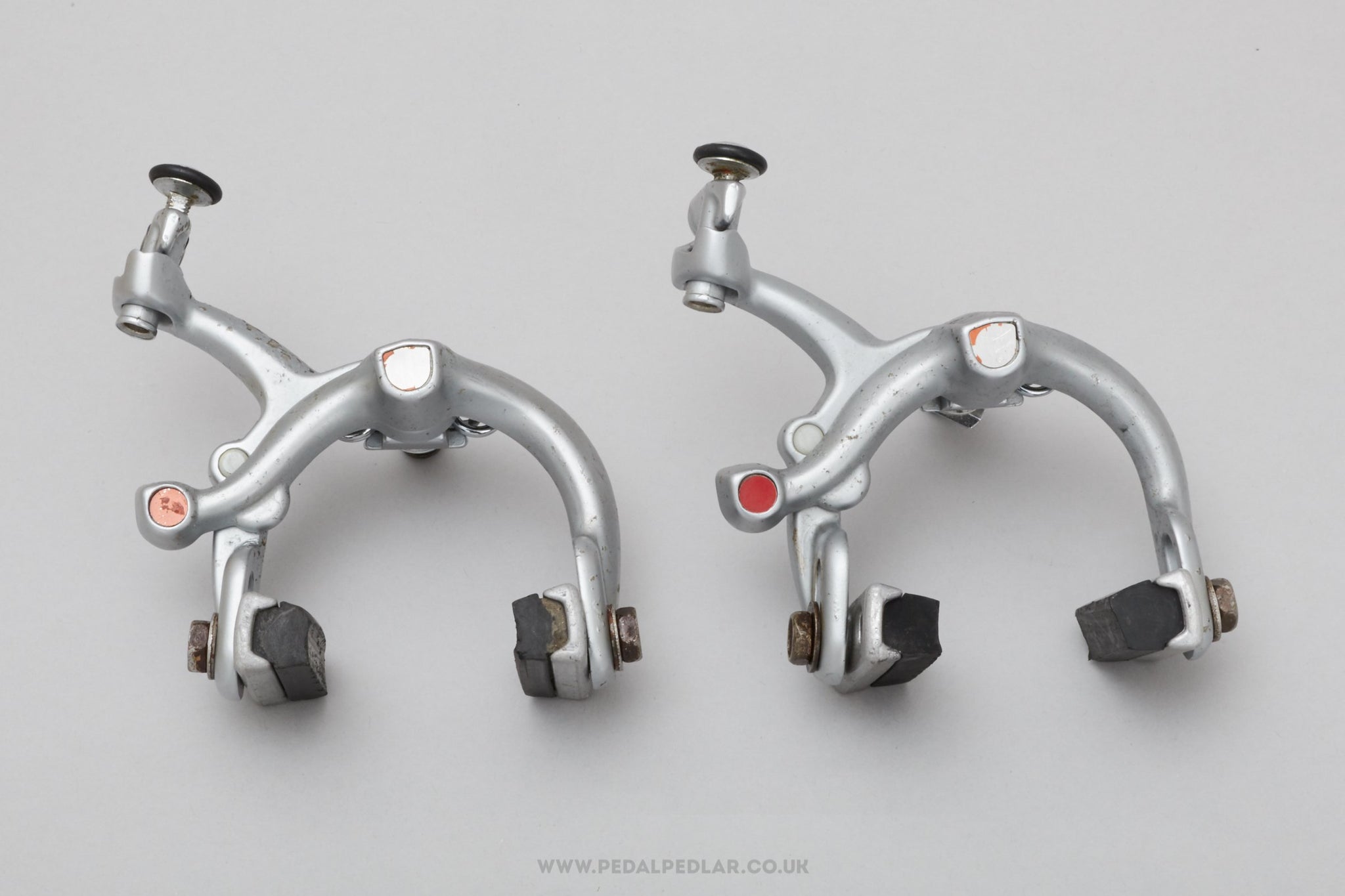


CLB Professionnel (Long Reach) Vintage Brake Calipers
£56.25 £75.00
✓ Original part - in production from the 1970s to the 1980s
✓ Suitable for historic cycling events such as L'Eroica
✓ Made in France
✓ Worldwide shipping
CLB Professionnel brake calipers, in production from the 1970s to the 1980s. Made from aluminium/steel and weighing in at 267 grams - incredibly lightweight for a pair of brake calipers at that time. A fine choice for keeping your vintage bike authentic, but also great for any other compatible bike too.
If you're taking part in L'Eroica or any other vintage event, this is fully compliant - so rest assured, the pre-1987 police won't lock you up for having the wrong brake calipers!
The brakes have been cleaned, thoroughly checked by one of our mechanics and graded as good condition, but do take a good look at the detailed photos so you can see the cosmetic condition before you buy.OVERVIEW
Model ID - Long Reach
Production Era - 1970s & 1980s
Country - French
Material - Aluminium/Steel
Weight - 267 grams
Stock Code - U-CP12V
TECHNICAL INFO
Brake Type - Single Pivot (Side Pull)
Brake Drop - 47 mm - 57 mm
Brake Fixing - Recessed Allen Key
-
▼SHIPPING, TAXES & RETURNS
-
We've been safely sending orders around the world since 2010. Orders are carefully packed, sent with tracking & insurance, and normally collected around midday on Tuesdays and Fridays. Larger items may occasionally require an extra day or two to prepare.
We accept returns, please notify us within 14 days and ensure the item arrives back with us no later than 30 days after the order was received.
EU orders under €150 (excluding shipping) - import VAT and the new €3 customs duty are paid as part of your order, so there's nothing further to pay on delivery.
EU orders over €150 (excluding shipping) - import fees are payable to the carrier before delivery, with nothing collected at checkout.
USA orders - import fees are collected at checkout for all orders to the USA, so there won’t be any surprise charges when your order arrives.
Other international orders - local import fees may apply and are not collected by us. Please check your country's import rules before purchasing.


CLB Route Speciale 'Ville' Vintage Randonneur Brake Levers
£58.50 £65.00
✓ Original levers - in production from the 1960s to the 1970s
✓ Suitable for historic cycling events such as L'Eroica
✓ Professionally checked & cleaned
✓ Worldwide shipping
CLB Route Speciale flat bar brake levers (or handles if you prefer), hailing from France and in production from the 1960s to the 1970s. Made from aluminium and weighing in at 182 grams. A fine choice for keeping your vintage bike authentic, but also great for any other compatible bike.
If you're taking part in L'Eroica or any other vintage event, these are fully compliant - so rest assured, the pre-1987 police won't lock you up for having the wrong brake levers!
The brake levers have been cleaned, checked by one of our mechanics and graded as good condition, but do take a good look at the detailed photos so you can see the cosmetic condition before you buy.OVERVIEW
Production Era - 1960s & 1970s
Country - French
Material - Aluminium
Weight - 182 g
Stock Code - U-LEV-F20V
NB - One pivot bolt not original.
TECHNICAL INFO
Bike Type - Randonneur
Brake Type - Calipers, Cantilevers, Mini V-Brakes
Bar Clamp Size - 23.5 mm
-
▼SHIPPING, TAXES & RETURNS
-
We've been safely sending orders around the world since 2010. Orders are carefully packed, sent with tracking & insurance, and normally collected around midday on Tuesdays and Fridays. Larger items may occasionally require an extra day or two to prepare.
We accept returns, please notify us within 14 days and ensure the item arrives back with us no later than 30 days after the order was received.
EU orders under €150 (excluding shipping) - import VAT and the new €3 customs duty are paid as part of your order, so there's nothing further to pay on delivery.
EU orders over €150 (excluding shipping) - import fees are payable to the carrier before delivery, with nothing collected at checkout.
USA orders - import fees are collected at checkout for all orders to the USA, so there won’t be any surprise charges when your order arrives.
Other international orders - local import fees may apply and are not collected by us. Please check your country's import rules before purchasing.
-
▼HELP SECTION
-
Bike Type - this is just a guide, any brake levers can technically be used on any bike as long as everything's compatible.
Brake Type - if you’re running direct pull cantilevers (V-Brakes), you’ll need compatible brake levers. For calipers, cantilevers and mini V-brakes you’ll need levers designed to be used with these as the cable pull is different.
Bar Clamp Size - this should be close to the outside diameter of your handlebars at the point the brake levers will be fitted. 23.8 mm is standard for drop bars and 22.2 mm is standard for 'flat' bars (including risers & swept-back types), but they can differ so this should be checked.


CLB Route Speciale 'Ville' Vintage Randonneur Brake Levers
£67.50 £75.00
✓ Original levers - in production from the 1960s to the 1970s
✓ Suitable for historic cycling events such as L'Eroica
✓ Professionally checked & cleaned
✓ Worldwide shipping
CLB Route Speciale flat bar brake levers (or handles if you prefer), hailing from France and in production from the 1960s to the 1970s. Made from aluminium and weighing in at 139 grams. A fine choice for keeping your vintage bike authentic, but also great for any other compatible bike.
If you're taking part in L'Eroica or any other vintage event, these are fully compliant - so rest assured, the pre-1987 police won't lock you up for having the wrong brake levers!
The brake levers have been cleaned, checked by one of our mechanics and graded as good condition, but do take a good look at the detailed photos so you can see the cosmetic condition before you buy.OVERVIEW
Production Era - 1960s & 1970s
Country - French
Material - Aluminium
Weight - 139 g
Stock Code - U-LEV-F21V
TECHNICAL INFO
Bike Type - Randonneur
Brake Type - Calipers, Cantilevers, Mini V-Brakes
Bar Clamp Size - 23.5 mm
-
▼SHIPPING, TAXES & RETURNS
-
We've been safely sending orders around the world since 2010. Orders are carefully packed, sent with tracking & insurance, and normally collected around midday on Tuesdays and Fridays. Larger items may occasionally require an extra day or two to prepare.
We accept returns, please notify us within 14 days and ensure the item arrives back with us no later than 30 days after the order was received.
EU orders under €150 (excluding shipping) - import VAT and the new €3 customs duty are paid as part of your order, so there's nothing further to pay on delivery.
EU orders over €150 (excluding shipping) - import fees are payable to the carrier before delivery, with nothing collected at checkout.
USA orders - import fees are collected at checkout for all orders to the USA, so there won’t be any surprise charges when your order arrives.
Other international orders - local import fees may apply and are not collected by us. Please check your country's import rules before purchasing.
-
▼HELP SECTION
-
Bike Type - this is just a guide, any brake levers can technically be used on any bike as long as everything's compatible.
Brake Type - if you’re running direct pull cantilevers (V-Brakes), you’ll need compatible brake levers. For calipers, cantilevers and mini V-brakes you’ll need levers designed to be used with these as the cable pull is different.
Bar Clamp Size - this should be close to the outside diameter of your handlebars at the point the brake levers will be fitted. 23.8 mm is standard for drop bars and 22.2 mm is standard for 'flat' bars (including risers & swept-back types), but they can differ so this should be checked.


CLB Route Speciale 'Ville' Vintage Randonneur Brake Levers
£76.50 £85.00
✓ Original levers - in production from the 1950s to the 1960s
✓ Suitable for historic cycling events such as L'Eroica
✓ Professionally checked & cleaned
✓ Worldwide shipping
CLB Route Speciale flat bar brake levers (or handles if you prefer), hailing from France and in production from the 1950s to the 1960s. Made from aluminium and weighing in at 139 grams. A fine choice for keeping your vintage bike authentic, but also great for any other compatible bike.
If you're taking part in L'Eroica or any other vintage event, these are fully compliant - so rest assured, the pre-1987 police won't lock you up for having the wrong brake levers!
The brake levers have been cleaned, checked by one of our mechanics and graded as good condition, but do take a good look at the detailed photos so you can see the cosmetic condition before you buy.OVERVIEW
Production Era - 1950s & 1960s
Country - French
Material - Aluminium
Weight - 139 g
Stock Code - U-LEV-F22V
TECHNICAL INFO
Bike Type - Randonneur
Brake Type - Calipers, Cantilevers, Mini V-Brakes
Bar Clamp Size - 23.5 mm
-
▼SHIPPING, TAXES & RETURNS
-
We've been safely sending orders around the world since 2010. Orders are carefully packed, sent with tracking & insurance, and normally collected around midday on Tuesdays and Fridays. Larger items may occasionally require an extra day or two to prepare.
We accept returns, please notify us within 14 days and ensure the item arrives back with us no later than 30 days after the order was received.
EU orders under €150 (excluding shipping) - import VAT and the new €3 customs duty are paid as part of your order, so there's nothing further to pay on delivery.
EU orders over €150 (excluding shipping) - import fees are payable to the carrier before delivery, with nothing collected at checkout.
USA orders - import fees are collected at checkout for all orders to the USA, so there won’t be any surprise charges when your order arrives.
Other international orders - local import fees may apply and are not collected by us. Please check your country's import rules before purchasing.
-
▼HELP SECTION
-
Bike Type - this is just a guide, any brake levers can technically be used on any bike as long as everything's compatible.
Brake Type - if you’re running direct pull cantilevers (V-Brakes), you’ll need compatible brake levers. For calipers, cantilevers and mini V-brakes you’ll need levers designed to be used with these as the cable pull is different.
Bar Clamp Size - this should be close to the outside diameter of your handlebars at the point the brake levers will be fitted. 23.8 mm is standard for drop bars and 22.2 mm is standard for 'flat' bars (including risers & swept-back types), but they can differ so this should be checked.


Cobra Campagnolo NOS Vintage 500 ml Water Bottle
£65.00
✓ Original water bottle - in production from the 1970s to the 1980s
✓ New old stock! Still unused after all these years
✓ Suitable for historic cycling events such as L'Eroica
✓ Worldwide shipping
Cobra Campagnolo water bottle, hailing from Italy and in production from the 1970s to the 1980s (yet still new & unused after all this time!). An excellent choice for vintage cycling enthusiasts, but great for cyclists of the non-vintage variety too of course!
If you're riding L'Eroica or a similar vintage event, this is of the correct era, so rest assured the pre-1987 police won't lock you up for having the wrong water bottle!
OVERVIEW
Production Era - 1970s & 1980s
Country - Italian
Material - Plastic
Weight - 81 g
Stock Code - D-BOT14V
*New old stock items may have marks from storage over the years, and as we often have multiples they can vary from piece to piece, but they are always genuine new & unused items.
TECHNICAL INFO
Capacity - 500 ml
Bottle Width - 75 mm
-
▼SHIPPING, TAXES & RETURNS
-
We've been safely sending orders around the world since 2010. Orders are carefully packed, sent with tracking & insurance, and normally collected around midday on Tuesdays and Fridays. Larger items may occasionally require an extra day or two to prepare.
We accept returns, please notify us within 14 days and ensure the item arrives back with us no later than 30 days after the order was received.
EU orders under €150 (excluding shipping) - import VAT and the new €3 customs duty are paid as part of your order, so there's nothing further to pay on delivery.
EU orders over €150 (excluding shipping) - import fees are payable to the carrier before delivery, with nothing collected at checkout.
USA orders - import fees are collected at checkout for all orders to the USA, so there won’t be any surprise charges when your order arrives.
Other international orders - local import fees may apply and are not collected by us. Please check your country's import rules before purchasing.
-
▼HELP SECTION
-
Capacity - 500ml used to be the standard sized bottle, but the taller modern versions tend to be 750ml.
Bottle width - almost all bottle cages take a 75 mm bottle width, the only rather rare exceptions are some old Elite cages that take a 66 mm bottle (and of course the funny shaped aero ones).


CODA Classic Triple Chainset
£82.50 £110.00
✓ Original part - produced in the 1990s
✓ Lightweight for the era - just 740 grams
✓ Professionally checked & cleaned
✓ Worldwide shipping
CODA chainset, hailing from the United States and in production during the 1990s. Made from aluminium/steel and weighing in at 740 grams - pretty lightweight for a chainset at that time. A fine choice for keeping your classic bike authentic, but also great for any other compatible bike too.
The chainset's been carefully cleaned, thoroughly checked by one of our mechanics and graded as good condition, but do take a good look at the detailed photos so you can see the cosmetic condition before you buy.OVERVIEW
Chainring Condition - Good
Production Era - 1990s
Country - American
Material - Aluminium/Steel
Weight - 740 g
Stock Code - U-CS59C
TECHNICAL INFO
Chainring Count - Triple
Tooth Count - 42 / 32 / 22
Chain Width - 3/32" (Standard)
BCD - 94 / 58 BCD
Intended Speed* - 7 Speed, 8 Speed
Crank Arm Length - 175 mm
Pedal Threads - Standard (9/16" x 20 TPI)
Bottom Bracket Type - Square Taper
*See help section.
-
▼SHIPPING, TAXES & RETURNS
-
We've been safely sending orders around the world since 2010. Orders are carefully packed, sent with tracking & insurance, and normally collected around midday on Tuesdays and Fridays. Larger items may occasionally require an extra day or two to prepare.
We accept returns, please notify us within 14 days and ensure the item arrives back with us no later than 30 days after the order was received.
EU orders under €150 (excluding shipping) - import VAT and the new €3 customs duty are paid as part of your order, so there's nothing further to pay on delivery.
EU orders over €150 (excluding shipping) - import fees are payable to the carrier before delivery, with nothing collected at checkout.
USA orders - import fees are collected at checkout for all orders to the USA, so there won’t be any surprise charges when your order arrives.
Other international orders - local import fees may apply and are not collected by us. Please check your country's import rules before purchasing.
-
▼HELP SECTION
-
Chainring count - the number of chainrings on the chainset. Fixed gear track bikes, single-speeds and some geared bikes use a single chainring, road bikes commonly use a double (two rings) and most touring bikes and mountain bikes will use a triple chainset (three rings).
Tooth count - the number of teeth on the chainring(s), the higher the number the harder the gear.
Chain width - this is only relevant for chainsets with a single chainring - if this is ⅛” then you must use a ⅛” chain. All double and triple (and some single) ring chainsets will use a standard 3/32” chain.
BCD - stands for Bolt Circle Diameter (sometimes referred to as PCD - Pitch Circle Diameter) and is only really needed when changing chainrings. To calculate the BCD, measure the distance in millimeters from the centre of any chainring bolt to the centre of an adjacent one and multiply it by 1.709 (you’ll likely need to round the resulting number up or down a little to get your BCD measurement).
*Intended speed - the number of cogs at the back the chainset was designed to be used with. We refer to it as ‘intended’ speed as most double and triple chainsets will actually work with different speeds than originally intended, but the further away you get from the intended speed the more likely you are to experience minor setup issues. The exception being some chainsets intended for 10 speed use or higher, with these it’s better to stick to the intended speed.
Crank arm length - this is measured from the absolute centre of the bottom bracket hole to the centre of the hole for the pedal.
Pedal threads - the thread type to match that of the chainset, this must match and is usually stamped on the pedals themselves and most bikes use a standard thread of 9/16” x 20 tpi. The exceptions being older French bikes, bikes with cheaper one-piece type chainsets and Shimano’s Dyna Drive system (easily identifiable as the pedal holes are about an inch wide!).
Bottom bracket type - ‘square taper’, as the name suggests have a square shaped axle that slots into the chainset and ‘cottered’ axles are round and secured by pins - pretty much every bike up until the 1990s would use one of these, cottered being the much earlier system. Since then, different manufacturers have introduced their own systems that are not interchangeable so you must use a chainset that matches.


Colnago - BBS Banden Small Vintage Winter Cycling Jacket
£65.00
✓ Original vintage jacket - 1980s style!
✓ Suitable for historic cycling events such as L'Eroica
✓ Thoroughly checked & honestly graded
✓ Great alternative to buying new
✓ Worldwide shipping
Colnago - BBS Banden winter cycling jacket, likely made in the 1980s given the style. An excellent choice for wearing on your vintage bike (or any occasion you fancy of course), and also a great alternative to buying brand new cycling kit!
If you're taking part in L'Eroica or a similar vintage event, this is compliant - so rest assured, the pre-1987 police won't lock you up for having the wrong jacket!
The jacket’s been thoroughly checked over and graded as good condition. If there are any issues worth noting we’ll do so in the overview section below, but please take a good look at the photos so you can see the condition yourself before you buy.OVERVIEW
Condition - Good
Condition Notes - Faded front & rub mark is starting to wear through as seen in the photos.
Material - Synthetic
Stock Code - U-G6-JK9V
**This is just an estimate based on the chest measurement alone so please check the actual measurements before buying, the best way to get the right fit is to compare them with those of a garment that fits well. Please use all the measurements provided as some vintage jackets can have irregular sizing, and we find that some of the orignal size labels can be very different to the actual size.
DETAIL & MEASUREMENTS
Pit to Pit (Laid Flat) - 46 cm
Top to Bottom (Front) - 66 cm
Top to Bottom (Back) - 72 cm
Shoulder Seam to Sleeve End (Oustide) - 64 cm
Across Neck (Laid Flat) - 18 cm
Across Sleeve End (Laid Flat) - 8 cm
NB: Check the help section to see how we take these measurements, so you can get a good comparison to your own.
-
▼SHIPPING, TAXES & RETURNS
-
We've been safely sending orders around the world since 2010. Orders are carefully packed, sent with tracking & insurance, and normally collected around midday on Tuesdays and Fridays. Larger items may occasionally require an extra day or two to prepare.
We accept returns, please notify us within 14 days and ensure the item arrives back with us no later than 30 days after the order was received.
EU orders under €150 (excluding shipping) - import VAT and the new €3 customs duty are paid as part of your order, so there's nothing further to pay on delivery.
EU orders over €150 (excluding shipping) - import fees are payable to the carrier before delivery, with nothing collected at checkout.
USA orders - import fees are collected at checkout for all orders to the USA, so there won’t be any surprise charges when your order arrives.
Other international orders - local import fees may apply and are not collected by us. Please check your country's import rules before purchasing.
-
▼SAFETY & COMPLIANCE
- This product complies with the EU General Product Safety Regulation (GPSR).
EU Authorised Representative - Global Trade Department NI Ltd, Office 834, Unit 6, 100 Lisburn Road, Belfast BT9 6AG, Northern Ireland
-
▼HELP SECTION
- We've provided reference below to illustrate how we take the measurements.
Pit to Pit - this measurement is taken from the centre of one armpit to the other, across the chest with the jacket laid flat.
Top to Bottom - this will always be from the very top of the collar to the very bottom hem, we provide measurements for both the front and back, always taken with the jacket laid flat.
Shoulder Seam to Sleeve End - this measurement is taken from the shoulder seam down to the very end of the sleeve on the outside.
Across Neck - for consistency on all neck shapes we gather the front and back together and lay them flat, then measure across the stitching (as shown in the supporting photos).
Across Sleeve End - measured across the sleeve end, laid flat.


Continental Super Sport Kevlar Black/White NOS Vintage 700 x 28c Tyres
£75.00
✓ Original pair of tyres - produced in the 1980s
✓ New old stock! Still unused after all these years
✓ Suitable for historic cycling events such as L'Eroica
✓ Worldwide shipping
Continental Super Sport tyres, hailing from Germany and in production during the 1980s (yet still new & unused after all this time!). Made from rubber/kevlar and weighing in at 772 grams (the weight and price displayed are for a pair of tyres). A fine choice for keeping your vintage bike authentic, but also great for any other compatible bike.
If you're taking part in L'Eroica, Anjou Velo, Velo Retro or another similar vintage cycling event, this is fully compliant - so rest assured, the pre-1987 police won't lock you up for having the wrong tyres!
NB: If mounted in the photos this is for illustrative purpose only, any wheels or rims shown are not included.OVERVIEW
Production Era - 1980s
Country - German
Material - Rubber / Kevlar
Weight - 772 g
Stock Code - D-TYP-R35V
*New old stock items may have marks from storage over the years, and as we often have multiples they can vary from piece to piece, but they are always genuine new & unused items.
TECHNICAL INFO
Size - 700 x 28c
Bike Type - Road
ISO Diameter - 622 mm (700c/28")
-
▼SHIPPING, TAXES & RETURNS
-
We've been safely sending orders around the world since 2010. Orders are carefully packed, sent with tracking & insurance, and normally collected around midday on Tuesdays and Fridays. Larger items may occasionally require an extra day or two to prepare.
We accept returns, please notify us within 14 days and ensure the item arrives back with us no later than 30 days after the order was received.
EU orders under €150 (excluding shipping) - import VAT and the new €3 customs duty are paid as part of your order, so there's nothing further to pay on delivery.
EU orders over €150 (excluding shipping) - import fees are payable to the carrier before delivery, with nothing collected at checkout.
USA orders - import fees are collected at checkout for all orders to the USA, so there won’t be any surprise charges when your order arrives.
Other international orders - local import fees may apply and are not collected by us. Please check your country's import rules before purchasing.
-
▼HELP SECTION
-
Size - this is the manufacturer’s sizing and must match the size or your wheels. This can be confusing as tyres have had different sizing systems over the years, and there are many (sometimes conflicting) sizes available. For this reason it’s important to check the ISO diameter too for clarification, especially for 26” wheels.
Bike Type - the type of bike the tyres were designed to be used on. Road tyres will generally be narrow with minimal tread, touring tyres wider with a bit more grip in the tread, and cyclocross & MTB tyres wider still (especially the latter), with a much more pronounced tread pattern.
ISO Diameter - this relates to the diameter of the wheel rims at the point where the tyres are seated (bead seat diameter). This is a universal measurement, often displayed on tyres as 28-622 or similar, 28 referring to the tyre width and 622 being the ISO diameter in millimetres.
TPI - stands for threads per inch and refers to the thread count of the tyre casings. A high thread count usually means more supple and lighter tyres, this can be anything as high as 320 tpi. We can’t always provide this information however, as it’s not always possible to know for sure.