
Big Old Sale - All Items 25% Off


Shimano Deore XT (FD-M700) 'Deer Head' NOS Vintage Clamp-On 28.6 mm Front Derailleur
£82.50 £110.00
✓ Original part - produced in the 1980s
✓ New old stock! Still unused after all these years
✓ Worldwide shipping
Shimano Deore XT front derailleur, hailing from Japan and in production during the 1980s (yet still new & unused after all this time!). Made from steel/aluminium and weighing in at 118 grams. A fine choice for keeping your vintage bike authentic, but also great for any other compatible bike.
OVERVIEW
Model ID - FD-M700
Production Era - 1980s
Country - Japanese
Material - Steel / Aluminium
Weight - 118 g
Stock Code - D-FM179V
*New old stock items may have marks from storage over the years, and as we often have multiples they can vary from piece to piece, but they are always genuine new & unused items.
TECHNICAL INFO
Chainset Type - Triple
Frame Fixing - Clamp-On 28.6 mm
Pull Type - Bottom Pull
*See help section.
-
▼SHIPPING, TAXES & RETURNS
-
We've been safely sending orders around the world since 2010. Orders are carefully packed, sent with tracking & insurance, and normally collected around midday on Tuesdays and Fridays. Larger items may occasionally require an extra day or two to prepare.
We accept returns, please notify us within 14 days and ensure the item arrives back with us no later than 30 days after the order was received.
EU orders under €150 (excluding shipping) - import VAT and the new €3 customs duty are paid as part of your order, so there's nothing further to pay on delivery.
EU orders over €150 (excluding shipping) - import fees are payable to the carrier before delivery, with nothing collected at checkout.
USA orders - import fees are collected at checkout for all orders to the USA, so there won’t be any surprise charges when your order arrives.
Other international orders - local import fees may apply and are not collected by us. Please check your country's import rules before purchasing.
-
▼HELP SECTION
-
Chainset Type - the number of chainrings the derailleur was designed to work with. ‘Double’ derailleurs are actually capable of working on ‘triple’ chainsets but they may struggle when shifting, especially if there’s a big step down from the middle to inner ring, so it’s better to match these correctly.
Frame Fixing - the way the derailleur fixes to the frame, if you have a tab on your frame to mount the derailleur to you need braze-on. If there’s no tab then you require a clamp-on type (also referred to as band-on or clip-on), these come in different sizes to match the diameter of your seat tube.
Pull Type - the direction of which the cable needs to ‘pull’ the mech in order to shift. If your cable runs up to the derailleur from the bottom bracket area then you need bottom pull, if your cable comes down from above you need top pull. Some later derailleurs can be used for either setups, these are referred to as dual pull.
Designated Speed (9 Speed & Above) - the speed of the chain that the mech was designed to be used with. This only becomes relevant for mechs marketed as 9 speed or above when chains became narrower, as the derailleur cage plates became marginally narrower too. We refer to it as ‘designated’ speed as technically you can use (almost) any derailleur with any chain, however if you want optimum performance it’s best to stay close to the manufacturers recommendations.
Indexing System (Shimano Only) - this is only applicable when using Shimano shifters that have an indexed left shifter such as STI or Rapidfire. For the indexing to work correctly when using these shifters the derailleur and shifters must be of the same type, so Shimano drop bar shifters need to be matched with a Shimano ‘road’ derailleur, and Shimano flat bar shifters must be used with Shimano ‘MTB’ derailleurs.


GES Huracan Crono NOS/NIB Vintage Yellow / White / Black Striped Saddle
£82.50 £110.00
✓ Original saddle - produced in the 1980s
✓ New old stock & still in the original packaging!
✓ Suitable for historic cycling events such as L'Eroica
✓ Worldwide shipping
GES Huracan Crono saddle, hailing from Spain and in production during the 1980s (yet still new & unused after all this time!). Made from synthetic/steel material and weighing in at 395 grams. A fine choice for keeping your vintage bike authentic, but also great for any other compatible bike.
If you're taking part in L'Eroica or a similar vintage event, this is fully compliant - so rest assured, the pre-1987 police won't lock you up for having the wrong saddle!
OVERVIEW
Production Era - 1980s
Country - Spanish
Material - Synthetic / Steel
Weight - 395 g
Stock Code - D-SA172V
*New old stock items may have marks from storage over the years, and as we often have multiples they can vary from piece to piece, but they are always genuine new & unused items.
TECHNICAL INFO
Colour* - Yellow / White / Black Striped
Cover Material - Synthetic
Length - 280 mm
Width (Widest Point) - 150 mm
*The colour description is just a guide, please check the photos to get a good idea of the colour too, as we make sure these are as close to the true colour as possible.
-
▼SHIPPING, TAXES & RETURNS
-
We've been safely sending orders around the world since 2010. Orders are carefully packed, sent with tracking & insurance, and normally collected around midday on Tuesdays and Fridays. Larger items may occasionally require an extra day or two to prepare.
We accept returns, please notify us within 14 days and ensure the item arrives back with us no later than 30 days after the order was received.
EU orders under €150 (excluding shipping) - import VAT and the new €3 customs duty are paid as part of your order, so there's nothing further to pay on delivery.
EU orders over €150 (excluding shipping) - import fees are payable to the carrier before delivery, with nothing collected at checkout.
USA orders - import fees are collected at checkout for all orders to the USA, so there won’t be any surprise charges when your order arrives.
Other international orders - local import fees may apply and are not collected by us. Please check your country's import rules before purchasing.


GES Huracan Crono NOS/NIB Vintage Green / White / Black Striped Saddle
£82.50 £110.00
✓ Original saddle - produced in the 1980s
✓ New old stock & still in the original packaging!
✓ Suitable for historic cycling events such as L'Eroica
✓ Worldwide shipping
GES Huracan Crono saddle, hailing from Spain and in production during the 1980s (yet still new & unused after all this time!). Made from synthetic/steel material and weighing in at 373 grams. A fine choice for keeping your vintage bike authentic, but also great for any other compatible bike.
If you're taking part in L'Eroica or a similar vintage event, this is fully compliant - so rest assured, the pre-1987 police won't lock you up for having the wrong saddle!
OVERVIEW
Production Era - 1980s
Country - Spanish
Material - Synthetic / Steel
Weight - 373 g
Stock Code - D-SA173V
*New old stock items may have marks from storage over the years, and as we often have multiples they can vary from piece to piece, but they are always genuine new & unused items.
TECHNICAL INFO
Colour* - Green / White / Black Striped
Cover Material - Synthetic
Length - 280 mm
Width (Widest Point) - 150 mm
*The colour description is just a guide, please check the photos to get a good idea of the colour too, as we make sure these are as close to the true colour as possible.
-
▼SHIPPING, TAXES & RETURNS
-
We've been safely sending orders around the world since 2010. Orders are carefully packed, sent with tracking & insurance, and normally collected around midday on Tuesdays and Fridays. Larger items may occasionally require an extra day or two to prepare.
We accept returns, please notify us within 14 days and ensure the item arrives back with us no later than 30 days after the order was received.
EU orders under €150 (excluding shipping) - import VAT and the new €3 customs duty are paid as part of your order, so there's nothing further to pay on delivery.
EU orders over €150 (excluding shipping) - import fees are payable to the carrier before delivery, with nothing collected at checkout.
USA orders - import fees are collected at checkout for all orders to the USA, so there won’t be any surprise charges when your order arrives.
Other international orders - local import fees may apply and are not collected by us. Please check your country's import rules before purchasing.


GES Huracan Crono NOS/NIB Vintage White / Grey / Black Striped Saddle
£82.50 £110.00
✓ Original saddle - produced in the 1980s
✓ New old stock & still in the original packaging!
✓ Suitable for historic cycling events such as L'Eroica
✓ Worldwide shipping
GES Huracan Crono saddle, hailing from Spain and in production during the 1980s (yet still new & unused after all this time!). Made from synthetic/steel material and weighing in at 380 grams. A fine choice for keeping your vintage bike authentic, but also great for any other compatible bike.
If you're taking part in L'Eroica or a similar vintage event, this is fully compliant - so rest assured, the pre-1987 police won't lock you up for having the wrong saddle!
OVERVIEW
Production Era - 1980s
Country - Spanish
Material - Synthetic / Steel
Weight - 380 g
Stock Code - D-SA174V
*New old stock items may have marks from storage over the years, and as we often have multiples they can vary from piece to piece, but they are always genuine new & unused items.
TECHNICAL INFO
Colour* - White / Grey / Black Striped
Cover Material - Synthetic
Length - 280 mm
Width (Widest Point) - 150 mm
*The colour description is just a guide, please check the photos to get a good idea of the colour too, as we make sure these are as close to the true colour as possible.
-
▼SHIPPING, TAXES & RETURNS
-
We've been safely sending orders around the world since 2010. Orders are carefully packed, sent with tracking & insurance, and normally collected around midday on Tuesdays and Fridays. Larger items may occasionally require an extra day or two to prepare.
We accept returns, please notify us within 14 days and ensure the item arrives back with us no later than 30 days after the order was received.
EU orders under €150 (excluding shipping) - import VAT and the new €3 customs duty are paid as part of your order, so there's nothing further to pay on delivery.
EU orders over €150 (excluding shipping) - import fees are payable to the carrier before delivery, with nothing collected at checkout.
USA orders - import fees are collected at checkout for all orders to the USA, so there won’t be any surprise charges when your order arrives.
Other international orders - local import fees may apply and are not collected by us. Please check your country's import rules before purchasing.


Velo Soffatti Jet Perforated NOS Classic Black Saddle
£56.25 £75.00
✓ Original saddle - produced in the 1990s
✓ New old stock! Still unused after all these years
✓ Worldwide shipping
Velo Soffatti Jet saddle, hailing from Taiwan and in production during the 1990s (yet still new & unused after all this time!). Made from synthetic/steel material and weighing in at 271 grams. A fine choice for keeping your classic bike authentic, but also great for any other compatible bike.
OVERVIEW
Production Era - 1990s
Country - Taiwanese
Material - Synthetic / Steel
Weight - 271 g
Stock Code - D-SA183C
*New old stock items may have marks from storage over the years, and as we often have multiples they can vary from piece to piece, but they are always genuine new & unused items.
TECHNICAL INFO
Colour* - Black
Cover Material - Synthetic
Length - 260 mm
Width (Widest Point) - 140 mm
*The colour description is just a guide, please check the photos to get a good idea of the colour too, as we make sure these are as close to the true colour as possible.
-
▼SHIPPING, TAXES & RETURNS
-
We've been safely sending orders around the world since 2010. Orders are carefully packed, sent with tracking & insurance, and normally collected around midday on Tuesdays and Fridays. Larger items may occasionally require an extra day or two to prepare.
We accept returns, please notify us within 14 days and ensure the item arrives back with us no later than 30 days after the order was received.
EU orders under €150 (excluding shipping) - import VAT and the new €3 customs duty are paid as part of your order, so there's nothing further to pay on delivery.
EU orders over €150 (excluding shipping) - import fees are payable to the carrier before delivery, with nothing collected at checkout.
USA orders - import fees are collected at checkout for all orders to the USA, so there won’t be any surprise charges when your order arrives.
Other international orders - local import fees may apply and are not collected by us. Please check your country's import rules before purchasing.


GES Soffatti Supra NOS Classic Black / Yellow Saddle
£56.25 £75.00
✓ Original saddle - produced in the 1990s
✓ New old stock! Still unused after all these years
✓ Worldwide shipping
GES Soffatti Supra saddle, hailing from Spain and in production during the 1990s (yet still new & unused after all this time!). Made from synthetic/plastic/steel material and weighing in at 318 grams. A fine choice for keeping your classic bike authentic, but also great for any other compatible bike.
OVERVIEW
Production Era - 1990s
Country - Spanish
Material - Synthetic / Plastic / Steel
Weight - 318 g
Stock Code - D-SA185C
*New old stock items may have marks from storage over the years, and as we often have multiples they can vary from piece to piece, but they are always genuine new & unused items.
TECHNICAL INFO
Colour* - Black / Yellow
Cover Material - Synthetic
Length - 270 mm
Width (Widest Point) - 130 mm
*The colour description is just a guide, please check the photos to get a good idea of the colour too, as we make sure these are as close to the true colour as possible.
-
▼SHIPPING, TAXES & RETURNS
-
We've been safely sending orders around the world since 2010. Orders are carefully packed, sent with tracking & insurance, and normally collected around midday on Tuesdays and Fridays. Larger items may occasionally require an extra day or two to prepare.
We accept returns, please notify us within 14 days and ensure the item arrives back with us no later than 30 days after the order was received.
EU orders under €150 (excluding shipping) - import VAT and the new €3 customs duty are paid as part of your order, so there's nothing further to pay on delivery.
EU orders over €150 (excluding shipping) - import fees are payable to the carrier before delivery, with nothing collected at checkout.
USA orders - import fees are collected at checkout for all orders to the USA, so there won’t be any surprise charges when your order arrives.
Other international orders - local import fees may apply and are not collected by us. Please check your country's import rules before purchasing.


Velo Soffatti Riveted NOS Classic Black Saddle
£56.25 £75.00
✓ Original saddle - produced in the 1990s
✓ New old stock! Still unused after all these years
✓ Worldwide shipping
Velo Soffatti saddle, hailing from Taiwan and in production during the 1990s (yet still new & unused after all this time!). Made from synthetic/steel material and weighing in at 341 grams. A fine choice for keeping your classic bike authentic, but also great for any other compatible bike.
OVERVIEW
Production Era - 1990s
Country - Taiwanese
Material - Synthetic / Steel
Weight - 341 g
Stock Code - D-SA187C
*New old stock items may have marks from storage over the years, and as we often have multiples they can vary from piece to piece, but they are always genuine new & unused items.
TECHNICAL INFO
Colour* - Black
Cover Material - Synthetic
Length - 270 mm
Width (Widest Point) - 150 mm
*The colour description is just a guide, please check the photos to get a good idea of the colour too, as we make sure these are as close to the true colour as possible.
-
▼SHIPPING, TAXES & RETURNS
-
We've been safely sending orders around the world since 2010. Orders are carefully packed, sent with tracking & insurance, and normally collected around midday on Tuesdays and Fridays. Larger items may occasionally require an extra day or two to prepare.
We accept returns, please notify us within 14 days and ensure the item arrives back with us no later than 30 days after the order was received.
EU orders under €150 (excluding shipping) - import VAT and the new €3 customs duty are paid as part of your order, so there's nothing further to pay on delivery.
EU orders over €150 (excluding shipping) - import fees are payable to the carrier before delivery, with nothing collected at checkout.
USA orders - import fees are collected at checkout for all orders to the USA, so there won’t be any surprise charges when your order arrives.
Other international orders - local import fees may apply and are not collected by us. Please check your country's import rules before purchasing.


Arius Amateur NOS Vintage Black Saddle
£63.75 £85.00
✓ Original saddle - produced in the 1970s
✓ New old stock! Still unused after all these years
✓ Suitable for historic cycling events such as L'Eroica
✓ Worldwide shipping
Arius Amateur saddle, hailing from Spain and in production during the 1970s (yet still new & unused after all this time!). Made from leather/steel material and weighing in at 335 grams. A fine choice for keeping your vintage bike authentic, but also great for any other compatible bike.
If you're taking part in L'Eroica or a similar vintage event, this is fully compliant - so rest assured, the pre-1987 police won't lock you up for having the wrong saddle!
OVERVIEW
Production Era - 1970s
Country - Spanish
Material - Leather / Steel
Weight - 335 g
Stock Code - D-SA208V
*New old stock items may have marks from storage over the years, and as we often have multiples they can vary from piece to piece, but they are always genuine new & unused items.
TECHNICAL INFO
Colour* - Black
Cover Material - Vinyl (Imitation Leather)
Length - 280 mm
Width (Widest Point) - 150 mm
*The colour description is just a guide, please check the photos to get a good idea of the colour too, as we make sure these are as close to the true colour as possible.
-
▼SHIPPING, TAXES & RETURNS
-
We've been safely sending orders around the world since 2010. Orders are carefully packed, sent with tracking & insurance, and normally collected around midday on Tuesdays and Fridays. Larger items may occasionally require an extra day or two to prepare.
We accept returns, please notify us within 14 days and ensure the item arrives back with us no later than 30 days after the order was received.
EU orders under €150 (excluding shipping) - import VAT and the new €3 customs duty are paid as part of your order, so there's nothing further to pay on delivery.
EU orders over €150 (excluding shipping) - import fees are payable to the carrier before delivery, with nothing collected at checkout.
USA orders - import fees are collected at checkout for all orders to the USA, so there won’t be any surprise charges when your order arrives.
Other international orders - local import fees may apply and are not collected by us. Please check your country's import rules before purchasing.


Arius Fangio Branded NOS Vintage Black Saddle
£63.75 £85.00
✓ Original saddle - produced in the 1970s
✓ New old stock! Still unused after all these years
✓ Suitable for historic cycling events such as L'Eroica
✓ Worldwide shipping
Arius saddle, hailing from Spain and in production during the 1970s (yet still new & unused after all this time!). Made from leather/steel material and weighing in at 329 grams. A fine choice for keeping your vintage bike authentic, but also great for any other compatible bike.
If you're taking part in L'Eroica or a similar vintage event, this is fully compliant - so rest assured, the pre-1987 police won't lock you up for having the wrong saddle!
OVERVIEW
Production Era - 1970s
Country - Spanish
Material - Leather / Steel
Weight - 329 g
Stock Code - D-SA209V
*New old stock items may have marks from storage over the years, and as we often have multiples they can vary from piece to piece, but they are always genuine new & unused items.
TECHNICAL INFO
Colour* - Black
Cover Material - Vinyl (Imitation Leather)
Length - 270 mm
Width (Widest Point) - 150 mm
*The colour description is just a guide, please check the photos to get a good idea of the colour too, as we make sure these are as close to the true colour as possible.
-
▼SHIPPING, TAXES & RETURNS
-
We've been safely sending orders around the world since 2010. Orders are carefully packed, sent with tracking & insurance, and normally collected around midday on Tuesdays and Fridays. Larger items may occasionally require an extra day or two to prepare.
We accept returns, please notify us within 14 days and ensure the item arrives back with us no later than 30 days after the order was received.
EU orders under €150 (excluding shipping) - import VAT and the new €3 customs duty are paid as part of your order, so there's nothing further to pay on delivery.
EU orders over €150 (excluding shipping) - import fees are payable to the carrier before delivery, with nothing collected at checkout.
USA orders - import fees are collected at checkout for all orders to the USA, so there won’t be any surprise charges when your order arrives.
Other international orders - local import fees may apply and are not collected by us. Please check your country's import rules before purchasing.
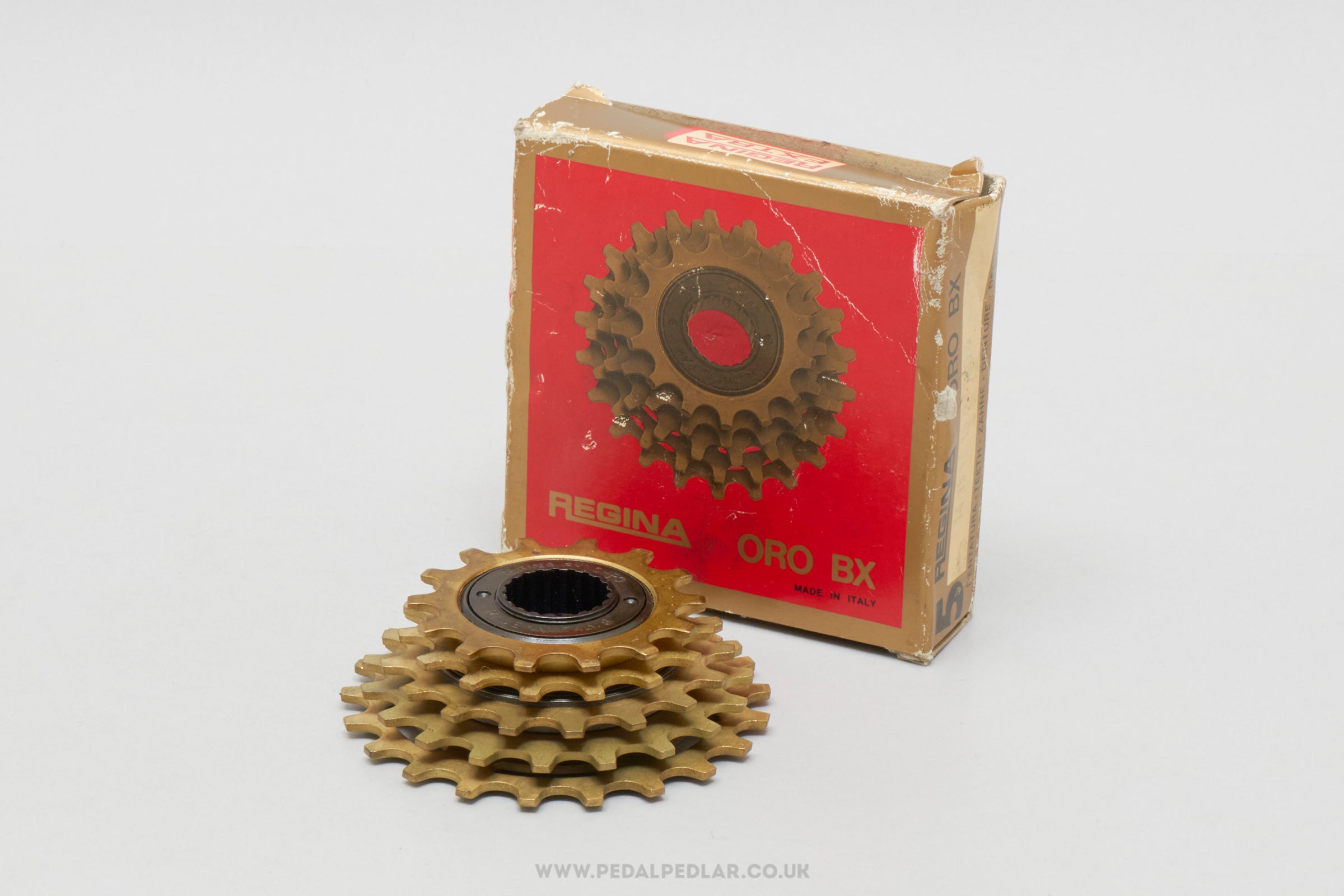


Regina Extra BX Oro NOS/NIB Vintage 5 Speed 14-21 Freewheel
£63.75 £85.00
✓ Original part - produced in the 1980s
✓ New old stock & still in the original packaging!
✓ Suitable for historic cycling events such as L'Eroica
✓ Worldwide shipping
Regina Extra BX freewheel, hailing from Italy and in production during the 1980s (yet still new & unused after all this time!). Made from steel and weighing in at 357 grams. A fine choice for keeping your vintage bike authentic, but also great for any other compatible bike.
If you're taking part in L'Eroica or a similar vintage event, this is fully compliant - so rest assured, the pre-1987 police won't lock you up for having the wrong freewheel!
OVERVIEW
Production Era - 1980s
Country - Italian
Material - Steel
Weight - 357 g
Stock Code - D-FW183V
NB - Freewheel body is marked Synchro, but the cogs are standard profile BX Oro.
*New old stock items may have marks from storage over the years, and as we often have multiples they can vary from piece to piece, but they are always genuine new & unused items.
TECHNICAL INFO
Speed - 5 Speed
Range - 14-21
Threading - English/ISO: 1.375 x 24 TPI
Stack Height - 27.5 mm
Cog Width - 3/32" (Standard)
-
▼SHIPPING, TAXES & RETURNS
-
We've been safely sending orders around the world since 2010. Orders are carefully packed, sent with tracking & insurance, and normally collected around midday on Tuesdays and Fridays. Larger items may occasionally require an extra day or two to prepare.
We accept returns, please notify us within 14 days and ensure the item arrives back with us no later than 30 days after the order was received.
EU orders under €150 (excluding shipping) - import VAT and the new €3 customs duty are paid as part of your order, so there's nothing further to pay on delivery.
EU orders over €150 (excluding shipping) - import fees are payable to the carrier before delivery, with nothing collected at checkout.
USA orders - import fees are collected at checkout for all orders to the USA, so there won’t be any surprise charges when your order arrives.
Other international orders - local import fees may apply and are not collected by us. Please check your country's import rules before purchasing.
-
▼HELP SECTION
-
Speed - the number of cogs on the freewheel.
Range - the number of teeth on the smalles and largest cogs, this gives you an indication of how hard or easy the gearing will be, the lower the number the harder the gears. The tooth count of the cogs inbetween are usually evenly spaced, ie: a 6 speed 14-24 freewheel would likely have cog sizes 14, 16, 18, 20, 22 & 24.
Threading - this needs to match the thread of your rear hub. ISO is the modern standard and is almost exactly the same as older English/British and Italian thread, allowing you to mix and match between these thread types as long as it's not going to be under extreme force, in which case it's best to stick to an exact match. Hubs with a French thread must be used with a French threaded freewheel.
Stack Height - the total height (or width if you're looking at it when installed) of the freewheel, this is measured from the base (back of the largest cog) to the top (front of the smallest cog).
Cog width - this is mainly relevant for singlespeed and some older 3 or 4 speed freewheels - if this is ⅛” then you must use a ⅛” chain, but most freewheels (especially multiple speed ones) will use a standard 3/32” chain.
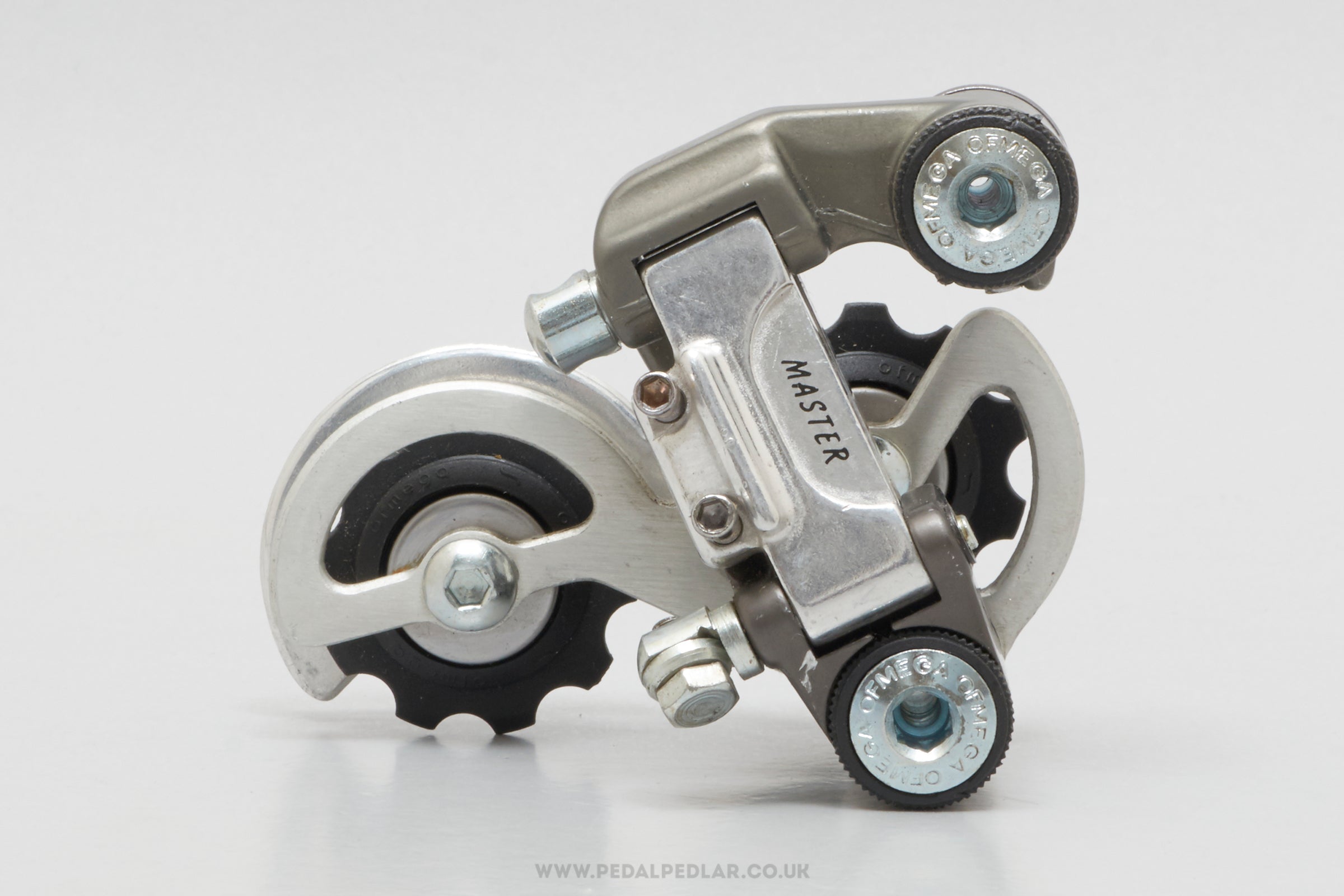


Ofmega Master NOS Vintage Rear Derailleur
£86.25 £115.00
✓ Original part - produced in the 1980s
✓ New old stock! Still unused after all these years
✓ Lightweight for the era - just 210 grams
✓ Suitable for historic cycling events such as L'Eroica
✓ Worldwide shipping
Ofmega Master rear derailleur (or mech if you prefer), hailing from Italy and in production during the 1980s (yet still new & unused after all this time!). Made from aluminium and weighing in at 210 grams - pretty lightweight for a rear derailleur at that time. A fine choice for keeping your vintage bike authentic, but also great for any other compatible bike.
If you're taking part in L'Eroica or a similar vintage event, this is fully compliant - so rest assured, the pre-1987 police won't lock you up for having the wrong rear mech!
OVERVIEW
Jockey Wheel Condition - New Old Stock*
Production Era - 1980s
Country - Italian
Material - Aluminium
Weight - 210 g
Stock Code - D-RM122V
*New old stock items may have marks from storage over the years, and as we often have multiples they can vary from piece to piece, but they are always genuine new & unused items.
TECHNICAL INFO
Shifting System - Friction
Speed* - 5 Speed, 6 Speed, 7 Speed
Max Cog Size - 26 Teeth
Max Chain Wrap - 26
Chain Width - 3/32" (Standard)
*See help section.
-
▼SHIPPING, TAXES & RETURNS
-
We've been safely sending orders around the world since 2010. Orders are carefully packed, sent with tracking & insurance, and normally collected around midday on Tuesdays and Fridays. Larger items may occasionally require an extra day or two to prepare.
We accept returns, please notify us within 14 days and ensure the item arrives back with us no later than 30 days after the order was received.
EU orders under €150 (excluding shipping) - import VAT and the new €3 customs duty are paid as part of your order, so there's nothing further to pay on delivery.
EU orders over €150 (excluding shipping) - import fees are payable to the carrier before delivery, with nothing collected at checkout.
USA orders - import fees are collected at checkout for all orders to the USA, so there won’t be any surprise charges when your order arrives.
Other international orders - local import fees may apply and are not collected by us. Please check your country's import rules before purchasing.
-
▼HELP SECTION
-
Shifting system - friction means your gear levers don't click when you change gear, when they do click it's referred to as indexed shifting. If you have indexed gear levers they must use the same system as the rear derailleur, if you're using friction levers you can mix and match.
Speed - the number of cogs at the back the derailleur was designed to be used with. This is important with indexed shifting, but with friction shifters you can in theory run any rear mech with any number of cogs, but you are more likely to have issues running high numbers of cogs with mechs from earlier eras.
Max cog size - the amount of teeth on the largest cog of your freewheel/cassette can be no greater than this to work with this derailleur.
Chain wrap - subtract the size of your smallest rear cog from your biggest, then do the same with your chainrings, add the 2 numbers together and you have your chain wrap.
Chain width - generally speaking, derailleurs designed for more than 3 speed use will fit a standard 3/32'' chain, the exception being some Cyclo & Simplex models from around the mid 1900s.
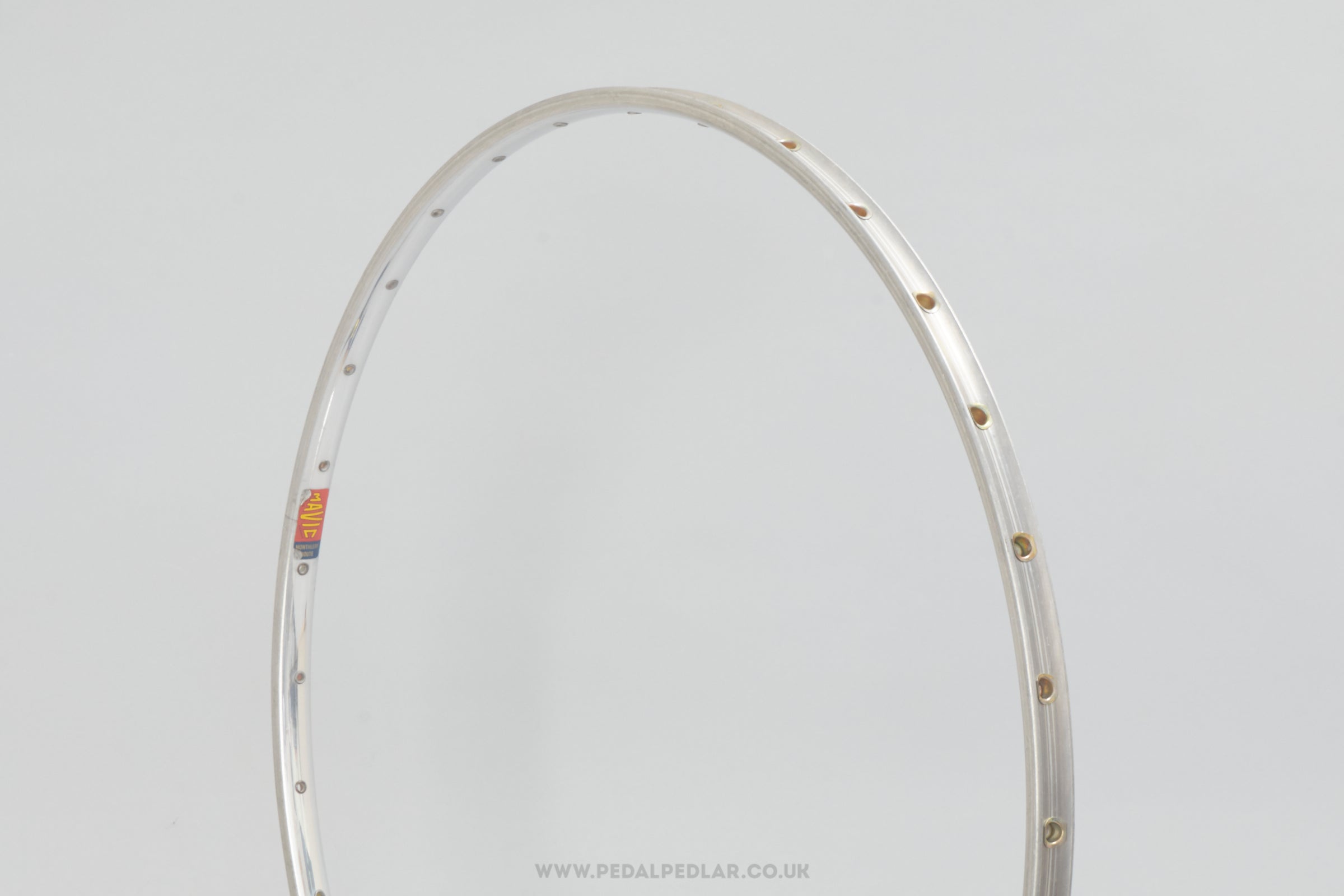


Mavic Monthlery Route Red Label Silver NOS Vintage 32h 28"/700c Tubular Rim
£56.25 £75.00
✓ Original rim - produced in the 1980s
✓ New old stock! Still unused after all these years
✓ Lightweight for the era - just 400 grams
✓ Suitable for historic cycling events such as L'Eroica
✓ Worldwide shipping
Mavic Monthlery Route wheel rim, hailing from France and in production during the 1980s (yet still new & unused after all this time!). Made from aluminium and weighing in at 400 grams (the weight and price displayed are for one rim, if we have more in stock you'll be able to add them to your basket) - pretty lightweight for a rim at that time. A fine choice for keeping your vintage bike authentic, but also great for any other compatible bike.
If you're taking part in L'Eroica or a similar vintage event, this is fully compliant - so rest assured, the pre-1987 police won't lock you up for having the wrong rim!
OVERVIEW
Production Era - 1980s
Country - French
Material - Aluminium
Weight - 400 g
Stock Code - D-RS105V
*New old stock items may have marks from storage over the years, and as we often have multiples they can vary from piece to piece, but they are always genuine new & unused items.
TECHNICAL INFO
Drilling - 32 Hole
Rim Size - 28"/700c Tubular
ISO Diameter - 622 mm (700c/28")
Valve Type - Presta
Rim Width (OD) - 21.5 mm
Rim Height - 12 mm
-
▼SHIPPING, TAXES & RETURNS
-
We've been safely sending orders around the world since 2010. Orders are carefully packed, sent with tracking & insurance, and normally collected around midday on Tuesdays and Fridays. Larger items may occasionally require an extra day or two to prepare.
We accept returns, please notify us within 14 days and ensure the item arrives back with us no later than 30 days after the order was received.
EU orders under €150 (excluding shipping) - import VAT and the new €3 customs duty are paid as part of your order, so there's nothing further to pay on delivery.
EU orders over €150 (excluding shipping) - import fees are payable to the carrier before delivery, with nothing collected at checkout.
USA orders - import fees are collected at checkout for all orders to the USA, so there won’t be any surprise charges when your order arrives.
Other international orders - local import fees may apply and are not collected by us. Please check your country's import rules before purchasing.
-
▼HELP SECTION
-
Drilling - the number of holes for the spokes.
Rim Size - the sizing given by the manufacturer, these can be confusing so we also give the ISO diameter too for clarification.
ISO Diameter - the diameter of the rim at the point where the tyre is seated (bead seat diameter). This is a universal measurement, often displayed on tyres as 28-622 or similar, 28 referring to the tyre width and 622 being the ISO diameter in millimetres.
Valve Type - presta valves are the thin ones and Schrader are the fatter ones. Schrader valve holes will also accept the older Dunlop/Woods type valves.
Rim Width (OD) - the width of the rim, measured from the outside of one wall to the other.
Rim Height - the overall height of the rim, measured to the highest point of the rim’s profile.
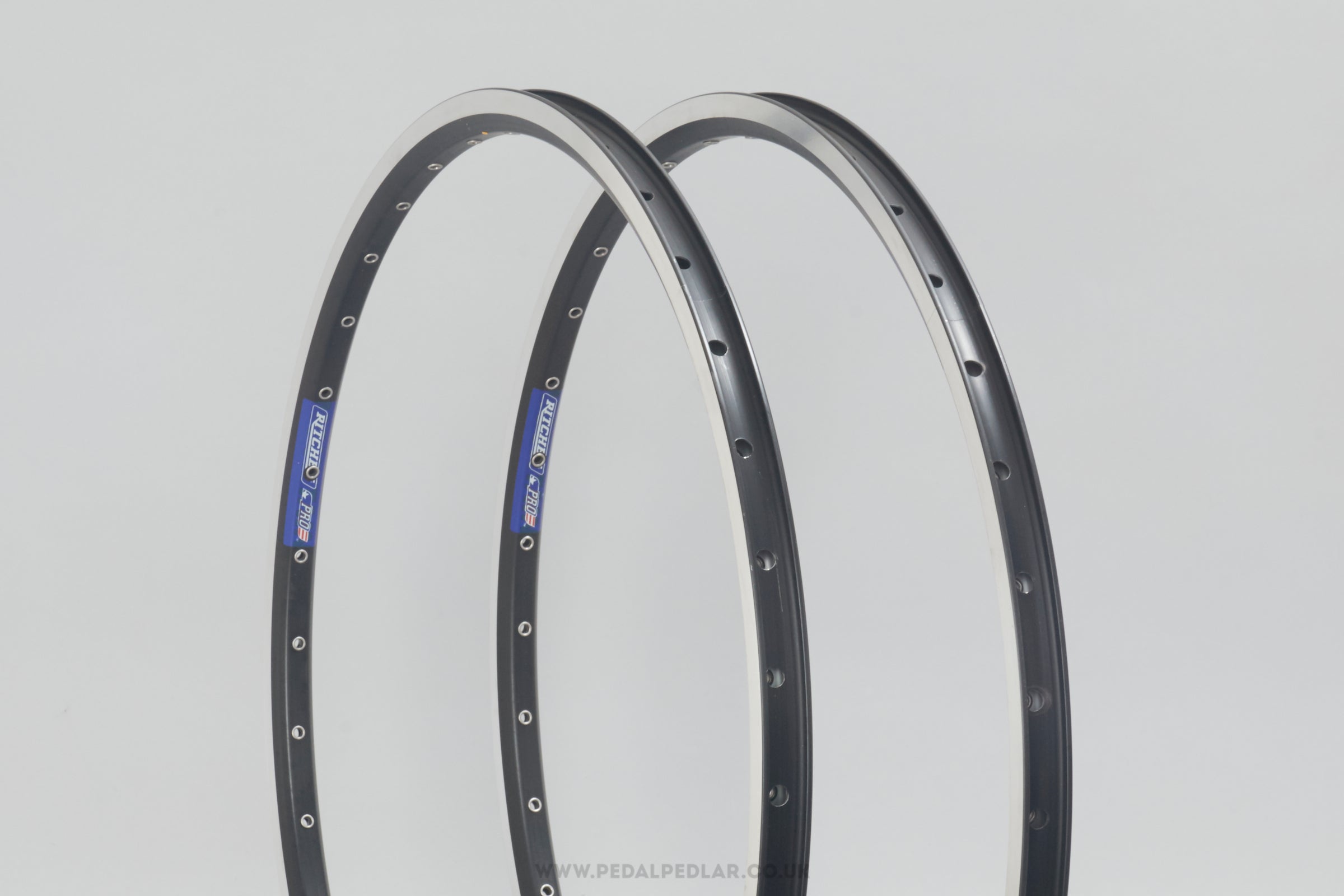


Ritchey Girder Pro Black NOS Classic 36h 26" Clincher Rims
£56.25 £75.00
✓ Original pair of rims - produced in the 1990s
✓ New old stock! Still unused after all these years
✓ Worldwide shipping
Ritchey Girder Pro wheel rims, hailing from the United States and in production during the 1990s (yet still new & unused after all this time!). Made from aluminium and weighing in at 1090 grams (the weight and price displayed are for a pair of rims). A fine choice for keeping your classic bike authentic, but also great for any other compatible bike.
OVERVIEW
Production Era - 1990s
Country - American
Material - Aluminium
Weight - 1090 g
Stock Code - D-RP21C
*New old stock items may have marks from storage over the years, and as we often have multiples they can vary from piece to piece, but they are always genuine new & unused items.
TECHNICAL INFO
Drilling - 36 Hole
Rim Size - 26" Clincher
ISO Diameter - 559 mm (26")
Valve Type - Schraeder
Rim Width (OD) - 23 mm
Rim Height - 20.5 mm
-
▼SHIPPING, TAXES & RETURNS
-
We've been safely sending orders around the world since 2010. Orders are carefully packed, sent with tracking & insurance, and normally collected around midday on Tuesdays and Fridays. Larger items may occasionally require an extra day or two to prepare.
We accept returns, please notify us within 14 days and ensure the item arrives back with us no later than 30 days after the order was received.
EU orders under €150 (excluding shipping) - import VAT and the new €3 customs duty are paid as part of your order, so there's nothing further to pay on delivery.
EU orders over €150 (excluding shipping) - import fees are payable to the carrier before delivery, with nothing collected at checkout.
USA orders - import fees are collected at checkout for all orders to the USA, so there won’t be any surprise charges when your order arrives.
Other international orders - local import fees may apply and are not collected by us. Please check your country's import rules before purchasing.
-
▼HELP SECTION
-
Drilling - the number of holes for the spokes.
Rim Size - the sizing given by the manufacturer, these can be confusing so we also give the ISO diameter too for clarification.
ISO Diameter - the diameter of the rim at the point where the tyre is seated (bead seat diameter). This is a universal measurement, often displayed on tyres as 28-622 or similar, 28 referring to the tyre width and 622 being the ISO diameter in millimetres.
Valve Type - presta valves are the thin ones and Schrader are the fatter ones. Schrader valve holes will also accept the older Dunlop/Woods type valves.
Rim Width (OD) - the width of the rim, measured from the outside of one wall to the other.
Rim Height - the overall height of the rim, measured to the highest point of the rim’s profile.
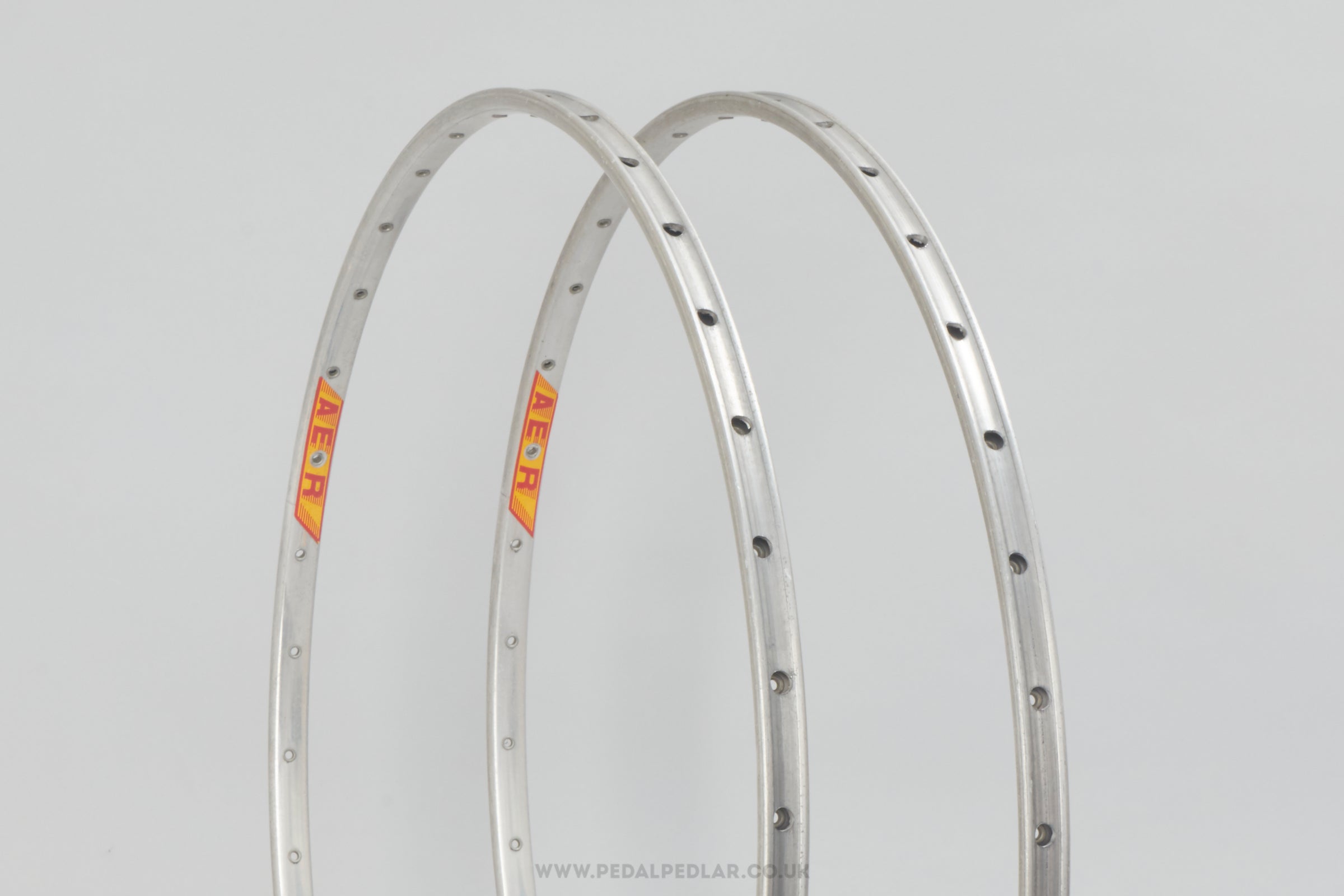


Martano AER Silver NOS Vintage 36h 28"/700c Tubular Rims
£86.25 £115.00
✓ Original pair of rims - in production from the 1970s to the 1980s
✓ New old stock! Still unused after all these years
✓ Lightweight for the era - just 915 grams
✓ Suitable for historic cycling events such as L'Eroica
✓ Worldwide shipping
Martano AER wheel rims, hailing from Italy and in production from the 1970s to the 1980s (yet still new & unused after all this time!). Made from aluminium and weighing in at 915 grams (the weight and price displayed are for a pair of rims) - pretty lightweight for a pair of rims at that time. A fine choice for keeping your vintage bike authentic, but also great for any other compatible bike.
If you're taking part in L'Eroica or a similar vintage event, these are fully compliant - so rest assured, the pre-1987 police won't lock you up for having the wrong rims!
OVERVIEW
Condition Notes - Valve holes are untidy from manufacture, some storage marks
Production Era - 1970s & 1980s
Country - Italian
Material - Aluminium
Weight - 915 g
Stock Code - D-RP20V
*New old stock items may have marks from storage over the years, and as we often have multiples they can vary from piece to piece, but they are always genuine new & unused items.
TECHNICAL INFO
Drilling - 36 Hole
Rim Size - 28"/700c Tubular
ISO Diameter - 622 mm (700c/28")
Valve Type - Presta
Rim Width (OD) - 21 mm
Rim Height - 12 mm
-
▼SHIPPING, TAXES & RETURNS
-
We've been safely sending orders around the world since 2010. Orders are carefully packed, sent with tracking & insurance, and normally collected around midday on Tuesdays and Fridays. Larger items may occasionally require an extra day or two to prepare.
We accept returns, please notify us within 14 days and ensure the item arrives back with us no later than 30 days after the order was received.
EU orders under €150 (excluding shipping) - import VAT and the new €3 customs duty are paid as part of your order, so there's nothing further to pay on delivery.
EU orders over €150 (excluding shipping) - import fees are payable to the carrier before delivery, with nothing collected at checkout.
USA orders - import fees are collected at checkout for all orders to the USA, so there won’t be any surprise charges when your order arrives.
Other international orders - local import fees may apply and are not collected by us. Please check your country's import rules before purchasing.
-
▼HELP SECTION
-
Drilling - the number of holes for the spokes.
Rim Size - the sizing given by the manufacturer, these can be confusing so we also give the ISO diameter too for clarification.
ISO Diameter - the diameter of the rim at the point where the tyre is seated (bead seat diameter). This is a universal measurement, often displayed on tyres as 28-622 or similar, 28 referring to the tyre width and 622 being the ISO diameter in millimetres.
Valve Type - presta valves are the thin ones and Schrader are the fatter ones. Schrader valve holes will also accept the older Dunlop/Woods type valves.
Rim Width (OD) - the width of the rim, measured from the outside of one wall to the other.
Rim Height - the overall height of the rim, measured to the highest point of the rim’s profile.
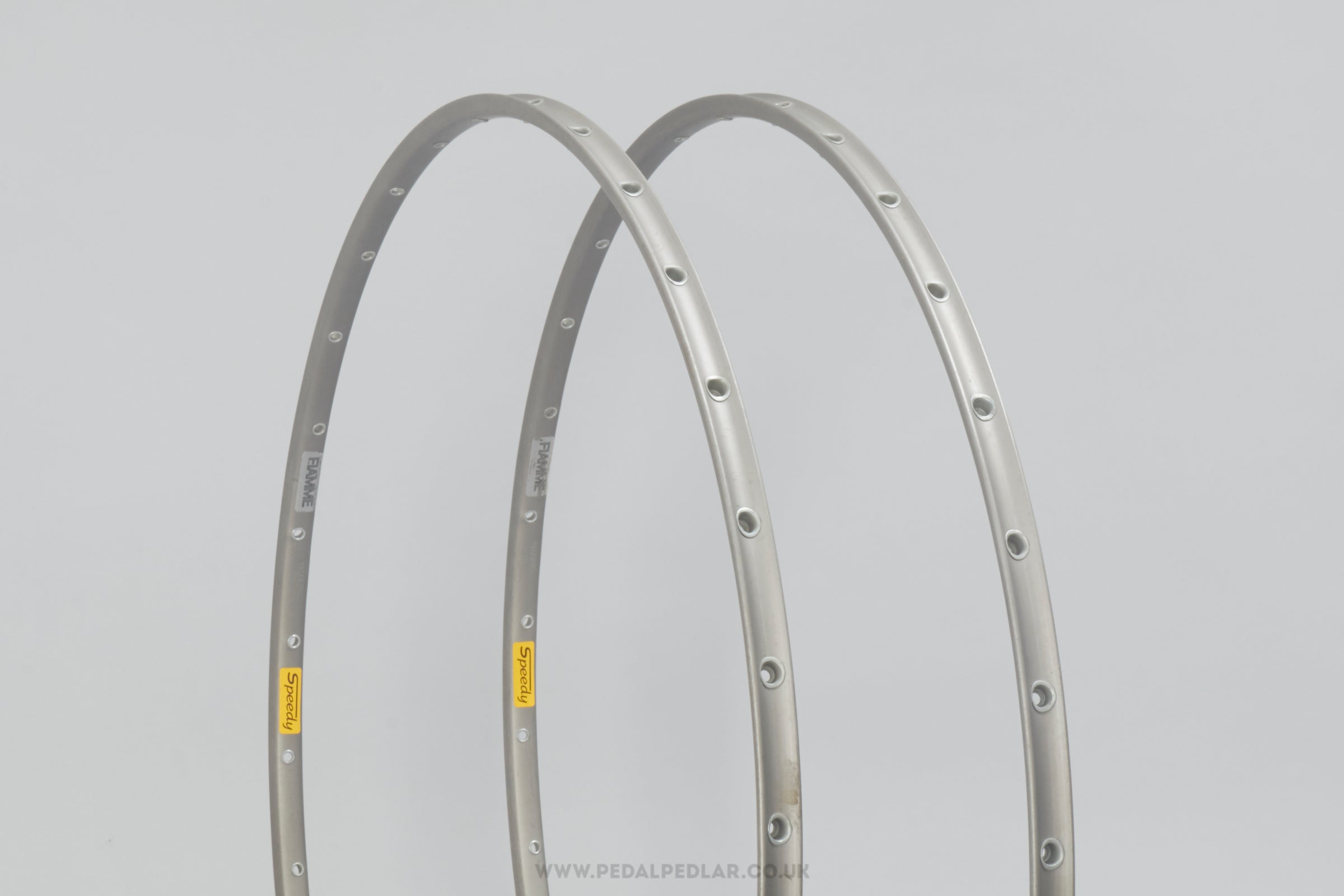


Fiamme Speedy Track Grey NOS Vintage 32h 28"/700c Tubular Rims
£93.75 £125.00
✓ Original pair of rims - produced in the 1980s
✓ New old stock! Still unused after all these years
✓ Super lightweight for the era - only 600 grams!
✓ Suitable for historic cycling events such as L'Eroica
✓ Worldwide shipping
Fiamme Speedy wheel rims, hailing from Italy and in production during the 1980s (yet still new & unused after all this time!). Made from aluminium and weighing in at 600 grams (the weight and price displayed are for a pair of rims) - incredibly lightweight for a pair of rims at that time. A fine choice for keeping your vintage bike authentic, but also great for any other compatible bike.
If you're taking part in L'Eroica or a similar vintage event, these are fully compliant - so rest assured, the pre-1987 police won't lock you up for having the wrong rims!
OVERVIEW
Condition Notes - Some storage marks
Production Era - 1980s
Country - Italian
Material - Aluminium
Weight - 600 g
Stock Code - D-RP16V
*New old stock items may have marks from storage over the years, and as we often have multiples they can vary from piece to piece, but they are always genuine new & unused items.
TECHNICAL INFO
Drilling - 32 Hole
Rim Size - 28"/700c Tubular
ISO Diameter - 622 mm (700c/28")
Valve Type - Presta
Rim Width (OD) - 18.5 mm
Rim Height - 11 mm
-
▼SHIPPING, TAXES & RETURNS
-
We've been safely sending orders around the world since 2010. Orders are carefully packed, sent with tracking & insurance, and normally collected around midday on Tuesdays and Fridays. Larger items may occasionally require an extra day or two to prepare.
We accept returns, please notify us within 14 days and ensure the item arrives back with us no later than 30 days after the order was received.
EU orders under €150 (excluding shipping) - import VAT and the new €3 customs duty are paid as part of your order, so there's nothing further to pay on delivery.
EU orders over €150 (excluding shipping) - import fees are payable to the carrier before delivery, with nothing collected at checkout.
USA orders - import fees are collected at checkout for all orders to the USA, so there won’t be any surprise charges when your order arrives.
Other international orders - local import fees may apply and are not collected by us. Please check your country's import rules before purchasing.
-
▼HELP SECTION
-
Drilling - the number of holes for the spokes.
Rim Size - the sizing given by the manufacturer, these can be confusing so we also give the ISO diameter too for clarification.
ISO Diameter - the diameter of the rim at the point where the tyre is seated (bead seat diameter). This is a universal measurement, often displayed on tyres as 28-622 or similar, 28 referring to the tyre width and 622 being the ISO diameter in millimetres.
Valve Type - presta valves are the thin ones and Schrader are the fatter ones. Schrader valve holes will also accept the older Dunlop/Woods type valves.
Rim Width (OD) - the width of the rim, measured from the outside of one wall to the other.
Rim Height - the overall height of the rim, measured to the highest point of the rim’s profile.