
test


Vintage Titanium O.M.A.S. Big Sliding Type English 112 mm Bottom Bracket
£103.50 £115.00
✓ Original part - in production from the 1970s to the 1980s
✓ Professionally checked & cleaned
✓ Worldwide shipping
Unbranded vintage Titanium bottom bracket (or BB for short), most likely in production from the 1970s to the 1980s. Made from titanium/aluminium and weighing in at 149 grams - incredibly lightweight for a BB at that time. A fine choice for keeping your vintage bike authentic, but also great for any other compatible bike.
The bottom bracket's been carefully cleaned, thoroughly checked by one of our mechanics and graded as mint condition, but do take a good look at the detailed photos so you can see the cosmetic condition before you buy.OVERVIEW
Condition Notes - Used cups and axle with new sealed bearing units
Production Era - 1970s & 1980s
Material - Titanium / Aluminium
Weight - 149 g
Stock Code - U-BB169V
NB - Almost identical to the O.M.A.S. Big Sliding but without any markings to confirm maker
TECHNICAL INFO
Thread Type - English Thread (British/ISO 1.37" x 24 TPI)
Axle Length - 112 mm
Axle Type - Square Taper
-
▼SHIPPING, TAXES & RETURNS
-
We've been safely sending orders around the world since 2010. Orders are carefully packed, sent with tracking & insurance, and normally collected around midday on Tuesdays and Fridays. Larger items may occasionally require an extra day or two to prepare.
We accept returns, please notify us within 14 days and ensure the item arrives back with us no later than 30 days after the order was received.
EU orders under €150 (excluding shipping) - import VAT and the new €3 customs duty are paid as part of your order, so there's nothing further to pay on delivery.
EU orders over €150 (excluding shipping) - import fees are payable to the carrier before delivery, with nothing collected at checkout.
USA orders - import fees are collected at checkout for all orders to the USA, so there won’t be any surprise charges when your order arrives.
Other international orders - local import fees may apply and are not collected by us. Please check your country's import rules before purchasing.
-
▼HELP SECTION
-
Thread Type - this must match the bottom bracket thread on your frame. The 3 common thread types on classic and vintage bikes are English (also known as British or ISO), Italian & French, and are usually (not always!) found on frames built in their respective countries. If you're replacing a bottom bracket the cups should have the thread type stamped on one of them, if not there are a couple of things to look at; bottom bracket shell width (English & French = 68 mm, Italian = 70 mm) & drive side cup thread direction (English = left, Italian & French = right). The only curveball to watch out for here, although pretty uncommon, are Swiss threads (also found on some French frames, Motobecanes being one) which will have the same shell width & thread direction as an English thread frame but the actual thread pitch will be different. If none of the above matches what you have, there are a few lesser known varieties that will require some further research.
Axle Length - your crankset dictates the axle length you need and the recommendation should be used to avoid issues with chainline. If you're replacing a bottom bracket that works perfectly then this can be matched, otherwise you'll need to check the manufacturers spec, a good resource for older bikes is Velobase.
Axle Type - you can tell which type of axle you need by looking at the shape of the bottom bracket hole in your crankset. For square tapers, the ISO introduced a standard for European makers in the early 90s, JIS then did the same in Asia. Before then it was not so simple, and although there is a degree of interchangeability, the best way to make sure you have the right axle is to stick to the same brand from the same era, ideally the proprietary model.


Vintage 2-Bolt Clunker MTB 90 mm 1" Quill Stem
£28.50 £30.00
✓ Original part - produced in the 1980s
✓ Checked & cleaned
✓ Worldwide shipping
Unbranded vintage handlebar stem (or gooseneck if you prefer), most likely in production during the 1980s. Made from steel and weighing in at 583 grams. A fine choice for keeping your vintage bike authentic, but also great for any other compatible bike.
The stem's been carefully cleaned, thoroughly checked and graded as very good condition, but do take a good look at the detailed photos so you can see the cosmetic condition before you buy.OVERVIEW
Production Era - 1980s
Material - Steel
Weight - 583 g
Stock Code - U-G1-ST242V
TECHNICAL INFO
Extension Length (ctc)* - 90 mm
Quill Size - 1"
Steerer Size (ID) - 22.2 mm (Standard)
Total Shaft Height - 190 mm
Clamp Size - 22.2 mm
*See help section.
-
▼SHIPPING, TAXES & RETURNS
-
We've been safely sending orders around the world since 2010. Orders are carefully packed, sent with tracking & insurance, and normally collected around midday on Tuesdays and Fridays. Larger items may occasionally require an extra day or two to prepare.
We accept returns, please notify us within 14 days and ensure the item arrives back with us no later than 30 days after the order was received.
EU orders under €150 (excluding shipping) - import VAT and the new €3 customs duty are paid as part of your order, so there's nothing further to pay on delivery.
EU orders over €150 (excluding shipping) - import fees are payable to the carrier before delivery, with nothing collected at checkout.
USA orders - import fees are collected at checkout for all orders to the USA, so there won’t be any surprise charges when your order arrives.
Other international orders - local import fees may apply and are not collected by us. Please check your country's import rules before purchasing.
-
▼SAFETY & COMPLIANCE
- This product complies with the EU General Product Safety Regulation (GPSR). Professional installation and regular inspections are strongly recommended. Due to the product's age, extra care should be taken during use.
EU Authorised Representative - Global Trade Department NI Ltd, Office 834, Unit 6, 100 Lisburn Road, Belfast BT9 6AG, Northern Ireland
-
▼HELP SECTION
-
Extension Length (ctc)* - we measure from the centre of the handlebar clamp to the centre of the shaft, to the point where the stem bolt passes through, to the nearest 5 mm. We always take this measurement in a straight line through middle of the extension, not along the top. In some cases the stem may be stamped with a different extension length as some manufacturers measured differently, but we always use our own measurement for consitency.
Quill Size - the most common size for classic and vintage road bikes is 1", this should be the same as the outside diameter of your fork's steerer column. Oversized steerers found on mountain bikes and later road bikes will be either 1 1/8" or 1 1/4".
Steerer Size (ID) - this is the most important measurement when checking the stem fits your bike. This should match the measurement of the inside of your fork's steerer column, where the stem will be inserted. The standard size for road quill stems was 22.2 mm, or 22.0 mm in France until the 1980s.
Total Shaft Height - measured from the top where the expander bolt head sits, to the bottom of the stem's shaft. To give you an idea of how high the stem can be set, there should be an absolute minimum of 50 mm inserted into the fork steerer, although most stems come with a 'minimum insertion line' to help with this.
Clamp Size - this should match the outside diameter of your handlebars and should be as close as possible to ensure a good and safe fit.
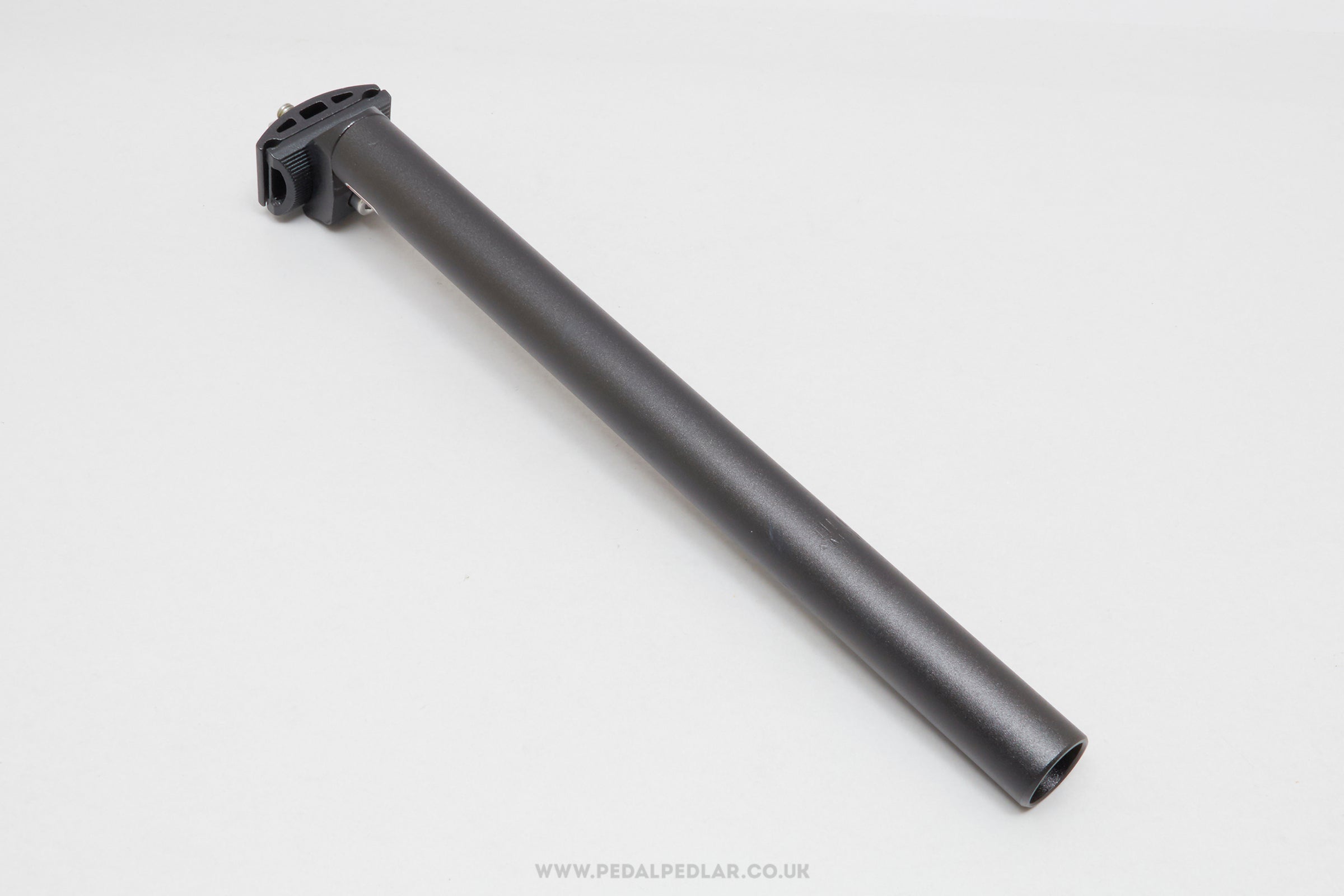


Classic Black Alloy NOS 27.2 mm Seatpost
£22.50 £25.00
✓ Original part - produced in the 2000s
✓ New old stock! Still unused after all these years
✓ Worldwide shipping
Unbranded classic seatpost (or seat pin if you prefer), most likely in production during the 2000s. Made from aluminium and weighing in at 288 grams - pretty lightweight for seatposts at that time. A fine choice for keeping your classic bike authentic, but also great for any other compatible bike.
Please note: Once inserted into a frame this cannot be returned, so please make sure to double check the diameter is correct before installing.OVERVIEW
Production Era - 2000s
Material - Aluminium
Weight - 288 g
Stock Code - D-G3-SP214C
*New old stock items may have marks from storage over the years, and as we often have multiples they can vary from piece to piece, but they are always genuine new & unused items.
TECHNICAL INFO
Seatpost Diameter - 27.2 mm
Length (Centre of Rails to Base) - 350 mm
-
▼SHIPPING, TAXES & RETURNS
-
We've been safely sending orders around the world since 2010. Orders are carefully packed, sent with tracking & insurance, and normally collected around midday on Tuesdays and Fridays. Larger items may occasionally require an extra day or two to prepare.
We accept returns, please notify us within 14 days and ensure the item arrives back with us no later than 30 days after the order was received.
EU orders under €150 (excluding shipping) - import VAT and the new €3 customs duty are paid as part of your order, so there's nothing further to pay on delivery.
EU orders over €150 (excluding shipping) - import fees are payable to the carrier before delivery, with nothing collected at checkout.
USA orders - import fees are collected at checkout for all orders to the USA, so there won’t be any surprise charges when your order arrives.
Other international orders - local import fees may apply and are not collected by us. Please check your country's import rules before purchasing.
-
▼SAFETY & COMPLIANCE
- This product complies with the EU General Product Safety Regulation (GPSR). Professional installation and regular inspections are recommended. Due to the product's age, extra care should be taken during use.
EU Authorised Representative - Global Trade Department NI Ltd, Office 834, Unit 6, 100 Lisburn Road, Belfast BT9 6AG, Northern Ireland
-
▼HELP SECTION
-
Seatpost Diameter - this needs to match the internal diameter of your frame’s seat tube closely, it should be possible to insert the seatpost without force but the fit should be tight enough so it doesn’t just drop in, with no play once inserted. If you have a post that fits the measurement should be stamped somewhere near the bottom, if not you’ll need to measure with a caliper or seatpost sizing tool as the sizes go up in 0.2 mm increments.
Length (Centre of Rails to Base) - measured from where the centre of the saddle rails will sit once installed, all the way to the bottom of the seatpost. Normally there’s a mark to tell you how much of the seatpost needs to be inserted in the frame, however this isn’t always the case so we’d recommend allowing a minimum of 6 cm.


Vintage Early TA Style NOS Steel Black Bottle Cage
£15.75 £17.50
✓ Original bottle cage - in production from the 1970s to the 1980s
✓ New old stock! Still unused after all these years
✓ Suitable for historic cycling events such as L'Eroica
✓ Worldwide shipping
Vintage water bottle cage (or bidon holder if you prefer), most likely in production from the 1970s to the 1980s (yet still new & unused after all this time). Made from steel/plastic and weighing in at 60 grams (the weight and price displayed are for one cage, if we have more in stock you'll be able to add them to your basket). The perfect finishing touch for your vintage bike, but great for bikes of the non-vintage variety too!
If you're taking part in L'Eroica or a similar vintage event, this is of the correct era, so rest assured the pre-1987 police won't lock you up for having the wrong bottle carrier!
OVERVIEW
Production Era - 1970s & 1980s
Material - Steel / Plastic
Weight - 60 g
Stock Code - D-G6-CAG158V
*New old stock items may have marks from storage over the years, and as we often have multiples they can vary from piece to piece, but they are always genuine new & unused items.
TECHNICAL INFO
Cage Fixing - Frame Fit (Braze-On)
Colour* - Black
Bottle Fit - Standard
*The colour description is just a guide, please check the photos too as we make sure these are as close to the true colour as possible.
-
▼SHIPPING, TAXES & RETURNS
-
We've been safely sending orders around the world since 2010. Orders are carefully packed, sent with tracking & insurance, and normally collected around midday on Tuesdays and Fridays. Larger items may occasionally require an extra day or two to prepare.
We accept returns, please notify us within 14 days and ensure the item arrives back with us no later than 30 days after the order was received.
EU orders under €150 (excluding shipping) - import VAT and the new €3 customs duty are paid as part of your order, so there's nothing further to pay on delivery.
EU orders over €150 (excluding shipping) - import fees are payable to the carrier before delivery, with nothing collected at checkout.
USA orders - import fees are collected at checkout for all orders to the USA, so there won’t be any surprise charges when your order arrives.
Other international orders - local import fees may apply and are not collected by us. Please check your country's import rules before purchasing.
-
▼SAFETY & COMPLIANCE
- This product complies with the EU General Product Safety Regulation (GPSR).
EU Authorised Representative - Global Trade Department NI Ltd, Office 834, Unit 6, 100 Lisburn Road, Belfast BT9 6AG, Northern Ireland
-
▼HELP SECTION
-
Cage Fixing - most bottle cages will be designed to fix to the frame, although some rare older ones mount to the handlebars and/or stem. If your frame doesn't have any bottle cage braze-ons to fix to you'll need a clamp-on bottle cage.
Bottle Fit - almost all cycling bottles measure between 70 - 75 mm in diameter so this is the standard bottle cage size, the only rather rare exceptions are some old Elite bottles that require a 66 mm cage, the more recent oversized ones and of course the funny shaped aero ones that only accept the bottle they were made for.