
30% Off All Items


Campagnolo Nuovo/Super Record (649) NOS/NIB Vintage Top Tube Brake Cable Guides / Housing Clips Set
£35.00
✓ Original parts - in production from the 1960s to the 1980s
✓ New old stock & still in the original packaging!
✓ Suitable for historic cycling events such as L'Eroica
✓ Worldwide shipping
Campagnolo Nuovo/Super Record top tube cable guides, hailing from Italy and in production from the 1960s to the 1980s (yet still new & unused after all this time!). Made from steel and weighing in at 12 grams. A fine choice for keeping your vintage bike authentic, but also great for any other compatible bike too.
If you're taking part in L'Eroica or any other vintage event, this is fully compliant - so rest assured, the pre-1987 police won't lock you up for having the wrong cable guides!
OVERVIEW
Model ID - 649
Production Era - 1960s - 1980s
Country - Italian
Material - Steel
Weight - 12 g
Stock Code - D-CGT16V
*New old stock items may have marks from storage over the years, and as we often have multiples they can vary from piece to piece, but they are always genuine new & unused items.
TECHNICAL INFO
Tube Diameter - 25.4 mm (Standard Steel Frame)
Number of Cables - Single
-
▼SHIPPING, TAXES & RETURNS
-
We've been safely sending orders around the world since 2010. Orders are carefully packed, sent with tracking & insurance, and normally collected around midday on Tuesdays and Fridays. Larger items may occasionally require an extra day or two to prepare.
We accept returns, please notify us within 14 days and ensure the item arrives back with us no later than 30 days after the order was received.
EU orders under €150 (excluding shipping) - import VAT and the new €3 customs duty are paid as part of your order, so there's nothing further to pay on delivery.
EU orders over €150 (excluding shipping) - import fees are payable to the carrier before delivery, with nothing collected at checkout.
USA orders - import fees are collected at checkout for all orders to the USA, so there won’t be any surprise charges when your order arrives.
Other international orders - local import fees may apply and are not collected by us. Please check your country's import rules before purchasing.
-
▼HELP SECTION
-
Tube Diameter - most steel frames will have a top tube with an outside diameter of 25.4 mm, this was standard for a long time but there are 'oversized' tubes that have a diameter of 28.6 mm. Most aluminium frames will have larger 31.8 mm tubes, the exception being earlier ones with lugged construction that have 25.4 mm tubes.
Number of Cables - the number of cables the guides are designed to accept.


Campagnolo Veloce (FC-VL242) 10 Speed NOS/NIB Classic 42T 135 BCD Inner Chainring
£49.50 £55.00
✓ Original part - produced in the 2000s
✓ New old stock & still in the original packaging!
✓ Worldwide shipping
Campagnolo Veloce chainring, hailing from Italy and in production during the 2000s. Made from aluminium and weighing in at 49 grams. A fine choice for keeping your classic bike authentic, but also great for any other compatible bike too.
OVERVIEW
Model ID - FC-VL242
Production Era - 2000s
Country - Italian
Material - Aluminium
Weight - 49 g
Stock Code - D-CRI38C
*New old stock items may have marks from storage over the years, and as we often have multiples they can vary from piece to piece, but they are always genuine new & unused items.
TECHNICAL INFO
Tooth Count - 42
Between Adjacent Bolt Holes - 79.4 mm
BCD - 135 BCD
Bolt Count - 5-Bolt
Chain Width - 3/32" (Standard)
Intended Speed* - 10 Speed
-
▼SHIPPING, TAXES & RETURNS
-
We've been safely sending orders around the world since 2010. Orders are carefully packed, sent with tracking & insurance, and normally collected around midday on Tuesdays and Fridays. Larger items may occasionally require an extra day or two to prepare.
We accept returns, please notify us within 14 days and ensure the item arrives back with us no later than 30 days after the order was received.
EU orders under €150 (excluding shipping) - import VAT and the new €3 customs duty are paid as part of your order, so there's nothing further to pay on delivery.
EU orders over €150 (excluding shipping) - import fees are payable to the carrier before delivery, with nothing collected at checkout.
USA orders - import fees are collected at checkout for all orders to the USA, so there won’t be any surprise charges when your order arrives.
Other international orders - local import fees may apply and are not collected by us. Please check your country's import rules before purchasing.
-
▼HELP SECTION
-
Tooth Count - the number of teeth on the chainring, the higher the number the harder the gear.
Between Adjacent Bolt Holes - the measurement from the centre of any bolt hole to the centre of an adjacent one, if this measurement is the same as that of your crankset and the bolt count is the same then the chainring should fit.
BCD - stands for Bolt Circle Diameter (sometimes referred to as PCD - Pitch Circle Diameter) and is the technical way to determine whether the chainring fits your crankset. To calculate, multiply the distance between adjacent holes (in mm) by 1.709 (you’ll likely need to round the resulting number up or down a little).
Bolt Count - the number of bolts securing the chainring to the chainset. As with the BCD, this must be the same as your chainset.
Chain Width - 3/32” is the standard width for double and triple chainsets, wherease 1/8” chainrings are only found on single ring chainsets, generally for track / singlespeed use and can only be used with a wide 1/8" chain.
Intended Speed - the number of cogs at the back the chainring was designed to be used with. We refer to it as ‘intended’ speed as most double and triple chainsets will actually work with different speeds than originally intended, but the further away you get from the intended speed the more likely you are to experience minor setup issues. The exception being some chainrings intended for 10 speed use or higher, with these it’s better to stick to the intended speed.


Ritchey Rizer Pro 2014 Alloy Double Butted Black NOS Classic 670 mm Riser Handlebars
£40.00
✓ Original bars - produced in the 2000s
✓ New old stock! Still unused after all these years
✓ Worldwide shipping
Ritchey Rizer Pro handlebars, hailing from the United States and in production during the 2000s . Made from aluminium and weighing in at 303 grams. A fine choice for keeping your classic bike authentic, but also great for any other compatible bike too.
OVERVIEW
Production Era - 2000s
Country - American
Material - Aluminium
Weight - 303 g
Stock Code - D-HBF6C
*New old stock items may have marks from storage over the years, and as we often have multiples they can vary from piece to piece, but they are always genuine new & unused items.
TECHNICAL INFO
Width (outside to outside) - 670 mm
Bar Type - Riser
Clamp Size - 25.4 mm
Grip Diameter - 22.2 mm
Rise/Drop (ctc at ends) - 45 mm
-
▼SHIPPING, TAXES & RETURNS
-
We've been safely sending orders around the world since 2010. Orders are carefully packed, sent with tracking & insurance, and normally collected around midday on Tuesdays and Fridays. Larger items may occasionally require an extra day or two to prepare.
We accept returns, please notify us within 14 days and ensure the item arrives back with us no later than 30 days after the order was received.
EU orders under €150 (excluding shipping) - import VAT and the new €3 customs duty are paid as part of your order, so there's nothing further to pay on delivery.
EU orders over €150 (excluding shipping) - import fees are payable to the carrier before delivery, with nothing collected at checkout.
USA orders - import fees are collected at checkout for all orders to the USA, so there won’t be any surprise charges when your order arrives.
Other international orders - local import fees may apply and are not collected by us. Please check your country's import rules before purchasing.
-
▼HELP SECTION
-
Width - the total width at its widest point, from end to end, rounded to the nearest 5 mm.
Clamp Size - this should match the internal diameter of your handlebar stem clamp, and should be as close as possible to ensure a good and safe fit.
Grip Diameter - the outside diameter of the area where handlebar grips are fitted, this determines not only what grips will fit but brake levers too so it's important to check if you have a specific setup in mind.
Rise/Drop - we measure this at the end of the bars, from the centre point of the clamp area to the centre of the end. This measurent can change when the bar is rotated so there is a bit of tolerance here, please use this as an approximate measurement only.


Tiger NOS Vintage 3 Speed 16-22 Freewheel
£40.50 £45.00
✓ Original part - produced in the 1970s
✓ New old stock! Still unused after all these years
✓ Suitable for historic cycling events such as L'Eroica
✓ Worldwide shipping
Tiger freewheel, hailing from the United Kingdom and in production during the 1970s (yet still new & unused after all this time!). Made from steel and weighing in at 299 grams. A fine choice for keeping your vintage bike authentic, but also great for any other compatible bike too.
If you're taking part in L'Eroica or a similar vintage event, this is fully compliant - so rest assured, the pre-1987 police won't lock you up for having the wrong freewheel!
OVERVIEW
Production Era - 1970s
Country - United Kingdom
Material - Steel
Weight - 299 g
Stock Code - D-FW55V
*New old stock items may have marks from storage over the years, and as we often have multiples they can vary from piece to piece, but they are always genuine new & unused items.
TECHNICAL INFO
Speed - 3 Speed
Range - 16-22
Threading - English/ISO: 1.375 x 24 TPI
Stack Height - 18 mm
Chain Width - 1/8"
-
▼SHIPPING, TAXES & RETURNS
-
We've been safely sending orders around the world since 2010. Orders are carefully packed, sent with tracking & insurance, and normally collected around midday on Tuesdays and Fridays. Larger items may occasionally require an extra day or two to prepare.
We accept returns, please notify us within 14 days and ensure the item arrives back with us no later than 30 days after the order was received.
EU orders under €150 (excluding shipping) - import VAT and the new €3 customs duty are paid as part of your order, so there's nothing further to pay on delivery.
EU orders over €150 (excluding shipping) - import fees are payable to the carrier before delivery, with nothing collected at checkout.
USA orders - import fees are collected at checkout for all orders to the USA, so there won’t be any surprise charges when your order arrives.
Other international orders - local import fees may apply and are not collected by us. Please check your country's import rules before purchasing.

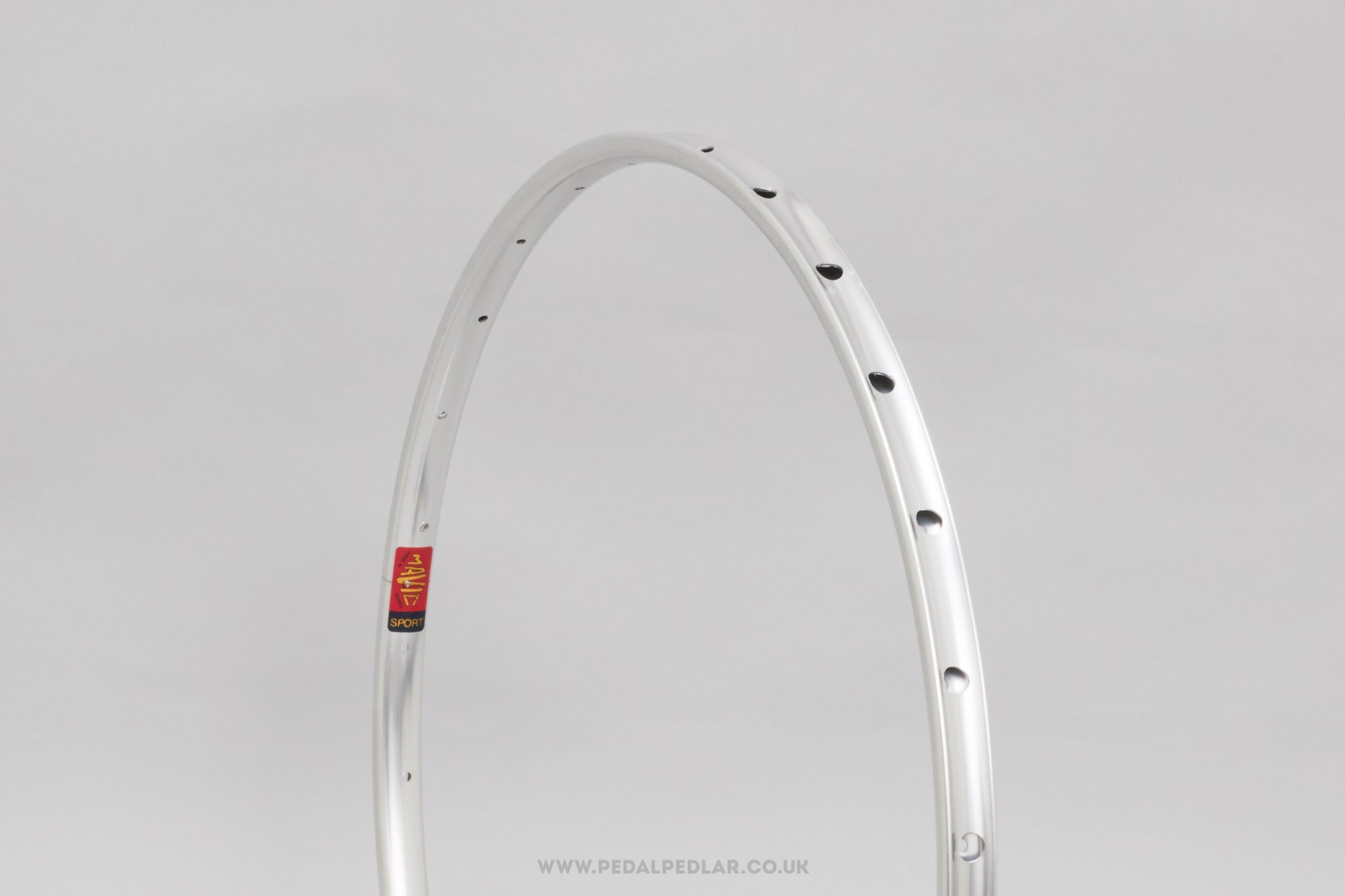


Mavic Sport NOS Vintage 28h 24"/600c Tubular Rim
£26.25 £35.00
✓ Original part - produced in the 1970s
✓ New old stock! Still unused after all these years
✓ Super lightweight for the era - only 290 grams!
✓ Worldwide shipping
Mavic Sport rim, hailing from France and in production during the 1970s (yet still new & unused after all this time!). Made from aluminium and weighing in at 290 grams - incredibly lightweight for a rim at that time. A fine choice for keeping your vintage bike authentic, but also great for any other compatible bike too.
OVERVIEW
Production Era - 1970s
Country - French
Material - Aluminium
Weight - 290 grams
Stock Code - D-RS48V
*New old stock items may have marks from storage over the years, and as we often have multiples they can vary from piece to piece, but they are always genuine new & unused items.
TECHNICAL INFO
Drilling - 28 Hole
Rim Size - 24"/600c Tubular
ISO Diameter - 520 mm
Valve Type - Presta
Rim Width (OD) - 21 mm
Rim Height - 12 mm
-
▼SHIPPING, TAXES & RETURNS
-
We've been safely sending orders around the world since 2010. Orders are carefully packed, sent with tracking & insurance, and normally collected around midday on Tuesdays and Fridays. Larger items may occasionally require an extra day or two to prepare.
We accept returns, please notify us within 14 days and ensure the item arrives back with us no later than 30 days after the order was received.
EU orders under €150 (excluding shipping) - import VAT and the new €3 customs duty are paid as part of your order, so there's nothing further to pay on delivery.
EU orders over €150 (excluding shipping) - import fees are payable to the carrier before delivery, with nothing collected at checkout.
USA orders - import fees are collected at checkout for all orders to the USA, so there won’t be any surprise charges when your order arrives.
Other international orders - local import fees may apply and are not collected by us. Please check your country's import rules before purchasing.


Dia-Compe Blaze NOS Vintage Brake Calipers
£36.00 £40.00
✓ Original parts - produced in the 1980s
✓ New old stock! Still unused after all these years
✓ Lightweight for the era - just 305 grams
✓ Worldwide shipping
Dia-Compe Blaze brake calipers, hailing from Japan and in production during the 1980s (yet still new & unused after all this time!). Made from aluminium and weighing in at 305 grams - pretty lightweight for a pair of brake calipers at that time. A fine choice for keeping your vintage bike authentic, but also great for any other compatible bike too.
OVERVIEW
Production Era - 1980s
Country - Japanese
Material - Aluminium
Weight - 305 g
Stock Code - D-CP119V
*New old stock items may have marks from storage over the years, and as we often have multiples they can vary from piece to piece, but they are always genuine new & unused items.
TECHNICAL INFO
Caliper Type - Single Pivot (Side Pull)
Front Brake Drop - 40 mm - 52 mm
Rear Brake Drop - 40 mm - 52 mm
Brake Fixing - Recessed Allen Key
-
▼SHIPPING, TAXES & RETURNS
-
We've been safely sending orders around the world since 2010. Orders are carefully packed, sent with tracking & insurance, and normally collected around midday on Tuesdays and Fridays. Larger items may occasionally require an extra day or two to prepare.
We accept returns, please notify us within 14 days and ensure the item arrives back with us no later than 30 days after the order was received.
EU orders under €150 (excluding shipping) - import VAT and the new €3 customs duty are paid as part of your order, so there's nothing further to pay on delivery.
EU orders over €150 (excluding shipping) - import fees are payable to the carrier before delivery, with nothing collected at checkout.
USA orders - import fees are collected at checkout for all orders to the USA, so there won’t be any surprise charges when your order arrives.
Other international orders - local import fees may apply and are not collected by us. Please check your country's import rules before purchasing.
-
▼HELP SECTION
-
Caliper Type - side pull calipers (single or dual pivot) require nothing more than a brake hole to fix them to as the cable feeds straight into one of the arms, whereas centre pull calipers require a brazed-on or fitted cable hanger to allow the cable to be pulled from the centre.
Brake Drop - measured from the centre of the brake mounting hole to the centre of the wheel rim in a straight line. Your measurement must be well within the range of the caliper's given brake drop to allow the brakes to have good contact with the rim's braking surface.
Brake Fixing - this refers to the way the brake is secured to the bike. For recessed allen key fixings the hole to the rear of the the fork crown/brake bridge should measure around 8mm, allowing the allen key head to be inserted and fixed to the brake bolt. External hex nut fixings require a hole of around 6mm, the hex nut is fixed to the protruding part of the brake bolt.
For a more detailed guide on getting the right brakes check out our journal.


Campagnolo Mirage (FC-MIB142) Triple Black NOS/NIB Classic 42T 135 BCD Middle Chainring
£46.75 £55.00
✓ Original part - produced in the 2000s
✓ New old stock & still in the original packaging!
✓ Lightweight for the era - just 46 grams
✓ Worldwide shipping
Campagnolo Mirage chainring, hailing from Italy and in production during the 2000s. Made from aluminium and weighing in at 46 grams - pretty lightweight for a middle chainring at that time. A fine choice for keeping your classic bike authentic, but also great for any other compatible bike too.
OVERVIEW
Model ID - FC-MIB142
Production Era - 2000s
Country - Italian
Material - Aluminium
Weight - 46 g
Stock Code - D-CRM7C
*New old stock items may have marks from storage over the years, and as we often have multiples they can vary from piece to piece, but they are always genuine new & unused items.
TECHNICAL INFO
Tooth Count - 42
Between Adjacent Bolt Holes - 79.4 mm
BCD - 135 BCD
Bolt Count - 5-Bolt
Chain Width - 3/32" (Standard)
Intended Speed* - 9 Speed
-
▼SHIPPING, TAXES & RETURNS
-
We've been safely sending orders around the world since 2010. Orders are carefully packed, sent with tracking & insurance, and normally collected around midday on Tuesdays and Fridays. Larger items may occasionally require an extra day or two to prepare.
We accept returns, please notify us within 14 days and ensure the item arrives back with us no later than 30 days after the order was received.
EU orders under €150 (excluding shipping) - import VAT and the new €3 customs duty are paid as part of your order, so there's nothing further to pay on delivery.
EU orders over €150 (excluding shipping) - import fees are payable to the carrier before delivery, with nothing collected at checkout.
USA orders - import fees are collected at checkout for all orders to the USA, so there won’t be any surprise charges when your order arrives.
Other international orders - local import fees may apply and are not collected by us. Please check your country's import rules before purchasing.
-
▼HELP SECTION
-
Tooth Count - the number of teeth on the chainring, the higher the number the harder the gear.
Between Adjacent Bolt Holes - the measurement from the centre of any bolt hole to the centre of an adjacent one, if this measurement is the same as that of your crankset and the bolt count is the same then the chainring should fit.
BCD - stands for Bolt Circle Diameter (sometimes referred to as PCD - Pitch Circle Diameter) and is the technical way to determine whether the chainring fits your crankset. To calculate, multiply the distance between adjacent holes (in mm) by 1.709 (you’ll likely need to round the resulting number up or down a little).
Bolt Count - the number of bolts securing the chainring to the chainset. As with the BCD, this must be the same as your chainset.
Chain Width - 3/32” is the standard width for double and triple chainsets, wherease 1/8” chainrings are only found on single ring chainsets, generally for track / singlespeed use and can only be used with a wide 1/8" chain.
Intended Speed - the number of cogs at the back the chainring was designed to be used with. We refer to it as ‘intended’ speed as most double and triple chainsets will actually work with different speeds than originally intended, but the further away you get from the intended speed the more likely you are to experience minor setup issues. The exception being some chainrings intended for 10 speed use or higher, with these it’s better to stick to the intended speed.


Simplex 3637 L Later Version NOS Vintage Stop & Demultiplicator Down Tube Gear Cable Guide / Clip
£38.25 £45.00
✓ Original part - produced in the 1970s
✓ New old stock! Still unused after all these years
✓ Suitable for historic cycling events such as L'Eroica
✓ Worldwide shipping
Simplex 3637 L down tube gear cable guide, hailing from France and in production during the 1970s (yet still new & unused after all this time!). Made from steel/plastic and weighing in at 26 grams. A fine choice for keeping your vintage bike authentic, but also great for any other compatible bike too.
If you're taking part in L'Eroica or any other vintage event, this is fully compliant - so rest assured, the pre-1987 police won't lock you up for having the wrong cable guide!
OVERVIEW
Production Era - 1970s
Country - French
Material - Steel / Plastic
Weight - 26 g
Stock Code - D-CGG35V
*New old stock items may have marks from storage over the years, and as we often have multiples they can vary from piece to piece, but they are always genuine new & unused items.
TECHNICAL INFO
Number of Cables - Double
Guide Type - Stop & Demultiplicator
Tube Diameter - 28.0 mm - 28.6 mm
-
▼SHIPPING, TAXES & RETURNS
-
We've been safely sending orders around the world since 2010. Orders are carefully packed, sent with tracking & insurance, and normally collected around midday on Tuesdays and Fridays. Larger items may occasionally require an extra day or two to prepare.
We accept returns, please notify us within 14 days and ensure the item arrives back with us no later than 30 days after the order was received.
EU orders under €150 (excluding shipping) - import VAT and the new €3 customs duty are paid as part of your order, so there's nothing further to pay on delivery.
EU orders over €150 (excluding shipping) - import fees are payable to the carrier before delivery, with nothing collected at checkout.
USA orders - import fees are collected at checkout for all orders to the USA, so there won’t be any surprise charges when your order arrives.
Other international orders - local import fees may apply and are not collected by us. Please check your country's import rules before purchasing.
-
▼HELP SECTION
-
Number of Cables - the number of cables the guide is designed to accept.
Guide Type - some setups require specific guides for the derailleurs to operate correctly. Tunnels simply act as a channel to guide the cable whereas stops create an end point for the cable housing, giving the cable the leverage it needs. Bar control stops are required when using handlebar shifters if your frame doesn't have any guides or braze-ons.
Tube Diameter - most steel (and early lugged aluminium) frames will have a down tube of 28.0 mm - 28.6 mm, this was standard for a long time but there are 'oversized' steel and aluminium tubes that have a diameter of 31.8, 34.9 and even 38.1 mm.


Shimano Light Action (PD-A550) NOS/NIB Classic Aero Road Pedals
£48.75 £65.00
✓ Original pedals - produced in the 1990s
✓ New old stock & still in the original packaging!
✓ Lightweight for the era - just 339 grams
✓ Worldwide shipping
Shimano Light Action pedals, hailing from Japan and in production during the 1990s (yet still new & unused after all this time!). Made from steel/aluminium and weighing in at 339 grams - pretty lightweight for pedals at that time. A fine choice for keeping your classic bike authentic, but also great for any other compatible bike too.
OVERVIEW
Bearing/Race Condition - New Old Stock*
Model ID - PD-A550
Production Era - 1990s
Country - Japanese
Material - Steel / Aluminium
Weight - 339 g
Stock Code - D-PD84C
NB - No hardware included, supplied as seen in photos.
*New old stock items may have marks from storage over the years, and as we often have multiples they can vary from piece to piece, but they are always genuine new & unused items.
TECHNICAL INFO
Pedal Type - Aero Road
Pedal Threads - Standard (9/16" x 20 TPI)
-
▼SHIPPING, TAXES & RETURNS
-
We've been safely sending orders around the world since 2010. Orders are carefully packed, sent with tracking & insurance, and normally collected around midday on Tuesdays and Fridays. Larger items may occasionally require an extra day or two to prepare.
We accept returns, please notify us within 14 days and ensure the item arrives back with us no later than 30 days after the order was received.
EU orders under €150 (excluding shipping) - import VAT and the new €3 customs duty are paid as part of your order, so there's nothing further to pay on delivery.
EU orders over €150 (excluding shipping) - import fees are payable to the carrier before delivery, with nothing collected at checkout.
USA orders - import fees are collected at checkout for all orders to the USA, so there won’t be any surprise charges when your order arrives.
Other international orders - local import fees may apply and are not collected by us. Please check your country's import rules before purchasing.
-
▼HELP SECTION
-
Pedal Type - this is just a guide to give you an idea of the pedal type, but any pedal can technically be used for any purpose. Track pedals are designed without the pointed 'quill' for safety though, so it's best to only use track pedals for this purpose. Most track pedals, along with quill & aero road pedals are designed to be used with toe clips & straps for best performance.
Pedal Threads - this must match the thread on your cranks. Sometimes it's stamped on the end of the crank arm, but most bikes use a standard thread of 9/16” x 20 tpi. The exceptions being older French bikes, bikes with cheaper one-piece type chainsets and Shimano’s Dyna Drive system (easily identifiable as the pedal holes are about an inch wide!).


Campagnolo Record 10 Speed Triple NOS Classic 30T 74 BCD Inner Chainring
£34.00 £40.00
✓ Original part - in production from the 1990s to the 2000s
✓ New old stock! Still unused after all these years
✓ Worldwide shipping
Campagnolo Record chainring, hailing from Italy and in production from the 1990s to the 2000s (yet still new & unused after all this time!). Made from aluminium and weighing in at 41 grams. A fine choice for keeping your classic bike authentic, but also great for any other compatible bike too.
OVERVIEW
Production Era - 1990s & 2000s
Country - Italian
Material - Aluminium
Weight - 41 g
Stock Code - D-CRI20C
*New old stock items may have marks from storage over the years, and as we often have multiples they can vary from piece to piece, but they are always genuine new & unused items.
TECHNICAL INFO
Tooth Count - 30
Between Adjacent Bolt Holes - 43.5 mm
BCD - 74 BCD
Bolt Count - 5-Bolt
Chain Width - 3/32" (Standard)
Intended Speed* - 10 Speed
-
▼SHIPPING, TAXES & RETURNS
-
We've been safely sending orders around the world since 2010. Orders are carefully packed, sent with tracking & insurance, and normally collected around midday on Tuesdays and Fridays. Larger items may occasionally require an extra day or two to prepare.
We accept returns, please notify us within 14 days and ensure the item arrives back with us no later than 30 days after the order was received.
EU orders under €150 (excluding shipping) - import VAT and the new €3 customs duty are paid as part of your order, so there's nothing further to pay on delivery.
EU orders over €150 (excluding shipping) - import fees are payable to the carrier before delivery, with nothing collected at checkout.
USA orders - import fees are collected at checkout for all orders to the USA, so there won’t be any surprise charges when your order arrives.
Other international orders - local import fees may apply and are not collected by us. Please check your country's import rules before purchasing.
-
▼HELP SECTION
-
Tooth Count - the number of teeth on the chainring, the higher the number the harder the gear.
Between Adjacent Bolt Holes - the measurement from the centre of any bolt hole to the centre of an adjacent one, if this measurement is the same as that of your crankset and the bolt count is the same then the chainring should fit.
BCD - stands for Bolt Circle Diameter (sometimes referred to as PCD - Pitch Circle Diameter) and is the technical way to determine whether the chainring fits your crankset. To calculate, multiply the distance between adjacent holes (in mm) by 1.709 (you’ll likely need to round the resulting number up or down a little).
Bolt Count - the number of bolts securing the chainring to the chainset. As with the BCD, this must be the same as your chainset.
Chain Width - 3/32” is the standard width for double and triple chainsets, wherease 1/8” chainrings are only found on single ring chainsets, generally for track / singlespeed use and can only be used with a wide 1/8" chain.
Intended Speed - the number of cogs at the back the chainring was designed to be used with. We refer to it as ‘intended’ speed as most double and triple chainsets will actually work with different speeds than originally intended, but the further away you get from the intended speed the more likely you are to experience minor setup issues. The exception being some chainrings intended for 10 speed use or higher, with these it’s better to stick to the intended speed.


Modolo O-Bone 6061 Alloy T6 Black NOS Classic 575 mm Flat/Straight Handlebars
£30.00 £40.00
✓ Original bars - produced in the 2000s
✓ New old stock! Still unused after all these years
✓ Worldwide shipping
Modolo O-Bone handlebars, hailing from Italy and in production during the 2000s . Made from aluminium and weighing in at 182 grams. A fine choice for keeping your classic bike authentic, but also great for any other compatible bike too.
OVERVIEW
Production Era - 2000s
Country - Italian
Material - Aluminium
Weight - 182 g
Stock Code - D-HBF7C
*New old stock items may have marks from storage over the years, and as we often have multiples they can vary from piece to piece, but they are always genuine new & unused items.
TECHNICAL INFO
Width (outside to outside) - 575 mm
Bar Type - Flat/Straight
Clamp Size - 25.4 mm
Grip Diameter - 22.2 mm
-
▼SHIPPING, TAXES & RETURNS
-
We've been safely sending orders around the world since 2010. Orders are carefully packed, sent with tracking & insurance, and normally collected around midday on Tuesdays and Fridays. Larger items may occasionally require an extra day or two to prepare.
We accept returns, please notify us within 14 days and ensure the item arrives back with us no later than 30 days after the order was received.
EU orders under €150 (excluding shipping) - import VAT and the new €3 customs duty are paid as part of your order, so there's nothing further to pay on delivery.
EU orders over €150 (excluding shipping) - import fees are payable to the carrier before delivery, with nothing collected at checkout.
USA orders - import fees are collected at checkout for all orders to the USA, so there won’t be any surprise charges when your order arrives.
Other international orders - local import fees may apply and are not collected by us. Please check your country's import rules before purchasing.
-
▼HELP SECTION
-
Width - the total width at its widest point, from end to end, rounded to the nearest 5 mm.
Clamp Size - this should match the internal diameter of your handlebar stem clamp, and should be as close as possible to ensure a good and safe fit.
Grip Diameter - the outside diameter of the area where handlebar grips are fitted, this determines not only what grips will fit but brake levers too so it's important to check if you have a specific setup in mind.
Rise/Drop - we measure this at the end of the bars, from the centre point of the clamp area to the centre of the end. This measurent can change when the bar is rotated so there is a bit of tolerance here, please use this as an approximate measurement only.


Campagnolo C-Record Adjustable NOS Size M Vintage Steel Toe Clips / Cages
£48.75 £65.00
✓ Original toe clips - produced in the 1980s
✓ New old stock! Still unused after all these years
✓ Suitable for historic cycling events such as L'Eroica
✓ Worldwide shipping
Campagnolo C-Record toe clips, hailing from Italy and in production during the 1980s (yet still new & unused after all this time!). Made from steel and weighing in at 76 grams. A fine choice for keeping your vintage bike authentic, but also great for any other compatible bike too.
If you're taking part in L'Eroica or any other vintage event, these are fully compliant - so rest assured, the pre-1987 police won't lock you up for having the wrong toe clips!
OVERVIEW
Size Guide** - M (Up to EU 42)
Condition - New Old Stock*
Production Era - 1980s
Material - Steel
Weight - 76 g
Stock Code - D-TC60V
*New old stock items may have marks from storage over the years, and as we often have multiples they can vary from piece to piece, but they are always genuine new & unused items.
**This is a guide based on traditional toe clip sizing for cycling shoes of the time, if you ride with chunkier shoes then we'd recommend going for a larger size. Please use this as a guide only and if possible use the length measurement provided to compare with toe clips you know fit well.
TECHNICAL INFO
Toe Clip Size - M
Pedal Fixing - Standard (Quill / Platform)
Toe Strap Type - Single Strap
Length (Fixing End to Toe End)* - 6 cm
Distance Between Fixing Bolts (ctc) - 25 mm
-
▼SHIPPING, TAXES & RETURNS
-
We've been safely sending orders around the world since 2010. Orders are carefully packed, sent with tracking & insurance, and normally collected around midday on Tuesdays and Fridays. Larger items may occasionally require an extra day or two to prepare.
We accept returns, please notify us within 14 days and ensure the item arrives back with us no later than 30 days after the order was received.
EU orders under €150 (excluding shipping) - import VAT and the new €3 customs duty are paid as part of your order, so there's nothing further to pay on delivery.
EU orders over €150 (excluding shipping) - import fees are payable to the carrier before delivery, with nothing collected at checkout.
USA orders - import fees are collected at checkout for all orders to the USA, so there won’t be any surprise charges when your order arrives.
Other international orders - local import fees may apply and are not collected by us. Please check your country's import rules before purchasing.
-
▼HELP SECTION
-
Pedal Fixing - 'standard' toe clips fix to the front of the pedals, most will be of this type and work with both quill & platform pedals providing they have mounting holes in the correct place. There are also 'aero' ones that attach to the top, and side fixing versions too. 'Wide platform' fixings are similar to standard ones but the fixing holes are almost 3 inches apart.
Toe Strap Type - most toe clips are designed to accept a single toe strap, but there are some less common ones that allow two toe straps to be fitted.
Length - this is measured from the fixing end to the toe end at the most extreme points, the same way the manufacturers measure and we use this to recommend the fit if there's no size stamped on them. All length measurements are rounded to the nearest 0.5 cm.
Distance Between Fixing Bolts - we measure this distance from the centre of one hole to the next (ctc), this usually only needs to be close, not exact, providing the holes on the toe clips are oblong shaped to allow a decent amount of wiggle room (most toe clips are made this way).


Strong w) Clamp NOS Vintage 26.8 mm Bullet Nose / Candlestick Seatpost
£28.13 £38.00
✓ Original part - produced in the 1980s
✓ New old stock! Still unused after all these years
✓ Suitable for historic cycling events such as L'Eroica
✓ Worldwide shipping
Strong seatpost, hailing from Japan and in production during the 1980s (yet still new & unused after all this time!). Made from aluminium/steel and weighing in at 217 grams. A fine choice for keeping your vintage bike authentic, but also great for any other compatible bike too.
If you're taking part in L'Eroica or a similar vintage event, this is fully compliant - so rest assured, the pre-1987 police won't lock you up for having the wrong seatpost!
OVERVIEW
Condition Notes - Some storage marks from over the years.
Production Era - 1980s
Country - Japanese
Material - Aluminium / Steel
Weight - 217 g
Stock Code - D-SPB4V
*New old stock items may have marks from storage over the years, and as we often have multiples they can vary from piece to piece, but they are always genuine new & unused items.
TECHNICAL INFO
Seatpost Diameter - 26.8 mm
Length (Top to Bottom) - 200 mm
-
▼SHIPPING, TAXES & RETURNS
-
We've been safely sending orders around the world since 2010. Orders are carefully packed, sent with tracking & insurance, and normally collected around midday on Tuesdays and Fridays. Larger items may occasionally require an extra day or two to prepare.
We accept returns, please notify us within 14 days and ensure the item arrives back with us no later than 30 days after the order was received.
EU orders under €150 (excluding shipping) - import VAT and the new €3 customs duty are paid as part of your order, so there's nothing further to pay on delivery.
EU orders over €150 (excluding shipping) - import fees are payable to the carrier before delivery, with nothing collected at checkout.
USA orders - import fees are collected at checkout for all orders to the USA, so there won’t be any surprise charges when your order arrives.
Other international orders - local import fees may apply and are not collected by us. Please check your country's import rules before purchasing.
-
▼HELP SECTION
-
Seatpost Diameter - this needs to match the internal diameter of your frame’s seat tube closely, it should be possible to insert the seatpost without force but the fit should be tight enough so it doesn’t just drop in, with no play once inserted. If you have a post that fits the measurement should be stamped somewhere near the bottom, if not you’ll need to measure with a caliper or seatpost sizing tool as the sizes go up in 0.2 mm increments.
Length (Top to Bottom) - measured from the top to the bottom of the seatpost. Normally there’s a mark to tell you how much of the seatpost needs to be inserted in the frame, however this isn’t always the case so we’d recommend allowing a minimum of 6 cm.


Strong w) Clamp NOS Vintage 27.0 mm Bullet Nose / Candlestick Seatpost
£28.13 £38.00
✓ Original part - produced in the 1980s
✓ New old stock! Still unused after all these years
✓ Suitable for historic cycling events such as L'Eroica
✓ Worldwide shipping
Strong seatpost, hailing from Japan and in production during the 1980s (yet still new & unused after all this time!). Made from aluminium/steel and weighing in at 217 grams. A fine choice for keeping your vintage bike authentic, but also great for any other compatible bike too.
If you're taking part in L'Eroica or a similar vintage event, this is fully compliant - so rest assured, the pre-1987 police won't lock you up for having the wrong seatpost!
OVERVIEW
Condition Notes - Some storage marks from over the years.
Production Era - 1980s
Country - Japanese
Material - Aluminium / Steel
Weight - 217 g
Stock Code - D-SPB5V
*New old stock items may have marks from storage over the years, and as we often have multiples they can vary from piece to piece, but they are always genuine new & unused items.
TECHNICAL INFO
Seatpost Diameter - 27.0 mm
Length (Top to Bottom) - 200 mm
-
▼SHIPPING, TAXES & RETURNS
-
We've been safely sending orders around the world since 2010. Orders are carefully packed, sent with tracking & insurance, and normally collected around midday on Tuesdays and Fridays. Larger items may occasionally require an extra day or two to prepare.
We accept returns, please notify us within 14 days and ensure the item arrives back with us no later than 30 days after the order was received.
EU orders under €150 (excluding shipping) - import VAT and the new €3 customs duty are paid as part of your order, so there's nothing further to pay on delivery.
EU orders over €150 (excluding shipping) - import fees are payable to the carrier before delivery, with nothing collected at checkout.
USA orders - import fees are collected at checkout for all orders to the USA, so there won’t be any surprise charges when your order arrives.
Other international orders - local import fees may apply and are not collected by us. Please check your country's import rules before purchasing.
-
▼HELP SECTION
-
Seatpost Diameter - this needs to match the internal diameter of your frame’s seat tube closely, it should be possible to insert the seatpost without force but the fit should be tight enough so it doesn’t just drop in, with no play once inserted. If you have a post that fits the measurement should be stamped somewhere near the bottom, if not you’ll need to measure with a caliper or seatpost sizing tool as the sizes go up in 0.2 mm increments.
Length (Top to Bottom) - measured from the top to the bottom of the seatpost. Normally there’s a mark to tell you how much of the seatpost needs to be inserted in the frame, however this isn’t always the case so we’d recommend allowing a minimum of 6 cm.


Atax XA Style c.1986 NOS Vintage 75 mm 1" French Quill Stem
£48.75 £65.00
✓ Original part - in production from the 1980s to the 1990s
✓ New old stock! Still unused after all these years
✓ Lightweight for the era - just 262 grams
✓ Suitable for historic cycling events such as L'Eroica
✓ Worldwide shipping
Atax stem, hailing from France and dating back to 1986 (yet still new & unused after all this time!). Made from aluminium/steel and weighing in at 262 grams - pretty lightweight for a stem at that time. A fine choice for keeping your vintage bike authentic, but also great for any other compatible bike too.
If you're taking part in L'Eroica or a similar vintage event, this is fully compliant - so rest assured, the pre-1987 police won't lock you up for having the wrong stem!
OVERVIEW
Production Era - 1980s & 1990s
Country - French
Material - Aluminium/Steel
Weight - 262 g
Stock Code - D-ST79V
*New old stock items may have marks from storage over the years, and as we often have multiples they can vary from piece to piece, but they are always genuine new & unused items.
TECHNICAL INFO
Extension Length (ctc) - 75 mm
Quill Size - 1" French
Steerer Size (ID) - 22.0 mm (French)
Total Shaft Height - 145 mm
Clamp Size - 25.0 mm
-
▼SHIPPING, TAXES & RETURNS
-
We've been safely sending orders around the world since 2010. Orders are carefully packed, sent with tracking & insurance, and normally collected around midday on Tuesdays and Fridays. Larger items may occasionally require an extra day or two to prepare.
We accept returns, please notify us within 14 days and ensure the item arrives back with us no later than 30 days after the order was received.
EU orders under €150 (excluding shipping) - import VAT and the new €3 customs duty are paid as part of your order, so there's nothing further to pay on delivery.
EU orders over €150 (excluding shipping) - import fees are payable to the carrier before delivery, with nothing collected at checkout.
USA orders - import fees are collected at checkout for all orders to the USA, so there won’t be any surprise charges when your order arrives.
Other international orders - local import fees may apply and are not collected by us. Please check your country's import rules before purchasing.
-
▼HELP SECTION
-
Extension Length (ctc) - this is measured from the centre of the handlebar clamp to the centre of the shaft, to the point where the stem bolt passes through. We always take this measurement in a straight line through middle of the extension, not along the top.
Quill Size - the most common size for classic and vintage road bikes is 1", this should be the same as the outside diameter of your fork's steerer column. Oversized steerers found on mountain bikes and later road bikes will be either 1 1/8" or 1 1/4".
Steerer Size (ID) - this is the most important measurement when checking the stem fits your bike. This should match the measurement of the inside of your fork's steerer column, where the stem will be inserted. The standard size for road quill stems was 22.2 mm, or 22.0 mm in France until the 1980s.
Total Shaft Height - measured from the top where the expander bolt head sits, to the bottom of the stem's shaft. To give you an idea of how high the stem can be set, there should be an absolute minimum of 50 mm inserted into the fork steerer, although most stems come with a 'minimum insertion line' to help with this.
Clamp Size - this should match the outside diameter of your handlebars and should be as close as possible to ensure a good and safe fit.


Selle Italia Canyon Junior NOS Vintage Blue Saddle
£33.75 £45.00
✓ Original saddle - produced in the 1980s
✓ New old stock! Still unused after all these years
✓ Worldwide shipping
Selle Italia Canyon Junior saddle, hailing from Italy and in production during the 1980s (yet still new & unused after all this time!). Made from synthetic/steel and weighing in at 366 grams. A fine choice for keeping your vintage bike authentic, but also great for any other compatible bike too.
OVERVIEW
Production Era - 1980s
Country - Italian
Material - Synthetic/Steel
Weight - 366 g
Stock Code - D-SA72V
NB - NB: This is a smaller, junior size saddle. Please check the measurents below.
*New old stock items may have marks from storage over the years, and as we often have multiples they can vary from piece to piece, but they are always genuine new & unused items.
TECHNICAL INFO
Colour* - Blue
Cover Material - Synthetic
Length - 240 mm
Width - 140 mm
*The colour description is just a guide, please check the photos to get a good idea of the colour too, as we make sure these are as close to the true colour as possible.
-
▼SHIPPING, TAXES & RETURNS
-
We've been safely sending orders around the world since 2010. Orders are carefully packed, sent with tracking & insurance, and normally collected around midday on Tuesdays and Fridays. Larger items may occasionally require an extra day or two to prepare.
We accept returns, please notify us within 14 days and ensure the item arrives back with us no later than 30 days after the order was received.
EU orders under €150 (excluding shipping) - import VAT and the new €3 customs duty are paid as part of your order, so there's nothing further to pay on delivery.
EU orders over €150 (excluding shipping) - import fees are payable to the carrier before delivery, with nothing collected at checkout.
USA orders - import fees are collected at checkout for all orders to the USA, so there won’t be any surprise charges when your order arrives.
Other international orders - local import fees may apply and are not collected by us. Please check your country's import rules before purchasing.