
7 Speed


Regina Extra CX-S (50) Unidirectional Vintage 6/7/8 Speed Chain
£61.75 £65.00
✓ Original part - produced in the 1980s
✓ Suitable for historic cycling events such as L'Eroica
✓ Professionally checked, cleaned & re-lubricated
✓ Worldwide shipping
Regina Extra CX-S chain, hailing from Italy and in production during the 1980s. Made from steel and weighing in at 300 grams. A fine choice for keeping your vintage bike authentic, but also great for any other compatible bike.
If you're taking part in L'Eroica, Anjou Velo, Velo Retro or another similar vintage cycling event, this is fully compliant - so rest assured, the pre-1987 police won't lock you up for having the wrong chain!
The chain's been examined for wear, thoroughly cleaned and degreased, then freshly lubricated and graded as very good condition, but do take a good look at the detailed photos so you can see the cosmetic condition before you buy. Chain stretch for this one comes in at 1/64” (around 15% worn), measured by hand as this is the most accurate method, and although it’s impossible to be exact it gives a good indication of how much use a chain has had.Please consider that chains do wear at the same rate as the sprockets they were originally used with, and when partnered with different ones they can on rare occasions skip. This can usually be avoided by using compatible sprockets with a similar amount of wear as the chain, but there is no way for us to confirm which combination will work before trying.
OVERVIEW
Model ID - 50
Production Era - 1980s
Country - Italian
Material - Steel
Weight - 300 g
Stock Code - U-G1-CHN49V
TECHNICAL INFO
Optimal Speed* - 7 Speed, 8 Speed, 6 Speed (Narrow)
Shifting System(s) - All Systems (Indexed), Friction (Non-Index)
Outer Width - 7.3 mm
Cog Width - 3/32" (Standard)
Pitch - 1/2" (Standard)
Number of Links - 106
Chain Stretch - 1/64” (Around 15% Worn)
*See help section.
-
▼SHIPPING, TAXES & RETURNS
-
We've been safely sending orders around the world since 2010. Orders are carefully packed, sent with tracking & insurance, and normally collected around midday on Tuesdays and Fridays. Larger items may occasionally require an extra day or two to prepare.
We accept returns, please notify us within 14 days and ensure the item arrives back with us no later than 30 days after the order was received.
EU orders under €150 (excluding shipping) - import VAT and the new €3 customs duty are paid as part of your order, so there's nothing further to pay on delivery.
EU orders over €150 (excluding shipping) - import fees are payable to the carrier before delivery, with nothing collected at checkout.
USA orders - import fees are collected at checkout for all orders to the USA, so there won’t be any surprise charges when your order arrives.
Other international orders - local import fees may apply and are not collected by us. Please check your country's import rules before purchasing.
-
▼SAFETY & COMPLIANCE
- This product complies with the EU General Product Safety Regulation (GPSR). Professional installation and regular inspections are strongly recommended. Due to the product's age, extra care should be taken during use.
EU Authorised Representative - Global Trade Department NI Ltd, Office 834, Unit 6, 100 Lisburn Road, Belfast BT9 6AG, Northern Ireland
-
▼HELP SECTION
-
Optimal Speed - the ideal number of rear cogs, based on the outer width of the chain and the cog width it was designed for. For 6 Speed Shimano Uniglide a 5/6 spd chain will perform best.
Shifting System(s) - indexed shifters 'click' when you change gear. For 9 speed upwards (or Suntour Accushift), to guarantee the best performance we recommend using the dedicated chain. Otherwise, for 8 speed and below, or any speed when using friction shifting (non-index), you just need the correct outer width.
Outer width - measured across the rivets at the widest point, these are the approximate widths for different speed setups (up to 4 speed is also dependent on cog width):
Speed Outer Width 2 to 4 Speed (1/8”) 8.5 to 9.5 mm Up to 6 Speed (3/32”) 7.8 to 8.0 mm 7 Speed / ‘Narrow’ 6 Speed 7.3 mm 8 Speed / ‘Narrow’ 7 Speed 7.0 to 7.3 mm 9 Speed 6.5 to 6.7 mm Cog Width - the gap between the inner plates allows for different rear cog/sprocket widths. 3/32" is the standard for 5 to 8 speed, above that it’s 11/128”. For 4 speed or less, 3/32” and 1/8” were both used, for the latter you will need a 1/8” chain. A wider 3/16" moped chain can be used as a heavy duty opton for single cog setups if required).
Chain pitch - the distance between the rivets/pins. All chains will be 1/2" with two exceptions; 3/16" (“inch pitch”) for very early track bikes, or Shimano's short lived 10 mm pitch system from the 70s/80s.
Number of links - if you're unsure how many you need, measure your old chain (each link has two rivets) or one with a similar setup to yours.
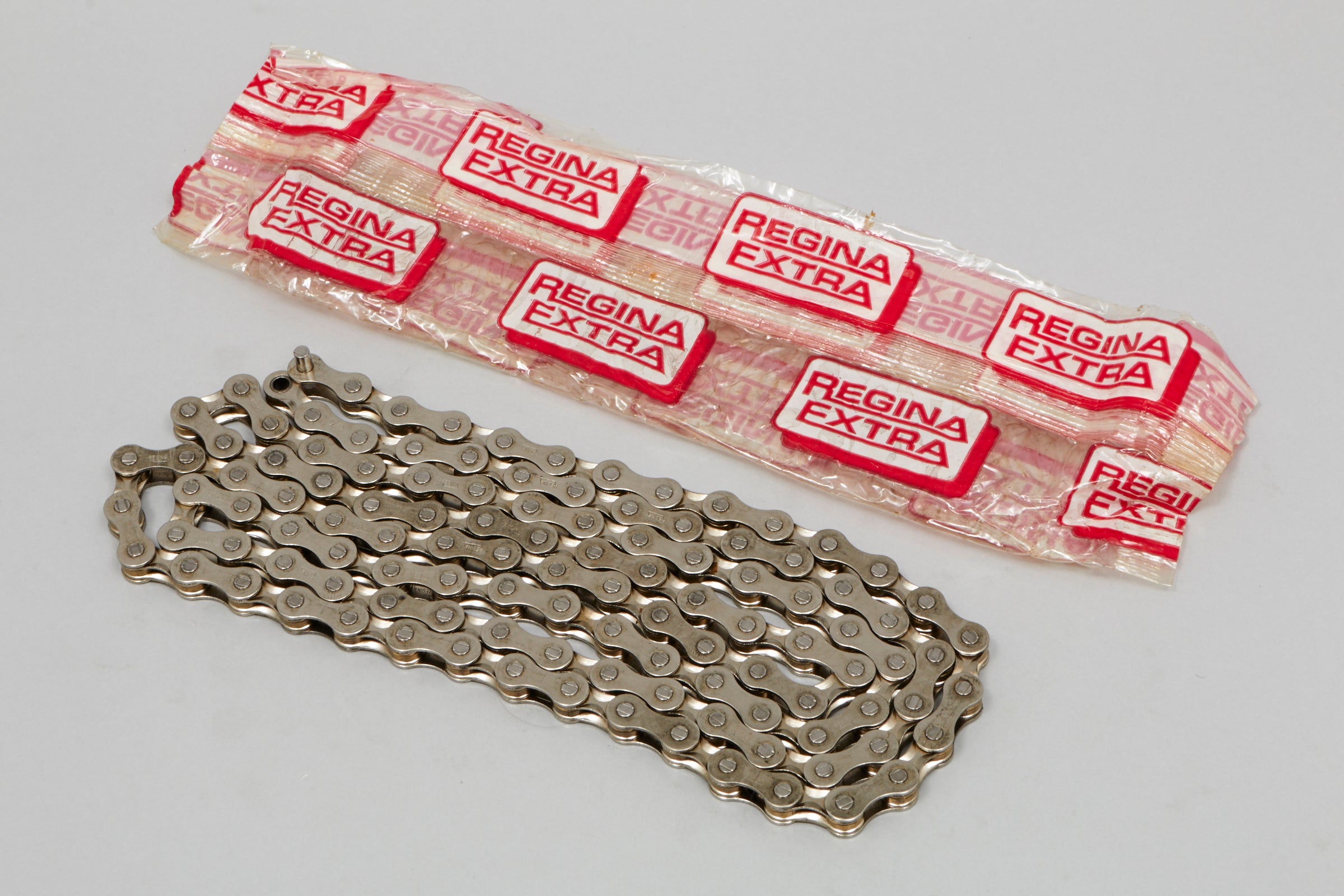


Regina Extra Super Racing (50) Silver NOS/NIB Vintage 6/7/8 Speed Chain
£110.00
✓ Original part - in production from the 1980s to the 1990s
✓ New old stock & still in the original packaging!
✓ Suitable for historic cycling events such as L'Eroica
✓ Worldwide shipping
Regina Extra Super Racing chain, hailing from Italy and in production from the 1980s to the 1990s (yet still new & unused after all this time!). Made from steel and weighing in at 332 grams. A fine choice for keeping your vintage bike authentic, but also great for any other compatible bike.
If you're taking part in L'Eroica, Anjou Velo, Velo Retro or another similar vintage cycling event, this is fully compliant - so rest assured, the pre-1987 police won't lock you up for having the wrong chain!
OVERVIEW
Model ID - 50
Production Era - 1980s & 1990s
Country - Italian
Material - Steel
Weight - 332 g
Stock Code - D-CHN43V
*New old stock items may have marks from storage over the years, and as we often have multiples they can vary from piece to piece, but they are always genuine new & unused items.
TECHNICAL INFO
Optimal Speed* - 6 Speed, 7 Speed, 8 Speed
Shifting System(s) - All Systems (Indexed), Friction (Non-Index)
Outer Width - 7.3 mm
Cog Width - 3/32" (Standard)
Pitch - 1/2" (Standard)
Number of Links - 116
*See help section.
-
▼SHIPPING, TAXES & RETURNS
-
We've been safely sending orders around the world since 2010. Orders are carefully packed, sent with tracking & insurance, and normally collected around midday on Tuesdays and Fridays. Larger items may occasionally require an extra day or two to prepare.
We accept returns, please notify us within 14 days and ensure the item arrives back with us no later than 30 days after the order was received.
EU orders under €150 (excluding shipping) - import VAT and the new €3 customs duty are paid as part of your order, so there's nothing further to pay on delivery.
EU orders over €150 (excluding shipping) - import fees are payable to the carrier before delivery, with nothing collected at checkout.
USA orders - import fees are collected at checkout for all orders to the USA, so there won’t be any surprise charges when your order arrives.
Other international orders - local import fees may apply and are not collected by us. Please check your country's import rules before purchasing.
-
▼HELP SECTION
-
Optimal Speed - the ideal number of rear cogs, based on the outer width of the chain and the cog width it was designed for. For 6 Speed Shimano Uniglide a 5/6 spd chain will perform best.
Shifting System(s) - indexed shifters 'click' when you change gear. For 9 speed upwards (or Suntour Accushift), to guarantee the best performance we recommend using the dedicated chain. Otherwise, for 8 speed and below, or any speed when using friction shifting (non-index), you just need the correct outer width.
Outer width - measured across the rivets at the widest point, these are the approximate widths for different speed setups (up to 4 speed is also dependent on cog width):
Speed Outer Width 2 to 4 Speed (1/8”) 8.5 to 9.5 mm Up to 6 Speed (3/32”) 7.8 to 8.0 mm 7 Speed / ‘Narrow’ 6 Speed 7.3 mm 8 Speed / ‘Narrow’ 7 Speed 7.0 to 7.3 mm 9 Speed 6.5 to 6.7 mm Cog Width - the gap between the inner plates allows for different rear cog/sprocket widths. 3/32" is the standard for 5 to 8 speed, above that it’s 11/128”. For 4 speed or less, 3/32” and 1/8” were both used, for the latter you will need a 1/8” chain. A wider 3/16" moped chain can be used as a heavy duty opton for single cog setups if required).
Chain pitch - the distance between the rivets/pins. All chains will be 1/2" with two exceptions; 3/16" (“inch pitch”) for very early track bikes, or Shimano's short lived 10 mm pitch system from the 70s/80s.
Number of links - if you're unsure how many you need, measure your old chain (each link has two rivets) or one with a similar setup to yours.


Regina Extra Synchro (90-S) NOS Vintage 7 Speed 12-28 Freewheel
£140.00
✓ Original part - produced in the 1980s
✓ New old stock! Still unused after all these years
✓ Suitable for historic cycling events such as L'Eroica
✓ Worldwide shipping
Regina Extra Synchro freewheel, hailing from Italy and in production during the 1980s (yet still new & unused after all this time!). Made from steel and weighing in at 470 grams. A fine choice for keeping your vintage bike authentic, but also great for any other compatible bike.
If you're taking part in L'Eroica or a similar vintage event, this is fully compliant - so rest assured, the pre-1987 police won't lock you up for having the wrong freewheel!
OVERVIEW
Model ID - 90-S
Production Era - 1980s
Country - Italian
Material - Steel
Weight - 470 g
Stock Code - D-FW151V
*New old stock items may have marks from storage over the years, and as we often have multiples they can vary from piece to piece, but they are always genuine new & unused items.
TECHNICAL INFO
Speed - 7 Speed
Range - 12-28
Threading - English/ISO: 1.375 x 24 TPI
Stack Height - 34 mm
Cog Width - 3/32" (Standard)
-
▼SHIPPING, TAXES & RETURNS
-
We've been safely sending orders around the world since 2010. Orders are carefully packed, sent with tracking & insurance, and normally collected around midday on Tuesdays and Fridays. Larger items may occasionally require an extra day or two to prepare.
We accept returns, please notify us within 14 days and ensure the item arrives back with us no later than 30 days after the order was received.
EU orders under €150 (excluding shipping) - import VAT and the new €3 customs duty are paid as part of your order, so there's nothing further to pay on delivery.
EU orders over €150 (excluding shipping) - import fees are payable to the carrier before delivery, with nothing collected at checkout.
USA orders - import fees are collected at checkout for all orders to the USA, so there won’t be any surprise charges when your order arrives.
Other international orders - local import fees may apply and are not collected by us. Please check your country's import rules before purchasing.
-
▼HELP SECTION
-
Speed - the number of cogs on the freewheel.
Range - the number of teeth on the smalles and largest cogs, this gives you an indication of how hard or easy the gearing will be, the lower the number the harder the gears. The tooth count of the cogs inbetween are usually evenly spaced, ie: a 6 speed 14-24 freewheel would likely have cog sizes 14, 16, 18, 20, 22 & 24.
Threading - this needs to match the thread of your rear hub. ISO is the modern standard and is almost exactly the same as older English/British and Italian thread, allowing you to mix and match between these thread types as long as it's not going to be under extreme force, in which case it's best to stick to an exact match. Hubs with a French thread must be used with a French threaded freewheel.
Stack Height - the total height (or width if you're looking at it when installed) of the freewheel, this is measured from the base (back of the largest cog) to the top (front of the smallest cog).
Cog width - this is mainly relevant for singlespeed and some older 3 or 4 speed freewheels - if this is ⅛” then you must use a ⅛” chain, but most freewheels (especially multiple speed ones) will use a standard 3/32” chain.
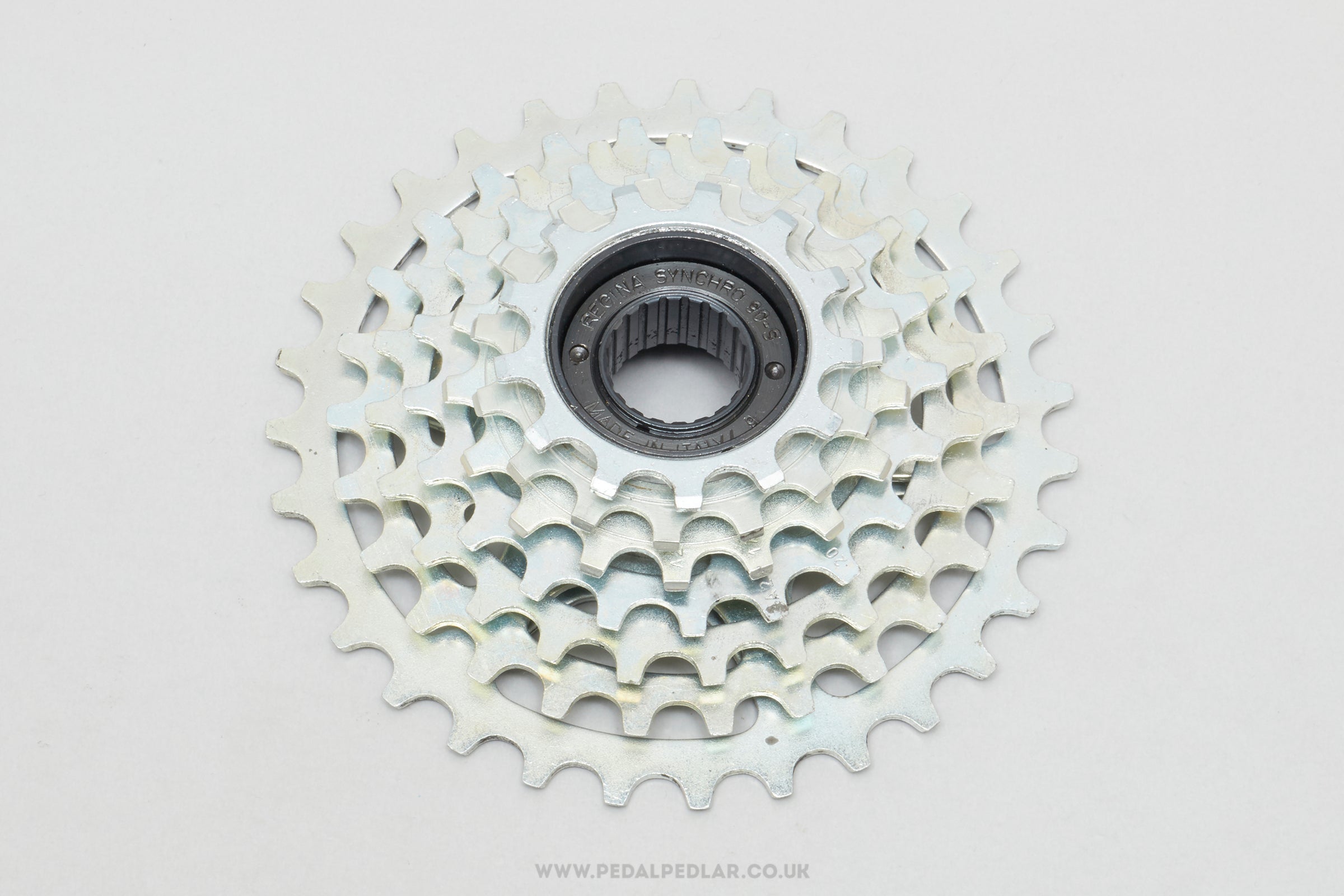


Regina Extra Synchro (90-S) NOS Vintage 7 Speed 13-31 Freewheel
£116.25 £155.00
✓ Original part - in production from the 1980s to the 1990s
✓ New old stock! Still unused after all these years
✓ Worldwide shipping
Regina Extra Synchro freewheel, hailing from Italy and in production from the 1980s to the 1990s (yet still new & unused after all this time!). Made from steel and weighing in at 519 grams. A fine choice for keeping your vintage bike authentic, but also great for any other compatible bike.
These Campagnolo designated freewheels were developed to be used with their 'Syncro' indexing system (sometimes stamped on the rear with a C in a diamond). One of the best freewheels available at the time, they work wonderfully with all non-index (friction) setups too.
OVERVIEW
Model ID - 90-S
Production Era - 1980s & 1990s
Country - Italian
Material - Steel
Weight - 519 g
Stock Code - D-FW188V
*New old stock items may have marks from storage over the years, and as we often have multiples they can vary from piece to piece, but they are always genuine new & unused items.
TECHNICAL INFO
Speed - 7 Speed
Range - 13-31
Threading - English/ISO: 1.375 x 24 TPI
Stack Height - 34 mm
Cog Width - 3/32" (Standard)
-
▼SHIPPING, TAXES & RETURNS
-
We've been safely sending orders around the world since 2010. Orders are carefully packed, sent with tracking & insurance, and normally collected around midday on Tuesdays and Fridays. Larger items may occasionally require an extra day or two to prepare.
We accept returns, please notify us within 14 days and ensure the item arrives back with us no later than 30 days after the order was received.
EU orders under €150 (excluding shipping) - import VAT and the new €3 customs duty are paid as part of your order, so there's nothing further to pay on delivery.
EU orders over €150 (excluding shipping) - import fees are payable to the carrier before delivery, with nothing collected at checkout.
USA orders - import fees are collected at checkout for all orders to the USA, so there won’t be any surprise charges when your order arrives.
Other international orders - local import fees may apply and are not collected by us. Please check your country's import rules before purchasing.
-
▼HELP SECTION
-
Speed - the number of cogs on the freewheel.
Range - the number of teeth on the smalles and largest cogs, this gives you an indication of how hard or easy the gearing will be, the lower the number the harder the gears. The tooth count of the cogs inbetween are usually evenly spaced, ie: a 6 speed 14-24 freewheel would likely have cog sizes 14, 16, 18, 20, 22 & 24.
Threading - this needs to match the thread of your rear hub. ISO is the modern standard and is almost exactly the same as older English/British and Italian thread, allowing you to mix and match between these thread types as long as it's not going to be under extreme force, in which case it's best to stick to an exact match. Hubs with a French thread must be used with a French threaded freewheel.
Stack Height - the total height (or width if you're looking at it when installed) of the freewheel, this is measured from the base (back of the largest cog) to the top (front of the smallest cog).
Cog width - this is mainly relevant for singlespeed and some older 3 or 4 speed freewheels - if this is ⅛” then you must use a ⅛” chain, but most freewheels (especially multiple speed ones) will use a standard 3/32” chain.
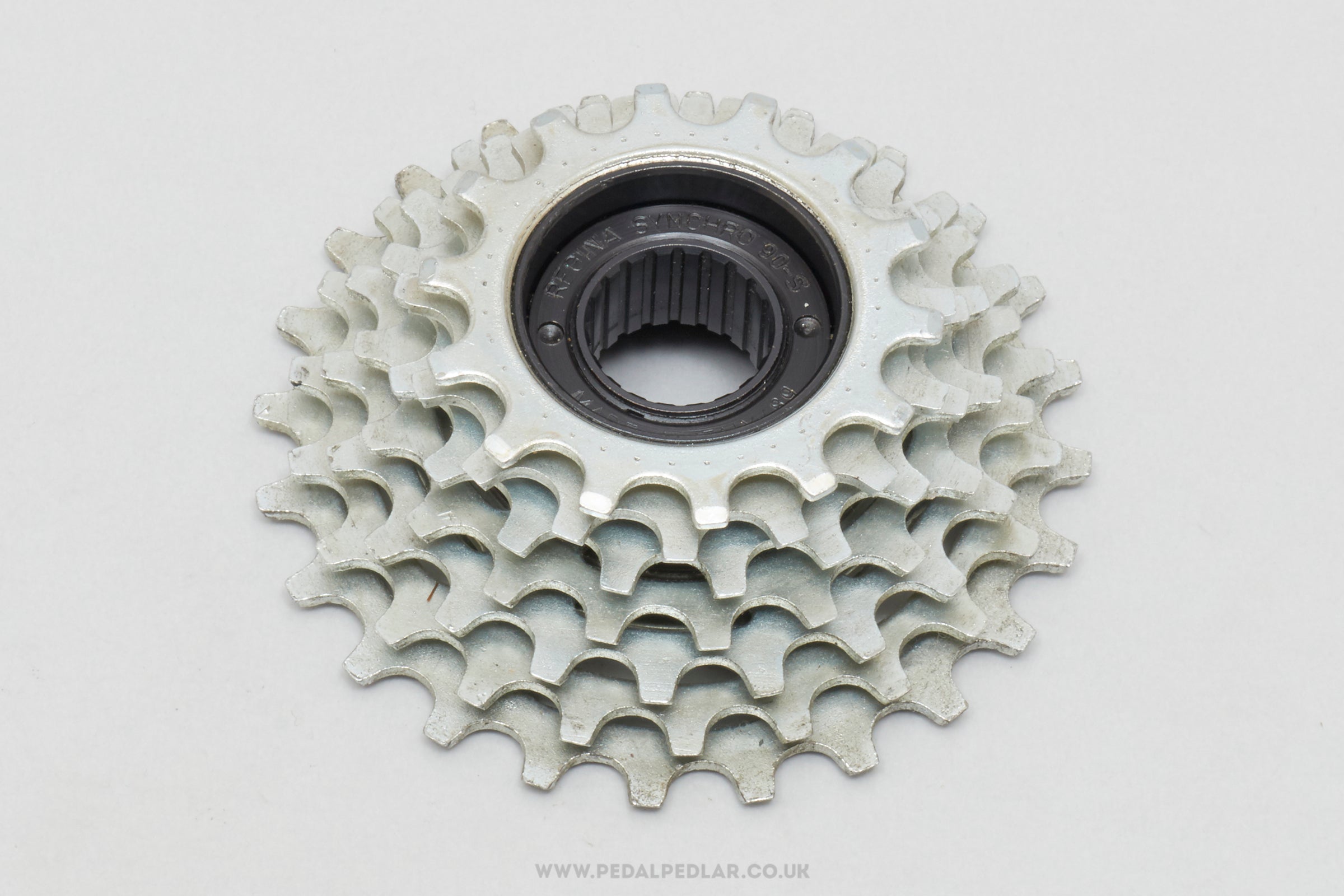


Regina Extra Synchro (90-S) NOS Vintage 7 Speed 14-24 Freewheel
£108.75 £145.00
✓ Original part - in production from the 1980s to the 1990s
✓ New old stock! Still unused after all these years
✓ Worldwide shipping
Regina Extra Synchro freewheel, hailing from Italy and in production from the 1980s to the 1990s (yet still new & unused after all this time!). Made from steel and weighing in at 453 grams. A fine choice for keeping your vintage bike authentic, but also great for any other compatible bike.
These Campagnolo designated freewheels were developed to be used with their 'Syncro' indexing system (sometimes stamped on the rear with a C in a diamond). One of the best freewheels available at the time, they work wonderfully with all non-index (friction) setups too.
OVERVIEW
Model ID - 90-S
Production Era - 1980s & 1990s
Country - Italian
Material - Steel
Weight - 453 g
Stock Code - D-FW182V
*New old stock items may have marks from storage over the years, and as we often have multiples they can vary from piece to piece, but they are always genuine new & unused items.
TECHNICAL INFO
Speed - 7 Speed
Range - 14-24
Threading - English/ISO: 1.375 x 24 TPI
Stack Height - 34 mm
Cog Width - 3/32" (Standard)
-
▼SHIPPING, TAXES & RETURNS
-
We've been safely sending orders around the world since 2010. Orders are carefully packed, sent with tracking & insurance, and normally collected around midday on Tuesdays and Fridays. Larger items may occasionally require an extra day or two to prepare.
We accept returns, please notify us within 14 days and ensure the item arrives back with us no later than 30 days after the order was received.
EU orders under €150 (excluding shipping) - import VAT and the new €3 customs duty are paid as part of your order, so there's nothing further to pay on delivery.
EU orders over €150 (excluding shipping) - import fees are payable to the carrier before delivery, with nothing collected at checkout.
USA orders - import fees are collected at checkout for all orders to the USA, so there won’t be any surprise charges when your order arrives.
Other international orders - local import fees may apply and are not collected by us. Please check your country's import rules before purchasing.
-
▼HELP SECTION
-
Speed - the number of cogs on the freewheel.
Range - the number of teeth on the smalles and largest cogs, this gives you an indication of how hard or easy the gearing will be, the lower the number the harder the gears. The tooth count of the cogs inbetween are usually evenly spaced, ie: a 6 speed 14-24 freewheel would likely have cog sizes 14, 16, 18, 20, 22 & 24.
Threading - this needs to match the thread of your rear hub. ISO is the modern standard and is almost exactly the same as older English/British and Italian thread, allowing you to mix and match between these thread types as long as it's not going to be under extreme force, in which case it's best to stick to an exact match. Hubs with a French thread must be used with a French threaded freewheel.
Stack Height - the total height (or width if you're looking at it when installed) of the freewheel, this is measured from the base (back of the largest cog) to the top (front of the smallest cog).
Cog width - this is mainly relevant for singlespeed and some older 3 or 4 speed freewheels - if this is ⅛” then you must use a ⅛” chain, but most freewheels (especially multiple speed ones) will use a standard 3/32” chain.


Regina Extra Synchro (90-S) NOS Vintage 7 Speed 14-32 Freewheel
£112.50 £150.00
✓ Original part - in production from the 1980s to the 1990s
✓ New old stock! Still unused after all these years
✓ Worldwide shipping
Regina Extra Synchro freewheel, hailing from Italy and in production from the 1980s to the 1990s (yet still new & unused after all this time!). Made from steel and weighing in at 541 grams. A fine choice for keeping your vintage bike authentic, but also great for any other compatible bike.
These Campagnolo designated freewheels were developed to be used with their 'Syncro' indexing system (usually stamped on the rear with a
OVERVIEW
Model ID - 90-S
Production Era - 1980s & 1990s
Country - Italian
Material - Steel
Weight - 541 g
Stock Code - D-FW148V
*New old stock items may have marks from storage over the years, and as we often have multiples they can vary from piece to piece, but they are always genuine new & unused items.
TECHNICAL INFO
Speed - 7 Speed
Range - 14-32
Threading - English/ISO: 1.375 x 24 TPI
Stack Height - 34 mm
Cog Width - 3/32" (Standard)
-
▼SHIPPING, TAXES & RETURNS
-
We've been safely sending orders around the world since 2010. Orders are carefully packed, sent with tracking & insurance, and normally collected around midday on Tuesdays and Fridays. Larger items may occasionally require an extra day or two to prepare.
We accept returns, please notify us within 14 days and ensure the item arrives back with us no later than 30 days after the order was received.
EU orders under €150 (excluding shipping) - import VAT and the new €3 customs duty are paid as part of your order, so there's nothing further to pay on delivery.
EU orders over €150 (excluding shipping) - import fees are payable to the carrier before delivery, with nothing collected at checkout.
USA orders - import fees are collected at checkout for all orders to the USA, so there won’t be any surprise charges when your order arrives.
Other international orders - local import fees may apply and are not collected by us. Please check your country's import rules before purchasing.
-
▼HELP SECTION
-
Speed - the number of cogs on the freewheel.
Range - the number of teeth on the smalles and largest cogs, this gives you an indication of how hard or easy the gearing will be, the lower the number the harder the gears. The tooth count of the cogs inbetween are usually evenly spaced, ie: a 6 speed 14-24 freewheel would likely have cog sizes 14, 16, 18, 20, 22 & 24.
Threading - this needs to match the thread of your rear hub. ISO is the modern standard and is almost exactly the same as older English/British and Italian thread, allowing you to mix and match between these thread types as long as it's not going to be under extreme force, in which case it's best to stick to an exact match. Hubs with a French thread must be used with a French threaded freewheel.
Stack Height - the total height (or width if you're looking at it when installed) of the freewheel, this is measured from the base (back of the largest cog) to the top (front of the smallest cog).
Cog width - this is mainly relevant for singlespeed and some older 3 or 4 speed freewheels - if this is ⅛” then you must use a ⅛” chain, but most freewheels (especially multiple speed ones) will use a standard 3/32” chain.