
8 Speed
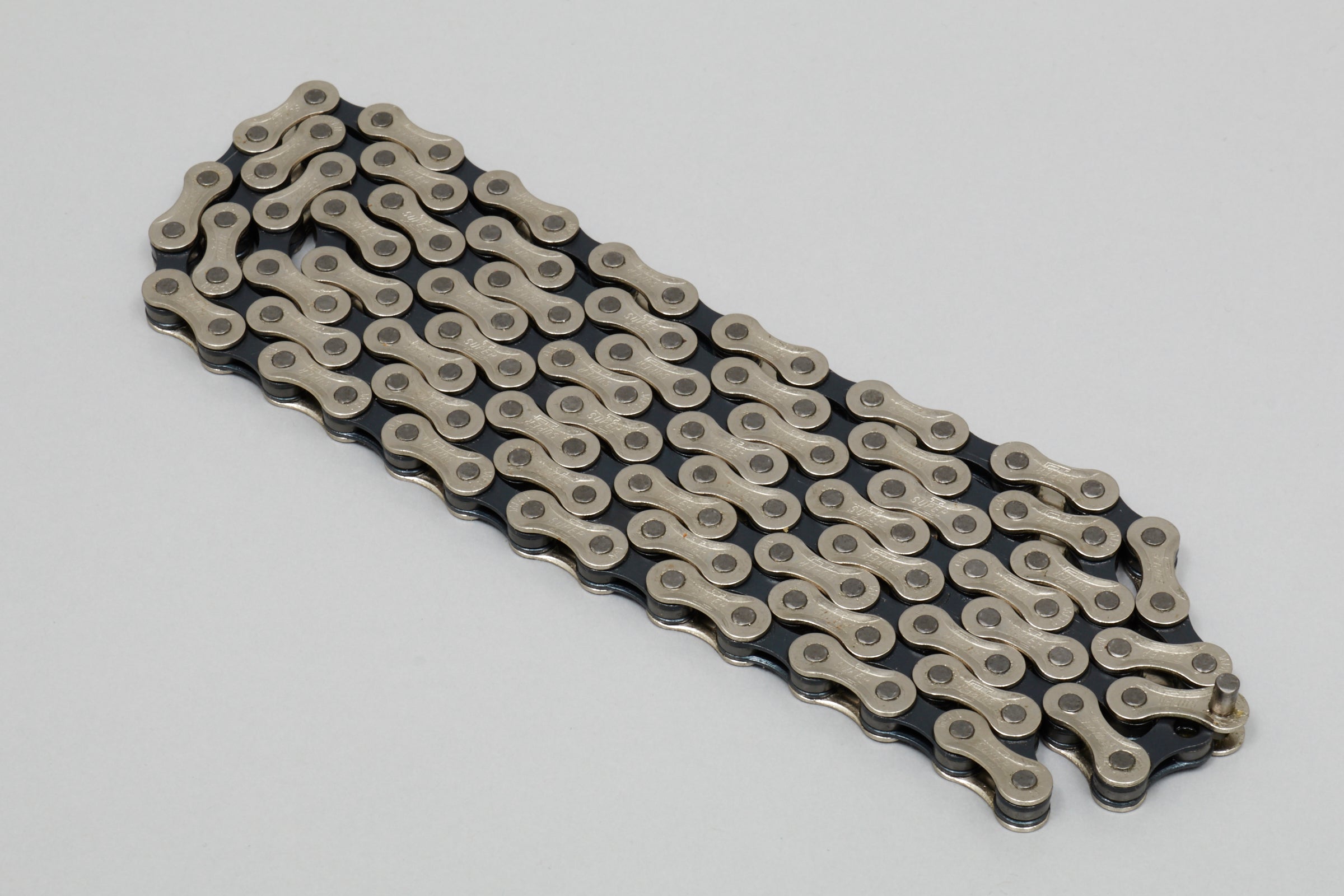


D.I.D Super L (Suntour Superbe / XC Pro CH-AP10) Accushift Plus NOS Classic 6/7/8 Speed Chain
£60.00
✓ Original part - produced in the 1990s
✓ New old stock! Still unused after all these years
✓ Worldwide shipping
D.I.D / Suntour Super Light chain, hailing from Japan and in production during the 1990s (yet still new & unused after all this time!). Made from steel and weighing in at 328 grams. A fine choice for keeping your classic bike authentic, but also great for any other compatible bike.
D.I.D manufactured chains for Suntour throughout the 1980s and 1990s, and these are effectively the same chains supplied with the Suntour Superbe and XC Pro groupsets (CH-AP10), but stamped ‘Super L’ rather than ‘Suntour AP’. They were sold by D.I.D for use with Suntour’s Accushift systems, with the same specification as the Suntour AP10. The only real difference is that these don’t come in Suntour packaging, but at around half the price we’ll take it!
OVERVIEW
Condition - New Old Stock*
Model ID - AP11
Production Era - 1990s
Country - Japanese
Material - Steel
Weight - 328 g
Stock Code - D-CHN36C
*New old stock items may have marks from storage over the years, and as we often have multiples they can vary from piece to piece, but they are always genuine new & unused items.
TECHNICAL INFO
Optimal Speed* - 6 Speed, 7 Speed, 8 Speed
Shifting System(s) - Suntour Accushift, All Systems (Indexed), Friction (Non-Index)
Outer Width - 7.3 mm
Cog Width - 3/32" (Standard)
Pitch - 1/2" (Standard)
Number of Links - 116
*See help section.
-
▼SHIPPING, TAXES & RETURNS
-
We've been safely sending orders around the world since 2010. Orders are carefully packed, sent with tracking & insurance, and normally collected around midday on Tuesdays and Fridays. Larger items may occasionally require an extra day or two to prepare.
We accept returns, please notify us within 14 days and ensure the item arrives back with us no later than 30 days after the order was received.
EU orders under €150 (excluding shipping) - import VAT and the new €3 customs duty are paid as part of your order, so there's nothing further to pay on delivery.
EU orders over €150 (excluding shipping) - import fees are payable to the carrier before delivery, with nothing collected at checkout.
USA orders - import fees are collected at checkout for all orders to the USA, so there won’t be any surprise charges when your order arrives.
Other international orders - local import fees may apply and are not collected by us. Please check your country's import rules before purchasing.
-
▼HELP SECTION
-
Optimal Speed - the ideal number of rear cogs, based on the outer width of the chain and the cog width it was designed for. For 6 Speed Shimano Uniglide a 5/6 spd chain will perform best.
Shifting System(s) - indexed shifters 'click' when you change gear. For 9 speed upwards (or Suntour Accushift), to guarantee the best performance we recommend using the dedicated chain. Otherwise, for 8 speed and below, or any speed when using friction shifting (non-index), you just need the correct outer width.
Outer width - measured across the rivets at the widest point, these are the approximate widths for different speed setups (up to 4 speed is also dependent on cog width):
Speed Outer Width 2 to 4 Speed (1/8”) 8.5 to 9.5 mm Up to 6 Speed (3/32”) 7.8 to 8.0 mm 7 Speed / ‘Narrow’ 6 Speed 7.3 mm 8 Speed / ‘Narrow’ 7 Speed 7.0 to 7.3 mm 9 Speed 6.5 to 6.7 mm Cog Width - the gap between the inner plates allows for different rear cog/sprocket widths. 3/32" is the standard for 5 to 8 speed, above that it’s 11/128”. For 4 speed or less, 3/32” and 1/8” were both used, for the latter you will need a 1/8” chain. A wider 3/16" moped chain can be used as a heavy duty opton for single cog setups if required).
Chain pitch - the distance between the rivets/pins. All chains will be 1/2" with two exceptions; 3/16" (“inch pitch”) for very early track bikes, or Shimano's short lived 10 mm pitch system from the 70s/80s.
Number of links - if you're unsure how many you need, measure your old chain (each link has two rivets) or one with a similar setup to yours.
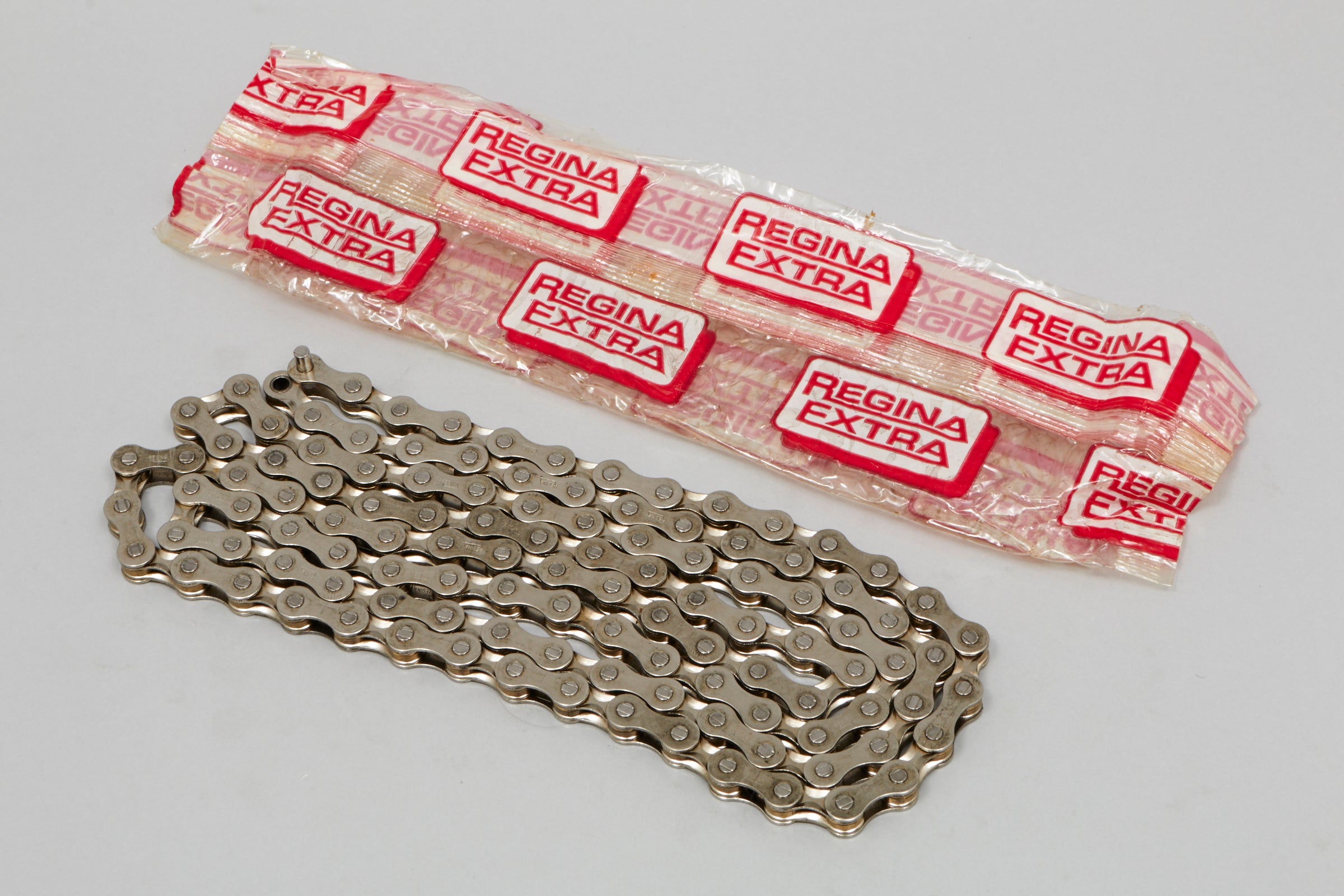


Regina Extra Super Racing (50) Silver NOS/NIB Vintage 6/7/8 Speed Chain
£110.00
✓ Original part - in production from the 1980s to the 1990s
✓ New old stock & still in the original packaging!
✓ Suitable for historic cycling events such as L'Eroica
✓ Worldwide shipping
Regina Extra Super Racing chain, hailing from Italy and in production from the 1980s to the 1990s (yet still new & unused after all this time!). Made from steel and weighing in at 332 grams. A fine choice for keeping your vintage bike authentic, but also great for any other compatible bike.
If you're taking part in L'Eroica, Anjou Velo, Velo Retro or another similar vintage cycling event, this is fully compliant - so rest assured, the pre-1987 police won't lock you up for having the wrong chain!
OVERVIEW
Model ID - 50
Production Era - 1980s & 1990s
Country - Italian
Material - Steel
Weight - 332 g
Stock Code - D-CHN43V
*New old stock items may have marks from storage over the years, and as we often have multiples they can vary from piece to piece, but they are always genuine new & unused items.
TECHNICAL INFO
Optimal Speed* - 6 Speed, 7 Speed, 8 Speed
Shifting System(s) - All Systems (Indexed), Friction (Non-Index)
Outer Width - 7.3 mm
Cog Width - 3/32" (Standard)
Pitch - 1/2" (Standard)
Number of Links - 116
*See help section.
-
▼SHIPPING, TAXES & RETURNS
-
We've been safely sending orders around the world since 2010. Orders are carefully packed, sent with tracking & insurance, and normally collected around midday on Tuesdays and Fridays. Larger items may occasionally require an extra day or two to prepare.
We accept returns, please notify us within 14 days and ensure the item arrives back with us no later than 30 days after the order was received.
EU orders under €150 (excluding shipping) - import VAT and the new €3 customs duty are paid as part of your order, so there's nothing further to pay on delivery.
EU orders over €150 (excluding shipping) - import fees are payable to the carrier before delivery, with nothing collected at checkout.
USA orders - import fees are collected at checkout for all orders to the USA, so there won’t be any surprise charges when your order arrives.
Other international orders - local import fees may apply and are not collected by us. Please check your country's import rules before purchasing.
-
▼HELP SECTION
-
Optimal Speed - the ideal number of rear cogs, based on the outer width of the chain and the cog width it was designed for. For 6 Speed Shimano Uniglide a 5/6 spd chain will perform best.
Shifting System(s) - indexed shifters 'click' when you change gear. For 9 speed upwards (or Suntour Accushift), to guarantee the best performance we recommend using the dedicated chain. Otherwise, for 8 speed and below, or any speed when using friction shifting (non-index), you just need the correct outer width.
Outer width - measured across the rivets at the widest point, these are the approximate widths for different speed setups (up to 4 speed is also dependent on cog width):
Speed Outer Width 2 to 4 Speed (1/8”) 8.5 to 9.5 mm Up to 6 Speed (3/32”) 7.8 to 8.0 mm 7 Speed / ‘Narrow’ 6 Speed 7.3 mm 8 Speed / ‘Narrow’ 7 Speed 7.0 to 7.3 mm 9 Speed 6.5 to 6.7 mm Cog Width - the gap between the inner plates allows for different rear cog/sprocket widths. 3/32" is the standard for 5 to 8 speed, above that it’s 11/128”. For 4 speed or less, 3/32” and 1/8” were both used, for the latter you will need a 1/8” chain. A wider 3/16" moped chain can be used as a heavy duty opton for single cog setups if required).
Chain pitch - the distance between the rivets/pins. All chains will be 1/2" with two exceptions; 3/16" (“inch pitch”) for very early track bikes, or Shimano's short lived 10 mm pitch system from the 70s/80s.
Number of links - if you're unsure how many you need, measure your old chain (each link has two rivets) or one with a similar setup to yours.
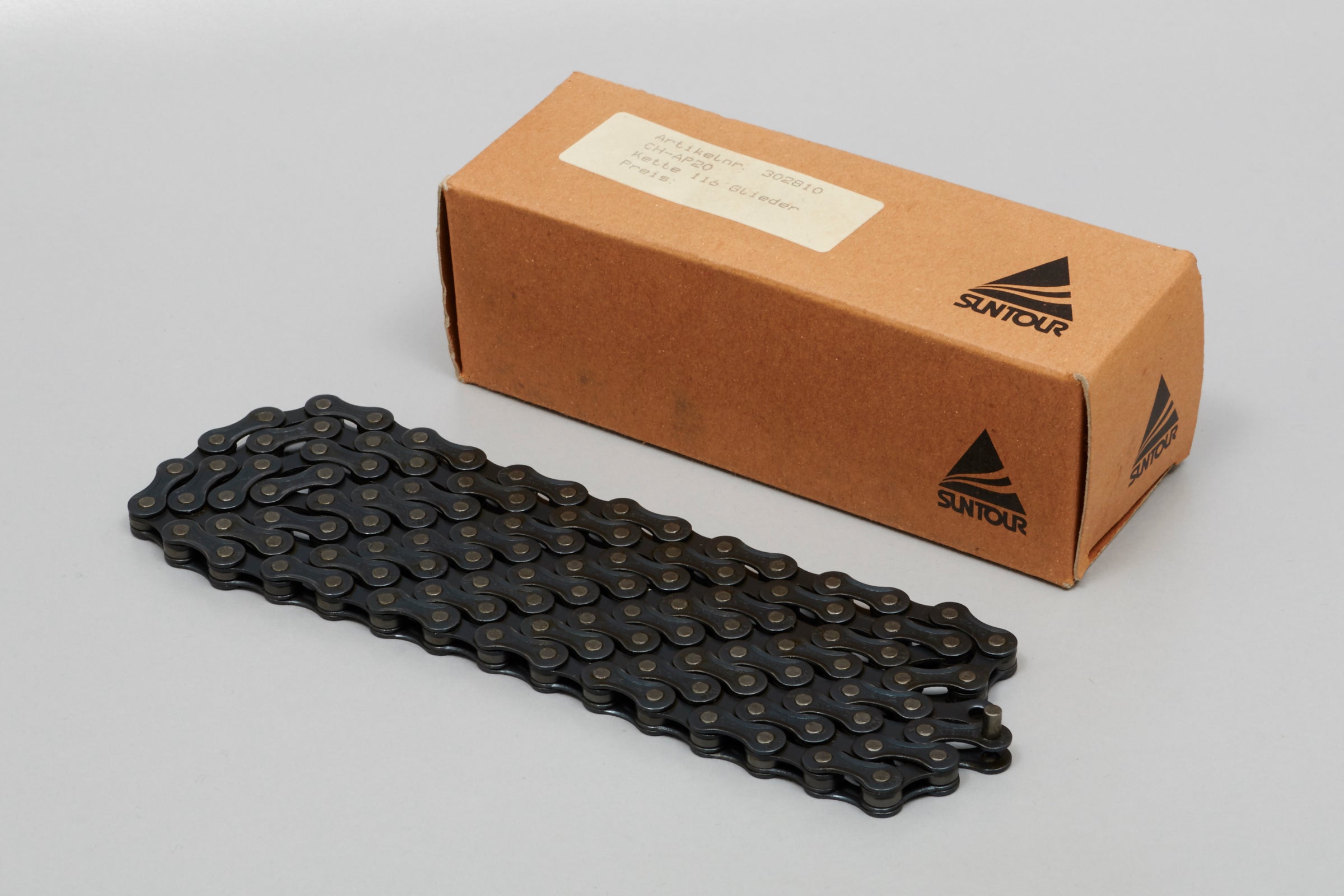


Suntour XCU / VX (CH-AP20) Accushift Plus NOS/NIB Classic 6/7/8 Speed Chain
£104.50 £110.00
✓ Original part - produced in the 1990s
✓ New old stock & still in the original packaging!
✓ Worldwide shipping
Suntour XCU / VX chain, hailing from Japan and in production during the 1990s (yet still new & unused after all this time!). Made from steel and weighing in at 329 grams. A fine choice for keeping your classic bike authentic, but also great for any other compatible bike.
OVERVIEW
Model ID - CH-AP20
Production Era - 1990s
Country - Japanese
Material - Steel
Weight - 329 g
Stock Code - D-CHN34C
*New old stock items may have marks from storage over the years, and as we often have multiples they can vary from piece to piece, but they are always genuine new & unused items.
TECHNICAL INFO
Optimal Speed* - 6 Speed, 7 Speed, 8 Speed
Shifting System(s) - Suntour Accushift, All Systems (Indexed), Friction (Non-Index)
Outer Width - 7.3 mm
Cog Width - 3/32" (Standard)
Pitch - 1/2" (Standard)
Number of Links - 116
*See help section.
-
▼SHIPPING, TAXES & RETURNS
-
We've been safely sending orders around the world since 2010. Orders are carefully packed, sent with tracking & insurance, and normally collected around midday on Tuesdays and Fridays. Larger items may occasionally require an extra day or two to prepare.
We accept returns, please notify us within 14 days and ensure the item arrives back with us no later than 30 days after the order was received.
EU orders under €150 (excluding shipping) - import VAT and the new €3 customs duty are paid as part of your order, so there's nothing further to pay on delivery.
EU orders over €150 (excluding shipping) - import fees are payable to the carrier before delivery, with nothing collected at checkout.
USA orders - import fees are collected at checkout for all orders to the USA, so there won’t be any surprise charges when your order arrives.
Other international orders - local import fees may apply and are not collected by us. Please check your country's import rules before purchasing.
-
▼HELP SECTION
-
Optimal Speed - the ideal number of rear cogs, based on the outer width of the chain and the cog width it was designed for. For 6 Speed Shimano Uniglide a 5/6 spd chain will perform best.
Shifting System(s) - indexed shifters 'click' when you change gear. For 9 speed upwards (or Suntour Accushift), to guarantee the best performance we recommend using the dedicated chain. Otherwise, for 8 speed and below, or any speed when using friction shifting (non-index), you just need the correct outer width.
Outer width - measured across the rivets at the widest point, these are the approximate widths for different speed setups (up to 4 speed is also dependent on cog width):
Speed Outer Width 2 to 4 Speed (1/8”) 8.5 to 9.5 mm Up to 6 Speed (3/32”) 7.8 to 8.0 mm 7 Speed / ‘Narrow’ 6 Speed 7.3 mm 8 Speed / ‘Narrow’ 7 Speed 7.0 to 7.3 mm 9 Speed 6.5 to 6.7 mm Cog Width - the gap between the inner plates allows for different rear cog/sprocket widths. 3/32" is the standard for 5 to 8 speed, above that it’s 11/128”. For 4 speed or less, 3/32” and 1/8” were both used, for the latter you will need a 1/8” chain. A wider 3/16" moped chain can be used as a heavy duty opton for single cog setups if required).
Chain pitch - the distance between the rivets/pins. All chains will be 1/2" with two exceptions; 3/16" (“inch pitch”) for very early track bikes, or Shimano's short lived 10 mm pitch system from the 70s/80s.
Number of links - if you're unsure how many you need, measure your old chain (each link has two rivets) or one with a similar setup to yours.


Tranz-X JD-002 Centeron G-Pulley Blue NOS/NIB Classic 10T Jockey Wheels
£30.00
✓ Original jockey wheels - produced in the 1990s
✓ New old stock & still in the original packaging!
✓ Worldwide shipping
Tranz-X JD-002 jockey wheels (or derailleur pulleys if you prefer), hailing from Taiwan and in production during the 1990s (yet still new & unused after all this time). Made from aluminium and weighing in at 46 grams. A fine choice for keeping your classic bike authentic, but also great for any other compatible bike.
OVERVIEW
Model ID - JD-002
Production Era - 1990s
Country - Taiwanese
Material - Aluminium
Weight - 46 g
Stock Code - D-JCK15C
NB - 2 sets of spacers supplied for 6/7 speed & 8 speed
*New old stock items may have marks from storage over the years, and as we often have multiples they can vary from piece to piece, but they are always genuine new & unused items.
TECHNICAL INFO
Teeth - 10
Compatible Speed* - 6 Speed, 7 Speed, 8 Speed
Diameter (OD) - 38 mm
Thickness - 8.1 mm / 10.2 mm
Centre Hole (ID) - 5 mm
*See help section.
-
▼SHIPPING, TAXES & RETURNS
-
We've been safely sending orders around the world since 2010. Orders are carefully packed, sent with tracking & insurance, and normally collected around midday on Tuesdays and Fridays. Larger items may occasionally require an extra day or two to prepare.
We accept returns, please notify us within 14 days and ensure the item arrives back with us no later than 30 days after the order was received.
EU orders under €150 (excluding shipping) - import VAT and the new €3 customs duty are paid as part of your order, so there's nothing further to pay on delivery.
EU orders over €150 (excluding shipping) - import fees are payable to the carrier before delivery, with nothing collected at checkout.
USA orders - import fees are collected at checkout for all orders to the USA, so there won’t be any surprise charges when your order arrives.
Other international orders - local import fees may apply and are not collected by us. Please check your country's import rules before purchasing.
-
▼HELP SECTION
-
Teeth - the tooth count has increased with the introduction of more gears, but this happened very gradually so 10 tooth jockey wheels were standard for a very long time.
*Compatible Speed - the number of cogs the jockey wheels were designed to be used with. When using derailleurs for indexed shifting it's important to stick to this, but friction shifting is much more forgiving so you're unlikely to have any problems using the next speed up or down, providing all the measurements are correct.
Diameter (OD) - the diameter of the jockey wheels, from the outside edge of the teeth. It’s important to stay close to the ones you're replacing to ensure they fit.
Thickness - measured at the widest point, by the centre hole. The spacing has generally become narrower over the years to accommodate more gears.
Centre Hole (ID) - the inside diameter (usually inside the bushing/spacer if present). This rarely presents a problem, but some older jockey wheels have a different diameter so it's worth double checking.


Tranz-X JD-002 Centeron G-Pulley Red NOS/NIB Classic 10T Jockey Wheels
£30.00
✓ Original jockey wheels - produced in the 1990s
✓ New old stock & still in the original packaging!
✓ Worldwide shipping
Tranz-X JD-002 jockey wheels (or derailleur pulleys if you prefer), hailing from Taiwan and in production during the 1990s (yet still new & unused after all this time). Made from aluminium and weighing in at 46 grams. A fine choice for keeping your classic bike authentic, but also great for any other compatible bike.
OVERVIEW
Model ID - JD-002
Production Era - 1990s
Country - Taiwanese
Material - Aluminium
Weight - 46 g
Stock Code - D-JCK16C
NB - 2 sets of spacers supplied for 6/7 speed & 8 speed
*New old stock items may have marks from storage over the years, and as we often have multiples they can vary from piece to piece, but they are always genuine new & unused items.
TECHNICAL INFO
Teeth - 10
Compatible Speed* - 6 Speed, 7 Speed, 8 Speed
Diameter (OD) - 38 mm
Thickness - 8.1 mm / 10.2 mm
Centre Hole (ID) - 5 mm
*See help section.
-
▼SHIPPING, TAXES & RETURNS
-
We've been safely sending orders around the world since 2010. Orders are carefully packed, sent with tracking & insurance, and normally collected around midday on Tuesdays and Fridays. Larger items may occasionally require an extra day or two to prepare.
We accept returns, please notify us within 14 days and ensure the item arrives back with us no later than 30 days after the order was received.
EU orders under €150 (excluding shipping) - import VAT and the new €3 customs duty are paid as part of your order, so there's nothing further to pay on delivery.
EU orders over €150 (excluding shipping) - import fees are payable to the carrier before delivery, with nothing collected at checkout.
USA orders - import fees are collected at checkout for all orders to the USA, so there won’t be any surprise charges when your order arrives.
Other international orders - local import fees may apply and are not collected by us. Please check your country's import rules before purchasing.
-
▼HELP SECTION
-
Teeth - the tooth count has increased with the introduction of more gears, but this happened very gradually so 10 tooth jockey wheels were standard for a very long time.
*Compatible Speed - the number of cogs the jockey wheels were designed to be used with. When using derailleurs for indexed shifting it's important to stick to this, but friction shifting is much more forgiving so you're unlikely to have any problems using the next speed up or down, providing all the measurements are correct.
Diameter (OD) - the diameter of the jockey wheels, from the outside edge of the teeth. It’s important to stay close to the ones you're replacing to ensure they fit.
Thickness - measured at the widest point, by the centre hole. The spacing has generally become narrower over the years to accommodate more gears.
Centre Hole (ID) - the inside diameter (usually inside the bushing/spacer if present). This rarely presents a problem, but some older jockey wheels have a different diameter so it's worth double checking.


Tranz-X JD-002 Centeron G-Pulley Silver NOS/NIB Classic 10T Jockey Wheels
£30.00
✓ Original jockey wheels - produced in the 1990s
✓ New old stock & still in the original packaging!
✓ Worldwide shipping
Tranz-X JD-002 jockey wheels (or derailleur pulleys if you prefer), hailing from Taiwan and in production during the 1990s (yet still new & unused after all this time). Made from aluminium and weighing in at 46 grams. A fine choice for keeping your classic bike authentic, but also great for any other compatible bike.
OVERVIEW
Model ID - JD-002
Production Era - 1990s
Country - Taiwanese
Material - Aluminium
Weight - 46 g
Stock Code - D-JCK14C
NB - 2 sets of spacers supplied for 6/7 speed & 8 speed
*New old stock items may have marks from storage over the years, and as we often have multiples they can vary from piece to piece, but they are always genuine new & unused items.
TECHNICAL INFO
Teeth - 10
Compatible Speed* - 6 Speed, 7 Speed, 8 Speed
Diameter (OD) - 38 mm
Thickness - 8.1 mm / 10.2 mm
Centre Hole (ID) - 5 mm
*See help section.
-
▼SHIPPING, TAXES & RETURNS
-
We've been safely sending orders around the world since 2010. Orders are carefully packed, sent with tracking & insurance, and normally collected around midday on Tuesdays and Fridays. Larger items may occasionally require an extra day or two to prepare.
We accept returns, please notify us within 14 days and ensure the item arrives back with us no later than 30 days after the order was received.
EU orders under €150 (excluding shipping) - import VAT and the new €3 customs duty are paid as part of your order, so there's nothing further to pay on delivery.
EU orders over €150 (excluding shipping) - import fees are payable to the carrier before delivery, with nothing collected at checkout.
USA orders - import fees are collected at checkout for all orders to the USA, so there won’t be any surprise charges when your order arrives.
Other international orders - local import fees may apply and are not collected by us. Please check your country's import rules before purchasing.
-
▼HELP SECTION
-
Teeth - the tooth count has increased with the introduction of more gears, but this happened very gradually so 10 tooth jockey wheels were standard for a very long time.
*Compatible Speed - the number of cogs the jockey wheels were designed to be used with. When using derailleurs for indexed shifting it's important to stick to this, but friction shifting is much more forgiving so you're unlikely to have any problems using the next speed up or down, providing all the measurements are correct.
Diameter (OD) - the diameter of the jockey wheels, from the outside edge of the teeth. It’s important to stay close to the ones you're replacing to ensure they fit.
Thickness - measured at the widest point, by the centre hole. The spacing has generally become narrower over the years to accommodate more gears.
Centre Hole (ID) - the inside diameter (usually inside the bushing/spacer if present). This rarely presents a problem, but some older jockey wheels have a different diameter so it's worth double checking.