
All Items 10% Off
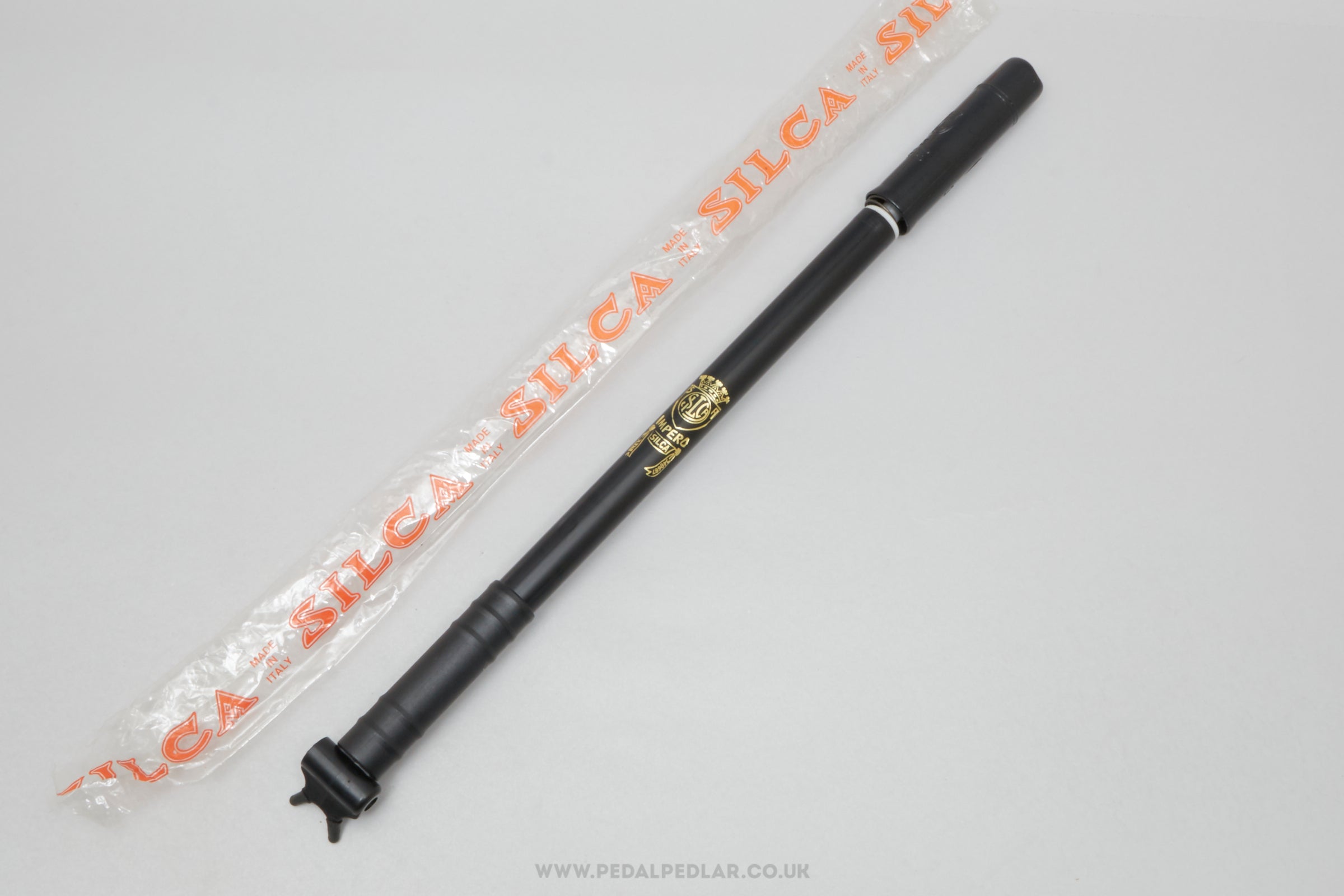


Silca Impero NOS/NIB Vintage Black 47 - 52.5 cm Frame Fit Bike Pump
£51.00 £60.00
✓ Original pump - produced in the 1980s
✓ New old stock & still in the original packaging!
✓ Suitable for historic cycling events such as L'Eroica
✓ Worldwide shipping
Silca Impero bicycle pump, hailing from Italy and in production during the 1980s (yet still new & unused after all this time!). An excellent choice for vintage cycling enthusiasts, but great for cyclists of the non-vintage variety too!
If you're taking part in L'Eroica or any other vintage event, this is fully compliant - so rest assured, the pre-1987 police won't lock you up for having the wrong pump!
OVERVIEW
Production Era - 1980s
Country - Italian
Material - Plastic
Weight - 128 g
Stock Code - D-PM-F64V
*New old stock items may have marks from storage over the years, and as we often have multiples they can vary from piece to piece, but they are always genuine new & unused items.
TECHNICAL INFO
Colour* - Black
Valve Type - Presta
Pump Mount Type - Frame Fit (With Peg Hole at Handle End)
Mount Location** - Seat Tube
Length (Min-Max) - 47 - 52.5 cm
*The colour description is just a guide, please check the photos too as we make sure these are as close to the true colour as possible.
**See help section.
-
▼SHIPPING, TAXES & RETURNS
-
We've been safely sending orders around the world since 2010. Orders are carefully packed, sent with tracking & insurance, and normally collected around midday on Tuesdays and Fridays. Larger items may occasionally require an extra day or two to prepare.
We accept returns, please notify us within 14 days and ensure the item arrives back with us no later than 30 days after the order was received.
EU orders under €150 (excluding shipping) - import VAT and the new €3 customs duty are paid as part of your order, so there's nothing further to pay on delivery.
EU orders over €150 (excluding shipping) - import fees are payable to the carrier before delivery, with nothing collected at checkout.
USA orders - import fees are collected at checkout for all orders to the USA, so there won’t be any surprise charges when your order arrives.
Other international orders - local import fees may apply and are not collected by us. Please check your country's import rules before purchasing.
-
▼HELP SECTION
-
Valve Type - there are 3 types of valves; Presta are thin with a little knurled nut on the end, Schrader are wider (the same as you would find on a car), and the less common Woods (aka "Dunlop"). Pumps designed for Presta valves can be used on Woods valves. Some pumps use hose connectors, these are available for all valve types.
Pump Mount Type - 'peg fit' pumps require pump pegs or 'umbrella' clips to fit to the frame, 'frame fit 'pumps are designed with curved ends to mount between two tubes (although these often have holes for pegs too). If mounting directly you'll need the correct length to fit your frame, or a clip/peg to hold one end.
Mount Location - frame fit pumps usually mount to the seat tube with the ends compressed between the top and down tube, they can however be mounted on other tubes as long as there's something supporting the handle end. Some head tubes have a little nipple or a small enough gap for under top tube mounting (this can be replcated with a simple strap or cable tie), and of course pump pegs or clips can be fitted anywhere!
Length (Min-Max) - the length of the pump fully compressed and uncompressed, measured at the points of support. The space you to intend to mount the pump should be within 1 cm of the minimum or maximum length to allow the pump to be securely mounted and dismounted.
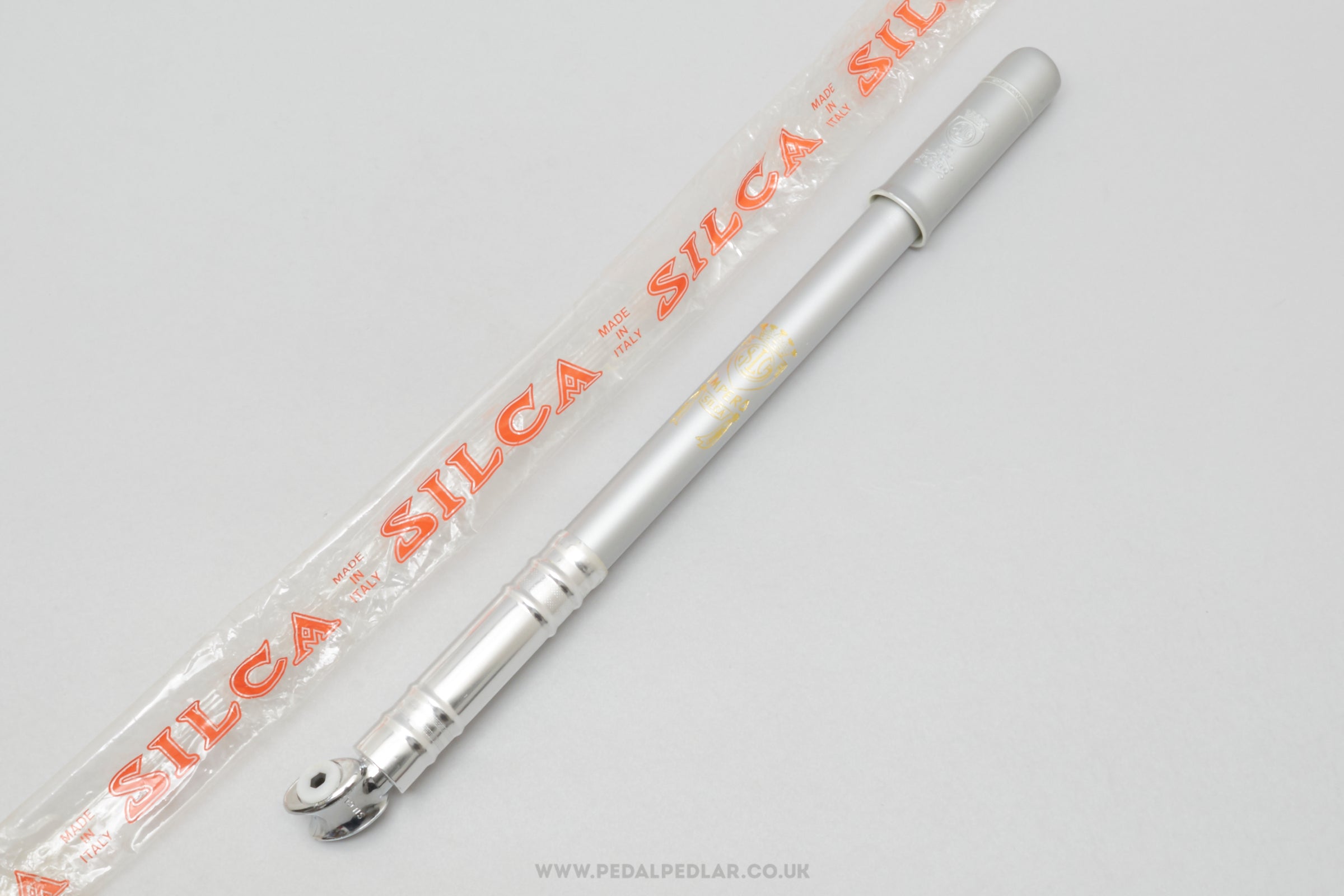


Silca Impero NOS Vintage Silver 39.5 - 43 cm Frame Fit Bike Pump
£60.00
✓ Original pump - produced in the 1980s
✓ New old stock! Still unused after all these years
✓ Suitable for historic cycling events such as L'Eroica
✓ Worldwide shipping
Silca Impero bicycle pump, hailing from Italy and in production during the 1980s (yet still new & unused after all this time!). An excellent choice for vintage cycling enthusiasts, but great for cyclists of the non-vintage variety too!
If you're taking part in L'Eroica or any other vintage event, this is fully compliant - so rest assured, the pre-1987 police won't lock you up for having the wrong pump!
OVERVIEW
Production Era - 1980s
Country - Italian
Material - Plastic
Weight - 122 g
Stock Code - D-PM-F50V
*New old stock items may have marks from storage over the years, and as we often have multiples they can vary from piece to piece, but they are always genuine new & unused items.
TECHNICAL INFO
Colour* - Silver
Valve Type - Presta
Pump Mount Type - Frame Fit (With Peg Hole at Handle End)
Mount Location** - Seat Tube
Length (Min-Max) - 39.5 - 43 cm
*The colour description is just a guide, please check the photos too as we make sure these are as close to the true colour as possible.
**See help section.
-
▼SHIPPING, TAXES & RETURNS
-
We've been safely sending orders around the world since 2010. Orders are carefully packed, sent with tracking & insurance, and normally collected around midday on Tuesdays and Fridays. Larger items may occasionally require an extra day or two to prepare.
We accept returns, please notify us within 14 days and ensure the item arrives back with us no later than 30 days after the order was received.
EU orders under €150 (excluding shipping) - import VAT and the new €3 customs duty are paid as part of your order, so there's nothing further to pay on delivery.
EU orders over €150 (excluding shipping) - import fees are payable to the carrier before delivery, with nothing collected at checkout.
USA orders - import fees are collected at checkout for all orders to the USA, so there won’t be any surprise charges when your order arrives.
Other international orders - local import fees may apply and are not collected by us. Please check your country's import rules before purchasing.
-
▼HELP SECTION
-
Valve Type - there are 3 types of valves; Presta are thin with a little knurled nut on the end, Schrader are wider (the same as you would find on a car), and the less common Woods (aka "Dunlop"). Pumps designed for Presta valves can be used on Woods valves. Some pumps use hose connectors, these are available for all valve types.
Pump Mount Type - 'peg fit' pumps require pump pegs or 'umbrella' clips to fit to the frame, 'frame fit 'pumps are designed with curved ends to mount between two tubes (although these often have holes for pegs too). If mounting directly you'll need the correct length to fit your frame, or a clip/peg to hold one end.
Mount Location - frame fit pumps usually mount to the seat tube with the ends compressed between the top and down tube, they can however be mounted on other tubes as long as there's something supporting the handle end. Some head tubes have a little nipple or a small enough gap for under top tube mounting (this can be replcated with a simple strap or cable tie), and of course pump pegs or clips can be fitted anywhere!
Length (Min-Max) - the length of the pump fully compressed and uncompressed, measured at the points of support. The space you to intend to mount the pump should be within 1 cm of the minimum or maximum length to allow the pump to be securely mounted and dismounted.
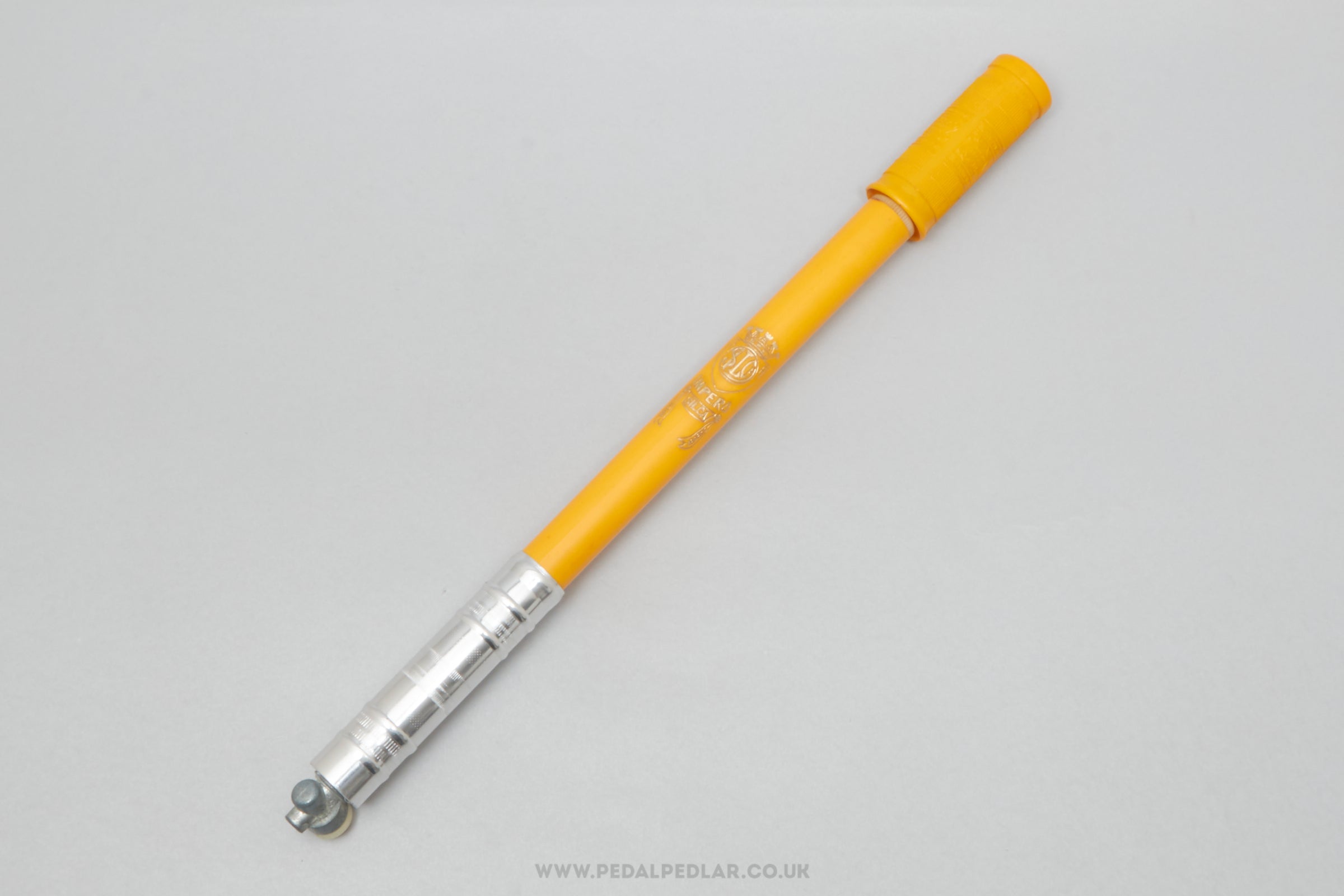


Silca Impero Flat Top NOS Vintage Yellow 39.5 - 43 cm Frame Peg Fit Bike Pump
£72.25 £85.00
✓ Original pump - in production from the 1950s to the 1960s
✓ New old stock! Still unused after all these years
✓ Suitable for historic cycling events such as L'Eroica
✓ Worldwide shipping
Silca Impero bicycle pump, hailing from Italy and in production from the 1950s to the 1960s (yet still new & unused after all this time!). An excellent choice for vintage cycling enthusiasts, but great for cyclists of the non-vintage variety too!
If you're taking part in L'Eroica or any other vintage event, this is fully compliant - so rest assured, the pre-1987 police won't lock you up for having the wrong pump!
OVERVIEW
Production Era - 1950s & 1960s
Country - Italian
Material - Plastic
Weight - 131 g
Stock Code - D-PM-F28V
*New old stock items may have marks from storage over the years, and as we often have multiples they can vary from piece to piece, but they are always genuine new & unused items.
TECHNICAL INFO
Colour* - Yellow
Valve Type - Presta
Pump Mount Type - Peg / Clip Fit (Needs Retaining Both Ends)
Mount Location** - Peg / Clip Dependent
Length (Min-Max) - 39.5 - 43 cm
*The colour description is just a guide, please check the photos too as we make sure these are as close to the true colour as possible.
**See help section.
-
▼SHIPPING, TAXES & RETURNS
-
We've been safely sending orders around the world since 2010. Orders are carefully packed, sent with tracking & insurance, and normally collected around midday on Tuesdays and Fridays. Larger items may occasionally require an extra day or two to prepare.
We accept returns, please notify us within 14 days and ensure the item arrives back with us no later than 30 days after the order was received.
EU orders under €150 (excluding shipping) - import VAT and the new €3 customs duty are paid as part of your order, so there's nothing further to pay on delivery.
EU orders over €150 (excluding shipping) - import fees are payable to the carrier before delivery, with nothing collected at checkout.
USA orders - import fees are collected at checkout for all orders to the USA, so there won’t be any surprise charges when your order arrives.
Other international orders - local import fees may apply and are not collected by us. Please check your country's import rules before purchasing.
-
▼HELP SECTION
-
Valve Type - there are 3 types of valves; Presta are thin with a little knurled nut on the end, Schrader are wider (the same as you would find on a car), and the less common Woods (aka "Dunlop"). Pumps designed for Presta valves can be used on Woods valves. Some pumps use hose connectors, these are available for all valve types.
Pump Mount Type - 'peg fit' pumps require pump pegs or 'umbrella' clips to fit to the frame, 'frame fit 'pumps are designed with curved ends to mount between two tubes (although these often have holes for pegs too). If mounting directly you'll need the correct length to fit your frame, or a clip/peg to hold one end.
Mount Location - frame fit pumps usually mount to the seat tube with the ends compressed between the top and down tube, they can however be mounted on other tubes as long as there's something supporting the handle end. Some head tubes have a little nipple or a small enough gap for under top tube mounting (this can be replcated with a simple strap or cable tie), and of course pump pegs or clips can be fitted anywhere!
Length (Min-Max) - the length of the pump fully compressed and uncompressed, measured at the points of support. The space you to intend to mount the pump should be within 1 cm of the minimum or maximum length to allow the pump to be securely mounted and dismounted.
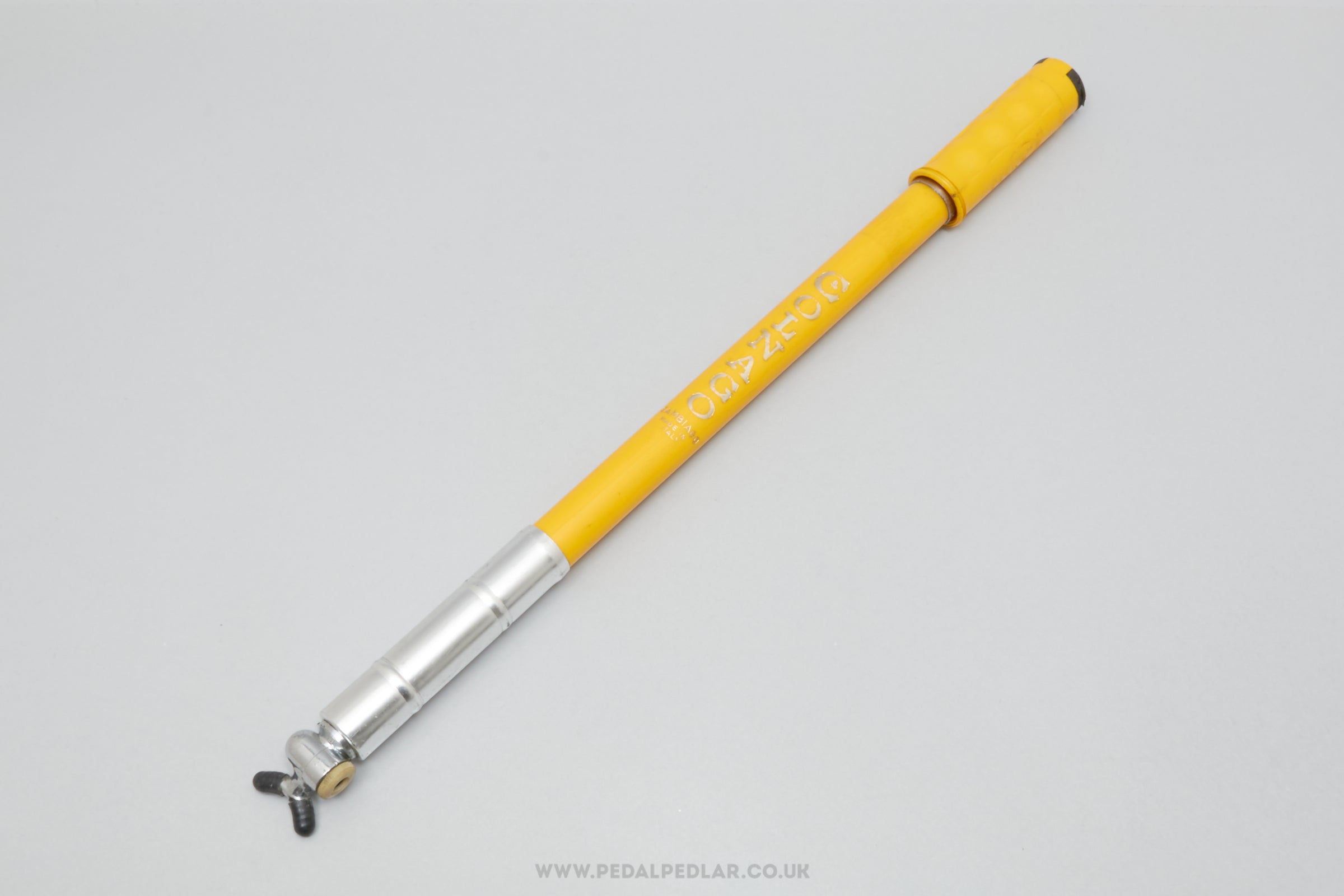


G.C Export Colnago Vintage Yellow 48 - 50 cm Frame Fit Bike Pump
£58.50 £65.00
✓ Original pump - produced in the 1970s
✓ Suitable for historic cycling events such as L'Eroica
✓ Checked & tested
✓ Worldwide shipping
G.C Export bicycle pump, hailing from Italy and in production during the 1970s. An excellent choice for vintage cycling enthusiasts, but great for cyclists of the non-vintage variety too!
If you're taking part in L'Eroica or any other vintage event, this is fully compliant - so rest assured, the pre-1987 police won't lock you up for having the wrong pump!
The pump's been thoroughly checked, tested and graded as very good condition, but do take a good look at the detailed photos so you can see the cosmetic condition before you buy.OVERVIEW
Condition Notes - Pump action is slightly stiff
Production Era - 1970s
Country - Italian
Material - Plastic
Weight - 143 g
Stock Code - U-PM-F25V
TECHNICAL INFO
Colour* - Yellow
Valve Type - Presta
Pump Mount Type - Frame Fit
Mount Location** - Seat Tube
Length (Min-Max) - 48 - 50 cm
*The colour description is just a guide, please check the photos too as we make sure these are as close to the true colour as possible.
**See help section.
-
▼SHIPPING, TAXES & RETURNS
-
We've been safely sending orders around the world since 2010. Orders are carefully packed, sent with tracking & insurance, and normally collected around midday on Tuesdays and Fridays. Larger items may occasionally require an extra day or two to prepare.
We accept returns, please notify us within 14 days and ensure the item arrives back with us no later than 30 days after the order was received.
EU orders under €150 (excluding shipping) - import VAT and the new €3 customs duty are paid as part of your order, so there's nothing further to pay on delivery.
EU orders over €150 (excluding shipping) - import fees are payable to the carrier before delivery, with nothing collected at checkout.
USA orders - import fees are collected at checkout for all orders to the USA, so there won’t be any surprise charges when your order arrives.
Other international orders - local import fees may apply and are not collected by us. Please check your country's import rules before purchasing.
-
▼HELP SECTION
-
Valve Type - there are 3 types of valves; Presta are thin with a little knurled nut on the end, Schrader are wider (the same as you would find on a car), and the less common Woods (aka "Dunlop"). Pumps designed for Presta valves can be used on Woods valves. Some pumps use hose connectors, these are available for all valve types.
Pump Mount Type - 'peg fit' pumps require pump pegs or 'umbrella' clips to fit to the frame, 'frame fit 'pumps are designed with curved ends to mount between two tubes (although these often have holes for pegs too). If mounting directly you'll need the correct length to fit your frame, or a clip/peg to hold one end.
Mount Location - frame fit pumps usually mount to the seat tube with the ends compressed between the top and down tube, they can however be mounted on other tubes as long as there's something supporting the handle end. Some head tubes have a little nipple or a small enough gap for under top tube mounting (this can be replcated with a simple strap or cable tie), and of course pump pegs or clips can be fitted anywhere!
Length (Min-Max) - the length of the pump fully compressed and uncompressed, measured at the points of support. The space you to intend to mount the pump should be within 1 cm of the minimum or maximum length to allow the pump to be securely mounted and dismounted.
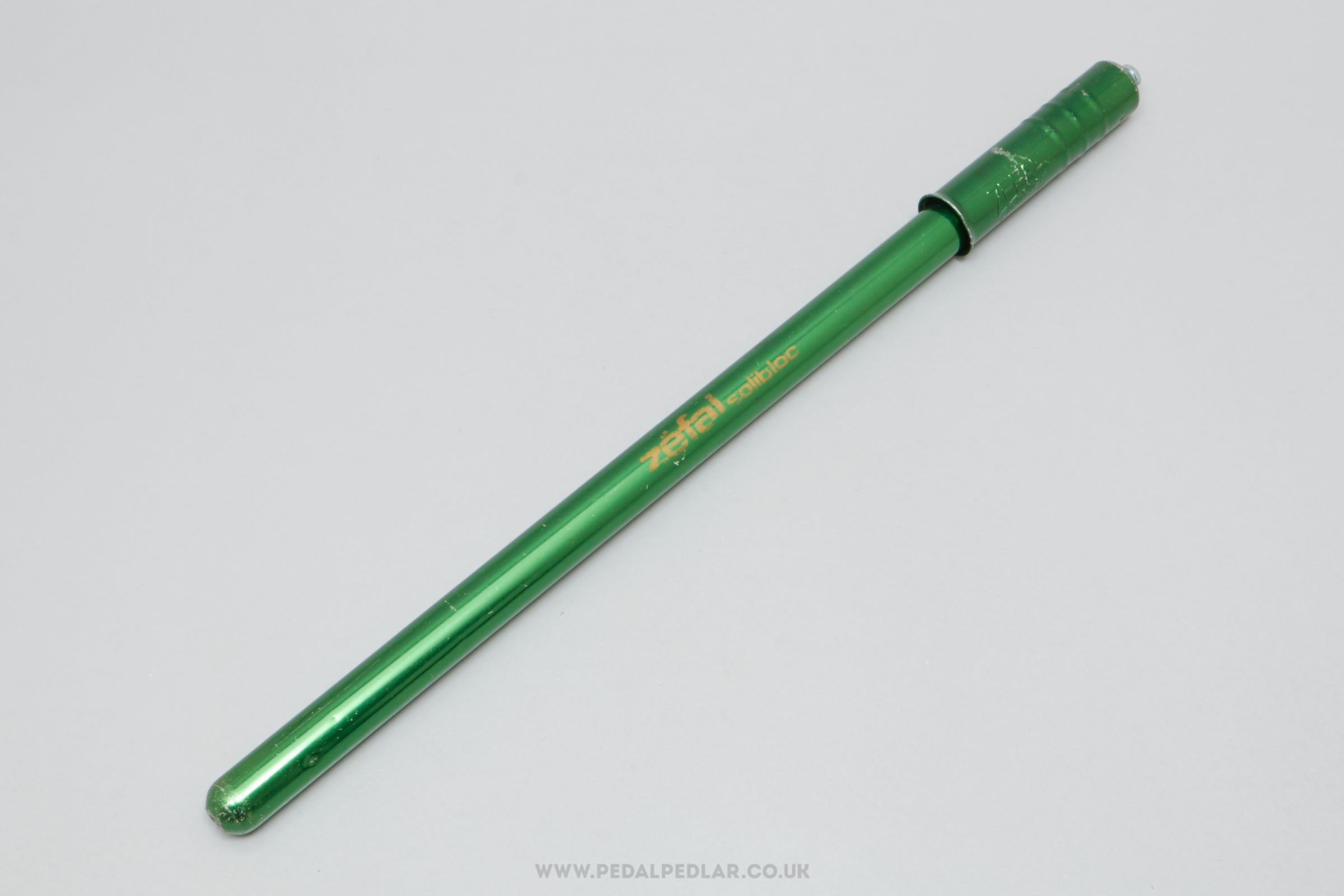


Zefal Solibloc Green Vintage Green 46.5 - 48 cm Frame Peg Fit Bike Pump
£67.50 £75.00
✓ Original pump - in production from the 1950s to the 1980s
✓ Suitable for historic cycling events such as L'Eroica
✓ Checked & tested
✓ Worldwide shipping
Zefal Solibloc bicycle pump, hailing from France and in production from the 1950s to the 1970s. An excellent choice for vintage cycling enthusiasts, but great for cyclists of the non-vintage variety too!
If you're taking part in L'Eroica or any other vintage event, this is fully compliant - so rest assured, the pre-1987 police won't lock you up for having the wrong pump!
The pump's been thoroughly checked, tested and graded as very good condition, but do take a good look at the detailed photos so you can see the cosmetic condition before you buy.OVERVIEW
Production Era - 1950s - 1970s
Country - French
Material - Aluminium
Weight - 127 g
Stock Code - U-PM-F18V
TECHNICAL INFO
Colour* - Green
Valve Type - Hose Connector (Presta/Woods Supplied)
Pump Mount Type - Peg / Clip Fit (Needs Retaining Both Ends)
Mount Location** - Peg / Clip Dependent
Length (Min-Max) - 46.5 - 48 cm
*The colour description is just a guide, please check the photos too as we make sure these are as close to the true colour as possible.
**See help section.
-
▼SHIPPING, TAXES & RETURNS
-
We've been safely sending orders around the world since 2010. Orders are carefully packed, sent with tracking & insurance, and normally collected around midday on Tuesdays and Fridays. Larger items may occasionally require an extra day or two to prepare.
We accept returns, please notify us within 14 days and ensure the item arrives back with us no later than 30 days after the order was received.
EU orders under €150 (excluding shipping) - import VAT and the new €3 customs duty are paid as part of your order, so there's nothing further to pay on delivery.
EU orders over €150 (excluding shipping) - import fees are payable to the carrier before delivery, with nothing collected at checkout.
USA orders - import fees are collected at checkout for all orders to the USA, so there won’t be any surprise charges when your order arrives.
Other international orders - local import fees may apply and are not collected by us. Please check your country's import rules before purchasing.
-
▼HELP SECTION
-
Valve Type - there are 3 types of valves; Presta are thin with a little knurled nut on the end, Schrader are wider (the same as you would find on a car), and the less common Woods (aka "Dunlop"). Pumps designed for Presta valves can be used on Woods valves. Some pumps use hose connectors, these are available for all valve types.
Pump Mount Type - 'peg fit' pumps require pump pegs or 'umbrella' clips to fit to the frame, 'frame fit 'pumps are designed with curved ends to mount between two tubes (although these often have holes for pegs too). If mounting directly you'll need the correct length to fit your frame, or a clip/peg to hold one end.
Mount Location - frame fit pumps usually mount to the seat tube with the ends compressed between the top and down tube, they can however be mounted on other tubes as long as there's something supporting the handle end. Some head tubes have a little nipple or a small enough gap for under top tube mounting (this can be replcated with a simple strap or cable tie), and of course pump pegs or clips can be fitted anywhere!
Length (Min-Max) - the length of the pump fully compressed and uncompressed, measured at the points of support. The space you to intend to mount the pump should be within 1 cm of the minimum or maximum length to allow the pump to be securely mounted and dismounted.
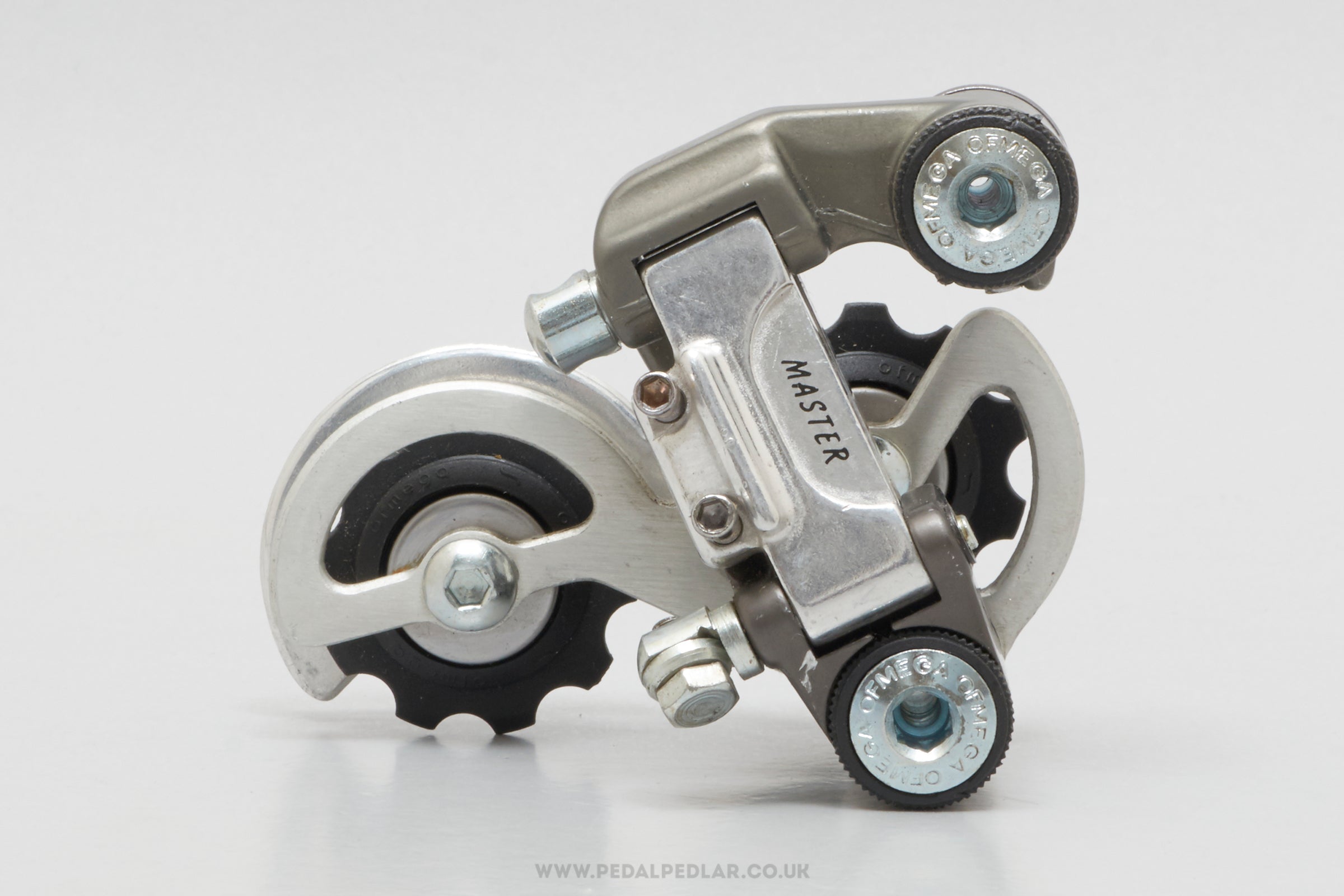


Ofmega Master NOS Vintage Rear Derailleur
£86.25 £115.00
✓ Original part - produced in the 1980s
✓ New old stock! Still unused after all these years
✓ Lightweight for the era - just 210 grams
✓ Suitable for historic cycling events such as L'Eroica
✓ Worldwide shipping
Ofmega Master rear derailleur (or mech if you prefer), hailing from Italy and in production during the 1980s (yet still new & unused after all this time!). Made from aluminium and weighing in at 210 grams - pretty lightweight for a rear derailleur at that time. A fine choice for keeping your vintage bike authentic, but also great for any other compatible bike.
If you're taking part in L'Eroica or a similar vintage event, this is fully compliant - so rest assured, the pre-1987 police won't lock you up for having the wrong rear mech!
OVERVIEW
Jockey Wheel Condition - New Old Stock*
Production Era - 1980s
Country - Italian
Material - Aluminium
Weight - 210 g
Stock Code - D-RM122V
*New old stock items may have marks from storage over the years, and as we often have multiples they can vary from piece to piece, but they are always genuine new & unused items.
TECHNICAL INFO
Shifting System - Friction
Speed* - 5 Speed, 6 Speed, 7 Speed
Max Cog Size - 26 Teeth
Max Chain Wrap - 26
Chain Width - 3/32" (Standard)
*See help section.
-
▼SHIPPING, TAXES & RETURNS
-
We've been safely sending orders around the world since 2010. Orders are carefully packed, sent with tracking & insurance, and normally collected around midday on Tuesdays and Fridays. Larger items may occasionally require an extra day or two to prepare.
We accept returns, please notify us within 14 days and ensure the item arrives back with us no later than 30 days after the order was received.
EU orders under €150 (excluding shipping) - import VAT and the new €3 customs duty are paid as part of your order, so there's nothing further to pay on delivery.
EU orders over €150 (excluding shipping) - import fees are payable to the carrier before delivery, with nothing collected at checkout.
USA orders - import fees are collected at checkout for all orders to the USA, so there won’t be any surprise charges when your order arrives.
Other international orders - local import fees may apply and are not collected by us. Please check your country's import rules before purchasing.
-
▼HELP SECTION
-
Shifting system - friction means your gear levers don't click when you change gear, when they do click it's referred to as indexed shifting. If you have indexed gear levers they must use the same system as the rear derailleur, if you're using friction levers you can mix and match.
Speed - the number of cogs at the back the derailleur was designed to be used with. This is important with indexed shifting, but with friction shifters you can in theory run any rear mech with any number of cogs, but you are more likely to have issues running high numbers of cogs with mechs from earlier eras.
Max cog size - the amount of teeth on the largest cog of your freewheel/cassette can be no greater than this to work with this derailleur.
Chain wrap - subtract the size of your smallest rear cog from your biggest, then do the same with your chainrings, add the 2 numbers together and you have your chain wrap.
Chain width - generally speaking, derailleurs designed for more than 3 speed use will fit a standard 3/32'' chain, the exception being some Cyclo & Simplex models from around the mid 1900s.
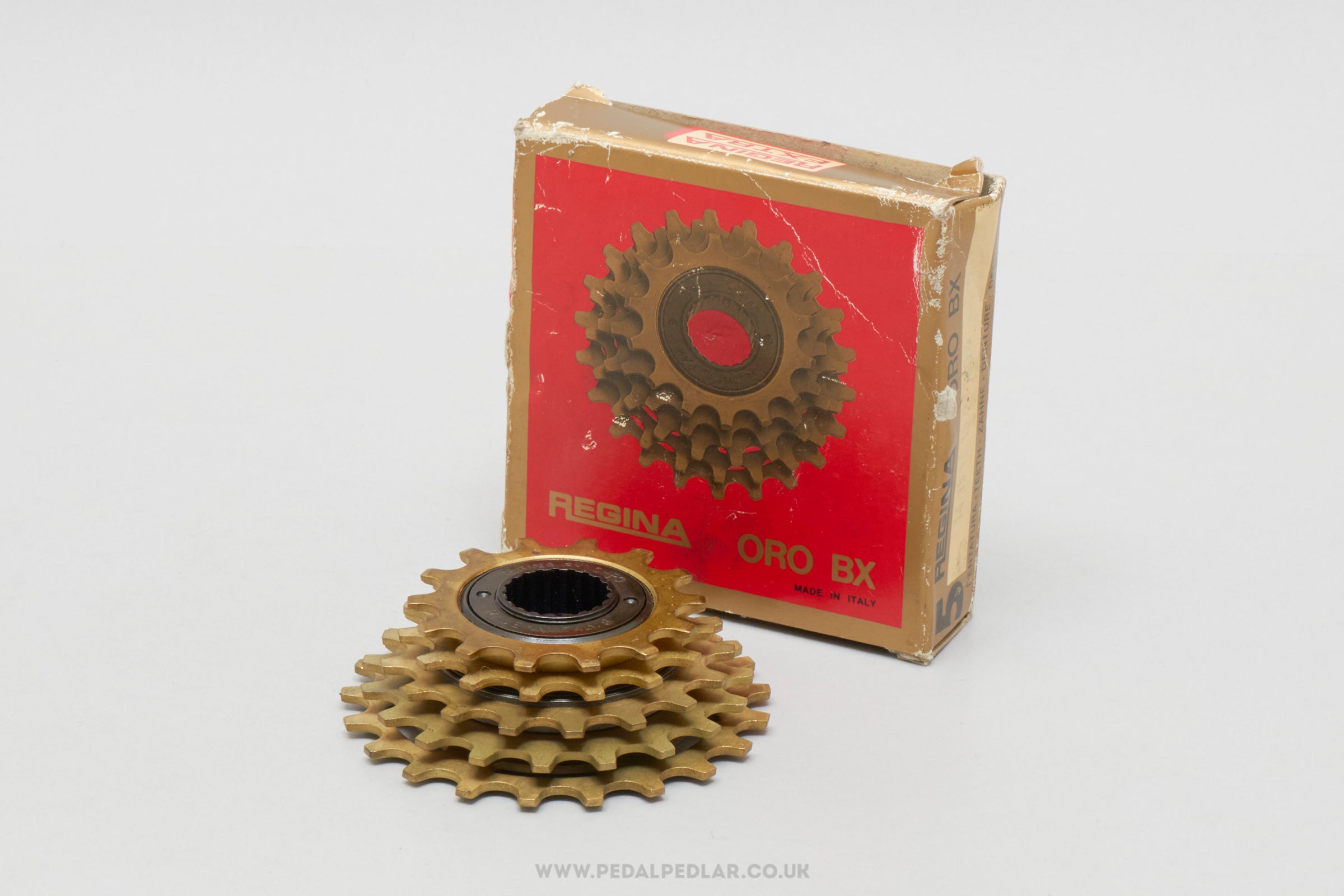


Regina Extra BX Oro NOS/NIB Vintage 5 Speed 14-21 Freewheel
£63.75 £85.00
✓ Original part - produced in the 1980s
✓ New old stock & still in the original packaging!
✓ Suitable for historic cycling events such as L'Eroica
✓ Worldwide shipping
Regina Extra BX freewheel, hailing from Italy and in production during the 1980s (yet still new & unused after all this time!). Made from steel and weighing in at 357 grams. A fine choice for keeping your vintage bike authentic, but also great for any other compatible bike.
If you're taking part in L'Eroica or a similar vintage event, this is fully compliant - so rest assured, the pre-1987 police won't lock you up for having the wrong freewheel!
OVERVIEW
Production Era - 1980s
Country - Italian
Material - Steel
Weight - 357 g
Stock Code - D-FW183V
NB - Freewheel body is marked Synchro, but the cogs are standard profile BX Oro.
*New old stock items may have marks from storage over the years, and as we often have multiples they can vary from piece to piece, but they are always genuine new & unused items.
TECHNICAL INFO
Speed - 5 Speed
Range - 14-21
Threading - English/ISO: 1.375 x 24 TPI
Stack Height - 27.5 mm
Cog Width - 3/32" (Standard)
-
▼SHIPPING, TAXES & RETURNS
-
We've been safely sending orders around the world since 2010. Orders are carefully packed, sent with tracking & insurance, and normally collected around midday on Tuesdays and Fridays. Larger items may occasionally require an extra day or two to prepare.
We accept returns, please notify us within 14 days and ensure the item arrives back with us no later than 30 days after the order was received.
EU orders under €150 (excluding shipping) - import VAT and the new €3 customs duty are paid as part of your order, so there's nothing further to pay on delivery.
EU orders over €150 (excluding shipping) - import fees are payable to the carrier before delivery, with nothing collected at checkout.
USA orders - import fees are collected at checkout for all orders to the USA, so there won’t be any surprise charges when your order arrives.
Other international orders - local import fees may apply and are not collected by us. Please check your country's import rules before purchasing.
-
▼HELP SECTION
-
Speed - the number of cogs on the freewheel.
Range - the number of teeth on the smalles and largest cogs, this gives you an indication of how hard or easy the gearing will be, the lower the number the harder the gears. The tooth count of the cogs inbetween are usually evenly spaced, ie: a 6 speed 14-24 freewheel would likely have cog sizes 14, 16, 18, 20, 22 & 24.
Threading - this needs to match the thread of your rear hub. ISO is the modern standard and is almost exactly the same as older English/British and Italian thread, allowing you to mix and match between these thread types as long as it's not going to be under extreme force, in which case it's best to stick to an exact match. Hubs with a French thread must be used with a French threaded freewheel.
Stack Height - the total height (or width if you're looking at it when installed) of the freewheel, this is measured from the base (back of the largest cog) to the top (front of the smallest cog).
Cog width - this is mainly relevant for singlespeed and some older 3 or 4 speed freewheels - if this is ⅛” then you must use a ⅛” chain, but most freewheels (especially multiple speed ones) will use a standard 3/32” chain.
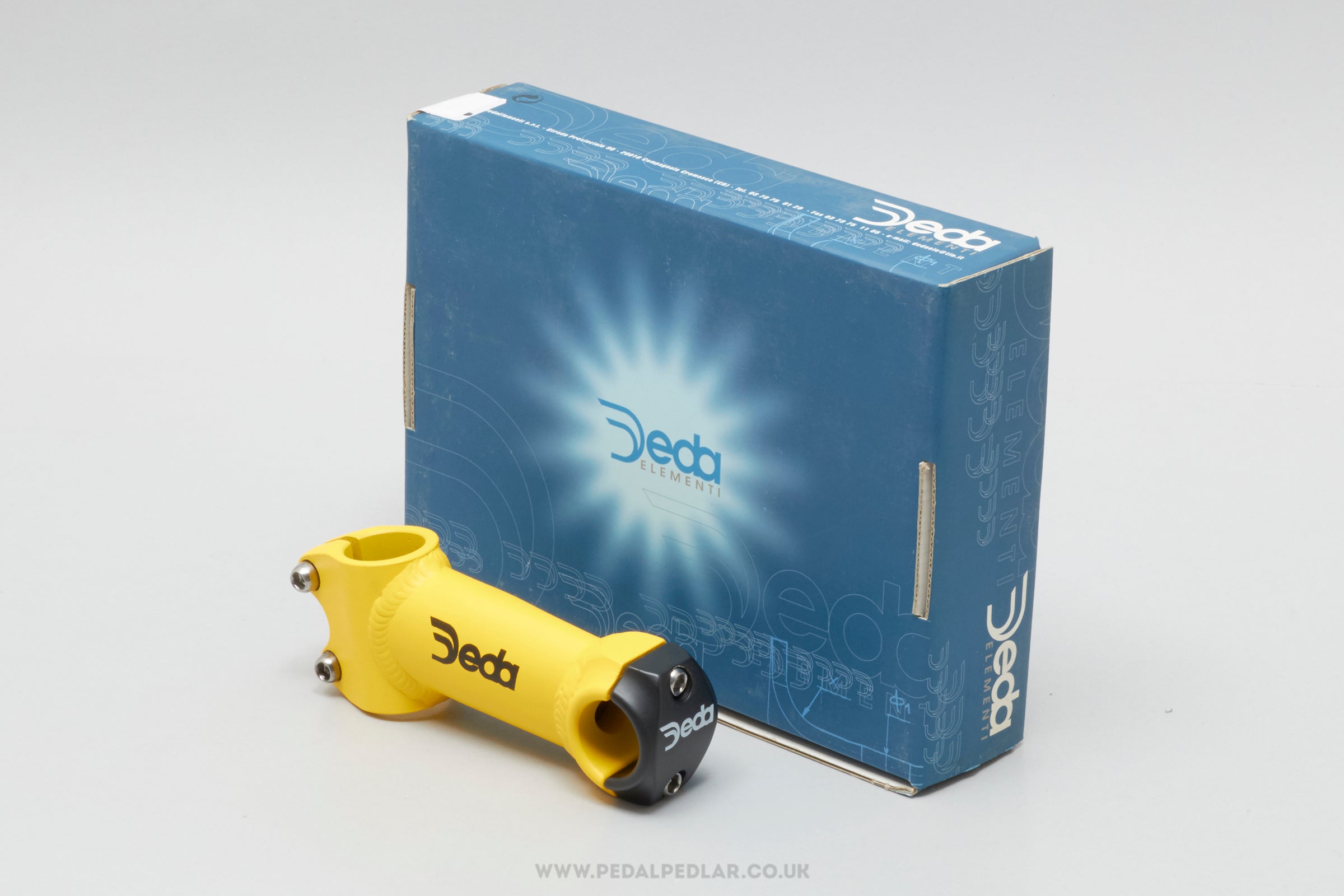


Deda Elementi Lynx Yellow NOS/NIB Classic 100 mm 1" A-Head Stem
£60.00
✓ Original part - produced in the 1990s
✓ New old stock & still in the original packaging!
✓ Worldwide shipping
Deda Elementi Lynx ahead handlebar stem, hailing from Italy and in production during the 1990s (yet still new & unused after all this time!). Made from aluminium and weighing in at 197 grams. A fine choice for keeping your classic bike authentic, but also great for any other compatible bike.
OVERVIEW
Production Era - 1990s
Country - Italian
Material - Aluminium
Weight - 197 g
Stock Code - D-STA38C
*New old stock items may have marks from storage over the years, and as we often have multiples they can vary from piece to piece, but they are always genuine new & unused items.
TECHNICAL INFO
Extension Length (ctc)* - 100 mm
Steerer Size (OD) - 1" (25.4 mm)
Bar Clamp Size - 26.0 mm
Stack Height - 50 mm
Angle - 78 Degrees
*See help section.
-
▼SHIPPING, TAXES & RETURNS
-
We've been safely sending orders around the world since 2010. Orders are carefully packed, sent with tracking & insurance, and normally collected around midday on Tuesdays and Fridays. Larger items may occasionally require an extra day or two to prepare.
We accept returns, please notify us within 14 days and ensure the item arrives back with us no later than 30 days after the order was received.
EU orders under €150 (excluding shipping) - import VAT and the new €3 customs duty are paid as part of your order, so there's nothing further to pay on delivery.
EU orders over €150 (excluding shipping) - import fees are payable to the carrier before delivery, with nothing collected at checkout.
USA orders - import fees are collected at checkout for all orders to the USA, so there won’t be any surprise charges when your order arrives.
Other international orders - local import fees may apply and are not collected by us. Please check your country's import rules before purchasing.
-
▼HELP SECTION
-
Extension Length (ctc)* - measured from the centre of the handlebar clamp to the centre of the steerer clamp, to the nearest 5 mm. This measurement is taken through the middle of the extension, not along the top or bottom.
Steerer Size (OD) - OD means outside diameter, this is the most important measurement when checking the stem fits your bike. This should match the measurement of the outside of your fork's steerer column, where the stem will be clamped.
Bar Clamp Size - this should match the outside diameter of your handlebars and should be as close as possible to ensure a good and safe fit.
Stack Height - the height of the part that clamps to the forks. This is the minimum amount of space you will need on the fork's steerer column for the stem to fit (minus a few mm as the top of the steerer tube needs to sit just below the top of the stem).
Angle - the angle of the stem's extension in relation to the the fork steerer. Bear in mind the steerer sits at the same angle as the head tube, so a 90 degree stem would not be parallel to the ground. Some manufacturers refer to this as rise or drop, in which case an 80 degree stem would drop 10 degrees from a right angle. Most a-head stems can be flipped although it does depend on the design.
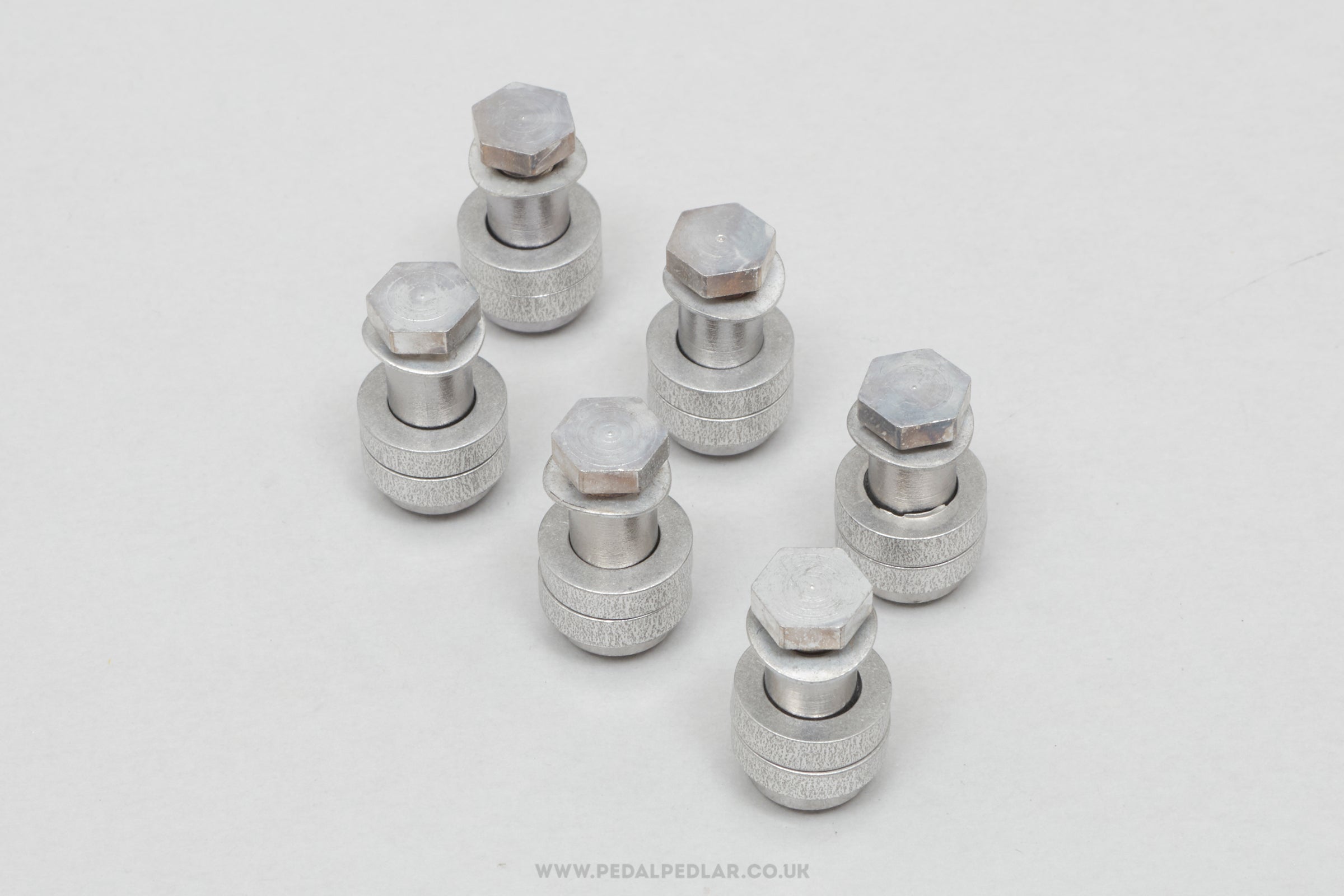


Specialites T.A. Cyclotourist (86) 6 Vis NOS/NIB Vintage Triple 50.4 BCD Chainring Bolts Set
£63.75 £75.00
✓ Original parts - in production from the 1970s to the 1980s
✓ New old stock & still in the original packaging!
✓ Suitable for historic cycling events such as L'Eroica
✓ Worldwide shipping
Specialites T.A. Cyclotourist set of chainring bolts (or screws if you prefer), hailing from France and in production from the 1970s to the 1980s (yet still new & unused after all this time!). Made from steel and weighing in at 42 grams. A fine choice for keeping your vintage bike authentic, but also great for any other compatible bike.
If you're taking part in L'Eroica, Anjou Velo, Velo Retro or another similar vintage cycling event, these are fully compliant - so rest assured, the pre-1987 police won't lock you up for having the wrong chainring bolts!
OVERVIEW
Model ID - 86
Production Era - 1970s & 1980s
Country - French
Material - Steel
Weight - 42 g
Stock Code - D-CRB63V
*New old stock items may have marks from storage over the years, and as we often have multiples they can vary from piece to piece, but they are always genuine new & unused items.
TECHNICAL INFO
Chainring Count - Triple
Crank Type - 50.4 BCD
Mount Type - Inner to Middle & Outer Chainring
Back Nut Length (Excluding Head) - 13 mm
Spacer Depth - 3.5 mm
-
▼SHIPPING, TAXES & RETURNS
-
We've been safely sending orders around the world since 2010. Orders are carefully packed, sent with tracking & insurance, and normally collected around midday on Tuesdays and Fridays. Larger items may occasionally require an extra day or two to prepare.
We accept returns, please notify us within 14 days and ensure the item arrives back with us no later than 30 days after the order was received.
EU orders under €150 (excluding shipping) - import VAT and the new €3 customs duty are paid as part of your order, so there's nothing further to pay on delivery.
EU orders over €150 (excluding shipping) - import fees are payable to the carrier before delivery, with nothing collected at checkout.
USA orders - import fees are collected at checkout for all orders to the USA, so there won’t be any surprise charges when your order arrives.
Other international orders - local import fees may apply and are not collected by us. Please check your country's import rules before purchasing.
-
▼HELP SECTION
-
Chainring Count - the number of chainrings the bolts are designed to fit, this must be the same as the number of chainrings you are using.
Crank Type - Most cranks require the standard 5-bolt sets that consist of 5 bolts with backs that slot into the rear of the crank spider, there are also some less common cranks with 3 arms that require the 3-arm chainring bolts. Specialites T.A. 'Professionel 5 Vis' and Stronglight '49D' type cranks require special 50.4 BCD chainring bolts that are specific to these crank designs.
Mount Type - most bolts simply fix the chainring to the crank, but some cranks require bolts to fix one chainring to another.
Back Nut Length (Excluding Head) - the more chainrings your crank has the longer the bolts and nuts need to be. We exclude the head part from the measurement (the bit that often sits recessed in back of the chainring).
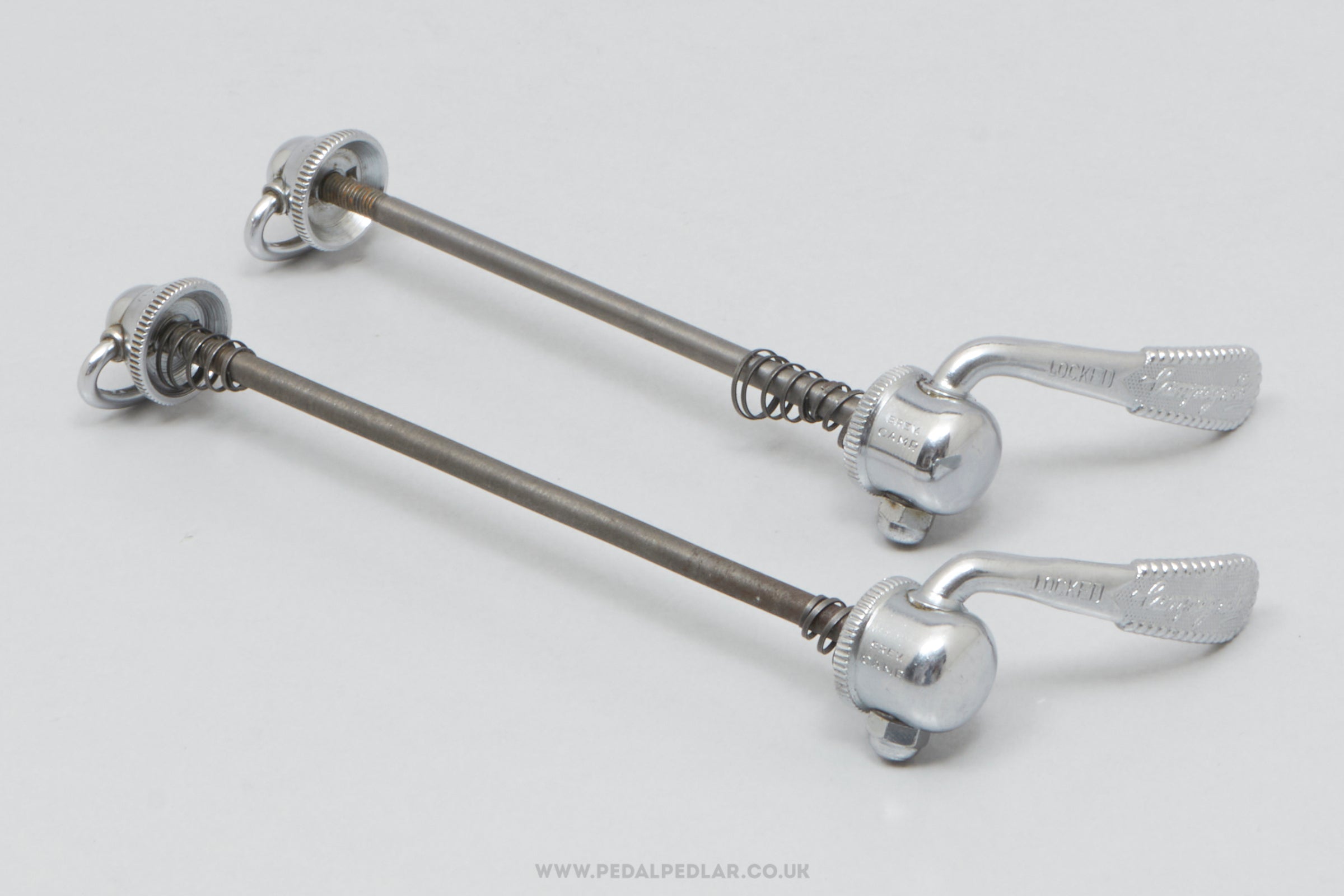


Campagnolo Nuovo/Super Record (1001/3 / 1006/8) Vintage Quick Release Skewers
£76.50 £85.00
✓ Original skewers - in production from the 1970s to the 1980s
✓ Suitable for historic cycling events such as L'Eroica
✓ Checked & cleaned
✓ Worldwide shipping
Campagnolo Nuovo/Super Record a pair of wheel skewers (or hub spindles if you prefer), hailing from Italy and in production from the 1970s to the 1980s. The design is of the ’post-CPSC’ era produced from around 1978 onwards. Made from steel and weighing in at 174 grams. A fine choice for keeping your vintage bike authentic, but also great for any other compatible bike.
If you're taking part in L'Eroica or any other vintage event, these are fully compliant - so rest assured, the pre-1987 police won't lock you up for having the wrong skewers!
The skewers have been cleaned, checked by one of our mechanics and graded as very good condition, but do take a good look at the detailed photos so you can see the cosmetic condition before you buy.OVERVIEW
Model ID - 1001/3 / 1006/8
Production Era - 1970s & 1980s
Country - Italian
Material - Steel
Weight - 174 g
Stock Code - U-SKW33V
TECHNICAL INFO
Skewer Type - Quick Release
Spacing* (F / R) ie: 110 mm / 130 mm - 113 mm / 135 mm
Threaded Section - 23 mm
End Nut Length - 15 mm
*See help section.
-
▼SHIPPING, TAXES & RETURNS
-
We've been safely sending orders around the world since 2010. Orders are carefully packed, sent with tracking & insurance, and normally collected around midday on Tuesdays and Fridays. Larger items may occasionally require an extra day or two to prepare.
We accept returns, please notify us within 14 days and ensure the item arrives back with us no later than 30 days after the order was received.
EU orders under €150 (excluding shipping) - import VAT and the new €3 customs duty are paid as part of your order, so there's nothing further to pay on delivery.
EU orders over €150 (excluding shipping) - import fees are payable to the carrier before delivery, with nothing collected at checkout.
USA orders - import fees are collected at checkout for all orders to the USA, so there won’t be any surprise charges when your order arrives.
Other international orders - local import fees may apply and are not collected by us. Please check your country's import rules before purchasing.
-
▼HELP SECTION
-
Skewer type - quick release skewers allow you to remove the wheel without any tools, whereas allen key and security skewers require a tool to allow the wheel to be removed.
*Spacing - this should be within a few milimetres of your frame & fork's outer dropout spacing (measured from the outside where the skewers clamp down). The measurement provided was taken with the exiting hole of the end nut flush with the end of the skewer. There will be some wiggle room to allow a narrower or wider dropout spacing to fit, we've provided the threaded section and end nut measurements to give you an indication of how much.
Threaded section - the amount of thread on the skewers for the end nut to be threaded onto.
End nut length - the total length of the nut from end to end.


Rito Green Anodised NOS Classic 560 mm Flat/Straight Handlebars
£50.00
✓ Original bars - produced in the 1990s
✓ New old stock! Still unused after all these years
✓ Worldwide shipping
Rito handlebars, in production during the 1990s (yet still new & unused after all this time!). Made from aluminium and weighing in at 174 grams. A fine choice for keeping your classic bike authentic, but also great for any other compatible bike.
OVERVIEW
Production Era - 1990s
Material - Aluminium
Weight - 174 g
Stock Code - D-HBF52C
*New old stock items may have marks from storage over the years, and as we often have multiples they can vary from piece to piece, but they are always genuine new & unused items.
TECHNICAL INFO
Width (outside to outside) - 560 mm
Bar Type - Flat/Straight
Clamp Size - 25.4 mm
Grip Diameter - 22.2 mm
-
▼SHIPPING, TAXES & RETURNS
-
We've been safely sending orders around the world since 2010. Orders are carefully packed, sent with tracking & insurance, and normally collected around midday on Tuesdays and Fridays. Larger items may occasionally require an extra day or two to prepare.
We accept returns, please notify us within 14 days and ensure the item arrives back with us no later than 30 days after the order was received.
EU orders under €150 (excluding shipping) - import VAT and the new €3 customs duty are paid as part of your order, so there's nothing further to pay on delivery.
EU orders over €150 (excluding shipping) - import fees are payable to the carrier before delivery, with nothing collected at checkout.
USA orders - import fees are collected at checkout for all orders to the USA, so there won’t be any surprise charges when your order arrives.
Other international orders - local import fees may apply and are not collected by us. Please check your country's import rules before purchasing.
-
▼HELP SECTION
-
Width - the total width at its widest point, from end to end, rounded to the nearest cm.
Clamp Size - this should match the internal diameter of your handlebar stem clamp, and should be as close as possible to ensure a good and safe fit.
Grip Diameter - the outside diameter of the area where handlebar grips are fitted, this determines not only what grips will fit but brake levers too so it's important to check if you have a specific setup in mind.
Rise/Drop - we measure this at the end of the bars, from the centre point of the clamp area to the centre of the end. This measurent can change when the bar is rotated so there is a bit of tolerance here, please use this as an approximate measurement only.


Arius Fangio Branded NOS Vintage Black Saddle
£63.75 £85.00
✓ Original saddle - produced in the 1970s
✓ New old stock! Still unused after all these years
✓ Suitable for historic cycling events such as L'Eroica
✓ Worldwide shipping
Arius saddle, hailing from Spain and in production during the 1970s (yet still new & unused after all this time!). Made from leather/steel material and weighing in at 329 grams. A fine choice for keeping your vintage bike authentic, but also great for any other compatible bike.
If you're taking part in L'Eroica or a similar vintage event, this is fully compliant - so rest assured, the pre-1987 police won't lock you up for having the wrong saddle!
OVERVIEW
Production Era - 1970s
Country - Spanish
Material - Leather / Steel
Weight - 329 g
Stock Code - D-SA209V
*New old stock items may have marks from storage over the years, and as we often have multiples they can vary from piece to piece, but they are always genuine new & unused items.
TECHNICAL INFO
Colour* - Black
Cover Material - Vinyl (Imitation Leather)
Length - 270 mm
Width (Widest Point) - 150 mm
*The colour description is just a guide, please check the photos to get a good idea of the colour too, as we make sure these are as close to the true colour as possible.
-
▼SHIPPING, TAXES & RETURNS
-
We've been safely sending orders around the world since 2010. Orders are carefully packed, sent with tracking & insurance, and normally collected around midday on Tuesdays and Fridays. Larger items may occasionally require an extra day or two to prepare.
We accept returns, please notify us within 14 days and ensure the item arrives back with us no later than 30 days after the order was received.
EU orders under €150 (excluding shipping) - import VAT and the new €3 customs duty are paid as part of your order, so there's nothing further to pay on delivery.
EU orders over €150 (excluding shipping) - import fees are payable to the carrier before delivery, with nothing collected at checkout.
USA orders - import fees are collected at checkout for all orders to the USA, so there won’t be any surprise charges when your order arrives.
Other international orders - local import fees may apply and are not collected by us. Please check your country's import rules before purchasing.


Arius Amateur NOS Vintage Black Saddle
£63.75 £85.00
✓ Original saddle - produced in the 1970s
✓ New old stock! Still unused after all these years
✓ Suitable for historic cycling events such as L'Eroica
✓ Worldwide shipping
Arius Amateur saddle, hailing from Spain and in production during the 1970s (yet still new & unused after all this time!). Made from leather/steel material and weighing in at 335 grams. A fine choice for keeping your vintage bike authentic, but also great for any other compatible bike.
If you're taking part in L'Eroica or a similar vintage event, this is fully compliant - so rest assured, the pre-1987 police won't lock you up for having the wrong saddle!
OVERVIEW
Production Era - 1970s
Country - Spanish
Material - Leather / Steel
Weight - 335 g
Stock Code - D-SA208V
*New old stock items may have marks from storage over the years, and as we often have multiples they can vary from piece to piece, but they are always genuine new & unused items.
TECHNICAL INFO
Colour* - Black
Cover Material - Vinyl (Imitation Leather)
Length - 280 mm
Width (Widest Point) - 150 mm
*The colour description is just a guide, please check the photos to get a good idea of the colour too, as we make sure these are as close to the true colour as possible.
-
▼SHIPPING, TAXES & RETURNS
-
We've been safely sending orders around the world since 2010. Orders are carefully packed, sent with tracking & insurance, and normally collected around midday on Tuesdays and Fridays. Larger items may occasionally require an extra day or two to prepare.
We accept returns, please notify us within 14 days and ensure the item arrives back with us no later than 30 days after the order was received.
EU orders under €150 (excluding shipping) - import VAT and the new €3 customs duty are paid as part of your order, so there's nothing further to pay on delivery.
EU orders over €150 (excluding shipping) - import fees are payable to the carrier before delivery, with nothing collected at checkout.
USA orders - import fees are collected at checkout for all orders to the USA, so there won’t be any surprise charges when your order arrives.
Other international orders - local import fees may apply and are not collected by us. Please check your country's import rules before purchasing.


Selle San Marco GI-LUX S.L (311) Super Light Vintage Dark Brown Leather Saddle
£72.25 £85.00
✓ Original saddle - in production from the 1970s to the 1980s
✓ Thoroughly checked & photographed in detail
✓ Worldwide shipping
Selle San Marco GI-LUX S.L saddle, hailing from Italy and in production from the 1970s to the 1980s. Made from leather/aluminium material and weighing in at 252 grams. A fine choice for keeping your vintage bike authentic, but also great for any other compatible bike.
The saddle's been checked over and graded as good condition, but do take a good look at the detailed photos so you can see the cosmetic condition before you buy.OVERVIEW
Model ID - 311
Production Era - 1970s & 1980s
Country - Italian
Material - Leather / Aluminium
Weight - 252 g
Stock Code - U-SA205V
TECHNICAL INFO
Colour* - Dark Brown
Cover Material - Leather
Length - 280 mm
Width (Widest Point) - 140 mm
*The colour description is just a guide, please check the photos too as we make sure these are as close to the true colour as possible.
-
▼SHIPPING, TAXES & RETURNS
-
We've been safely sending orders around the world since 2010. Orders are carefully packed, sent with tracking & insurance, and normally collected around midday on Tuesdays and Fridays. Larger items may occasionally require an extra day or two to prepare.
We accept returns, please notify us within 14 days and ensure the item arrives back with us no later than 30 days after the order was received.
EU orders under €150 (excluding shipping) - import VAT and the new €3 customs duty are paid as part of your order, so there's nothing further to pay on delivery.
EU orders over €150 (excluding shipping) - import fees are payable to the carrier before delivery, with nothing collected at checkout.
USA orders - import fees are collected at checkout for all orders to the USA, so there won’t be any surprise charges when your order arrives.
Other international orders - local import fees may apply and are not collected by us. Please check your country's import rules before purchasing.


Selle Bassano Vuelta Airline Classic Black / White Leather Saddle
£63.75 £75.00
✓ Original saddle - produced in the 1990s
✓ Thoroughly checked & photographed in detail
✓ Worldwide shipping
Selle Bassano Vuelta saddle, hailing from Italy and in production during the 1990s. Made from leather/steel material and weighing in at 337 grams. A fine choice for keeping your classic bike authentic, but also great for any other compatible bike.
The saddle's been checked over and graded as good condition, but do take a good look at the detailed photos so you can see the cosmetic condition before you buy.OVERVIEW
Condition Notes - Some cracks to the plastic fairings as pictured, as was common with the Vuelta saddles.
Production Era - 1990s
Country - Italian
Material - Leather / Steel
Weight - 337 g
Stock Code - U-SA204C
NB - In original box with spare elastomers and instructions
TECHNICAL INFO
Colour* - Black / White
Cover Material - Leather
Length - 275 mm
Width (Widest Point) - 140 mm
*The colour description is just a guide, please check the photos to get a good idea of the colour too, as we make sure these are as close to the true colour as possible.
-
▼SHIPPING, TAXES & RETURNS
-
We've been safely sending orders around the world since 2010. Orders are carefully packed, sent with tracking & insurance, and normally collected around midday on Tuesdays and Fridays. Larger items may occasionally require an extra day or two to prepare.
We accept returns, please notify us within 14 days and ensure the item arrives back with us no later than 30 days after the order was received.
EU orders under €150 (excluding shipping) - import VAT and the new €3 customs duty are paid as part of your order, so there's nothing further to pay on delivery.
EU orders over €150 (excluding shipping) - import fees are payable to the carrier before delivery, with nothing collected at checkout.
USA orders - import fees are collected at checkout for all orders to the USA, so there won’t be any surprise charges when your order arrives.
Other international orders - local import fees may apply and are not collected by us. Please check your country's import rules before purchasing.


Selle Royal Vintage Black Leather Saddle
£55.25 £65.00
✓ Original saddle - in production from the 1970s to the 1980s
✓ Suitable for historic cycling events such as L'Eroica
✓ Thoroughly checked & photographed in detail
✓ Worldwide shipping
Selle Royal saddle, hailing from Italy and in production from the 1970s to the 1980s. Made from leather/steel material and weighing in at 405 grams. A fine choice for keeping your vintage bike authentic, but also great for any other compatible bike.
If you're taking part in L'Eroica or a similar vintage event, this is fully compliant - so rest assured, the pre-1987 police won't lock you up for having the wrong saddle!
The saddle's been checked over and graded as good condition, but do take a good look at the detailed photos so you can see the cosmetic condition before you buy.OVERVIEW
Production Era - 1970s & 1980s
Country - Italian
Material - Leather / Steel
Weight - 405 g
Stock Code - U-SA201V
TECHNICAL INFO
Colour* - Black
Cover Material - Leather
Length - 275 mm
Width (Widest Point) - 140 mm
*The colour description is just a guide, please check the photos to get a good idea of the colour too, as we make sure these are as close to the true colour as possible.
-
▼SHIPPING, TAXES & RETURNS
-
We've been safely sending orders around the world since 2010. Orders are carefully packed, sent with tracking & insurance, and normally collected around midday on Tuesdays and Fridays. Larger items may occasionally require an extra day or two to prepare.
We accept returns, please notify us within 14 days and ensure the item arrives back with us no later than 30 days after the order was received.
EU orders under €150 (excluding shipping) - import VAT and the new €3 customs duty are paid as part of your order, so there's nothing further to pay on delivery.
EU orders over €150 (excluding shipping) - import fees are payable to the carrier before delivery, with nothing collected at checkout.
USA orders - import fees are collected at checkout for all orders to the USA, so there won’t be any surprise charges when your order arrives.
Other international orders - local import fees may apply and are not collected by us. Please check your country's import rules before purchasing.


Tron & Berthet Ideale 70 Speciale Competition Vintage Dark Brown Leather Saddle
£63.75 £75.00
✓ Original saddle - in production from the 1960s to the 1970s
✓ Suitable for historic cycling events such as L'Eroica
✓ Thoroughly checked & photographed in detail
✓ Worldwide shipping
Tron & Berthet Ideale 70 saddle, hailing from France and in production from the 1960s to the 1970s. Made from leather/steel material and weighing in at 520 grams. A fine choice for keeping your vintage bike authentic, but also great for any other compatible bike.
If you're taking part in L'Eroica or a similar vintage event, this is fully compliant - so rest assured, the pre-1987 police won't lock you up for having the wrong saddle!
The saddle's been checked over and graded as good condition, but do take a good look at the detailed photos so you can see the cosmetic condition before you buy.OVERVIEW
Condition Notes - One rivet missing
Production Era - 1960s & 1970s
Country - French
Material - Leather / Steel
Weight - 520 g
Stock Code - U-SA199V
TECHNICAL INFO
Colour* - Dark Brown
Cover Material - Leather
Length - 270 mm
Width (Widest Point) - 150 mm
*The colour description is just a guide, please check the photos to get a good idea of the colour too, as we make sure these are as close to the true colour as possible.
-
▼SHIPPING, TAXES & RETURNS
-
We've been safely sending orders around the world since 2010. Orders are carefully packed, sent with tracking & insurance, and normally collected around midday on Tuesdays and Fridays. Larger items may occasionally require an extra day or two to prepare.
We accept returns, please notify us within 14 days and ensure the item arrives back with us no later than 30 days after the order was received.
EU orders under €150 (excluding shipping) - import VAT and the new €3 customs duty are paid as part of your order, so there's nothing further to pay on delivery.
EU orders over €150 (excluding shipping) - import fees are payable to the carrier before delivery, with nothing collected at checkout.
USA orders - import fees are collected at checkout for all orders to the USA, so there won’t be any surprise charges when your order arrives.
Other international orders - local import fees may apply and are not collected by us. Please check your country's import rules before purchasing.


Selle Italia Sprint Vintage Black Leather Saddle
£55.25 £65.00
✓ Original saddle - in production from the 1970s to the 1980s
✓ Suitable for historic cycling events such as L'Eroica
✓ Thoroughly checked & photographed in detail
✓ Worldwide shipping
Selle Italia Sprint saddle, hailing from Italy and in production from the 1970s to the 1980s. Made from leather/steel material and weighing in at 382 grams. A fine choice for keeping your vintage bike authentic, but also great for any other compatible bike.
If you're taking part in L'Eroica or a similar vintage event, this is fully compliant - so rest assured, the pre-1987 police won't lock you up for having the wrong saddle!
The saddle's been checked over and graded as very good condition, but do take a good look at the detailed photos so you can see the cosmetic condition before you buy.OVERVIEW
Production Era - 1970s & 1980s
Country - Italian
Material - Leather / Steel
Weight - 382 g
Stock Code - U-SA198V
TECHNICAL INFO
Colour* - Black
Cover Material - Leather (Suede)
Length - 275 mm
Width (Widest Point) - 140 mm
*The colour description is just a guide, please check the photos to get a good idea of the colour too, as we make sure these are as close to the true colour as possible.
-
▼SHIPPING, TAXES & RETURNS
-
We've been safely sending orders around the world since 2010. Orders are carefully packed, sent with tracking & insurance, and normally collected around midday on Tuesdays and Fridays. Larger items may occasionally require an extra day or two to prepare.
We accept returns, please notify us within 14 days and ensure the item arrives back with us no later than 30 days after the order was received.
EU orders under €150 (excluding shipping) - import VAT and the new €3 customs duty are paid as part of your order, so there's nothing further to pay on delivery.
EU orders over €150 (excluding shipping) - import fees are payable to the carrier before delivery, with nothing collected at checkout.
USA orders - import fees are collected at checkout for all orders to the USA, so there won’t be any surprise charges when your order arrives.
Other international orders - local import fees may apply and are not collected by us. Please check your country's import rules before purchasing.


Vintage Chesini Branded Brown Leather Saddle
£72.25 £85.00
✓ Original saddle - produced in the 1970s
✓ Suitable for historic cycling events such as L'Eroica
✓ Thoroughly checked & photographed in detail
✓ Worldwide shipping
Unbranded vintage saddle, most likely in production during the 1970s. Made from leather/steel material and weighing in at 397 grams. A fine choice for keeping your vintage bike authentic, but also great for any other compatible bike.
If you're taking part in L'Eroica or a similar vintage event, this is fully compliant - so rest assured, the pre-1987 police won't lock you up for having the wrong saddle!
The saddle's been checked over and graded as good condition, but do take a good look at the detailed photos so you can see the cosmetic condition before you buy.OVERVIEW
Production Era - 1970s
Material - Leather / Steel
Weight - 397 g
Stock Code - U-SA197V
NB - Seems to be a Selle Italia Sprint but Chesini branded
TECHNICAL INFO
Colour* - Brown
Cover Material - Leather (Suede)
Length - 275 mm
Width (Widest Point) - 150 mm
*The colour description is just a guide, please check the photos too as we make sure these are as close to the true colour as possible.
-
▼SHIPPING, TAXES & RETURNS
-
We've been safely sending orders around the world since 2010. Orders are carefully packed, sent with tracking & insurance, and normally collected around midday on Tuesdays and Fridays. Larger items may occasionally require an extra day or two to prepare.
We accept returns, please notify us within 14 days and ensure the item arrives back with us no later than 30 days after the order was received.
EU orders under €150 (excluding shipping) - import VAT and the new €3 customs duty are paid as part of your order, so there's nothing further to pay on delivery.
EU orders over €150 (excluding shipping) - import fees are payable to the carrier before delivery, with nothing collected at checkout.
USA orders - import fees are collected at checkout for all orders to the USA, so there won’t be any surprise charges when your order arrives.
Other international orders - local import fees may apply and are not collected by us. Please check your country's import rules before purchasing.


Velo Soffatti Riveted NOS Classic Black Saddle
£56.25 £75.00
✓ Original saddle - produced in the 1990s
✓ New old stock! Still unused after all these years
✓ Worldwide shipping
Velo Soffatti saddle, hailing from Taiwan and in production during the 1990s (yet still new & unused after all this time!). Made from synthetic/steel material and weighing in at 341 grams. A fine choice for keeping your classic bike authentic, but also great for any other compatible bike.
OVERVIEW
Production Era - 1990s
Country - Taiwanese
Material - Synthetic / Steel
Weight - 341 g
Stock Code - D-SA187C
*New old stock items may have marks from storage over the years, and as we often have multiples they can vary from piece to piece, but they are always genuine new & unused items.
TECHNICAL INFO
Colour* - Black
Cover Material - Synthetic
Length - 270 mm
Width (Widest Point) - 150 mm
*The colour description is just a guide, please check the photos to get a good idea of the colour too, as we make sure these are as close to the true colour as possible.
-
▼SHIPPING, TAXES & RETURNS
-
We've been safely sending orders around the world since 2010. Orders are carefully packed, sent with tracking & insurance, and normally collected around midday on Tuesdays and Fridays. Larger items may occasionally require an extra day or two to prepare.
We accept returns, please notify us within 14 days and ensure the item arrives back with us no later than 30 days after the order was received.
EU orders under €150 (excluding shipping) - import VAT and the new €3 customs duty are paid as part of your order, so there's nothing further to pay on delivery.
EU orders over €150 (excluding shipping) - import fees are payable to the carrier before delivery, with nothing collected at checkout.
USA orders - import fees are collected at checkout for all orders to the USA, so there won’t be any surprise charges when your order arrives.
Other international orders - local import fees may apply and are not collected by us. Please check your country's import rules before purchasing.


GES Soffatti Supra NOS Classic Black / Yellow Saddle
£56.25 £75.00
✓ Original saddle - produced in the 1990s
✓ New old stock! Still unused after all these years
✓ Worldwide shipping
GES Soffatti Supra saddle, hailing from Spain and in production during the 1990s (yet still new & unused after all this time!). Made from synthetic/plastic/steel material and weighing in at 318 grams. A fine choice for keeping your classic bike authentic, but also great for any other compatible bike.
OVERVIEW
Production Era - 1990s
Country - Spanish
Material - Synthetic / Plastic / Steel
Weight - 318 g
Stock Code - D-SA185C
*New old stock items may have marks from storage over the years, and as we often have multiples they can vary from piece to piece, but they are always genuine new & unused items.
TECHNICAL INFO
Colour* - Black / Yellow
Cover Material - Synthetic
Length - 270 mm
Width (Widest Point) - 130 mm
*The colour description is just a guide, please check the photos to get a good idea of the colour too, as we make sure these are as close to the true colour as possible.
-
▼SHIPPING, TAXES & RETURNS
-
We've been safely sending orders around the world since 2010. Orders are carefully packed, sent with tracking & insurance, and normally collected around midday on Tuesdays and Fridays. Larger items may occasionally require an extra day or two to prepare.
We accept returns, please notify us within 14 days and ensure the item arrives back with us no later than 30 days after the order was received.
EU orders under €150 (excluding shipping) - import VAT and the new €3 customs duty are paid as part of your order, so there's nothing further to pay on delivery.
EU orders over €150 (excluding shipping) - import fees are payable to the carrier before delivery, with nothing collected at checkout.
USA orders - import fees are collected at checkout for all orders to the USA, so there won’t be any surprise charges when your order arrives.
Other international orders - local import fees may apply and are not collected by us. Please check your country's import rules before purchasing.


Velo Soffatti Jet Perforated NOS Classic Black Saddle
£56.25 £75.00
✓ Original saddle - produced in the 1990s
✓ New old stock! Still unused after all these years
✓ Worldwide shipping
Velo Soffatti Jet saddle, hailing from Taiwan and in production during the 1990s (yet still new & unused after all this time!). Made from synthetic/steel material and weighing in at 271 grams. A fine choice for keeping your classic bike authentic, but also great for any other compatible bike.
OVERVIEW
Production Era - 1990s
Country - Taiwanese
Material - Synthetic / Steel
Weight - 271 g
Stock Code - D-SA183C
*New old stock items may have marks from storage over the years, and as we often have multiples they can vary from piece to piece, but they are always genuine new & unused items.
TECHNICAL INFO
Colour* - Black
Cover Material - Synthetic
Length - 260 mm
Width (Widest Point) - 140 mm
*The colour description is just a guide, please check the photos to get a good idea of the colour too, as we make sure these are as close to the true colour as possible.
-
▼SHIPPING, TAXES & RETURNS
-
We've been safely sending orders around the world since 2010. Orders are carefully packed, sent with tracking & insurance, and normally collected around midday on Tuesdays and Fridays. Larger items may occasionally require an extra day or two to prepare.
We accept returns, please notify us within 14 days and ensure the item arrives back with us no later than 30 days after the order was received.
EU orders under €150 (excluding shipping) - import VAT and the new €3 customs duty are paid as part of your order, so there's nothing further to pay on delivery.
EU orders over €150 (excluding shipping) - import fees are payable to the carrier before delivery, with nothing collected at checkout.
USA orders - import fees are collected at checkout for all orders to the USA, so there won’t be any surprise charges when your order arrives.
Other international orders - local import fees may apply and are not collected by us. Please check your country's import rules before purchasing.


Selle San Marco Concor Supercorsa Vintage Black Leather Saddle
£55.25 £65.00
✓ Original saddle - in production from the 1970s to the 1980s
✓ Suitable for historic cycling events such as L'Eroica
✓ Thoroughly checked & photographed in detail
✓ Worldwide shipping
Selle San Marco Concor Supercorsa saddle, hailing from Italy and in production from the 1970s to the 1980s. Made from leather/steel material and weighing in at 354 grams. A fine choice for keeping your vintage bike authentic, but also great for any other compatible bike.
If you're taking part in L'Eroica or a similar vintage event, this is fully compliant - so rest assured, the pre-1987 police won't lock you up for having the wrong saddle!
The saddle's been checked over and graded as very good condition, but do take a good look at the detailed photos so you can see the cosmetic condition before you buy.OVERVIEW
Condition Notes - One inch long nick in the top as pictured
Production Era - 1970s & 1980s
Country - Italian
Material - Leather / Steel
Weight - 354 g
Stock Code - U-SA178V
TECHNICAL INFO
Colour* - Black
Cover Material - Leather
Length - 250 mm
Width (Widest Point) - 140 mm
*The colour description is just a guide, please check the photos to get a good idea of the colour too, as we make sure these are as close to the true colour as possible.
-
▼SHIPPING, TAXES & RETURNS
-
We've been safely sending orders around the world since 2010. Orders are carefully packed, sent with tracking & insurance, and normally collected around midday on Tuesdays and Fridays. Larger items may occasionally require an extra day or two to prepare.
We accept returns, please notify us within 14 days and ensure the item arrives back with us no later than 30 days after the order was received.
EU orders under €150 (excluding shipping) - import VAT and the new €3 customs duty are paid as part of your order, so there's nothing further to pay on delivery.
EU orders over €150 (excluding shipping) - import fees are payable to the carrier before delivery, with nothing collected at checkout.
USA orders - import fees are collected at checkout for all orders to the USA, so there won’t be any surprise charges when your order arrives.
Other international orders - local import fees may apply and are not collected by us. Please check your country's import rules before purchasing.


GES Huracan Crono NOS/NIB Vintage White / Grey / Black Striped Saddle
£82.50 £110.00
✓ Original saddle - produced in the 1980s
✓ New old stock & still in the original packaging!
✓ Suitable for historic cycling events such as L'Eroica
✓ Worldwide shipping
GES Huracan Crono saddle, hailing from Spain and in production during the 1980s (yet still new & unused after all this time!). Made from synthetic/steel material and weighing in at 380 grams. A fine choice for keeping your vintage bike authentic, but also great for any other compatible bike.
If you're taking part in L'Eroica or a similar vintage event, this is fully compliant - so rest assured, the pre-1987 police won't lock you up for having the wrong saddle!
OVERVIEW
Production Era - 1980s
Country - Spanish
Material - Synthetic / Steel
Weight - 380 g
Stock Code - D-SA174V
*New old stock items may have marks from storage over the years, and as we often have multiples they can vary from piece to piece, but they are always genuine new & unused items.
TECHNICAL INFO
Colour* - White / Grey / Black Striped
Cover Material - Synthetic
Length - 280 mm
Width (Widest Point) - 150 mm
*The colour description is just a guide, please check the photos to get a good idea of the colour too, as we make sure these are as close to the true colour as possible.
-
▼SHIPPING, TAXES & RETURNS
-
We've been safely sending orders around the world since 2010. Orders are carefully packed, sent with tracking & insurance, and normally collected around midday on Tuesdays and Fridays. Larger items may occasionally require an extra day or two to prepare.
We accept returns, please notify us within 14 days and ensure the item arrives back with us no later than 30 days after the order was received.
EU orders under €150 (excluding shipping) - import VAT and the new €3 customs duty are paid as part of your order, so there's nothing further to pay on delivery.
EU orders over €150 (excluding shipping) - import fees are payable to the carrier before delivery, with nothing collected at checkout.
USA orders - import fees are collected at checkout for all orders to the USA, so there won’t be any surprise charges when your order arrives.
Other international orders - local import fees may apply and are not collected by us. Please check your country's import rules before purchasing.


GES Huracan Crono NOS/NIB Vintage Green / White / Black Striped Saddle
£82.50 £110.00
✓ Original saddle - produced in the 1980s
✓ New old stock & still in the original packaging!
✓ Suitable for historic cycling events such as L'Eroica
✓ Worldwide shipping
GES Huracan Crono saddle, hailing from Spain and in production during the 1980s (yet still new & unused after all this time!). Made from synthetic/steel material and weighing in at 373 grams. A fine choice for keeping your vintage bike authentic, but also great for any other compatible bike.
If you're taking part in L'Eroica or a similar vintage event, this is fully compliant - so rest assured, the pre-1987 police won't lock you up for having the wrong saddle!
OVERVIEW
Production Era - 1980s
Country - Spanish
Material - Synthetic / Steel
Weight - 373 g
Stock Code - D-SA173V
*New old stock items may have marks from storage over the years, and as we often have multiples they can vary from piece to piece, but they are always genuine new & unused items.
TECHNICAL INFO
Colour* - Green / White / Black Striped
Cover Material - Synthetic
Length - 280 mm
Width (Widest Point) - 150 mm
*The colour description is just a guide, please check the photos to get a good idea of the colour too, as we make sure these are as close to the true colour as possible.
-
▼SHIPPING, TAXES & RETURNS
-
We've been safely sending orders around the world since 2010. Orders are carefully packed, sent with tracking & insurance, and normally collected around midday on Tuesdays and Fridays. Larger items may occasionally require an extra day or two to prepare.
We accept returns, please notify us within 14 days and ensure the item arrives back with us no later than 30 days after the order was received.
EU orders under €150 (excluding shipping) - import VAT and the new €3 customs duty are paid as part of your order, so there's nothing further to pay on delivery.
EU orders over €150 (excluding shipping) - import fees are payable to the carrier before delivery, with nothing collected at checkout.
USA orders - import fees are collected at checkout for all orders to the USA, so there won’t be any surprise charges when your order arrives.
Other international orders - local import fees may apply and are not collected by us. Please check your country's import rules before purchasing.


GES Huracan Crono NOS/NIB Vintage Yellow / White / Black Striped Saddle
£82.50 £110.00
✓ Original saddle - produced in the 1980s
✓ New old stock & still in the original packaging!
✓ Suitable for historic cycling events such as L'Eroica
✓ Worldwide shipping
GES Huracan Crono saddle, hailing from Spain and in production during the 1980s (yet still new & unused after all this time!). Made from synthetic/steel material and weighing in at 395 grams. A fine choice for keeping your vintage bike authentic, but also great for any other compatible bike.
If you're taking part in L'Eroica or a similar vintage event, this is fully compliant - so rest assured, the pre-1987 police won't lock you up for having the wrong saddle!
OVERVIEW
Production Era - 1980s
Country - Spanish
Material - Synthetic / Steel
Weight - 395 g
Stock Code - D-SA172V
*New old stock items may have marks from storage over the years, and as we often have multiples they can vary from piece to piece, but they are always genuine new & unused items.
TECHNICAL INFO
Colour* - Yellow / White / Black Striped
Cover Material - Synthetic
Length - 280 mm
Width (Widest Point) - 150 mm
*The colour description is just a guide, please check the photos to get a good idea of the colour too, as we make sure these are as close to the true colour as possible.
-
▼SHIPPING, TAXES & RETURNS
-
We've been safely sending orders around the world since 2010. Orders are carefully packed, sent with tracking & insurance, and normally collected around midday on Tuesdays and Fridays. Larger items may occasionally require an extra day or two to prepare.
We accept returns, please notify us within 14 days and ensure the item arrives back with us no later than 30 days after the order was received.
EU orders under €150 (excluding shipping) - import VAT and the new €3 customs duty are paid as part of your order, so there's nothing further to pay on delivery.
EU orders over €150 (excluding shipping) - import fees are payable to the carrier before delivery, with nothing collected at checkout.
USA orders - import fees are collected at checkout for all orders to the USA, so there won’t be any surprise charges when your order arrives.
Other international orders - local import fees may apply and are not collected by us. Please check your country's import rules before purchasing.


Shimano Deore XT (FD-M700) 'Deer Head' NOS Vintage Clamp-On 28.6 mm Front Derailleur
£82.50 £110.00
✓ Original part - produced in the 1980s
✓ New old stock! Still unused after all these years
✓ Worldwide shipping
Shimano Deore XT front derailleur, hailing from Japan and in production during the 1980s (yet still new & unused after all this time!). Made from steel/aluminium and weighing in at 118 grams. A fine choice for keeping your vintage bike authentic, but also great for any other compatible bike.
OVERVIEW
Model ID - FD-M700
Production Era - 1980s
Country - Japanese
Material - Steel / Aluminium
Weight - 118 g
Stock Code - D-FM179V
*New old stock items may have marks from storage over the years, and as we often have multiples they can vary from piece to piece, but they are always genuine new & unused items.
TECHNICAL INFO
Chainset Type - Triple
Frame Fixing - Clamp-On 28.6 mm
Pull Type - Bottom Pull
*See help section.
-
▼SHIPPING, TAXES & RETURNS
-
We've been safely sending orders around the world since 2010. Orders are carefully packed, sent with tracking & insurance, and normally collected around midday on Tuesdays and Fridays. Larger items may occasionally require an extra day or two to prepare.
We accept returns, please notify us within 14 days and ensure the item arrives back with us no later than 30 days after the order was received.
EU orders under €150 (excluding shipping) - import VAT and the new €3 customs duty are paid as part of your order, so there's nothing further to pay on delivery.
EU orders over €150 (excluding shipping) - import fees are payable to the carrier before delivery, with nothing collected at checkout.
USA orders - import fees are collected at checkout for all orders to the USA, so there won’t be any surprise charges when your order arrives.
Other international orders - local import fees may apply and are not collected by us. Please check your country's import rules before purchasing.
-
▼HELP SECTION
-
Chainset Type - the number of chainrings the derailleur was designed to work with. ‘Double’ derailleurs are actually capable of working on ‘triple’ chainsets but they may struggle when shifting, especially if there’s a big step down from the middle to inner ring, so it’s better to match these correctly.
Frame Fixing - the way the derailleur fixes to the frame, if you have a tab on your frame to mount the derailleur to you need braze-on. If there’s no tab then you require a clamp-on type (also referred to as band-on or clip-on), these come in different sizes to match the diameter of your seat tube.
Pull Type - the direction of which the cable needs to ‘pull’ the mech in order to shift. If your cable runs up to the derailleur from the bottom bracket area then you need bottom pull, if your cable comes down from above you need top pull. Some later derailleurs can be used for either setups, these are referred to as dual pull.
Designated Speed (9 Speed & Above) - the speed of the chain that the mech was designed to be used with. This only becomes relevant for mechs marketed as 9 speed or above when chains became narrower, as the derailleur cage plates became marginally narrower too. We refer to it as ‘designated’ speed as technically you can use (almost) any derailleur with any chain, however if you want optimum performance it’s best to stay close to the manufacturers recommendations.
Indexing System (Shimano Only) - this is only applicable when using Shimano shifters that have an indexed left shifter such as STI or Rapidfire. For the indexing to work correctly when using these shifters the derailleur and shifters must be of the same type, so Shimano drop bar shifters need to be matched with a Shimano ‘road’ derailleur, and Shimano flat bar shifters must be used with Shimano ‘MTB’ derailleurs.


Shimano Deore XT (FD-M737) NOS/NIB Classic MTB Clamp-On 31.8 mm Front Derailleur
£63.75 £85.00
✓ Original part - produced in the 1990s
✓ New old stock & still in the original packaging!
✓ Worldwide shipping
Shimano Deore XT front derailleur, hailing from Japan and in production during the 1990s (yet still new & unused after all this time!). Made from aluminium/steel and weighing in at 140 grams. A fine choice for keeping your classic bike authentic, but also great for any other compatible bike.
OVERVIEW
Model ID - FD-M737
Production Era - 1990s
Country - Japanese
Material - Aluminium / Steel
Weight - 140 g
Stock Code - D-FM174C
*New old stock items may have marks from storage over the years, and as we often have multiples they can vary from piece to piece, but they are always genuine new & unused items.
TECHNICAL INFO
Chainset Type - Triple
Frame Fixing - Clamp-On 31.8 mm
Pull Type - Top Pull
Indexing System* - MTB
*See help section.
-
▼SHIPPING, TAXES & RETURNS
-
We've been safely sending orders around the world since 2010. Orders are carefully packed, sent with tracking & insurance, and normally collected around midday on Tuesdays and Fridays. Larger items may occasionally require an extra day or two to prepare.
We accept returns, please notify us within 14 days and ensure the item arrives back with us no later than 30 days after the order was received.
EU orders under €150 (excluding shipping) - import VAT and the new €3 customs duty are paid as part of your order, so there's nothing further to pay on delivery.
EU orders over €150 (excluding shipping) - import fees are payable to the carrier before delivery, with nothing collected at checkout.
USA orders - import fees are collected at checkout for all orders to the USA, so there won’t be any surprise charges when your order arrives.
Other international orders - local import fees may apply and are not collected by us. Please check your country's import rules before purchasing.
-
▼HELP SECTION
-
Chainset Type - the number of chainrings the derailleur was designed to work with. ‘Double’ derailleurs are actually capable of working on ‘triple’ chainsets but they may struggle when shifting, especially if there’s a big step down from the middle to inner ring, so it’s better to match these correctly.
Frame Fixing - the way the derailleur fixes to the frame, if you have a tab on your frame to mount the derailleur to you need braze-on. If there’s no tab then you require a clamp-on type (also referred to as band-on or clip-on), these come in different sizes to match the diameter of your seat tube.
Pull Type - the direction of which the cable needs to ‘pull’ the mech in order to shift. If your cable runs up to the derailleur from the bottom bracket area then you need bottom pull, if your cable comes down from above you need top pull. Some later derailleurs can be used for either setups, these are referred to as dual pull.
Designated Speed (9 Speed & Above) - the speed of the chain that the mech was designed to be used with. This only becomes relevant for mechs marketed as 9 speed or above when chains became narrower, as the derailleur cage plates became marginally narrower too. We refer to it as ‘designated’ speed as technically you can use (almost) any derailleur with any chain, however if you want optimum performance it’s best to stay close to the manufacturers recommendations.
Indexing System (Shimano Only) - this is only applicable when using Shimano shifters that have an indexed left shifter such as STI or Rapidfire. For the indexing to work correctly when using these shifters the derailleur and shifters must be of the same type, so Shimano drop bar shifters need to be matched with a Shimano ‘road’ derailleur, and Shimano flat bar shifters must be used with Shimano ‘MTB’ derailleurs.


Shimano Dura-Ace EX (FD-7200) NOS/NIB Vintage Clamp-On 28.6 mm Front Derailleur
£93.75 £125.00
✓ Original part - in production from the 1970s to the 1980s
✓ New old stock & still in the original packaging!
✓ Suitable for historic cycling events such as L'Eroica
✓ Worldwide shipping
Shimano Dura-Ace EX front derailleur, hailing from Japan and in production from the 1970s to the 1980s (yet still new & unused after all this time!). Made from aluminium/steel and weighing in at 98 grams. A fine choice for keeping your vintage bike authentic, but also great for any other compatible bike.
If you're taking part in L'Eroica or a similar vintage event, this is fully compliant - so rest assured, the pre-1987 police won't lock you up for having the wrong front mech!
OVERVIEW
Model ID - FD-7200
Production Era - 1970s & 1980s
Country - Japanese
Material - Aluminium / Steel
Weight - 98 g
Stock Code - D-FM173V
*New old stock items may have marks from storage over the years, and as we often have multiples they can vary from piece to piece, but they are always genuine new & unused items.
TECHNICAL INFO
Chainset Type - Double
Frame Fixing - Clamp-On 28.6 mm
Pull Type - Bottom Pull
*See help section.
-
▼SHIPPING, TAXES & RETURNS
-
We've been safely sending orders around the world since 2010. Orders are carefully packed, sent with tracking & insurance, and normally collected around midday on Tuesdays and Fridays. Larger items may occasionally require an extra day or two to prepare.
We accept returns, please notify us within 14 days and ensure the item arrives back with us no later than 30 days after the order was received.
EU orders under €150 (excluding shipping) - import VAT and the new €3 customs duty are paid as part of your order, so there's nothing further to pay on delivery.
EU orders over €150 (excluding shipping) - import fees are payable to the carrier before delivery, with nothing collected at checkout.
USA orders - import fees are collected at checkout for all orders to the USA, so there won’t be any surprise charges when your order arrives.
Other international orders - local import fees may apply and are not collected by us. Please check your country's import rules before purchasing.
-
▼HELP SECTION
-
Chainset Type - the number of chainrings the derailleur was designed to work with. ‘Double’ derailleurs are actually capable of working on ‘triple’ chainsets but they may struggle when shifting, especially if there’s a big step down from the middle to inner ring, so it’s better to match these correctly.
Frame Fixing - the way the derailleur fixes to the frame, if you have a tab on your frame to mount the derailleur to you need braze-on. If there’s no tab then you require a clamp-on type (also referred to as band-on or clip-on), these come in different sizes to match the diameter of your seat tube.
Pull Type - the direction of which the cable needs to ‘pull’ the mech in order to shift. If your cable runs up to the derailleur from the bottom bracket area then you need bottom pull, if your cable comes down from above you need top pull. Some later derailleurs can be used for either setups, these are referred to as dual pull.
Designated Speed (9 Speed & Above) - the speed of the chain that the mech was designed to be used with. This only becomes relevant for mechs marketed as 9 speed or above when chains became narrower, as the derailleur cage plates became marginally narrower too. We refer to it as ‘designated’ speed as technically you can use (almost) any derailleur with any chain, however if you want optimum performance it’s best to stay close to the manufacturers recommendations.
Indexing System (Shimano Only) - this is only applicable when using Shimano shifters that have an indexed left shifter such as STI or Rapidfire. For the indexing to work correctly when using these shifters the derailleur and shifters must be of the same type, so Shimano drop bar shifters need to be matched with a Shimano ‘road’ derailleur, and Shimano flat bar shifters must be used with Shimano ‘MTB’ derailleurs.


Campagnolo Nuovo/Super Record (1052/NT) 8th Gen 4-Hole Vintage Clamp-On 28.6 mm Front Derailleur
£72.25 £85.00
✓ Original part - produced in the 1980s
✓ Suitable for historic cycling events such as L'Eroica
✓ Professionally checked & cleaned
✓ Worldwide shipping
Campagnolo Nuovo/Super Record front derailleur, hailing from Italy and in production during the 1980s. Made from aluminium/steel and weighing in at 92 grams. A fine choice for keeping your vintage bike authentic, but also great for any other compatible bike.
If you're taking part in L'Eroica or a similar vintage event, this is fully compliant - so rest assured, the pre-1987 police won't lock you up for having the wrong front mech!
The front derailleur's been carefully cleaned, thoroughly checked by one of our mechanics and graded as good condition, but do take a good look at the detailed photos so you can see the cosmetic condition before you buy.OVERVIEW
Model ID - 1052/NT
Production Era - 1980s
Country - Italian
Material - Aluminium / Steel
Weight - 92 g
Stock Code - U-FM143V
NB - The clamp is from an earlier generation without the circlip
TECHNICAL INFO
Chainset Type - Double
Frame Fixing - Clamp-On 28.6 mm
Pull Type - Bottom Pull
*See help section.
-
▼SHIPPING, TAXES & RETURNS
-
We've been safely sending orders around the world since 2010. Orders are carefully packed, sent with tracking & insurance, and normally collected around midday on Tuesdays and Fridays. Larger items may occasionally require an extra day or two to prepare.
We accept returns, please notify us within 14 days and ensure the item arrives back with us no later than 30 days after the order was received.
EU orders under €150 (excluding shipping) - import VAT and the new €3 customs duty are paid as part of your order, so there's nothing further to pay on delivery.
EU orders over €150 (excluding shipping) - import fees are payable to the carrier before delivery, with nothing collected at checkout.
USA orders - import fees are collected at checkout for all orders to the USA, so there won’t be any surprise charges when your order arrives.
Other international orders - local import fees may apply and are not collected by us. Please check your country's import rules before purchasing.
-
▼HELP SECTION
-
Chainset Type - the number of chainrings the derailleur was designed to work with. ‘Double’ derailleurs are actually capable of working on ‘triple’ chainsets but they may struggle when shifting, especially if there’s a big step down from the middle to inner ring, so it’s better to match these correctly.
Frame Fixing - the way the derailleur fixes to the frame, if you have a tab on your frame to mount the derailleur to you need braze-on. If there’s no tab then you require a clamp-on type (also referred to as band-on or clip-on), these come in different sizes to match the diameter of your seat tube.
Pull Type - the direction of which the cable needs to ‘pull’ the mech in order to shift. If your cable runs up to the derailleur from the bottom bracket area then you need bottom pull, if your cable comes down from above you need top pull. Some later derailleurs can be used for either setups, these are referred to as dual pull.
Designated Speed (9 Speed & Above) - the speed of the chain that the mech was designed to be used with. This only becomes relevant for mechs marketed as 9 speed or above when chains became narrower, as the derailleur cage plates became marginally narrower too. We refer to it as ‘designated’ speed as technically you can use (almost) any derailleur with any chain, however if you want optimum performance it’s best to stay close to the manufacturers recommendations.
Indexing System (Shimano Only) - this is only applicable when using Shimano shifters that have an indexed left shifter such as STI or Rapidfire. For the indexing to work correctly when using these shifters the derailleur and shifters must be of the same type, so Shimano drop bar shifters need to be matched with a Shimano ‘road’ derailleur, and Shimano flat bar shifters must be used with Shimano ‘MTB’ derailleurs.


Cinelli Model 1A Winged C Logo Vintage 110 mm 1" Quill Stem
£55.25 £65.00
✓ Original part - in production from the 1970s to the 1980s
✓ Suitable for historic cycling events such as L'Eroica
✓ Checked & cleaned
✓ Worldwide shipping
Cinelli Model 1A stem, hailing from Italy and in production from the 1970s to the 1980s. Made from aluminium/steel and weighing in at 307 grams. A fine choice for keeping your vintage bike authentic, but also great for any other compatible bike.
If you're taking part in L'Eroica or a similar vintage event, this is fully compliant - so rest assured, the pre-1987 police won't lock you up for having the wrong stem!
The stem's been carefully cleaned, thoroughly checked and graded as very good condition, but do take a good look at the detailed photos so you can see the cosmetic condition before you buy.OVERVIEW
Production Era - 1970s & 1980s
Country - Italian
Material - Aluminium / Steel
Weight - 307 g
Stock Code - U-ST216V
TECHNICAL INFO
Extension Length (ctc)* - 110 mm
Quill Size - 1"
Steerer Size (ID) - 22.2 mm (Standard)
Total Shaft Height - 135 mm
Clamp Size - 26.4 mm
*See help section.
-
▼SHIPPING, TAXES & RETURNS
-
We've been safely sending orders around the world since 2010. Orders are carefully packed, sent with tracking & insurance, and normally collected around midday on Tuesdays and Fridays. Larger items may occasionally require an extra day or two to prepare.
We accept returns, please notify us within 14 days and ensure the item arrives back with us no later than 30 days after the order was received.
EU orders under €150 (excluding shipping) - import VAT and the new €3 customs duty are paid as part of your order, so there's nothing further to pay on delivery.
EU orders over €150 (excluding shipping) - import fees are payable to the carrier before delivery, with nothing collected at checkout.
USA orders - import fees are collected at checkout for all orders to the USA, so there won’t be any surprise charges when your order arrives.
Other international orders - local import fees may apply and are not collected by us. Please check your country's import rules before purchasing.
-
▼HELP SECTION
-
Extension Length (ctc)* - we measure from the centre of the handlebar clamp to the centre of the shaft, to the point where the stem bolt passes through, to the nearest 5 mm. We always take this measurement in a straight line through middle of the extension, not along the top. In some cases the stem may be stamped with a different extension length as some manufacturers measured differently, but we always use our own measurement for consitency.
Quill Size - the most common size for classic and vintage road bikes is 1", this should be the same as the outside diameter of your fork's steerer column. Oversized steerers found on mountain bikes and later road bikes will be either 1 1/8" or 1 1/4".
Steerer Size (ID) - this is the most important measurement when checking the stem fits your bike. This should match the measurement of the inside of your fork's steerer column, where the stem will be inserted. The standard size for road quill stems was 22.2 mm, or 22.0 mm in France until the 1980s.
Total Shaft Height - measured from the top where the expander bolt head sits, to the bottom of the stem's shaft. To give you an idea of how high the stem can be set, there should be an absolute minimum of 50 mm inserted into the fork steerer, although most stems come with a 'minimum insertion line' to help with this.
Clamp Size - this should match the outside diameter of your handlebars and should be as close as possible to ensure a good and safe fit.


Regina Extra America 1992 NOS/NIB Classic 7 Speed 13-21 Freewheel
£93.75 £125.00
✓ Original part - produced in the 1990s
✓ New old stock & still in the original packaging!
✓ Worldwide shipping
Regina Extra America 1992 freewheel, hailing from Italy and in production during the 1990s (yet still new & unused after all this time!). Made from steel and weighing in at 375 grams. A fine choice for keeping your classic bike authentic, but also great for any other compatible bike too.
OVERVIEW
Production Era - 1990s
Country - Italian
Material - Steel
Weight - 375 g
Stock Code - D-FW74C
*New old stock items may have marks from storage over the years, and as we often have multiples they can vary from piece to piece, but they are always genuine new & unused items.
TECHNICAL INFO
Speed - 7 Speed
Range - 13-21
Threading - English/ISO: 1.375 x 24 TPI
Stack Height - 35 mm
Chain Width - 3/32"
-
▼SHIPPING, TAXES & RETURNS
-
We've been safely sending orders around the world since 2010. Orders are carefully packed, sent with tracking & insurance, and normally collected around midday on Tuesdays and Fridays. Larger items may occasionally require an extra day or two to prepare.
We accept returns, please notify us within 14 days and ensure the item arrives back with us no later than 30 days after the order was received.
EU orders under €150 (excluding shipping) - import VAT and the new €3 customs duty are paid as part of your order, so there's nothing further to pay on delivery.
EU orders over €150 (excluding shipping) - import fees are payable to the carrier before delivery, with nothing collected at checkout.
USA orders - import fees are collected at checkout for all orders to the USA, so there won’t be any surprise charges when your order arrives.
Other international orders - local import fees may apply and are not collected by us. Please check your country's import rules before purchasing.


Cinelli 101 NOS/NIB Classic 125 mm 1" Quill Stem
£90.00 £120.00
✓ Original part - produced in the 1990s
✓ New old stock & still in the original packaging!
✓ Lightweight for the era - just 290 grams
✓ Worldwide shipping
Cinelli 101 stem, hailing from Italy and in production during the 1990s (yet still new & unused after all this time!). Made from aluminium and weighing in at 290 grams - pretty lightweight for a stem at that time. A fine choice for keeping your classic bike authentic, but also great for any other compatible bike.
OVERVIEW
Production Era - 1990s
Country - Italian
Material - Aluminium
Weight - 290 g
Stock Code - D-ST196C
*New old stock items may have marks from storage over the years, and as we often have multiples they can vary from piece to piece, but they are always genuine new & unused items.
TECHNICAL INFO
Extension Length (ctc)* - 125 mm
Quill Size - 1"
Steerer Size (ID) - 22.2 mm (Standard)
Total Shaft Height - 135 mm
Clamp Size - 26.4 mm
*See help section.
-
▼SHIPPING, TAXES & RETURNS
-
We've been safely sending orders around the world since 2010. Orders are carefully packed, sent with tracking & insurance, and normally collected around midday on Tuesdays and Fridays. Larger items may occasionally require an extra day or two to prepare.
We accept returns, please notify us within 14 days and ensure the item arrives back with us no later than 30 days after the order was received.
EU orders under €150 (excluding shipping) - import VAT and the new €3 customs duty are paid as part of your order, so there's nothing further to pay on delivery.
EU orders over €150 (excluding shipping) - import fees are payable to the carrier before delivery, with nothing collected at checkout.
USA orders - import fees are collected at checkout for all orders to the USA, so there won’t be any surprise charges when your order arrives.
Other international orders - local import fees may apply and are not collected by us. Please check your country's import rules before purchasing.
-
▼HELP SECTION
-
Extension Length (ctc)* - we measure from the centre of the handlebar clamp to the centre of the shaft, to the point where the stem bolt passes through, to the nearest 5 mm. We always take this measurement in a straight line through middle of the extension, not along the top. In some cases the stem may be stamped with a different extension length as some manufacturers measured differently, but we always use our own measurement for consitency.
Quill Size - the most common size for classic and vintage road bikes is 1", this should be the same as the outside diameter of your fork's steerer column. Oversized steerers found on mountain bikes and later road bikes will be either 1 1/8" or 1 1/4".
Steerer Size (ID) - this is the most important measurement when checking the stem fits your bike. This should match the measurement of the inside of your fork's steerer column, where the stem will be inserted. The standard size for road quill stems was 22.2 mm, or 22.0 mm in France until the 1980s.
Total Shaft Height - measured from the top where the expander bolt head sits, to the bottom of the stem's shaft. To give you an idea of how high the stem can be set, there should be an absolute minimum of 50 mm inserted into the fork steerer, although most stems come with a 'minimum insertion line' to help with this.
Clamp Size - this should match the outside diameter of your handlebars and should be as close as possible to ensure a good and safe fit.


3TTT Status NOS/NIB Classic 140 mm 1" Quill Stem
£56.25 £75.00
✓ Original part - produced in the 1990s
✓ New old stock & still in the original packaging!
✓ Lightweight for the era - just 292 grams
✓ Worldwide shipping
3TTT Status stem, hailing from Italy and in production during the 1990s (yet still new & unused after all this time!). Made from aluminium and weighing in at 292 grams - pretty lightweight for a stem at that time. A fine choice for keeping your classic bike authentic, but also great for any other compatible bike.
OVERVIEW
Condition Notes - Box has tape around it as seen in photos
Production Era - 1990s
Country - Italian
Material - Aluminium
Weight - 292 g
Stock Code - D-ST195C
*New old stock items may have marks from storage over the years, and as we often have multiples they can vary from piece to piece, but they are always genuine new & unused items.
TECHNICAL INFO
Extension Length (ctc)* - 140 mm
Quill Size - 1"
Steerer Size (ID) - 22.2 mm (Standard)
Total Shaft Height - 145 mm
Clamp Size - 25.8 mm
*See help section.
-
▼SHIPPING, TAXES & RETURNS
-
We've been safely sending orders around the world since 2010. Orders are carefully packed, sent with tracking & insurance, and normally collected around midday on Tuesdays and Fridays. Larger items may occasionally require an extra day or two to prepare.
We accept returns, please notify us within 14 days and ensure the item arrives back with us no later than 30 days after the order was received.
EU orders under €150 (excluding shipping) - import VAT and the new €3 customs duty are paid as part of your order, so there's nothing further to pay on delivery.
EU orders over €150 (excluding shipping) - import fees are payable to the carrier before delivery, with nothing collected at checkout.
USA orders - import fees are collected at checkout for all orders to the USA, so there won’t be any surprise charges when your order arrives.
Other international orders - local import fees may apply and are not collected by us. Please check your country's import rules before purchasing.
-
▼HELP SECTION
-
Extension Length (ctc)* - we measure from the centre of the handlebar clamp to the centre of the shaft, to the point where the stem bolt passes through, to the nearest 5 mm. We always take this measurement in a straight line through middle of the extension, not along the top. In some cases the stem may be stamped with a different extension length as some manufacturers measured differently, but we always use our own measurement for consitency.
Quill Size - the most common size for classic and vintage road bikes is 1", this should be the same as the outside diameter of your fork's steerer column. Oversized steerers found on mountain bikes and later road bikes will be either 1 1/8" or 1 1/4".
Steerer Size (ID) - this is the most important measurement when checking the stem fits your bike. This should match the measurement of the inside of your fork's steerer column, where the stem will be inserted. The standard size for road quill stems was 22.2 mm, or 22.0 mm in France until the 1980s.
Total Shaft Height - measured from the top where the expander bolt head sits, to the bottom of the stem's shaft. To give you an idea of how high the stem can be set, there should be an absolute minimum of 50 mm inserted into the fork steerer, although most stems come with a 'minimum insertion line' to help with this.
Clamp Size - this should match the outside diameter of your handlebars and should be as close as possible to ensure a good and safe fit.


3TTT Status NOS/NIB Classic 125 mm 1" Quill Stem
£56.25 £75.00
✓ Original part - produced in the 1990s
✓ New old stock & still in the original packaging!
✓ Lightweight for the era - just 273 grams
✓ Worldwide shipping
3TTT Status stem, hailing from Italy and in production during the 1990s (yet still new & unused after all this time!). Made from aluminium and weighing in at 273 grams - pretty lightweight for a stem at that time. A fine choice for keeping your classic bike authentic, but also great for any other compatible bike.
OVERVIEW
Condition Notes - Box has sticker and writing as seen in photos
Production Era - 1990s
Country - Italian
Material - Aluminium
Weight - 273 g
Stock Code - D-ST187C
*New old stock items may have marks from storage over the years, and as we often have multiples they can vary from piece to piece, but they are always genuine new & unused items.
TECHNICAL INFO
Extension Length (ctc)* - 125 mm
Quill Size - 1"
Steerer Size (ID) - 22.2 mm (Standard)
Total Shaft Height - 145 mm
Clamp Size - 25.8 mm
*See help section.
-
▼SHIPPING, TAXES & RETURNS
-
We've been safely sending orders around the world since 2010. Orders are carefully packed, sent with tracking & insurance, and normally collected around midday on Tuesdays and Fridays. Larger items may occasionally require an extra day or two to prepare.
We accept returns, please notify us within 14 days and ensure the item arrives back with us no later than 30 days after the order was received.
EU orders under €150 (excluding shipping) - import VAT and the new €3 customs duty are paid as part of your order, so there's nothing further to pay on delivery.
EU orders over €150 (excluding shipping) - import fees are payable to the carrier before delivery, with nothing collected at checkout.
USA orders - import fees are collected at checkout for all orders to the USA, so there won’t be any surprise charges when your order arrives.
Other international orders - local import fees may apply and are not collected by us. Please check your country's import rules before purchasing.
-
▼HELP SECTION
-
Extension Length (ctc)* - we measure from the centre of the handlebar clamp to the centre of the shaft, to the point where the stem bolt passes through, to the nearest 5 mm. We always take this measurement in a straight line through middle of the extension, not along the top. In some cases the stem may be stamped with a different extension length as some manufacturers measured differently, but we always use our own measurement for consitency.
Quill Size - the most common size for classic and vintage road bikes is 1", this should be the same as the outside diameter of your fork's steerer column. Oversized steerers found on mountain bikes and later road bikes will be either 1 1/8" or 1 1/4".
Steerer Size (ID) - this is the most important measurement when checking the stem fits your bike. This should match the measurement of the inside of your fork's steerer column, where the stem will be inserted. The standard size for road quill stems was 22.2 mm, or 22.0 mm in France until the 1980s.
Total Shaft Height - measured from the top where the expander bolt head sits, to the bottom of the stem's shaft. To give you an idea of how high the stem can be set, there should be an absolute minimum of 50 mm inserted into the fork steerer, although most stems come with a 'minimum insertion line' to help with this.
Clamp Size - this should match the outside diameter of your handlebars and should be as close as possible to ensure a good and safe fit.


Campagnolo Croce d'Aune (C0R2) Aero Long Version Vintage 27.2 mm Seatpost
£63.75 £75.00
✓ Original part - produced in the 1980s
✓ Lightweight for the era - just 258 grams
✓ Professionally checked & cleaned
✓ Worldwide shipping
Campagnolo Croce d'Aune seatpost, hailing from Italy and in production during the 1980s. Made from aluminium and weighing in at 258 grams - pretty lightweight for seatposts at that time. A fine choice for keeping your vintage bike authentic, but also great for any other compatible bike.
The seatpost's been carefully cleaned, thoroughly checked by one of our mechanics and graded as good condition, but do take a good look at the detailed photos so you can see the cosmetic condition before you buy.OVERVIEW
Model ID - C0R2
Production Era - 1980s
Country - Italian
Material - Aluminium
Weight - 258 g
Stock Code - U-SP149V
TECHNICAL INFO
Seatpost Diameter - 27.2 mm
Length (Centre of Rails to Base) - 200 mm
-
▼SHIPPING, TAXES & RETURNS
-
We've been safely sending orders around the world since 2010. Orders are carefully packed, sent with tracking & insurance, and normally collected around midday on Tuesdays and Fridays. Larger items may occasionally require an extra day or two to prepare.
We accept returns, please notify us within 14 days and ensure the item arrives back with us no later than 30 days after the order was received.
EU orders under €150 (excluding shipping) - import VAT and the new €3 customs duty are paid as part of your order, so there's nothing further to pay on delivery.
EU orders over €150 (excluding shipping) - import fees are payable to the carrier before delivery, with nothing collected at checkout.
USA orders - import fees are collected at checkout for all orders to the USA, so there won’t be any surprise charges when your order arrives.
Other international orders - local import fees may apply and are not collected by us. Please check your country's import rules before purchasing.
-
▼HELP SECTION
-
Seatpost Diameter - this needs to match the internal diameter of your frame’s seat tube closely, it should be possible to insert the seatpost without force but the fit should be tight enough so it doesn’t just drop in, with no play once inserted. If you have a post that fits the measurement should be stamped somewhere near the bottom, if not you’ll need to measure with a caliper or seatpost sizing tool as the sizes go up in 0.2 mm increments.
Length (Centre of Rails to Base) - measured from where the centre of the saddle rails will sit once installed, all the way to the bottom of the seatpost. Normally there’s a mark to tell you how much of the seatpost needs to be inserted in the frame, however this isn’t always the case so we’d recommend allowing a minimum of 6 cm.


Modolo X-Tra Curvissima NOS/NIB Classic 42 cm Anatomic Drop Handlebars
£71.25 £95.00
✓ Original bars - produced in the 2000s
✓ New old stock & still in the original packaging!
✓ Worldwide shipping
Modolo X-Tra Curvissima drop handlebars, hailing from Italy and in production during the 2000s. Made from aluminium and weighing in at 215 grams. A fine choice for keeping your classic bike authentic, but also great for any other compatible bike.
OVERVIEW
Production Era - 2000s
Country - Italian
Material - Aluminium
Weight - 215 g
Stock Code - D-HB139C
*New old stock items may have marks from storage over the years, and as we often have multiples they can vary from piece to piece, but they are always genuine new & unused items.
TECHNICAL INFO
Width (ctc) - 42 cm
Shape - Anatomic
Clamp Size - 26.0 mm
Drop (ctc) - 145 mm
Reach (ctc) - 100 mm
Cable Groove - Double
-
▼SHIPPING, TAXES & RETURNS
-
We've been safely sending orders around the world since 2010. Orders are carefully packed, sent with tracking & insurance, and normally collected around midday on Tuesdays and Fridays. Larger items may occasionally require an extra day or two to prepare.
We accept returns, please notify us within 14 days and ensure the item arrives back with us no later than 30 days after the order was received.
EU orders under €150 (excluding shipping) - import VAT and the new €3 customs duty are paid as part of your order, so there's nothing further to pay on delivery.
EU orders over €150 (excluding shipping) - import fees are payable to the carrier before delivery, with nothing collected at checkout.
USA orders - import fees are collected at checkout for all orders to the USA, so there won’t be any surprise charges when your order arrives.
Other international orders - local import fees may apply and are not collected by us. Please check your country's import rules before purchasing.
-
▼HELP SECTION
-
Width (ctc)* - measured at the ends of the drops, from the centre of one side to the other (ctc), to the nearest cm. In some cases the bars may display a different width as some brands measure outside to outside rather than ctc, but we always use this measurement for consistency.
Shape - Classic' drops have a smooth curve, 'anatomic' have multiple angles for different hand positions, 'compact' are short reach with a shallow drop and randonneur bars are usually classic in shape but flare out at the drops.
Clamp Size - this should match the internal diameter of your handlebar stem clamp, and should be as close as possible to ensure a good and safe fit.
Drop (ctc) - from the top flat section to the bottom of the drops, measured from the centre of one to the other with the flat part at the end of the drops parrallel to the ground.
Reach (ctc) - measured from the centre of the top section to the centre of the 'curve' at its furthest point, giving you the maximum reach. We measure this with the flat part at the end of of the drops parrallel to the ground.
Cable Groove - these allow you to run your cables neatly underneath the handlebar tape, if your setup requires this.


Campagnolo Record (1052/1) 3rd Gen v2 Vintage Clamp-On 28.6 mm Front Derailleur
£68.00 £80.00
✓ Original part - produced in the 1960s
✓ Suitable for historic cycling events such as L'Eroica
✓ Professionally checked & cleaned
✓ Worldwide shipping
Campagnolo Record front derailleur, hailing from Italy and in production during the 1960s. Made from aluminium/steel and weighing in at 95 grams. A fine choice for keeping your vintage bike authentic, but also great for any other compatible bike.
If you're taking part in L'Eroica or a similar vintage event, this is fully compliant - so rest assured, the pre-1987 police won't lock you up for having the wrong front mech!
The front derailleur's been carefully cleaned, thoroughly checked by one of our mechanics and graded as OK condition, but do take a good look at the detailed photos so you can see the cosmetic condition before you buy.OVERVIEW
Model ID - 1052/1
Production Era - 1960s
Country - Italian
Material - Aluminium / Steel
Weight - 95 g
Stock Code - U-FM144V
TECHNICAL INFO
Chainset Type - Double
Frame Fixing - Clamp-On 28.6 mm
Pull Type - Bottom Pull
*See help section.
-
▼SHIPPING, TAXES & RETURNS
-
We've been safely sending orders around the world since 2010. Orders are carefully packed, sent with tracking & insurance, and normally collected around midday on Tuesdays and Fridays. Larger items may occasionally require an extra day or two to prepare.
We accept returns, please notify us within 14 days and ensure the item arrives back with us no later than 30 days after the order was received.
EU orders under €150 (excluding shipping) - import VAT and the new €3 customs duty are paid as part of your order, so there's nothing further to pay on delivery.
EU orders over €150 (excluding shipping) - import fees are payable to the carrier before delivery, with nothing collected at checkout.
USA orders - import fees are collected at checkout for all orders to the USA, so there won’t be any surprise charges when your order arrives.
Other international orders - local import fees may apply and are not collected by us. Please check your country's import rules before purchasing.
-
▼HELP SECTION
-
Chainset Type - the number of chainrings the derailleur was designed to work with. ‘Double’ derailleurs are actually capable of working on ‘triple’ chainsets but they may struggle when shifting, especially if there’s a big step down from the middle to inner ring, so it’s better to match these correctly.
Frame Fixing - the way the derailleur fixes to the frame, if you have a tab on your frame to mount the derailleur to you need braze-on. If there’s no tab then you require a clamp-on type (also referred to as band-on or clip-on), these come in different sizes to match the diameter of your seat tube.
Pull Type - the direction of which the cable needs to ‘pull’ the mech in order to shift. If your cable runs up to the derailleur from the bottom bracket area then you need bottom pull, if your cable comes down from above you need top pull. Some later derailleurs can be used for either setups, these are referred to as dual pull.
Designated Speed (9 Speed & Above) - the speed of the chain that the mech was designed to be used with. This only becomes relevant for mechs marketed as 9 speed or above when chains became narrower, as the derailleur cage plates became marginally narrower too. We refer to it as ‘designated’ speed as technically you can use (almost) any derailleur with any chain, however if you want optimum performance it’s best to stay close to the manufacturers recommendations.
Indexing System (Shimano Only) - this is only applicable when using Shimano shifters that have an indexed left shifter such as STI or Rapidfire. For the indexing to work correctly when using these shifters the derailleur and shifters must be of the same type, so Shimano drop bar shifters need to be matched with a Shimano ‘road’ derailleur, and Shimano flat bar shifters must be used with Shimano ‘MTB’ derailleurs.


Jacky Aernoudt - Meubelen - Rossin c.1983 NOS Vintage Italian Cotton Cycling Cap
£51.00 £60.00
✓ Original vintage cap - circa 1983!
✓ New old stock! Still unused after all these years
✓ Suitable for historic cycling events such as L'Eroica
✓ Great alternative to buying new
✓ Worldwide shipping
Vintage Jacky Aernoudt - Meubelen - Rossin cycling cap, hailing from Italy and dating back to 1983 (yet still new & unused after all this time!). An excellent choice for wearing on your vintage bike (or any occasion you fancy of course), and also a great alternative to buying brand new cycling kit!
If you're taking part in L'Eroica or any other vintage event, this is fully compliant - so rest assured, the pre-1987 police won't lock you up for having the wrong cap!
OVERVIEW
Condition - New Old Stock*
Condition Notes - Some discolouration as pictured, mostly on the peak.
Production Era - 1980s
Country - Italian
Stock Code - D-CAP37V
*New old stock items may have marks from storage over the years, and as we often have multiples they can vary from piece to piece, but they are always genuine new & unused items.
**Most cycling caps come in ‘one size’ as standard and will fit most head sizes. Some can be on the small side however, so we list these as a ‘smaller fit’ and wouldn’t recommend them for a head circumference above 58 cm.
DETAIL
Cap Type - Summer/Under Helmet
Construction - 4 Panel
Colour* - White / Red
*The colour description is just a guide, please check the photos to get a good idea of the colour too, as we make sure these are as close to the true colour as possible.
-
▼SHIPPING, TAXES & RETURNS
-
We've been safely sending orders around the world since 2010. Orders are carefully packed, sent with tracking & insurance, and normally collected around midday on Tuesdays and Fridays. Larger items may occasionally require an extra day or two to prepare.
We accept returns, please notify us within 14 days and ensure the item arrives back with us no later than 30 days after the order was received.
EU orders under €150 (excluding shipping) - import VAT and the new €3 customs duty are paid as part of your order, so there's nothing further to pay on delivery.
EU orders over €150 (excluding shipping) - import fees are payable to the carrier before delivery, with nothing collected at checkout.
USA orders - import fees are collected at checkout for all orders to the USA, so there won’t be any surprise charges when your order arrives.
Other international orders - local import fees may apply and are not collected by us. Please check your country's import rules before purchasing.
-
▼HELP SECTION
-
Cap Type - we refer to the classic cycling cap type as summer/under helmet, although they can of course be used all year round. When worn under a helmet they provide comfort, sun protection and are sweat-wicking too. Winter hats will usually cover the ears and are referred to as 'Belgian' caps. Baseball caps were often worn by support teams or sold as branded merchandise.
Construction - the number of panels the cap body is made up of, not including the peak.


Sanson Gelati Vintage Cotton Cycling Cap
£54.00 £60.00
✓ Original vintage cap - 1970s style!
✓ Suitable for historic cycling events such as L'Eroica
✓ Thoroughly checked & honestly graded
✓ Great alternative to buying new
✓ Worldwide shipping
Vintage Sanson Gelati cycling cap, likely made in the 1970s given the style. An excellent choice for wearing on your vintage bike (or any occasion you fancy of course), and also a great alternative to buying brand new cycling kit!
If you're taking part in L'Eroica or any other vintage event, this is fully compliant - so rest assured, the pre-1987 police won't lock you up for having the wrong cap!
The cap's been thoroughly checked over and graded as very good condition. If there are any issues worth noting we’ll do so in the overview section below, but please take a good look at the photos so you can see the condition yourself before you buy.OVERVIEW
Condition - Very Good
Production Era - 1970s
Stock Code - U-CAP23V
**Most cycling caps come in ‘one size’ as standard and will fit most head sizes. Some can be on the small side however, so we list these as a ‘smaller fit’ and wouldn’t recommend them for a head circumference above 58 cm.
DETAIL
Cap Type - Summer/Under Helmet
Construction - 4 Panel
Colour* - White / Green / Blue
*The colour description is just a guide, please check the photos to get a good idea of the colour too, as we make sure these are as close to the true colour as possible.
-
▼SHIPPING, TAXES & RETURNS
-
We've been safely sending orders around the world since 2010. Orders are carefully packed, sent with tracking & insurance, and normally collected around midday on Tuesdays and Fridays. Larger items may occasionally require an extra day or two to prepare.
We accept returns, please notify us within 14 days and ensure the item arrives back with us no later than 30 days after the order was received.
EU orders under €150 (excluding shipping) - import VAT and the new €3 customs duty are paid as part of your order, so there's nothing further to pay on delivery.
EU orders over €150 (excluding shipping) - import fees are payable to the carrier before delivery, with nothing collected at checkout.
USA orders - import fees are collected at checkout for all orders to the USA, so there won’t be any surprise charges when your order arrives.
Other international orders - local import fees may apply and are not collected by us. Please check your country's import rules before purchasing.
-
▼HELP SECTION
-
Cap Type - we refer to the classic cycling cap type as summer/under helmet, although they can of course be used all year round. When worn under a helmet they provide comfort, sun protection and are sweat-wicking too. Winter hats will usually cover the ears and are referred to as 'Belgian' caps. Baseball caps were often worn by support teams or sold as branded merchandise.
Construction - the number of panels the cap body is made up of, not including the peak.


Diadora Ironman NOS/NIB Vintage Size EU 36 Leather Road Cycling Shoes
£71.25 £95.00
✓ Original vintage cycling shoes - 1980s style!
✓ New old stock & still in the original packaging!
✓ Suitable for historic cycling events such as L'Eroica
✓ Worldwide shipping
Diadora Ironman cycling shoes in size EU 36, likely made in the 1980s given the style (yet still new & unused after all this time!). An excellent choice for wearing on your vintage bike (or any occasion you fancy of course), and also a responsible alternative to buying brand new cycling kit!
If you're taking part in L'Eroica or a similar vintage event, these are fully compliant - so rest assured, the pre-1987 police won't lock you up for having the wrong shoes!
OVERVIEW
Condition - New Old Stock - In Original Packaging*
Production Era - 1980s
Country - Italian
Stock Code - D-SH61V
*New old stock items may have marks from storage over the years, and as we often have multiples they can vary from piece to piece, but they are always genuine new & unused items.
**Most cycling shoes use European sizing but some brands do have conversion charts available. A good rule of thumb, especially with older European shoes is go for a size up as they often come up small. We also provide the length & width, check the help section to see how we measure these.
DETAIL & MEASUREMENTS
Colour* - Black / White / Yellow
Upper Material - Leather
Sole Material - Plastic
Shoe Type - Road
Fastening Type - Velcro
Cleat Type - Slotted / Clipless Road (2 / 3 Bolt)
Length (Heel to Toe) - 22.6 cm
Width (At Widest Part) - 8.6 cm
*The colour description is just a guide, please check the photos to get a good idea of the colour too, as we make sure these are as close to the true colour as possible.
-
▼SHIPPING, TAXES & RETURNS
-
We've been safely sending orders around the world since 2010. Orders are carefully packed, sent with tracking & insurance, and normally collected around midday on Tuesdays and Fridays. Larger items may occasionally require an extra day or two to prepare.
We accept returns, please notify us within 14 days and ensure the item arrives back with us no later than 30 days after the order was received.
EU orders under €150 (excluding shipping) - import VAT and the new €3 customs duty are paid as part of your order, so there's nothing further to pay on delivery.
EU orders over €150 (excluding shipping) - import fees are payable to the carrier before delivery, with nothing collected at checkout.
USA orders - import fees are collected at checkout for all orders to the USA, so there won’t be any surprise charges when your order arrives.
Other international orders - local import fees may apply and are not collected by us. Please check your country's import rules before purchasing.
-
▼HELP SECTION
-
Cleat Type - slotted' cleats fit onto traditional pedal cages and the foot is secured with toe clips and straps, various fixings types exist and some are brand specific. Most cleats for clipless road pedals fit the 3 bolt fixing invented by Look in the 80s, the exceptions being the 4 bolt fixing for Time's TBT system (and later Speedplay), and the Podio specific fixings for Merckx shoes. Mountain bike (SPD type) cleats have a standard 2 bolt fixing, and some shoes are even designed to take more than one type of cleat!
Length (Heel to Toe) - measured from the very back of the heel to the front of the toes at their furthest points. We find this measurement useful if you have a similar shape shoe to compare to, and although there will be variation in design, when combined with the width it can be helpful in determining whether the shoes will be a close fit or not.
Width (At Widest Part) - measured across the metatarsal at the widest part of the shoe, on the outside, not the inside.
If you require any further measurements please get in touch.


Detto Pietro Plume (Art. 76) NOS/NIB Vintage Size EU 34 Leather Road Cycling Shoes
£63.75 £85.00
✓ Original vintage cycling shoes - 1970s/80s style!
✓ New old stock & still in the original packaging!
✓ Suitable for historic cycling events such as L'Eroica
✓ Worldwide shipping
Detto Pietro Plume cycling shoes in size EU 34, likely made in the 1970s/1980s given the style (yet still new & unused after all this time!). An excellent choice for wearing on your vintage bike (or any occasion you fancy of course), and also a responsible alternative to buying brand new cycling kit!
If you're taking part in L'Eroica or a similar vintage event, these are fully compliant - so rest assured, the pre-1987 police won't lock you up for having the wrong shoes!
OVERVIEW
Condition - New Old Stock - In Original Packaging*
Model ID - Art. 76
Production Era - 1970s & 1980s
Country - Italian
Stock Code - D-SH58V
NB - No laces included
*New old stock items may have marks from storage over the years, and as we often have multiples they can vary from piece to piece, but they are always genuine new & unused items.
**Most cycling shoes use European sizing but some brands do have conversion charts available. A good rule of thumb, especially with older European shoes is go for a size up as they often come up small. We also provide the length & width, check the help section to see how we measure these.
DETAIL & MEASUREMENTS
Colour* - Black
Upper Material - Leather
Sole Material - Leather
Shoe Type - Road
Fastening Type - Lace-Up
Cleat Type - Slotted
Length (Heel to Toe) - 21.9 cm
Width (At Widest Part) - 7.6 cm
*The colour description is just a guide, please check the photos to get a good idea of the colour too, as we make sure these are as close to the true colour as possible.
-
▼SHIPPING, TAXES & RETURNS
-
We've been safely sending orders around the world since 2010. Orders are carefully packed, sent with tracking & insurance, and normally collected around midday on Tuesdays and Fridays. Larger items may occasionally require an extra day or two to prepare.
We accept returns, please notify us within 14 days and ensure the item arrives back with us no later than 30 days after the order was received.
EU orders under €150 (excluding shipping) - import VAT and the new €3 customs duty are paid as part of your order, so there's nothing further to pay on delivery.
EU orders over €150 (excluding shipping) - import fees are payable to the carrier before delivery, with nothing collected at checkout.
USA orders - import fees are collected at checkout for all orders to the USA, so there won’t be any surprise charges when your order arrives.
Other international orders - local import fees may apply and are not collected by us. Please check your country's import rules before purchasing.
-
▼HELP SECTION
-
Cleat Type - slotted' cleats fit onto traditional pedal cages and the foot is secured with toe clips and straps, various fixings types exist and some are brand specific. Most cleats for clipless road pedals fit the 3 bolt fixing invented by Look in the 80s, the exceptions being the 4 bolt fixing for Time's TBT system (and later Speedplay), and the Podio specific fixings for Merckx shoes. Mountain bike (SPD type) cleats have a standard 2 bolt fixing, and some shoes are even designed to take more than one type of cleat!
Length (Heel to Toe) - measured from the very back of the heel to the front of the toes at their furthest points. We find this measurement useful if you have a similar shape shoe to compare to, and although there will be variation in design, when combined with the width it can be helpful in determining whether the shoes will be a close fit or not.
Width (At Widest Part) - measured across the metatarsal at the widest part of the shoe, on the outside, not the inside.
If you require any further measurements please get in touch.


Detto Pietro Plume (Art. 76) NOS/NIB Vintage Size EU 40 Leather Road Cycling Shoes
£86.25 £115.00
✓ Original vintage cycling shoes - 1970s/80s style!
✓ New old stock & still in the original packaging!
✓ Suitable for historic cycling events such as L'Eroica
✓ Worldwide shipping
Detto Pietro Plume cycling shoes in size EU 40, likely made in the 1970s/1980s given the style (yet still new & unused after all this time!). An excellent choice for wearing on your vintage bike (or any occasion you fancy of course), and also a responsible alternative to buying brand new cycling kit!
If you're taking part in L'Eroica or a similar vintage event, these are fully compliant - so rest assured, the pre-1987 police won't lock you up for having the wrong shoes!
OVERVIEW
Condition - New Old Stock - In Original Packaging*
Condition Notes - Laces have lots of fading present as seen in photos
Model ID - Art. 76
Production Era - 1970s & 1980s
Country - Italian
Stock Code - D-SH57V
*New old stock items may have marks from storage over the years, and as we often have multiples they can vary from piece to piece, but they are always genuine new & unused items.
**Most cycling shoes use European sizing but some brands do have conversion charts available. A good rule of thumb, especially with older European shoes is go for a size up as they often come up small. We also provide the length & width, check the help section to see how we measure these.
DETAIL & MEASUREMENTS
Colour* - Black
Upper Material - Leather
Sole Material - Leather
Shoe Type - Road
Fastening Type - Lace-Up
Length (Heel to Toe) - 25.4 cm
Width (At Widest Part) - 8.5 cm
*The colour description is just a guide, please check the photos to get a good idea of the colour too, as we make sure these are as close to the true colour as possible.
-
▼SHIPPING, TAXES & RETURNS
-
We've been safely sending orders around the world since 2010. Orders are carefully packed, sent with tracking & insurance, and normally collected around midday on Tuesdays and Fridays. Larger items may occasionally require an extra day or two to prepare.
We accept returns, please notify us within 14 days and ensure the item arrives back with us no later than 30 days after the order was received.
EU orders under €150 (excluding shipping) - import VAT and the new €3 customs duty are paid as part of your order, so there's nothing further to pay on delivery.
EU orders over €150 (excluding shipping) - import fees are payable to the carrier before delivery, with nothing collected at checkout.
USA orders - import fees are collected at checkout for all orders to the USA, so there won’t be any surprise charges when your order arrives.
Other international orders - local import fees may apply and are not collected by us. Please check your country's import rules before purchasing.
-
▼HELP SECTION
-
Cleat Type - slotted' cleats fit onto traditional pedal cages and the foot is secured with toe clips and straps, various fixings types exist and some are brand specific. Most cleats for clipless road pedals fit the 3 bolt fixing invented by Look in the 80s, the exceptions being the 4 bolt fixing for Time's TBT system (and later Speedplay), and the Podio specific fixings for Merckx shoes. Mountain bike (SPD type) cleats have a standard 2 bolt fixing, and some shoes are even designed to take more than one type of cleat!
Length (Heel to Toe) - measured from the very back of the heel to the front of the toes at their furthest points. We find this measurement useful if you have a similar shape shoe to compare to, and although there will be variation in design, when combined with the width it can be helpful in determining whether the shoes will be a close fit or not.
Width (At Widest Part) - measured across the metatarsal at the widest part of the shoe, on the outside, not the inside.
If you require any further measurements please get in touch.


Diadora Circuit NOS/NIB Vintage Size EU 49 Leather Road Cycling Shoes
£86.25 £115.00
✓ Original vintage cycling shoes - 1980s style!
✓ New old stock & still in the original packaging!
✓ Suitable for historic cycling events such as L'Eroica
✓ Worldwide shipping
Diadora Circuit cycling shoes in size EU 49, likely made in the 1980s given the style (yet still new & unused after all this time!). An excellent choice for wearing on your vintage bike (or any occasion you fancy of course), and also a responsible alternative to buying brand new cycling kit!
If you're taking part in L'Eroica or a similar vintage event, these are fully compliant - so rest assured, the pre-1987 police won't lock you up for having the wrong shoes!
OVERVIEW
Condition - New Old Stock - In Original Packaging*
Production Era - 1980s
Country - Italian
Stock Code - D-SH56V
*New old stock items may have marks from storage over the years, and as we often have multiples they can vary from piece to piece, but they are always genuine new & unused items.
**Most cycling shoes use European sizing but some brands do have conversion charts available. A good rule of thumb, especially with older European shoes is go for a size up as they often come up small. We also provide the length & width, check the help section to see how we measure these.
DETAIL & MEASUREMENTS
Colour* - Black / Neon Yellow
Upper Material - Leather
Sole Material - Plastic
Shoe Type - Road
Fastening Type - Lace-Up / Velcro
Cleat Type - Slotted
Length (Heel to Toe) - 32.1 cm
Width (At Widest Part) - 10.6 cm
*The colour description is just a guide, please check the photos to get a good idea of the colour too, as we make sure these are as close to the true colour as possible.
-
▼SHIPPING, TAXES & RETURNS
-
We've been safely sending orders around the world since 2010. Orders are carefully packed, sent with tracking & insurance, and normally collected around midday on Tuesdays and Fridays. Larger items may occasionally require an extra day or two to prepare.
We accept returns, please notify us within 14 days and ensure the item arrives back with us no later than 30 days after the order was received.
EU orders under €150 (excluding shipping) - import VAT and the new €3 customs duty are paid as part of your order, so there's nothing further to pay on delivery.
EU orders over €150 (excluding shipping) - import fees are payable to the carrier before delivery, with nothing collected at checkout.
USA orders - import fees are collected at checkout for all orders to the USA, so there won’t be any surprise charges when your order arrives.
Other international orders - local import fees may apply and are not collected by us. Please check your country's import rules before purchasing.
-
▼HELP SECTION
-
Cleat Type - slotted' cleats fit onto traditional pedal cages and the foot is secured with toe clips and straps, various fixings types exist and some are brand specific. Most cleats for clipless road pedals fit the 3 bolt fixing invented by Look in the 80s, the exceptions being the 4 bolt fixing for Time's TBT system (and later Speedplay), and the Podio specific fixings for Merckx shoes. Mountain bike (SPD type) cleats have a standard 2 bolt fixing, and some shoes are even designed to take more than one type of cleat!
Length (Heel to Toe) - measured from the very back of the heel to the front of the toes at their furthest points. We find this measurement useful if you have a similar shape shoe to compare to, and although there will be variation in design, when combined with the width it can be helpful in determining whether the shoes will be a close fit or not.
Width (At Widest Part) - measured across the metatarsal at the widest part of the shoe, on the outside, not the inside.
If you require any further measurements please get in touch.


Detto Pietro Plume (Art. 46) NOS/NIB Vintage Size EU 39 Leather Road Cycling Shoes
£86.25 £115.00
✓ Original vintage cycling shoes - 1970s/80s style!
✓ New old stock & still in the original packaging!
✓ Suitable for historic cycling events such as L'Eroica
✓ Worldwide shipping
Detto Pietro Plume cycling shoes in size EU 39, likely made in the 1970s/1980s given the style (yet still new & unused after all this time!). An excellent choice for wearing on your vintage bike (or any occasion you fancy of course), and also a responsible alternative to buying brand new cycling kit!
If you're taking part in L'Eroica or a similar vintage event, these are fully compliant - so rest assured, the pre-1987 police won't lock you up for having the wrong shoes!
OVERVIEW
Condition - New Old Stock - In Original Packaging*
Model ID - Art. 46
Production Era - 1970s & 1980s
Country - Italian
Stock Code - D-SH53V
*New old stock items may have marks from storage over the years, and as we often have multiples they can vary from piece to piece, but they are always genuine new & unused items.
**Most cycling shoes use European sizing but some brands do have conversion charts available. A good rule of thumb, especially with older European shoes is go for a size up as they often come up small. We also provide the length & width, check the help section to see how we measure these.
DETAIL & MEASUREMENTS
Colour* - Black
Upper Material - Leather
Sole Material - Leather
Shoe Type - Road
Fastening Type - Lace-Up
Length (Heel to Toe) - 24.2 cm
Width (At Widest Part) - 8.4 cm
*The colour description is just a guide, please check the photos to get a good idea of the colour too, as we make sure these are as close to the true colour as possible.
-
▼SHIPPING, TAXES & RETURNS
-
We've been safely sending orders around the world since 2010. Orders are carefully packed, sent with tracking & insurance, and normally collected around midday on Tuesdays and Fridays. Larger items may occasionally require an extra day or two to prepare.
We accept returns, please notify us within 14 days and ensure the item arrives back with us no later than 30 days after the order was received.
EU orders under €150 (excluding shipping) - import VAT and the new €3 customs duty are paid as part of your order, so there's nothing further to pay on delivery.
EU orders over €150 (excluding shipping) - import fees are payable to the carrier before delivery, with nothing collected at checkout.
USA orders - import fees are collected at checkout for all orders to the USA, so there won’t be any surprise charges when your order arrives.
Other international orders - local import fees may apply and are not collected by us. Please check your country's import rules before purchasing.
-
▼HELP SECTION
-
Cleat Type - slotted' cleats fit onto traditional pedal cages and the foot is secured with toe clips and straps, various fixings types exist and some are brand specific. Most cleats for clipless road pedals fit the 3 bolt fixing invented by Look in the 80s, the exceptions being the 4 bolt fixing for Time's TBT system (and later Speedplay), and the Podio specific fixings for Merckx shoes. Mountain bike (SPD type) cleats have a standard 2 bolt fixing, and some shoes are even designed to take more than one type of cleat!
Length (Heel to Toe) - measured from the very back of the heel to the front of the toes at their furthest points. We find this measurement useful if you have a similar shape shoe to compare to, and although there will be variation in design, when combined with the width it can be helpful in determining whether the shoes will be a close fit or not.
Width (At Widest Part) - measured across the metatarsal at the widest part of the shoe, on the outside, not the inside.
If you require any further measurements please get in touch.


Axo Sport Turbo NOS/NIB Vintage Size EU 41 Leather Road Cycling Shoes
£63.75 £85.00
✓ Original vintage cycling shoes - 1980s style!
✓ New old stock & still in the original packaging!
✓ Suitable for historic cycling events such as L'Eroica
✓ Worldwide shipping
Axo Sport Turbo cycling shoes in size EU 41, likely made in the 1980s given the style (yet still new & unused after all this time!). An excellent choice for wearing on your vintage bike (or any occasion you fancy of course), and also a responsible alternative to buying brand new cycling kit!
If you're taking part in L'Eroica or a similar vintage event, these are fully compliant - so rest assured, the pre-1987 police won't lock you up for having the wrong shoes!
OVERVIEW
Condition - New Old Stock - In Original Packaging*
Production Era - 1980s
Country - Italian
Stock Code - D-SH52V
*New old stock items may have marks from storage over the years, and as we often have multiples they can vary from piece to piece, but they are always genuine new & unused items.
**Most cycling shoes use European sizing but some brands do have conversion charts available. A good rule of thumb, especially with older European shoes is go for a size up as they often come up small. We also provide the length & width, check the help section to see how we measure these.
DETAIL & MEASUREMENTS
Colour* - Black / White
Upper Material - Leather
Sole Material - Plastic
Shoe Type - Road
Fastening Type - Lace-Up / Velcro
Cleat Type - Slotted / Clipless Road (2 / 3 Bolt)
Length (Heel to Toe) - 25.6 cm
Width (At Widest Part) - 9 cm
*The colour description is just a guide, please check the photos to get a good idea of the colour too, as we make sure these are as close to the true colour as possible.
-
▼SHIPPING, TAXES & RETURNS
-
We've been safely sending orders around the world since 2010. Orders are carefully packed, sent with tracking & insurance, and normally collected around midday on Tuesdays and Fridays. Larger items may occasionally require an extra day or two to prepare.
We accept returns, please notify us within 14 days and ensure the item arrives back with us no later than 30 days after the order was received.
EU orders under €150 (excluding shipping) - import VAT and the new €3 customs duty are paid as part of your order, so there's nothing further to pay on delivery.
EU orders over €150 (excluding shipping) - import fees are payable to the carrier before delivery, with nothing collected at checkout.
USA orders - import fees are collected at checkout for all orders to the USA, so there won’t be any surprise charges when your order arrives.
Other international orders - local import fees may apply and are not collected by us. Please check your country's import rules before purchasing.
-
▼HELP SECTION
-
Cleat Type - slotted' cleats fit onto traditional pedal cages and the foot is secured with toe clips and straps, various fixings types exist and some are brand specific. Most cleats for clipless road pedals fit the 3 bolt fixing invented by Look in the 80s, the exceptions being the 4 bolt fixing for Time's TBT system (and later Speedplay), and the Podio specific fixings for Merckx shoes. Mountain bike (SPD type) cleats have a standard 2 bolt fixing, and some shoes are even designed to take more than one type of cleat!
Length (Heel to Toe) - measured from the very back of the heel to the front of the toes at their furthest points. We find this measurement useful if you have a similar shape shoe to compare to, and although there will be variation in design, when combined with the width it can be helpful in determining whether the shoes will be a close fit or not.
Width (At Widest Part) - measured across the metatarsal at the widest part of the shoe, on the outside, not the inside.
If you require any further measurements please get in touch.


Eddy Merckx Podio (S.F.S 2000) NOS/NIB Classic Size EU 41 Road Cycling Shoes
£71.25 £95.00
✓ Original classic cycling shoes - 1990s style!
✓ New old stock & still in the original packaging!
✓ Worldwide shipping
Eddy Merckx Podio cycling shoes in size EU 41, likely made in the 1990s given the style (yet still new & unused after all this time!). An excellent choice for wearing on your classic bike (or any occasion you fancy of course), and also a responsible alternative to buying brand new cycling kit!
OVERVIEW
Condition - New Old Stock - In Original Packaging*
Condition Notes - Appear to have had some cleats installed at some point
Model ID - S.F.S 2000
Production Era - 1990s
Country - Belgian
Stock Code - D-SH51C
*New old stock items may have marks from storage over the years, and as we often have multiples they can vary from piece to piece, but they are always genuine new & unused items.
**Most cycling shoes use European sizing but some brands do have conversion charts available. A good rule of thumb, especially with older European shoes is go for a size up as they often come up small. We also provide the length & width, check the help section to see how we measure these.
DETAIL & MEASUREMENTS
Colour* - Silver / Blue / Red / Black
Upper Material - Lorica
Sole Material - Plastic
Shoe Type - Road
Fastening Type - Velcro
Cleat Type - Podio
Length (Heel to Toe) - 26.3 cm
Width (At Widest Part) - 9.3 cm
*The colour description is just a guide, please check the photos to get a good idea of the colour too, as we make sure these are as close to the true colour as possible.
-
▼SHIPPING, TAXES & RETURNS
-
We've been safely sending orders around the world since 2010. Orders are carefully packed, sent with tracking & insurance, and normally collected around midday on Tuesdays and Fridays. Larger items may occasionally require an extra day or two to prepare.
We accept returns, please notify us within 14 days and ensure the item arrives back with us no later than 30 days after the order was received.
EU orders under €150 (excluding shipping) - import VAT and the new €3 customs duty are paid as part of your order, so there's nothing further to pay on delivery.
EU orders over €150 (excluding shipping) - import fees are payable to the carrier before delivery, with nothing collected at checkout.
USA orders - import fees are collected at checkout for all orders to the USA, so there won’t be any surprise charges when your order arrives.
Other international orders - local import fees may apply and are not collected by us. Please check your country's import rules before purchasing.
-
▼HELP SECTION
-
Cleat Type - slotted' cleats fit onto traditional pedal cages and the foot is secured with toe clips and straps, various fixings types exist and some are brand specific. Most cleats for clipless road pedals fit the 3 bolt fixing invented by Look in the 80s, the exceptions being the 4 bolt fixing for Time's TBT system (and later Speedplay), and the Podio specific fixings for Merckx shoes. Mountain bike (SPD type) cleats have a standard 2 bolt fixing, and some shoes are even designed to take more than one type of cleat!
Length (Heel to Toe) - measured from the very back of the heel to the front of the toes at their furthest points. We find this measurement useful if you have a similar shape shoe to compare to, and although there will be variation in design, when combined with the width it can be helpful in determining whether the shoes will be a close fit or not.
Width (At Widest Part) - measured across the metatarsal at the widest part of the shoe, on the outside, not the inside.
If you require any further measurements please get in touch.


Detto Pietro Koga-Pro NOS/NIB Vintage Size EU 36 Leather Road Cycling Shoes
£71.25 £95.00
✓ Original vintage cycling shoes - 1970s/80s style!
✓ New old stock & still in the original packaging!
✓ Suitable for historic cycling events such as L'Eroica
✓ Worldwide shipping
Detto Pietro Koga-Pro cycling shoes in size EU 36, likely made in the 1970s/1980s given the style (yet still new & unused after all this time!). An excellent choice for wearing on your vintage bike (or any occasion you fancy of course), and also a responsible alternative to buying brand new cycling kit!
If you're taking part in L'Eroica or a similar vintage event, these are fully compliant - so rest assured, the pre-1987 police won't lock you up for having the wrong shoes!
OVERVIEW
Condition - New Old Stock - In Original Packaging*
Production Era - 1970s & 1980s
Country - Italian
Stock Code - D-SH50V
*New old stock items may have marks from storage over the years, and as we often have multiples they can vary from piece to piece, but they are always genuine new & unused items.
**Most cycling shoes use European sizing but some brands do have conversion charts available. A good rule of thumb, especially with older European shoes is go for a size up as they often come up small. We also provide the length & width, check the help section to see how we measure these.
DETAIL & MEASUREMENTS
Colour* - Black
Upper Material - Leather
Sole Material - Leather
Shoe Type - Road
Fastening Type - Lace-Up
Cleat Type - Slotted
Length (Heel to Toe) - 22.7 cm
Width (At Widest Part) - 8.1 cm
*The colour description is just a guide, please check the photos to get a good idea of the colour too, as we make sure these are as close to the true colour as possible.
-
▼SHIPPING, TAXES & RETURNS
-
We've been safely sending orders around the world since 2010. Orders are carefully packed, sent with tracking & insurance, and normally collected around midday on Tuesdays and Fridays. Larger items may occasionally require an extra day or two to prepare.
We accept returns, please notify us within 14 days and ensure the item arrives back with us no later than 30 days after the order was received.
EU orders under €150 (excluding shipping) - import VAT and the new €3 customs duty are paid as part of your order, so there's nothing further to pay on delivery.
EU orders over €150 (excluding shipping) - import fees are payable to the carrier before delivery, with nothing collected at checkout.
USA orders - import fees are collected at checkout for all orders to the USA, so there won’t be any surprise charges when your order arrives.
Other international orders - local import fees may apply and are not collected by us. Please check your country's import rules before purchasing.
-
▼HELP SECTION
-
Cleat Type - slotted' cleats fit onto traditional pedal cages and the foot is secured with toe clips and straps, various fixings types exist and some are brand specific. Most cleats for clipless road pedals fit the 3 bolt fixing invented by Look in the 80s, the exceptions being the 4 bolt fixing for Time's TBT system (and later Speedplay), and the Podio specific fixings for Merckx shoes. Mountain bike (SPD type) cleats have a standard 2 bolt fixing, and some shoes are even designed to take more than one type of cleat!
Length (Heel to Toe) - measured from the very back of the heel to the front of the toes at their furthest points. We find this measurement useful if you have a similar shape shoe to compare to, and although there will be variation in design, when combined with the width it can be helpful in determining whether the shoes will be a close fit or not.
Width (At Widest Part) - measured across the metatarsal at the widest part of the shoe, on the outside, not the inside.
If you require any further measurements please get in touch.


Duegi NOS Vintage Size EU 37 Leather Road Cycling Shoes
£63.75 £85.00
✓ Original vintage cycling shoes - 1970s/80s style!
✓ New old stock! Still unused after all these years
✓ Suitable for historic cycling events such as L'Eroica
✓ Worldwide shipping
Duegi cycling shoes in size EU 37, likely made in the 1970s/1980s given the style (yet still new & unused after all this time!). An excellent choice for wearing on your vintage bike (or any occasion you fancy of course), and also a responsible alternative to buying brand new cycling kit!
If you're taking part in L'Eroica or a similar vintage event, these are fully compliant - so rest assured, the pre-1987 police won't lock you up for having the wrong shoes!
OVERVIEW
Condition - New Old Stock*
Production Era - 1970s & 1980s
Country - Italian
Stock Code - D-SH46V
*New old stock items may have marks from storage over the years, and as we often have multiples they can vary from piece to piece, but they are always genuine new & unused items.
**Most cycling shoes use European sizing but some brands do have conversion charts available. A good rule of thumb, especially with older European shoes is go for a size up as they often come up small. We also provide the length & width, check the help section to see how we measure these.
DETAIL & MEASUREMENTS
Colour* - Black
Upper Material - Leather
Sole Material - Leather
Shoe Type - Road
Fastening Type - Lace-Up
Cleat Type - Slotted
Length (Heel to Toe) - 24.3 cm
Width (At Widest Part) - 8.2 cm
*The colour description is just a guide, please check the photos to get a good idea of the colour too, as we make sure these are as close to the true colour as possible.
-
▼SHIPPING, TAXES & RETURNS
-
We've been safely sending orders around the world since 2010. Orders are carefully packed, sent with tracking & insurance, and normally collected around midday on Tuesdays and Fridays. Larger items may occasionally require an extra day or two to prepare.
We accept returns, please notify us within 14 days and ensure the item arrives back with us no later than 30 days after the order was received.
EU orders under €150 (excluding shipping) - import VAT and the new €3 customs duty are paid as part of your order, so there's nothing further to pay on delivery.
EU orders over €150 (excluding shipping) - import fees are payable to the carrier before delivery, with nothing collected at checkout.
USA orders - import fees are collected at checkout for all orders to the USA, so there won’t be any surprise charges when your order arrives.
Other international orders - local import fees may apply and are not collected by us. Please check your country's import rules before purchasing.
-
▼HELP SECTION
-
Cleat Type - slotted' cleats fit onto traditional pedal cages and the foot is secured with toe clips and straps, various fixings types exist and some are brand specific. Most cleats for clipless road pedals fit the 3 bolt fixing invented by Look in the 80s, the exceptions being the 4 bolt fixing for Time's TBT system (and later Speedplay), and the Podio specific fixings for Merckx shoes. Mountain bike (SPD type) cleats have a standard 2 bolt fixing, and some shoes are even designed to take more than one type of cleat!
Length (Heel to Toe) - measured from the very back of the heel to the front of the toes at their furthest points. We find this measurement useful if you have a similar shape shoe to compare to, and although there will be variation in design, when combined with the width it can be helpful in determining whether the shoes will be a close fit or not.
Width (At Widest Part) - measured across the metatarsal at the widest part of the shoe, on the outside, not the inside.
If you require any further measurements please get in touch.


Rogelli NOS Vintage Size 6 Leather Road Cycling Shoes
£56.25 £75.00
✓ Original vintage cycling shoes - 1970s/80s style!
✓ New old stock! Still unused after all these years
✓ Suitable for historic cycling events such as L'Eroica
✓ Worldwide shipping
Rogelli cycling shoes in size 6, likely made in the 1970s/1980s given the style (yet still new & unused after all this time!). An excellent choice for wearing on your vintage bike (or any occasion you fancy of course), and also a responsible alternative to buying brand new cycling kit!
If you're taking part in L'Eroica or a similar vintage event, these are fully compliant - so rest assured, the pre-1987 police won't lock you up for having the wrong shoes!
OVERVIEW
Condition - New Old Stock*
Production Era - 1970s & 1980s
Country - Dutch
Stock Code - D-SH44V
NB - Stamped '6' with no reference to UK or US sizing.
*New old stock items may have marks from storage over the years, and as we often have multiples they can vary from piece to piece, but they are always genuine new & unused items.
**Most cycling shoes use European sizing but some brands do have conversion charts available. A good rule of thumb, especially with older European shoes is go for a size up as they often come up small. We also provide the length & width, check the help section to see how we measure these.
DETAIL & MEASUREMENTS
Colour* - Black
Upper Material - Leather
Sole Material - Leather
Shoe Type - Road
Fastening Type - Lace-Up
Cleat Type - Slotted
Length (Heel to Toe) - 23.4 cm
Width (At Widest Part) - 7.9 cm
*The colour description is just a guide, please check the photos to get a good idea of the colour too, as we make sure these are as close to the true colour as possible.
-
▼SHIPPING, TAXES & RETURNS
-
We've been safely sending orders around the world since 2010. Orders are carefully packed, sent with tracking & insurance, and normally collected around midday on Tuesdays and Fridays. Larger items may occasionally require an extra day or two to prepare.
We accept returns, please notify us within 14 days and ensure the item arrives back with us no later than 30 days after the order was received.
EU orders under €150 (excluding shipping) - import VAT and the new €3 customs duty are paid as part of your order, so there's nothing further to pay on delivery.
EU orders over €150 (excluding shipping) - import fees are payable to the carrier before delivery, with nothing collected at checkout.
USA orders - import fees are collected at checkout for all orders to the USA, so there won’t be any surprise charges when your order arrives.
Other international orders - local import fees may apply and are not collected by us. Please check your country's import rules before purchasing.
-
▼HELP SECTION
-
Cleat Type - slotted' cleats fit onto traditional pedal cages and the foot is secured with toe clips and straps, various fixings types exist and some are brand specific. Most cleats for clipless road pedals fit the 3 bolt fixing invented by Look in the 80s, the exceptions being the 4 bolt fixing for Time's TBT system (and later Speedplay), and the Podio specific fixings for Merckx shoes. Mountain bike (SPD type) cleats have a standard 2 bolt fixing, and some shoes are even designed to take more than one type of cleat!
Length (Heel to Toe) - measured from the very back of the heel to the front of the toes at their furthest points. We find this measurement useful if you have a similar shape shoe to compare to, and although there will be variation in design, when combined with the width it can be helpful in determining whether the shoes will be a close fit or not.
Width (At Widest Part) - measured across the metatarsal at the widest part of the shoe, on the outside, not the inside.
If you require any further measurements please get in touch.