
All Sale Items
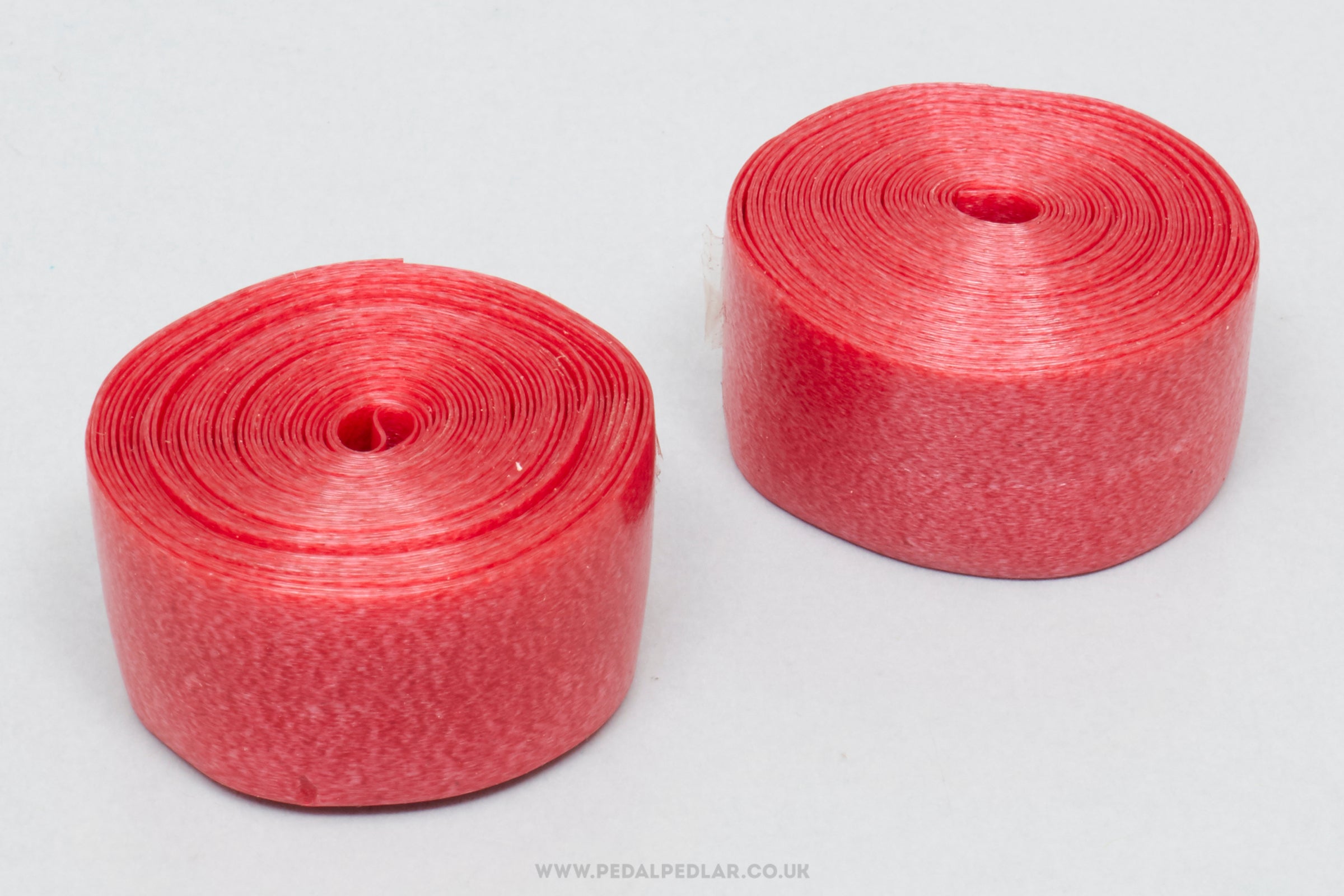


Vintage 'Cello' Style NOS Red Smooth Handlebar Tape
£11.25 £15.00
✓ Original bar tape - in production from the 1970s to the 1980s
✓ New old stock! Still unused after all these years
✓ Suitable for historic cycling events such as L'Eroica
✓ Worldwide shipping
Unbranded vintage bar tape (or grip, or wrap if you prefer), most likely in production from the 1970s to the 1980s (yet still new & unused after all this time!). Supplied as shown in the photos, enough tape to cover a set of drop bars. The perfect finishing touch for your vintage bike, but great for bikes of the non-vintage variety too!
If you're taking part in L'Eroica or a similar vintage event, this is of the correct era, so rest assured the pre-1987 police won't lock you up for having the wrong handlebar grip!
OVERVIEW
Production Era - 1970s & 1980s
Stock Code - D-BT24V
*New old stock items may have marks from storage over the years, and as we often have multiples they can vary from piece to piece, but they are always genuine new & unused items.
TECHNICAL INFO
Colour* - Red
Tape Style - Smooth
*The colour description is just a guide, please check the photos too as we make sure these are as close to the true colour as possible.
-
▼SHIPPING, TAXES & RETURNS
-
We've been safely sending orders around the world since 2010. Orders are carefully packed, sent with tracking & insurance, and normally collected around midday on Tuesdays and Fridays. Larger items may occasionally require an extra day or two to prepare.
We accept returns, please notify us within 14 days and ensure the item arrives back with us no later than 30 days after the order was received.
EU orders under €150 (excluding shipping) - import VAT and the new €3 customs duty are paid as part of your order, so there's nothing further to pay on delivery.
EU orders over €150 (excluding shipping) - import fees are payable to the carrier before delivery, with nothing collected at checkout.
USA orders - import fees are collected at checkout for all orders to the USA, so there won’t be any surprise charges when your order arrives.
Other international orders - local import fees may apply and are not collected by us. Please check your country's import rules before purchasing.
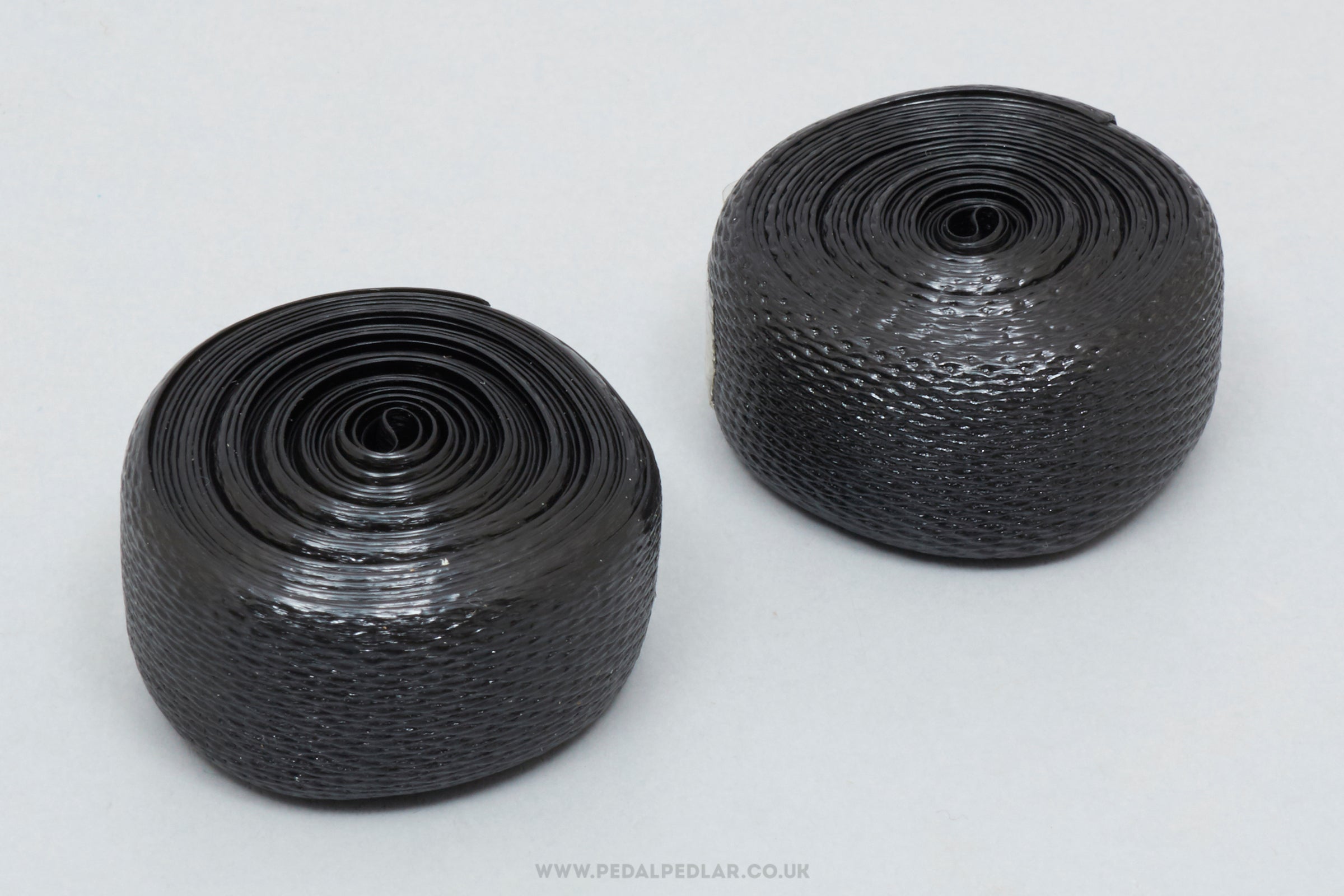


DPS Celo-Nastro Professionale 'Cello' NOS/NIB Vintage Black Textured Handlebar Tape
£22.50 £30.00
✓ Original bar tape - in production from the 1970s to the 1980s
✓ New old stock & still in the original packaging!
✓ Suitable for historic cycling events such as L'Eroica
✓ Worldwide shipping
DPS Celo-Nastro Professionale bar tape (or grip, or wrap if you prefer), hailing from Italy and in production from the 1970s to the 1980s (yet still new & unused after all this time!). Supplied as shown in the photos, enough tape to cover a set of drop bars. The perfect finishing touch for your vintage bike, but great for bikes of the non-vintage variety too!
If you're taking part in L'Eroica or a similar vintage event, this is of the correct era, so rest assured the pre-1987 police won't lock you up for having the wrong handlebar grip!
OVERVIEW
Production Era - 1970s & 1980s
Country - Italian
Stock Code - D-BT25V
*New old stock items may have marks from storage over the years, and as we often have multiples they can vary from piece to piece, but they are always genuine new & unused items.
TECHNICAL INFO
Colour* - Black
Tape Style - Textured
*The colour description is just a guide, please check the photos too as we make sure these are as close to the true colour as possible.
-
▼SHIPPING, TAXES & RETURNS
-
We've been safely sending orders around the world since 2010. Orders are carefully packed, sent with tracking & insurance, and normally collected around midday on Tuesdays and Fridays. Larger items may occasionally require an extra day or two to prepare.
We accept returns, please notify us within 14 days and ensure the item arrives back with us no later than 30 days after the order was received.
EU orders under €150 (excluding shipping) - import VAT and the new €3 customs duty are paid as part of your order, so there's nothing further to pay on delivery.
EU orders over €150 (excluding shipping) - import fees are payable to the carrier before delivery, with nothing collected at checkout.
USA orders - import fees are collected at checkout for all orders to the USA, so there won’t be any surprise charges when your order arrives.
Other international orders - local import fees may apply and are not collected by us. Please check your country's import rules before purchasing.
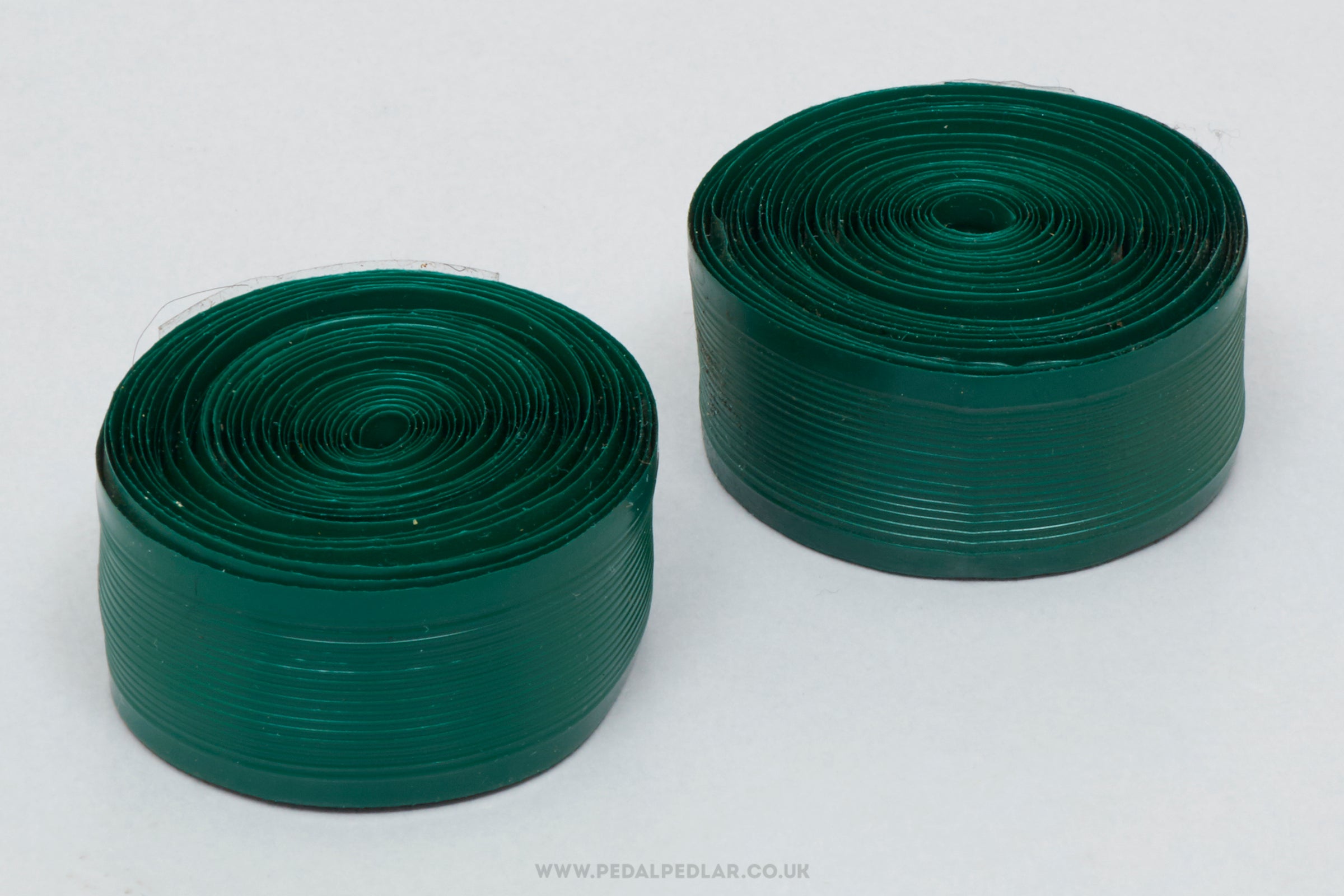


Bluemels NOS Vintage Dark Green Vinyl Handlebar Tape
£9.38 £12.50
✓ Original bar tape - in production from the 1970s to the 1980s
✓ New old stock! Still unused after all these years
✓ Suitable for historic cycling events such as L'Eroica
✓ Worldwide shipping
Bluemels bar tape (or grip, or wrap if you prefer), hailing from Great Britain and in production from the 1970s to the 1980s (yet still new & unused after all this time!). Supplied as shown in the photos, enough tape to cover a set of drop bars. The perfect finishing touch for your vintage bike, but great for bikes of the non-vintage variety too!
If you're taking part in L'Eroica or a similar vintage event, this is of the correct era, so rest assured the pre-1987 police won't lock you up for having the wrong handlebar grip!
OVERVIEW
Production Era - 1970s & 1980s
Country - British
Stock Code - D-BT35V
*New old stock items may have marks from storage over the years, and as we often have multiples they can vary from piece to piece, but they are always genuine new & unused items.
TECHNICAL INFO
Colour* - Dark Green
Tape Style - Vinyl (Textured)
*The colour description is just a guide, please check the photos too as we make sure these are as close to the true colour as possible.
-
▼SHIPPING, TAXES & RETURNS
-
We've been safely sending orders around the world since 2010. Orders are carefully packed, sent with tracking & insurance, and normally collected around midday on Tuesdays and Fridays. Larger items may occasionally require an extra day or two to prepare.
We accept returns, please notify us within 14 days and ensure the item arrives back with us no later than 30 days after the order was received.
EU orders under €150 (excluding shipping) - import VAT and the new €3 customs duty are paid as part of your order, so there's nothing further to pay on delivery.
EU orders over €150 (excluding shipping) - import fees are payable to the carrier before delivery, with nothing collected at checkout.
USA orders - import fees are collected at checkout for all orders to the USA, so there won’t be any surprise charges when your order arrives.
Other international orders - local import fees may apply and are not collected by us. Please check your country's import rules before purchasing.
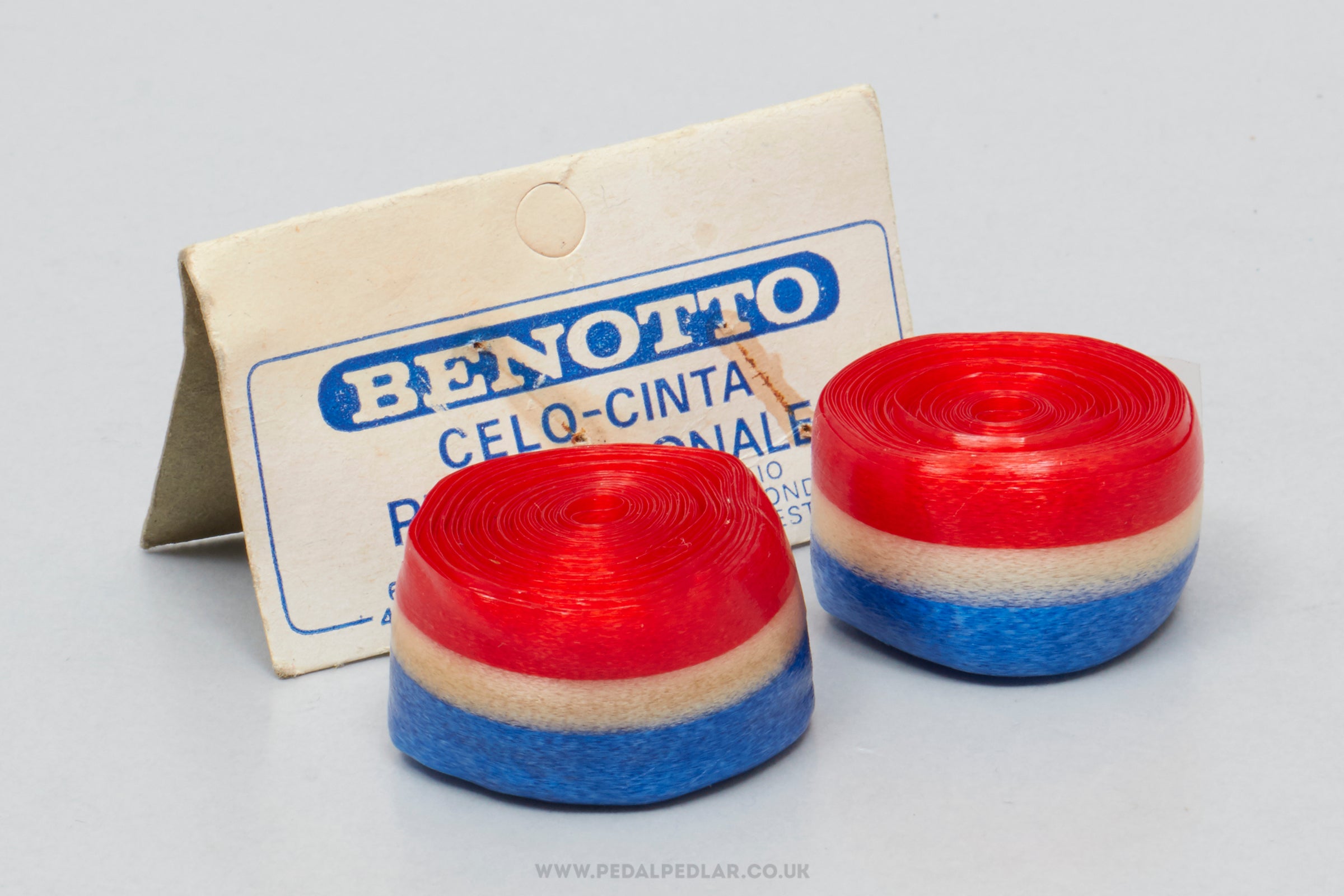


Benotto Celo-Cinta Professionale 'Cello' NOS/NIB Vintage French Flag Smooth Handlebar Tape
£18.75 £25.00
✓ Original bar tape - in production from the 1970s to the 1980s
✓ New old stock & still in the original packaging!
✓ Suitable for historic cycling events such as L'Eroica
✓ Worldwide shipping
Benotto Celo-Cinta Professionale bar tape (or grip, or wrap if you prefer), hailing from Italy and in production from the 1970s to the 1980s (yet still new & unused after all this time!). Supplied as shown in the photos, enough tape to cover a set of drop bars. The perfect finishing touch for your vintage bike, but great for bikes of the non-vintage variety too!
If you're taking part in L'Eroica or a similar vintage event, this is of the correct era, so rest assured the pre-1987 police won't lock you up for having the wrong handlebar grip!
OVERVIEW
Production Era - 1970s & 1980s
Country - Italian
Stock Code - D-BT38V
*New old stock items may have marks from storage over the years, and as we often have multiples they can vary from piece to piece, but they are always genuine new & unused items.
TECHNICAL INFO
Colour* - French Flag
Tape Style - Smooth
*The colour description is just a guide, please check the photos too as we make sure these are as close to the true colour as possible.
-
▼SHIPPING, TAXES & RETURNS
-
We've been safely sending orders around the world since 2010. Orders are carefully packed, sent with tracking & insurance, and normally collected around midday on Tuesdays and Fridays. Larger items may occasionally require an extra day or two to prepare.
We accept returns, please notify us within 14 days and ensure the item arrives back with us no later than 30 days after the order was received.
EU orders under €150 (excluding shipping) - import VAT and the new €3 customs duty are paid as part of your order, so there's nothing further to pay on delivery.
EU orders over €150 (excluding shipping) - import fees are payable to the carrier before delivery, with nothing collected at checkout.
USA orders - import fees are collected at checkout for all orders to the USA, so there won’t be any surprise charges when your order arrives.
Other international orders - local import fees may apply and are not collected by us. Please check your country's import rules before purchasing.
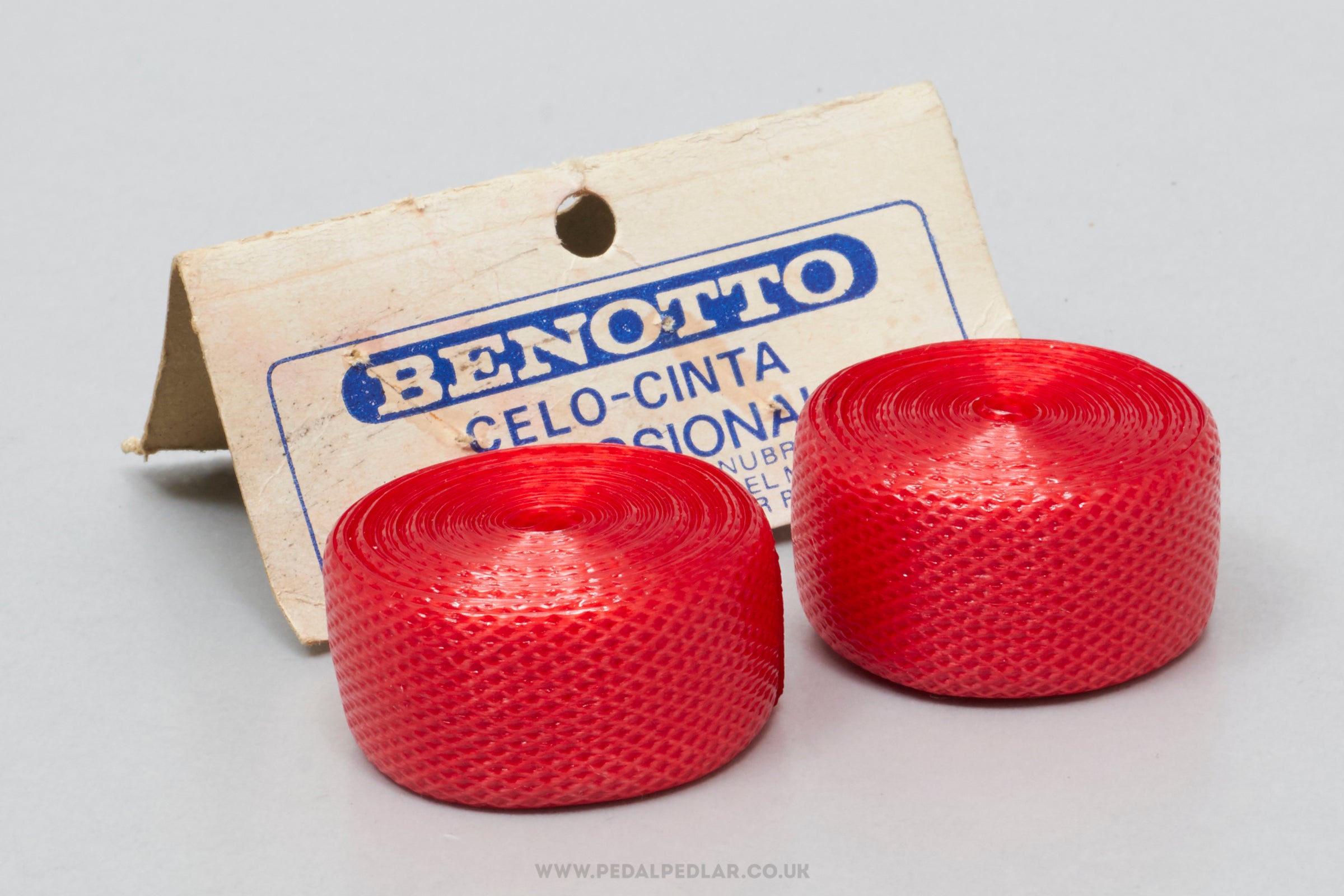


Benotto Celo-Cinta Professionale 'Cello' NOS/NIB Vintage Red Textured Handlebar Tape
£18.75 £25.00
✓ Original bar tape - in production from the 1970s to the 1980s
✓ New old stock & still in the original packaging!
✓ Suitable for historic cycling events such as L'Eroica
✓ Worldwide shipping
Benotto Celo-Cinta Professionale bar tape (or grip, or wrap if you prefer), hailing from Italy and in production from the 1970s to the 1980s (yet still new & unused after all this time!). Supplied as shown in the photos, enough tape to cover a set of drop bars. The perfect finishing touch for your vintage bike, but great for bikes of the non-vintage variety too!
If you're taking part in L'Eroica or a similar vintage event, this is of the correct era, so rest assured the pre-1987 police won't lock you up for having the wrong handlebar grip!
OVERVIEW
Production Era - 1970s & 1980s
Country - Italian
Stock Code - D-BT42V
*New old stock items may have marks from storage over the years, and as we often have multiples they can vary from piece to piece, but they are always genuine new & unused items.
TECHNICAL INFO
Colour* - Red
Tape Style - Textured
*The colour description is just a guide, please check the photos too as we make sure these are as close to the true colour as possible.
-
▼SHIPPING, TAXES & RETURNS
-
We've been safely sending orders around the world since 2010. Orders are carefully packed, sent with tracking & insurance, and normally collected around midday on Tuesdays and Fridays. Larger items may occasionally require an extra day or two to prepare.
We accept returns, please notify us within 14 days and ensure the item arrives back with us no later than 30 days after the order was received.
EU orders under €150 (excluding shipping) - import VAT and the new €3 customs duty are paid as part of your order, so there's nothing further to pay on delivery.
EU orders over €150 (excluding shipping) - import fees are payable to the carrier before delivery, with nothing collected at checkout.
USA orders - import fees are collected at checkout for all orders to the USA, so there won’t be any surprise charges when your order arrives.
Other international orders - local import fees may apply and are not collected by us. Please check your country's import rules before purchasing.
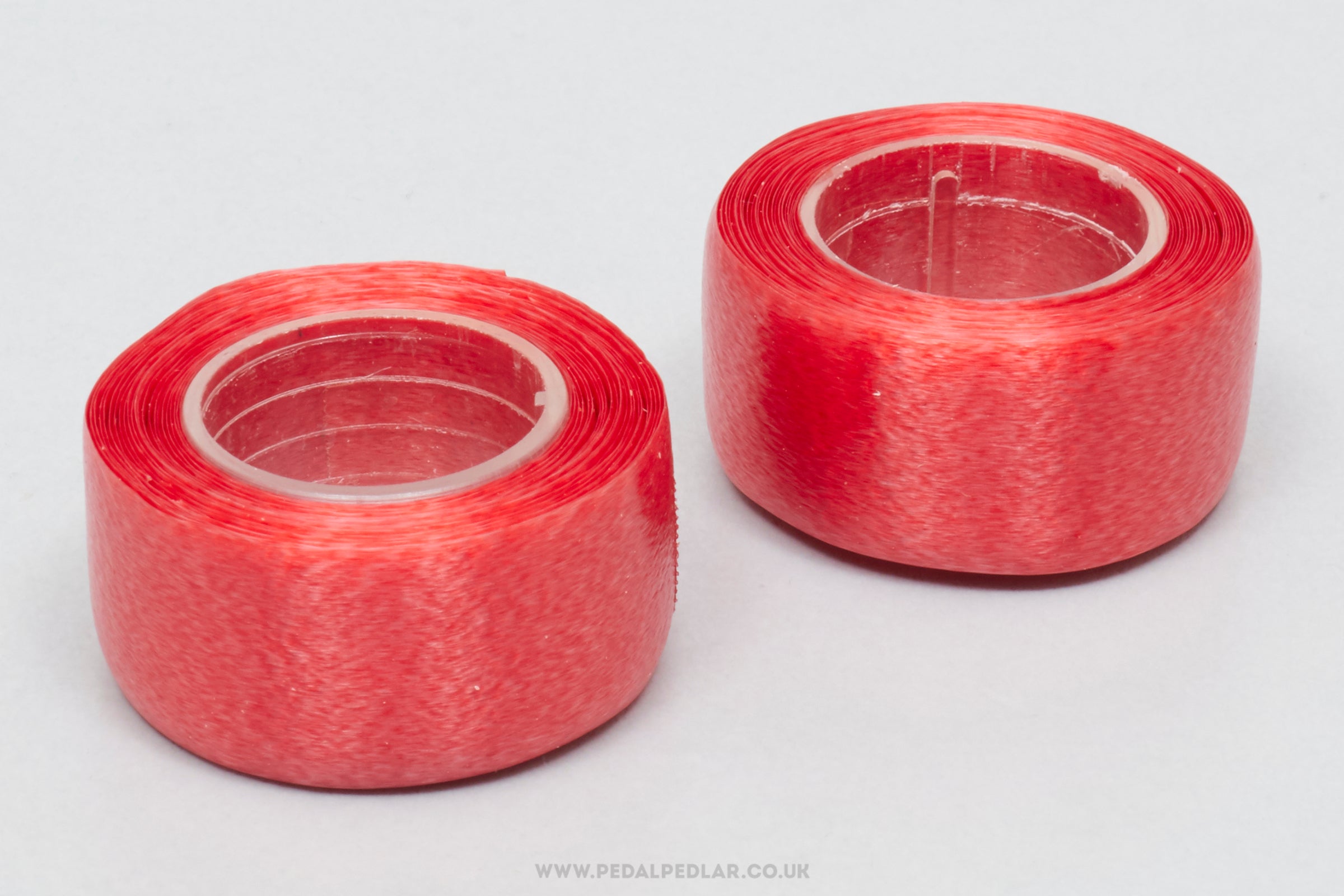


Ciclolinea 'Cello' Style NOS/NIB Vintage Red Smooth Handlebar Tape
£7.50 £10.00
✓ Original bar tape - produced in the 1980s
✓ New old stock & still in the original packaging!
✓ Suitable for historic cycling events such as L'Eroica
✓ Worldwide shipping
Ciclolinea bar tape (or grip, or wrap if you prefer), hailing from Italy and in production during the 1980s (yet still new & unused after all this time!). Supplied as shown in the photos, enough tape to cover a set of drop bars. The perfect finishing touch for your vintage bike, but great for bikes of the non-vintage variety too!
If you're taking part in L'Eroica or a similar vintage event, this is of the correct era, so rest assured the pre-1987 police won't lock you up for having the wrong handlebar grip!
OVERVIEW
Production Era - 1980s
Country - Italian
Stock Code - D-BT45V
*New old stock items may have marks from storage over the years, and as we often have multiples they can vary from piece to piece, but they are always genuine new & unused items.
TECHNICAL INFO
Colour* - Red
Tape Style - Smooth
*The colour description is just a guide, please check the photos too as we make sure these are as close to the true colour as possible.
-
▼SHIPPING, TAXES & RETURNS
-
We've been safely sending orders around the world since 2010. Orders are carefully packed, sent with tracking & insurance, and normally collected around midday on Tuesdays and Fridays. Larger items may occasionally require an extra day or two to prepare.
We accept returns, please notify us within 14 days and ensure the item arrives back with us no later than 30 days after the order was received.
EU orders under €150 (excluding shipping) - import VAT and the new €3 customs duty are paid as part of your order, so there's nothing further to pay on delivery.
EU orders over €150 (excluding shipping) - import fees are payable to the carrier before delivery, with nothing collected at checkout.
USA orders - import fees are collected at checkout for all orders to the USA, so there won’t be any surprise charges when your order arrives.
Other international orders - local import fees may apply and are not collected by us. Please check your country's import rules before purchasing.
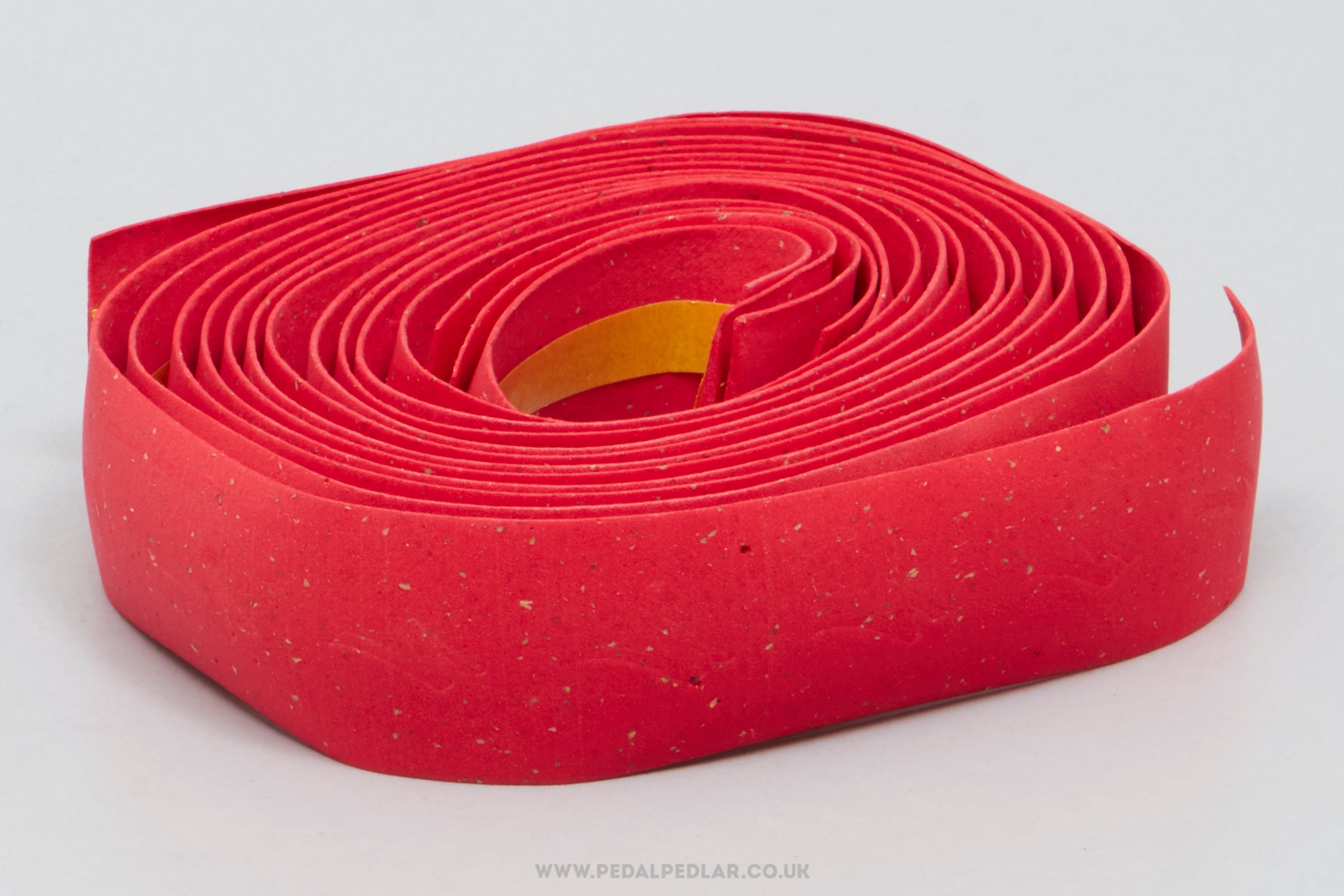


3TTT Specialized Branded NOS Vintage Red Cork Handlebar Tape
£11.25 £15.00
✓ Original bar tape - in production from the 1980s to the 1990s
✓ New old stock! Still unused after all these years
✓ Suitable for historic cycling events such as L'Eroica
✓ Worldwide shipping
3TTT bar tape (or grip, or wrap if you prefer), hailing from Italy and in production from the 1980s to the 1990s (yet still new & unused after all this time!). Supplied as shown in the photos, enough tape to cover a set of drop bars. The perfect finishing touch for your vintage bike, but great for bikes of the non-vintage variety too!
If you're taking part in L'Eroica or a similar vintage event, this is of the correct era, so rest assured the pre-1987 police won't lock you up for having the wrong handlebar grip!
OVERVIEW
Production Era - 1980s & 1990s
Country - Italian
Stock Code - D-BT48V
*New old stock items may have marks from storage over the years, and as we often have multiples they can vary from piece to piece, but they are always genuine new & unused items.
TECHNICAL INFO
Colour* - Red
Tape Style - Cork
*The colour description is just a guide, please check the photos too as we make sure these are as close to the true colour as possible.
-
▼SHIPPING, TAXES & RETURNS
-
We've been safely sending orders around the world since 2010. Orders are carefully packed, sent with tracking & insurance, and normally collected around midday on Tuesdays and Fridays. Larger items may occasionally require an extra day or two to prepare.
We accept returns, please notify us within 14 days and ensure the item arrives back with us no later than 30 days after the order was received.
EU orders under €150 (excluding shipping) - import VAT and the new €3 customs duty are paid as part of your order, so there's nothing further to pay on delivery.
EU orders over €150 (excluding shipping) - import fees are payable to the carrier before delivery, with nothing collected at checkout.
USA orders - import fees are collected at checkout for all orders to the USA, so there won’t be any surprise charges when your order arrives.
Other international orders - local import fees may apply and are not collected by us. Please check your country's import rules before purchasing.
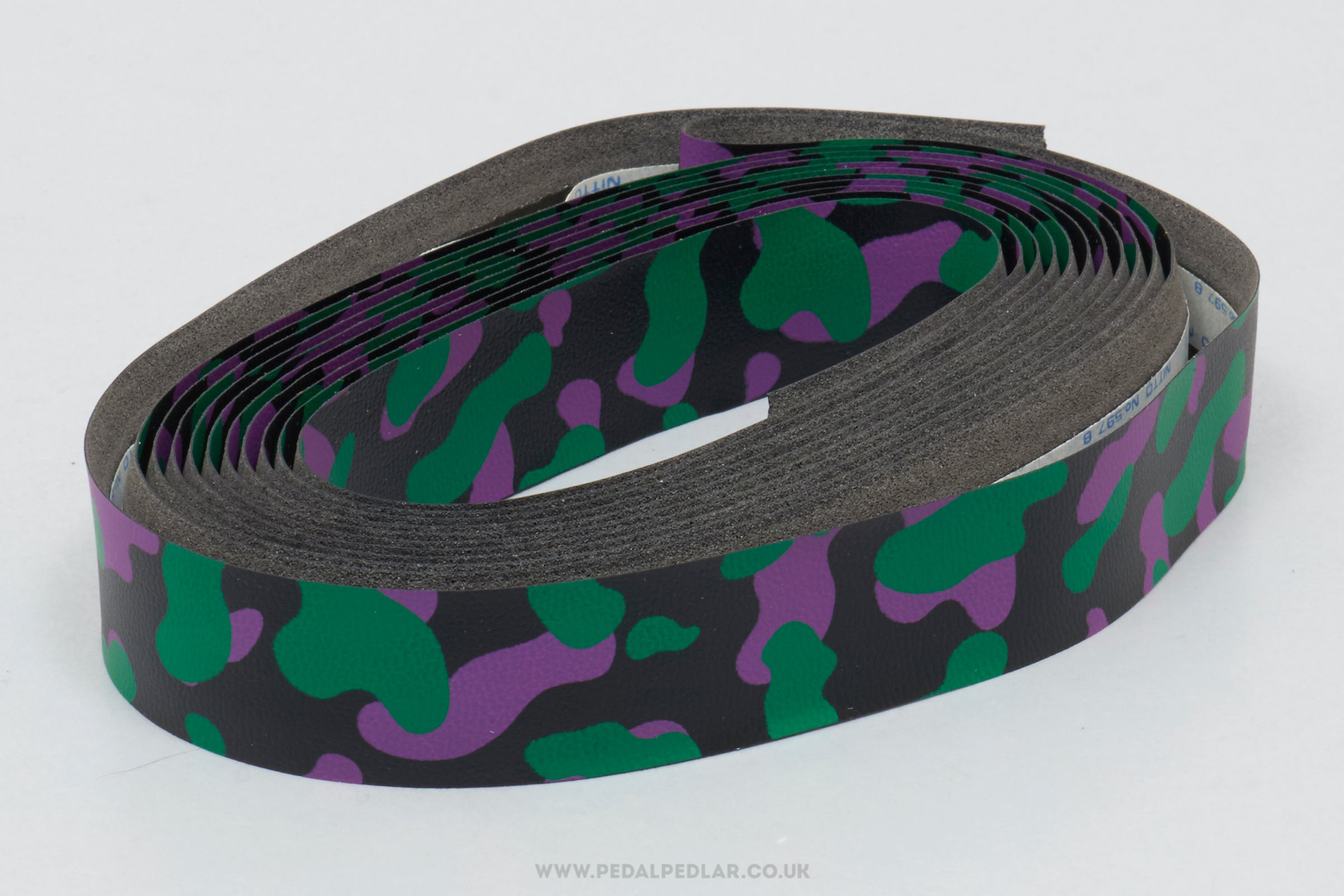


GES Flash Ribbon NOS/NIB Vintage Black/Green/Purple Vinyl Handlebar Tape
£11.25 £15.00
✓ Original bar tape - produced in the 1980s
✓ New old stock & still in the original packaging!
✓ Suitable for historic cycling events such as L'Eroica
✓ Worldwide shipping
GES Flash Ribbon bar tape (or grip, or wrap if you prefer), hailing from Spain and in production during the 1980s (yet still new & unused after all this time!). Supplied as shown in the photos, enough tape to cover a set of drop bars. The perfect finishing touch for your vintage bike, but great for bikes of the non-vintage variety too!
If you're taking part in L'Eroica or a similar vintage event, this is of the correct era, so rest assured the pre-1987 police won't lock you up for having the wrong handlebar grip!
OVERVIEW
Production Era - 1980s
Country - Spanish
Stock Code - D-BT53V
*New old stock items may have marks from storage over the years, and as we often have multiples they can vary from piece to piece, but they are always genuine new & unused items.
TECHNICAL INFO
Colour* - Black / Green / Purple
Tape Style - Vinyl (PVC Non-Perforated)
*The colour description is just a guide, please check the photos too as we make sure these are as close to the true colour as possible.
-
▼SHIPPING, TAXES & RETURNS
-
We've been safely sending orders around the world since 2010. Orders are carefully packed, sent with tracking & insurance, and normally collected around midday on Tuesdays and Fridays. Larger items may occasionally require an extra day or two to prepare.
We accept returns, please notify us within 14 days and ensure the item arrives back with us no later than 30 days after the order was received.
EU orders under €150 (excluding shipping) - import VAT and the new €3 customs duty are paid as part of your order, so there's nothing further to pay on delivery.
EU orders over €150 (excluding shipping) - import fees are payable to the carrier before delivery, with nothing collected at checkout.
USA orders - import fees are collected at checkout for all orders to the USA, so there won’t be any surprise charges when your order arrives.
Other international orders - local import fees may apply and are not collected by us. Please check your country's import rules before purchasing.
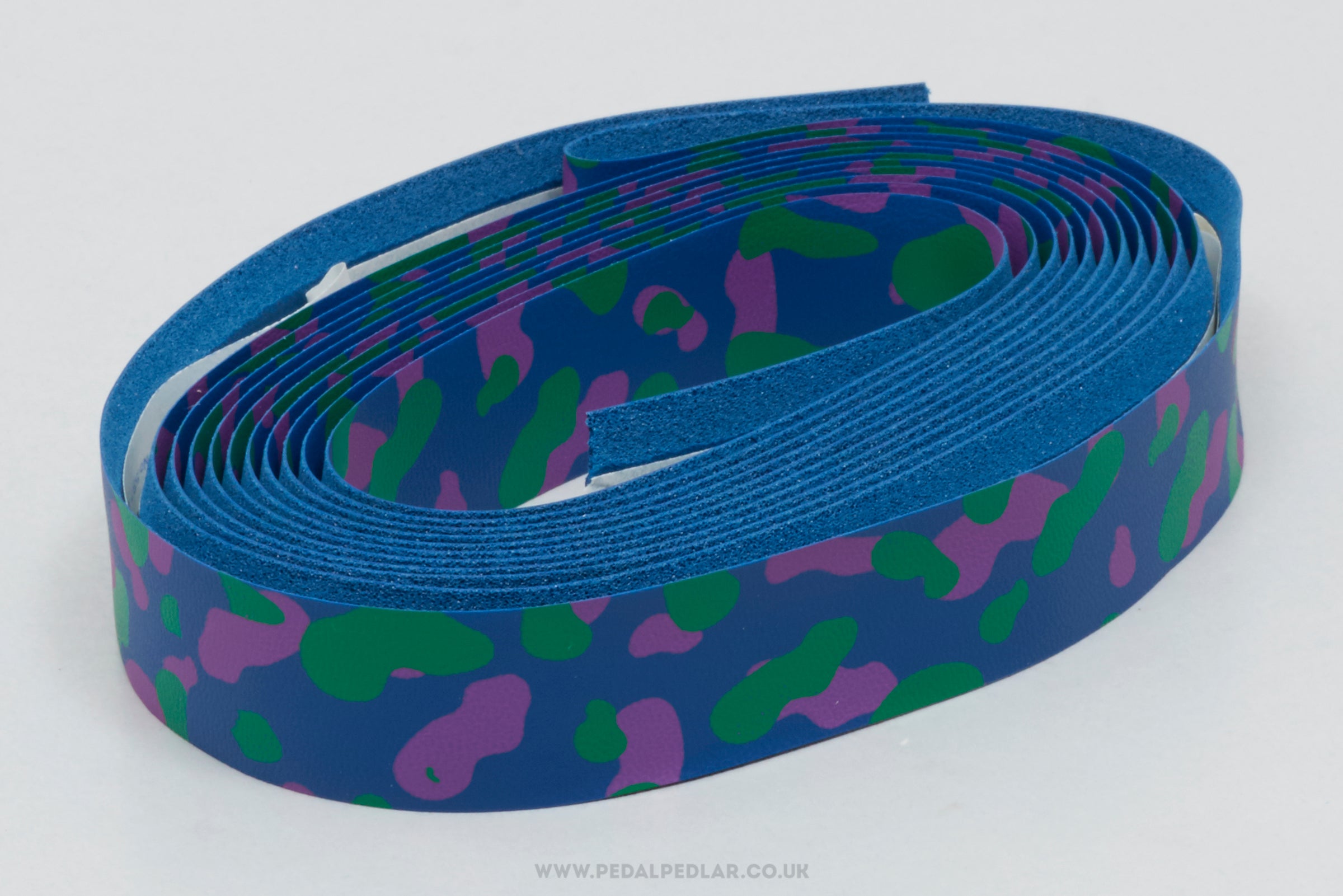


GES Flash Ribbon NOS/NIB Vintage Blue/Green/Purple Vinyl Handlebar Tape
£11.25 £15.00
✓ Original bar tape - produced in the 1980s
✓ New old stock & still in the original packaging!
✓ Suitable for historic cycling events such as L'Eroica
✓ Worldwide shipping
GES Flash Ribbon bar tape (or grip, or wrap if you prefer), hailing from Spain and in production during the 1980s (yet still new & unused after all this time!). Supplied as shown in the photos, enough tape to cover a set of drop bars. The perfect finishing touch for your vintage bike, but great for bikes of the non-vintage variety too!
If you're taking part in L'Eroica or a similar vintage event, this is of the correct era, so rest assured the pre-1987 police won't lock you up for having the wrong handlebar grip!
OVERVIEW
Production Era - 1980s
Country - Spanish
Stock Code - D-BT54V
*New old stock items may have marks from storage over the years, and as we often have multiples they can vary from piece to piece, but they are always genuine new & unused items.
TECHNICAL INFO
Colour* - Blue / Green / Purple
Tape Style - Vinyl (PVC Non-Perforated)
*The colour description is just a guide, please check the photos too as we make sure these are as close to the true colour as possible.
-
▼SHIPPING, TAXES & RETURNS
-
We've been safely sending orders around the world since 2010. Orders are carefully packed, sent with tracking & insurance, and normally collected around midday on Tuesdays and Fridays. Larger items may occasionally require an extra day or two to prepare.
We accept returns, please notify us within 14 days and ensure the item arrives back with us no later than 30 days after the order was received.
EU orders under €150 (excluding shipping) - import VAT and the new €3 customs duty are paid as part of your order, so there's nothing further to pay on delivery.
EU orders over €150 (excluding shipping) - import fees are payable to the carrier before delivery, with nothing collected at checkout.
USA orders - import fees are collected at checkout for all orders to the USA, so there won’t be any surprise charges when your order arrives.
Other international orders - local import fees may apply and are not collected by us. Please check your country's import rules before purchasing.
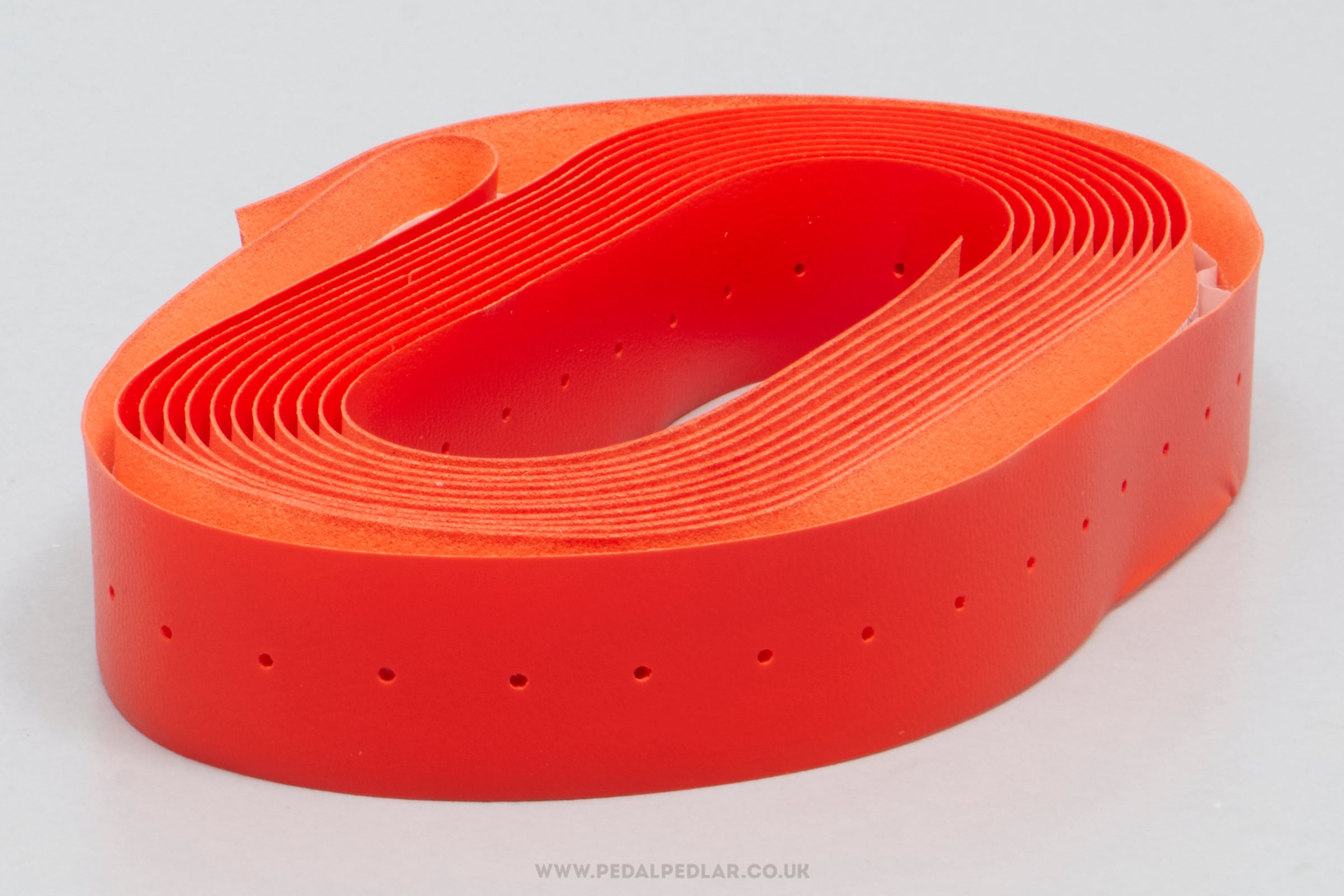


GES Race Ribbon NOS/NIB Vintage Red Vinyl Handlebar Tape
£15.00 £20.00
✓ Original bar tape - produced in the 1980s
✓ New old stock & still in the original packaging!
✓ Suitable for historic cycling events such as L'Eroica
✓ Worldwide shipping
GES Race Ribbon bar tape (or grip, or wrap if you prefer), hailing from Spain and in production during the 1980s (yet still new & unused after all this time!). Supplied as shown in the photos, enough tape to cover a set of drop bars. The perfect finishing touch for your vintage bike, but great for bikes of the non-vintage variety too!
If you're taking part in L'Eroica or a similar vintage event, this is of the correct era, so rest assured the pre-1987 police won't lock you up for having the wrong handlebar grip!
OVERVIEW
Production Era - 1980s
Country - Spanish
Stock Code - D-BT56V
*New old stock items may have marks from storage over the years, and as we often have multiples they can vary from piece to piece, but they are always genuine new & unused items.
TECHNICAL INFO
Colour* - Red
Tape Style - Vinyl (PVC Perforated)
*The colour description is just a guide, please check the photos too as we make sure these are as close to the true colour as possible.
-
▼SHIPPING, TAXES & RETURNS
-
We've been safely sending orders around the world since 2010. Orders are carefully packed, sent with tracking & insurance, and normally collected around midday on Tuesdays and Fridays. Larger items may occasionally require an extra day or two to prepare.
We accept returns, please notify us within 14 days and ensure the item arrives back with us no later than 30 days after the order was received.
EU orders under €150 (excluding shipping) - import VAT and the new €3 customs duty are paid as part of your order, so there's nothing further to pay on delivery.
EU orders over €150 (excluding shipping) - import fees are payable to the carrier before delivery, with nothing collected at checkout.
USA orders - import fees are collected at checkout for all orders to the USA, so there won’t be any surprise charges when your order arrives.
Other international orders - local import fees may apply and are not collected by us. Please check your country's import rules before purchasing.
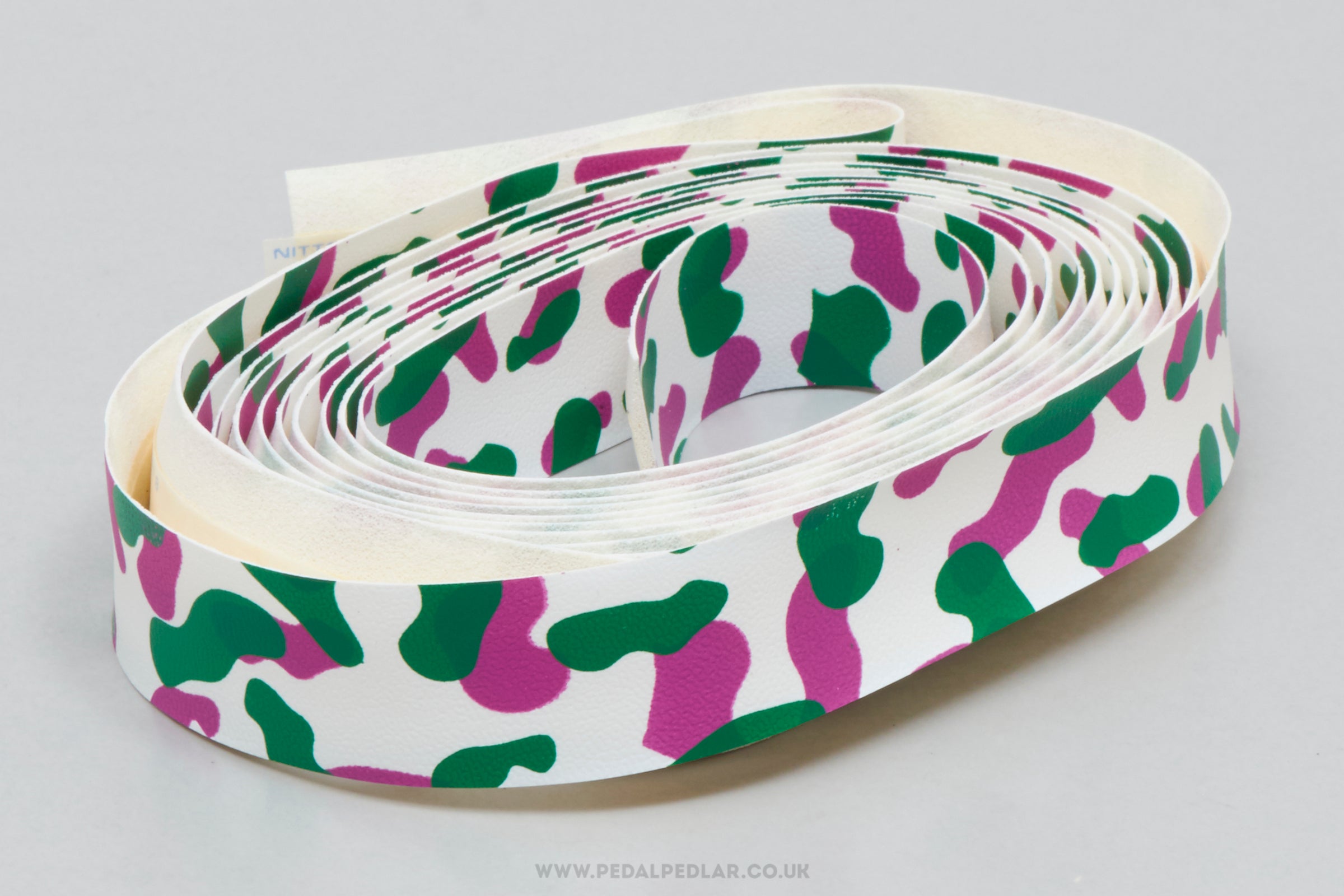


GES Flash Ribbon NOS/NIB Vintage White/Green/Purple Vinyl Handlebar Tape
£11.25 £15.00
✓ Original bar tape - produced in the 1980s
✓ New old stock & still in the original packaging!
✓ Suitable for historic cycling events such as L'Eroica
✓ Worldwide shipping
GES Flash Ribbon bar tape (or grip, or wrap if you prefer), hailing from Spain and in production during the 1980s (yet still new & unused after all this time!). Supplied as shown in the photos, enough tape to cover a set of drop bars. The perfect finishing touch for your vintage bike, but great for bikes of the non-vintage variety too!
If you're taking part in L'Eroica or a similar vintage event, this is of the correct era, so rest assured the pre-1987 police won't lock you up for having the wrong handlebar grip!
OVERVIEW
Production Era - 1980s
Country - Spanish
Stock Code - D-BT52V
*New old stock items may have marks from storage over the years, and as we often have multiples they can vary from piece to piece, but they are always genuine new & unused items.
TECHNICAL INFO
Colour* - White / Green / Purple
Tape Style - Vinyl (PVC Non-Perforated)
*The colour description is just a guide, please check the photos too as we make sure these are as close to the true colour as possible.
-
▼SHIPPING, TAXES & RETURNS
-
We've been safely sending orders around the world since 2010. Orders are carefully packed, sent with tracking & insurance, and normally collected around midday on Tuesdays and Fridays. Larger items may occasionally require an extra day or two to prepare.
We accept returns, please notify us within 14 days and ensure the item arrives back with us no later than 30 days after the order was received.
EU orders under €150 (excluding shipping) - import VAT and the new €3 customs duty are paid as part of your order, so there's nothing further to pay on delivery.
EU orders over €150 (excluding shipping) - import fees are payable to the carrier before delivery, with nothing collected at checkout.
USA orders - import fees are collected at checkout for all orders to the USA, so there won’t be any surprise charges when your order arrives.
Other international orders - local import fees may apply and are not collected by us. Please check your country's import rules before purchasing.


Bluemels NOS Vintage Red Vinyl Handlebar Tape
£9.38 £13.00
✓ Original bar tape - in production from the 1970s to the 1980s
✓ New old stock! Still unused after all these years
✓ Suitable for historic cycling events such as L'Eroica
✓ Worldwide shipping
Bluemels bar tape (or grip, or wrap if you prefer), hailing from Great Britain and in production from the 1970s to the 1980s (yet still new & unused after all this time!). Supplied as shown in the photos, enough tape to cover a set of drop bars. The perfect finishing touch for your vintage bike, but great for bikes of the non-vintage variety too!
If you're taking part in L'Eroica or a similar vintage event, this is of the correct era, so rest assured the pre-1987 police won't lock you up for having the wrong handlebar grip!
OVERVIEW
Production Era - 1970s & 1980s
Country - British
Stock Code - D-BT61V
NB - Each roll is 12 ft long
*New old stock items may have marks from storage over the years, and as we often have multiples they can vary from piece to piece, but they are always genuine new & unused items.
TECHNICAL INFO
Colour* - Red
Tape Style - Vinyl (Textured)
*The colour description is just a guide, please check the photos too as we make sure these are as close to the true colour as possible.
-
▼SHIPPING, TAXES & RETURNS
-
We've been safely sending orders around the world since 2010. Orders are carefully packed, sent with tracking & insurance, and normally collected around midday on Tuesdays and Fridays. Larger items may occasionally require an extra day or two to prepare.
We accept returns, please notify us within 14 days and ensure the item arrives back with us no later than 30 days after the order was received.
EU orders under €150 (excluding shipping) - import VAT and the new €3 customs duty are paid as part of your order, so there's nothing further to pay on delivery.
EU orders over €150 (excluding shipping) - import fees are payable to the carrier before delivery, with nothing collected at checkout.
USA orders - import fees are collected at checkout for all orders to the USA, so there won’t be any surprise charges when your order arrives.
Other international orders - local import fees may apply and are not collected by us. Please check your country's import rules before purchasing.
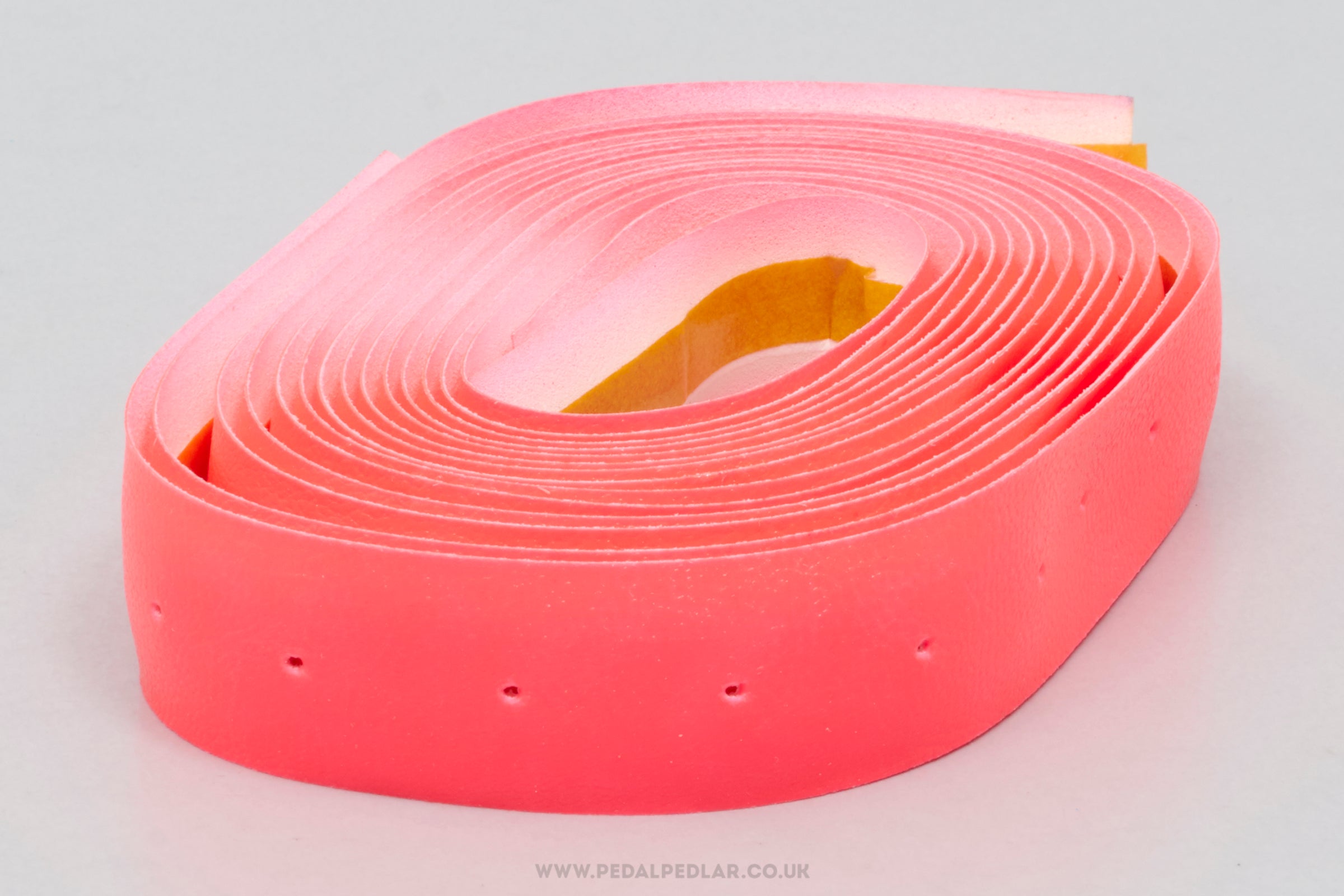


3TTT 3 Ribbon NOS/NIB Vintage Neon Pink Vinyl Handlebar Tape
£15.00 £20.00
✓ Original bar tape - produced in the 1980s
✓ New old stock & still in the original packaging!
✓ Suitable for historic cycling events such as L'Eroica
✓ Worldwide shipping
3TTT 3 Ribbon bar tape (or grip, or wrap if you prefer), hailing from Italy and in production during the 1980s (yet still new & unused after all this time!). Supplied as shown in the photos, enough tape to cover a set of drop bars. The perfect finishing touch for your vintage bike, but great for bikes of the non-vintage variety too!
If you're taking part in L'Eroica or a similar vintage event, this is of the correct era, so rest assured the pre-1987 police won't lock you up for having the wrong handlebar grip!
OVERVIEW
Production Era - 1980s
Country - Italian
Stock Code - D-BT64V
*New old stock items may have marks from storage over the years, and as we often have multiples they can vary from piece to piece, but they are always genuine new & unused items.
TECHNICAL INFO
Colour* - Neon Pink
Tape Style - Vinyl (PVC Perforated)
*The colour description is just a guide, please check the photos too as we make sure these are as close to the true colour as possible.
-
▼SHIPPING, TAXES & RETURNS
-
We've been safely sending orders around the world since 2010. Orders are carefully packed, sent with tracking & insurance, and normally collected around midday on Tuesdays and Fridays. Larger items may occasionally require an extra day or two to prepare.
We accept returns, please notify us within 14 days and ensure the item arrives back with us no later than 30 days after the order was received.
EU orders under €150 (excluding shipping) - import VAT and the new €3 customs duty are paid as part of your order, so there's nothing further to pay on delivery.
EU orders over €150 (excluding shipping) - import fees are payable to the carrier before delivery, with nothing collected at checkout.
USA orders - import fees are collected at checkout for all orders to the USA, so there won’t be any surprise charges when your order arrives.
Other international orders - local import fees may apply and are not collected by us. Please check your country's import rules before purchasing.
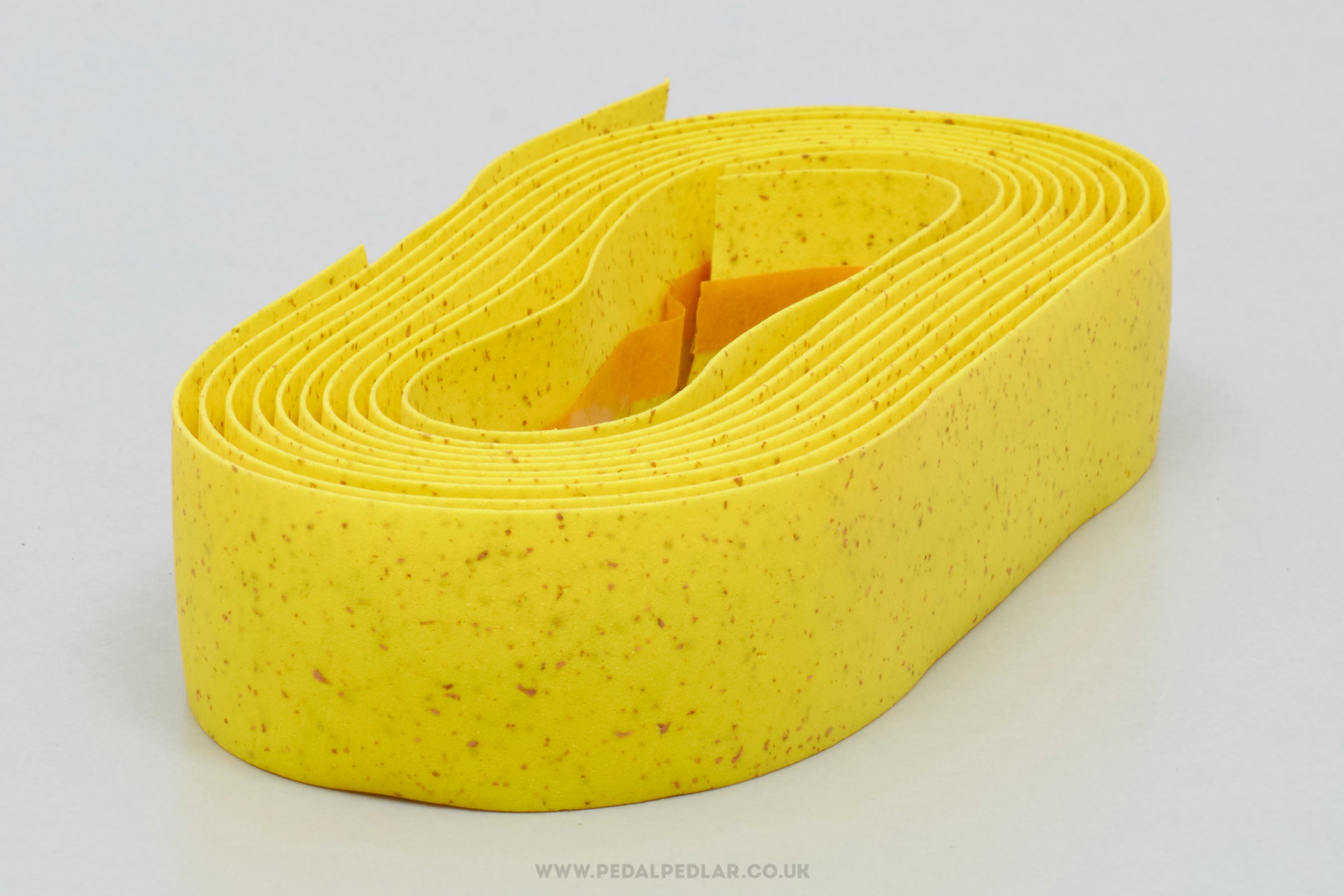


3TTT Ribbon NOS/NIB Classic Yellow Cork Handlebar Tape
£11.25 £15.00
✓ Original bar tape - in production from the 1990s to the 2000s
✓ New old stock & still in the original packaging!
✓ Worldwide shipping
3TTT Ribbon bar tape (or grip, or wrap if you prefer), hailing from Italy and in production from the 1990s to the 2000s (yet still new & unused after all this time!). Supplied as shown in the photos, enough tape to cover a set of drop bars. The perfect finishing touch for your classic bike, but great for bikes of the non-classic variety too!
OVERVIEW
Production Era - 1990s & 2000s
Country - Italian
Stock Code - D-BT75C
*New old stock items may have marks from storage over the years, and as we often have multiples they can vary from piece to piece, but they are always genuine new & unused items.
TECHNICAL INFO
Colour* - Yellow
Tape Style - Cork
*The colour description is just a guide, please check the photos too as we make sure these are as close to the true colour as possible.
-
▼SHIPPING, TAXES & RETURNS
-
We've been safely sending orders around the world since 2010. Orders are carefully packed, sent with tracking & insurance, and normally collected around midday on Tuesdays and Fridays. Larger items may occasionally require an extra day or two to prepare.
We accept returns, please notify us within 14 days and ensure the item arrives back with us no later than 30 days after the order was received.
EU orders under €150 (excluding shipping) - import VAT and the new €3 customs duty are paid as part of your order, so there's nothing further to pay on delivery.
EU orders over €150 (excluding shipping) - import fees are payable to the carrier before delivery, with nothing collected at checkout.
USA orders - import fees are collected at checkout for all orders to the USA, so there won’t be any surprise charges when your order arrives.
Other international orders - local import fees may apply and are not collected by us. Please check your country's import rules before purchasing.
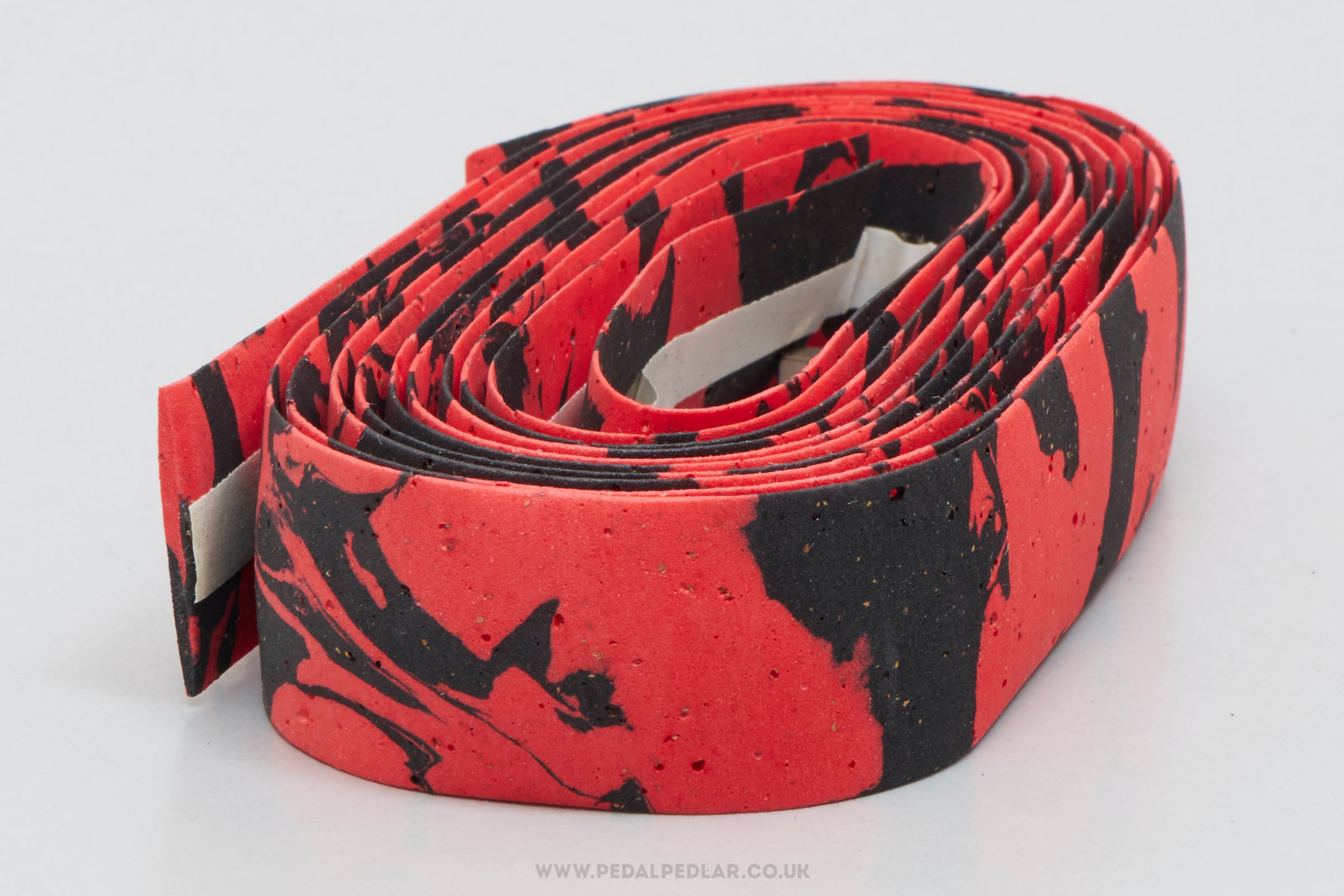


3TTT Ribbon Splash NOS/NIB Classic Red/Black Cork Handlebar Tape
£15.00 £20.00
✓ Original bar tape - in production from the 1990s to the 2000s
✓ New old stock & still in the original packaging!
✓ Worldwide shipping
3TTT Ribbon bar tape (or grip, or wrap if you prefer), hailing from Italy and in production from the 1990s to the 2000s (yet still new & unused after all this time!). Supplied as shown in the photos, enough tape to cover a set of drop bars. The perfect finishing touch for your classic bike, but great for bikes of the non-classic variety too!
OVERVIEW
Production Era - 1990s & 2000s
Country - Italian
Stock Code - D-BT84C
*New old stock items may have marks from storage over the years, and as we often have multiples they can vary from piece to piece, but they are always genuine new & unused items.
TECHNICAL INFO
Colour* - Red / Black
Tape Style - Cork
*The colour description is just a guide, please check the photos too as we make sure these are as close to the true colour as possible.
-
▼SHIPPING, TAXES & RETURNS
-
We've been safely sending orders around the world since 2010. Orders are carefully packed, sent with tracking & insurance, and normally collected around midday on Tuesdays and Fridays. Larger items may occasionally require an extra day or two to prepare.
We accept returns, please notify us within 14 days and ensure the item arrives back with us no later than 30 days after the order was received.
EU orders under €150 (excluding shipping) - import VAT and the new €3 customs duty are paid as part of your order, so there's nothing further to pay on delivery.
EU orders over €150 (excluding shipping) - import fees are payable to the carrier before delivery, with nothing collected at checkout.
USA orders - import fees are collected at checkout for all orders to the USA, so there won’t be any surprise charges when your order arrives.
Other international orders - local import fees may apply and are not collected by us. Please check your country's import rules before purchasing.


Celo-Cinta Professionale Benotto 'Cello' Type NOS/NIB Vintage Red Smooth Handlebar Tape
£22.50 £30.00
✓ Original bar tape - in production from the 1970s to the 1980s
✓ New old stock & still in the original packaging!
✓ Suitable for historic cycling events such as L'Eroica
✓ Worldwide shipping
Celo-Cinta Professionale bar tape (or grip, or wrap if you prefer), hailing from Italy and in production from the 1970s to the 1980s (yet still new & unused after all this time!). Supplied as shown in the photos, enough tape to cover a set of drop bars. The perfect finishing touch for your vintage bike, but great for bikes of the non-vintage variety too!
If you're taking part in L'Eroica or a similar vintage event, this is of the correct era, so rest assured the pre-1987 police won't lock you up for having the wrong handlebar grip!
OVERVIEW
Production Era - 1970s & 1980s
Country - Italian
Stock Code - D-BT88V
*New old stock items may have marks from storage over the years, and as we often have multiples they can vary from piece to piece, but they are always genuine new & unused items.
TECHNICAL INFO
Colour* - Red
Tape Style - Smooth
*The colour description is just a guide, please check the photos too as we make sure these are as close to the true colour as possible.
-
▼SHIPPING, TAXES & RETURNS
-
We've been safely sending orders around the world since 2010. Orders are carefully packed, sent with tracking & insurance, and normally collected around midday on Tuesdays and Fridays. Larger items may occasionally require an extra day or two to prepare.
We accept returns, please notify us within 14 days and ensure the item arrives back with us no later than 30 days after the order was received.
EU orders under €150 (excluding shipping) - import VAT and the new €3 customs duty are paid as part of your order, so there's nothing further to pay on delivery.
EU orders over €150 (excluding shipping) - import fees are payable to the carrier before delivery, with nothing collected at checkout.
USA orders - import fees are collected at checkout for all orders to the USA, so there won’t be any surprise charges when your order arrives.
Other international orders - local import fees may apply and are not collected by us. Please check your country's import rules before purchasing.


3TTT Nastro Resina 'Cello' NOS/NIB Vintage Black Smooth Handlebar Tape
£18.75 £25.00
✓ Original bar tape - in production from the 1970s to the 1980s
✓ New old stock & still in the original packaging!
✓ Suitable for historic cycling events such as L'Eroica
✓ Worldwide shipping
3TTT Nastro Resina bar tape (or grip, or wrap if you prefer), hailing from Italy and in production from the 1970s to the 1980s (yet still new & unused after all this time!). Supplied as shown in the photos, enough tape to cover a set of drop bars. The perfect finishing touch for your vintage bike, but great for bikes of the non-vintage variety too!
If you're taking part in L'Eroica or a similar vintage event, this is of the correct era, so rest assured the pre-1987 police won't lock you up for having the wrong handlebar grip!
OVERVIEW
Production Era - 1970s & 1980s
Country - Italian
Stock Code - D-BT90V
*New old stock items may have marks from storage over the years, and as we often have multiples they can vary from piece to piece, but they are always genuine new & unused items.
TECHNICAL INFO
Colour* - Black
Tape Style - Smooth
*The colour description is just a guide, please check the photos too as we make sure these are as close to the true colour as possible.
-
▼SHIPPING, TAXES & RETURNS
-
We've been safely sending orders around the world since 2010. Orders are carefully packed, sent with tracking & insurance, and normally collected around midday on Tuesdays and Fridays. Larger items may occasionally require an extra day or two to prepare.
We accept returns, please notify us within 14 days and ensure the item arrives back with us no later than 30 days after the order was received.
EU orders under €150 (excluding shipping) - import VAT and the new €3 customs duty are paid as part of your order, so there's nothing further to pay on delivery.
EU orders over €150 (excluding shipping) - import fees are payable to the carrier before delivery, with nothing collected at checkout.
USA orders - import fees are collected at checkout for all orders to the USA, so there won’t be any surprise charges when your order arrives.
Other international orders - local import fees may apply and are not collected by us. Please check your country's import rules before purchasing.
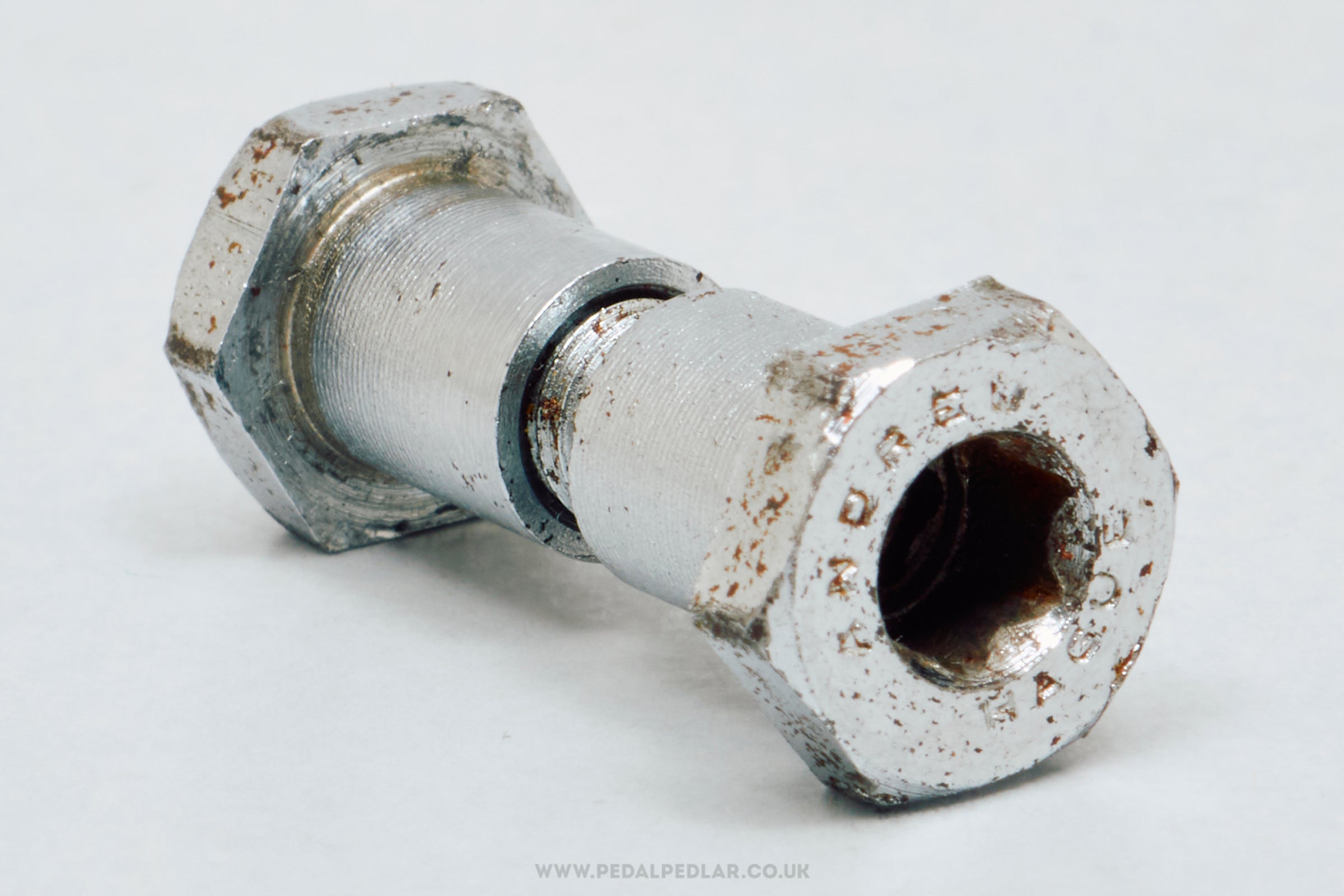


Andrew Hague Vintage 21-25 mm Hex Head Seatpost Binder Bolt
£13.50 £15.00
✓ Original part - produced in the 1970s
✓ Suitable for historic cycling events such as L'Eroica
✓ Checked & cleaned
✓ Worldwide shipping
Andrew Hague seat post binder bolt (to clamp the frame around the seat pin), hailing from Great Britain and in production during the 1970s. Made from steel and weighing in at 12 grams. A fine choice for keeping your vintage bike authentic, but also great for any other compatible bike.
If you're taking part in L'Eroica or any other vintage event, this is fully compliant - so rest assured, the pre-1987 police won't lock you up for having the wrong seatpost binder bolt!
The seatpost binder bolt's been cleaned, checked and graded as good condition, but do take a good look at the detailed photos so you can see the cosmetic condition before you buy.OVERVIEW
Production Era - 1970s
Country - British
Material - Steel
Weight - 12 g
Stock Code - U-SBB23V
TECHNICAL INFO
Clamp Opening (Min-Max) - 21-25 mm
Outer Diameter - 8 mm
Bolt Fixing Type - Hex Head (Both Sides)
-
▼SHIPPING, TAXES & RETURNS
-
We've been safely sending orders around the world since 2010. Orders are carefully packed, sent with tracking & insurance, and normally collected around midday on Tuesdays and Fridays. Larger items may occasionally require an extra day or two to prepare.
We accept returns, please notify us within 14 days and ensure the item arrives back with us no later than 30 days after the order was received.
EU orders under €150 (excluding shipping) - import VAT and the new €3 customs duty are paid as part of your order, so there's nothing further to pay on delivery.
EU orders over €150 (excluding shipping) - import fees are payable to the carrier before delivery, with nothing collected at checkout.
USA orders - import fees are collected at checkout for all orders to the USA, so there won’t be any surprise charges when your order arrives.
Other international orders - local import fees may apply and are not collected by us. Please check your country's import rules before purchasing.
-
▼HELP SECTION
-
Clamp Opening - the minimum and maximum distance between the inside of the nut and bolt heads. The minimum is measured with the bolt tightened as much as possible (for hex head types this may mean the bolt end will stick quite far out of the nut). For the maximum opening we ensure 5-6 mm of thread remainis in the nut for a secure fixing.
Outer Diameter - the part that goes through the frame, most steel frames will take an 8 mm bolt whereas early lugged aluminium frames often have a larger hole that takes a 10 mm bolt diameter.
Bolt Fixing Type - some binder bolts have tightening mechanisms on both sides to secure the seatpost in the frame. Single sided bolts need something else to help; some have knurled parts that grip the inside of the bolt hole, others have a small notched 'key' locator that lines up with a cut-out in the frame (if you have one).
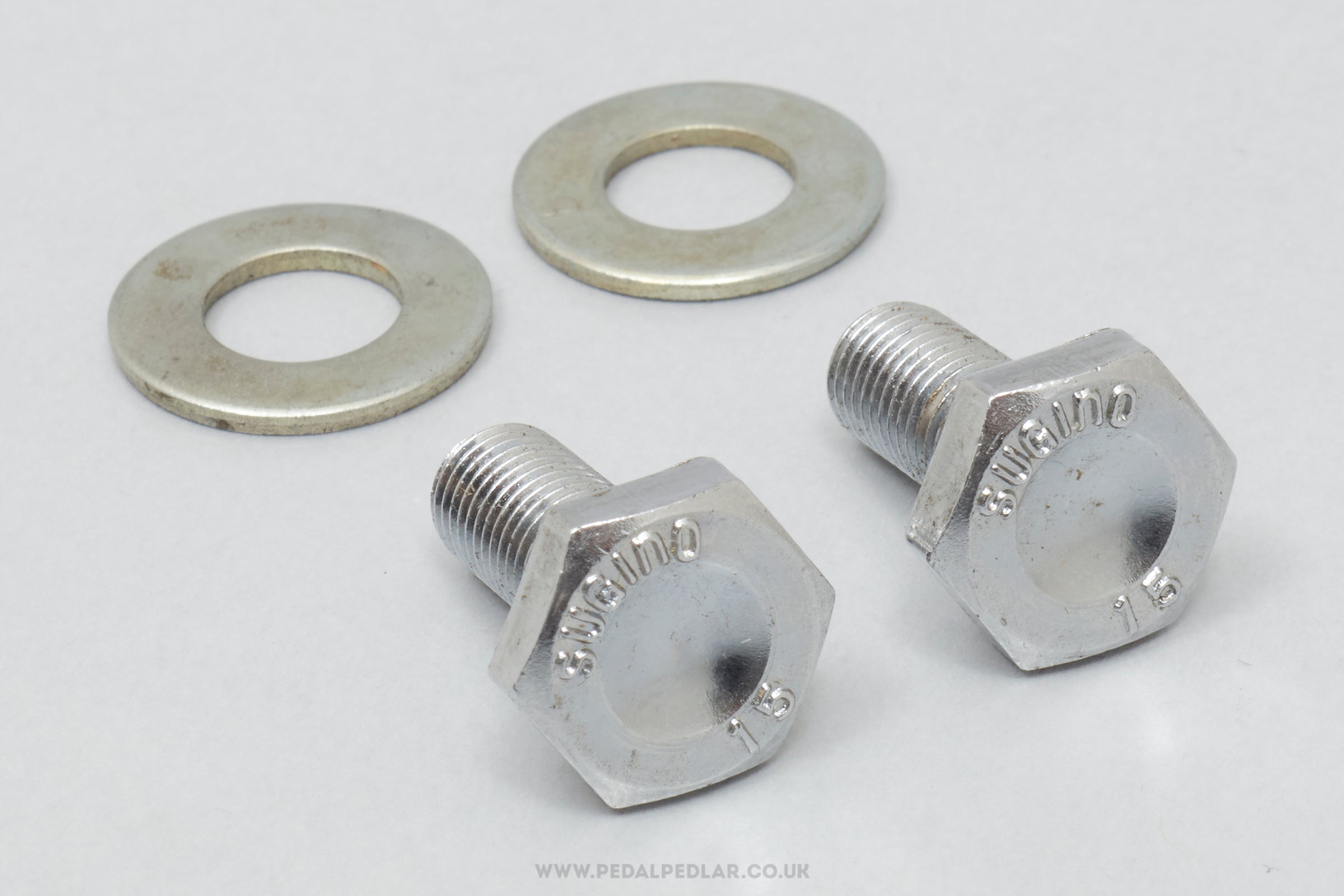


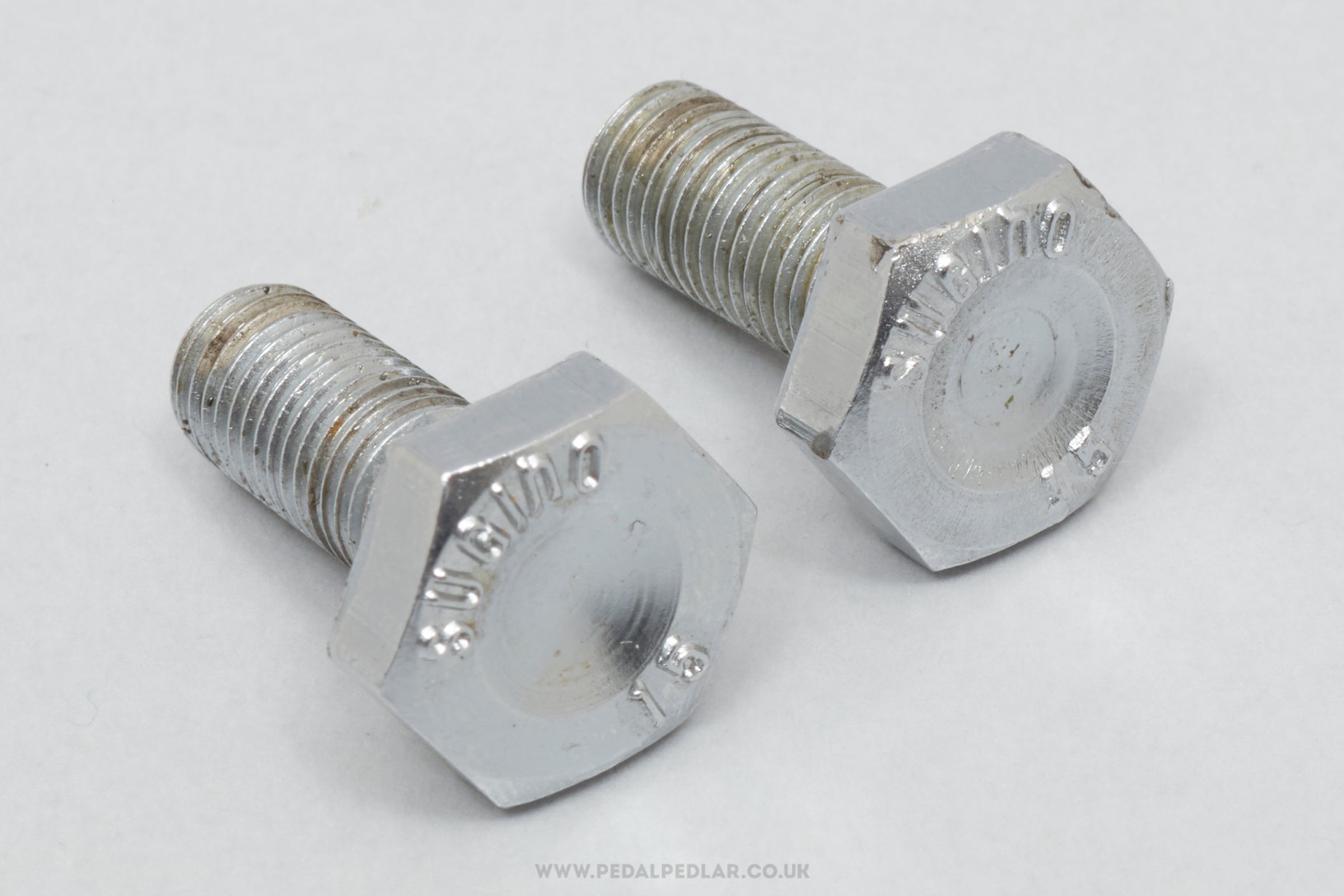
Sugino NOS Vintage Crank Arm Bolts Set
£19.13 £22.50
✓ Original parts - in production from the 1980s to the 1990s
✓ New old stock! Still unused after all these years
✓ Suitable for historic cycling events such as L'Eroica
✓ Worldwide shipping
Sugino crankset fixing bolts (or bottom bracket screws if you prefer), hailing from Japan and in production from the 1980s to the 1990s (yet still new & unused after all this time!). Made from steel and weighing in at 30 grams. A fine choice for keeping your vintage bike authentic, but also great for any other compatible bike.
If you're taking part in L'Eroica or a similar vintage event, these are fully compliant - so rest assured, the pre-1987 police won't lock you up for having the wrong crank bolts!
OVERVIEW
Production Era - 1980s & 1990s
Country - Japanese
Material - Steel
Weight - 30 g
Stock Code - D-CB44V
*New old stock items may have marks from storage over the years, and as we often have multiples they can vary from piece to piece, but they are always genuine new & unused items.
TECHNICAL INFO
Crank Bolt Type - 15 mm Hex (Standard)
Crank Bolt Thread - M8 x 1 mm (Standard)
-
▼SHIPPING, TAXES & RETURNS
-
We've been safely sending orders around the world since 2010. Orders are carefully packed, sent with tracking & insurance, and normally collected around midday on Tuesdays and Fridays. Larger items may occasionally require an extra day or two to prepare.
We accept returns, please notify us within 14 days and ensure the item arrives back with us no later than 30 days after the order was received.
EU orders under €150 (excluding shipping) - import VAT and the new €3 customs duty are paid as part of your order, so there's nothing further to pay on delivery.
EU orders over €150 (excluding shipping) - import fees are payable to the carrier before delivery, with nothing collected at checkout.
USA orders - import fees are collected at checkout for all orders to the USA, so there won’t be any surprise charges when your order arrives.
Other international orders - local import fees may apply and are not collected by us. Please check your country's import rules before purchasing.
-
▼HELP SECTION
-
Crank Bolt Type - 15 mm hex bolts used to be standard but some older TA, Stronglight and Zeus cranks used a larger 16 mm bolt, plus a few Japanese makers used a smaller 14 mm hex head. Allen key types were introduced in the 1980s and some are self-extracting, which means the crank removes itself when you undo the bolts.
Crank Bolt Thread - All square taper bottom brackets have a standard M8 x 1 mm thread, the only different thread types you’ll find on crank bolts are the much larger M12 & M15 bolts that are specifically for Octalink and ISIS bottom brackets.


Sugino Vintage Crank Arm Bolts Set
£15.75 £17.50
✓ Original parts - in production from the 1980s to the 1990s
✓ Suitable for historic cycling events such as L'Eroica
✓ Checked & cleaned
✓ Worldwide shipping
Sugino crankset fixing bolts (or bottom bracket screws if you prefer), hailing from Japan and in production from the 1980s to the 1990s. Made from steel and weighing in at 27 grams. A fine choice for keeping your vintage bike authentic, but also great for any other compatible bike.
If you're taking part in L'Eroica or a similar vintage event, these are fully compliant - so rest assured, the pre-1987 police won't lock you up for having the wrong crank bolts!
The crank bolts have been cleaned, checked and graded as excellent condition, but do take a good look at the detailed photos so you can see the cosmetic condition before you buy.OVERVIEW
Production Era - 1980s & 1990s
Country - Japanese
Material - Steel
Weight - 27 g
Stock Code - U-CB43V
TECHNICAL INFO
Crank Bolt Type - 15 mm Hex (Standard)
Crank Bolt Thread - M8 x 1 mm (Standard)
-
▼SHIPPING, TAXES & RETURNS
-
We've been safely sending orders around the world since 2010. Orders are carefully packed, sent with tracking & insurance, and normally collected around midday on Tuesdays and Fridays. Larger items may occasionally require an extra day or two to prepare.
We accept returns, please notify us within 14 days and ensure the item arrives back with us no later than 30 days after the order was received.
EU orders under €150 (excluding shipping) - import VAT and the new €3 customs duty are paid as part of your order, so there's nothing further to pay on delivery.
EU orders over €150 (excluding shipping) - import fees are payable to the carrier before delivery, with nothing collected at checkout.
USA orders - import fees are collected at checkout for all orders to the USA, so there won’t be any surprise charges when your order arrives.
Other international orders - local import fees may apply and are not collected by us. Please check your country's import rules before purchasing.
-
▼HELP SECTION
-
Crank Bolt Type - 15 mm hex bolts used to be standard but some older TA, Stronglight and Zeus cranks used a larger 16 mm bolt, plus a few Japanese makers used a smaller 14 mm hex head. Allen key types were introduced in the 1980s and some are self-extracting, which means the crank removes itself when you undo the bolts.
Crank Bolt Thread - All square taper bottom brackets have a standard M8 x 1 mm thread, the only different thread types you’ll find on crank bolts are the much larger M12 & M15 bolts that are specifically for Octalink and ISIS bottom brackets.
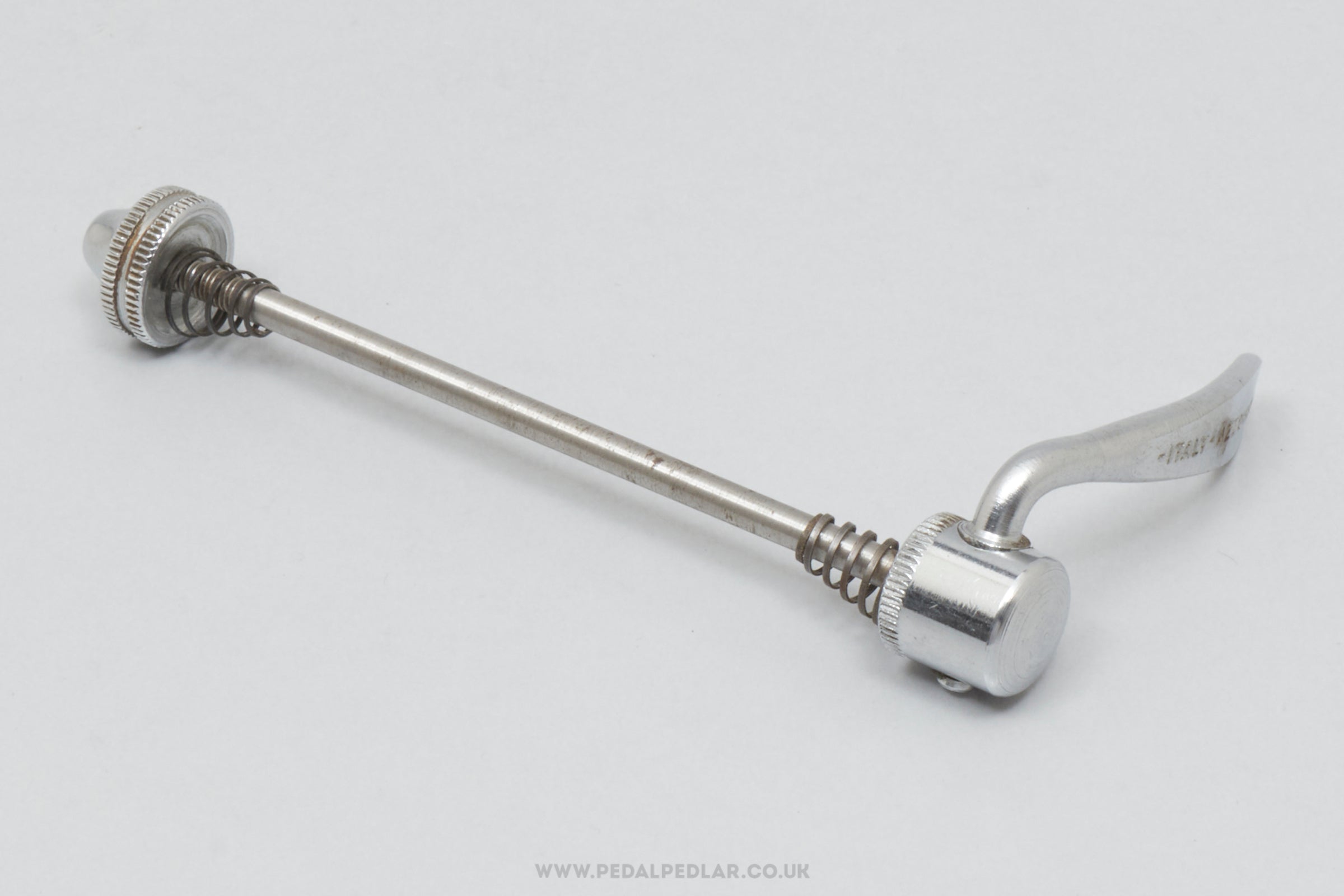


Gipiemme Azzurro Vintage Quick Release Front Skewer
£18.00 £20.00
✓ Original skewer - in production from the 1970s to the 1980s
✓ Suitable for historic cycling events such as L'Eroica
✓ Checked & cleaned
✓ Worldwide shipping
Gipiemme Azzurro front wheel skewer (or hub spindle if you prefer), hailing from Italy and in production from the 1970s to the 1980s. Made from steel and weighing in at 84 grams. A fine choice for keeping your vintage bike authentic, but also great for any other compatible bike.
If you're taking part in L'Eroica or any other vintage event, this is fully compliant - so rest assured, the pre-1987 police won't lock you up for having the wrong skewer!
The skewer's been cleaned, checked by one of our mechanics and graded as good condition, but do take a good look at the detailed photos so you can see the cosmetic condition before you buy.OVERVIEW
Production Era - 1970s & 1980s
Country - Italian
Material - Steel
Weight - 84 g
Stock Code - U-SKW-F25V
TECHNICAL INFO
Skewer Type - Quick Release
Spacing* - 111 mm
Threaded Section - 24 mm
End Nut Length - 15 mm
*See help section.
-
▼SHIPPING, TAXES & RETURNS
-
We've been safely sending orders around the world since 2010. Orders are carefully packed, sent with tracking & insurance, and normally collected around midday on Tuesdays and Fridays. Larger items may occasionally require an extra day or two to prepare.
We accept returns, please notify us within 14 days and ensure the item arrives back with us no later than 30 days after the order was received.
EU orders under €150 (excluding shipping) - import VAT and the new €3 customs duty are paid as part of your order, so there's nothing further to pay on delivery.
EU orders over €150 (excluding shipping) - import fees are payable to the carrier before delivery, with nothing collected at checkout.
USA orders - import fees are collected at checkout for all orders to the USA, so there won’t be any surprise charges when your order arrives.
Other international orders - local import fees may apply and are not collected by us. Please check your country's import rules before purchasing.
-
▼HELP SECTION
-
Skewer type - quick release skewers allow you to remove the wheel without any tools, whereas allen key and security skewers require a tool to allow the wheel to be removed.
*Spacing - this should be within a few milimetres of your fork's outer dropout spacing (measured from the outside where the skewers clamp down). The measurement provided was taken with the exiting hole of the end nut flush with the end of the skewer. There will be some wiggle room to allow a narrower or wider dropout spacing to fit, we've provided the threaded section and end nut measurements to give you an indication of how much.
Threaded section - the amount of thread on the skewers for the end nut to be threaded onto.
End nut length - the total length of the nut from end to end.
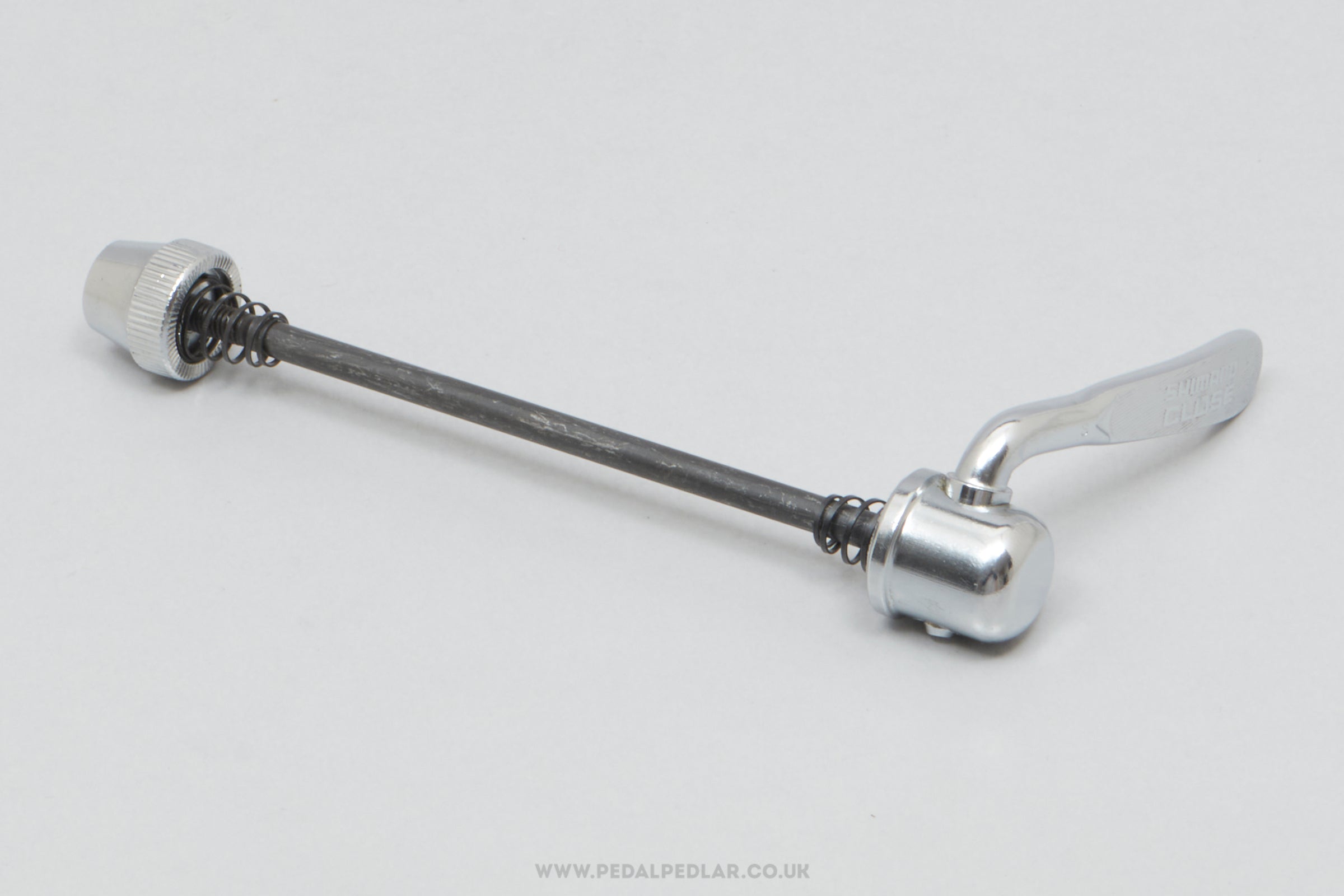


Shimano NOS Classic Quick Release Front Skewer
£12.75 £15.00
✓ Original skewer - produced in the 1990s
✓ New old stock! Still unused after all these years
✓ Worldwide shipping
Shimano front wheel skewer (or hub spindle if you prefer), hailing from Japan and in production during the 1990s (yet still new & unused after all this time!). Made from steel/plastic and weighing in at 93 grams. A fine choice for keeping your classic bike authentic, but also great for any other compatible bike.
OVERVIEW
Production Era - 1990s
Country - Japanese
Material - Steel / Plastic
Weight - 93 g
Stock Code - D-SKW-F30C
*New old stock items may have marks from storage over the years, and as we often have multiples they can vary from piece to piece, but they are always genuine new & unused items.
TECHNICAL INFO
Skewer Type - Quick Release
Spacing* - 109 mm
Threaded Section - 22 mm
End Nut Length - 16 mm
*See help section.
-
▼SHIPPING, TAXES & RETURNS
-
We've been safely sending orders around the world since 2010. Orders are carefully packed, sent with tracking & insurance, and normally collected around midday on Tuesdays and Fridays. Larger items may occasionally require an extra day or two to prepare.
We accept returns, please notify us within 14 days and ensure the item arrives back with us no later than 30 days after the order was received.
EU orders under €150 (excluding shipping) - import VAT and the new €3 customs duty are paid as part of your order, so there's nothing further to pay on delivery.
EU orders over €150 (excluding shipping) - import fees are payable to the carrier before delivery, with nothing collected at checkout.
USA orders - import fees are collected at checkout for all orders to the USA, so there won’t be any surprise charges when your order arrives.
Other international orders - local import fees may apply and are not collected by us. Please check your country's import rules before purchasing.
-
▼HELP SECTION
-
Skewer type - quick release skewers allow you to remove the wheel without any tools, whereas allen key and security skewers require a tool to allow the wheel to be removed.
*Spacing - this should be within a few milimetres of your fork's outer dropout spacing (measured from the outside where the skewers clamp down). The measurement provided was taken with the exiting hole of the end nut flush with the end of the skewer. There will be some wiggle room to allow a narrower or wider dropout spacing to fit, we've provided the threaded section and end nut measurements to give you an indication of how much.
Threaded section - the amount of thread on the skewers for the end nut to be threaded onto.
End nut length - the total length of the nut from end to end.
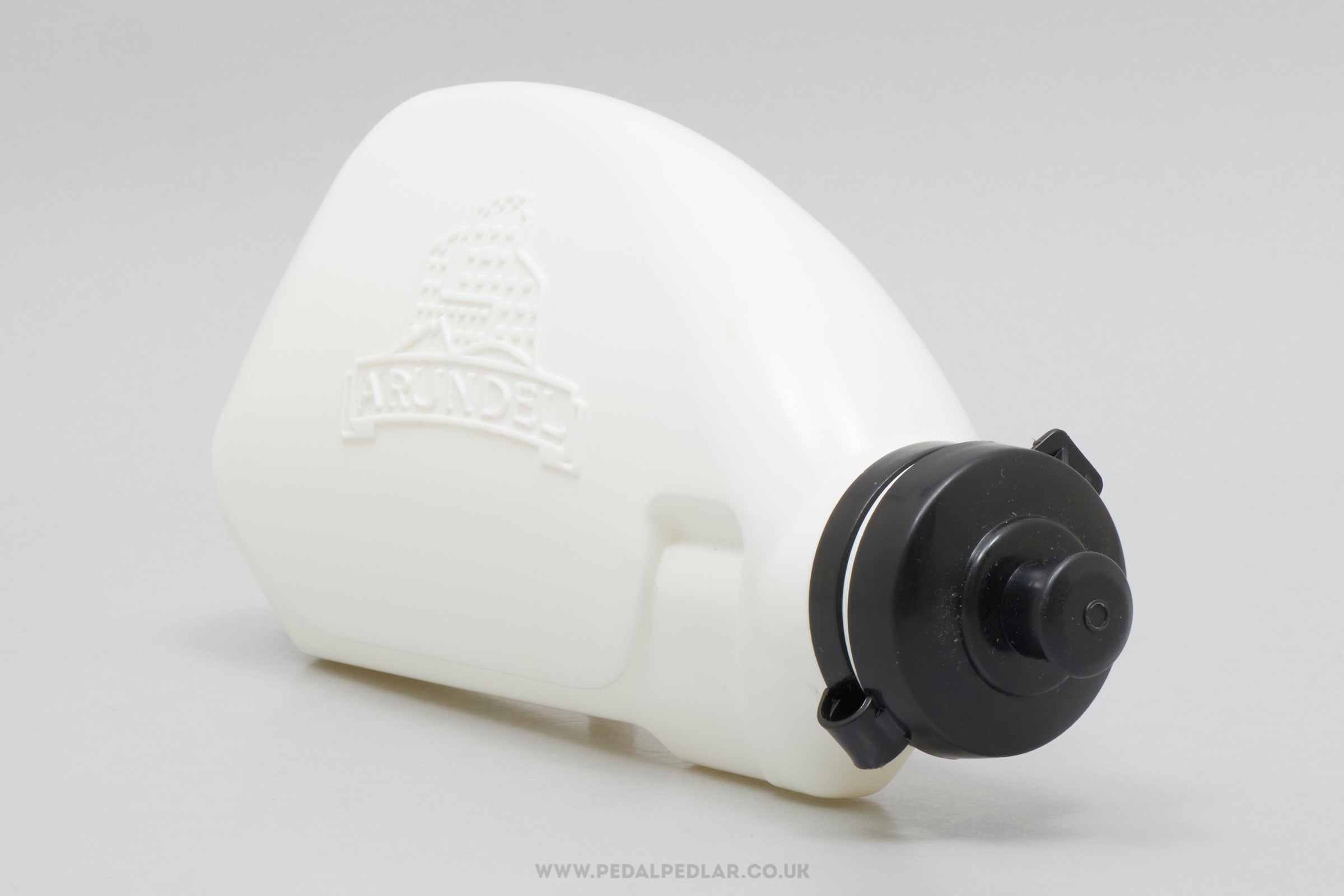


Arundel Chrono TT White NOS Classic 600 ml Aero Water Bottle
£15.00 £20.00
✓ Original drinks bottle - in production from the 1990s to the 2000s
✓ New old stock! Still unused after all these years
✓ Worldwide shipping
Arundel Chrono TT water bottle (or bidon, or borraccia...), hailing from the United States and in production from the 1990s to the 2000s (yet still new & unused after all this time!). The perfect finishing touch for your classic bike, but great for bikes of the non-classic variety too!
OVERVIEW
Production Era - 1990s & 2000s
Country - American
Material - Plastic
Weight - 88 g
Stock Code - D-BOT37C
*New old stock items may have marks from storage over the years, and as we often have multiples they can vary from piece to piece, but they are always genuine new & unused items.
TECHNICAL INFO
Capacity - 600 ml
Cage Fit - Aero (Bottle Specific)
-
▼SHIPPING, TAXES & RETURNS
-
We've been safely sending orders around the world since 2010. Orders are carefully packed, sent with tracking & insurance, and normally collected around midday on Tuesdays and Fridays. Larger items may occasionally require an extra day or two to prepare.
We accept returns, please notify us within 14 days and ensure the item arrives back with us no later than 30 days after the order was received.
EU orders under €150 (excluding shipping) - import VAT and the new €3 customs duty are paid as part of your order, so there's nothing further to pay on delivery.
EU orders over €150 (excluding shipping) - import fees are payable to the carrier before delivery, with nothing collected at checkout.
USA orders - import fees are collected at checkout for all orders to the USA, so there won’t be any surprise charges when your order arrives.
Other international orders - local import fees may apply and are not collected by us. Please check your country's import rules before purchasing.
-
▼HELP SECTION
-
Capacity - 500ml used to be the standard sized bottle, but the taller modern versions tend to be 750ml.
Cage Fit - almost all bottle cages have a standard opening size (between 70 -75 mm), the only rather rare exceptions are some old Elite cages that take a 66 mm bottle (and of course the funny shaped aero ones).
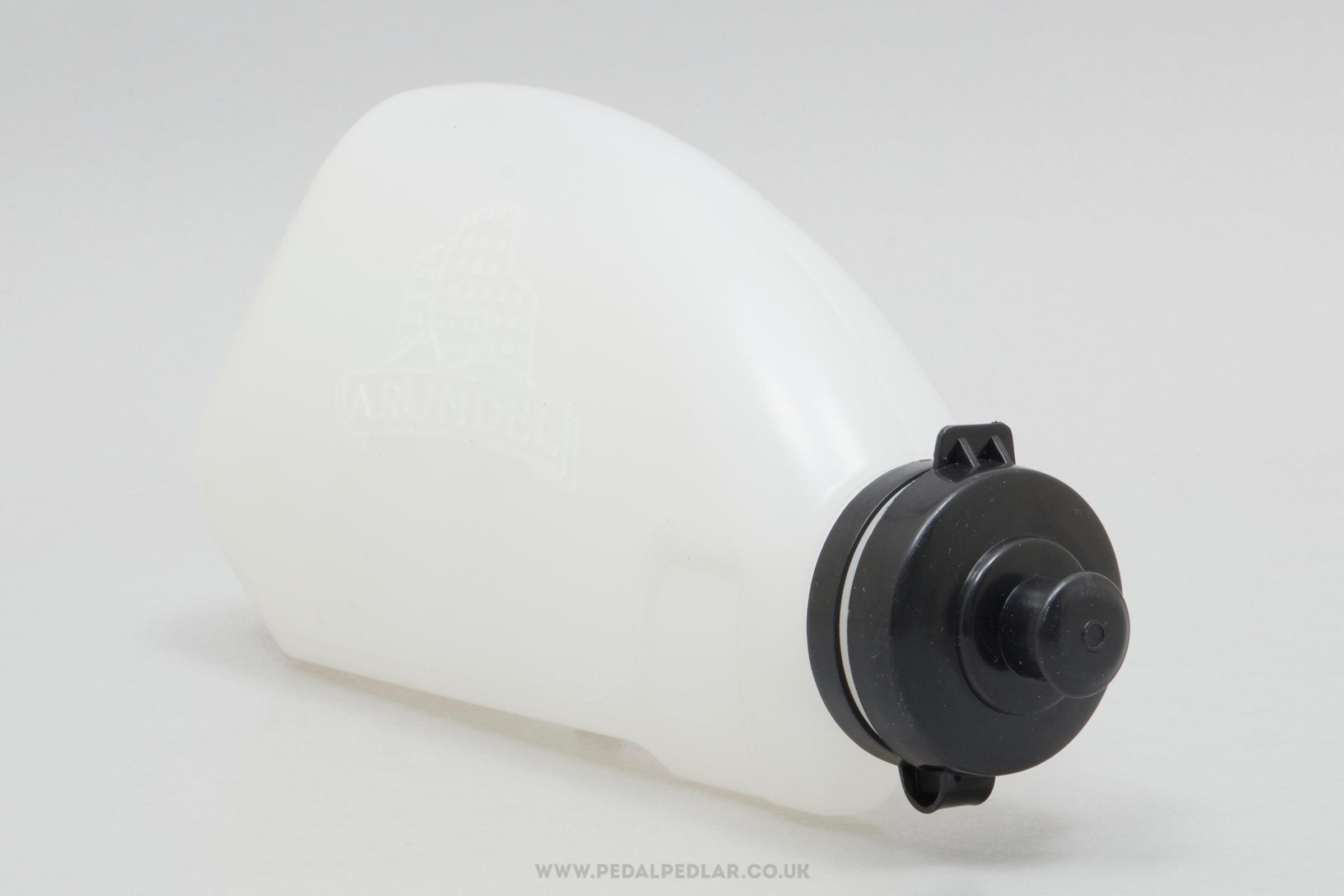


Arundel Chrono TT Clear NOS Classic 600 ml Aero Water Bottle
£18.00 £20.00
✓ Original drinks bottle - in production from the 1990s to the 2000s
✓ New old stock! Still unused after all these years
✓ Worldwide shipping
Arundel Chrono TT water bottle (or bidon, or borraccia...), hailing from the United States and in production from the 1990s to the 2000s (yet still new & unused after all this time!). The perfect finishing touch for your classic bike, but great for bikes of the non-classic variety too!
OVERVIEW
Production Era - 1990s & 2000s
Country - American
Material - Plastic
Weight - 88 g
Stock Code - D-BOT39C
*New old stock items may have marks from storage over the years, and as we often have multiples they can vary from piece to piece, but they are always genuine new & unused items.
TECHNICAL INFO
Capacity - 600 ml
Cage Fit - Aero (Bottle Specific)
-
▼SHIPPING, TAXES & RETURNS
-
We've been safely sending orders around the world since 2010. Orders are carefully packed, sent with tracking & insurance, and normally collected around midday on Tuesdays and Fridays. Larger items may occasionally require an extra day or two to prepare.
We accept returns, please notify us within 14 days and ensure the item arrives back with us no later than 30 days after the order was received.
EU orders under €150 (excluding shipping) - import VAT and the new €3 customs duty are paid as part of your order, so there's nothing further to pay on delivery.
EU orders over €150 (excluding shipping) - import fees are payable to the carrier before delivery, with nothing collected at checkout.
USA orders - import fees are collected at checkout for all orders to the USA, so there won’t be any surprise charges when your order arrives.
Other international orders - local import fees may apply and are not collected by us. Please check your country's import rules before purchasing.
-
▼HELP SECTION
-
Capacity - 500ml used to be the standard sized bottle, but the taller modern versions tend to be 750ml.
Cage Fit - almost all bottle cages have a standard opening size (between 70 -75 mm), the only rather rare exceptions are some old Elite cages that take a 66 mm bottle (and of course the funny shaped aero ones).
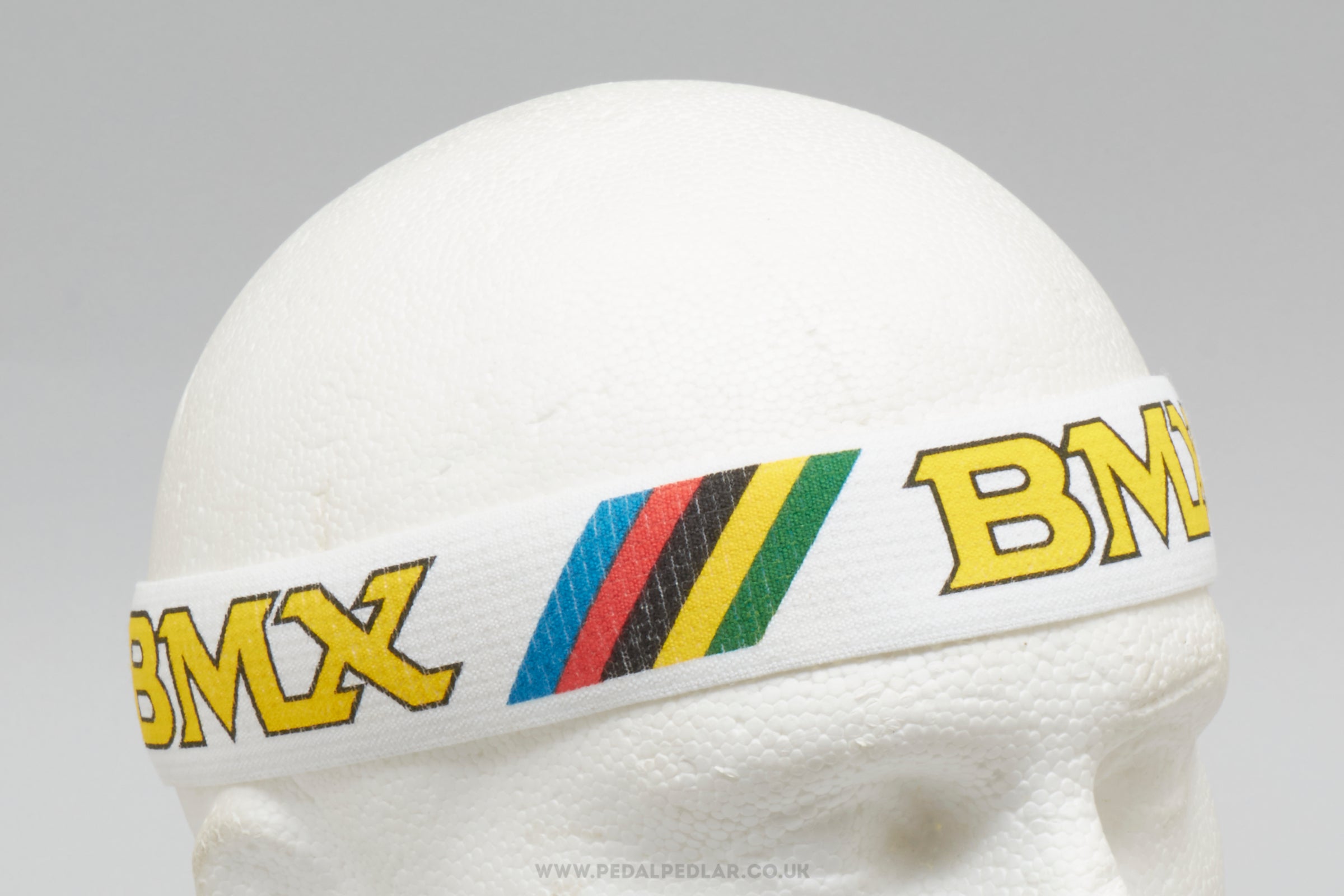


Ciclolinea 'BMX' NOS/NIB Vintage Cycling Headband
£21.25 £25.00
✓ Original vintage headband - 1980s style!
✓ New old stock & still in the original packaging!
✓ Suitable for historic cycling events such as L'Eroica
✓ Worldwide shipping
Ciclolinea headband (or sweat band if you prefer), likely made in the 1980s given the style (yet still new & unused after all this time!). An excellent choice for wearing on your vintage bike (or any occasion you fancy of course), and also a great alternative to buying brand new cycling kit!
If you're taking part in L'Eroica or any other vintage event, this is fully compliant - so rest assured, the pre-1987 police won't lock you up for having the wrong headband!
OVERVIEW
Production Era - 1980s
Stock Code - D-HBD1V
*New old stock items may have marks from storage over the years, and as we often have multiples they can vary from piece to piece, but they are always genuine new & unused items.
DETAIL & MEASUREMENTS
Head Size - One Size (Elasticated)
Colour* - White
*The colour description is just a guide, please check the photos too as we make sure these are as close to the true colour as possible.
-
▼SHIPPING, TAXES & RETURNS
-
We've been safely sending orders around the world since 2010. Orders are carefully packed, sent with tracking & insurance, and normally collected around midday on Tuesdays and Fridays. Larger items may occasionally require an extra day or two to prepare.
We accept returns, please notify us within 14 days and ensure the item arrives back with us no later than 30 days after the order was received.
EU orders under €150 (excluding shipping) - import VAT and the new €3 customs duty are paid as part of your order, so there's nothing further to pay on delivery.
EU orders over €150 (excluding shipping) - import fees are payable to the carrier before delivery, with nothing collected at checkout.
USA orders - import fees are collected at checkout for all orders to the USA, so there won’t be any surprise charges when your order arrives.
Other international orders - local import fees may apply and are not collected by us. Please check your country's import rules before purchasing.
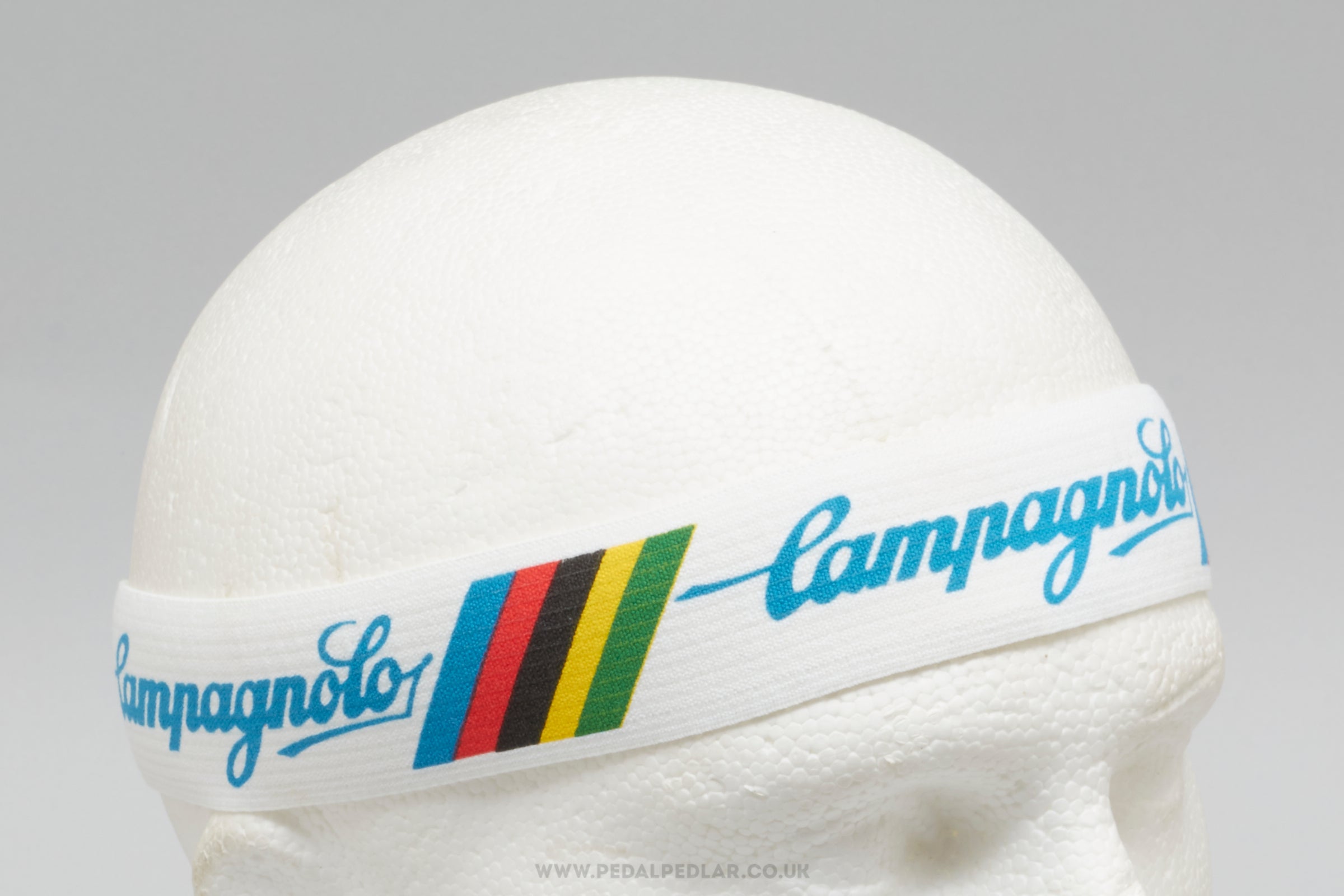


Ciclolinea 'Campagnolo' NOS/NIB Vintage Cycling Headband
£23.38 £27.50
✓ Original vintage headband - 1980s style!
✓ New old stock & still in the original packaging!
✓ Suitable for historic cycling events such as L'Eroica
✓ Worldwide shipping
Ciclolinea headband (or sweat band if you prefer), likely made in the 1980s given the style (yet still new & unused after all this time!). An excellent choice for wearing on your vintage bike (or any occasion you fancy of course), and also a great alternative to buying brand new cycling kit!
If you're taking part in L'Eroica or any other vintage event, this is fully compliant - so rest assured, the pre-1987 police won't lock you up for having the wrong headband!
OVERVIEW
Production Era - 1980s
Stock Code - D-HBD2V
*New old stock items may have marks from storage over the years, and as we often have multiples they can vary from piece to piece, but they are always genuine new & unused items.
DETAIL & MEASUREMENTS
Head Size - One Size (Elasticated)
Colour* - White / Blue
*The colour description is just a guide, please check the photos too as we make sure these are as close to the true colour as possible.
-
▼SHIPPING, TAXES & RETURNS
-
We've been safely sending orders around the world since 2010. Orders are carefully packed, sent with tracking & insurance, and normally collected around midday on Tuesdays and Fridays. Larger items may occasionally require an extra day or two to prepare.
We accept returns, please notify us within 14 days and ensure the item arrives back with us no later than 30 days after the order was received.
EU orders under €150 (excluding shipping) - import VAT and the new €3 customs duty are paid as part of your order, so there's nothing further to pay on delivery.
EU orders over €150 (excluding shipping) - import fees are payable to the carrier before delivery, with nothing collected at checkout.
USA orders - import fees are collected at checkout for all orders to the USA, so there won’t be any surprise charges when your order arrives.
Other international orders - local import fees may apply and are not collected by us. Please check your country's import rules before purchasing.


Ciclolinea 'World Champion Stripes' NOS/NIB Vintage Cycling Headband
£21.25 £25.00
✓ Original vintage headband - 1980s style!
✓ New old stock & still in the original packaging!
✓ Suitable for historic cycling events such as L'Eroica
✓ Worldwide shipping
Ciclolinea headband (or sweat band if you prefer), likely made in the 1980s given the style (yet still new & unused after all this time!). An excellent choice for wearing on your vintage bike (or any occasion you fancy of course), and also a great alternative to buying brand new cycling kit!
If you're taking part in L'Eroica or any other vintage event, this is fully compliant - so rest assured, the pre-1987 police won't lock you up for having the wrong headband!
OVERVIEW
Production Era - 1980s
Stock Code - D-HBD3V
*New old stock items may have marks from storage over the years, and as we often have multiples they can vary from piece to piece, but they are always genuine new & unused items.
DETAIL & MEASUREMENTS
Head Size - One Size (Elasticated)
Colour* - White (World Champ Stripes)
*The colour description is just a guide, please check the photos too as we make sure these are as close to the true colour as possible.
-
▼SHIPPING, TAXES & RETURNS
-
We've been safely sending orders around the world since 2010. Orders are carefully packed, sent with tracking & insurance, and normally collected around midday on Tuesdays and Fridays. Larger items may occasionally require an extra day or two to prepare.
We accept returns, please notify us within 14 days and ensure the item arrives back with us no later than 30 days after the order was received.
EU orders under €150 (excluding shipping) - import VAT and the new €3 customs duty are paid as part of your order, so there's nothing further to pay on delivery.
EU orders over €150 (excluding shipping) - import fees are payable to the carrier before delivery, with nothing collected at checkout.
USA orders - import fees are collected at checkout for all orders to the USA, so there won’t be any surprise charges when your order arrives.
Other international orders - local import fees may apply and are not collected by us. Please check your country's import rules before purchasing.


Ciclolinea 'French Flag' NOS/NIB Vintage Cycling Headband
£21.25 £25.00
✓ Original vintage headband - 1980s style!
✓ New old stock & still in the original packaging!
✓ Suitable for historic cycling events such as L'Eroica
✓ Worldwide shipping
Ciclolinea headband (or sweat band if you prefer), likely made in the 1980s given the style (yet still new & unused after all this time!). An excellent choice for wearing on your vintage bike (or any occasion you fancy of course), and also a great alternative to buying brand new cycling kit!
If you're taking part in L'Eroica or any other vintage event, this is fully compliant - so rest assured, the pre-1987 police won't lock you up for having the wrong headband!
OVERVIEW
Production Era - 1980s
Stock Code - D-HBD5V
*New old stock items may have marks from storage over the years, and as we often have multiples they can vary from piece to piece, but they are always genuine new & unused items.
DETAIL & MEASUREMENTS
Head Size - One Size (Elasticated)
Colour* - White / Blue / Red
*The colour description is just a guide, please check the photos too as we make sure these are as close to the true colour as possible.
-
▼SHIPPING, TAXES & RETURNS
-
We've been safely sending orders around the world since 2010. Orders are carefully packed, sent with tracking & insurance, and normally collected around midday on Tuesdays and Fridays. Larger items may occasionally require an extra day or two to prepare.
We accept returns, please notify us within 14 days and ensure the item arrives back with us no later than 30 days after the order was received.
EU orders under €150 (excluding shipping) - import VAT and the new €3 customs duty are paid as part of your order, so there's nothing further to pay on delivery.
EU orders over €150 (excluding shipping) - import fees are payable to the carrier before delivery, with nothing collected at checkout.
USA orders - import fees are collected at checkout for all orders to the USA, so there won’t be any surprise charges when your order arrives.
Other international orders - local import fees may apply and are not collected by us. Please check your country's import rules before purchasing.
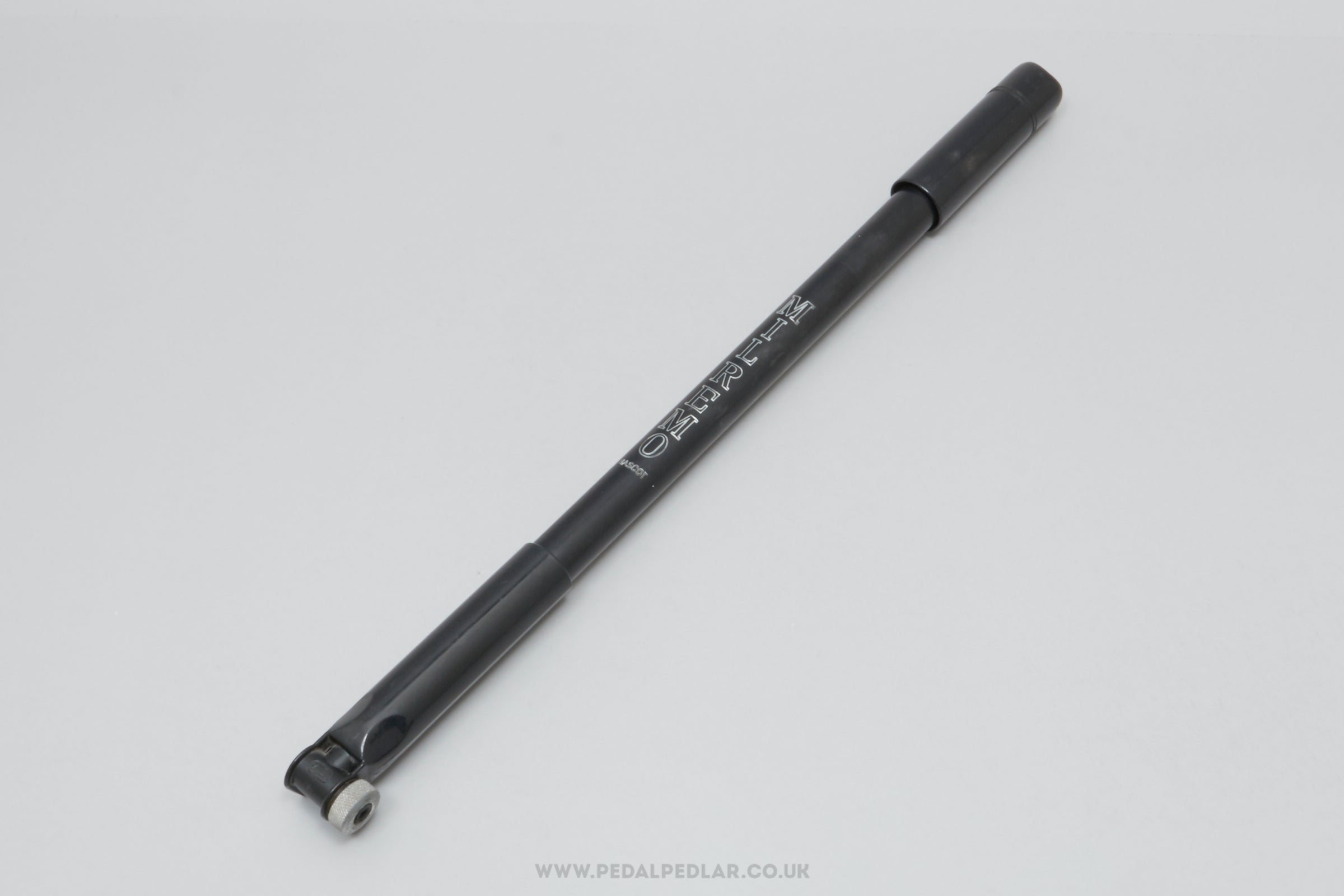


Heta Mascot Milremo Vintage Black 46 - 50 cm Frame Fit Bike Pump
£18.00 £20.00
✓ Original pump - produced in the 1970s
✓ Suitable for historic cycling events such as L'Eroica
✓ Checked & tested
✓ Worldwide shipping
Heta Mascot bicycle pump, hailing from Spain and in production during the 1970s. An excellent choice for vintage cycling enthusiasts, but great for cyclists of the non-vintage variety too!
If you're taking part in L'Eroica or any other vintage event, this is fully compliant - so rest assured, the pre-1987 police won't lock you up for having the wrong pump!
The pump's been thoroughly checked, tested and graded as very good condition, but do take a good look at the detailed photos so you can see the cosmetic condition before you buy.OVERVIEW
Production Era - 1970s
Country - Spanish
Material - Plastic
Weight - 136 g
Stock Code - U-PM-F1V
TECHNICAL INFO
Colour* - Black
Valve Type - Presta
Pump Mount Type - Frame Fit (With Peg Hole at Handle End)
Mount Location** - Seat Tube
Length (Min-Max) - 46 - 50 cm
*The colour description is just a guide, please check the photos too as we make sure these are as close to the true colour as possible.
**See help section.
-
▼SHIPPING, TAXES & RETURNS
-
We've been safely sending orders around the world since 2010. Orders are carefully packed, sent with tracking & insurance, and normally collected around midday on Tuesdays and Fridays. Larger items may occasionally require an extra day or two to prepare.
We accept returns, please notify us within 14 days and ensure the item arrives back with us no later than 30 days after the order was received.
EU orders under €150 (excluding shipping) - import VAT and the new €3 customs duty are paid as part of your order, so there's nothing further to pay on delivery.
EU orders over €150 (excluding shipping) - import fees are payable to the carrier before delivery, with nothing collected at checkout.
USA orders - import fees are collected at checkout for all orders to the USA, so there won’t be any surprise charges when your order arrives.
Other international orders - local import fees may apply and are not collected by us. Please check your country's import rules before purchasing.
-
▼HELP SECTION
-
Valve Type - there are 3 types of valves; Presta are thin with a little knurled nut on the end, Schrader are wider (the same as you would find on a car), and the less common Woods (aka "Dunlop"). Pumps designed for Presta valves can be used on Woods valves. Some pumps use hose connectors, these are available for all valve types.
Pump Mount Type - 'peg fit' pumps require pump pegs or 'umbrella' clips to fit to the frame, 'frame fit 'pumps are designed with curved ends to mount between two tubes (although these often have holes for pegs too). If mounting directly you'll need the correct length to fit your frame, or a clip/peg to hold one end.
Mount Location - frame fit pumps usually mount to the seat tube with the ends compressed between the top and down tube, they can however be mounted on other tubes as long as there's something supporting the handle end. Some head tubes have a little nipple or a small enough gap for under top tube mounting (this can be replcated with a simple strap or cable tie), and of course pump pegs or clips can be fitted anywhere!
Length (Min-Max) - the length of the pump fully compressed and uncompressed, measured at the points of support. The space you to intend to mount the pump should be within 1 cm of the minimum or maximum length to allow the pump to be securely mounted and dismounted.
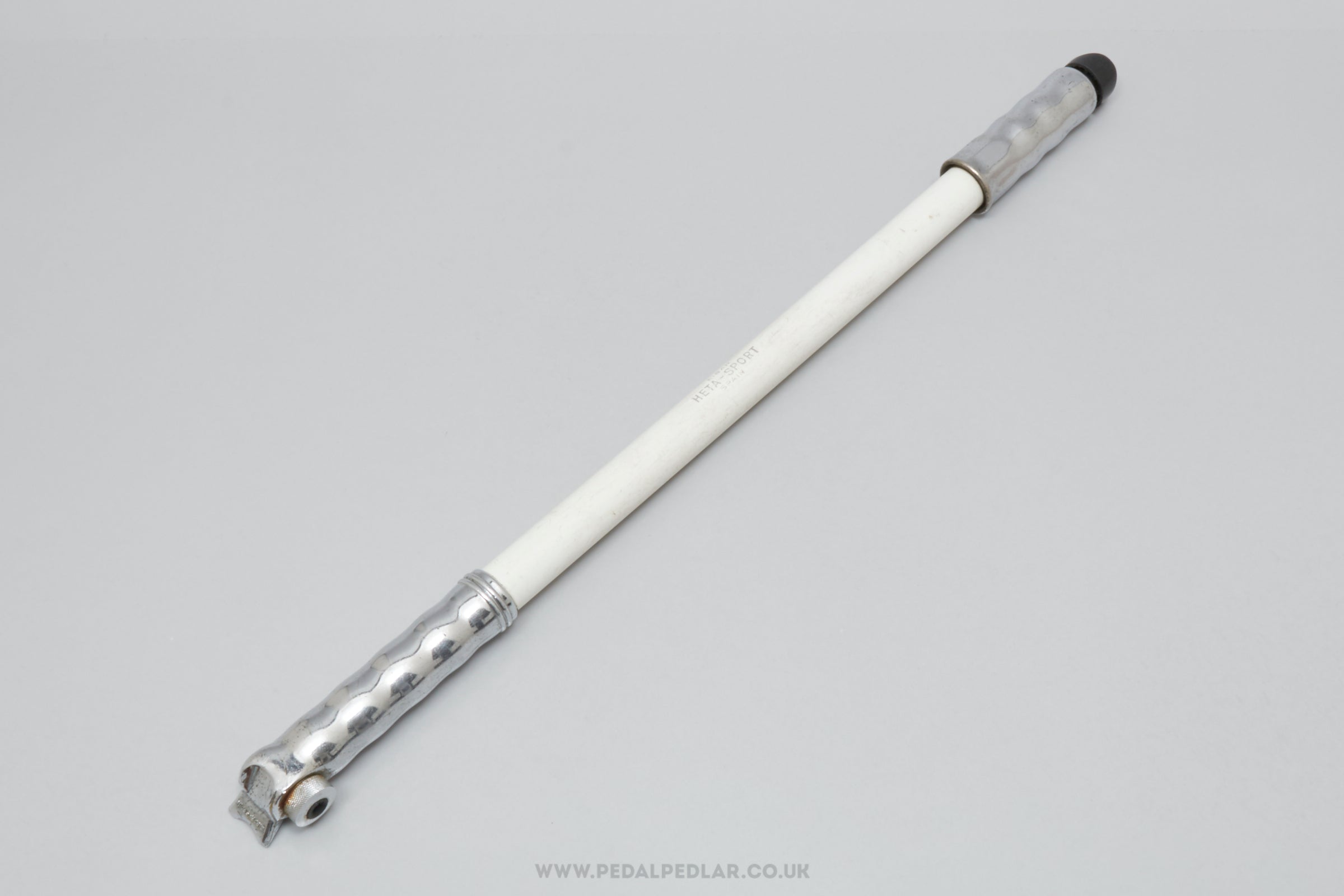


Heta Sport Vintage White 50 - 55 cm Frame Fit Bike Pump
£22.50 £25.00
✓ Original pump - in production from the 1970s to the 1980s
✓ Suitable for historic cycling events such as L'Eroica
✓ Checked & tested
✓ Worldwide shipping
Heta Sport bicycle pump, hailing from Spain and in production from the 1970s to the 1980s. An excellent choice for vintage cycling enthusiasts, but great for cyclists of the non-vintage variety too!
If you're taking part in L'Eroica or any other vintage event, this is fully compliant - so rest assured, the pre-1987 police won't lock you up for having the wrong pump!
The pump's been thoroughly checked, tested and graded as good condition, but do take a good look at the detailed photos so you can see the cosmetic condition before you buy.OVERVIEW
Production Era - 1970s & 1980s
Country - Spanish
Material - Plastic
Weight - 151 g
Stock Code - U-PM-F2V
TECHNICAL INFO
Colour* - White
Valve Type - Presta
Pump Mount Type - Frame Fit (With Peg Hole at Handle End)
Mount Location** - Seat Tube
Length (Min-Max) - 50 - 55 cm
*The colour description is just a guide, please check the photos too as we make sure these are as close to the true colour as possible.
**See help section.
-
▼SHIPPING, TAXES & RETURNS
-
We've been safely sending orders around the world since 2010. Orders are carefully packed, sent with tracking & insurance, and normally collected around midday on Tuesdays and Fridays. Larger items may occasionally require an extra day or two to prepare.
We accept returns, please notify us within 14 days and ensure the item arrives back with us no later than 30 days after the order was received.
EU orders under €150 (excluding shipping) - import VAT and the new €3 customs duty are paid as part of your order, so there's nothing further to pay on delivery.
EU orders over €150 (excluding shipping) - import fees are payable to the carrier before delivery, with nothing collected at checkout.
USA orders - import fees are collected at checkout for all orders to the USA, so there won’t be any surprise charges when your order arrives.
Other international orders - local import fees may apply and are not collected by us. Please check your country's import rules before purchasing.
-
▼HELP SECTION
-
Valve Type - there are 3 types of valves; Presta are thin with a little knurled nut on the end, Schrader are wider (the same as you would find on a car), and the less common Woods (aka "Dunlop"). Pumps designed for Presta valves can be used on Woods valves. Some pumps use hose connectors, these are available for all valve types.
Pump Mount Type - 'peg fit' pumps require pump pegs or 'umbrella' clips to fit to the frame, 'frame fit 'pumps are designed with curved ends to mount between two tubes (although these often have holes for pegs too). If mounting directly you'll need the correct length to fit your frame, or a clip/peg to hold one end.
Mount Location - frame fit pumps usually mount to the seat tube with the ends compressed between the top and down tube, they can however be mounted on other tubes as long as there's something supporting the handle end. Some head tubes have a little nipple or a small enough gap for under top tube mounting (this can be replcated with a simple strap or cable tie), and of course pump pegs or clips can be fitted anywhere!
Length (Min-Max) - the length of the pump fully compressed and uncompressed, measured at the points of support. The space you to intend to mount the pump should be within 1 cm of the minimum or maximum length to allow the pump to be securely mounted and dismounted.
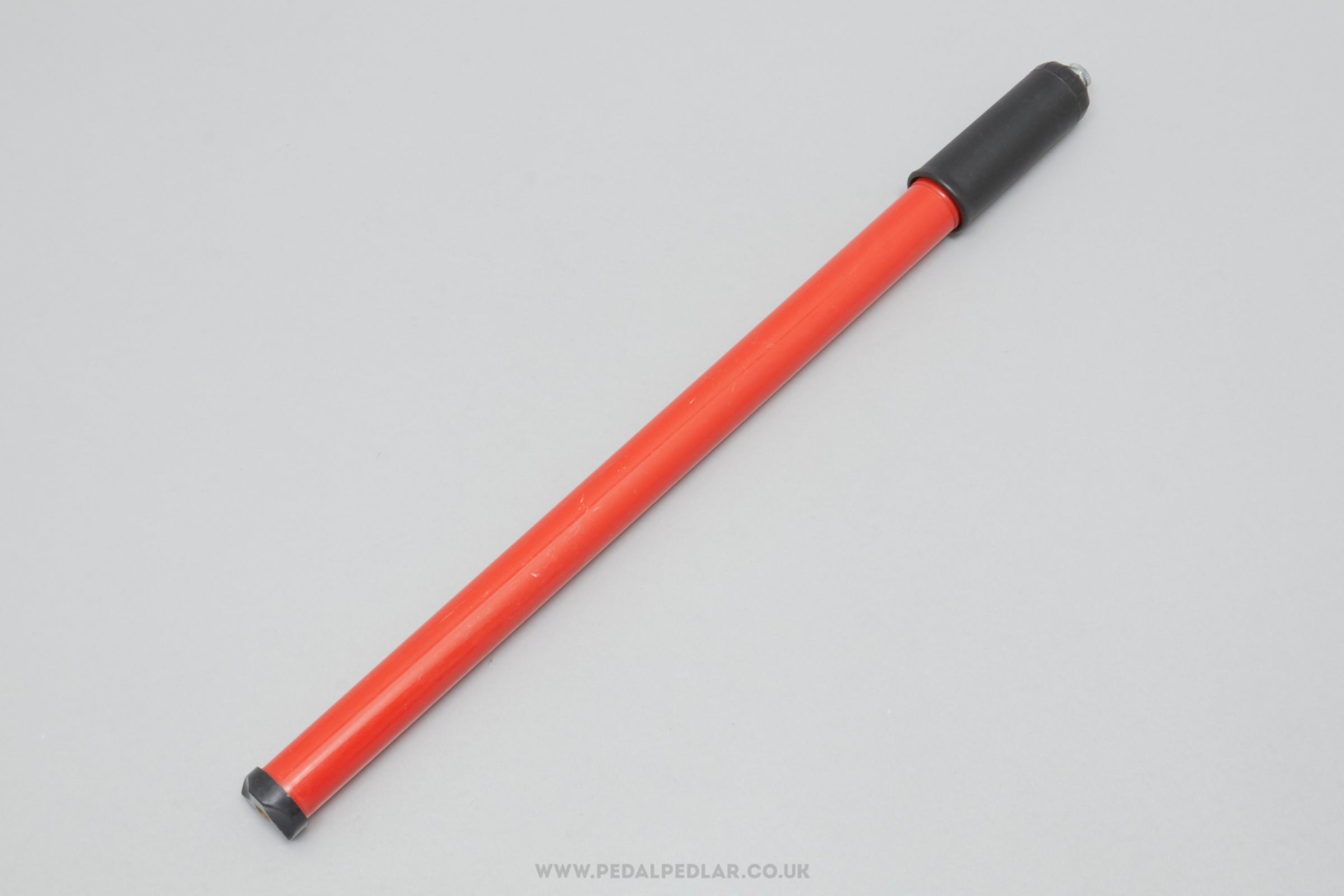


Vintage NOS Red 38 - 40.5 cm Frame Peg Fit Bike Pump
£12.75 £15.00
✓ Original pump - produced in the 1980s
✓ New old stock! Still unused after all these years
✓ Suitable for historic cycling events such as L'Eroica
✓ Worldwide shipping
Unbranded vintage bicycle pump, most likely in production during the 1980s (yet still new & unused after all this time!). An excellent choice for vintage cycling enthusiasts, but great for cyclists of the non-vintage variety too!
If you're taking part in L'Eroica or any other vintage event, this is fully compliant - so rest assured, the pre-1987 police won't lock you up for having the wrong pump!
OVERVIEW
Condition Notes - Some light corrosion on plunger shaft
Production Era - 1980s
Material - Plastic
Weight - 97 g
Stock Code - D-PM-F11V
*New old stock items may have marks from storage over the years, and as we often have multiples they can vary from piece to piece, but they are always genuine new & unused items.
TECHNICAL INFO
Colour* - Red
Valve Type - Hose Connector (Presta/Woods Supplied)
Pump Mount Type - Peg / Clip Fit (Needs Retaining Both Ends)
Mount Location** - Peg / Clip Dependent
Length (Min-Max) - 38 - 40.5 cm
*The colour description is just a guide, please check the photos too as we make sure these are as close to the true colour as possible.
**See help section.
-
▼SHIPPING, TAXES & RETURNS
-
We've been safely sending orders around the world since 2010. Orders are carefully packed, sent with tracking & insurance, and normally collected around midday on Tuesdays and Fridays. Larger items may occasionally require an extra day or two to prepare.
We accept returns, please notify us within 14 days and ensure the item arrives back with us no later than 30 days after the order was received.
EU orders under €150 (excluding shipping) - import VAT and the new €3 customs duty are paid as part of your order, so there's nothing further to pay on delivery.
EU orders over €150 (excluding shipping) - import fees are payable to the carrier before delivery, with nothing collected at checkout.
USA orders - import fees are collected at checkout for all orders to the USA, so there won’t be any surprise charges when your order arrives.
Other international orders - local import fees may apply and are not collected by us. Please check your country's import rules before purchasing.
-
▼HELP SECTION
-
Valve Type - there are 3 types of valves; Presta are thin with a little knurled nut on the end, Schrader are wider (the same as you would find on a car), and the less common Woods (aka "Dunlop"). Pumps designed for Presta valves can be used on Woods valves. Some pumps use hose connectors, these are available for all valve types.
Pump Mount Type - 'peg fit' pumps require pump pegs or 'umbrella' clips to fit to the frame, 'frame fit 'pumps are designed with curved ends to mount between two tubes (although these often have holes for pegs too). If mounting directly you'll need the correct length to fit your frame, or a clip/peg to hold one end.
Mount Location - frame fit pumps usually mount to the seat tube with the ends compressed between the top and down tube, they can however be mounted on other tubes as long as there's something supporting the handle end. Some head tubes have a little nipple or a small enough gap for under top tube mounting (this can be replcated with a simple strap or cable tie), and of course pump pegs or clips can be fitted anywhere!
Length (Min-Max) - the length of the pump fully compressed and uncompressed, measured at the points of support. The space you to intend to mount the pump should be within 1 cm of the minimum or maximum length to allow the pump to be securely mounted and dismounted.
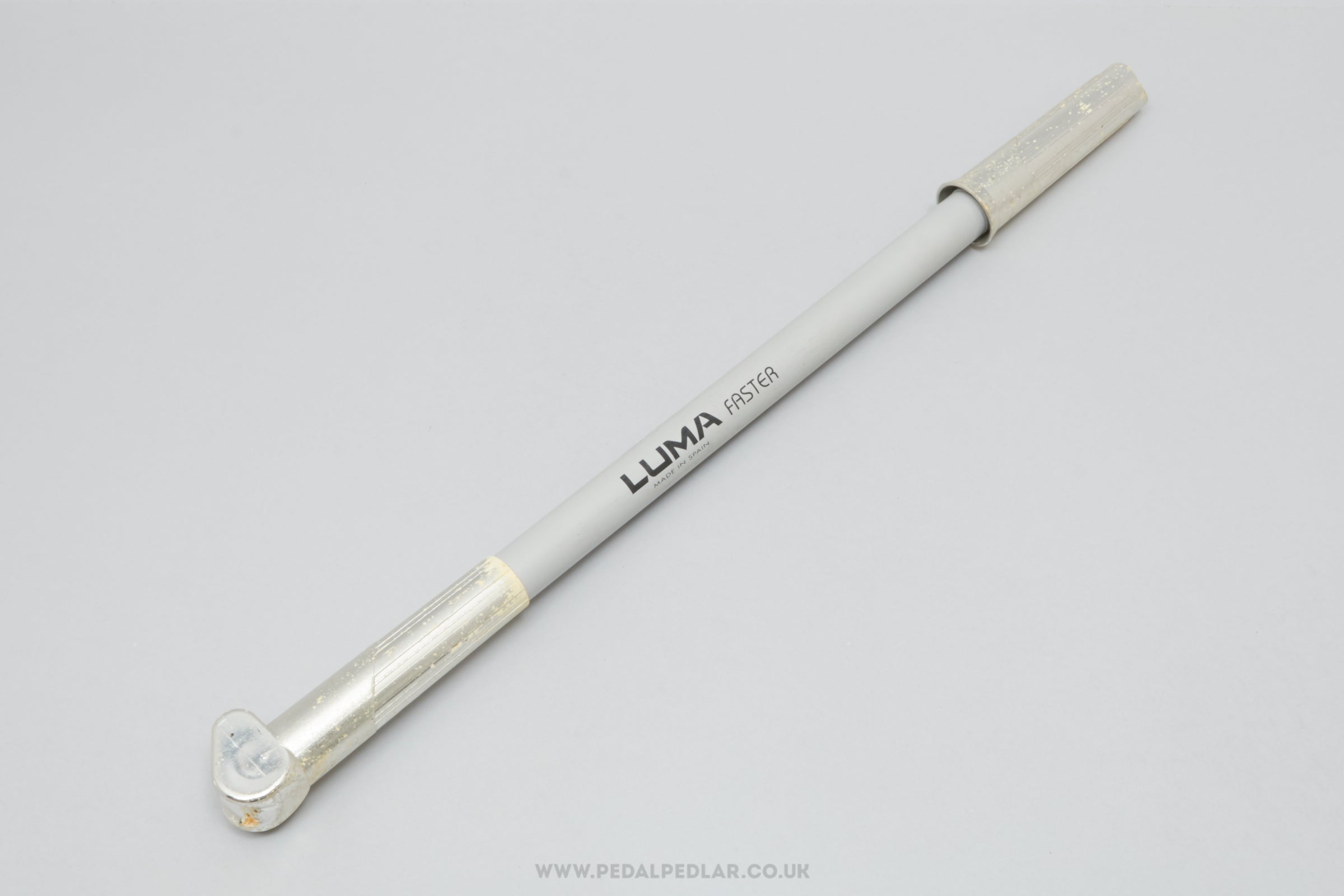


Luma Faster Vintage Grey 47 - 52 cm Frame Fit Bike Pump
£18.00 £20.00
✓ Original pump - produced in the 1980s
✓ Suitable for historic cycling events such as L'Eroica
✓ Checked & tested
✓ Worldwide shipping
Luma Faster bicycle pump, hailing from Spain and in production during the 1980s. An excellent choice for vintage cycling enthusiasts, but great for cyclists of the non-vintage variety too!
If you're taking part in L'Eroica or any other vintage event, this is fully compliant - so rest assured, the pre-1987 police won't lock you up for having the wrong pump!
The pump's been thoroughly checked, tested and graded as good condition, but do take a good look at the detailed photos so you can see the cosmetic condition before you buy.OVERVIEW
Production Era - 1980s
Country - Spanish
Material - Plastic
Weight - 165 g
Stock Code - U-PM-F17V
TECHNICAL INFO
Colour* - Grey
Valve Type - Presta
Pump Mount Type - Frame Fit (With Peg Holes Both Ends)
Mount Location** - Seat Tube
Length (Min-Max) - 47 - 52 cm
*The colour description is just a guide, please check the photos too as we make sure these are as close to the true colour as possible.
**See help section.
-
▼SHIPPING, TAXES & RETURNS
-
We've been safely sending orders around the world since 2010. Orders are carefully packed, sent with tracking & insurance, and normally collected around midday on Tuesdays and Fridays. Larger items may occasionally require an extra day or two to prepare.
We accept returns, please notify us within 14 days and ensure the item arrives back with us no later than 30 days after the order was received.
EU orders under €150 (excluding shipping) - import VAT and the new €3 customs duty are paid as part of your order, so there's nothing further to pay on delivery.
EU orders over €150 (excluding shipping) - import fees are payable to the carrier before delivery, with nothing collected at checkout.
USA orders - import fees are collected at checkout for all orders to the USA, so there won’t be any surprise charges when your order arrives.
Other international orders - local import fees may apply and are not collected by us. Please check your country's import rules before purchasing.
-
▼HELP SECTION
-
Valve Type - there are 3 types of valves; Presta are thin with a little knurled nut on the end, Schrader are wider (the same as you would find on a car), and the less common Woods (aka "Dunlop"). Pumps designed for Presta valves can be used on Woods valves. Some pumps use hose connectors, these are available for all valve types.
Pump Mount Type - 'peg fit' pumps require pump pegs or 'umbrella' clips to fit to the frame, 'frame fit 'pumps are designed with curved ends to mount between two tubes (although these often have holes for pegs too). If mounting directly you'll need the correct length to fit your frame, or a clip/peg to hold one end.
Mount Location - frame fit pumps usually mount to the seat tube with the ends compressed between the top and down tube, they can however be mounted on other tubes as long as there's something supporting the handle end. Some head tubes have a little nipple or a small enough gap for under top tube mounting (this can be replcated with a simple strap or cable tie), and of course pump pegs or clips can be fitted anywhere!
Length (Min-Max) - the length of the pump fully compressed and uncompressed, measured at the points of support. The space you to intend to mount the pump should be within 1 cm of the minimum or maximum length to allow the pump to be securely mounted and dismounted.
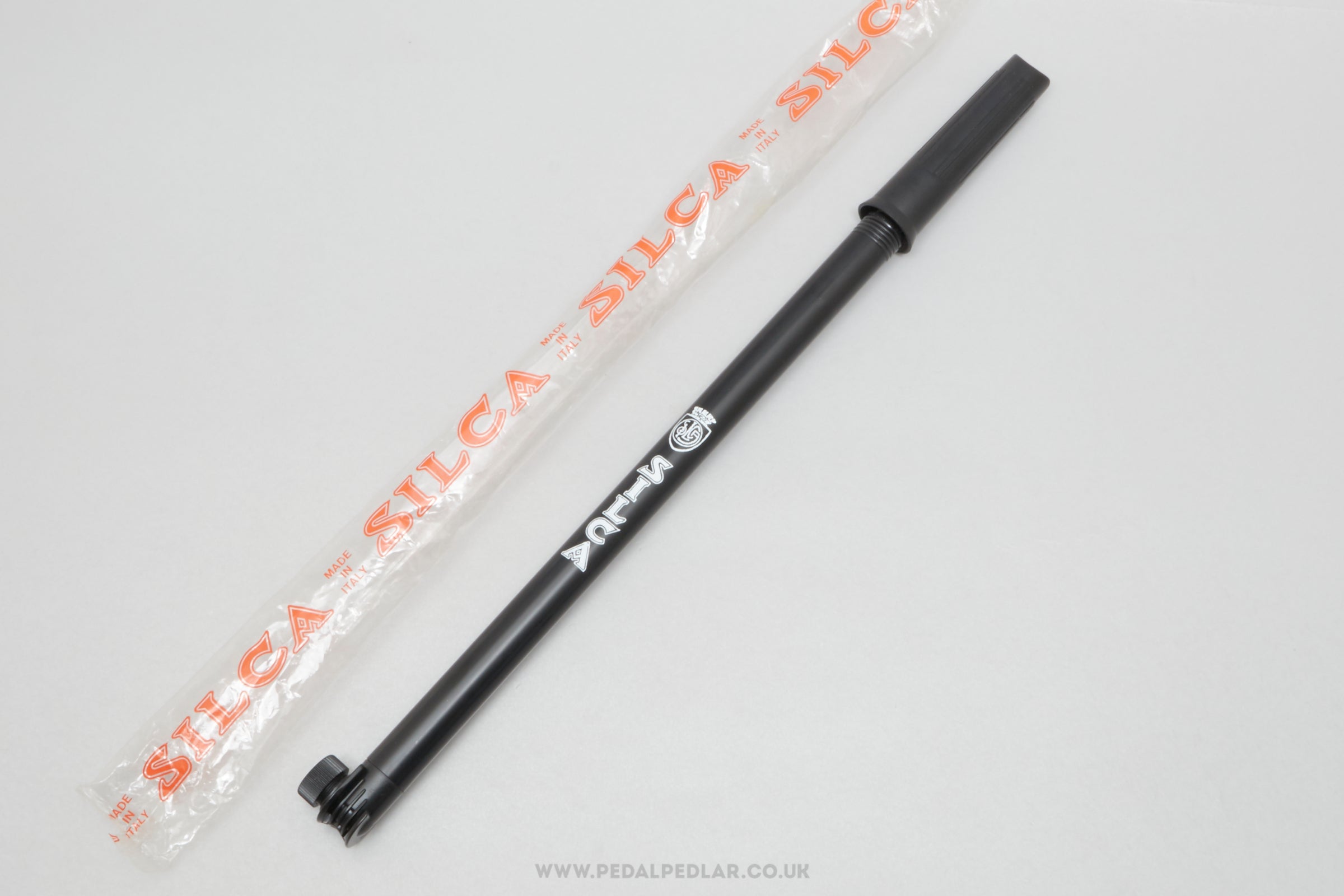


Silca Pro-Am NOS Vintage Black 43 - 50 cm Frame Fit Bike Pump
£19.00 £20.00
✓ Original pump - in production from the 1970s to the 1980s
✓ New old stock! Still unused after all these years
✓ Suitable for historic cycling events such as L'Eroica
✓ Worldwide shipping
Silca Pro-Am bicycle pump, hailing from Italy and in production from the 1970s to the 1980s (yet still new & unused after all this time!). An excellent choice for vintage cycling enthusiasts, but great for cyclists of the non-vintage variety too!
If you're taking part in L'Eroica or any other vintage event, this is fully compliant - so rest assured, the pre-1987 police won't lock you up for having the wrong pump!
OVERVIEW
Production Era - 1970s & 1980s
Country - Italian
Material - Plastic
Weight - 129 g
Stock Code - D-PM-F44V
*New old stock items may have marks from storage over the years, and as we often have multiples they can vary from piece to piece, but they are always genuine new & unused items.
TECHNICAL INFO
Colour* - Black
Valve Type - Presta
Pump Mount Type - Frame Fit (With Peg Holes Both Ends)
Mount Location** - Seat Tube
Length (Min-Max) - 43 - 50 cm
*The colour description is just a guide, please check the photos too as we make sure these are as close to the true colour as possible.
**See help section.
-
▼SHIPPING, TAXES & RETURNS
-
We've been safely sending orders around the world since 2010. Orders are carefully packed, sent with tracking & insurance, and normally collected around midday on Tuesdays and Fridays. Larger items may occasionally require an extra day or two to prepare.
We accept returns, please notify us within 14 days and ensure the item arrives back with us no later than 30 days after the order was received.
EU orders under €150 (excluding shipping) - import VAT and the new €3 customs duty are paid as part of your order, so there's nothing further to pay on delivery.
EU orders over €150 (excluding shipping) - import fees are payable to the carrier before delivery, with nothing collected at checkout.
USA orders - import fees are collected at checkout for all orders to the USA, so there won’t be any surprise charges when your order arrives.
Other international orders - local import fees may apply and are not collected by us. Please check your country's import rules before purchasing.
-
▼HELP SECTION
-
Valve Type - there are 3 types of valves; Presta are thin with a little knurled nut on the end, Schrader are wider (the same as you would find on a car), and the less common Woods (aka "Dunlop"). Pumps designed for Presta valves can be used on Woods valves. Some pumps use hose connectors, these are available for all valve types.
Pump Mount Type - 'peg fit' pumps require pump pegs or 'umbrella' clips to fit to the frame, 'frame fit 'pumps are designed with curved ends to mount between two tubes (although these often have holes for pegs too). If mounting directly you'll need the correct length to fit your frame, or a clip/peg to hold one end.
Mount Location - frame fit pumps usually mount to the seat tube with the ends compressed between the top and down tube, they can however be mounted on other tubes as long as there's something supporting the handle end. Some head tubes have a little nipple or a small enough gap for under top tube mounting (this can be replcated with a simple strap or cable tie), and of course pump pegs or clips can be fitted anywhere!
Length (Min-Max) - the length of the pump fully compressed and uncompressed, measured at the points of support. The space you to intend to mount the pump should be within 1 cm of the minimum or maximum length to allow the pump to be securely mounted and dismounted.
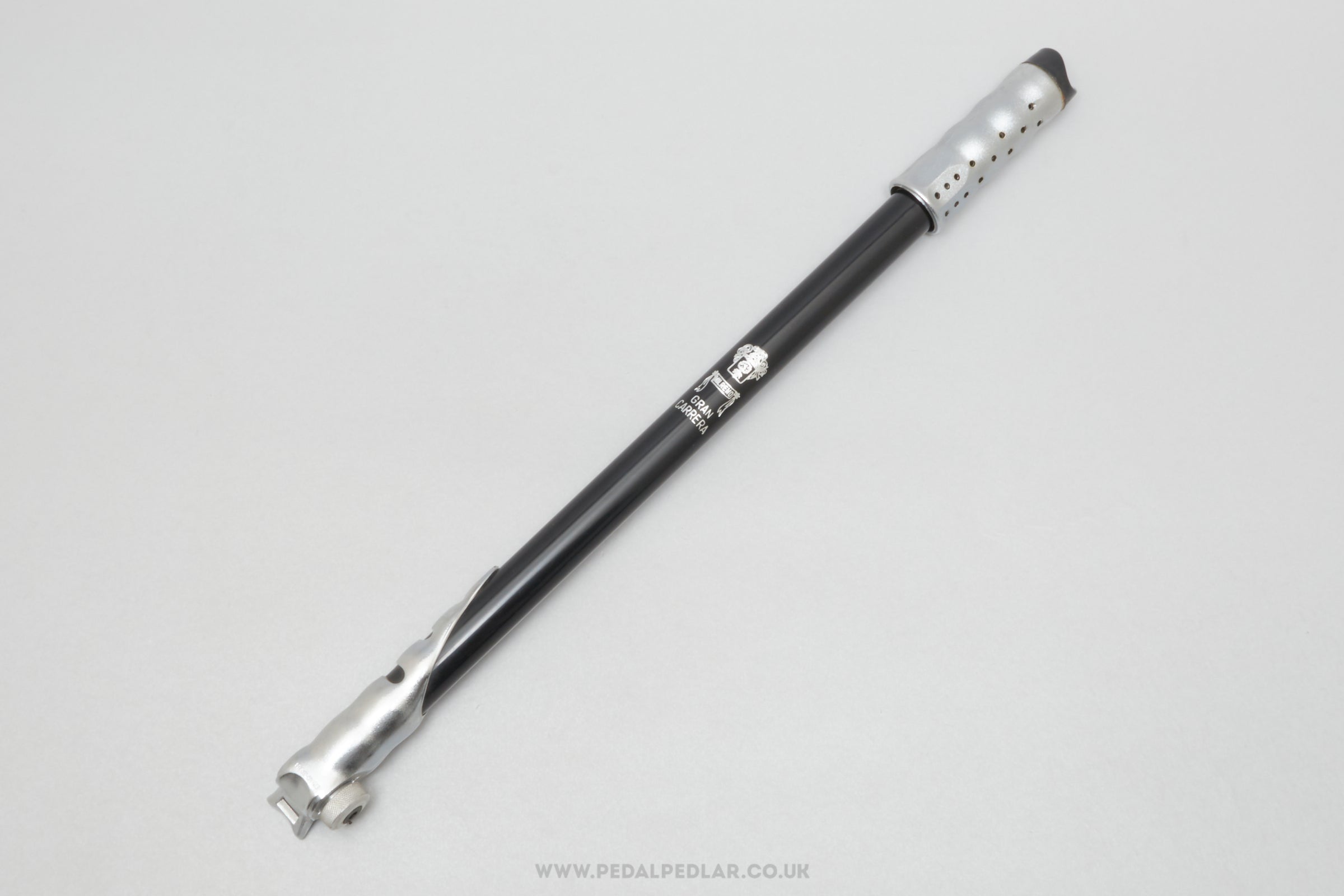


Heta Gran Carrera Milremo NOS Vintage Black 44 - 48.5 cm Frame Fit Bike Pump
£21.25 £25.00
✓ Original pump - produced in the 1970s
✓ New old stock! Still unused after all these years
✓ Suitable for historic cycling events such as L'Eroica
✓ Worldwide shipping
Heta Gran Carrera bicycle pump, hailing from Spain and in production during the 1970s (yet still new & unused after all this time!). An excellent choice for vintage cycling enthusiasts, but great for cyclists of the non-vintage variety too!
If you're taking part in L'Eroica or any other vintage event, this is fully compliant - so rest assured, the pre-1987 police won't lock you up for having the wrong pump!
OVERVIEW
Production Era - 1970s
Country - Spanish
Material - Plastic
Weight - 133 g
Stock Code - D-PM-F45V
*New old stock items may have marks from storage over the years, and as we often have multiples they can vary from piece to piece, but they are always genuine new & unused items.
TECHNICAL INFO
Colour* - Black
Valve Type - Presta
Pump Mount Type - Frame Fit
Mount Location** - Seat Tube
Length (Min-Max) - 44 - 48.5 cm
*The colour description is just a guide, please check the photos too as we make sure these are as close to the true colour as possible.
**See help section.
-
▼SHIPPING, TAXES & RETURNS
-
We've been safely sending orders around the world since 2010. Orders are carefully packed, sent with tracking & insurance, and normally collected around midday on Tuesdays and Fridays. Larger items may occasionally require an extra day or two to prepare.
We accept returns, please notify us within 14 days and ensure the item arrives back with us no later than 30 days after the order was received.
EU orders under €150 (excluding shipping) - import VAT and the new €3 customs duty are paid as part of your order, so there's nothing further to pay on delivery.
EU orders over €150 (excluding shipping) - import fees are payable to the carrier before delivery, with nothing collected at checkout.
USA orders - import fees are collected at checkout for all orders to the USA, so there won’t be any surprise charges when your order arrives.
Other international orders - local import fees may apply and are not collected by us. Please check your country's import rules before purchasing.
-
▼HELP SECTION
-
Valve Type - there are 3 types of valves; Presta are thin with a little knurled nut on the end, Schrader are wider (the same as you would find on a car), and the less common Woods (aka "Dunlop"). Pumps designed for Presta valves can be used on Woods valves. Some pumps use hose connectors, these are available for all valve types.
Pump Mount Type - 'peg fit' pumps require pump pegs or 'umbrella' clips to fit to the frame, 'frame fit 'pumps are designed with curved ends to mount between two tubes (although these often have holes for pegs too). If mounting directly you'll need the correct length to fit your frame, or a clip/peg to hold one end.
Mount Location - frame fit pumps usually mount to the seat tube with the ends compressed between the top and down tube, they can however be mounted on other tubes as long as there's something supporting the handle end. Some head tubes have a little nipple or a small enough gap for under top tube mounting (this can be replcated with a simple strap or cable tie), and of course pump pegs or clips can be fitted anywhere!
Length (Min-Max) - the length of the pump fully compressed and uncompressed, measured at the points of support. The space you to intend to mount the pump should be within 1 cm of the minimum or maximum length to allow the pump to be securely mounted and dismounted.
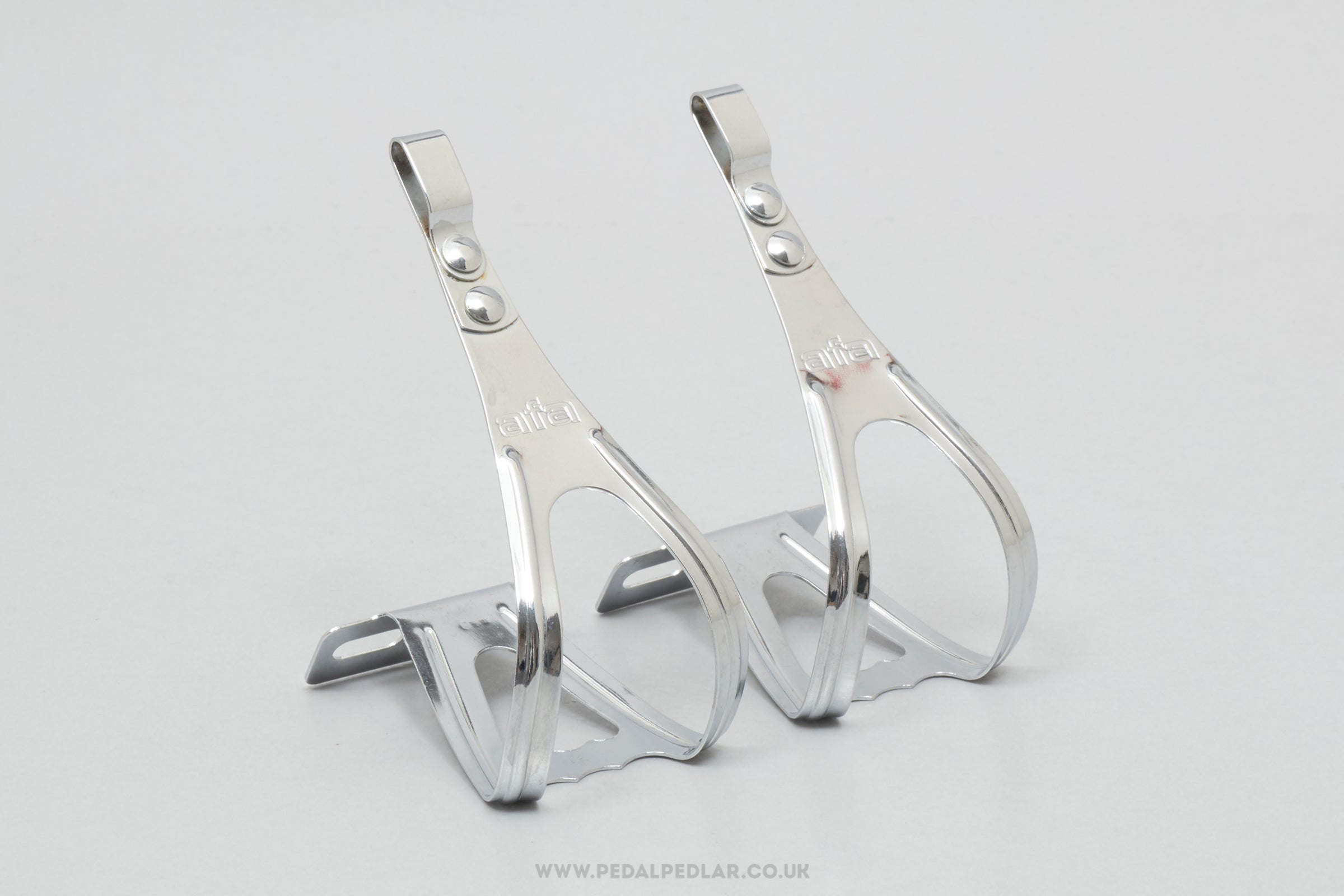


AFA 172 NOS Size M/L Vintage Steel Toe Clips
£21.25 £25.00
✓ Original toe clips - produced in the 1980s
✓ New old stock! Still unused after all these years
✓ Suitable for historic cycling events such as L'Eroica
✓ Worldwide shipping
AFA 172 toe clips (or pedal cages if you prefer), hailing from France and in production during the 1980s (yet still new & unused after all this time!). Made from steel and weighing in at 55 grams. A fine choice for keeping your vintage bike authentic, but also great for any other compatible bike.
If you're taking part in L'Eroica or any other vintage event, these are fully compliant - so rest assured, the pre-1987 police won't lock you up for having the wrong toe clips!
OVERVIEW
Condition - New Old Stock*
Production Era - 1980s
Material - Steel
Weight - 55 g
Stock Code - D-TC81V
*New old stock items may have marks from storage over the years, and as we often have multiples they can vary from piece to piece, but they are always genuine new & unused items.
**This is a guide based on traditional toe clip sizing for cycling shoes of the time, if you ride with chunkier shoes then we'd recommend going for a larger size. Please use this as a guide only and if possible use the length measurement provided to compare with toe clips you know fit well.
TECHNICAL INFO
Pedal Fixing - Standard (Quill / Platform)
Toe Strap Fit - Single Strap
Length (Fixing End to Toe End)* - 6 cm
Distance Between Fixing Bolts (ctc) - 25 mm
-
▼SHIPPING, TAXES & RETURNS
-
We've been safely sending orders around the world since 2010. Orders are carefully packed, sent with tracking & insurance, and normally collected around midday on Tuesdays and Fridays. Larger items may occasionally require an extra day or two to prepare.
We accept returns, please notify us within 14 days and ensure the item arrives back with us no later than 30 days after the order was received.
EU orders under €150 (excluding shipping) - import VAT and the new €3 customs duty are paid as part of your order, so there's nothing further to pay on delivery.
EU orders over €150 (excluding shipping) - import fees are payable to the carrier before delivery, with nothing collected at checkout.
USA orders - import fees are collected at checkout for all orders to the USA, so there won’t be any surprise charges when your order arrives.
Other international orders - local import fees may apply and are not collected by us. Please check your country's import rules before purchasing.
-
▼HELP SECTION
-
Pedal Fixing - 'standard' toe clips fix to the front of the pedals, most will be of this type and work with both quill & platform pedals providing they have mounting holes in the correct place. There are also 'aero' ones that attach to the top, and side fixing versions too. 'Wide platform' fixings are similar to standard ones but the fixing holes are almost 3 inches apart.
Toe Strap Fit - most toe clips are designed to accept a single toe strap, but there are some less common ones that allow two toe straps to be fitted.
Length - this is measured from the fixing end to the toe end at the most extreme points, the same way the manufacturers measure and we use this to recommend the fit if there's no size stamped on them. All length measurements are rounded to the nearest 0.5 cm.
Distance Between Fixing Bolts - we measure this distance from the centre of one hole to the next (ctc), this usually only needs to be close, not exact, providing the holes on the toe clips are oblong shaped to allow a decent amount of wiggle room (most toe clips are made this way).


Christophe 50 / 506 AFA 'Special' Size M/L Vintage Steel Toe Clips
£13.50 £15.00
✓ Original toe clips - in production from the 1980s to the 1990s
✓ Suitable for historic cycling events such as L'Eroica
✓ Checked & cleaned
✓ Worldwide shipping
Christophe 50 / 506 toe clips (or pedal cages if you prefer), hailing from France and in production from the 1980s to the 1990s. Made from steel and weighing in at 71 grams. A fine choice for keeping your vintage bike authentic, but also great for any other compatible bike.
If you're taking part in L'Eroica or any other vintage event, these are fully compliant - so rest assured, the pre-1987 police won't lock you up for having the wrong toe clips!
The toe clips have been checked, cleaned and graded as good condition, but do take a good look at the detailed photos so you can see the shape & condition before you buy.OVERVIEW
Condition - Good
Production Era - 1980s & 1990s
Material - Steel
Weight - 71 g
Stock Code - U-TC85V
**This is a guide based on traditional toe clip sizing for cycling shoes of the time, if you ride with chunkier shoes then we'd recommend going for a larger size. Please use this as a guide only and if possible use the length measurement provided to compare with toe clips you know fit well.
TECHNICAL INFO
Pedal Fixing - Standard (Quill / Platform)
Toe Strap Fit - Single Strap
Length (Fixing End to Toe End)* - 6 cm
Distance Between Fixing Bolts (ctc) - 25 mm
-
▼SHIPPING, TAXES & RETURNS
-
We've been safely sending orders around the world since 2010. Orders are carefully packed, sent with tracking & insurance, and normally collected around midday on Tuesdays and Fridays. Larger items may occasionally require an extra day or two to prepare.
We accept returns, please notify us within 14 days and ensure the item arrives back with us no later than 30 days after the order was received.
EU orders under €150 (excluding shipping) - import VAT and the new €3 customs duty are paid as part of your order, so there's nothing further to pay on delivery.
EU orders over €150 (excluding shipping) - import fees are payable to the carrier before delivery, with nothing collected at checkout.
USA orders - import fees are collected at checkout for all orders to the USA, so there won’t be any surprise charges when your order arrives.
Other international orders - local import fees may apply and are not collected by us. Please check your country's import rules before purchasing.
-
▼HELP SECTION
-
Pedal Fixing - 'standard' toe clips fix to the front of the pedals, most will be of this type and work with both quill & platform pedals providing they have mounting holes in the correct place. There are also 'aero' ones that attach to the top, and side fixing versions too. 'Wide platform' fixings are similar to standard ones but the fixing holes are almost 3 inches apart.
Toe Strap Fit - most toe clips are designed to accept a single toe strap, but there are some less common ones that allow two toe straps to be fitted.
Length - this is measured from the fixing end to the toe end at the most extreme points, the same way the manufacturers measure and we use this to recommend the fit if there's no size stamped on them. All length measurements are rounded to the nearest 0.5 cm.
Distance Between Fixing Bolts - we measure this distance from the centre of one hole to the next (ctc), this usually only needs to be close, not exact, providing the holes on the toe clips are oblong shaped to allow a decent amount of wiggle room (most toe clips are made this way).
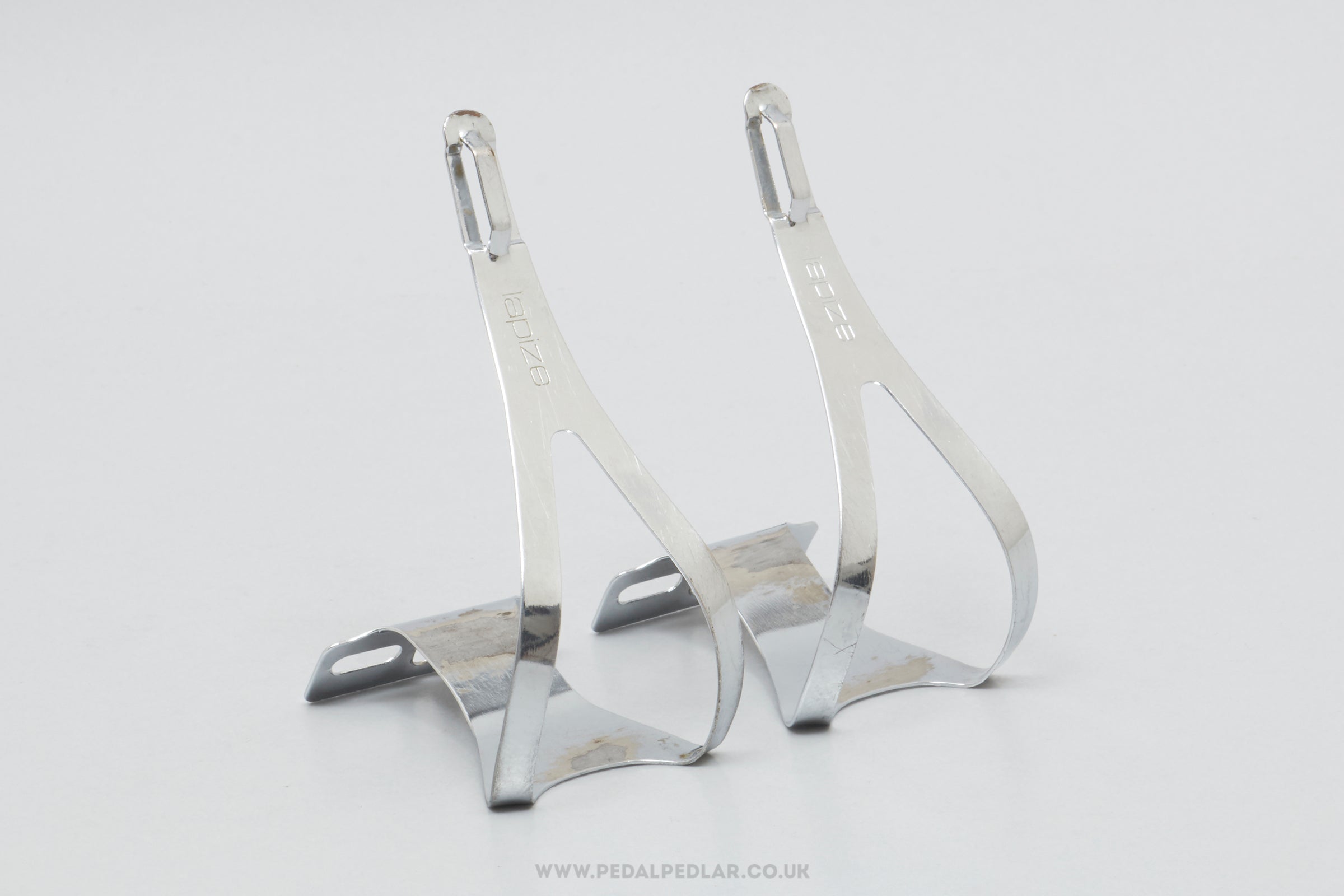


Lapize 160 Size M Vintage Steel Toe Clips
£13.50 £15.00
✓ Original toe clips - produced in the 1980s
✓ Suitable for historic cycling events such as L'Eroica
✓ Checked & cleaned
✓ Worldwide shipping
Lapize 160 toe clips (or pedal cages if you prefer), hailing from France and in production during the 1980s. Made from steel and weighing in at 47 grams. A fine choice for keeping your vintage bike authentic, but also great for any other compatible bike.
If you're taking part in L'Eroica or any other vintage event, these are fully compliant - so rest assured, the pre-1987 police won't lock you up for having the wrong toe clips!
The toe clips have been checked, cleaned and graded as very good condition, but do take a good look at the detailed photos so you can see the shape & condition before you buy.OVERVIEW
Condition - Very Good
Production Era - 1980s
Material - Steel
Weight - 47 g
Stock Code - U-TC86V
**This is a guide based on traditional toe clip sizing for cycling shoes of the time, if you ride with chunkier shoes then we'd recommend going for a larger size. Please use this as a guide only and if possible use the length measurement provided to compare with toe clips you know fit well.
TECHNICAL INFO
Pedal Fixing - Standard (Quill / Platform)
Toe Strap Fit - Single Strap
Length (Fixing End to Toe End)* - 5.5 cm
Distance Between Fixing Bolts (ctc) - 25 mm
-
▼SHIPPING, TAXES & RETURNS
-
We've been safely sending orders around the world since 2010. Orders are carefully packed, sent with tracking & insurance, and normally collected around midday on Tuesdays and Fridays. Larger items may occasionally require an extra day or two to prepare.
We accept returns, please notify us within 14 days and ensure the item arrives back with us no later than 30 days after the order was received.
EU orders under €150 (excluding shipping) - import VAT and the new €3 customs duty are paid as part of your order, so there's nothing further to pay on delivery.
EU orders over €150 (excluding shipping) - import fees are payable to the carrier before delivery, with nothing collected at checkout.
USA orders - import fees are collected at checkout for all orders to the USA, so there won’t be any surprise charges when your order arrives.
Other international orders - local import fees may apply and are not collected by us. Please check your country's import rules before purchasing.
-
▼HELP SECTION
-
Pedal Fixing - 'standard' toe clips fix to the front of the pedals, most will be of this type and work with both quill & platform pedals providing they have mounting holes in the correct place. There are also 'aero' ones that attach to the top, and side fixing versions too. 'Wide platform' fixings are similar to standard ones but the fixing holes are almost 3 inches apart.
Toe Strap Fit - most toe clips are designed to accept a single toe strap, but there are some less common ones that allow two toe straps to be fitted.
Length - this is measured from the fixing end to the toe end at the most extreme points, the same way the manufacturers measure and we use this to recommend the fit if there's no size stamped on them. All length measurements are rounded to the nearest 0.5 cm.
Distance Between Fixing Bolts - we measure this distance from the centre of one hole to the next (ctc), this usually only needs to be close, not exact, providing the holes on the toe clips are oblong shaped to allow a decent amount of wiggle room (most toe clips are made this way).
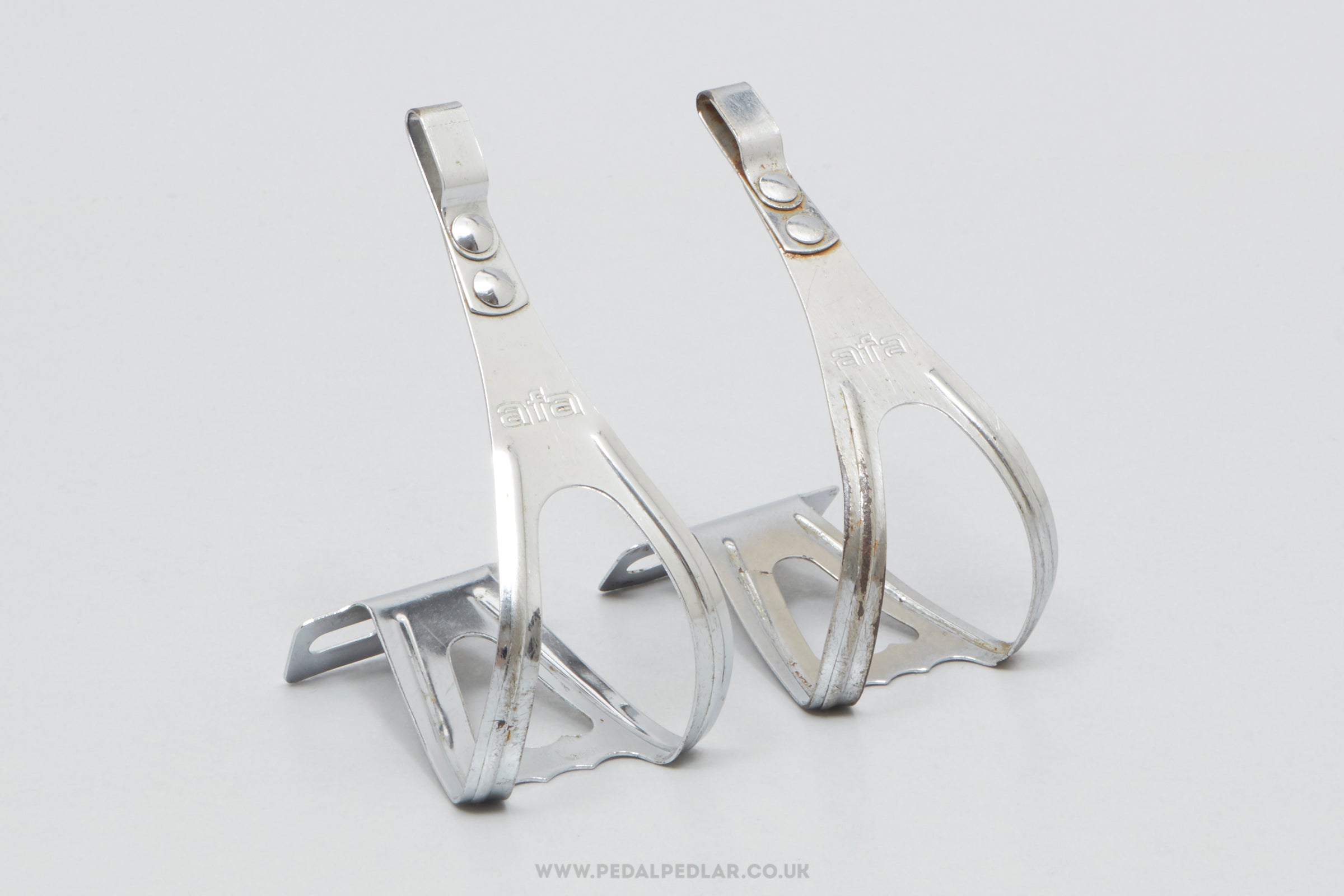


AFA 172 Size M/L Vintage Steel Toe Clips
£13.50 £15.00
✓ Original toe clips - produced in the 1980s
✓ Suitable for historic cycling events such as L'Eroica
✓ Checked & cleaned
✓ Worldwide shipping
AFA 172 toe clips (or pedal cages if you prefer), hailing from France and in production during the 1980s. Made from steel and weighing in at 52 grams. A fine choice for keeping your vintage bike authentic, but also great for any other compatible bike.
If you're taking part in L'Eroica or any other vintage event, these are fully compliant - so rest assured, the pre-1987 police won't lock you up for having the wrong toe clips!
The toe clips have been checked, cleaned and graded as good condition, but do take a good look at the detailed photos so you can see the shape & condition before you buy.OVERVIEW
Condition - Good
Production Era - 1980s
Material - Steel
Weight - 52 g
Stock Code - U-TC91V
**This is a guide based on traditional toe clip sizing for cycling shoes of the time, if you ride with chunkier shoes then we'd recommend going for a larger size. Please use this as a guide only and if possible use the length measurement provided to compare with toe clips you know fit well.
TECHNICAL INFO
Pedal Fixing - Standard (Quill / Platform)
Toe Strap Fit - Single Strap
Length (Fixing End to Toe End)* - 6 cm
Distance Between Fixing Bolts (ctc) - 25 mm
-
▼SHIPPING, TAXES & RETURNS
-
We've been safely sending orders around the world since 2010. Orders are carefully packed, sent with tracking & insurance, and normally collected around midday on Tuesdays and Fridays. Larger items may occasionally require an extra day or two to prepare.
We accept returns, please notify us within 14 days and ensure the item arrives back with us no later than 30 days after the order was received.
EU orders under €150 (excluding shipping) - import VAT and the new €3 customs duty are paid as part of your order, so there's nothing further to pay on delivery.
EU orders over €150 (excluding shipping) - import fees are payable to the carrier before delivery, with nothing collected at checkout.
USA orders - import fees are collected at checkout for all orders to the USA, so there won’t be any surprise charges when your order arrives.
Other international orders - local import fees may apply and are not collected by us. Please check your country's import rules before purchasing.
-
▼HELP SECTION
-
Pedal Fixing - 'standard' toe clips fix to the front of the pedals, most will be of this type and work with both quill & platform pedals providing they have mounting holes in the correct place. There are also 'aero' ones that attach to the top, and side fixing versions too. 'Wide platform' fixings are similar to standard ones but the fixing holes are almost 3 inches apart.
Toe Strap Fit - most toe clips are designed to accept a single toe strap, but there are some less common ones that allow two toe straps to be fitted.
Length - this is measured from the fixing end to the toe end at the most extreme points, the same way the manufacturers measure and we use this to recommend the fit if there's no size stamped on them. All length measurements are rounded to the nearest 0.5 cm.
Distance Between Fixing Bolts - we measure this distance from the centre of one hole to the next (ctc), this usually only needs to be close, not exact, providing the holes on the toe clips are oblong shaped to allow a decent amount of wiggle room (most toe clips are made this way).
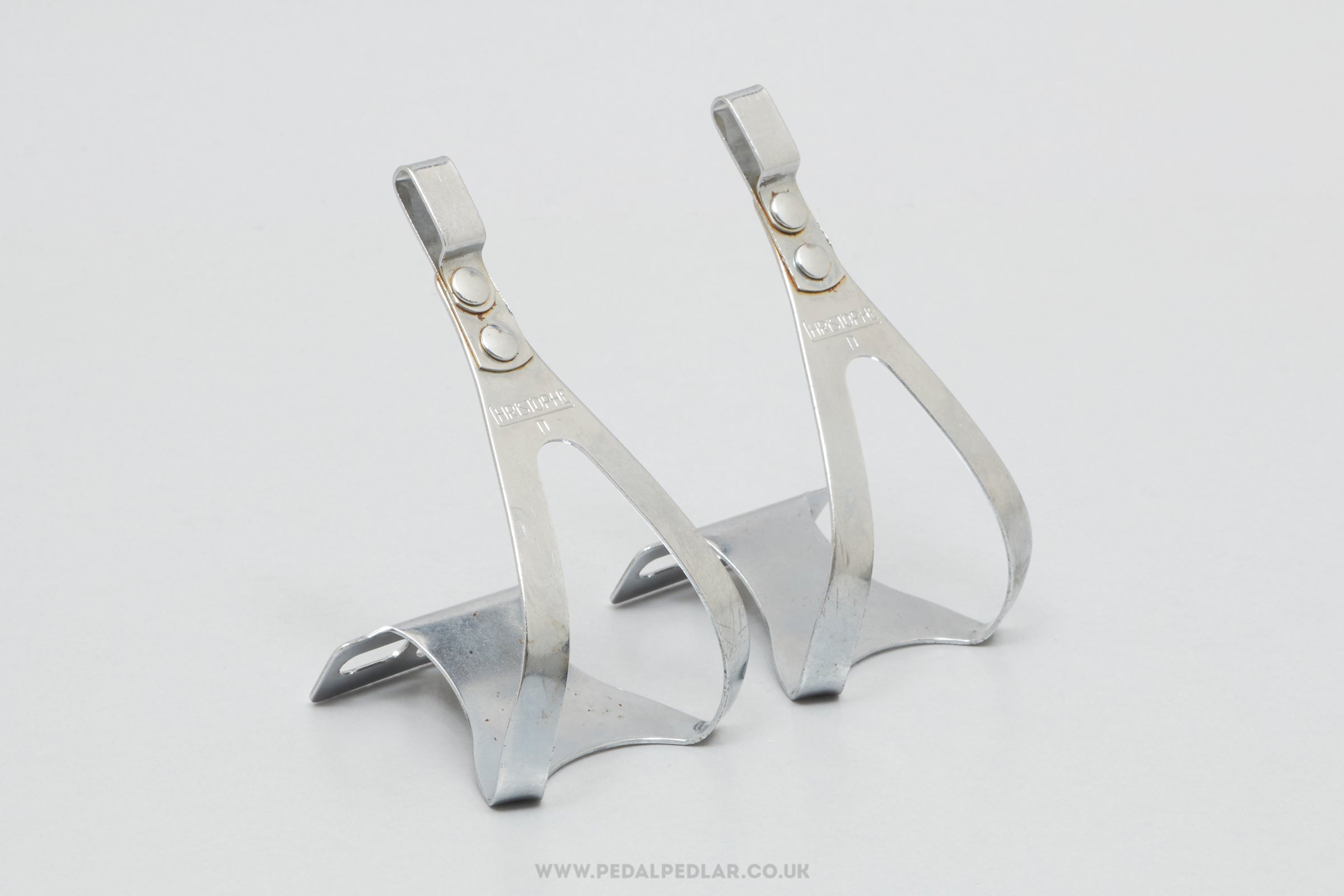


Christophe 50 / 506 Size M Vintage Steel Toe Clips
£15.75 £18.00
✓ Original toe clips - in production from the 1980s to the 1990s
✓ Suitable for historic cycling events such as L'Eroica
✓ Checked & cleaned
✓ Worldwide shipping
Christophe 50 / 506 toe clips (or pedal cages if you prefer), hailing from France and in production from the 1980s to the 1990s. Made from steel and weighing in at 64 grams. A fine choice for keeping your vintage bike authentic, but also great for any other compatible bike.
If you're taking part in L'Eroica or any other vintage event, these are fully compliant - so rest assured, the pre-1987 police won't lock you up for having the wrong toe clips!
The toe clips have been checked, cleaned and graded as very good condition, but do take a good look at the detailed photos so you can see the shape & condition before you buy.OVERVIEW
Condition - Very Good
Production Era - 1980s & 1990s
Material - Steel
Weight - 64 g
Stock Code - U-TC99V
**This is a guide based on traditional toe clip sizing for cycling shoes of the time, if you ride with chunkier shoes then we'd recommend going for a larger size. Please use this as a guide only and if possible use the length measurement provided to compare with toe clips you know fit well.
TECHNICAL INFO
Pedal Fixing - Standard (Quill / Platform)
Toe Strap Fit - Single Strap
Length (Fixing End to Toe End)* - 5 cm
Distance Between Fixing Bolts (ctc) - 25 mm
-
▼SHIPPING, TAXES & RETURNS
-
We've been safely sending orders around the world since 2010. Orders are carefully packed, sent with tracking & insurance, and normally collected around midday on Tuesdays and Fridays. Larger items may occasionally require an extra day or two to prepare.
We accept returns, please notify us within 14 days and ensure the item arrives back with us no later than 30 days after the order was received.
EU orders under €150 (excluding shipping) - import VAT and the new €3 customs duty are paid as part of your order, so there's nothing further to pay on delivery.
EU orders over €150 (excluding shipping) - import fees are payable to the carrier before delivery, with nothing collected at checkout.
USA orders - import fees are collected at checkout for all orders to the USA, so there won’t be any surprise charges when your order arrives.
Other international orders - local import fees may apply and are not collected by us. Please check your country's import rules before purchasing.
-
▼HELP SECTION
-
Pedal Fixing - 'standard' toe clips fix to the front of the pedals, most will be of this type and work with both quill & platform pedals providing they have mounting holes in the correct place. There are also 'aero' ones that attach to the top, and side fixing versions too. 'Wide platform' fixings are similar to standard ones but the fixing holes are almost 3 inches apart.
Toe Strap Fit - most toe clips are designed to accept a single toe strap, but there are some less common ones that allow two toe straps to be fitted.
Length - this is measured from the fixing end to the toe end at the most extreme points, the same way the manufacturers measure and we use this to recommend the fit if there's no size stamped on them. All length measurements are rounded to the nearest 0.5 cm.
Distance Between Fixing Bolts - we measure this distance from the centre of one hole to the next (ctc), this usually only needs to be close, not exact, providing the holes on the toe clips are oblong shaped to allow a decent amount of wiggle room (most toe clips are made this way).
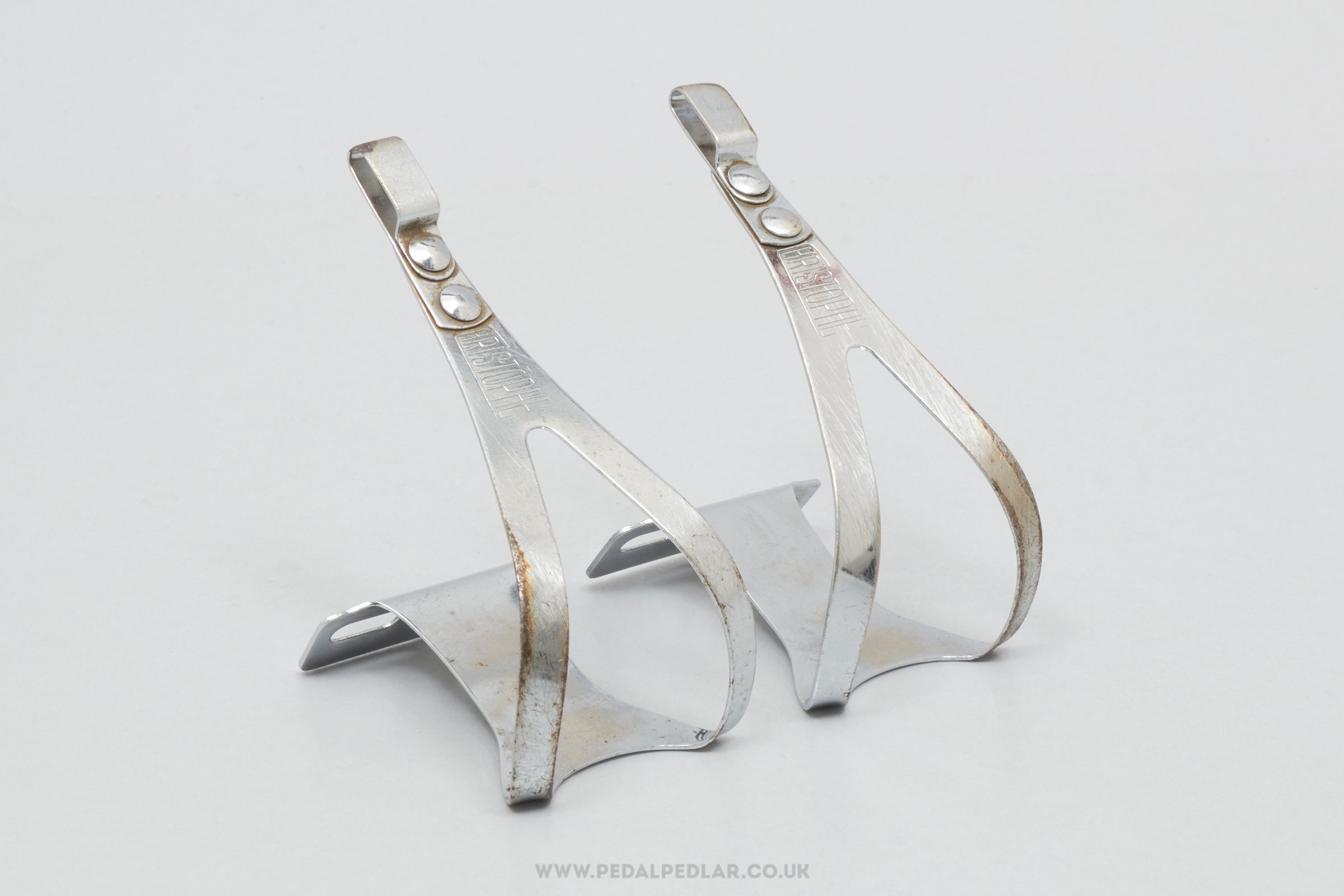


Christophe 50 / 506 Early AFA Size M Vintage Steel Toe Clips
£13.50 £15.00
✓ Original toe clips - in production from the 1920s to the 1970s
✓ Suitable for historic cycling events such as L'Eroica
✓ Checked & cleaned
✓ Worldwide shipping
Christophe 50 / 506 toe clips (or pedal cages if you prefer), hailing from France and in production from the 1920s to the 1970s. Made from steel and weighing in at 64 grams. A fine choice for keeping your vintage bike authentic, but also great for any other compatible bike.
If you're taking part in L'Eroica or any other vintage event, these are fully compliant - so rest assured, the pre-1987 police won't lock you up for having the wrong toe clips!
The toe clips have been checked, cleaned and graded as good condition, but do take a good look at the detailed photos so you can see the shape & condition before you buy.OVERVIEW
Condition - Good
Production Era - 1920s - 1970s
Material - Steel
Weight - 64 g
Stock Code - U-TC100V
**This is a guide based on traditional toe clip sizing for cycling shoes of the time, if you ride with chunkier shoes then we'd recommend going for a larger size. Please use this as a guide only and if possible use the length measurement provided to compare with toe clips you know fit well.
TECHNICAL INFO
Pedal Fixing - Standard (Quill / Platform)
Toe Strap Fit - Single Strap
Length (Fixing End to Toe End)* - 5.5 cm
Distance Between Fixing Bolts (ctc) - 25 mm
-
▼SHIPPING, TAXES & RETURNS
-
We've been safely sending orders around the world since 2010. Orders are carefully packed, sent with tracking & insurance, and normally collected around midday on Tuesdays and Fridays. Larger items may occasionally require an extra day or two to prepare.
We accept returns, please notify us within 14 days and ensure the item arrives back with us no later than 30 days after the order was received.
EU orders under €150 (excluding shipping) - import VAT and the new €3 customs duty are paid as part of your order, so there's nothing further to pay on delivery.
EU orders over €150 (excluding shipping) - import fees are payable to the carrier before delivery, with nothing collected at checkout.
USA orders - import fees are collected at checkout for all orders to the USA, so there won’t be any surprise charges when your order arrives.
Other international orders - local import fees may apply and are not collected by us. Please check your country's import rules before purchasing.
-
▼HELP SECTION
-
Pedal Fixing - 'standard' toe clips fix to the front of the pedals, most will be of this type and work with both quill & platform pedals providing they have mounting holes in the correct place. There are also 'aero' ones that attach to the top, and side fixing versions too. 'Wide platform' fixings are similar to standard ones but the fixing holes are almost 3 inches apart.
Toe Strap Fit - most toe clips are designed to accept a single toe strap, but there are some less common ones that allow two toe straps to be fitted.
Length - this is measured from the fixing end to the toe end at the most extreme points, the same way the manufacturers measure and we use this to recommend the fit if there's no size stamped on them. All length measurements are rounded to the nearest 0.5 cm.
Distance Between Fixing Bolts - we measure this distance from the centre of one hole to the next (ctc), this usually only needs to be close, not exact, providing the holes on the toe clips are oblong shaped to allow a decent amount of wiggle room (most toe clips are made this way).


Camusso Leather Vintage Red Toe Clip Straps
£19.00 £20.00
✓ Original toe straps - in production from the 1970s to the 1980s
✓ Suitable for historic cycling events such as L'Eroica
✓ Checked & cleaned
✓ Worldwide shipping
Camusso toe straps (or pedal straps if you prefer), hailing from Italy and in production from the 1970s to the 1980s. The straps are red in colour and made from leather/steel, the perfect finishing touch for your vintage bike, but great for bikes of the non-vintage variety too of course!
If you're taking part in L'Eroica, Anjou Velo, Velo Retro or another similar vintage cycling event, these are fully compliant - so rest assured, the pre-1987 police won't lock you up for having the wrong toe straps!
The straps have been checked over, cleaned (as much as you can clean toe straps!) and graded as good condition, but do take a good look at the detailed photos so you can see the cosmetic condition before you buy.OVERVIEW
Production Era - 1970s & 1980s
Country - Italian
Material - Leather / Steel
Weight - 44 g
Stock Code - U-STR42V
TECHNICAL INFO
Colour* - Red
Toe Strap Type - Standard
Strap Width - 13 mm
*The colour description is just a guide, please check the photos too as we make sure these are as close to the true colour as possible.
-
▼SHIPPING, TAXES & RETURNS
-
We've been safely sending orders around the world since 2010. Orders are carefully packed, sent with tracking & insurance, and normally collected around midday on Tuesdays and Fridays. Larger items may occasionally require an extra day or two to prepare.
We accept returns, please notify us within 14 days and ensure the item arrives back with us no later than 30 days after the order was received.
EU orders under €150 (excluding shipping) - import VAT and the new €3 customs duty are paid as part of your order, so there's nothing further to pay on delivery.
EU orders over €150 (excluding shipping) - import fees are payable to the carrier before delivery, with nothing collected at checkout.
USA orders - import fees are collected at checkout for all orders to the USA, so there won’t be any surprise charges when your order arrives.
Other international orders - local import fees may apply and are not collected by us. Please check your country's import rules before purchasing.
-
▼HELP SECTION
-
Toe Strap Type - standard toe clips are designed to accept single toe straps, but there are some that allow double toe straps to be fitted.
Strap Width - measured across one of the straps at its widest point.
Toe Strap Length - the total length including the buckle, measured to the nearest 0.5 cm.


Lapize 511 Poutrait-Morin Leather Vintage White Toe Clip Straps
£16.63 £17.50
✓ Original toe straps - produced in the 1980s
✓ Suitable for historic cycling events such as L'Eroica
✓ Checked & cleaned
✓ Worldwide shipping
Lapize 511 toe straps (or pedal straps if you prefer), hailing from France and in production during the 1980s. The straps are white in colour and made from leather/steel, the perfect finishing touch for your vintage bike, but great for bikes of the non-vintage variety too of course!
If you're taking part in L'Eroica, Anjou Velo, Velo Retro or another similar vintage cycling event, these are fully compliant - so rest assured, the pre-1987 police won't lock you up for having the wrong toe straps!
The straps have been checked over, cleaned (as much as you can clean toe straps!) and graded as good condition, but do take a good look at the detailed photos so you can see the cosmetic condition before you buy.OVERVIEW
Production Era - 1980s
Country - French
Material - Leather / Steel
Weight - 48 g
Stock Code - U-STR46V
TECHNICAL INFO
Colour* - White
Toe Strap Type - Standard
Strap Width - 12 mm
Toe Strap Length - 41 cm
*The colour description is just a guide, please check the photos too as we make sure these are as close to the true colour as possible.
-
▼SHIPPING, TAXES & RETURNS
-
We've been safely sending orders around the world since 2010. Orders are carefully packed, sent with tracking & insurance, and normally collected around midday on Tuesdays and Fridays. Larger items may occasionally require an extra day or two to prepare.
We accept returns, please notify us within 14 days and ensure the item arrives back with us no later than 30 days after the order was received.
EU orders under €150 (excluding shipping) - import VAT and the new €3 customs duty are paid as part of your order, so there's nothing further to pay on delivery.
EU orders over €150 (excluding shipping) - import fees are payable to the carrier before delivery, with nothing collected at checkout.
USA orders - import fees are collected at checkout for all orders to the USA, so there won’t be any surprise charges when your order arrives.
Other international orders - local import fees may apply and are not collected by us. Please check your country's import rules before purchasing.
-
▼HELP SECTION
-
Toe Strap Type - standard toe clips are designed to accept single toe straps, but there are some that allow double toe straps to be fitted.
Strap Width - measured across one of the straps at its widest point.
Toe Strap Length - the total length including the buckle, measured to the nearest 0.5 cm.
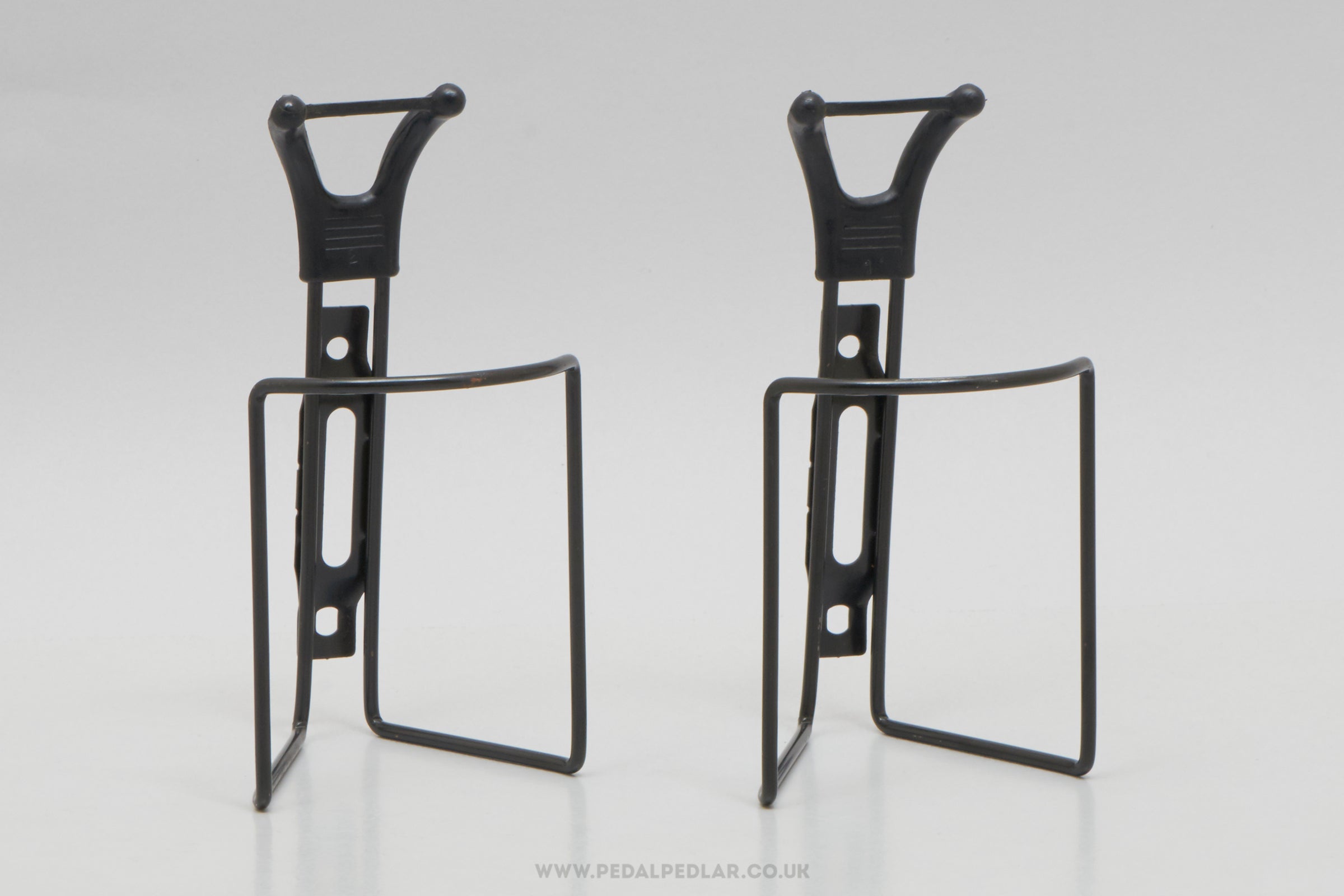


Vintage Early TA Style NOS Steel Black Bottle Cages
£12.75 £15.00
✓ Original pair of bottle cages - in production from the 1970s to the 1980s
✓ New old stock! Still unused after all these years
✓ Suitable for historic cycling events such as L'Eroica
✓ Worldwide shipping
Unbranded vintage water bottle cages (or bidon holders if you prefer), most likely in production from the 1970s to the 1980s (yet still new & unused after all this time!). Made from steel/plastic and weighing in at 122 grams (the weight and price displayed are for a pair of cages). The perfect finishing touch for your vintage bike, but great for bikes of the non-vintage variety too!
If you're taking part in L'Eroica or a similar vintage event, these are of the correct era, so rest assured the pre-1987 police won't lock you up for having the wrong bottle carriers!
OVERVIEW
Production Era - 1970s & 1980s
Material - Steel / Plastic
Weight - 122 g
Stock Code - D-CAG-P12V
*New old stock items may have marks from storage over the years, and as we often have multiples they can vary from piece to piece, but they are always genuine new & unused items.
TECHNICAL INFO
Cage Fixing - Frame Fit (Braze-On)
Colour* - Black
Bottle Fit - Standard
*The colour description is just a guide, please check the photos too as we make sure these are as close to the true colour as possible.
-
▼SHIPPING, TAXES & RETURNS
-
We've been safely sending orders around the world since 2010. Orders are carefully packed, sent with tracking & insurance, and normally collected around midday on Tuesdays and Fridays. Larger items may occasionally require an extra day or two to prepare.
We accept returns, please notify us within 14 days and ensure the item arrives back with us no later than 30 days after the order was received.
EU orders under €150 (excluding shipping) - import VAT and the new €3 customs duty are paid as part of your order, so there's nothing further to pay on delivery.
EU orders over €150 (excluding shipping) - import fees are payable to the carrier before delivery, with nothing collected at checkout.
USA orders - import fees are collected at checkout for all orders to the USA, so there won’t be any surprise charges when your order arrives.
Other international orders - local import fees may apply and are not collected by us. Please check your country's import rules before purchasing.
-
▼HELP SECTION
-
Cage Fixing - most bottle cages will be designed to fix to the frame, although some rare older ones mount to the handlebars and/or stem. If your frame doesn't have any bottle cage braze-ons to fix to you'll need clamp-on bottle cages.
Bottle Fit - almost all cycling bottles measure between 70 - 75 mm in diameter so this is the standard bottle cage size, the only rather rare exceptions are some old Elite bottles that require a 66 mm cage, the more recent oversized ones and of course the funny shaped aero ones that only accept the bottle they were made for.
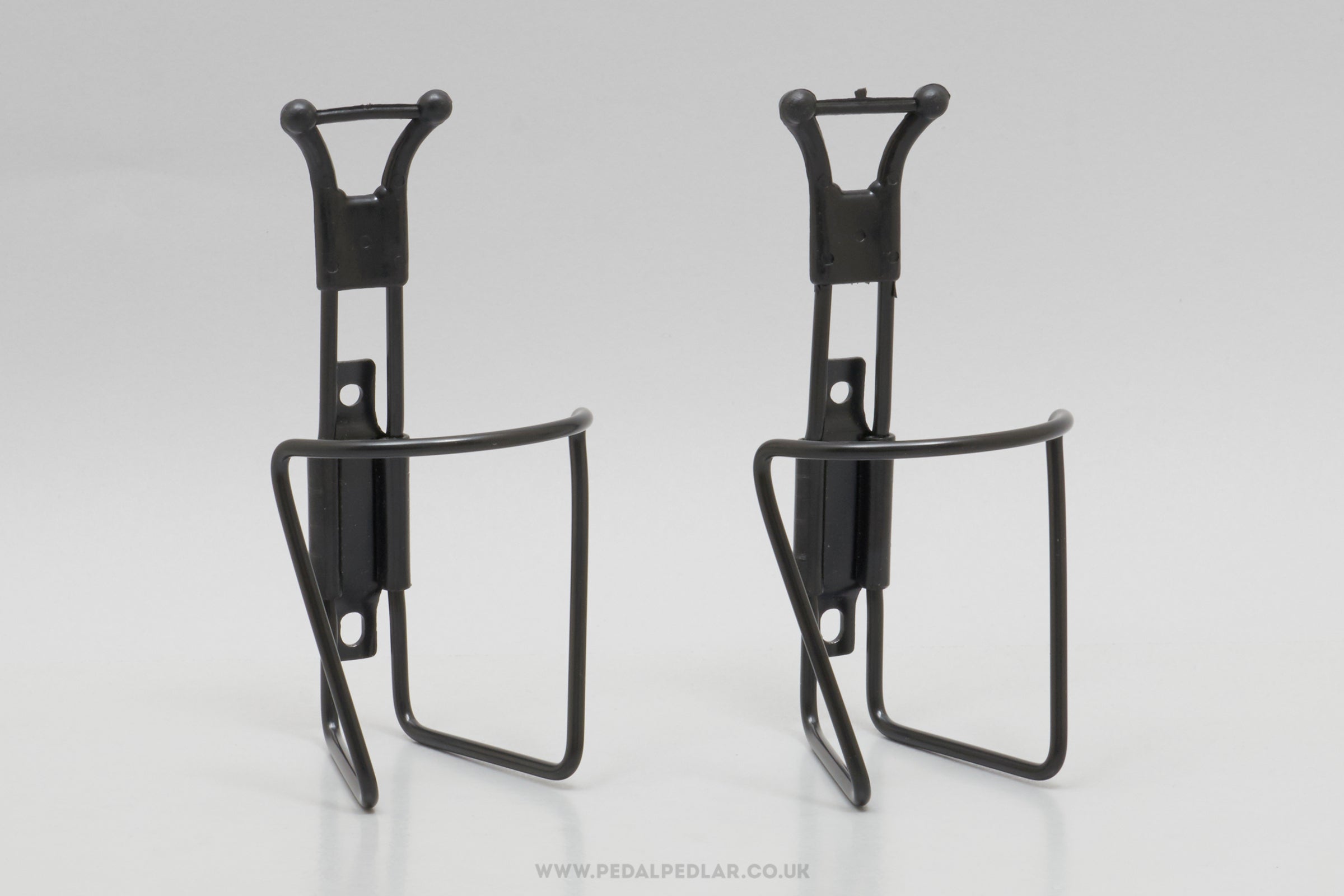


Vintage TA Style NOS Black Bottle Cages
£19.13 £23.00
✓ Original pair of bottle cages - in production from the 1970s to the 1980s
✓ New old stock! Still unused after all these years
✓ Suitable for historic cycling events such as L'Eroica
✓ Worldwide shipping
Unbranded vintage water bottle cages (or bidon holders if you prefer), most likely in production from the 1970s to the 1980s (yet still new & unused after all this time!). Made from aluminium/plastic and weighing in at 90 grams (the weight and price displayed are for a pair of cages). The perfect finishing touch for your vintage bike, but great for bikes of the non-vintage variety too!
If you're taking part in L'Eroica or a similar vintage event, these are of the correct era, so rest assured the pre-1987 police won't lock you up for having the wrong bottle carriers!
OVERVIEW
Production Era - 1970s & 1980s
Material - Aluminium / Plastic
Weight - 90 g
Stock Code - D-CAG-P15V
*New old stock items may have marks from storage over the years, and as we often have multiples they can vary from piece to piece, but they are always genuine new & unused items.
TECHNICAL INFO
Cage Fixing - Frame Fit (Braze-On)
Colour* - Black
Bottle Fit - Standard
*The colour description is just a guide, please check the photos too as we make sure these are as close to the true colour as possible.
-
▼SHIPPING, TAXES & RETURNS
-
We've been safely sending orders around the world since 2010. Orders are carefully packed, sent with tracking & insurance, and normally collected around midday on Tuesdays and Fridays. Larger items may occasionally require an extra day or two to prepare.
We accept returns, please notify us within 14 days and ensure the item arrives back with us no later than 30 days after the order was received.
EU orders under €150 (excluding shipping) - import VAT and the new €3 customs duty are paid as part of your order, so there's nothing further to pay on delivery.
EU orders over €150 (excluding shipping) - import fees are payable to the carrier before delivery, with nothing collected at checkout.
USA orders - import fees are collected at checkout for all orders to the USA, so there won’t be any surprise charges when your order arrives.
Other international orders - local import fees may apply and are not collected by us. Please check your country's import rules before purchasing.
-
▼HELP SECTION
-
Cage Fixing - most bottle cages will be designed to fix to the frame, although some rare older ones mount to the handlebars and/or stem. If your frame doesn't have any bottle cage braze-ons to fix to you'll need clamp-on bottle cages.
Bottle Fit - almost all cycling bottles measure between 70 - 75 mm in diameter so this is the standard bottle cage size, the only rather rare exceptions are some old Elite bottles that require a 66 mm cage, the more recent oversized ones and of course the funny shaped aero ones that only accept the bottle they were made for.
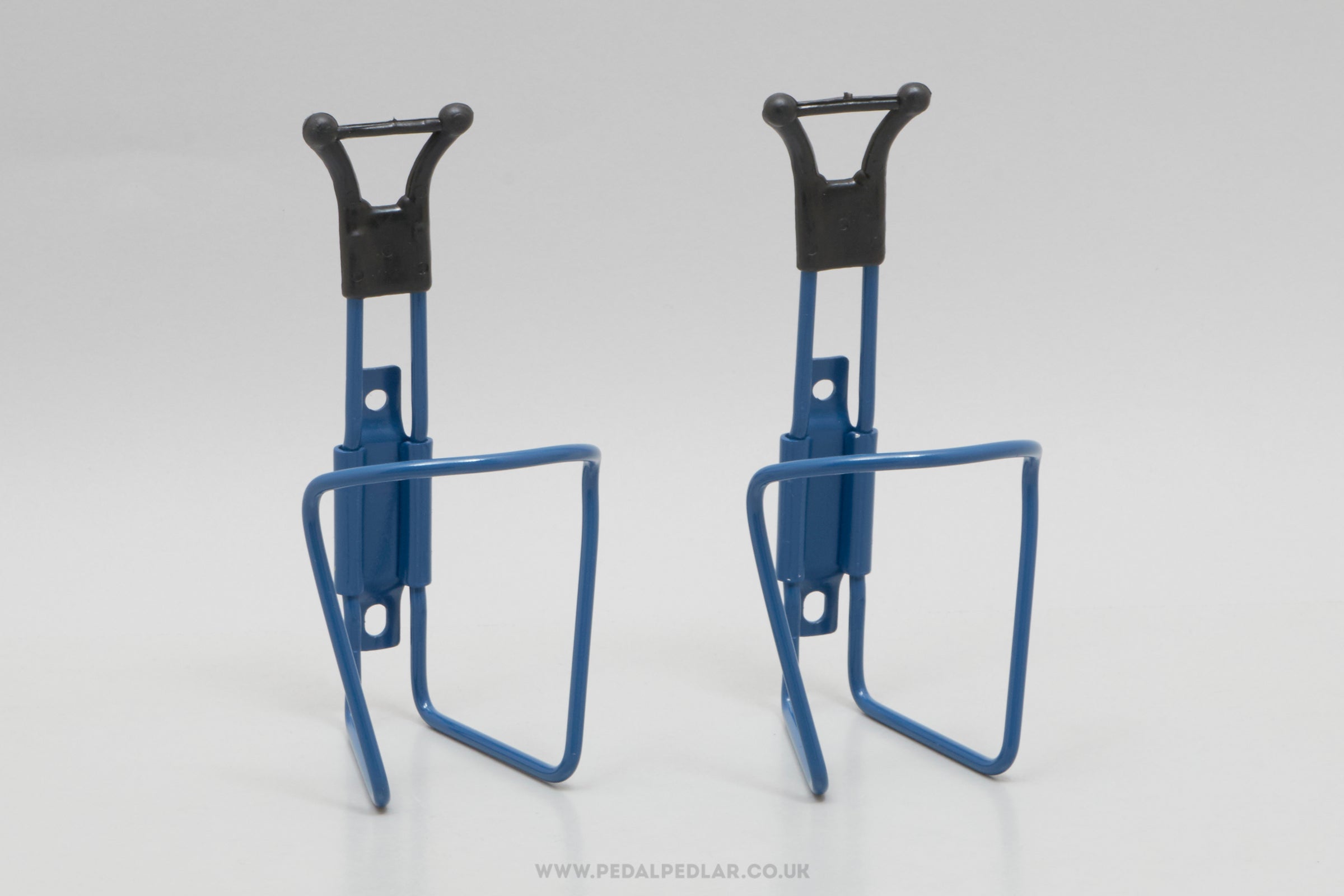


Vintage TA Style NOS Blue Bottle Cages
£19.13 £23.00
✓ Original pair of bottle cages - in production from the 1970s to the 1980s
✓ New old stock! Still unused after all these years
✓ Suitable for historic cycling events such as L'Eroica
✓ Worldwide shipping
Unbranded vintage water bottle cages (or bidon holders if you prefer), most likely in production from the 1970s to the 1980s (yet still new & unused after all this time!). Made from aluminium/plastic and weighing in at 130 grams (the weight and price displayed are for a pair of cages). The perfect finishing touch for your vintage bike, but great for bikes of the non-vintage variety too!
If you're taking part in L'Eroica or a similar vintage event, these are of the correct era, so rest assured the pre-1987 police won't lock you up for having the wrong bottle carriers!
OVERVIEW
Production Era - 1970s & 1980s
Material - Aluminium / Plastic
Weight - 130 g
Stock Code - D-CAG-P17V
*New old stock items may have marks from storage over the years, and as we often have multiples they can vary from piece to piece, but they are always genuine new & unused items.
TECHNICAL INFO
Cage Fixing - Frame Fit (Braze-On)
Colour* - Blue
Bottle Fit - Standard
*The colour description is just a guide, please check the photos too as we make sure these are as close to the true colour as possible.
-
▼SHIPPING, TAXES & RETURNS
-
We've been safely sending orders around the world since 2010. Orders are carefully packed, sent with tracking & insurance, and normally collected around midday on Tuesdays and Fridays. Larger items may occasionally require an extra day or two to prepare.
We accept returns, please notify us within 14 days and ensure the item arrives back with us no later than 30 days after the order was received.
EU orders under €150 (excluding shipping) - import VAT and the new €3 customs duty are paid as part of your order, so there's nothing further to pay on delivery.
EU orders over €150 (excluding shipping) - import fees are payable to the carrier before delivery, with nothing collected at checkout.
USA orders - import fees are collected at checkout for all orders to the USA, so there won’t be any surprise charges when your order arrives.
Other international orders - local import fees may apply and are not collected by us. Please check your country's import rules before purchasing.
-
▼HELP SECTION
-
Cage Fixing - most bottle cages will be designed to fix to the frame, although some rare older ones mount to the handlebars and/or stem. If your frame doesn't have any bottle cage braze-ons to fix to you'll need clamp-on bottle cages.
Bottle Fit - almost all cycling bottles measure between 70 - 75 mm in diameter so this is the standard bottle cage size, the only rather rare exceptions are some old Elite bottles that require a 66 mm cage, the more recent oversized ones and of course the funny shaped aero ones that only accept the bottle they were made for.
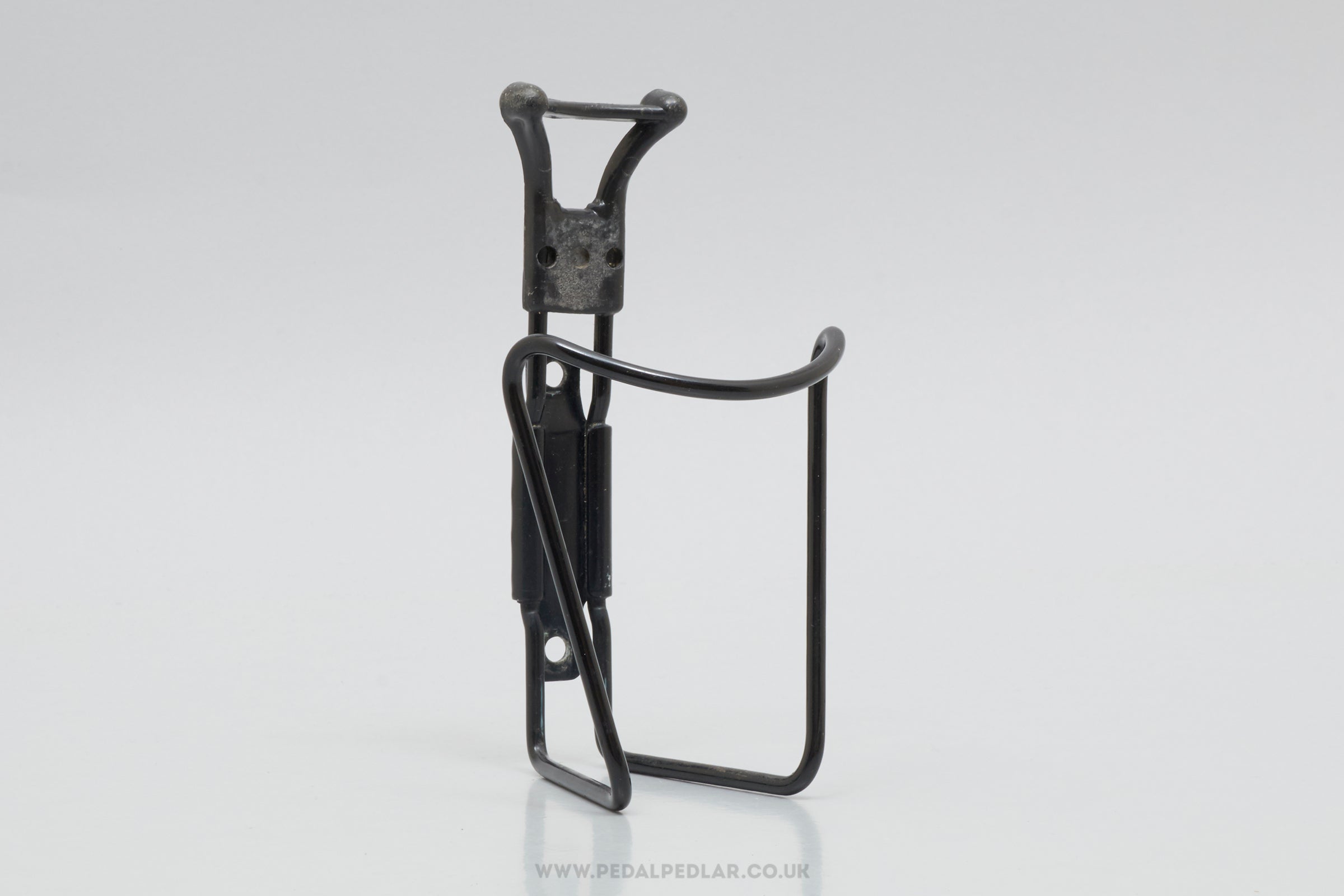


Emmepi TA Style Vintage Black Bottle Cage
£22.50 £25.00
✓ Original bottle cage - in production from the 1970s to the 1980s
✓ Suitable for historic cycling events such as L'Eroica
✓ Checked & cleaned
✓ Worldwide shipping
Emmepi water bottle cage (or bidon holder if you prefer), hailing from Italy and in production from the 1970s to the 1980s. Made from aluminium and weighing in at 44 grams. The perfect finishing touch for your vintage bike, but great for bikes of the non-vintage variety too!
If you're taking part in L'Eroica or a similar vintage event, this is of the correct era, so rest assured the pre-1987 police won't lock you up for having the wrong bottle carrier!
The bottle cage has been checked for damage, thoroughly cleaned and graded as good condition, but do take a good look at the detailed photos so you can see the shape & condition before you buy.OVERVIEW
Production Era - 1970s & 1980s
Country - Italian
Material - Aluminium
Weight - 44 g
Stock Code - U-CAG149V
TECHNICAL INFO
Cage Fixing - Frame Fit (Braze-On)
Colour* - Black
Bottle Fit - Standard
*The colour description is just a guide, please check the photos too as we make sure these are as close to the true colour as possible.
-
▼SHIPPING, TAXES & RETURNS
-
We've been safely sending orders around the world since 2010. Orders are carefully packed, sent with tracking & insurance, and normally collected around midday on Tuesdays and Fridays. Larger items may occasionally require an extra day or two to prepare.
We accept returns, please notify us within 14 days and ensure the item arrives back with us no later than 30 days after the order was received.
EU orders under €150 (excluding shipping) - import VAT and the new €3 customs duty are paid as part of your order, so there's nothing further to pay on delivery.
EU orders over €150 (excluding shipping) - import fees are payable to the carrier before delivery, with nothing collected at checkout.
USA orders - import fees are collected at checkout for all orders to the USA, so there won’t be any surprise charges when your order arrives.
Other international orders - local import fees may apply and are not collected by us. Please check your country's import rules before purchasing.
-
▼HELP SECTION
-
Cage Fixing - most bottle cages will be designed to fix to the frame, although some rare older ones mount to the handlebars and/or stem. If your frame doesn't have any bottle cage braze-ons to fix to you'll need a clamp-on bottle cage.
Bottle Fit - almost all cycling bottles measure between 70 - 75 mm in diameter so this is the standard bottle cage size, the only rather rare exceptions are some old Elite bottles that require a 66 mm cage, the more recent oversized ones and of course the funny shaped aero ones that only accept the bottle they were made for.
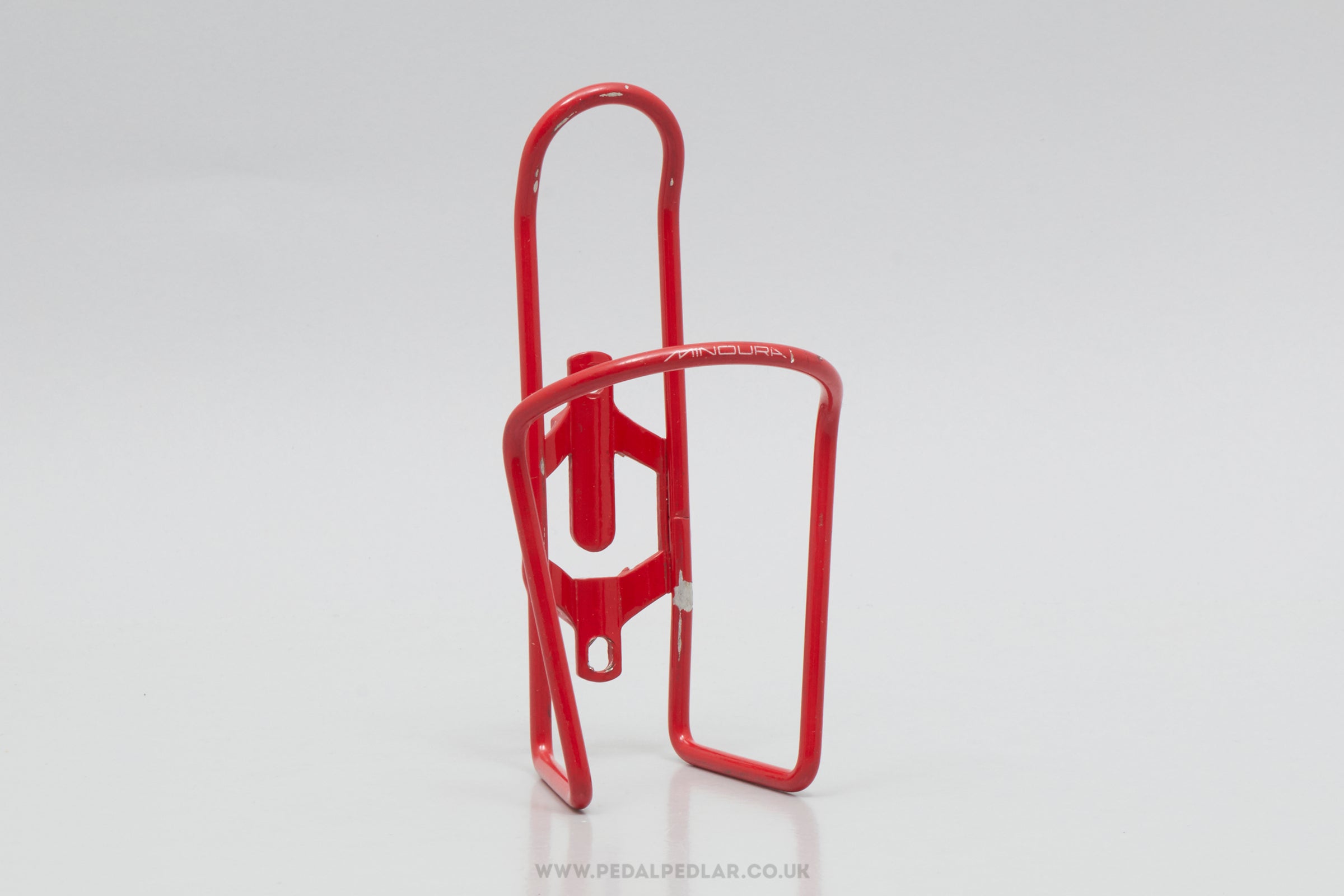


Minoura Classic Red Bottle Cage
£9.00 £10.00
✓ Original bottle cage - produced in the 1990s
✓ Checked & cleaned
✓ Worldwide shipping
Minoura water bottle cage (or bidon holder if you prefer), hailing from Japan and in production during the 1990s. Made from aluminium and weighing in at 49 grams. The perfect finishing touch for your classic bike, but great for bikes of the non-classic variety too!
The bottle cage has been checked for damage, thoroughly cleaned and graded as good condition, but do take a good look at the detailed photos so you can see the shape & condition before you buy.OVERVIEW
Production Era - 1990s
Country - Japanese
Material - Aluminium
Weight - 49 g
Stock Code - U-CAG151C
TECHNICAL INFO
Cage Fixing - Frame Fit (Braze-On)
Colour* - Red
Bottle Fit - Standard
*The colour description is just a guide, please check the photos too as we make sure these are as close to the true colour as possible.
-
▼SHIPPING, TAXES & RETURNS
-
We've been safely sending orders around the world since 2010. Orders are carefully packed, sent with tracking & insurance, and normally collected around midday on Tuesdays and Fridays. Larger items may occasionally require an extra day or two to prepare.
We accept returns, please notify us within 14 days and ensure the item arrives back with us no later than 30 days after the order was received.
EU orders under €150 (excluding shipping) - import VAT and the new €3 customs duty are paid as part of your order, so there's nothing further to pay on delivery.
EU orders over €150 (excluding shipping) - import fees are payable to the carrier before delivery, with nothing collected at checkout.
USA orders - import fees are collected at checkout for all orders to the USA, so there won’t be any surprise charges when your order arrives.
Other international orders - local import fees may apply and are not collected by us. Please check your country's import rules before purchasing.
-
▼HELP SECTION
-
Cage Fixing - most bottle cages will be designed to fix to the frame, although some rare older ones mount to the handlebars and/or stem. If your frame doesn't have any bottle cage braze-ons to fix to you'll need a clamp-on bottle cage.
Bottle Fit - almost all cycling bottles measure between 70 - 75 mm in diameter so this is the standard bottle cage size, the only rather rare exceptions are some old Elite bottles that require a 66 mm cage, the more recent oversized ones and of course the funny shaped aero ones that only accept the bottle they were made for.
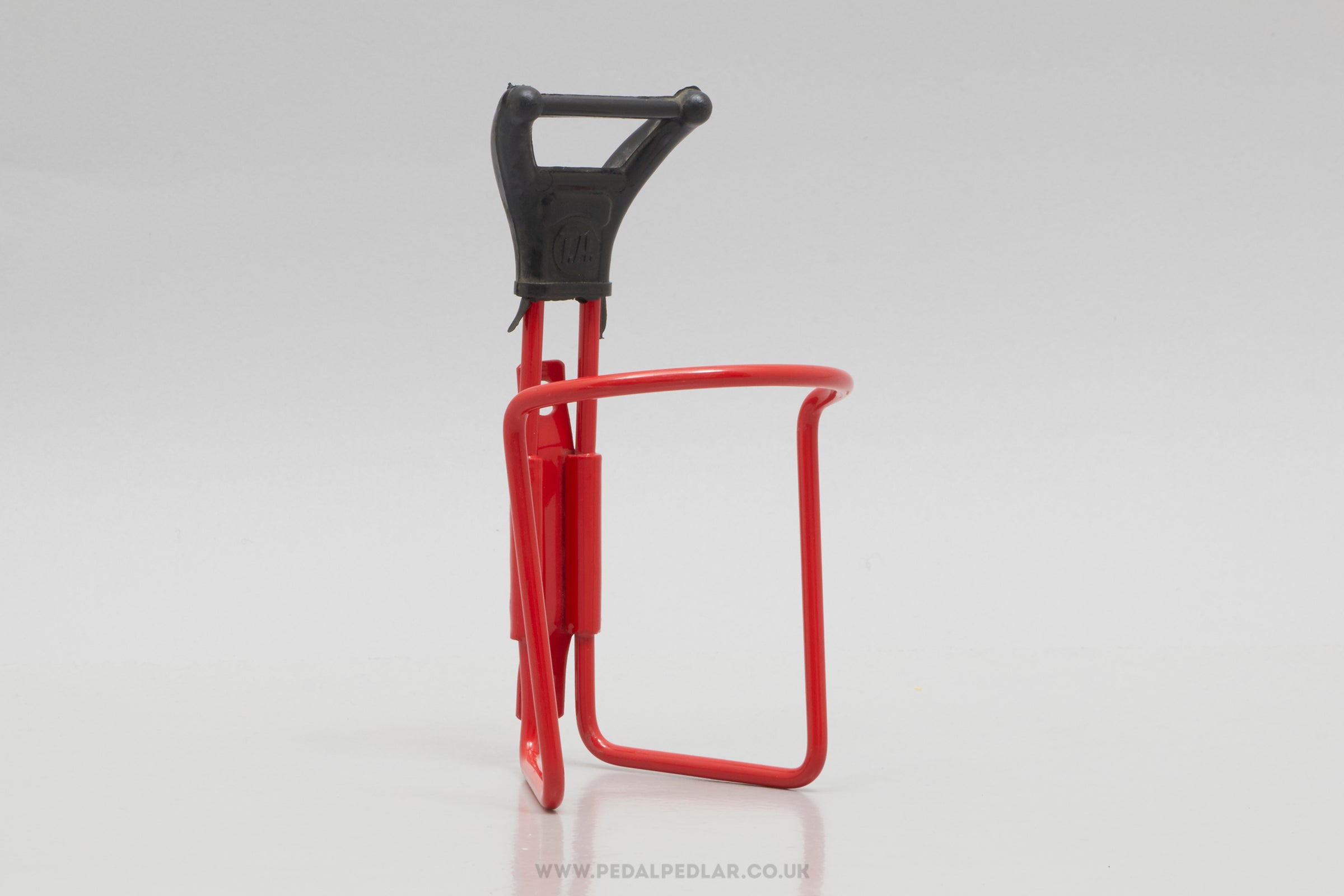


Specialites T.A. 'Plum' (417) NOS Vintage Red Bottle Cage
£19.13 £23.00
✓ Original bottle cage - in production from the 1980s to the 1990s
✓ New old stock! Still unused after all these years
✓ Suitable for historic cycling events such as L'Eroica
✓ Worldwide shipping
Specialites T.A. 'Plum' water bottle cage (or bidon holder if you prefer), hailing from France and in production from the 1980s to the 1990s (yet still new & unused after all this time!). Made from aluminium/plastic and weighing in at 47 grams (the weight and price displayed are for one cage, if we have more in stock you'll be able to add them to your basket). The perfect finishing touch for your vintage bike, but great for bikes of the non-vintage variety too!
This is the final version of the Plum lightweight bottle cage, featuring wrap-around 'sleeves' and punched dimples on the rear of the frame mount, replacing the exposed welded construction of the previous design.
If you're taking part in L'Eroica or a similar vintage event, this is of the correct era, so rest assured the pre-1987 police won't lock you up for having the wrong bottle carrier!
OVERVIEW
Model ID - 417
Production Era - 1980s & 1990s
Country - French
Material - Aluminium / Plastic
Weight - 47 g
Stock Code - D-CAG153V
*New old stock items may have marks from storage over the years, and as we often have multiples they can vary from piece to piece, but they are always genuine new & unused items.
TECHNICAL INFO
Cage Fixing - Frame Fit (Braze-On)
Colour* - Red
Bottle Fit - Standard
*The colour description is just a guide, please check the photos too as we make sure these are as close to the true colour as possible.
-
▼SHIPPING, TAXES & RETURNS
-
We've been safely sending orders around the world since 2010. Orders are carefully packed, sent with tracking & insurance, and normally collected around midday on Tuesdays and Fridays. Larger items may occasionally require an extra day or two to prepare.
We accept returns, please notify us within 14 days and ensure the item arrives back with us no later than 30 days after the order was received.
EU orders under €150 (excluding shipping) - import VAT and the new €3 customs duty are paid as part of your order, so there's nothing further to pay on delivery.
EU orders over €150 (excluding shipping) - import fees are payable to the carrier before delivery, with nothing collected at checkout.
USA orders - import fees are collected at checkout for all orders to the USA, so there won’t be any surprise charges when your order arrives.
Other international orders - local import fees may apply and are not collected by us. Please check your country's import rules before purchasing.
-
▼HELP SECTION
-
Cage Fixing - most bottle cages will be designed to fix to the frame, although some rare older ones mount to the handlebars and/or stem. If your frame doesn't have any bottle cage braze-ons to fix to you'll need a clamp-on bottle cage.
Bottle Fit - almost all cycling bottles measure between 70 - 75 mm in diameter so this is the standard bottle cage size, the only rather rare exceptions are some old Elite bottles that require a 66 mm cage, the more recent oversized ones and of course the funny shaped aero ones that only accept the bottle they were made for.
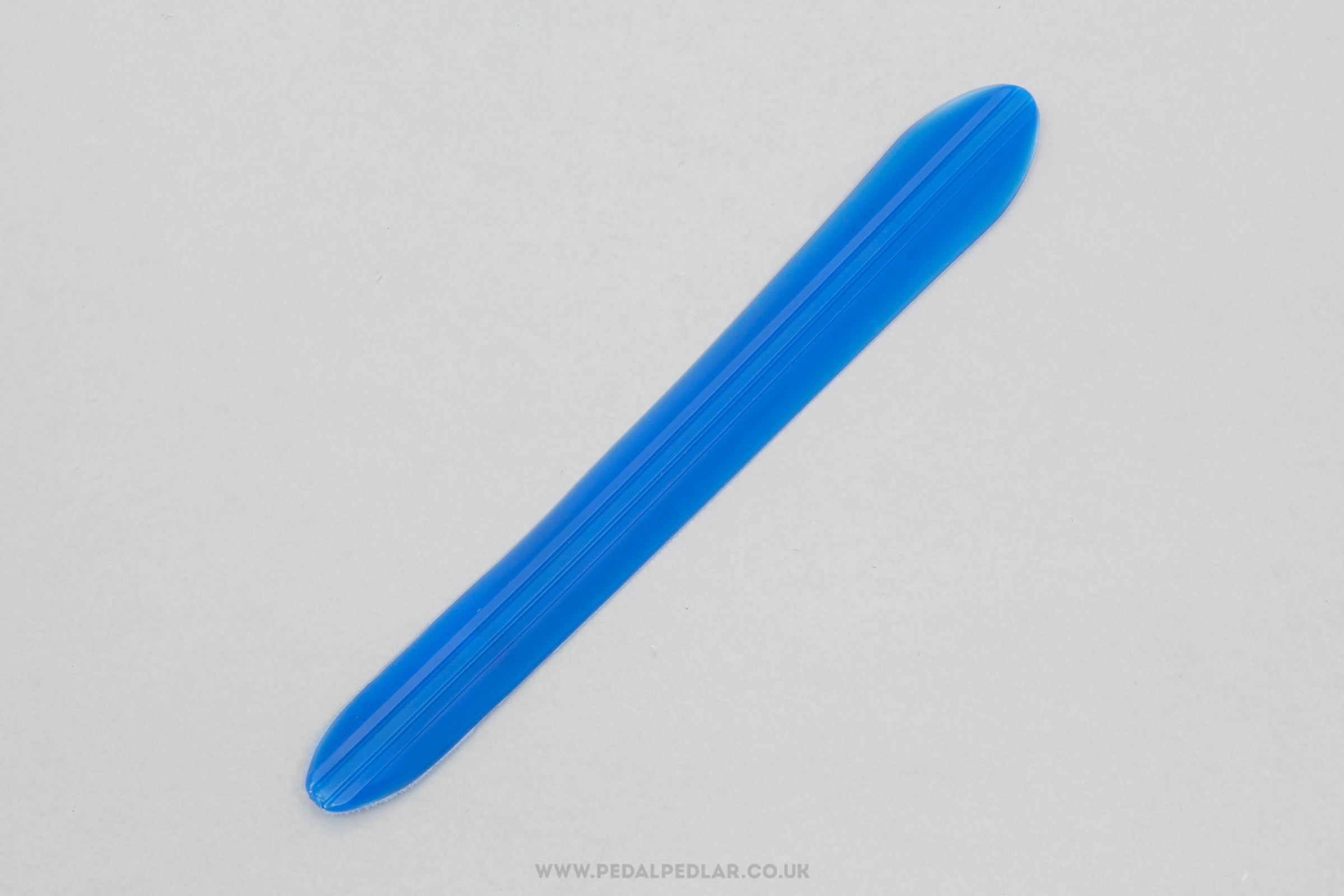


Minoura Chain Plate NOS/NIB Classic Blue Chainstay Frame Protector
£9.00 £10.00
✓ Original frame protection - produced in the 1990s
✓ New old stock & still in the original packaging!
✓ Worldwide shipping
Minoura Chain Plate chainstay protector, hailing from Japan and in production during the 1990s (yet still new & unused after all this time!). An excellent choice for classic cycling enthusiasts, but great for cyclists of the non-classic variety too!
OVERVIEW
Production Era - 1990s
Country - Japanese
Material - Plastic
Weight - 8 g
Stock Code - D-PRC5C
*New old stock items may have marks from storage over the years, and as we often have multiples they can vary from piece to piece, but they are always genuine new & unused items.
TECHNICAL INFO
Colour* - Blue
Length - 16.5 cm
Backing - Adhesive
-
▼SHIPPING, TAXES & RETURNS
-
We've been safely sending orders around the world since 2010. Orders are carefully packed, sent with tracking & insurance, and normally collected around midday on Tuesdays and Fridays. Larger items may occasionally require an extra day or two to prepare.
We accept returns, please notify us within 14 days and ensure the item arrives back with us no later than 30 days after the order was received.
EU orders under €150 (excluding shipping) - import VAT and the new €3 customs duty are paid as part of your order, so there's nothing further to pay on delivery.
EU orders over €150 (excluding shipping) - import fees are payable to the carrier before delivery, with nothing collected at checkout.
USA orders - import fees are collected at checkout for all orders to the USA, so there won’t be any surprise charges when your order arrives.
Other international orders - local import fees may apply and are not collected by us. Please check your country's import rules before purchasing.
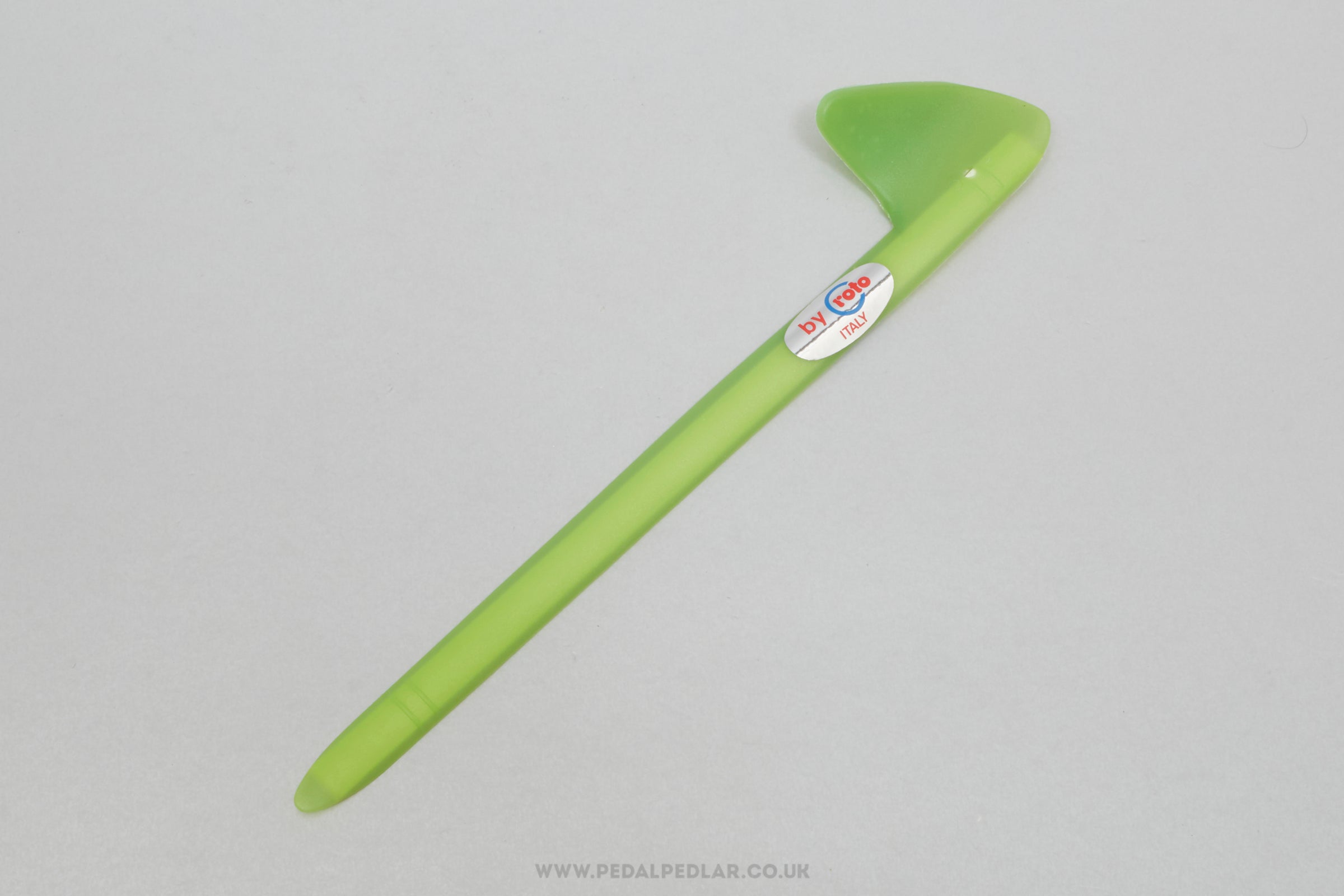


Roto Shark Fin NOS/NIB Classic Neon Green Chainstay Frame Protector
£13.50 £15.00
✓ Original chain stay protection - produced in the 1990s
✓ New old stock & still in the original packaging!
✓ Worldwide shipping
Roto chainstay protector (or frame guard if you prefer), hailing from Italy and in production during the 1990s (yet still new & unused after all this time!). An excellent choice for classic cycling enthusiasts, but great for cyclists of the non-classic variety too!
OVERVIEW
Production Era - 1990s
Country - Italian
Material - Plastic
Weight - 16 g
Stock Code - D-PRC7C
*New old stock items may have marks from storage over the years, and as we often have multiples they can vary from piece to piece, but they are always genuine new & unused items.
TECHNICAL INFO
Colour* - Neon Green
Length - 23.5 cm
Backing - Adhesive
-
▼SHIPPING, TAXES & RETURNS
-
We've been safely sending orders around the world since 2010. Orders are carefully packed, sent with tracking & insurance, and normally collected around midday on Tuesdays and Fridays. Larger items may occasionally require an extra day or two to prepare.
We accept returns, please notify us within 14 days and ensure the item arrives back with us no later than 30 days after the order was received.
EU orders under €150 (excluding shipping) - import VAT and the new €3 customs duty are paid as part of your order, so there's nothing further to pay on delivery.
EU orders over €150 (excluding shipping) - import fees are payable to the carrier before delivery, with nothing collected at checkout.
USA orders - import fees are collected at checkout for all orders to the USA, so there won’t be any surprise charges when your order arrives.
Other international orders - local import fees may apply and are not collected by us. Please check your country's import rules before purchasing.