
Back In Stock


Shimano Deore (HB-M510) Silver NOS Classic 36h Front Hub
£25.00
✓ Original hub - produced in the 2000s
✓ New old stock! Still unused after all these years
✓ Worldwide shipping
Shimano Deore front hub, hailing from Japan and in production during the 2000s. Made from aluminium/steel and weighing in at 233 grams. A fine choice for keeping your classic bike authentic, but also great for any other compatible bike.
OVERVIEW
Bearing / Race Condition - New Old Stock*
Model ID - HB-M510
Production Era - 2000s
Country - Japanese
Material - Aluminium / Steel
Weight - 233 g
Stock Code - D-HU-F52C
*New old stock items may have marks from storage over the years, and as we often have multiples they can vary from piece to piece, but they are always genuine new & unused items.
TECHNICAL INFO
Spoke Drilling - 36 Hole
Spacing (O.L.D.) - 100 mm
-
▼SHIPPING, TAXES & RETURNS
-
We've been safely sending orders around the world since 2010. Orders are carefully packed, sent with tracking & insurance, and normally collected around midday on Tuesdays and Fridays. Larger items may occasionally require an extra day or two to prepare.
We accept returns, please notify us within 14 days and ensure the item arrives back with us no later than 30 days after the order was received.
EU orders under €150 (excluding shipping) - import VAT and the new €3 customs duty are paid as part of your order, so there's nothing further to pay on delivery.
EU orders over €150 (excluding shipping) - import fees are payable to the carrier before delivery, with nothing collected at checkout.
USA orders - import fees are collected at checkout for all orders to the USA, so there won’t be any surprise charges when your order arrives.
Other international orders - local import fees may apply and are not collected by us. Please check your country's import rules before purchasing.
-
▼HELP SECTION
-
Spoke Drilling - the number of holes for the spokes, your wheel rim needs to match the hub exactly.
Spacing (O.L.D.) - the width of the hub measured at its widest point, from the outside of the locking end nuts (O.L.D. = Over Locknut Dimension), not including the hub axle. This measurement needs to match the inside of your fork's dropouts. Steel forks can be stretched or squeezed a few mm but it's always best to avoid this if possible, aluminium or carbon forks should never be stretched.


Shimano Deore LX (HB-T660) Silver NOS Classic 32h Front Hub
£25.00
✓ Original hub - produced in the 2000s
✓ New old stock! Still unused after all these years
✓ Lightweight for the era - just 219 grams
✓ Worldwide shipping
Shimano Deore LX front hub, hailing from Japan and in production during the 2000s. Made from aluminium/steel and weighing in at 219 grams - pretty lightweight for a front hub at that time. A fine choice for keeping your classic bike authentic, but also great for any other compatible bike.
OVERVIEW
Bearing / Race Condition - New Old Stock*
Model ID - HB-T660
Production Era - 2000s
Country - Japanese
Material - Aluminium / Steel
Weight - 219 g
Stock Code - D-HU-F54C
*New old stock items may have marks from storage over the years, and as we often have multiples they can vary from piece to piece, but they are always genuine new & unused items.
TECHNICAL INFO
Spoke Drilling - 32 Hole
Spacing (O.L.D.) - 100 mm
-
▼SHIPPING, TAXES & RETURNS
-
We've been safely sending orders around the world since 2010. Orders are carefully packed, sent with tracking & insurance, and normally collected around midday on Tuesdays and Fridays. Larger items may occasionally require an extra day or two to prepare.
We accept returns, please notify us within 14 days and ensure the item arrives back with us no later than 30 days after the order was received.
EU orders under €150 (excluding shipping) - import VAT and the new €3 customs duty are paid as part of your order, so there's nothing further to pay on delivery.
EU orders over €150 (excluding shipping) - import fees are payable to the carrier before delivery, with nothing collected at checkout.
USA orders - import fees are collected at checkout for all orders to the USA, so there won’t be any surprise charges when your order arrives.
Other international orders - local import fees may apply and are not collected by us. Please check your country's import rules before purchasing.
-
▼HELP SECTION
-
Spoke Drilling - the number of holes for the spokes, your wheel rim needs to match the hub exactly.
Spacing (O.L.D.) - the width of the hub measured at its widest point, from the outside of the locking end nuts (O.L.D. = Over Locknut Dimension), not including the hub axle. This measurement needs to match the inside of your fork's dropouts. Steel forks can be stretched or squeezed a few mm but it's always best to avoid this if possible, aluminium or carbon forks should never be stretched.


Campagnolo C-Record Black NOS Vintage 10T Jockey Wheels
£30.00
✓ Original jockey wheels - produced in the 1980s
✓ New old stock! Still unused after all these years
✓ Suitable for historic cycling events such as L'Eroica
✓ Worldwide shipping
Campagnolo C-Record jockey wheels (or derailleur pulleys if you prefer), hailing from Italy and in production during the 1980s (yet still new & unused after all this time). Made from plastic and weighing in at 10 grams. A fine choice for keeping your vintage bike authentic, but also great for any other compatible bike.
These work with all Campagnolo 7/8 speed rear derailleurs from the same era, including Croce D'Aune, Chorus, Athena etc.
If you're taking part in L'Eroica or a similar vintage event, this is fully compliant - so rest assured, the pre-1987 police won't lock you up for having the jockey wheels!
OVERVIEW
Production Era - 1980s
Country - Italian
Material - Plastic
Weight - 10 g
Stock Code - D-JCK11V
NB - Wheels only as pictured, no bearings or covers provided
*New old stock items may have marks from storage over the years, and as we often have multiples they can vary from piece to piece, but they are always genuine new & unused items.
TECHNICAL INFO
Teeth - 10
Compatible Speed* - 7 Speed, 8 Speed
Diameter (OD) - 38 mm
Thickness - 5.65 mm (Without Bearings / Covers)
Centre Hole (ID) - 14 mm (Without Bearings / Covers)
*See help section.
-
▼SHIPPING, TAXES & RETURNS
-
We've been safely sending orders around the world since 2010. Orders are carefully packed, sent with tracking & insurance, and normally collected around midday on Tuesdays and Fridays. Larger items may occasionally require an extra day or two to prepare.
We accept returns, please notify us within 14 days and ensure the item arrives back with us no later than 30 days after the order was received.
EU orders under €150 (excluding shipping) - import VAT and the new €3 customs duty are paid as part of your order, so there's nothing further to pay on delivery.
EU orders over €150 (excluding shipping) - import fees are payable to the carrier before delivery, with nothing collected at checkout.
USA orders - import fees are collected at checkout for all orders to the USA, so there won’t be any surprise charges when your order arrives.
Other international orders - local import fees may apply and are not collected by us. Please check your country's import rules before purchasing.
-
▼HELP SECTION
-
Teeth - the tooth count has increased with the introduction of more gears, but this happened very gradually so 10 tooth jockey wheels were standard for a very long time.
*Compatible Speed - the number of cogs the jockey wheels were designed to be used with. When using derailleurs for indexed shifting it's important to stick to this, but friction shifting is much more forgiving so you're unlikely to have any problems using the next speed up or down, providing all the measurements are correct.
Diameter (OD) - the diameter of the jockey wheels, from the outside edge of the teeth. It’s important to stay close to the ones you're replacing to ensure they fit.
Thickness - measured at the widest point, by the centre hole. The spacing has generally become narrower over the years to accommodate more gears.
Centre Hole (ID) - the inside diameter (usually inside the bushing/spacer if present). This rarely presents a problem, but some older jockey wheels have a different diameter so it's worth double checking.
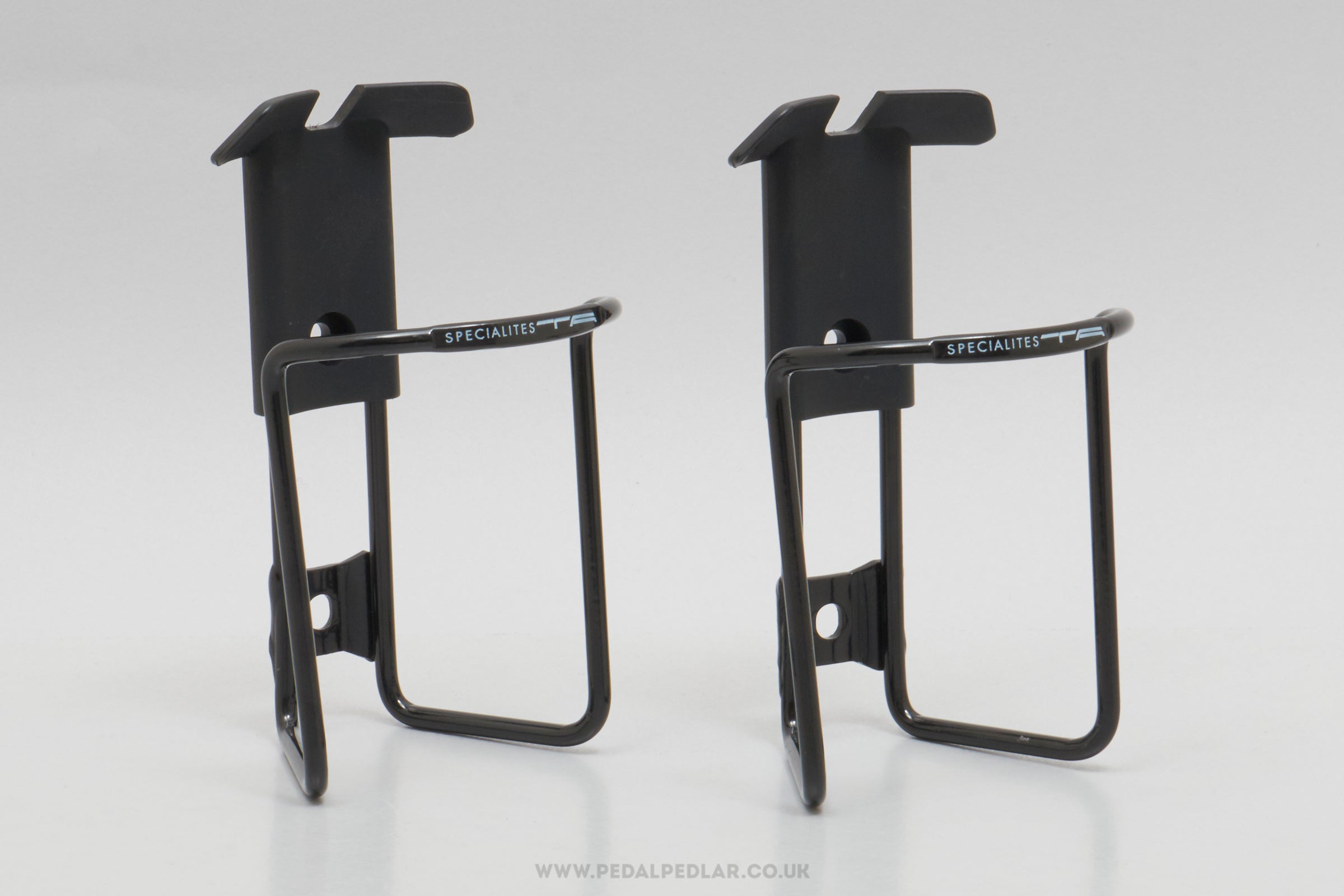


Specialites T.A. Sierra NOS Classic Black Bottle Cages
£30.00
✓ Original pair of bottle cages - produced in the 1990s
✓ New old stock! Still unused after all these years
✓ Worldwide shipping
Specialites T.A. Sierra water bottle cages (or bidon holders if you prefer), hailing from France and in production during the 1990s (yet still new & unused after all this time!). Made from aluminium/plastic and weighing in at 116 grams (the weight and price displayed are for a pair of cages). The perfect finishing touch for your classic bike, but great for bikes of the non-classic variety too!
OVERVIEW
Production Era - 1990s
Country - French
Material - Aluminium / Plastic
Weight - 116 g
Stock Code - D-CAG-P23C
*New old stock items may have marks from storage over the years, and as we often have multiples they can vary from piece to piece, but they are always genuine new & unused items.
TECHNICAL INFO
Cage Fixing - Frame Fit (Braze-On)
Colour* - Black
Bottle Fit - Standard
*The colour description is just a guide, please check the photos too as we make sure these are as close to the true colour as possible.
-
▼SHIPPING, TAXES & RETURNS
-
We've been safely sending orders around the world since 2010. Orders are carefully packed, sent with tracking & insurance, and normally collected around midday on Tuesdays and Fridays. Larger items may occasionally require an extra day or two to prepare.
We accept returns, please notify us within 14 days and ensure the item arrives back with us no later than 30 days after the order was received.
EU orders under €150 (excluding shipping) - import VAT and the new €3 customs duty are paid as part of your order, so there's nothing further to pay on delivery.
EU orders over €150 (excluding shipping) - import fees are payable to the carrier before delivery, with nothing collected at checkout.
USA orders - import fees are collected at checkout for all orders to the USA, so there won’t be any surprise charges when your order arrives.
Other international orders - local import fees may apply and are not collected by us. Please check your country's import rules before purchasing.
-
▼HELP SECTION
-
Cage Fixing - most bottle cages will be designed to fix to the frame, although some rare older ones mount to the handlebars and/or stem. If your frame doesn't have any bottle cage braze-ons to fix to you'll need clamp-on bottle cages.
Bottle Fit - almost all cycling bottles measure between 70 - 75 mm in diameter so this is the standard bottle cage size, the only rather rare exceptions are some old Elite bottles that require a 66 mm cage, the more recent oversized ones and of course the funny shaped aero ones that only accept the bottle they were made for.


Specialites T.A. 'Plum' (417) NOS Vintage White Bottle Cages
£25.00
✓ Original pair of bottle cages - in production from the 1980s to the 1990s
✓ New old stock! Still unused after all these years
✓ Suitable for historic cycling events such as L'Eroica
✓ Worldwide shipping
Specialites T.A. 'Plum' water bottle cages (or bidon holders if you prefer), hailing from France and in production from the 1980s to the 1990s (yet still new & unused after all this time). Made from aluminium/plastic and weighing in at 92 grams (the weight and price displayed are for a pair of cages). The perfect finishing touch for your vintage bike, but great for bikes of the non-vintage variety too!
These are the final versions of the Plum lightweight bottle cage, featuring wrap-around 'sleeves' and punched dimples on the rear of the frame mounts, replacing the exposed welded construction of the previous design.
If you're taking part in L'Eroica or a similar vintage event, these are of the correct era, so rest assured the pre-1987 police won't lock you up for having the wrong bottle carriers!
OVERVIEW
Model ID - 417
Production Era - 1980s & 1990s
Country - French
Material - Aluminium / Plastic
Weight - 92 g
Stock Code - D-G6-CAG-P32V
*New old stock items may have marks from storage over the years, and as we often have multiples they can vary from piece to piece, but they are always genuine new & unused items.
TECHNICAL INFO
Cage Fixing - Frame Fit (Braze-On)
Colour* - White
Bottle Fit - Standard
*The colour description is just a guide, please check the photos too as we make sure these are as close to the true colour as possible.
-
▼SHIPPING, TAXES & RETURNS
-
We've been safely sending orders around the world since 2010. Orders are carefully packed, sent with tracking & insurance, and normally collected around midday on Tuesdays and Fridays. Larger items may occasionally require an extra day or two to prepare.
We accept returns, please notify us within 14 days and ensure the item arrives back with us no later than 30 days after the order was received.
EU orders under €150 (excluding shipping) - import VAT and the new €3 customs duty are paid as part of your order, so there's nothing further to pay on delivery.
EU orders over €150 (excluding shipping) - import fees are payable to the carrier before delivery, with nothing collected at checkout.
USA orders - import fees are collected at checkout for all orders to the USA, so there won’t be any surprise charges when your order arrives.
Other international orders - local import fees may apply and are not collected by us. Please check your country's import rules before purchasing.
-
▼SAFETY & COMPLIANCE
- This product complies with the EU General Product Safety Regulation (GPSR).
Product Manufacturer - Specialites T.A. 41 Bis Rue de Laon, 02150 Sissonne, France
EU Authorised Representative - Global Trade Department NI Ltd, Office 834, Unit 6, 100 Lisburn Road, Belfast BT9 6AG, Northern Ireland
-
▼HELP SECTION
-
Cage Fixing - most bottle cages will be designed to fix to the frame, although some rare older ones mount to the handlebars and/or stem. If your frame doesn't have any bottle cage braze-ons to fix to you'll need clamp-on bottle cages.
Bottle Fit - almost all cycling bottles measure between 70 - 75 mm in diameter so this is the standard bottle cage size, the only rather rare exceptions are some old Elite bottles that require a 66 mm cage, the more recent oversized ones and of course the funny shaped aero ones that only accept the bottle they were made for.