
Big Old Sale - All Items 25% Off


Shimano Ultegra (CS-6500) NOS Classic 9 Speed Hyperglide 14-25 Cassette
£60.00 £80.00
✓ Original part - produced in the 2000s
✓ New old stock! Still unused after all these years
✓ Worldwide shipping
Shimano Ultegra cassette, hailing from Japan and in production during the 2000s. Made from steel/aluminium and weighing in at 260 grams. A fine choice for keeping your classic bike authentic, but also great for any other compatible bike too.
OVERVIEW
Model ID - CS-6500
Production Era - 2000s
Country - Japanese
Material - Steel / Aluminium
Weight - 260 g
Stock Code - D-CAS45C
*New old stock items may have marks from storage over the years, and as we often have multiples they can vary from piece to piece, but they are always genuine new & unused items.
TECHNICAL INFO
Speed - 9 Speed
Spline Pattern - Shimano Hyperglide
Range - 14-25
-
▼SHIPPING, TAXES & RETURNS
-
We've been safely sending orders around the world since 2010. Orders are carefully packed, sent with tracking & insurance, and normally collected around midday on Tuesdays and Fridays. Larger items may occasionally require an extra day or two to prepare.
We accept returns, please notify us within 14 days and ensure the item arrives back with us no later than 30 days after the order was received.
EU orders under €150 (excluding shipping) - import VAT and the new €3 customs duty are paid as part of your order, so there's nothing further to pay on delivery.
EU orders over €150 (excluding shipping) - import fees are payable to the carrier before delivery, with nothing collected at checkout.
USA orders - import fees are collected at checkout for all orders to the USA, so there won’t be any surprise charges when your order arrives.
Other international orders - local import fees may apply and are not collected by us. Please check your country's import rules before purchasing.
-
▼HELP SECTION
-
Speed - the number of cogs on the cassette.
Spline Pattern - the shape of the cogs where they slide on to the freehub body, this must match the spline pattern of your hub to able to fit. In the 1980s Shimano introduced Uniglide cassettes that share the same spline pattern as their now standard Hyperglide, but the smallest sprocket threads on to the hub to secure it rather than using a conventional lockring, these will only fit hubs with a threaded section on the outside of the freehub body.
Range - the number of teeth on the smalles and largest cogs, this gives you an indication of how hard or easy the gearing will be, the lower the number the harder the gears. The tooth count of the cogs inbetween are usually evenly spaced, ie: a 6 speed 14-24 freewheel would likely have cog sizes 14, 16, 18, 20, 22 & 24.


Campagnolo Mirage (FD4-MIB2) 9 Speed NOS Classic Braze-On Front Derailleur
£26.25 £35.00
✓ Original part - produced in the 2000s
✓ New old stock! Still unused after all these years
✓ Worldwide shipping
Campagnolo Mirage front derailleur, hailing from Italy and in production during the 2000s. Made from steel/plastic and weighing in at 102 grams. A fine choice for keeping your classic bike authentic, but also great for any other compatible bike.
OVERVIEW
Model ID - FD4-MIB2
Production Era - 2000s
Country - Italian
Material - Steel / Plastic
Weight - 102 g
Stock Code - D-FM163C
*New old stock items may have marks from storage over the years, and as we often have multiples they can vary from piece to piece, but they are always genuine new & unused items.
TECHNICAL INFO
Chainset Type - Double
Frame Fixing - Braze-On
Pull Type - Bottom Pull
Designated Speed* - 9 Speed
*See help section.
-
▼SHIPPING, TAXES & RETURNS
-
We've been safely sending orders around the world since 2010. Orders are carefully packed, sent with tracking & insurance, and normally collected around midday on Tuesdays and Fridays. Larger items may occasionally require an extra day or two to prepare.
We accept returns, please notify us within 14 days and ensure the item arrives back with us no later than 30 days after the order was received.
EU orders under €150 (excluding shipping) - import VAT and the new €3 customs duty are paid as part of your order, so there's nothing further to pay on delivery.
EU orders over €150 (excluding shipping) - import fees are payable to the carrier before delivery, with nothing collected at checkout.
USA orders - import fees are collected at checkout for all orders to the USA, so there won’t be any surprise charges when your order arrives.
Other international orders - local import fees may apply and are not collected by us. Please check your country's import rules before purchasing.
-
▼HELP SECTION
-
Chainset Type - the number of chainrings the derailleur was designed to work with. ‘Double’ derailleurs are actually capable of working on ‘triple’ chainsets but they may struggle when shifting, especially if there’s a big step down from the middle to inner ring, so it’s better to match these correctly.
Frame Fixing - the way the derailleur fixes to the frame, if you have a tab on your frame to mount the derailleur to you need braze-on. If there’s no tab then you require a clamp-on type (also referred to as band-on or clip-on), these come in different sizes to match the diameter of your seat tube.
Pull Type - the direction of which the cable needs to ‘pull’ the mech in order to shift. If your cable runs up to the derailleur from the bottom bracket area then you need bottom pull, if your cable comes down from above you need top pull. Some later derailleurs can be used for either setups, these are referred to as dual pull.
Designated Speed (9 Speed & Above) - the speed of the chain that the mech was designed to be used with. This only becomes relevant for mechs marketed as 9 speed or above when chains became narrower, as the derailleur cage plates became marginally narrower too. We refer to it as ‘designated’ speed as technically you can use (almost) any derailleur with any chain, however if you want optimum performance it’s best to stay close to the manufacturers recommendations.
Indexing System (Shimano Only) - this is only applicable when using Shimano shifters that have an indexed left shifter such as STI or Rapidfire. For the indexing to work correctly when using these shifters the derailleur and shifters must be of the same type, so Shimano drop bar shifters need to be matched with a Shimano ‘road’ derailleur, and Shimano flat bar shifters must be used with Shimano ‘MTB’ derailleurs.


Campagnolo Chorus UD NOS/NIB Classic 9 Speed 12-21 Cassette
£86.25 £115.00
✓ Original part - produced in the 2000s
✓ New old stock & still in the original packaging!
✓ Worldwide shipping
Campagnolo Chorus UD cassette, hailing from Italy and in production during the 2000s . Made from steel/plastic and weighing in at 191 grams. A fine choice for keeping your classic bike authentic, but also great for any other compatible bike too.
OVERVIEW
Production Era - 2000s
Country - Italian
Material - Steel/Plastic
Weight - 191 g
Stock Code - D-CAS6C
NB - This model does not come with a lockring as standard.
*New old stock items may have marks from storage over the years, and as we often have multiples they can vary from piece to piece, but they are always genuine new & unused items.
TECHNICAL INFO
Speed - 9 Speed
Spline Pattern - Campagnolo (Standard)
Range - 12-21
-
▼SHIPPING, TAXES & RETURNS
-
We've been safely sending orders around the world since 2010. Orders are carefully packed, sent with tracking & insurance, and normally collected around midday on Tuesdays and Fridays. Larger items may occasionally require an extra day or two to prepare.
We accept returns, please notify us within 14 days and ensure the item arrives back with us no later than 30 days after the order was received.
EU orders under €150 (excluding shipping) - import VAT and the new €3 customs duty are paid as part of your order, so there's nothing further to pay on delivery.
EU orders over €150 (excluding shipping) - import fees are payable to the carrier before delivery, with nothing collected at checkout.
USA orders - import fees are collected at checkout for all orders to the USA, so there won’t be any surprise charges when your order arrives.
Other international orders - local import fees may apply and are not collected by us. Please check your country's import rules before purchasing.


SR Suntour PF70 NOS Classic 9 Speed Shimano Hyperglide 11-32 Cassette
£41.25 £55.00
✓ Original part - produced in the 2000s
✓ New old stock! Still unused after all these years
✓ Worldwide shipping
SR Suntour PF70 cassette, in production during the 2000s . Made from steel/plastic and weighing in at 358 grams. A fine choice for keeping your classic bike authentic, but also great for any other compatible bike too.
OVERVIEW
Production Era - 2000s
Country -
Material - Steel/Plastic
Weight - 358 g
Stock Code - D-CAS8C
*New old stock items may have marks from storage over the years, and as we often have multiples they can vary from piece to piece, but they are always genuine new & unused items.
TECHNICAL INFO
Speed - 9 Speed
Spline Pattern - Shimano Hyperglide
Range - 11-32
-
▼SHIPPING, TAXES & RETURNS
-
We've been safely sending orders around the world since 2010. Orders are carefully packed, sent with tracking & insurance, and normally collected around midday on Tuesdays and Fridays. Larger items may occasionally require an extra day or two to prepare.
We accept returns, please notify us within 14 days and ensure the item arrives back with us no later than 30 days after the order was received.
EU orders under €150 (excluding shipping) - import VAT and the new €3 customs duty are paid as part of your order, so there's nothing further to pay on delivery.
EU orders over €150 (excluding shipping) - import fees are payable to the carrier before delivery, with nothing collected at checkout.
USA orders - import fees are collected at checkout for all orders to the USA, so there won’t be any surprise charges when your order arrives.
Other international orders - local import fees may apply and are not collected by us. Please check your country's import rules before purchasing.


Shimano Ultegra (RD-6500) c.2002 Classic Rear Mech
£67.50 £90.00
✓ Original part - produced in the 2000s
✓ Lightweight for the era - just 218 grams
✓ Professionally checked & cleaned
✓ Worldwide shipping
Shimano Ultegra rear mech, hailing from Japan and dating back to 2002. Made from aluminium/steel and weighing in at 218 grams - pretty lightweight for a rear derailleur at that time. A fine choice for keeping your classic bike authentic, but also great for any other compatible bike too.
The mech's been carefully cleaned, thoroughly checked by one of our mechanics and graded as good condition, but do take a good look at the detailed photos so you can see the cosmetic condition before you buy.OVERVIEW
Jockey Wheel Condition - Very Good
Model ID - RD-6500
Production Era - 2000s
Country - Japanese
Material - Aluminium/Steel
Weight - 218 g
Stock Code - U-RM80C
TECHNICAL INFO
Shifting System - Shimano STI, Shimano SIS, Friction
Speed* - 9 Speed
Max Sprocket Size - 28 Teeth
Max Chain Wrap - 29
Chain Width - 3/32" (Standard)
*See help section.
-
▼SHIPPING, TAXES & RETURNS
-
We've been safely sending orders around the world since 2010. Orders are carefully packed, sent with tracking & insurance, and normally collected around midday on Tuesdays and Fridays. Larger items may occasionally require an extra day or two to prepare.
We accept returns, please notify us within 14 days and ensure the item arrives back with us no later than 30 days after the order was received.
EU orders under €150 (excluding shipping) - import VAT and the new €3 customs duty are paid as part of your order, so there's nothing further to pay on delivery.
EU orders over €150 (excluding shipping) - import fees are payable to the carrier before delivery, with nothing collected at checkout.
USA orders - import fees are collected at checkout for all orders to the USA, so there won’t be any surprise charges when your order arrives.
Other international orders - local import fees may apply and are not collected by us. Please check your country's import rules before purchasing.
-
▼HELP SECTION
-
Shifting system - friction means your gear levers don't click when you change gear, when they do click it's referred to as indexed shifting. If you have indexed gear levers they must use the same system as the rear derailleur, if you're using friction levers you can mix and match.
*Speed - the number of cogs at the back the derailleur was designed to be used with. This is important with indexed shifting, but with friction shifters you can in theory run any rear mech with any number of cogs, but you are more likely to have issues running high numbers of cogs with mechs from earlier eras.
Max cog size - the amount of teeth on the largest cog of your freewheel/cassette can be no greater than this to work with this derailleur.
Chain wrap - subtract the size of your smallest rear cog from your biggest, then do the same with your chainrings, add the 2 numbers together and you have your chain wrap.
Chain width - generally speaking, derailleurs designed for more than 3 speed use will fit a standard 3/32'' chain, the exception being some Cyclo & Simplex models from around the mid 1900s.


Bianchi / FIR NET2000 Classic 700c Clincher Road Wheels
£198.75 £265.00
✓ Original classic wheels - produced in the 2000s
✓ Professionally checked & serviced
✓ Worldwide shipping
Bianchi wheels built with FIR NET2000 rims, the hubs hailing from Italy and in production during the 2000s. Made from aluminium/steel and weighing in at 2.2 kg. A fine choice for keeping your classic bike authentic, but also great for any other compatible bike too.
The wheels have been serviced, checked by one of our mechanics and graded as good condition, but do take a good look at the detailed photos so you can see the cosmetic condition before you buy.OVERVIEW
Rim Condition - Very Good
Production Era - 2000s
Country - Italian
Material - Aluminium/Steel
Weight - 2.151 kg
Stock Code - U-W-PR50C
TECHNICAL INFO
Rim Size - 700c Clincher
Bike Type - Road
Drilling (F/R) - 32/32 Hole
Spacing (O.L.D.) (F / R) - 100 mm / 130 mm
Speed - 9 Speed, 10 Speed, 11 Speed
Sprocket Fitting - Campagnolo 9/10/11 Spd
-
▼SHIPPING, TAXES & RETURNS
-
We've been safely sending orders around the world since 2010. Orders are carefully packed, sent with tracking & insurance, and normally collected around midday on Tuesdays and Fridays. Larger items may occasionally require an extra day or two to prepare.
We accept returns, please notify us within 14 days and ensure the item arrives back with us no later than 30 days after the order was received.
EU orders under €150 (excluding shipping) - import VAT and the new €3 customs duty are paid as part of your order, so there's nothing further to pay on delivery.
EU orders over €150 (excluding shipping) - import fees are payable to the carrier before delivery, with nothing collected at checkout.
USA orders - import fees are collected at checkout for all orders to the USA, so there won’t be any surprise charges when your order arrives.
Other international orders - local import fees may apply and are not collected by us. Please check your country's import rules before purchasing.


Sport Energy Large Flange Classic 18h Rear Hub
£48.75 £65.00
✓ Original hub - in production from the 1990s to the 2000s
✓ Professionally checked, cleaned & serviced
✓ Worldwide shipping
Sport Energy rear hub, in production from the 1990s to the 2000s. Made from aluminium/steel and weighing in at 366 grams. A fine choice for keeping your classic bike authentic, but also great for any other compatible bike too.
The hub's been carefully cleaned, thoroughly serviced by one of our mechanics and graded as very good condition, but do take a good look at the detailed photos so you can see the cosmetic condition before you buy.OVERVIEW
Bearing / Race Condition - New
Condition Notes - New sealed bearing units installed.
Production Era - 1990s & 2000s
Country - 0
Material - Aluminium / Steel
Weight - 366 g
Stock Code - U-HU-R25C
TECHNICAL INFO
Spoke Drilling - 18 Hole
Spacing (O.L.D.) - 130 mm
Speed - 8 Speed, 9 Speed, 10 Speed
Sprocket Fitting - Shimano Hyperglide
-
▼SHIPPING, TAXES & RETURNS
-
We've been safely sending orders around the world since 2010. Orders are carefully packed, sent with tracking & insurance, and normally collected around midday on Tuesdays and Fridays. Larger items may occasionally require an extra day or two to prepare.
We accept returns, please notify us within 14 days and ensure the item arrives back with us no later than 30 days after the order was received.
EU orders under €150 (excluding shipping) - import VAT and the new €3 customs duty are paid as part of your order, so there's nothing further to pay on delivery.
EU orders over €150 (excluding shipping) - import fees are payable to the carrier before delivery, with nothing collected at checkout.
USA orders - import fees are collected at checkout for all orders to the USA, so there won’t be any surprise charges when your order arrives.
Other international orders - local import fees may apply and are not collected by us. Please check your country's import rules before purchasing.
-
▼HELP SECTION
-
Spoke Drilling - the number of holes for the spokes, your wheel rim needs to match the hub exactly.
Spacing (O.L.D.) - the width of the hub measured at its widest point, from the outside of the locking end nuts (O.L.D. = Over Locknut Dimension), not including the hub axle. This measurement needs to match the inside of your frame's dropouts. Steel frames can be stretched or squeezed a few mm but it's always best to avoid this if possible, aluminium or carbon frames should never be stretched.
Speed - the number of cogs the hub was designed to be used with.
Sprocket Fitting - for cassette hubs this refers to the spline pattern (the shape of the cogs where they slide on to the hub) and this must match the cassette you intend to use. With freewheel hubs it refers to the thread, ISO is the modern standard and is almost exactly the same as older English/British and Italian thread, allowing you to mix and match between these thread types as long as it's not going to be under extreme force, in which case it's best to stick to an exact match. Freewheel hubs with a French thread must be used with a French threaded freewheel.


Shimano Ultegra (CS-6500) NOS Classic 9 Speed Hyperglide 12-23 Cassette
£56.25 £75.00
✓ Original part - produced in the 2000s
✓ New old stock! Still unused after all these years
✓ Worldwide shipping
Shimano Ultegra cassette, hailing from Japan and in production during the 2000s. Made from steel/aluminium and weighing in at 210 grams. A fine choice for keeping your classic bike authentic, but also great for any other compatible bike too.
OVERVIEW
Model ID - CS-6500
Production Era - 2000s
Country - Japanese
Material - Steel / Aluminium
Weight - 210 g
Stock Code - D-CAS44C
*New old stock items may have marks from storage over the years, and as we often have multiples they can vary from piece to piece, but they are always genuine new & unused items.
TECHNICAL INFO
Speed - 9 Speed
Spline Pattern - Shimano Hyperglide
Range - 12-23
-
▼SHIPPING, TAXES & RETURNS
-
We've been safely sending orders around the world since 2010. Orders are carefully packed, sent with tracking & insurance, and normally collected around midday on Tuesdays and Fridays. Larger items may occasionally require an extra day or two to prepare.
We accept returns, please notify us within 14 days and ensure the item arrives back with us no later than 30 days after the order was received.
EU orders under €150 (excluding shipping) - import VAT and the new €3 customs duty are paid as part of your order, so there's nothing further to pay on delivery.
EU orders over €150 (excluding shipping) - import fees are payable to the carrier before delivery, with nothing collected at checkout.
USA orders - import fees are collected at checkout for all orders to the USA, so there won’t be any surprise charges when your order arrives.
Other international orders - local import fees may apply and are not collected by us. Please check your country's import rules before purchasing.
-
▼HELP SECTION
-
Speed - the number of cogs on the cassette.
Spline Pattern - the shape of the cogs where they slide on to the freehub body, this must match the spline pattern of your hub to able to fit. In the 1980s Shimano introduced Uniglide cassettes that share the same spline pattern as their now standard Hyperglide, but the smallest sprocket threads on to the hub to secure it rather than using a conventional lockring, these will only fit hubs with a threaded section on the outside of the freehub body.
Range - the number of teeth on the smalles and largest cogs, this gives you an indication of how hard or easy the gearing will be, the lower the number the harder the gears. The tooth count of the cogs inbetween are usually evenly spaced, ie: a 6 speed 14-24 freewheel would likely have cog sizes 14, 16, 18, 20, 22 & 24.
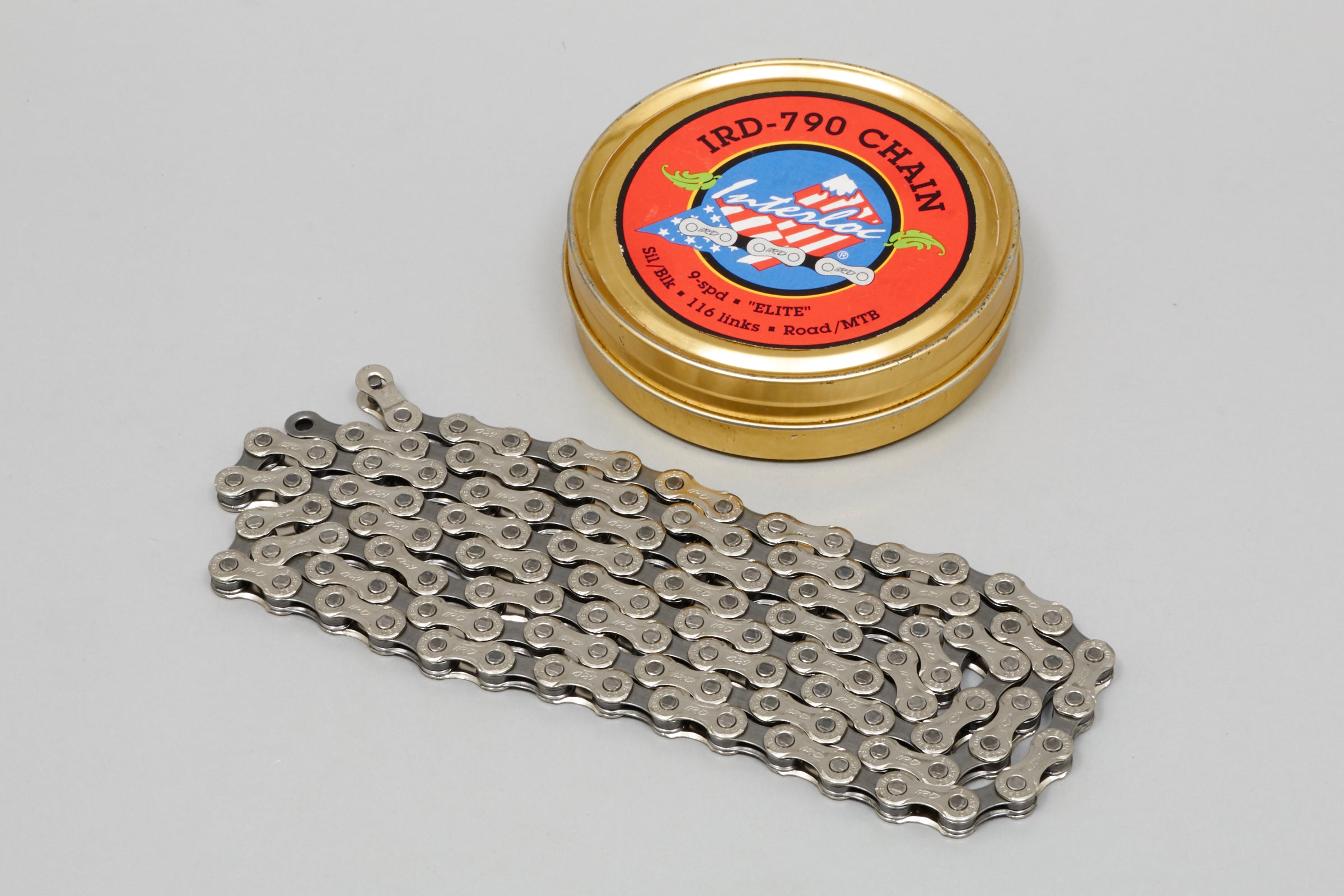


IRD 790 NOS/NIB Classic 9 Speed Chain
£26.25 £35.00
✓ Original part - produced in the 1990s
✓ New old stock & still in the original packaging!
✓ Worldwide shipping
IRD 790 chain, hailing from the United States and in production during the 1990s (yet still new & unused after all this time!). Made from steel and weighing in at 360 grams. A fine choice for keeping your classic bike authentic, but also great for any other compatible bike.
OVERVIEW
Production Era - 1990s
Country - American
Material - Steel
Weight - 360 g
Stock Code - D-CHN39C
*New old stock items may have marks from storage over the years, and as we often have multiples they can vary from piece to piece, but they are always genuine new & unused items.
TECHNICAL INFO
Optimal Speed* - 9 Speed
Shifting System(s) - All Systems (Indexed), Friction (Non-Index)
Outer Width - 6.7 mm
Cog Width - 11/128"
Pitch - 1/2" (Standard)
Number of Links - 116
*See help section.
-
▼SHIPPING, TAXES & RETURNS
-
We've been safely sending orders around the world since 2010. Orders are carefully packed, sent with tracking & insurance, and normally collected around midday on Tuesdays and Fridays. Larger items may occasionally require an extra day or two to prepare.
We accept returns, please notify us within 14 days and ensure the item arrives back with us no later than 30 days after the order was received.
EU orders under €150 (excluding shipping) - import VAT and the new €3 customs duty are paid as part of your order, so there's nothing further to pay on delivery.
EU orders over €150 (excluding shipping) - import fees are payable to the carrier before delivery, with nothing collected at checkout.
USA orders - import fees are collected at checkout for all orders to the USA, so there won’t be any surprise charges when your order arrives.
Other international orders - local import fees may apply and are not collected by us. Please check your country's import rules before purchasing.
-
▼HELP SECTION
-
Optimal Speed - the ideal number of rear cogs, based on the outer width of the chain and the cog width it was designed for. For 6 Speed Shimano Uniglide a 5/6 spd chain will perform best.
Shifting System(s) - indexed shifters 'click' when you change gear. For 9 speed upwards (or Suntour Accushift), to guarantee the best performance we recommend using the dedicated chain. Otherwise, for 8 speed and below, or any speed when using friction shifting (non-index), you just need the correct outer width.
Outer width - measured across the rivets at the widest point, these are the approximate widths for different speed setups (up to 4 speed is also dependent on cog width):
Speed Outer Width 2 to 4 Speed (1/8”) 8.5 to 9.5 mm Up to 6 Speed (3/32”) 7.8 to 8.0 mm 7 Speed / ‘Narrow’ 6 Speed 7.3 mm 8 Speed / ‘Narrow’ 7 Speed 7.0 to 7.3 mm 9 Speed 6.5 to 6.7 mm Cog Width - the gap between the inner plates allows for different rear cog/sprocket widths. 3/32" is the standard for 5 to 8 speed, above that it’s 11/128”. For 4 speed or less, 3/32” and 1/8” were both used, for the latter you will need a 1/8” chain. A wider 3/16" moped chain can be used as a heavy duty opton for single cog setups if required).
Chain pitch - the distance between the rivets/pins. All chains will be 1/2" with two exceptions; 3/16" (“inch pitch”) for very early track bikes, or Shimano's short lived 10 mm pitch system from the 70s/80s.
Number of links - if you're unsure how many you need, measure your old chain (each link has two rivets) or one with a similar setup to yours.


Campagnolo Veloce (FD01-VL2F32) 9 Speed NOS Classic Clamp-On 32.0 mm Front Derailleur
£48.75 £65.00
✓ Original part - produced in the 2000s
✓ New old stock! Still unused after all these years
✓ Worldwide shipping
Campagnolo Veloce front derailleur, hailing from Italy and in production during the 2000s. Made from aluminium/steel and weighing in at 109 grams. A fine choice for keeping your classic bike authentic, but also great for any other compatible bike.
OVERVIEW
Model ID - FD01-VL2F32
Production Era - 2000s
Country - Italian
Material - Aluminium / Steel
Weight - 109 g
Stock Code - D-FM167C
*New old stock items may have marks from storage over the years, and as we often have multiples they can vary from piece to piece, but they are always genuine new & unused items.
TECHNICAL INFO
Chainset Type - Double
Frame Fixing - Clamp-On 32.0 mm
Pull Type - Bottom Pull
Designated Speed* - 9 Speed
*See help section.
-
▼SHIPPING, TAXES & RETURNS
-
We've been safely sending orders around the world since 2010. Orders are carefully packed, sent with tracking & insurance, and normally collected around midday on Tuesdays and Fridays. Larger items may occasionally require an extra day or two to prepare.
We accept returns, please notify us within 14 days and ensure the item arrives back with us no later than 30 days after the order was received.
EU orders under €150 (excluding shipping) - import VAT and the new €3 customs duty are paid as part of your order, so there's nothing further to pay on delivery.
EU orders over €150 (excluding shipping) - import fees are payable to the carrier before delivery, with nothing collected at checkout.
USA orders - import fees are collected at checkout for all orders to the USA, so there won’t be any surprise charges when your order arrives.
Other international orders - local import fees may apply and are not collected by us. Please check your country's import rules before purchasing.
-
▼HELP SECTION
-
Chainset Type - the number of chainrings the derailleur was designed to work with. ‘Double’ derailleurs are actually capable of working on ‘triple’ chainsets but they may struggle when shifting, especially if there’s a big step down from the middle to inner ring, so it’s better to match these correctly.
Frame Fixing - the way the derailleur fixes to the frame, if you have a tab on your frame to mount the derailleur to you need braze-on. If there’s no tab then you require a clamp-on type (also referred to as band-on or clip-on), these come in different sizes to match the diameter of your seat tube.
Pull Type - the direction of which the cable needs to ‘pull’ the mech in order to shift. If your cable runs up to the derailleur from the bottom bracket area then you need bottom pull, if your cable comes down from above you need top pull. Some later derailleurs can be used for either setups, these are referred to as dual pull.
Designated Speed (9 Speed & Above) - the speed of the chain that the mech was designed to be used with. This only becomes relevant for mechs marketed as 9 speed or above when chains became narrower, as the derailleur cage plates became marginally narrower too. We refer to it as ‘designated’ speed as technically you can use (almost) any derailleur with any chain, however if you want optimum performance it’s best to stay close to the manufacturers recommendations.
Indexing System (Shimano Only) - this is only applicable when using Shimano shifters that have an indexed left shifter such as STI or Rapidfire. For the indexing to work correctly when using these shifters the derailleur and shifters must be of the same type, so Shimano drop bar shifters need to be matched with a Shimano ‘road’ derailleur, and Shimano flat bar shifters must be used with Shimano ‘MTB’ derailleurs.