
Big Old Sale - All Items 25% Off


Ofmega City Vintage Double Chainset
£41.25 £55.00
✓ Original part - produced in the 1980s
✓ Made in Italy
✓ Professionally Checked & Cleaned
✓ Worldwide shipping
Ofmega City chainset, in production during the 1980s. Made from aluminium/steel/plastic and weighing in at 983 grams. A fine choice for keeping your vintage bike authentic, but also great for any other compatible bike too.
The chainset's been carefully cleaned, thoroughly checked by one of our mechanics and graded as ok condition, but do take a good look at the detailed photos so you can see the cosmetic condition before you buy.
OVERVIEW
Chainring Condition - Good
Condition Notes - Crack in plastic on non-drive side - not structural as this is just an outer casing.
Production Era - 1980s
Country - Italian
Material - Aluminium/Steel/Plastic
Weight - 983 grams
Stock Code - U-CS6V
TECHNICAL INFO
Chainring Count - Double
Tooth Count - 52/42
Chain Width - 3/32"
BCD - 144 BCD
Speed* - 5 Speed, 6 Speed, 7 Speed
Crank Length - 170 mm
Pedal Threads - Standard (9/16" x 20 TPI)
Bottom Bracket Type - Square Taper
*See help section.
-
▼SHIPPING, TAXES & RETURNS
-
We've been safely sending orders around the world since 2010. Orders are carefully packed, sent with tracking & insurance, and normally collected around midday on Tuesdays and Fridays. Larger items may occasionally require an extra day or two to prepare.
We accept returns, please notify us within 14 days and ensure the item arrives back with us no later than 30 days after the order was received.
EU orders under €150 (excluding shipping) - import VAT and the new €3 customs duty are paid as part of your order, so there's nothing further to pay on delivery.
EU orders over €150 (excluding shipping) - import fees are payable to the carrier before delivery, with nothing collected at checkout.
USA orders - import fees are collected at checkout for all orders to the USA, so there won’t be any surprise charges when your order arrives.
Other international orders - local import fees may apply and are not collected by us. Please check your country's import rules before purchasing.
-
▼HELP SECTION
-
Tooth count - the number of teeth on the chainring(s), the higher the number the harder the gear.
Chain width - some single chainsets will only work with a thicker 1/8” chain, all other chainsets take a standard 3/32” chain.
BCD - the distance between the chainring bolts, you’ll need this if you want to change rings.
Speed* - the number of cogs at the back the chainset was originally designed to be used with. You can happily mix different speeds, it’s just worth noting that the bigger the difference the more likely you are to experience shifting issues. As a rule of thumb, one or two speed difference shouldn’t be a problem, unless the chainset is for 10 speed or higher - these usually need the correct speed chain to avoid problems.
Pedal threads - this is usually stamped on the pedals. The standard thread is 9/16” x 20 tpi which almost all bikes use, the exception being older French bikes, bikes with one-piece cranks and Shimano’s Dyna Drive system - these are not interchangeable.
Bottom bracket type - ‘square taper’ bottom brackets, as the name suggests, have a square shaped axle that slots into the chainset. These are interchangeable between brands as long as you stick to the same axle length & profile. With all the other brand specific systems such as Shimano’s Octalink you must stick to the matching bottom bracket type.


Ofmega Gran Premio Vintage 36h Front Hub
£26.25 £35.00
✓ Original part - produced in the 1980s
✓ Suitable for historic cycling events such as L'Eroica
✓ Made in Italy
✓ Worldwide shipping
Ofmega Gran Premio front hub, in production during the 1980s. Made from aluminium/steel and weighing in at 228 grams. A fine choice for keeping your vintage bike authentic, but also great for any other compatible bike too.
If you're taking part in L'Eroica or any other vintage event, this is fully compliant - so rest assured, the pre-1987 police won't lock you up for having the wrong front hub!
The hub's been carefully cleaned, thoroughly serviced by one of our mechanics and graded as good condition, but do take a good look at the detailed photos so you can see the cosmetic condition before you buy.OVERVIEW
Bearing / Race Condition - Good
Production Era - 1980s
Country - Italian
Material - Aluminium/Steel
Weight - 228 grams
Stock Code - U-HU-F12V
TECHNICAL INFO
Drilling - 36 Hole
Spacing (O.L.D.) - 100 mm
-
▼SHIPPING, TAXES & RETURNS
-
We've been safely sending orders around the world since 2010. Orders are carefully packed, sent with tracking & insurance, and normally collected around midday on Tuesdays and Fridays. Larger items may occasionally require an extra day or two to prepare.
We accept returns, please notify us within 14 days and ensure the item arrives back with us no later than 30 days after the order was received.
EU orders under €150 (excluding shipping) - import VAT and the new €3 customs duty are paid as part of your order, so there's nothing further to pay on delivery.
EU orders over €150 (excluding shipping) - import fees are payable to the carrier before delivery, with nothing collected at checkout.
USA orders - import fees are collected at checkout for all orders to the USA, so there won’t be any surprise charges when your order arrives.
Other international orders - local import fees may apply and are not collected by us. Please check your country's import rules before purchasing.


Ofmega Master / Mavic Monthlery Pro Vintage 28"/700c Tubular Road Wheels
£210.00 £280.00
✓ Original vintage wheels - produced in the 1970s
✓ Lightweight for the era - just 1.9 kg (for the pair)
✓ Suitable for historic cycling events such as L'Eroica
✓ Professionally checked & serviced
✓ Worldwide shipping
Ofmega Master wheels built with Mavic Monthlery Pro rims, the hubs hailing from Italy and in production during the 1970s. Made from aluminium/steel and weighing in at 1.9 kg - pretty lightweight for a pair of wheels at that time. A fine choice for keeping your vintage bike authentic, but also great for any other compatible bike too.
If you're taking part in L'Eroica or a similar vintage event, these are fully compliant - so rest assured, the pre-1987 police won't lock you up for having the wrong wheels!
The wheels have been serviced, checked by one of our mechanics and graded as good condition, but do take a good look at the detailed photos so you can see the cosmetic condition before you buy.OVERVIEW
Rim Condition - Good
Production Era - 1970s
Country - Italian
Material - Aluminium/Steel
Weight - 1.853 kg
Stock Code - U-W-PR33V
TECHNICAL INFO
Rim Size - 28"/700c Tubular
Bike Type - Road
Drilling (F/R) - 36/36 Hole
Spacing (O.L.D.) F/R - 100 mm / 126 mm
Speed - 5 Speed, 6 Speed, 7 Speed
Sprocket Fitting - Screw On (English/ISO: 1.375 x 24 TPI)
-
▼SHIPPING, TAXES & RETURNS
-
We've been safely sending orders around the world since 2010. Orders are carefully packed, sent with tracking & insurance, and normally collected around midday on Tuesdays and Fridays. Larger items may occasionally require an extra day or two to prepare.
We accept returns, please notify us within 14 days and ensure the item arrives back with us no later than 30 days after the order was received.
EU orders under €150 (excluding shipping) - import VAT and the new €3 customs duty are paid as part of your order, so there's nothing further to pay on delivery.
EU orders over €150 (excluding shipping) - import fees are payable to the carrier before delivery, with nothing collected at checkout.
USA orders - import fees are collected at checkout for all orders to the USA, so there won’t be any surprise charges when your order arrives.
Other international orders - local import fees may apply and are not collected by us. Please check your country's import rules before purchasing.


Ofmega Super Competizione Vintage Quill Road Pedals
£48.75 £65.00
✓ Original pedals - produced in the 1980s
✓ Suitable for historic cycling events such as L'Eroica
✓ Professionally checked & cleaned
✓ Worldwide shipping
Ofmega Super Competizione pedals, hailing from Italy and in production during the 1980s. Made from aluminium/steel and weighing in at 399 grams. A fine choice for keeping your vintage bike authentic, but also great for any other compatible bike too.
If you're taking part in L'Eroica, Anjou Velo, Velo Retro or another similar vintage cycling event, this is fully compliant - so rest assured, the pre-1987 police won't lock you up for having the wrong pedals!
The pedals have been carefully cleaned, thoroughly checked by one of our mechanics and graded as good condition, but do take a good look at the detailed photos so you can see the cosmetic condition before you buy.OVERVIEW
Bearing/Race Condition - Good
Condition Notes - One dust cap is missing
Production Era - 1980s
Country - Italian
Material - Aluminium/Steel
Weight - 399 g
Stock Code - U-PD51V
TECHNICAL INFO
Pedal Type - Quill Road
Pedal Threads - Standard (9/16" x 20 TPI)
-
▼SHIPPING, TAXES & RETURNS
-
We've been safely sending orders around the world since 2010. Orders are carefully packed, sent with tracking & insurance, and normally collected around midday on Tuesdays and Fridays. Larger items may occasionally require an extra day or two to prepare.
We accept returns, please notify us within 14 days and ensure the item arrives back with us no later than 30 days after the order was received.
EU orders under €150 (excluding shipping) - import VAT and the new €3 customs duty are paid as part of your order, so there's nothing further to pay on delivery.
EU orders over €150 (excluding shipping) - import fees are payable to the carrier before delivery, with nothing collected at checkout.
USA orders - import fees are collected at checkout for all orders to the USA, so there won’t be any surprise charges when your order arrives.
Other international orders - local import fees may apply and are not collected by us. Please check your country's import rules before purchasing.
-
▼HELP SECTION
-
Pedal Type - this is just a guide to give you an idea of the pedal type, but any pedal can technically be used for any purpose. Track pedals are designed without the pointed 'quill' for safety though, so it's best to only use track pedals for this purpose. Most track pedals, along with quill & aero road pedals are designed to be used with toe clips & straps for best performance.
Pedal Threads - this must match the thread on your cranks. Sometimes it's stamped on the end of the crank arm, but most bikes use a standard thread of 9/16” x 20 tpi. The exceptions being older French bikes, bikes with cheaper one-piece type chainsets and Shimano’s Dyna Drive system (easily identifiable as the pedal holes are about an inch wide!).


Ofmega Super Competizione / Mavic Vintage Tubular Road Front Wheel
£63.75 £85.00
✓ Original vintage wheel - produced in the 1970s
✓ Super lightweight for the era - only 796 grams!
✓ Suitable for historic cycling events such as L'Eroica
✓ Professionally serviced, cleaned & tub glue removed*
✓ Worldwide shipping
Ofmega Super Competizione front wheel built with a Mavic rim, the hub hailing from Italy and in production during the 1970s. Made from aluminium/steel and weighing in at 796 g - incredibly lightweight for a front wheel at that time. A fine choice for keeping your vintage bike authentic, but also great for any other compatible bike too.
If you're taking part in L'Eroica or a similar vintage event, this is fully compliant - so rest assured, the pre-1987 police won't lock you up for having the wrong wheel!
The wheel’s been serviced, excess glue residue removed and graded as OK condition, but do take a good look at the detailed photos so you can see the cosmetic condition before you buy.*Heavily bonded glue residue may be left on the rim as new glue can be applied to this. If using tape please check the brand guidelines as some manufacturers recommend removing all traces of old glue, even if extremely well bonded.
OVERVIEW
Rim Condition - Good
Hub - Ofmega Super Competizione
Rim - Mavic
Production Era - 1970s
Material - Aluminium / Steel
Weight - 796 g
Stock Code - U-W-SF51V
TECHNICAL INFO
Rim Size - 28"/700c Tubular
Bike Type - Road
Drilling - 36 Hole
Spacing (O.L.D.) - 100 mm
-
▼SHIPPING, TAXES & RETURNS
-
We've been safely sending orders around the world since 2010. Orders are carefully packed, sent with tracking & insurance, and normally collected around midday on Tuesdays and Fridays. Larger items may occasionally require an extra day or two to prepare.
We accept returns, please notify us within 14 days and ensure the item arrives back with us no later than 30 days after the order was received.
EU orders under €150 (excluding shipping) - import VAT and the new €3 customs duty are paid as part of your order, so there's nothing further to pay on delivery.
EU orders over €150 (excluding shipping) - import fees are payable to the carrier before delivery, with nothing collected at checkout.
USA orders - import fees are collected at checkout for all orders to the USA, so there won’t be any surprise charges when your order arrives.
Other international orders - local import fees may apply and are not collected by us. Please check your country's import rules before purchasing.
-
▼HELP SECTION
-
Rim Size - this should match the size your bike is designed to fit. Standard/full size tubulars only come in one wheel size, these are often referred to as 28" or 700c (sometimes even 27"). These are all the same size, the next size down is 26", so any rim larger than 26" will be a standard/full size tubular.
Bike Type - this is really just a guide, as technically any wheel can be used on any bike as long as everything's compatible. Within reason of course - we wouldn't recommend riding a skinny tubular road wheel down a mountain!
Drilling - the number of spokes in the wheel.
Spacing (O.L.D.) - the width of the hub measured at its widest point, from the outside of the locking end nuts (O.L.D. = Over Locknut Dimension), not including the hub axle. This measurement needs to match the inside of your fork's dropouts. Steel forks can be stretched or squeezed a few mm but it's always best to avoid this if possible, aluminium or carbon forks should never be stretched.


Ofmega 7150/R NOS/NIB Vintage Italian 128 mm Bottom Bracket
£56.25 £75.00
✓ Original part - produced in the 1970s
✓ New old stock & still in the original packaging!
✓ Suitable for historic cycling events such as L'Eroica
✓ Worldwide shipping
Ofmega 7150/R bottom bracket, hailing from Italy and in production during the 1970s (yet still new & unused after all this time!). Made from steel and weighing in at 366 grams. A fine choice for keeping your vintage bike authentic, but also great for any other compatible bike.
If you're taking part in L'Eroica or a similar vintage event, this is fully compliant - so rest assured, the pre-1987 police won't lock you up for having the wrong bottom bracket!
OVERVIEW
Model ID - 7150/R
Production Era - 1970s
Country - Italian
Material - Steel
Weight - 366 g
Stock Code - D-BB160V
*New old stock items may have marks from storage over the years, and as we often have multiples they can vary from piece to piece, but they are always genuine new & unused items.
TECHNICAL INFO
Thread Type - Italian Thread (ITA 36 mm x 24 TPI)
Axle Length - 128 mm
Axle Type - Square Taper
-
▼SHIPPING, TAXES & RETURNS
-
We've been safely sending orders around the world since 2010. Orders are carefully packed, sent with tracking & insurance, and normally collected around midday on Tuesdays and Fridays. Larger items may occasionally require an extra day or two to prepare.
We accept returns, please notify us within 14 days and ensure the item arrives back with us no later than 30 days after the order was received.
EU orders under €150 (excluding shipping) - import VAT and the new €3 customs duty are paid as part of your order, so there's nothing further to pay on delivery.
EU orders over €150 (excluding shipping) - import fees are payable to the carrier before delivery, with nothing collected at checkout.
USA orders - import fees are collected at checkout for all orders to the USA, so there won’t be any surprise charges when your order arrives.
Other international orders - local import fees may apply and are not collected by us. Please check your country's import rules before purchasing.
-
▼HELP SECTION
-
Thread Type - this must match the bottom bracket thread on your frame. The 3 common thread types on classic and vintage bikes are English (also known as British or ISO), Italian & French, and are usually (not always!) found on frames built in their respective countries. If you're replacing a bottom bracket the cups should have the thread type stamped on one of them, if not there are a couple of things to look at; bottom bracket shell width (English & French = 68 mm, Italian = 70 mm) & drive side cup thread direction (English = left, Italian & French = right). The only curveball to watch out for here, although pretty uncommon, are Swiss threads (also found on some French frames, Motobecanes being one) which will have the same shell width & thread direction as an English thread frame but the actual thread pitch will be different. If none of the above matches what you have, there are a few lesser known varieties that will require some further research.
Axle Length - your crankset dictates the axle length you need and the recommendation should be used to avoid issues with chainline. If you're replacing a bottom bracket that works perfectly then this can be matched, otherwise you'll need to check the manufacturers spec, a good resource for older bikes is Velobase.
Axle Type - you can tell which type of axle you need by looking at the shape of the bottom bracket hole in your crankset. For square tapers, the ISO introduced a standard for European makers in the early 90s, JIS then did the same in Asia. Before then it was not so simple, and although there is a degree of interchangeability, the best way to make sure you have the right axle is to stick to the same brand from the same era, ideally the proprietary model.


Ofmega Premier Bianchi Edition NOS Vintage Rear Mech
£112.50 £150.00
✓ Original part - produced in the 1980s
✓ New old stock! Still unused after all these years
✓ Lightweight for the era - just 218 grams
✓ Suitable for historic cycling events such as L'Eroica
✓ Worldwide shipping
Ofmega Premier rear mech (or derailleur, if you prefer), hailing from Italy and in production during the 1980s (yet still new & unused after all this time!). Made from aluminium/steel and weighing in at 218 grams - pretty lightweight for a rear derailleur at that time. A fine choice for keeping your vintage bike authentic, but also great for any other compatible bike.
If you're taking part in L'Eroica or a similar vintage event, this is fully compliant - so rest assured, the pre-1987 police won't lock you up for having the wrong rear mech!
OVERVIEW
Jockey Wheel Condition - New Old Stock*
Production Era - 1980s
Country - Italian
Material - Aluminium / Steel
Weight - 218 g
Stock Code - D-RM115V
*New old stock items may have marks from storage over the years, and as we often have multiples they can vary from piece to piece, but they are always genuine new & unused items.
TECHNICAL INFO
Shifting System - Friction
Speed* - 5 Speed, 6 Speed, 7 Speed
Max Cog Size - 24 Teeth
Max Chain Wrap - 24
Chain Width - 3/32" (Standard)
*See help section.
-
▼SHIPPING, TAXES & RETURNS
-
We've been safely sending orders around the world since 2010. Orders are carefully packed, sent with tracking & insurance, and normally collected around midday on Tuesdays and Fridays. Larger items may occasionally require an extra day or two to prepare.
We accept returns, please notify us within 14 days and ensure the item arrives back with us no later than 30 days after the order was received.
EU orders under €150 (excluding shipping) - import VAT and the new €3 customs duty are paid as part of your order, so there's nothing further to pay on delivery.
EU orders over €150 (excluding shipping) - import fees are payable to the carrier before delivery, with nothing collected at checkout.
USA orders - import fees are collected at checkout for all orders to the USA, so there won’t be any surprise charges when your order arrives.
Other international orders - local import fees may apply and are not collected by us. Please check your country's import rules before purchasing.
-
▼HELP SECTION
-
Shifting system - friction means your gear levers don't click when you change gear, when they do click it's referred to as indexed shifting. If you have indexed gear levers they must use the same system as the rear derailleur, if you're using friction levers you can mix and match.
Speed - the number of cogs at the back the derailleur was designed to be used with. This is important with indexed shifting, but with friction shifters you can in theory run any rear mech with any number of cogs, but you are more likely to have issues running high numbers of cogs with mechs from earlier eras.
Max cog size - the amount of teeth on the largest cog of your freewheel/cassette can be no greater than this to work with this derailleur.
Chain wrap - subtract the size of your smallest rear cog from your biggest, then do the same with your chainrings, add the 2 numbers together and you have your chain wrap.
Chain width - generally speaking, derailleurs designed for more than 3 speed use will fit a standard 3/32'' chain, the exception being some Cyclo & Simplex models from around the mid 1900s.
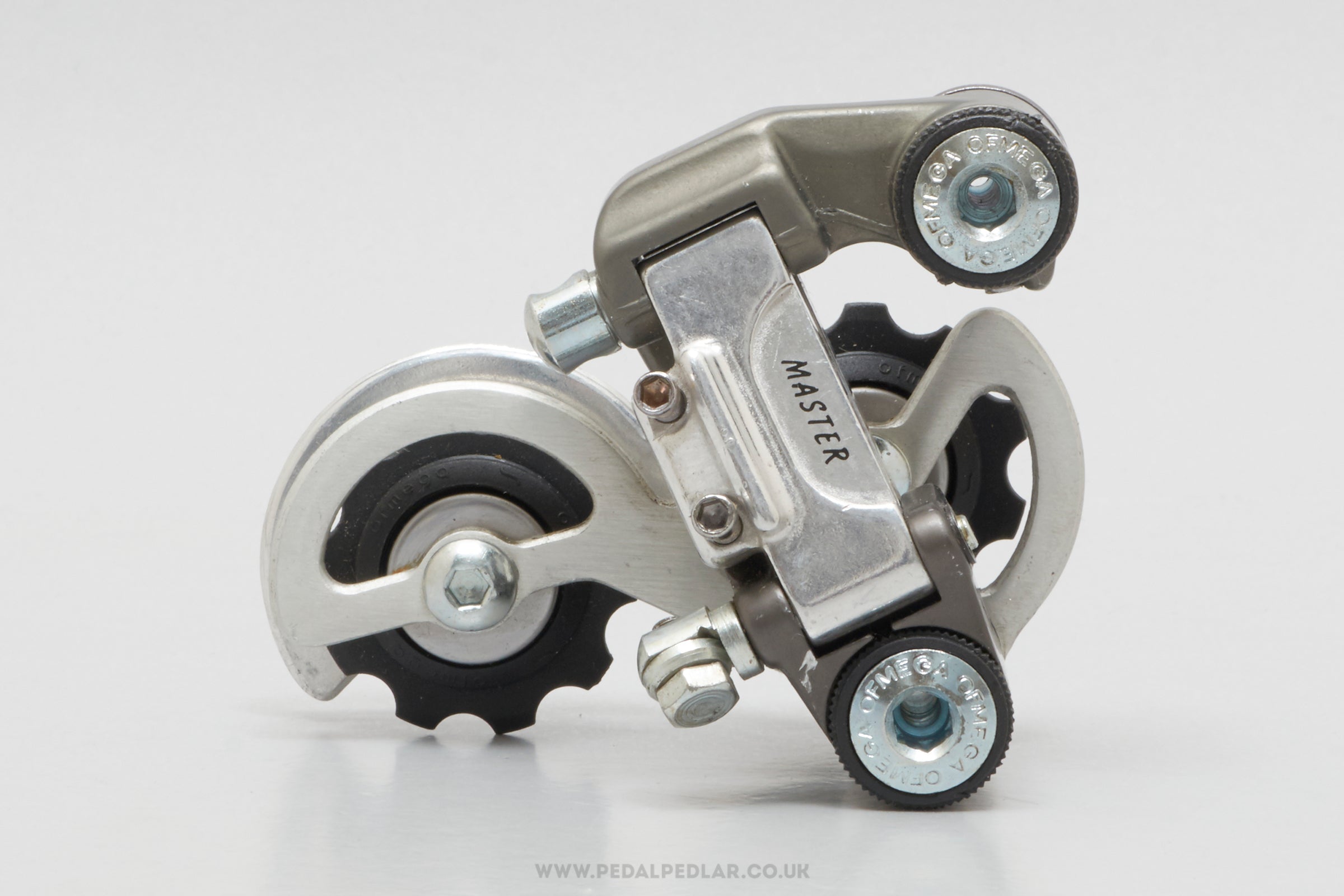


Ofmega Master NOS Vintage Rear Derailleur
£86.25 £115.00
✓ Original part - produced in the 1980s
✓ New old stock! Still unused after all these years
✓ Lightweight for the era - just 210 grams
✓ Suitable for historic cycling events such as L'Eroica
✓ Worldwide shipping
Ofmega Master rear derailleur (or mech if you prefer), hailing from Italy and in production during the 1980s (yet still new & unused after all this time!). Made from aluminium and weighing in at 210 grams - pretty lightweight for a rear derailleur at that time. A fine choice for keeping your vintage bike authentic, but also great for any other compatible bike.
If you're taking part in L'Eroica or a similar vintage event, this is fully compliant - so rest assured, the pre-1987 police won't lock you up for having the wrong rear mech!
OVERVIEW
Jockey Wheel Condition - New Old Stock*
Production Era - 1980s
Country - Italian
Material - Aluminium
Weight - 210 g
Stock Code - D-RM122V
*New old stock items may have marks from storage over the years, and as we often have multiples they can vary from piece to piece, but they are always genuine new & unused items.
TECHNICAL INFO
Shifting System - Friction
Speed* - 5 Speed, 6 Speed, 7 Speed
Max Cog Size - 26 Teeth
Max Chain Wrap - 26
Chain Width - 3/32" (Standard)
*See help section.
-
▼SHIPPING, TAXES & RETURNS
-
We've been safely sending orders around the world since 2010. Orders are carefully packed, sent with tracking & insurance, and normally collected around midday on Tuesdays and Fridays. Larger items may occasionally require an extra day or two to prepare.
We accept returns, please notify us within 14 days and ensure the item arrives back with us no later than 30 days after the order was received.
EU orders under €150 (excluding shipping) - import VAT and the new €3 customs duty are paid as part of your order, so there's nothing further to pay on delivery.
EU orders over €150 (excluding shipping) - import fees are payable to the carrier before delivery, with nothing collected at checkout.
USA orders - import fees are collected at checkout for all orders to the USA, so there won’t be any surprise charges when your order arrives.
Other international orders - local import fees may apply and are not collected by us. Please check your country's import rules before purchasing.
-
▼HELP SECTION
-
Shifting system - friction means your gear levers don't click when you change gear, when they do click it's referred to as indexed shifting. If you have indexed gear levers they must use the same system as the rear derailleur, if you're using friction levers you can mix and match.
Speed - the number of cogs at the back the derailleur was designed to be used with. This is important with indexed shifting, but with friction shifters you can in theory run any rear mech with any number of cogs, but you are more likely to have issues running high numbers of cogs with mechs from earlier eras.
Max cog size - the amount of teeth on the largest cog of your freewheel/cassette can be no greater than this to work with this derailleur.
Chain wrap - subtract the size of your smallest rear cog from your biggest, then do the same with your chainrings, add the 2 numbers together and you have your chain wrap.
Chain width - generally speaking, derailleurs designed for more than 3 speed use will fit a standard 3/32'' chain, the exception being some Cyclo & Simplex models from around the mid 1900s.