
All


Simplex Vintage Quick Release Front Skewer
£14.88 £18.00
✓ Original skewer - in production from the 1970s to the 1980s
✓ Suitable for historic cycling events such as L'Eroica
✓ Checked & cleaned
✓ Worldwide shipping
Simplex front skewer, hailing from France and in production from the 1970s to the 1980s. Made from steel/plastic and weighing in at 86 grams. A fine choice for keeping your vintage bike authentic, but also great for any other compatible bike too.
If you're taking part in L'Eroica or any other vintage event, this is fully compliant - so rest assured, the pre-1987 police won't lock you up for having the wrong skewer!
The skewer's been cleaned, checked by one of our mechanics and graded as good condition, but do take a good look at the detailed photos so you can see the cosmetic condition before you buy.OVERVIEW
Production Era - 1970s & 1980s
Country - French
Material - Steel/Plastic
Weight - 86 g
Stock Code - U-SKW-F6V
TECHNICAL INFO
Skewer Type - Quick Release
Spacing* - 103 mm
Threaded Section - 24 mm
End Nut Length - 22 mm
*See help section.
-
▼SHIPPING, TAXES & RETURNS
-
We've been safely sending orders around the world since 2010. Orders are carefully packed, sent with tracking & insurance, and normally collected around midday on Tuesdays and Fridays. Larger items may occasionally require an extra day or two to prepare.
We accept returns, please notify us within 14 days and ensure the item arrives back with us no later than 30 days after the order was received.
EU orders under €150 (excluding shipping) - import VAT and the new €3 customs duty are paid as part of your order, so there's nothing further to pay on delivery.
EU orders over €150 (excluding shipping) - import fees are payable to the carrier before delivery, with nothing collected at checkout.
USA orders - import fees are collected at checkout for all orders to the USA, so there won’t be any surprise charges when your order arrives.
Other international orders - local import fees may apply and are not collected by us. Please check your country's import rules before purchasing.
-
▼HELP SECTION
-
Skewer type - quick release skewers allow you to remove the wheel without any tools, whereas allen key and security skewers require a tool to allow the wheel to be removed.
*Spacing - this should be within a few milimetres of your fork's outer dropout spacing (measured from the outside where the skewers clamp down). The measurement provided was taken with the exiting hole of the end nut flush with the end of the skewer. There will be some wiggle room to allow a narrower or wider dropout spacing to fit, we've provided the threaded section and end nut measurements to give you an indication of how much.
Threaded section - the amount of thread on the skewers for the end nut to be threaded onto.
End nut length - the total length of the nut from end to end.


Sonico NOS/NIB Vintage Single Chainset
£33.75 £45.00
✓ Original part - produced in the 1970s
✓ New old stock & still in the original packaging!
✓ Suitable for historic cycling events such as L'Eroica
✓ Worldwide shipping
Sonico chainset, hailing from India and in production during the 1970s (yet still new & unused after all this time!). Made from steel and weighing in at 1111 grams. A fine choice for keeping your vintage bike authentic, but also great for any other compatible bike too.
If you're taking part in L'Eroica or a similar vintage event, this is fully compliant - so rest assured, the pre-1987 police won't lock you up for having the wrong chainset!
OVERVIEW
Chainring Condition - New Old Stock - In Original Packaging*
Production Era - 1970s
Country - India
Material - Steel
Weight - 1111 g
Stock Code - D-CS22V
*New old stock items may have marks from storage over the years, and as we often have multiples they can vary from piece to piece, but they are always genuine new & unused items.
TECHNICAL INFO
Chainring Count - Single
Tooth Count - 48
Chain Width - 1/8"
BCD - 118 BCD
Intended Speed* - Single Speed / Track
Crank Length - 167.5 mm
Pedal Threads - Standard (9/16" x 20 TPI)
Bottom Bracket Type - Cottered
*See help section.
-
▼SHIPPING, TAXES & RETURNS
-
We've been safely sending orders around the world since 2010. Orders are carefully packed, sent with tracking & insurance, and normally collected around midday on Tuesdays and Fridays. Larger items may occasionally require an extra day or two to prepare.
We accept returns, please notify us within 14 days and ensure the item arrives back with us no later than 30 days after the order was received.
EU orders under €150 (excluding shipping) - import VAT and the new €3 customs duty are paid as part of your order, so there's nothing further to pay on delivery.
EU orders over €150 (excluding shipping) - import fees are payable to the carrier before delivery, with nothing collected at checkout.
USA orders - import fees are collected at checkout for all orders to the USA, so there won’t be any surprise charges when your order arrives.
Other international orders - local import fees may apply and are not collected by us. Please check your country's import rules before purchasing.
-
▼HELP SECTION
-
Chainring count - the number of chainrings on the chainset. Fixed gear track bikes, single-speeds and some geared bikes use a single chainring, road bikes commonly use a double (two rings) and most touring bikes and mountain bikes will use a triple chainset (three rings).
Tooth count - the number of teeth on the chainring(s), the higher the number the harder the gear.
Chain width - this is only relevant for chainsets with a single chainring - if this is ⅛” then you must use a ⅛” chain. All double and triple (and some single) ring chainsets will use a standard 3/32” chain.
BCD - stands for Bolt Circle Diameter (sometimes referred to as PCD - Pitch Circle Diameter) and is only really needed when changing chainrings. To calculate the BCD, measure the distance in millimeters from the centre of any chainring bolt to the centre of an adjacent one and multiply it by 1.709 (you’ll likely need to round the resulting number up or down a little to get your BCD measurement).
*Intended speed - the number of cogs at the back the chainset was designed to be used with. We refer to it as ‘intended’ speed as most double and triple chainsets will actually work with different speeds than originally intended, but the further away you get from the intended speed the more likely you are to experience minor setup issues. The exception being some chainsets intended for 10 speed use or higher, with these it’s better to stick to the intended speed.
Crank length - this is measured from the absolute centre of the bottom bracket hole to the centre of the hole for the pedal.
Pedal threads - the pattern of the thread that your pedals screw into, this is usually stamped on the pedals themselves and most bikes use a standard thread of 9/16” x 20 tpi. The exceptions being older French bikes, bikes with cheaper one-piece type chainsets and Shimano’s Dyna Drive system (easily identifiable as the pedal holes are about an inch wide!).
Bottom bracket type - ‘square taper’, as the name suggests have a square shaped axle that slots into the chainset and ‘cottered’ axles are round and secured by pins - pretty much every bike up until the 1990s would use one of these, cottered being the much earlier system. Since then, different manufacturers have introduced their own systems that are not interchangeable so you must use a chainset that matches.


Sparrow NOS/NIB Vintage 5 Speed 14-22 Freewheel
£33.75 £45.00
✓ Original part - produced in the 1970s
✓ New old stock & still in the original packaging!
✓ Suitable for historic cycling events such as L'Eroica
✓ Worldwide shipping
Sparrow freewheel, hailing from the United Kingdom and in production during the 1970s (yet still new & unused after all this time!). Made from steel and weighing in at 435 grams. A fine choice for keeping your vintage bike authentic, but also great for any other compatible bike too.
If you're taking part in L'Eroica or a similar vintage event, this is fully compliant - so rest assured, the pre-1987 police won't lock you up for having the wrong freewheel!
OVERVIEW
Production Era - 1970s
Country - United Kingdom
Material - Steel
Weight - 435 g
Stock Code - D-FW76V
*New old stock items may have marks from storage over the years, and as we often have multiples they can vary from piece to piece, but they are always genuine new & unused items.
TECHNICAL INFO
Speed - 5 Speed
Range - 14-22
Threading - English/ISO: 1.375 x 24 TPI
Stack Height - 27 mm
Chain Width - 3/32"
-
▼SHIPPING, TAXES & RETURNS
-
We've been safely sending orders around the world since 2010. Orders are carefully packed, sent with tracking & insurance, and normally collected around midday on Tuesdays and Fridays. Larger items may occasionally require an extra day or two to prepare.
We accept returns, please notify us within 14 days and ensure the item arrives back with us no later than 30 days after the order was received.
EU orders under €150 (excluding shipping) - import VAT and the new €3 customs duty are paid as part of your order, so there's nothing further to pay on delivery.
EU orders over €150 (excluding shipping) - import fees are payable to the carrier before delivery, with nothing collected at checkout.
USA orders - import fees are collected at checkout for all orders to the USA, so there won’t be any surprise charges when your order arrives.
Other international orders - local import fees may apply and are not collected by us. Please check your country's import rules before purchasing.


Sparrow NOS/NIB Vintage 5 Speed 14-24 Freewheel
£34.00 £40.00
✓ Original part - produced in the 1970s
✓ New old stock & still in the original packaging!
✓ Suitable for historic cycling events such as L'Eroica
✓ Worldwide shipping
Sparrow freewheel, hailing from Great Britain and in production during the 1970s (yet still new & unused after all this time!). Made from steel and weighing in at 407 grams. A fine choice for keeping your vintage bike authentic, but also great for any other compatible bike.
If you're taking part in L'Eroica or a similar vintage event, this is fully compliant - so rest assured, the pre-1987 police won't lock you up for having the wrong freewheel!
OVERVIEW
Production Era - 1970s
Country - British
Material - Steel
Weight - 407 g
Stock Code - D-FW142V
*New old stock items may have marks from storage over the years, and as we often have multiples they can vary from piece to piece, but they are always genuine new & unused items.
TECHNICAL INFO
Speed - 5 Speed
Range - 14-24
Threading - English/ISO: 1.375 x 24 TPI
Stack Height - 27 mm
Cog Width - 3/32" (Standard)
-
▼SHIPPING, TAXES & RETURNS
-
We've been safely sending orders around the world since 2010. Orders are carefully packed, sent with tracking & insurance, and normally collected around midday on Tuesdays and Fridays. Larger items may occasionally require an extra day or two to prepare.
We accept returns, please notify us within 14 days and ensure the item arrives back with us no later than 30 days after the order was received.
EU orders under €150 (excluding shipping) - import VAT and the new €3 customs duty are paid as part of your order, so there's nothing further to pay on delivery.
EU orders over €150 (excluding shipping) - import fees are payable to the carrier before delivery, with nothing collected at checkout.
USA orders - import fees are collected at checkout for all orders to the USA, so there won’t be any surprise charges when your order arrives.
Other international orders - local import fees may apply and are not collected by us. Please check your country's import rules before purchasing.
-
▼HELP SECTION
-
Speed - the number of cogs on the freewheel.
Range - the number of teeth on the smalles and largest cogs, this gives you an indication of how hard or easy the gearing will be, the lower the number the harder the gears. The tooth count of the cogs inbetween are usually evenly spaced, ie: a 6 speed 14-24 freewheel would likely have cog sizes 14, 16, 18, 20, 22 & 24.
Threading - this needs to match the thread of your rear hub. ISO is the modern standard and is almost exactly the same as older English/British and Italian thread, allowing you to mix and match between these thread types as long as it's not going to be under extreme force, in which case it's best to stick to an exact match. Hubs with a French thread must be used with a French threaded freewheel.
Stack Height - the total height (or width if you're looking at it when installed) of the freewheel, this is measured from the base (back of the largest cog) to the top (front of the smallest cog).
Cog width - this is mainly relevant for singlespeed and some older 3 or 4 speed freewheels - if this is ⅛” then you must use a ⅛” chain, but most freewheels (especially multiple speed ones) will use a standard 3/32” chain.


Specialites T.A. 'Plum' (417) Later Version Vintage Red Aluminium Bottle Cage / Holder
£15.00 £20.00
✓ Original bottle cage - produced in the 1980s
✓ Suitable for historic cycling events such as L'Eroica
✓ Checked & cleaned
✓ Worldwide shipping
Specialites T.A. 'Plum' bottle cage, hailing from France and in production during the 1980s. The perfect finishing touch for your vintage bike, but great for bikes of the non-vintage variety too of course!
If you're taking part in L'Eroica or a similar vintage event, this is of the correct era, so rest assured the pre-1987 police won't lock you up for having the wrong bottle carrier!
The bottle cage has been checked for damage, thoroughly cleaned and graded as very good condition, but do take a good look at the detailed photos so you can see the shape & condition before you buy.OVERVIEW
Model ID - 417
Production Era - 1980s
Country - French
Material - Aluminium / Plastic
Weight - 47 g
Stock Code - U-CAG31V
TECHNICAL INFO
Cage Fixing - Frame Fit (Braze-On)
Colour* - Red
Bottle Size - 75 mm (Standard)
*The colour description is just a guide, please check the photos to get a good idea of the colour too, as we make sure these are as close to the true colour as possible.
-
▼SHIPPING, TAXES & RETURNS
-
We've been safely sending orders around the world since 2010. Orders are carefully packed, sent with tracking & insurance, and normally collected around midday on Tuesdays and Fridays. Larger items may occasionally require an extra day or two to prepare.
We accept returns, please notify us within 14 days and ensure the item arrives back with us no later than 30 days after the order was received.
EU orders under €150 (excluding shipping) - import VAT and the new €3 customs duty are paid as part of your order, so there's nothing further to pay on delivery.
EU orders over €150 (excluding shipping) - import fees are payable to the carrier before delivery, with nothing collected at checkout.
USA orders - import fees are collected at checkout for all orders to the USA, so there won’t be any surprise charges when your order arrives.
Other international orders - local import fees may apply and are not collected by us. Please check your country's import rules before purchasing.
-
▼HELP SECTION
-
Cage Fixing - most bottle cages will be designed to fix to the frame, although some rare older ones mount to the handlebars and/or stem. If your frame doesn't have any bottle cage braze-ons to fix to you'll need a clamp-on bottle cage.
Bottle Size - almost all cycling bottles measure just under 75 mm in diameter so this is the standard bottle cage size, the only rather rare exceptions are some old Elite bottles that require a 66 mm cage, the more recent oversized ones and of course the funny shaped aero ones that only accept the bottle they were made for.


Specialites T.A. 'Plum' (417) NOS Vintage Purple Bottle Cage
£16.63 £17.50
✓ Original bottle cage - produced in the 1980s
✓ New old stock! Still unused after all these years
✓ Suitable for historic cycling events such as L'Eroica
✓ Worldwide shipping
Specialites T.A. 'Plum' water bottle cage (or bidon holder if you prefer), hailing from France and in production during the 1980s (yet still new & unused after all this time!). The perfect finishing touch for your vintage bike, but great for bikes of the non-vintage variety too of course!
If you're taking part in L'Eroica or a similar vintage event, this is of the correct era, so rest assured the pre-1987 police won't lock you up for having the wrong bottle carrier!
OVERVIEW
Model ID - 417
Production Era - 1980s
Country - French
Material - Aluminium / Plastic
Weight - 45 g
Stock Code - D-CAG114V
*New old stock items may have marks from storage over the years, and as we often have multiples they can vary from piece to piece, but they are always genuine new & unused items.
TECHNICAL INFO
Cage Fixing - Frame Fit (Braze-On)
Colour* - Purple
Bottle Size - 75 mm (Standard)
*The colour description is just a guide, please check the photos to get a good idea of the colour too, as we make sure these are as close to the true colour as possible.
-
▼SHIPPING, TAXES & RETURNS
-
We've been safely sending orders around the world since 2010. Orders are carefully packed, sent with tracking & insurance, and normally collected around midday on Tuesdays and Fridays. Larger items may occasionally require an extra day or two to prepare.
We accept returns, please notify us within 14 days and ensure the item arrives back with us no later than 30 days after the order was received.
EU orders under €150 (excluding shipping) - import VAT and the new €3 customs duty are paid as part of your order, so there's nothing further to pay on delivery.
EU orders over €150 (excluding shipping) - import fees are payable to the carrier before delivery, with nothing collected at checkout.
USA orders - import fees are collected at checkout for all orders to the USA, so there won’t be any surprise charges when your order arrives.
Other international orders - local import fees may apply and are not collected by us. Please check your country's import rules before purchasing.
-
▼HELP SECTION
-
Cage Fixing - most bottle cages will be designed to fix to the frame, although some rare older ones mount to the handlebars and/or stem. If your frame doesn't have any bottle cage braze-ons to fix to you'll need a clamp-on bottle cage.
Bottle Size - almost all cycling bottles measure just under 75 mm in diameter so this is the standard bottle cage size, the only rather rare exceptions are some old Elite bottles that require a 66 mm cage, the more recent oversized ones and of course the funny shaped aero ones that only accept the bottle they were made for.
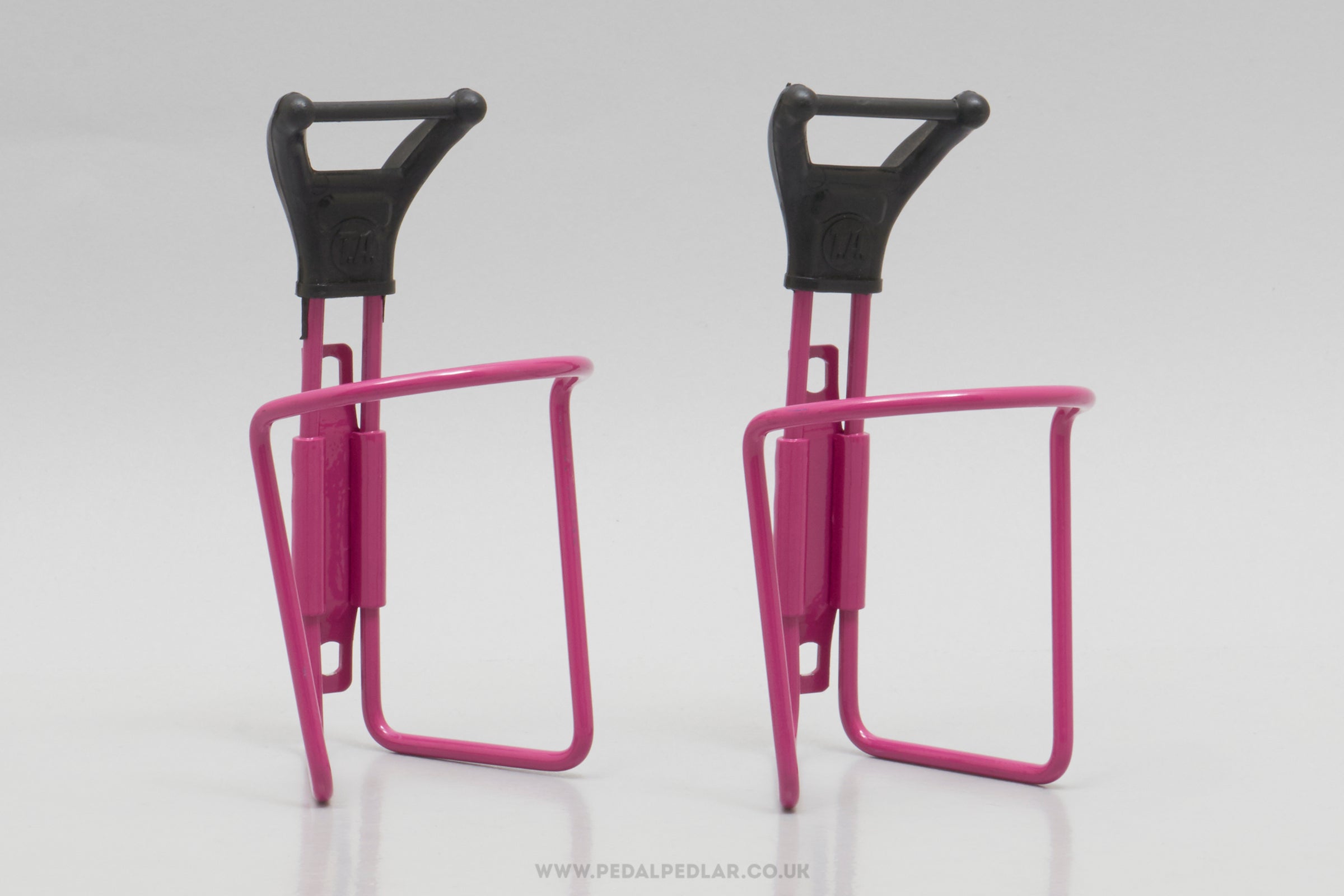


Specialites T.A. 'Plum' (417) NOS Vintage Purple Bottle Cages
£35.00
✓ Original pair of bottle cages - in production from the 1980s to the 1990s
✓ New old stock! Still unused after all these years
✓ Suitable for historic cycling events such as L'Eroica
✓ Worldwide shipping
Specialites T.A. 'Plum' water bottle cages (or bidon holders if you prefer), hailing from France and in production from the 1980s to the 1990s (yet still new & unused after all this time!). Made from aluminium/plastic and weighing in at 92 grams (the weight and price displayed are for a pair of cages). The perfect finishing touch for your vintage bike, but great for bikes of the non-vintage variety too!
These are the final versions of the Plum lightweight bottle cage, featuring wrap-around 'sleeves' and punched dimples on the rear of the frame mounts, replacing the exposed welded construction of the previous design.
If you're taking part in L'Eroica or a similar vintage event, these are of the correct era, so rest assured the pre-1987 police won't lock you up for having the wrong bottle carriers!
OVERVIEW
Model ID - 417
Production Era - 1980s & 1990s
Country - French
Material - Aluminium / Plastic
Weight - 92 g
Stock Code - D-CAG-P21V
*New old stock items may have marks from storage over the years, and as we often have multiples they can vary from piece to piece, but they are always genuine new & unused items.
TECHNICAL INFO
Cage Fixing - Frame Fit (Braze-On)
Colour* - Purple
Bottle Fit - Standard
*The colour description is just a guide, please check the photos too as we make sure these are as close to the true colour as possible.
-
▼SHIPPING, TAXES & RETURNS
-
We've been safely sending orders around the world since 2010. Orders are carefully packed, sent with tracking & insurance, and normally collected around midday on Tuesdays and Fridays. Larger items may occasionally require an extra day or two to prepare.
We accept returns, please notify us within 14 days and ensure the item arrives back with us no later than 30 days after the order was received.
EU orders under €150 (excluding shipping) - import VAT and the new €3 customs duty are paid as part of your order, so there's nothing further to pay on delivery.
EU orders over €150 (excluding shipping) - import fees are payable to the carrier before delivery, with nothing collected at checkout.
USA orders - import fees are collected at checkout for all orders to the USA, so there won’t be any surprise charges when your order arrives.
Other international orders - local import fees may apply and are not collected by us. Please check your country's import rules before purchasing.
-
▼HELP SECTION
-
Cage Fixing - most bottle cages will be designed to fix to the frame, although some rare older ones mount to the handlebars and/or stem. If your frame doesn't have any bottle cage braze-ons to fix to you'll need clamp-on bottle cages.
Bottle Fit - almost all cycling bottles measure between 70 - 75 mm in diameter so this is the standard bottle cage size, the only rather rare exceptions are some old Elite bottles that require a 66 mm cage, the more recent oversized ones and of course the funny shaped aero ones that only accept the bottle they were made for.
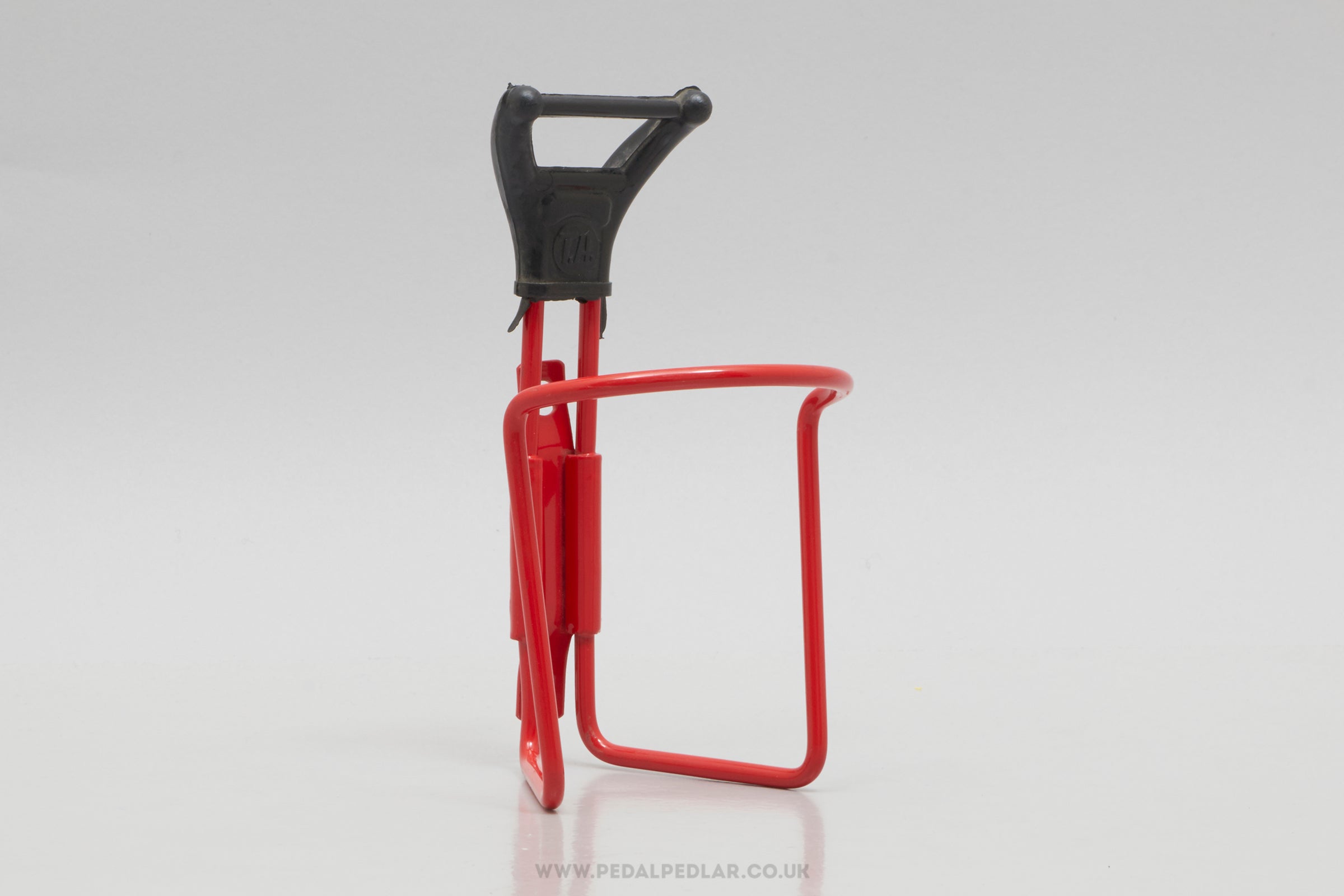


Specialites T.A. 'Plum' (417) NOS Vintage Red Bottle Cage
£19.13 £23.00
✓ Original bottle cage - in production from the 1980s to the 1990s
✓ New old stock! Still unused after all these years
✓ Suitable for historic cycling events such as L'Eroica
✓ Worldwide shipping
Specialites T.A. 'Plum' water bottle cage (or bidon holder if you prefer), hailing from France and in production from the 1980s to the 1990s (yet still new & unused after all this time!). Made from aluminium/plastic and weighing in at 47 grams (the weight and price displayed are for one cage, if we have more in stock you'll be able to add them to your basket). The perfect finishing touch for your vintage bike, but great for bikes of the non-vintage variety too!
This is the final version of the Plum lightweight bottle cage, featuring wrap-around 'sleeves' and punched dimples on the rear of the frame mount, replacing the exposed welded construction of the previous design.
If you're taking part in L'Eroica or a similar vintage event, this is of the correct era, so rest assured the pre-1987 police won't lock you up for having the wrong bottle carrier!
OVERVIEW
Model ID - 417
Production Era - 1980s & 1990s
Country - French
Material - Aluminium / Plastic
Weight - 47 g
Stock Code - D-CAG153V
*New old stock items may have marks from storage over the years, and as we often have multiples they can vary from piece to piece, but they are always genuine new & unused items.
TECHNICAL INFO
Cage Fixing - Frame Fit (Braze-On)
Colour* - Red
Bottle Fit - Standard
*The colour description is just a guide, please check the photos too as we make sure these are as close to the true colour as possible.
-
▼SHIPPING, TAXES & RETURNS
-
We've been safely sending orders around the world since 2010. Orders are carefully packed, sent with tracking & insurance, and normally collected around midday on Tuesdays and Fridays. Larger items may occasionally require an extra day or two to prepare.
We accept returns, please notify us within 14 days and ensure the item arrives back with us no later than 30 days after the order was received.
EU orders under €150 (excluding shipping) - import VAT and the new €3 customs duty are paid as part of your order, so there's nothing further to pay on delivery.
EU orders over €150 (excluding shipping) - import fees are payable to the carrier before delivery, with nothing collected at checkout.
USA orders - import fees are collected at checkout for all orders to the USA, so there won’t be any surprise charges when your order arrives.
Other international orders - local import fees may apply and are not collected by us. Please check your country's import rules before purchasing.
-
▼HELP SECTION
-
Cage Fixing - most bottle cages will be designed to fix to the frame, although some rare older ones mount to the handlebars and/or stem. If your frame doesn't have any bottle cage braze-ons to fix to you'll need a clamp-on bottle cage.
Bottle Fit - almost all cycling bottles measure between 70 - 75 mm in diameter so this is the standard bottle cage size, the only rather rare exceptions are some old Elite bottles that require a 66 mm cage, the more recent oversized ones and of course the funny shaped aero ones that only accept the bottle they were made for.
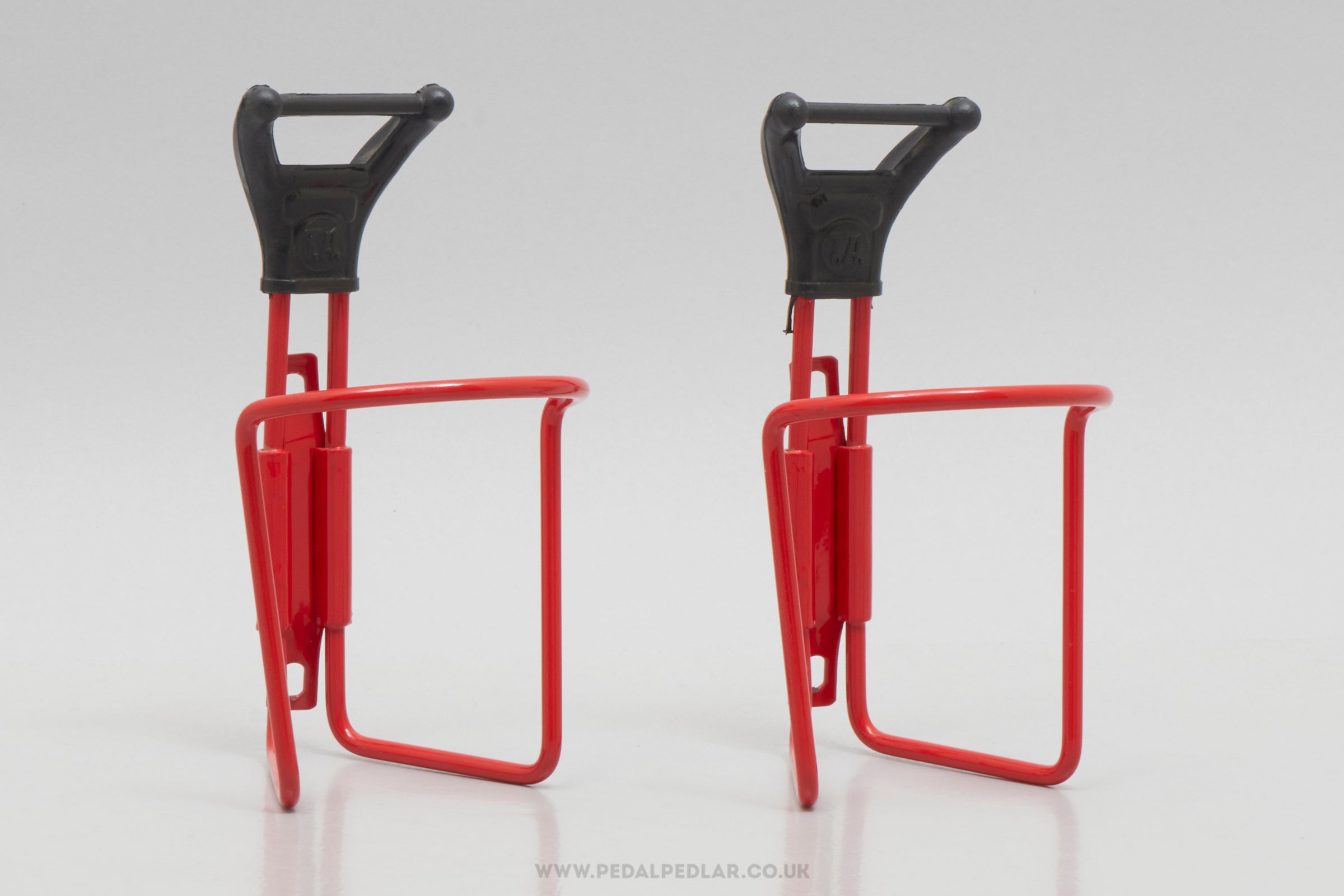


Specialites T.A. 'Plum' (417) NOS Vintage Red Bottle Cages
£40.00
✓ Original pair of bottle cages - in production from the 1980s to the 1990s
✓ New old stock! Still unused after all these years
✓ Suitable for historic cycling events such as L'Eroica
✓ Worldwide shipping
Specialites T.A. 'Plum' water bottle cages (or bidon holders if you prefer), hailing from France and in production from the 1980s to the 1990s (yet still new & unused after all this time!). Made from aluminium/plastic and weighing in at 95 grams (the weight and price displayed are for a pair of cages). The perfect finishing touch for your vintage bike, but great for bikes of the non-vintage variety too!
These are the final versions of the Plum lightweight bottle cage, featuring wrap-around 'sleeves' and punched dimples on the rear of the frame mounts, replacing the exposed welded construction of the previous design.
If you're taking part in L'Eroica or a similar vintage event, these are of the correct era, so rest assured the pre-1987 police won't lock you up for having the wrong bottle carriers!
OVERVIEW
Model ID - 417
Production Era - 1980s & 1990s
Country - French
Material - Aluminium / Plastic
Weight - 95 g
Stock Code - D-CAG-P18V
*New old stock items may have marks from storage over the years, and as we often have multiples they can vary from piece to piece, but they are always genuine new & unused items.
TECHNICAL INFO
Cage Fixing - Frame Fit (Braze-On)
Colour* - Red
Bottle Fit - Standard
*The colour description is just a guide, please check the photos too as we make sure these are as close to the true colour as possible.
-
▼SHIPPING, TAXES & RETURNS
-
We've been safely sending orders around the world since 2010. Orders are carefully packed, sent with tracking & insurance, and normally collected around midday on Tuesdays and Fridays. Larger items may occasionally require an extra day or two to prepare.
We accept returns, please notify us within 14 days and ensure the item arrives back with us no later than 30 days after the order was received.
EU orders under €150 (excluding shipping) - import VAT and the new €3 customs duty are paid as part of your order, so there's nothing further to pay on delivery.
EU orders over €150 (excluding shipping) - import fees are payable to the carrier before delivery, with nothing collected at checkout.
USA orders - import fees are collected at checkout for all orders to the USA, so there won’t be any surprise charges when your order arrives.
Other international orders - local import fees may apply and are not collected by us. Please check your country's import rules before purchasing.
-
▼HELP SECTION
-
Cage Fixing - most bottle cages will be designed to fix to the frame, although some rare older ones mount to the handlebars and/or stem. If your frame doesn't have any bottle cage braze-ons to fix to you'll need clamp-on bottle cages.
Bottle Fit - almost all cycling bottles measure between 70 - 75 mm in diameter so this is the standard bottle cage size, the only rather rare exceptions are some old Elite bottles that require a 66 mm cage, the more recent oversized ones and of course the funny shaped aero ones that only accept the bottle they were made for.


Specialites T.A. 'Plum' (417) NOS Vintage Silver Bottle Cage
£16.88 £23.00
✓ Original bottle cage - produced in the 1980s
✓ New old stock! Still unused after all these years
✓ Suitable for historic cycling events such as L'Eroica
✓ Worldwide shipping
Specialites T.A. 'Plum' water bottle cage (or bidon holder if you prefer), hailing from France and in production during the 1980s (yet still new & unused after all this time!). The perfect finishing touch for your vintage bike, but great for bikes of the non-vintage variety too of course!
If you're taking part in L'Eroica or a similar vintage event, this is of the correct era, so rest assured the pre-1987 police won't lock you up for having the wrong bottle carrier!
OVERVIEW
Model ID - 417
Production Era - 1980s
Country - French
Material - Aluminium / Plastic
Weight - 44 g
Stock Code - D-CAG111V
*New old stock items may have marks from storage over the years, and as we often have multiples they can vary from piece to piece, but they are always genuine new & unused items.
TECHNICAL INFO
Cage Fixing - Frame Fit (Braze-On)
Colour* - Silver
Bottle Size - 75 mm (Standard)
*The colour description is just a guide, please check the photos to get a good idea of the colour too, as we make sure these are as close to the true colour as possible.
-
▼SHIPPING, TAXES & RETURNS
-
We've been safely sending orders around the world since 2010. Orders are carefully packed, sent with tracking & insurance, and normally collected around midday on Tuesdays and Fridays. Larger items may occasionally require an extra day or two to prepare.
We accept returns, please notify us within 14 days and ensure the item arrives back with us no later than 30 days after the order was received.
EU orders under €150 (excluding shipping) - import VAT and the new €3 customs duty are paid as part of your order, so there's nothing further to pay on delivery.
EU orders over €150 (excluding shipping) - import fees are payable to the carrier before delivery, with nothing collected at checkout.
USA orders - import fees are collected at checkout for all orders to the USA, so there won’t be any surprise charges when your order arrives.
Other international orders - local import fees may apply and are not collected by us. Please check your country's import rules before purchasing.
-
▼HELP SECTION
-
Cage Fixing - most bottle cages will be designed to fix to the frame, although some rare older ones mount to the handlebars and/or stem. If your frame doesn't have any bottle cage braze-ons to fix to you'll need a clamp-on bottle cage.
Bottle Size - almost all cycling bottles measure just under 75 mm in diameter so this is the standard bottle cage size, the only rather rare exceptions are some old Elite bottles that require a 66 mm cage, the more recent oversized ones and of course the funny shaped aero ones that only accept the bottle they were made for.
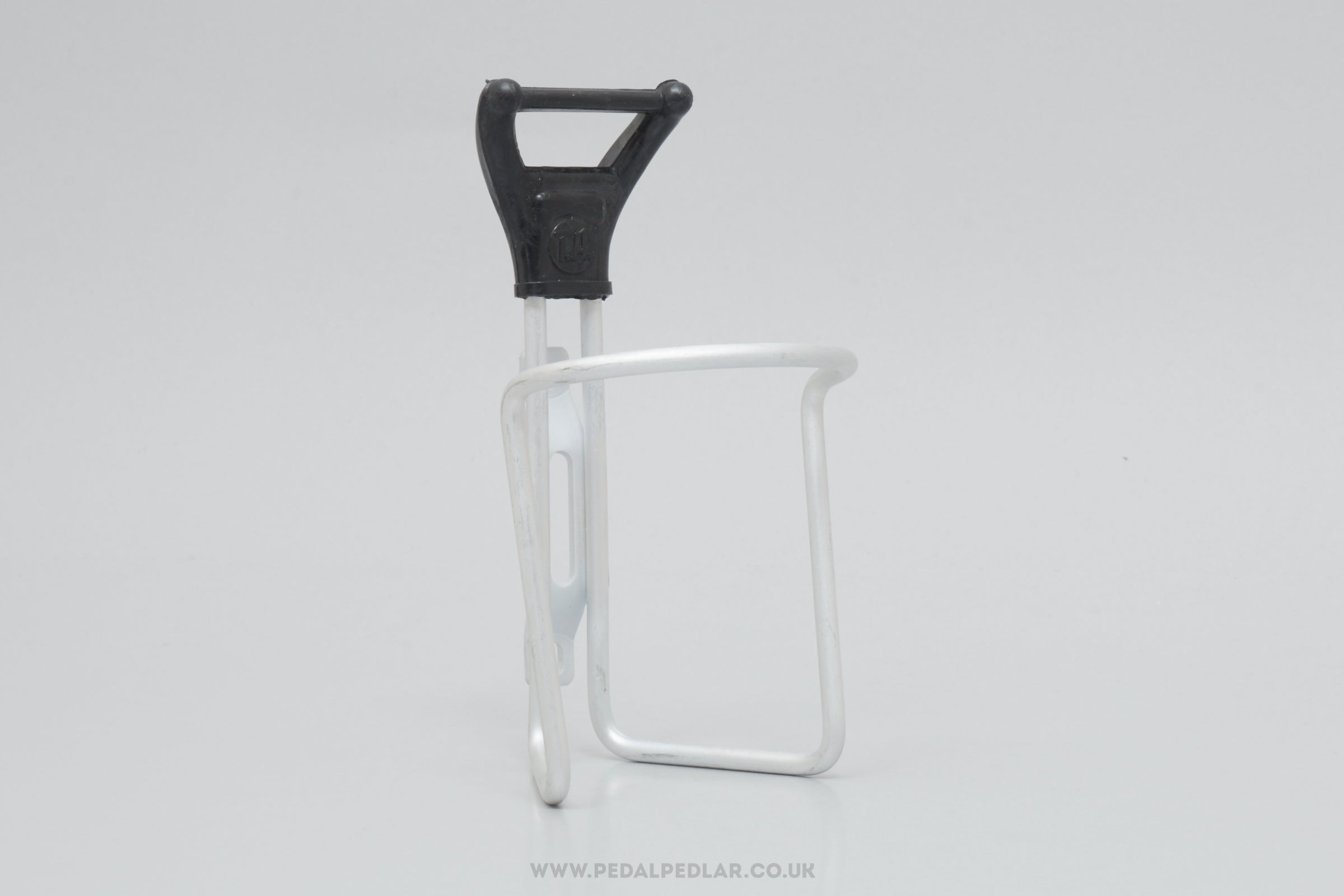


Specialites T.A. 'Plum' (417) NOS Vintage Silver Bottle Cage
£23.75 £25.00
✓ Original bottle cage - produced in the 1980s
✓ New old stock! Still unused after all these years
✓ Suitable for historic cycling events such as L'Eroica
✓ Worldwide shipping
Specialites T.A. 'Plum' water bottle cage (or bidon holder if you prefer), hailing from France and in production during the 1980s (yet still new & unused after all this time!). Made from aluminium/plastic and weighing in at 47 grams (the weight and price displayed are for one cage, if we have more in stock you'll be able to add them to your basket). The perfect finishing touch for your vintage bike, but great for bikes of the non-vintage variety too!
First introduced in the 1970s and originally available in black & silver only, this version of the Plum lightweight bottle cage features the exposed welded construction favoured for its strength and durability. The later T.A. logo on the black plastic tab was introduced in the 1980s when it became available in a choice of colours.
If you're taking part in L'Eroica or a similar vintage event, this is of the correct era, so rest assured the pre-1987 police won't lock you up for having the wrong bottle carrier!
OVERVIEW
Model ID - 417
Production Era - 1980s
Country - French
Material - Aluminium / Plastic
Weight - 47 g
Stock Code - D-CAG145V
*New old stock items may have marks from storage over the years, and as we often have multiples they can vary from piece to piece, but they are always genuine new & unused items.
TECHNICAL INFO
Cage Fixing - Frame Fit (Braze-On)
Colour* - Silver (Satin)
Bottle Fit - Standard
*The colour description is just a guide, please check the photos too as we make sure these are as close to the true colour as possible.
-
▼SHIPPING, TAXES & RETURNS
-
We've been safely sending orders around the world since 2010. Orders are carefully packed, sent with tracking & insurance, and normally collected around midday on Tuesdays and Fridays. Larger items may occasionally require an extra day or two to prepare.
We accept returns, please notify us within 14 days and ensure the item arrives back with us no later than 30 days after the order was received.
EU orders under €150 (excluding shipping) - import VAT and the new €3 customs duty are paid as part of your order, so there's nothing further to pay on delivery.
EU orders over €150 (excluding shipping) - import fees are payable to the carrier before delivery, with nothing collected at checkout.
USA orders - import fees are collected at checkout for all orders to the USA, so there won’t be any surprise charges when your order arrives.
Other international orders - local import fees may apply and are not collected by us. Please check your country's import rules before purchasing.
-
▼HELP SECTION
-
Cage Fixing - most bottle cages will be designed to fix to the frame, although some rare older ones mount to the handlebars and/or stem. If your frame doesn't have any bottle cage braze-ons to fix to you'll need a clamp-on bottle cage.
Bottle Fit - almost all cycling bottles measure between 70 - 75 mm in diameter so this is the standard bottle cage size, the only rather rare exceptions are some old Elite bottles that require a 66 mm cage, the more recent oversized ones and of course the funny shaped aero ones that only accept the bottle they were made for.
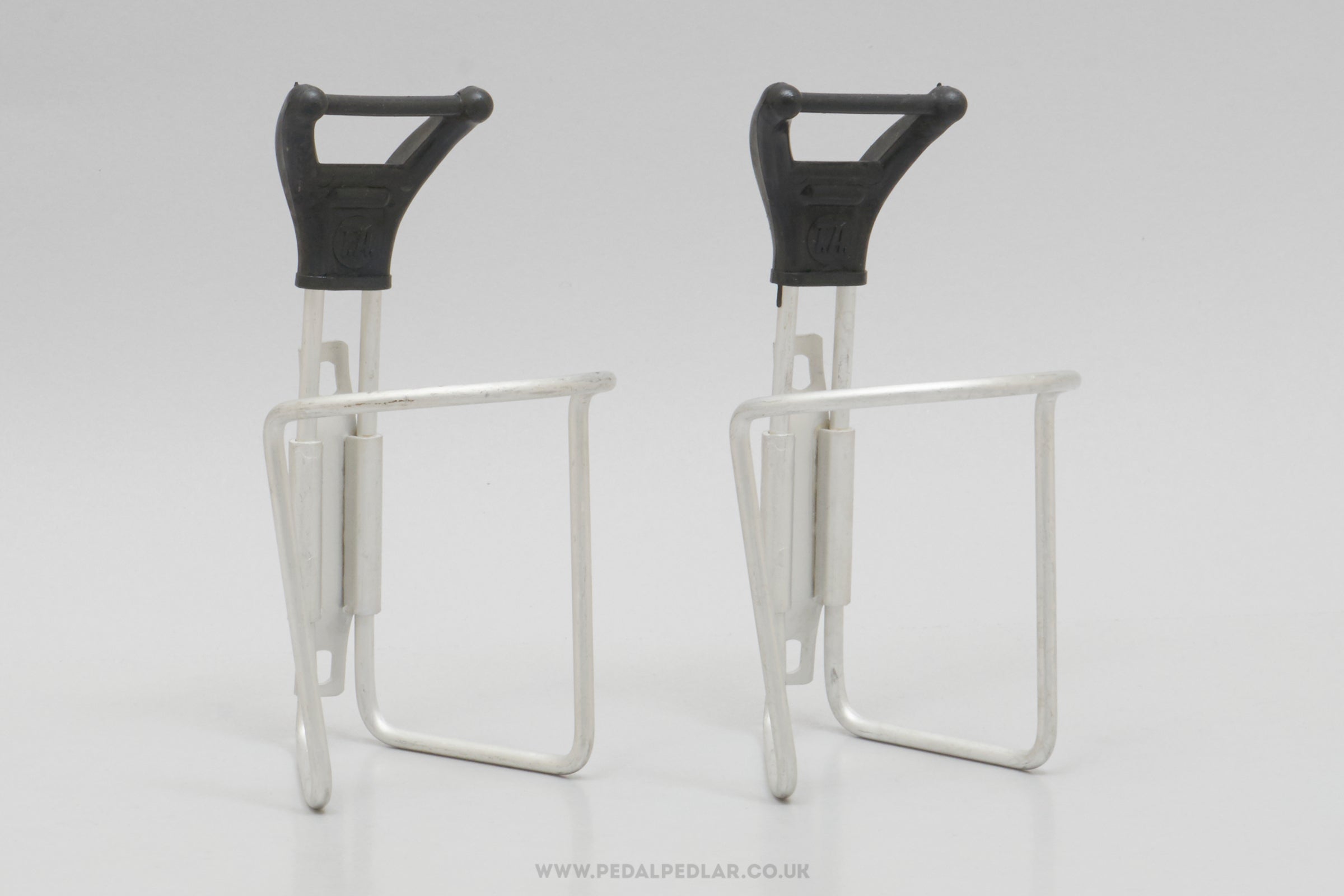


Specialites T.A. 'Plum' (417) NOS Vintage Silver Bottle Cages
£34.00 £40.00
✓ Original pair of bottle cages - in production from the 1980s to the 1990s
✓ New old stock! Still unused after all these years
✓ Suitable for historic cycling events such as L'Eroica
✓ Worldwide shipping
Specialites T.A. 'Plum' water bottle cages (or bidon holders if you prefer), hailing from France and in production from the 1980s to the 1990s (yet still new & unused after all this time!). Made from aluminium/plastic and weighing in at 88 grams (the weight and price displayed are for a pair of cages). The perfect finishing touch for your vintage bike, but great for bikes of the non-vintage variety too!
These are the final versions of the Plum lightweight bottle cage, featuring wrap-around 'sleeves' and punched dimples on the rear of the frame mounts, replacing the exposed welded construction of the previous design.
If you're taking part in L'Eroica or a similar vintage event, these are of the correct era, so rest assured the pre-1987 police won't lock you up for having the wrong bottle carriers!
OVERVIEW
Model ID - 417
Production Era - 1980s & 1990s
Country - French
Material - Aluminium / Plastic
Weight - 88 g
Stock Code - D-CAG-P7V
*New old stock items may have marks from storage over the years, and as we often have multiples they can vary from piece to piece, but they are always genuine new & unused items.
TECHNICAL INFO
Cage Fixing - Frame Fit (Braze-On)
Colour* - Silver (Satin)
Bottle Fit - Standard
*The colour description is just a guide, please check the photos too as we make sure these are as close to the true colour as possible.
-
▼SHIPPING, TAXES & RETURNS
-
We've been safely sending orders around the world since 2010. Orders are carefully packed, sent with tracking & insurance, and normally collected around midday on Tuesdays and Fridays. Larger items may occasionally require an extra day or two to prepare.
We accept returns, please notify us within 14 days and ensure the item arrives back with us no later than 30 days after the order was received.
EU orders under €150 (excluding shipping) - import VAT and the new €3 customs duty are paid as part of your order, so there's nothing further to pay on delivery.
EU orders over €150 (excluding shipping) - import fees are payable to the carrier before delivery, with nothing collected at checkout.
USA orders - import fees are collected at checkout for all orders to the USA, so there won’t be any surprise charges when your order arrives.
Other international orders - local import fees may apply and are not collected by us. Please check your country's import rules before purchasing.
-
▼HELP SECTION
-
Cage Fixing - most bottle cages will be designed to fix to the frame, although some rare older ones mount to the handlebars and/or stem. If your frame doesn't have any bottle cage braze-ons to fix to you'll need clamp-on bottle cages.
Bottle Fit - almost all cycling bottles measure between 70 - 75 mm in diameter so this is the standard bottle cage size, the only rather rare exceptions are some old Elite bottles that require a 66 mm cage, the more recent oversized ones and of course the funny shaped aero ones that only accept the bottle they were made for.
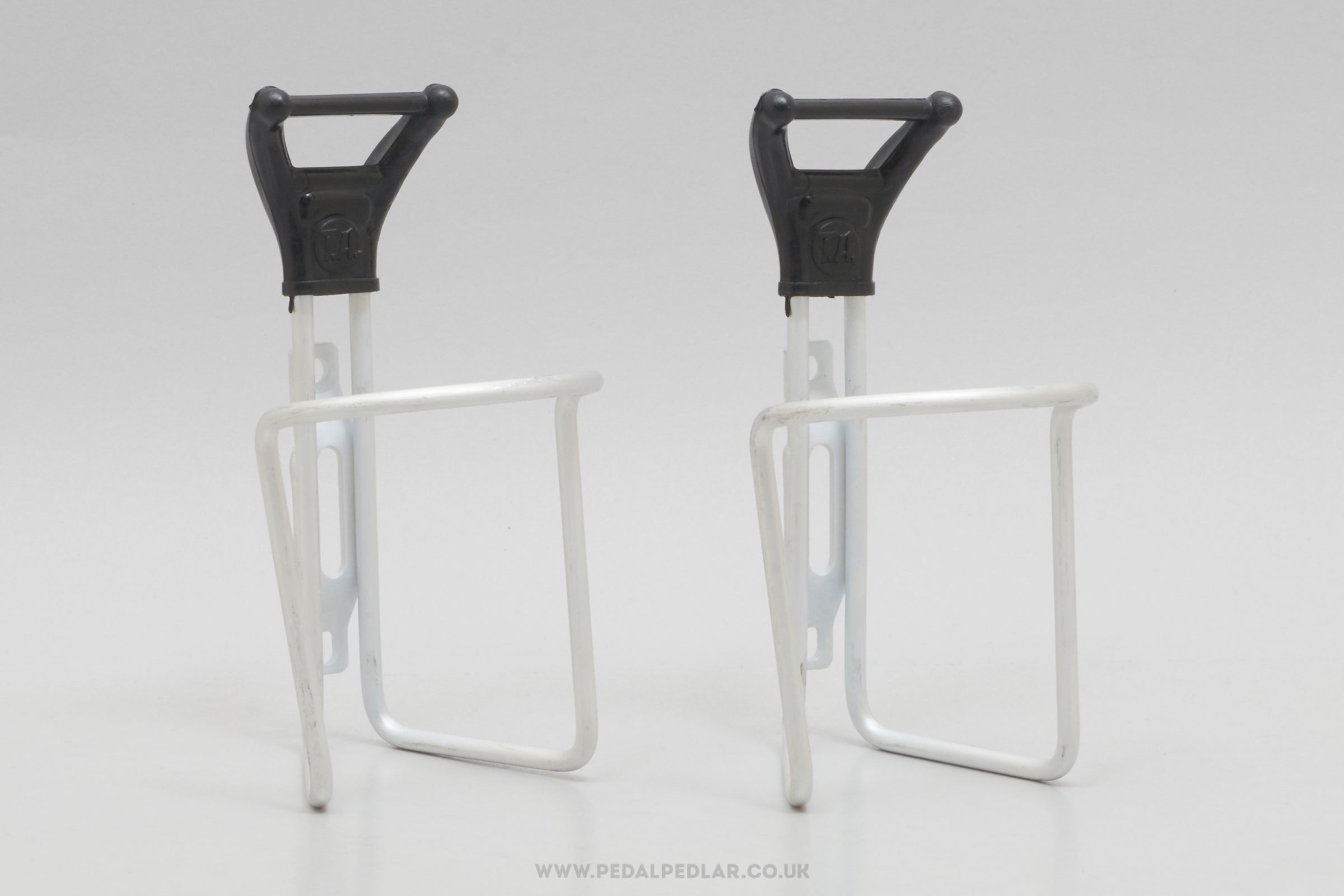


Specialites T.A. 'Plum' (417) NOS Vintage Silver Bottle Cages
£45.00
✓ Original pair of bottle cages - produced in the 1980s
✓ New old stock! Still unused after all these years
✓ Suitable for historic cycling events such as L'Eroica
✓ Worldwide shipping
Specialites T.A. 'Plum' water bottle cages (or bidon holders if you prefer), hailing from France and in production during the 1980s (yet still new & unused after all this time!). Made from aluminium/plastic and weighing in at 94 grams (the weight and price displayed are for a pair of cages). The perfect finishing touch for your vintage bike, but great for bikes of the non-vintage variety too!
First introduced in the 1970s and originally available in black & silver only, these versions of the Plum lightweight bottle cage feature the exposed welded construction favoured for its strength and durability. The later T.A. logo on the black plastic tab was introduced in the 1980s when it became available in a choice of colours.
If you're taking part in L'Eroica or a similar vintage event, these are of the correct era, so rest assured the pre-1987 police won't lock you up for having the wrong bottle carriers!
OVERVIEW
Model ID - 417
Production Era - 1980s
Country - French
Material - Aluminium / Plastic
Weight - 94 g
Stock Code - D-CAG-P19V
*New old stock items may have marks from storage over the years, and as we often have multiples they can vary from piece to piece, but they are always genuine new & unused items.
TECHNICAL INFO
Cage Fixing - Frame Fit (Braze-On)
Colour* - Silver (Satin)
Bottle Fit - Standard
*The colour description is just a guide, please check the photos too as we make sure these are as close to the true colour as possible.
-
▼SHIPPING, TAXES & RETURNS
-
We've been safely sending orders around the world since 2010. Orders are carefully packed, sent with tracking & insurance, and normally collected around midday on Tuesdays and Fridays. Larger items may occasionally require an extra day or two to prepare.
We accept returns, please notify us within 14 days and ensure the item arrives back with us no later than 30 days after the order was received.
EU orders under €150 (excluding shipping) - import VAT and the new €3 customs duty are paid as part of your order, so there's nothing further to pay on delivery.
EU orders over €150 (excluding shipping) - import fees are payable to the carrier before delivery, with nothing collected at checkout.
USA orders - import fees are collected at checkout for all orders to the USA, so there won’t be any surprise charges when your order arrives.
Other international orders - local import fees may apply and are not collected by us. Please check your country's import rules before purchasing.
-
▼HELP SECTION
-
Cage Fixing - most bottle cages will be designed to fix to the frame, although some rare older ones mount to the handlebars and/or stem. If your frame doesn't have any bottle cage braze-ons to fix to you'll need clamp-on bottle cages.
Bottle Fit - almost all cycling bottles measure between 70 - 75 mm in diameter so this is the standard bottle cage size, the only rather rare exceptions are some old Elite bottles that require a 66 mm cage, the more recent oversized ones and of course the funny shaped aero ones that only accept the bottle they were made for.


Specialites T.A. 'Plum' (417) NOS Vintage White Bottle Cage
£17.50
✓ Original bottle cage - produced in the 1980s
✓ New old stock! Still unused after all these years
✓ Suitable for historic cycling events such as L'Eroica
✓ Worldwide shipping
Specialites T.A. 'Plum' water bottle cage (or bidon holder if you prefer), hailing from France and in production during the 1980s (yet still new & unused after all this time!). The perfect finishing touch for your vintage bike, but great for bikes of the non-vintage variety too of course!
If you're taking part in L'Eroica or a similar vintage event, this is of the correct era, so rest assured the pre-1987 police won't lock you up for having the wrong bottle carrier!
OVERVIEW
Model ID - 417
Production Era - 1980s
Country - French
Material - Aluminium / Plastic
Weight - 49 g
Stock Code - D-CAG112V
*New old stock items may have marks from storage over the years, and as we often have multiples they can vary from piece to piece, but they are always genuine new & unused items.
TECHNICAL INFO
Cage Fixing - Frame Fit (Braze-On)
Colour* - White
Bottle Size - 75 mm (Standard)
*The colour description is just a guide, please check the photos to get a good idea of the colour too, as we make sure these are as close to the true colour as possible.
-
▼SHIPPING, TAXES & RETURNS
-
We've been safely sending orders around the world since 2010. Orders are carefully packed, sent with tracking & insurance, and normally collected around midday on Tuesdays and Fridays. Larger items may occasionally require an extra day or two to prepare.
We accept returns, please notify us within 14 days and ensure the item arrives back with us no later than 30 days after the order was received.
EU orders under €150 (excluding shipping) - import VAT and the new €3 customs duty are paid as part of your order, so there's nothing further to pay on delivery.
EU orders over €150 (excluding shipping) - import fees are payable to the carrier before delivery, with nothing collected at checkout.
USA orders - import fees are collected at checkout for all orders to the USA, so there won’t be any surprise charges when your order arrives.
Other international orders - local import fees may apply and are not collected by us. Please check your country's import rules before purchasing.
-
▼HELP SECTION
-
Cage Fixing - most bottle cages will be designed to fix to the frame, although some rare older ones mount to the handlebars and/or stem. If your frame doesn't have any bottle cage braze-ons to fix to you'll need a clamp-on bottle cage.
Bottle Size - almost all cycling bottles measure just under 75 mm in diameter so this is the standard bottle cage size, the only rather rare exceptions are some old Elite bottles that require a 66 mm cage, the more recent oversized ones and of course the funny shaped aero ones that only accept the bottle they were made for.
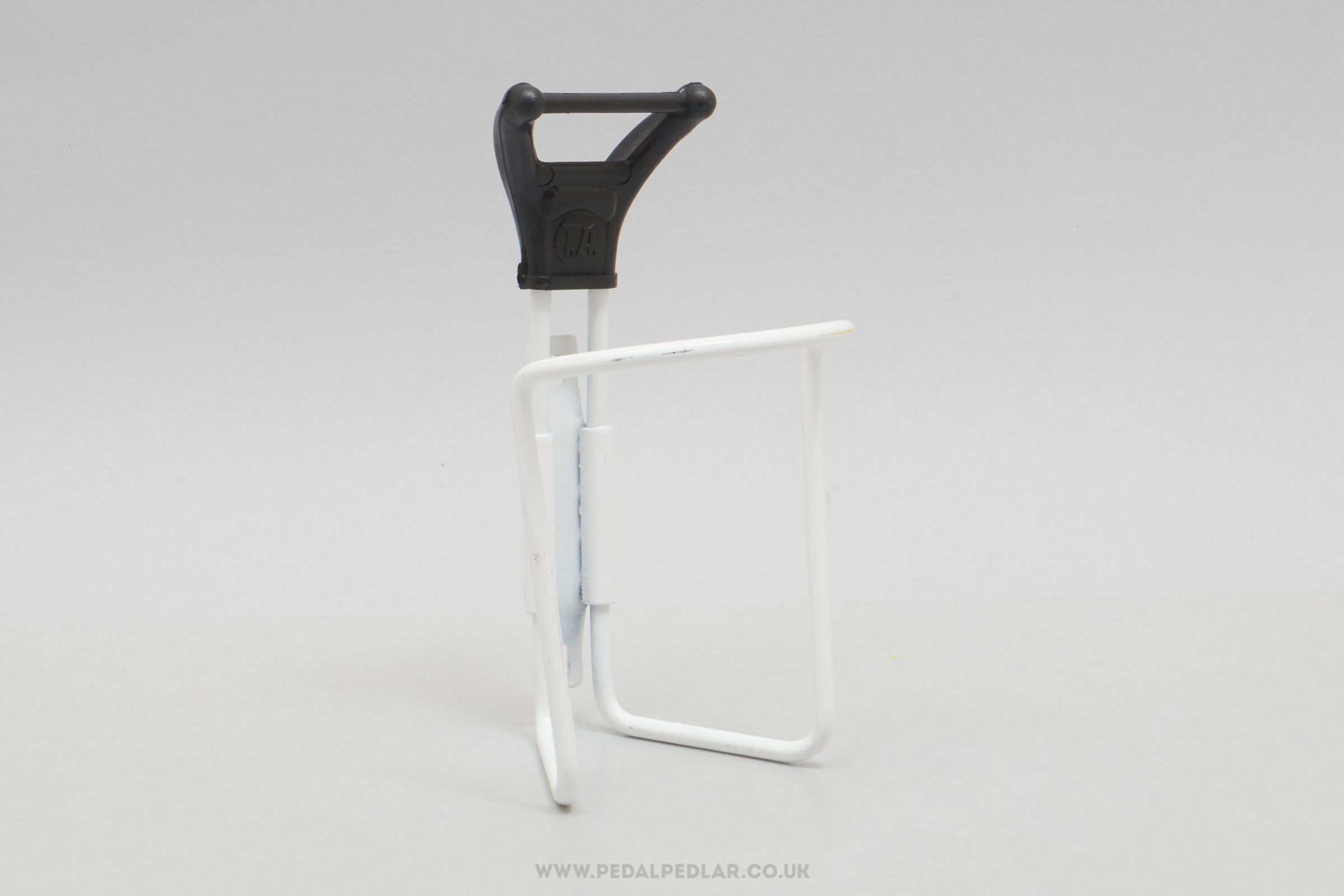


Specialites T.A. 'Plum' (417) NOS Vintage White Bottle Cage
£14.88 £18.00
✓ Original bottle cage - in production from the 1980s to the 1990s
✓ New old stock! Still unused after all these years
✓ Suitable for historic cycling events such as L'Eroica
✓ Worldwide shipping
Specialites T.A. 'Plum' water bottle cage (or bidon holder if you prefer), hailing from France and in production from the 1980s to the 1990s (yet still new & unused after all this time!). Made from aluminium/plasttic and weighing in at 46 grams (the weight and price displayed are for one cage, if we have more in stock you'll be able to add them to your basket). The perfect finishing touch for your vintage bike, but great for bikes of the non-vintage variety too!
This is the final version of the Plum lightweight bottle cage, featuring wrap-around 'sleeves' and punched dimples on the rear of the frame mount, replacing the exposed welded construction of the previous design.
If you're taking part in L'Eroica or a similar vintage event, this is of the correct era, so rest assured the pre-1987 police won't lock you up for having the wrong bottle carrier!
OVERVIEW
Model ID - 417
Production Era - 1980s & 1990s
Country - French
Material - Aluminium / Plasttic
Weight - 46 g
Stock Code - D-CAG154V
*New old stock items may have marks from storage over the years, and as we often have multiples they can vary from piece to piece, but they are always genuine new & unused items.
TECHNICAL INFO
Cage Fixing - Frame Fit (Braze-On)
Colour* - White
Bottle Fit - Standard
*The colour description is just a guide, please check the photos too as we make sure these are as close to the true colour as possible.
-
▼SHIPPING, TAXES & RETURNS
-
We've been safely sending orders around the world since 2010. Orders are carefully packed, sent with tracking & insurance, and normally collected around midday on Tuesdays and Fridays. Larger items may occasionally require an extra day or two to prepare.
We accept returns, please notify us within 14 days and ensure the item arrives back with us no later than 30 days after the order was received.
EU orders under €150 (excluding shipping) - import VAT and the new €3 customs duty are paid as part of your order, so there's nothing further to pay on delivery.
EU orders over €150 (excluding shipping) - import fees are payable to the carrier before delivery, with nothing collected at checkout.
USA orders - import fees are collected at checkout for all orders to the USA, so there won’t be any surprise charges when your order arrives.
Other international orders - local import fees may apply and are not collected by us. Please check your country's import rules before purchasing.
-
▼HELP SECTION
-
Cage Fixing - most bottle cages will be designed to fix to the frame, although some rare older ones mount to the handlebars and/or stem. If your frame doesn't have any bottle cage braze-ons to fix to you'll need a clamp-on bottle cage.
Bottle Fit - almost all cycling bottles measure between 70 - 75 mm in diameter so this is the standard bottle cage size, the only rather rare exceptions are some old Elite bottles that require a 66 mm cage, the more recent oversized ones and of course the funny shaped aero ones that only accept the bottle they were made for.
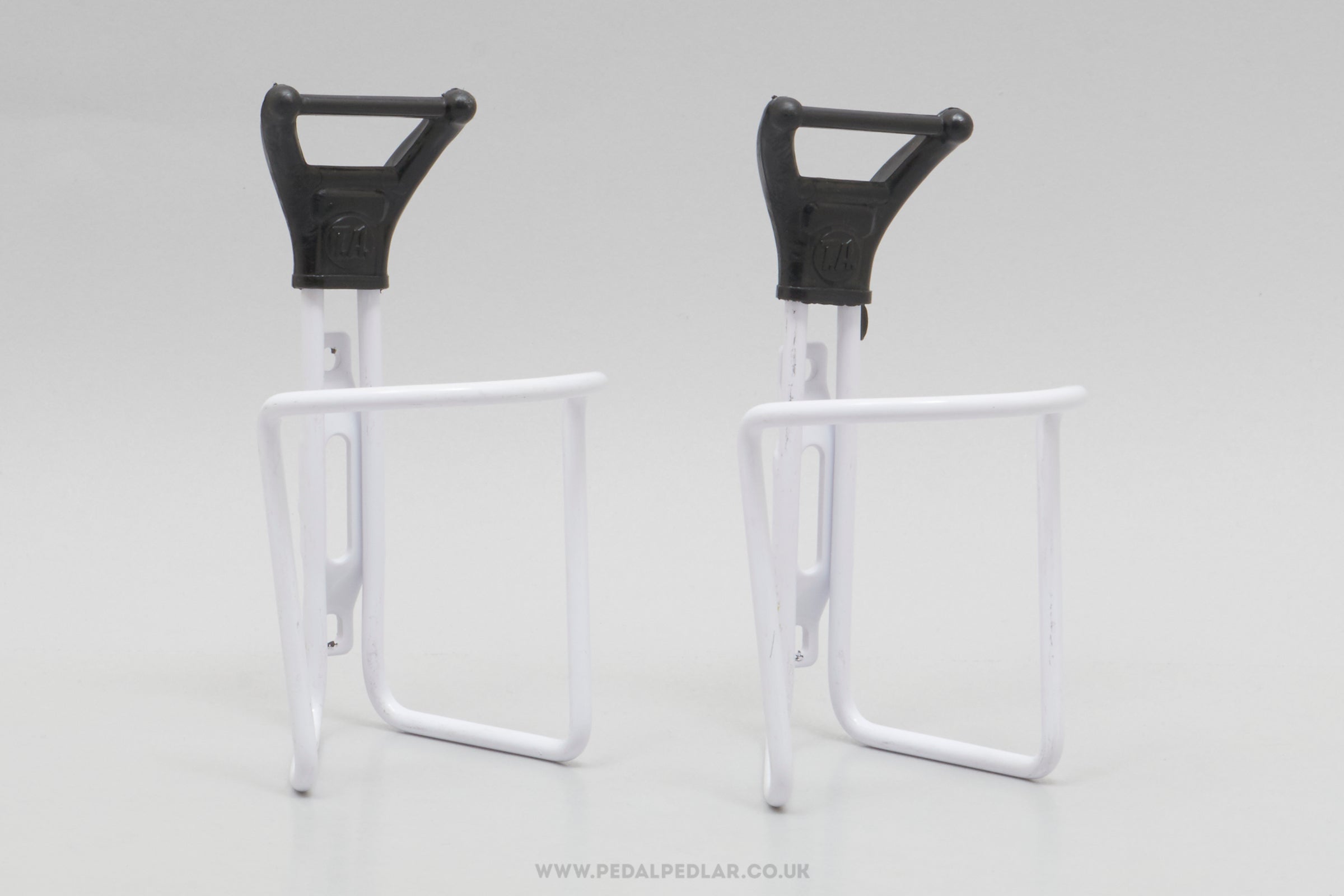


Specialites T.A. 'Plum' (417) NOS Vintage White Bottle Cages
£27.00 £30.00
✓ Original pair of bottle cages - produced in the 1980s
✓ New old stock! Still unused after all these years
✓ Suitable for historic cycling events such as L'Eroica
✓ Worldwide shipping
Specialites T.A. 'Plum' water bottle cages (or bidon holders if you prefer), hailing from France and in production during the 1980s (yet still new & unused after all this time!). Made from aluminium/plastic and weighing in at 102 grams (the weight and price displayed are for a pair of cages). The perfect finishing touch for your vintage bike, but great for bikes of the non-vintage variety too!
First introduced in the 1970s and originally available in black & silver only, these versions of the Plum lightweight bottle cage feature the exposed welded construction favoured for its strength and durability. The later T.A. logo on the black plastic tab was introduced in the 1980s when it became available in a choice of colours.
If you're taking part in L'Eroica or a similar vintage event, these are of the correct era, so rest assured the pre-1987 police won't lock you up for having the wrong bottle carriers!
OVERVIEW
Model ID - 417
Production Era - 1980s
Country - French
Material - Aluminium / Plastic
Weight - 102 g
Stock Code - D-CAG-P22V
*New old stock items may have marks from storage over the years, and as we often have multiples they can vary from piece to piece, but they are always genuine new & unused items.
TECHNICAL INFO
Cage Fixing - Frame Fit (Braze-On)
Colour* - White
Bottle Fit - Standard
*The colour description is just a guide, please check the photos too as we make sure these are as close to the true colour as possible.
-
▼SHIPPING, TAXES & RETURNS
-
We've been safely sending orders around the world since 2010. Orders are carefully packed, sent with tracking & insurance, and normally collected around midday on Tuesdays and Fridays. Larger items may occasionally require an extra day or two to prepare.
We accept returns, please notify us within 14 days and ensure the item arrives back with us no later than 30 days after the order was received.
EU orders under €150 (excluding shipping) - import VAT and the new €3 customs duty are paid as part of your order, so there's nothing further to pay on delivery.
EU orders over €150 (excluding shipping) - import fees are payable to the carrier before delivery, with nothing collected at checkout.
USA orders - import fees are collected at checkout for all orders to the USA, so there won’t be any surprise charges when your order arrives.
Other international orders - local import fees may apply and are not collected by us. Please check your country's import rules before purchasing.
-
▼HELP SECTION
-
Cage Fixing - most bottle cages will be designed to fix to the frame, although some rare older ones mount to the handlebars and/or stem. If your frame doesn't have any bottle cage braze-ons to fix to you'll need clamp-on bottle cages.
Bottle Fit - almost all cycling bottles measure between 70 - 75 mm in diameter so this is the standard bottle cage size, the only rather rare exceptions are some old Elite bottles that require a 66 mm cage, the more recent oversized ones and of course the funny shaped aero ones that only accept the bottle they were made for.


Specialites T.A. 'Plum' (417) NOS Vintage Yellow Bottle Cage
£17.50
✓ Original bottle cage - produced in the 1980s
✓ New old stock! Still unused after all these years
✓ Suitable for historic cycling events such as L'Eroica
✓ Worldwide shipping
Specialites T.A. 'Plum' water bottle cage (or bidon holder if you prefer), hailing from France and in production during the 1980s (yet still new & unused after all this time!). The perfect finishing touch for your vintage bike, but great for bikes of the non-vintage variety too of course!
If you're taking part in L'Eroica or a similar vintage event, this is of the correct era, so rest assured the pre-1987 police won't lock you up for having the wrong bottle carrier!
OVERVIEW
Model ID - 417
Production Era - 1980s
Country - French
Material - Aluminium / Plastic
Weight - 46 g
Stock Code - D-CAG113V
*New old stock items may have marks from storage over the years, and as we often have multiples they can vary from piece to piece, but they are always genuine new & unused items.
TECHNICAL INFO
Cage Fixing - Frame Fit (Braze-On)
Colour* - Yellow
Bottle Size - 75 mm (Standard)
*The colour description is just a guide, please check the photos to get a good idea of the colour too, as we make sure these are as close to the true colour as possible.
-
▼SHIPPING, TAXES & RETURNS
-
We've been safely sending orders around the world since 2010. Orders are carefully packed, sent with tracking & insurance, and normally collected around midday on Tuesdays and Fridays. Larger items may occasionally require an extra day or two to prepare.
We accept returns, please notify us within 14 days and ensure the item arrives back with us no later than 30 days after the order was received.
EU orders under €150 (excluding shipping) - import VAT and the new €3 customs duty are paid as part of your order, so there's nothing further to pay on delivery.
EU orders over €150 (excluding shipping) - import fees are payable to the carrier before delivery, with nothing collected at checkout.
USA orders - import fees are collected at checkout for all orders to the USA, so there won’t be any surprise charges when your order arrives.
Other international orders - local import fees may apply and are not collected by us. Please check your country's import rules before purchasing.
-
▼HELP SECTION
-
Cage Fixing - most bottle cages will be designed to fix to the frame, although some rare older ones mount to the handlebars and/or stem. If your frame doesn't have any bottle cage braze-ons to fix to you'll need a clamp-on bottle cage.
Bottle Size - almost all cycling bottles measure just under 75 mm in diameter so this is the standard bottle cage size, the only rather rare exceptions are some old Elite bottles that require a 66 mm cage, the more recent oversized ones and of course the funny shaped aero ones that only accept the bottle they were made for.
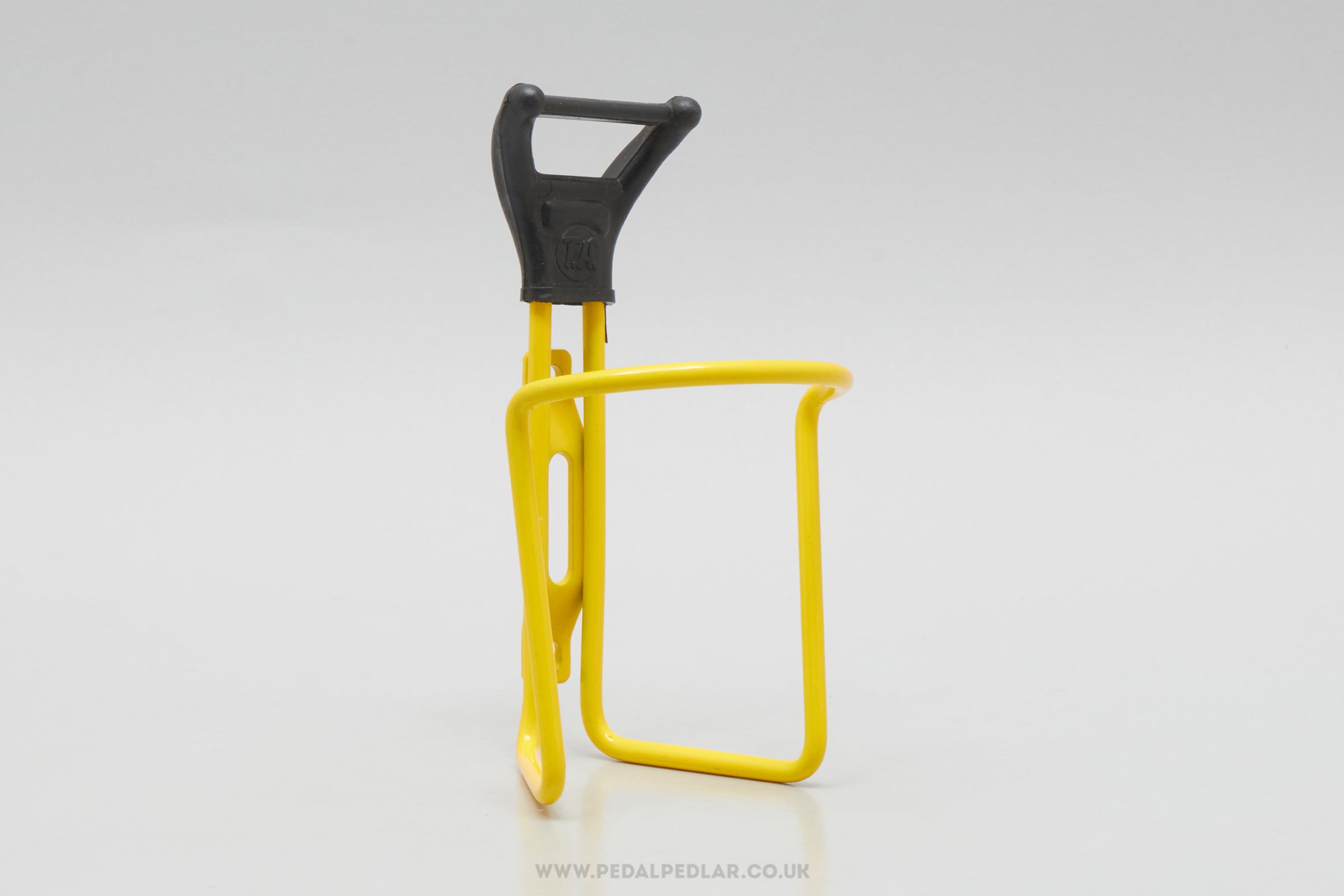


Specialites T.A. 'Plum' (417) NOS Vintage Yellow Bottle Cage
£20.00
✓ Original bottle cage - produced in the 1980s
✓ New old stock! Still unused after all these years
✓ Suitable for historic cycling events such as L'Eroica
✓ Worldwide shipping
Specialites T.A. 'Plum' water bottle cage (or bidon holder if you prefer), hailing from France and in production during the 1980s (yet still new & unused after all this time!). Made from aluminium/plastic and weighing in at 48 grams (the weight and price displayed are for one cage, if we have more in stock you'll be able to add them to your basket). The perfect finishing touch for your vintage bike, but great for bikes of the non-vintage variety too!
First introduced in the 1970s and originally available in black & silver only, this version of the Plum lightweight bottle cage features the exposed welded construction favoured for its strength and durability. The later T.A. logo on the black plastic tab was introduced in the 1980s when it became available in a choice of colours.
If you're taking part in L'Eroica or a similar vintage event, this is of the correct era, so rest assured the pre-1987 police won't lock you up for having the wrong bottle carrier!
OVERVIEW
Model ID - 417
Production Era - 1980s
Country - French
Material - Aluminium / Plastic
Weight - 48 g
Stock Code - D-CAG152V
*New old stock items may have marks from storage over the years, and as we often have multiples they can vary from piece to piece, but they are always genuine new & unused items.
TECHNICAL INFO
Cage Fixing - Frame Fit (Braze-On)
Colour* - Yellow
Bottle Fit - Standard
*The colour description is just a guide, please check the photos too as we make sure these are as close to the true colour as possible.
-
▼SHIPPING, TAXES & RETURNS
-
We've been safely sending orders around the world since 2010. Orders are carefully packed, sent with tracking & insurance, and normally collected around midday on Tuesdays and Fridays. Larger items may occasionally require an extra day or two to prepare.
We accept returns, please notify us within 14 days and ensure the item arrives back with us no later than 30 days after the order was received.
EU orders under €150 (excluding shipping) - import VAT and the new €3 customs duty are paid as part of your order, so there's nothing further to pay on delivery.
EU orders over €150 (excluding shipping) - import fees are payable to the carrier before delivery, with nothing collected at checkout.
USA orders - import fees are collected at checkout for all orders to the USA, so there won’t be any surprise charges when your order arrives.
Other international orders - local import fees may apply and are not collected by us. Please check your country's import rules before purchasing.
-
▼HELP SECTION
-
Cage Fixing - most bottle cages will be designed to fix to the frame, although some rare older ones mount to the handlebars and/or stem. If your frame doesn't have any bottle cage braze-ons to fix to you'll need a clamp-on bottle cage.
Bottle Fit - almost all cycling bottles measure between 70 - 75 mm in diameter so this is the standard bottle cage size, the only rather rare exceptions are some old Elite bottles that require a 66 mm cage, the more recent oversized ones and of course the funny shaped aero ones that only accept the bottle they were made for.
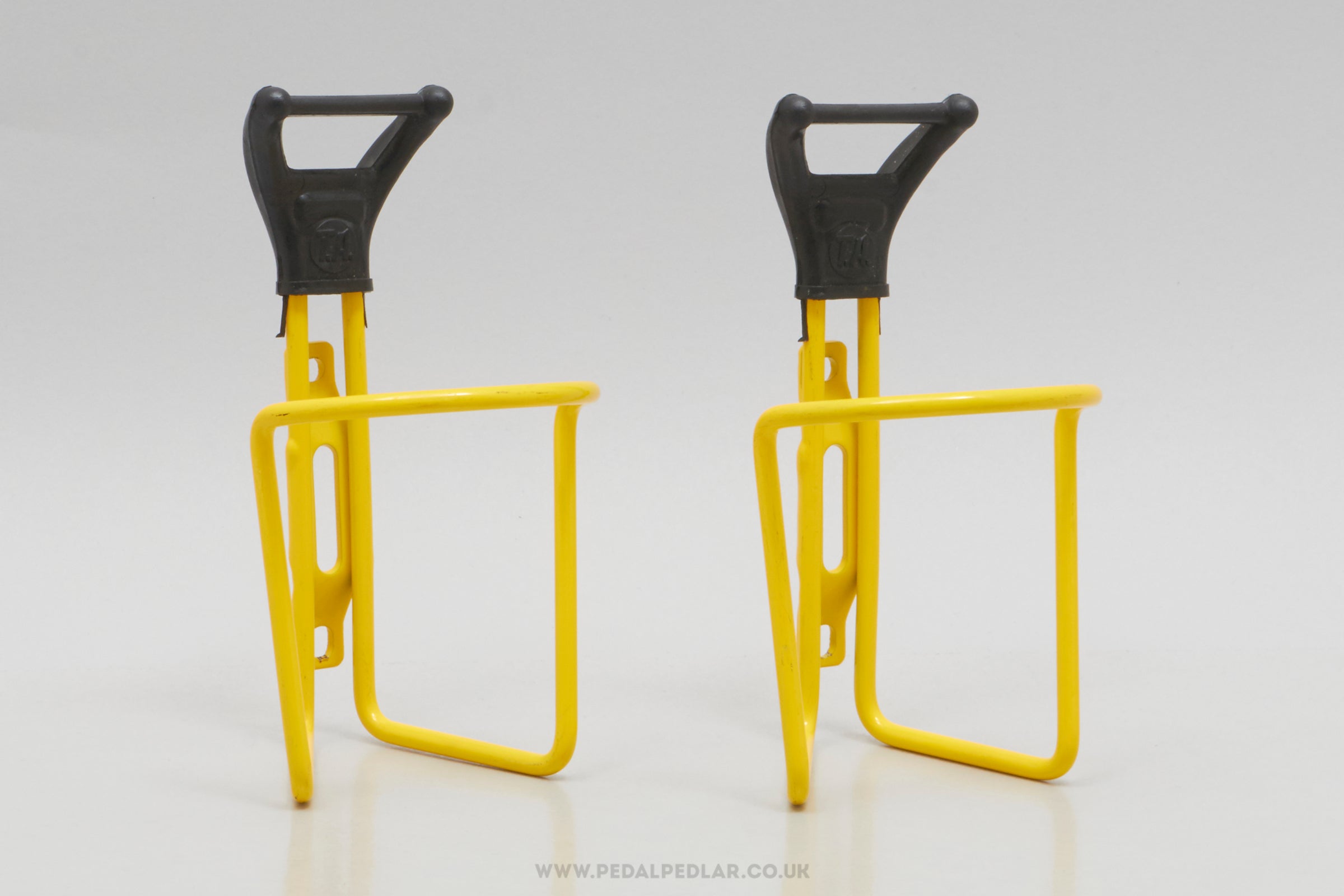


Specialites T.A. 'Plum' (417) NOS Vintage Yellow Bottle Cages
£31.50 £35.00
✓ Original pair of bottle cages - produced in the 1980s
✓ New old stock! Still unused after all these years
✓ Suitable for historic cycling events such as L'Eroica
✓ Worldwide shipping
Specialites T.A. 'Plum' water bottle cages (or bidon holders if you prefer), hailing from France and in production during the 1980s (yet still new & unused after all this time!). Made from aluminium/plastic and weighing in at 100 grams (the weight and price displayed are for a pair of cages). The perfect finishing touch for your vintage bike, but great for bikes of the non-vintage variety too!
First introduced in the 1970s and originally available in black & silver only, these versions of the Plum lightweight bottle cage feature the exposed welded construction favoured for its strength and durability. The later T.A. logo on the black plastic tab was introduced in the 1980s when it became available in a choice of colours.
If you're taking part in L'Eroica or a similar vintage event, these are of the correct era, so rest assured the pre-1987 police won't lock you up for having the wrong bottle carriers!
OVERVIEW
Model ID - 417
Production Era - 1980s
Country - French
Material - Aluminium / Plastic
Weight - 100 g
Stock Code - D-CAG-P20V
*New old stock items may have marks from storage over the years, and as we often have multiples they can vary from piece to piece, but they are always genuine new & unused items.
TECHNICAL INFO
Cage Fixing - Frame Fit (Braze-On)
Colour* - Yellow
Bottle Fit - Standard
*The colour description is just a guide, please check the photos too as we make sure these are as close to the true colour as possible.
-
▼SHIPPING, TAXES & RETURNS
-
We've been safely sending orders around the world since 2010. Orders are carefully packed, sent with tracking & insurance, and normally collected around midday on Tuesdays and Fridays. Larger items may occasionally require an extra day or two to prepare.
We accept returns, please notify us within 14 days and ensure the item arrives back with us no later than 30 days after the order was received.
EU orders under €150 (excluding shipping) - import VAT and the new €3 customs duty are paid as part of your order, so there's nothing further to pay on delivery.
EU orders over €150 (excluding shipping) - import fees are payable to the carrier before delivery, with nothing collected at checkout.
USA orders - import fees are collected at checkout for all orders to the USA, so there won’t be any surprise charges when your order arrives.
Other international orders - local import fees may apply and are not collected by us. Please check your country's import rules before purchasing.
-
▼HELP SECTION
-
Cage Fixing - most bottle cages will be designed to fix to the frame, although some rare older ones mount to the handlebars and/or stem. If your frame doesn't have any bottle cage braze-ons to fix to you'll need clamp-on bottle cages.
Bottle Fit - almost all cycling bottles measure between 70 - 75 mm in diameter so this is the standard bottle cage size, the only rather rare exceptions are some old Elite bottles that require a 66 mm cage, the more recent oversized ones and of course the funny shaped aero ones that only accept the bottle they were made for.


Specialites T.A. 'Plum' (417) Vintage White Bottle Cage
£10.00
✓ Original bottle cage - produced in the 1980s
✓ Suitable for historic cycling events such as L'Eroica
✓ Checked & cleaned
✓ Worldwide shipping
Specialites T.A. 'Plum' water bottle cage (or bidon holder if you prefer), hailing from France and in production during the 1980s. Made from aluminium/plastic and weighing in at 49 grams. The perfect finishing touch for your vintage bike, but great for bikes of the non-vintage variety too!
First introduced in the 1970s and originally available in black & silver only, this version of the Plum lightweight bottle cage features the exposed welded construction favoured for its strength and durability. The later T.A. logo on the black plastic tab was introduced in the 1980s when it became available in a choice of colours.
If you're taking part in L'Eroica or a similar vintage event, this is of the correct era, so rest assured the pre-1987 police won't lock you up for having the wrong bottle carrier!
The bottle cage has been checked for damage, thoroughly cleaned and graded as OK condition, but do take a good look at the detailed photos so you can see the shape & condition before you buy.OVERVIEW
Model ID - 417
Production Era - 1980s
Country - French
Material - Aluminium / Plastic
Weight - 49 g
Stock Code - U-G6-CAG168V
TECHNICAL INFO
Cage Fixing - Frame Fit (Braze-On)
Colour* - White
Bottle Fit - Standard
*The colour description is just a guide, please check the photos too as we make sure these are as close to the true colour as possible.
-
▼SHIPPING, TAXES & RETURNS
-
We've been safely sending orders around the world since 2010. Orders are carefully packed, sent with tracking & insurance, and normally collected around midday on Tuesdays and Fridays. Larger items may occasionally require an extra day or two to prepare.
We accept returns, please notify us within 14 days and ensure the item arrives back with us no later than 30 days after the order was received.
EU orders under €150 (excluding shipping) - import VAT and the new €3 customs duty are paid as part of your order, so there's nothing further to pay on delivery.
EU orders over €150 (excluding shipping) - import fees are payable to the carrier before delivery, with nothing collected at checkout.
USA orders - import fees are collected at checkout for all orders to the USA, so there won’t be any surprise charges when your order arrives.
Other international orders - local import fees may apply and are not collected by us. Please check your country's import rules before purchasing.
-
▼SAFETY & COMPLIANCE
- This product complies with the EU General Product Safety Regulation (GPSR).
Product Manufacturer - Specialites T.A. 41 Bis Rue de Laon, 02150 Sissonne, France
EU Authorised Representative - Global Trade Department NI Ltd, Office 834, Unit 6, 100 Lisburn Road, Belfast BT9 6AG, Northern Ireland
-
▼HELP SECTION
-
Cage Fixing - most bottle cages will be designed to fix to the frame, although some rare older ones mount to the handlebars and/or stem. If your frame doesn't have any bottle cage braze-ons to fix to you'll need a clamp-on bottle cage.
Bottle Fit - almost all cycling bottles measure between 70 - 75 mm in diameter so this is the standard bottle cage size, the only rather rare exceptions are some old Elite bottles that require a 66 mm cage, the more recent oversized ones and of course the funny shaped aero ones that only accept the bottle they were made for.


Specialites T.A. 'Professional' (215) Later Version Vintage White Steel Bottle Cage / Holder
£18.75 £25.00
✓ Original bottle cage - produced in the 1980s
✓ Suitable for historic cycling events such as L'Eroica
✓ Checked & cleaned
✓ Worldwide shipping
Specialites T.A. 'Professional' bottle cage, hailing from France and in production during the 1980s. The perfect finishing touch for your vintage bike, but great for bikes of the non-vintage variety too of course!
If you're taking part in L'Eroica or a similar vintage event, this is of the correct era, so rest assured the pre-1987 police won't lock you up for having the wrong bottle carrier!
The bottle cage has been checked for damage, thoroughly cleaned and graded as very good condition, but do take a good look at the detailed photos so you can see the shape & condition before you buy.OVERVIEW
Condition Notes - We assume this has been painted as there's no record of these being available in white.
Model ID - 215
Production Era - 1980s
Country - French
Material - Steel / Plastic
Weight - 103 g
Stock Code - U-CAG58V
TECHNICAL INFO
Cage Fixing - Frame Fit (Braze-On)
Colour* - White
Bottle Size - 75 mm (Standard)
*The colour description is just a guide, please check the photos to get a good idea of the colour too, as we make sure these are as close to the true colour as possible.
-
▼SHIPPING, TAXES & RETURNS
-
We've been safely sending orders around the world since 2010. Orders are carefully packed, sent with tracking & insurance, and normally collected around midday on Tuesdays and Fridays. Larger items may occasionally require an extra day or two to prepare.
We accept returns, please notify us within 14 days and ensure the item arrives back with us no later than 30 days after the order was received.
EU orders under €150 (excluding shipping) - import VAT and the new €3 customs duty are paid as part of your order, so there's nothing further to pay on delivery.
EU orders over €150 (excluding shipping) - import fees are payable to the carrier before delivery, with nothing collected at checkout.
USA orders - import fees are collected at checkout for all orders to the USA, so there won’t be any surprise charges when your order arrives.
Other international orders - local import fees may apply and are not collected by us. Please check your country's import rules before purchasing.
-
▼HELP SECTION
-
Cage Fixing - most bottle cages will be designed to fix to the frame, although some rare older ones mount to the handlebars and/or stem. If your frame doesn't have any bottle cage braze-ons to fix to you'll need a clamp-on bottle cage.
Bottle Size - almost all cycling bottles measure just under 75 mm in diameter so this is the standard bottle cage size, the only rather rare exceptions are some old Elite bottles that require a 66 mm cage, the more recent oversized ones and of course the funny shaped aero ones that only accept the bottle they were made for.


Specialites T.A. 31 NOS Vintage Crank Arm Dust Caps Set
£34.00 £40.00
✓ Original parts - in production from the 1970s to the 1980s
✓ New old stock! Still unused after all these years
✓ Suitable for historic cycling events such as L'Eroica
✓ Worldwide shipping
Specialites T.A. 31 crankset dust caps (or bolt covers if you prefer), hailing from France and in production from the 1970s to the 1980s (yet still new & unused after all this time!). Made from steel and weighing in at 17 grams (for the pair). A fine choice for keeping your vintage bike authentic, but also great for any other compatible bike.
If you're taking part in L'Eroica or a similar vintage event, these are fully compliant - so rest assured, the pre-1987 police won't lock you up for having the wrong dust covers!
OVERVIEW
Model ID - 31
Production Era - 1970s & 1980s
Country - French
Material - Steel
Weight - 17 g
Stock Code - D-CDC57V
*New old stock items may have marks from storage over the years, and as we often have multiples they can vary from piece to piece, but they are always genuine new & unused items.
TECHNICAL INFO
Crank Thread - 23 mm (T.A. Specialites)
-
▼SHIPPING, TAXES & RETURNS
-
We've been safely sending orders around the world since 2010. Orders are carefully packed, sent with tracking & insurance, and normally collected around midday on Tuesdays and Fridays. Larger items may occasionally require an extra day or two to prepare.
We accept returns, please notify us within 14 days and ensure the item arrives back with us no later than 30 days after the order was received.
EU orders under €150 (excluding shipping) - import VAT and the new €3 customs duty are paid as part of your order, so there's nothing further to pay on delivery.
EU orders over €150 (excluding shipping) - import fees are payable to the carrier before delivery, with nothing collected at checkout.
USA orders - import fees are collected at checkout for all orders to the USA, so there won’t be any surprise charges when your order arrives.
Other international orders - local import fees may apply and are not collected by us. Please check your country's import rules before purchasing.
-
▼HELP SECTION
-
Crank Thread - 22 mm is the standard thread for almost all cotterless crank arms, the only exceptions are some Stronglight cranks made up until the early 1980s, and Specialites T.A. Campagnolo produced some self-extracting crank bolts with covers that had a reverse thread.
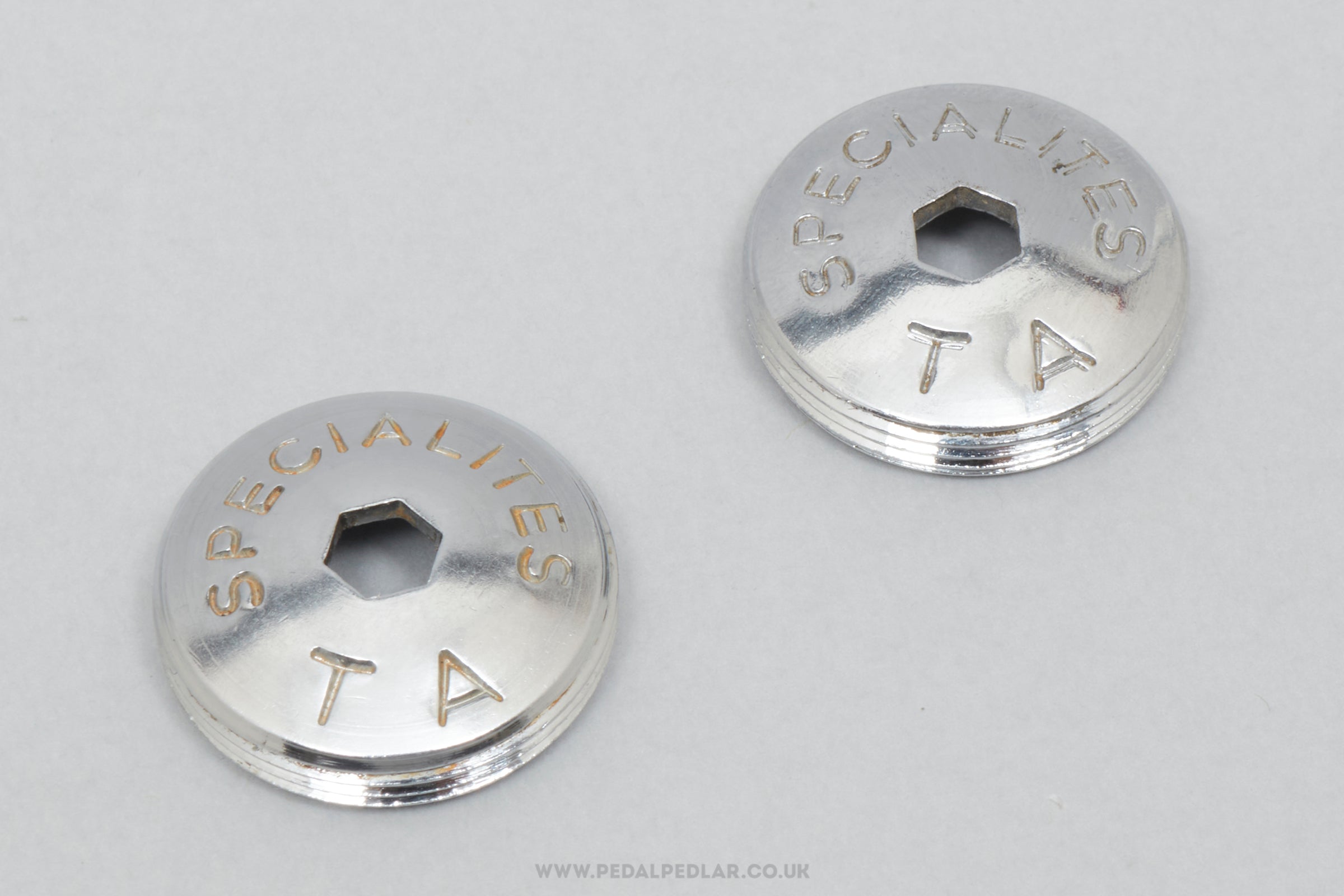


Specialites T.A. 31 NOS Vintage Crank Arm Dust Caps Set
£36.00 £40.00
✓ Original parts - in production from the 1970s to the 1980s
✓ New old stock! Still unused after all these years
✓ Suitable for historic cycling events such as L'Eroica
✓ Worldwide shipping
Specialites T.A. 31 crankset dust caps (or bolt covers if you prefer), hailing from France and in production from the 1970s to the 1980s (yet still new & unused after all this time!). Made from steel and weighing in at 14 grams (for the pair). A fine choice for keeping your vintage bike authentic, but also great for any other compatible bike.
If you're taking part in L'Eroica or a similar vintage event, these are fully compliant - so rest assured, the pre-1987 police won't lock you up for having the wrong dust covers!
OVERVIEW
Model ID - 31
Production Era - 1970s & 1980s
Country - French
Material - Steel
Weight - 14 g
Stock Code - D-CDC58V
*New old stock items may have marks from storage over the years, and as we often have multiples they can vary from piece to piece, but they are always genuine new & unused items.
TECHNICAL INFO
Crank Thread - 23 mm (T.A. Specialites)
-
▼SHIPPING, TAXES & RETURNS
-
We've been safely sending orders around the world since 2010. Orders are carefully packed, sent with tracking & insurance, and normally collected around midday on Tuesdays and Fridays. Larger items may occasionally require an extra day or two to prepare.
We accept returns, please notify us within 14 days and ensure the item arrives back with us no later than 30 days after the order was received.
EU orders under €150 (excluding shipping) - import VAT and the new €3 customs duty are paid as part of your order, so there's nothing further to pay on delivery.
EU orders over €150 (excluding shipping) - import fees are payable to the carrier before delivery, with nothing collected at checkout.
USA orders - import fees are collected at checkout for all orders to the USA, so there won’t be any surprise charges when your order arrives.
Other international orders - local import fees may apply and are not collected by us. Please check your country's import rules before purchasing.
-
▼HELP SECTION
-
Crank Thread - 22 mm is the standard thread for almost all cotterless crank arms, the only exceptions are some Stronglight cranks made up until the early 1980s, and Specialites T.A. Campagnolo produced some self-extracting crank bolts with covers that had a reverse thread.


Specialites T.A. Aluminium Vintage Crank Dust Caps / Covers
£29.75 £35.00
✓ Original parts - in production from the 1960s to the 1970s
✓ Suitable for historic cycling events such as L'Eroica
✓ Checked & cleaned
✓ Worldwide shipping
Specialites T.A. crank dust caps, hailing from France and in production from the 1960s to the 1970s. Made from aluminium and weighing in at 14 grams. A fine choice for keeping your vintage bike authentic, but also great for any other compatible bike too.
If you're taking part in L'Eroica or a similar vintage event, this is fully compliant - so rest assured, the pre-1987 police won't lock you up for having the wrong dust covers!
The dust caps have been cleaned, checked and graded as very good condition, but do take a good look at the detailed photos so you can see the cosmetic condition before you buy.OVERVIEW
Production Era - 1960s & 1970s
Country - French
Material - Aluminium
Weight - 14 g
Stock Code - U-CDC1V
TECHNICAL INFO
Crank Thread - 23 mm (T.A. Specialites)
-
▼SHIPPING, TAXES & RETURNS
-
We've been safely sending orders around the world since 2010. Orders are carefully packed, sent with tracking & insurance, and normally collected around midday on Tuesdays and Fridays. Larger items may occasionally require an extra day or two to prepare.
We accept returns, please notify us within 14 days and ensure the item arrives back with us no later than 30 days after the order was received.
EU orders under €150 (excluding shipping) - import VAT and the new €3 customs duty are paid as part of your order, so there's nothing further to pay on delivery.
EU orders over €150 (excluding shipping) - import fees are payable to the carrier before delivery, with nothing collected at checkout.
USA orders - import fees are collected at checkout for all orders to the USA, so there won’t be any surprise charges when your order arrives.
Other international orders - local import fees may apply and are not collected by us. Please check your country's import rules before purchasing.
-
▼HELP SECTION
-
Crank Thread - 22 mm is the standard thread for almost all cotterless cranks, the only exceptions are some Stronglight cranks made up until the early 1980s, and Specialites T.A. Campagnolo produced some self-extracting crank bolts with covers that had a reverse thread.
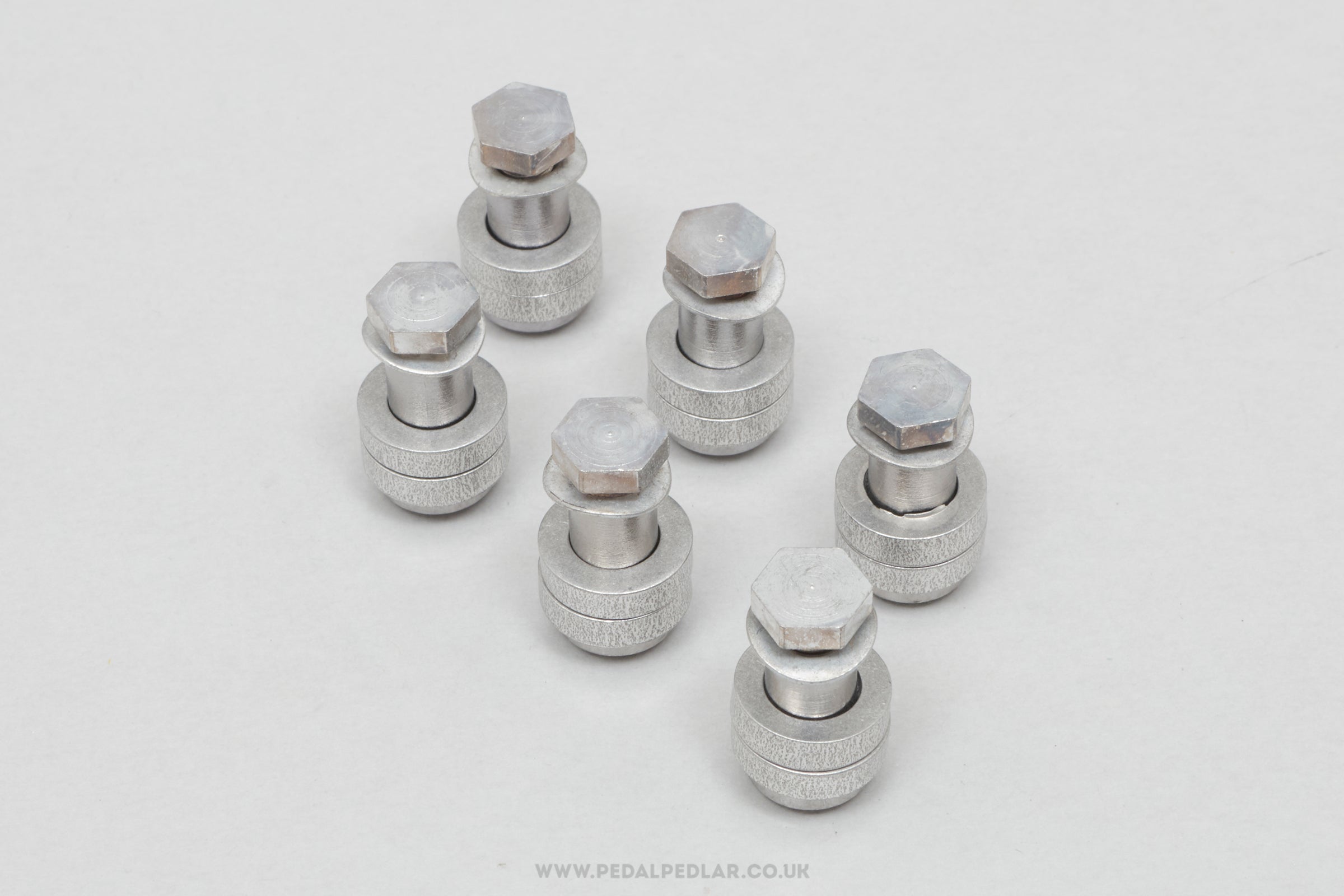


Specialites T.A. Cyclotourist (86) 6 Vis NOS/NIB Vintage Triple 50.4 BCD Chainring Bolts Set
£63.75 £75.00
✓ Original parts - in production from the 1970s to the 1980s
✓ New old stock & still in the original packaging!
✓ Suitable for historic cycling events such as L'Eroica
✓ Worldwide shipping
Specialites T.A. Cyclotourist set of chainring bolts (or screws if you prefer), hailing from France and in production from the 1970s to the 1980s (yet still new & unused after all this time!). Made from steel and weighing in at 42 grams. A fine choice for keeping your vintage bike authentic, but also great for any other compatible bike.
If you're taking part in L'Eroica, Anjou Velo, Velo Retro or another similar vintage cycling event, these are fully compliant - so rest assured, the pre-1987 police won't lock you up for having the wrong chainring bolts!
OVERVIEW
Model ID - 86
Production Era - 1970s & 1980s
Country - French
Material - Steel
Weight - 42 g
Stock Code - D-CRB63V
*New old stock items may have marks from storage over the years, and as we often have multiples they can vary from piece to piece, but they are always genuine new & unused items.
TECHNICAL INFO
Chainring Count - Triple
Crank Type - 50.4 BCD
Mount Type - Inner to Middle & Outer Chainring
Back Nut Length (Excluding Head) - 13 mm
Spacer Depth - 3.5 mm
-
▼SHIPPING, TAXES & RETURNS
-
We've been safely sending orders around the world since 2010. Orders are carefully packed, sent with tracking & insurance, and normally collected around midday on Tuesdays and Fridays. Larger items may occasionally require an extra day or two to prepare.
We accept returns, please notify us within 14 days and ensure the item arrives back with us no later than 30 days after the order was received.
EU orders under €150 (excluding shipping) - import VAT and the new €3 customs duty are paid as part of your order, so there's nothing further to pay on delivery.
EU orders over €150 (excluding shipping) - import fees are payable to the carrier before delivery, with nothing collected at checkout.
USA orders - import fees are collected at checkout for all orders to the USA, so there won’t be any surprise charges when your order arrives.
Other international orders - local import fees may apply and are not collected by us. Please check your country's import rules before purchasing.
-
▼HELP SECTION
-
Chainring Count - the number of chainrings the bolts are designed to fit, this must be the same as the number of chainrings you are using.
Crank Type - Most cranks require the standard 5-bolt sets that consist of 5 bolts with backs that slot into the rear of the crank spider, there are also some less common cranks with 3 arms that require the 3-arm chainring bolts. Specialites T.A. 'Professionel 5 Vis' and Stronglight '49D' type cranks require special 50.4 BCD chainring bolts that are specific to these crank designs.
Mount Type - most bolts simply fix the chainring to the crank, but some cranks require bolts to fix one chainring to another.
Back Nut Length (Excluding Head) - the more chainrings your crank has the longer the bolts and nuts need to be. We exclude the head part from the measurement (the bit that often sits recessed in back of the chainring).


Specialites T.A. Cyclotouriste Vintage 50.4 BCD 170 mm Right Crank Arm / Spider
£45.00 £60.00
✓ Original part - in production from the 1960s to the 1970s
✓ Suitable for historic cycling events such as L'Eroica
✓ Professionally checked & cleaned
✓ Worldwide shipping
Specialites T.A. Cyclotouriste right crank arm/spider, hailing from France and in production from the 1960s to the 1970s. Made from aluminium and weighing in at 194 grams. A fine choice for keeping your vintage bike authentic, but also great for any other compatible bike too.
If you're taking part in L'Eroica or a similar vintage event, this is fully compliant - so rest assured, the pre-1987 police won't lock you up for having the wrong crank!
The crank arm has been carefully cleaned, thoroughly checked by one of our mechanics and graded as good condition, but do take a good look at the detailed photos so you can see the cosmetic condition before you buy.OVERVIEW
Production Era - 1960s & 1970s
Country - French
Material - Aluminium
Weight - 194 g
Stock Code - U-CA-SR24V
TECHNICAL INFO
Chainring Count - Double/Triple
BCD - 50.4 BCD
Crank Arm Length - 170 mm
Pedal Threads - Standard (9/16" x 20 TPI)
Bottom Bracket Type - Square Taper
-
▼SHIPPING, TAXES & RETURNS
-
We've been safely sending orders around the world since 2010. Orders are carefully packed, sent with tracking & insurance, and normally collected around midday on Tuesdays and Fridays. Larger items may occasionally require an extra day or two to prepare.
We accept returns, please notify us within 14 days and ensure the item arrives back with us no later than 30 days after the order was received.
EU orders under €150 (excluding shipping) - import VAT and the new €3 customs duty are paid as part of your order, so there's nothing further to pay on delivery.
EU orders over €150 (excluding shipping) - import fees are payable to the carrier before delivery, with nothing collected at checkout.
USA orders - import fees are collected at checkout for all orders to the USA, so there won’t be any surprise charges when your order arrives.
Other international orders - local import fees may apply and are not collected by us. Please check your country's import rules before purchasing.
-
▼HELP SECTION
-
Chainring Count - the number of chainrings the crank was designed to fit. Fixed gear track bikes, single-speeds and some geared bikes use a single chainring, road bikes commonly use a double (two rings) and most touring bikes and mountain bikes will use a triple chainset (three rings).
BCD - stands for Bolt Circle Diameter (sometimes referred to as PCD - Pitch Circle Diameter), and this needs to match the BCD of your chainring(s). To calculate this, measure the distance in millimeters from the centre of any chainring bolt hole to the centre of an adjacent one and multiply it by 1.709 (you’ll likely need to round the resulting number up or down a little to get your BCD measurement).
Crank Arm Length - this is measured from the absolute centre of the bottom bracket hole to the centre of the hole for the pedal.
Pedal Threads - the pattern of the thread that your pedals screw into, this is usually stamped on the pedals themselves and most bikes use a standard thread of 9/16” x 20 tpi. The exceptions being older French bikes, bikes with cheaper one-piece type chainsets and Shimano’s Dyna Drive system (easily identifiable as the pedal holes are about an inch wide!).
Bottom Bracket Type - ‘square taper’, as the name suggests have a square shaped axle that slots into the crank and ‘cottered’ axles are round and secured by pins - pretty much every bike up until the 1990s would use one of these, cottered being the much earlier system. Since then, different manufacturers have introduced their own systems that are not interchangeable so you must use a crank that matches.


Specialites T.A. NOS Classic Purple Bottle Cage
£15.00
✓ Original bottle cage - produced in the 1990s
✓ New old stock! Still unused after all these years
✓ Worldwide shipping
Specialites T.A. water bottle cage (or bidon holder if you prefer), hailing from France and in production during the 1990s (yet still new & unused after all this time). Made from aluminium/plastic and weighing in at 67 grams (the weight and price displayed are for one cage, if we have more in stock you'll be able to add them to your basket). The perfect finishing touch for your classic bike, but great for bikes of the non-classic variety too!
OVERVIEW
Production Era - 1990s
Country - French
Material - Aluminium / Plastic
Weight - 67 g
Stock Code - D-G6-CAG161C
*New old stock items may have marks from storage over the years, and as we often have multiples they can vary from piece to piece, but they are always genuine new & unused items.
TECHNICAL INFO
Cage Fixing - Frame Fit (Braze-On)
Colour* - Purple
Bottle Fit - Standard
*The colour description is just a guide, please check the photos too as we make sure these are as close to the true colour as possible.
-
▼SHIPPING, TAXES & RETURNS
-
We've been safely sending orders around the world since 2010. Orders are carefully packed, sent with tracking & insurance, and normally collected around midday on Tuesdays and Fridays. Larger items may occasionally require an extra day or two to prepare.
We accept returns, please notify us within 14 days and ensure the item arrives back with us no later than 30 days after the order was received.
EU orders under €150 (excluding shipping) - import VAT and the new €3 customs duty are paid as part of your order, so there's nothing further to pay on delivery.
EU orders over €150 (excluding shipping) - import fees are payable to the carrier before delivery, with nothing collected at checkout.
USA orders - import fees are collected at checkout for all orders to the USA, so there won’t be any surprise charges when your order arrives.
Other international orders - local import fees may apply and are not collected by us. Please check your country's import rules before purchasing.
-
▼SAFETY & COMPLIANCE
- This product complies with the EU General Product Safety Regulation (GPSR).
Product Manufacturer - Specialites T.A. 41 Bis Rue de Laon, 02150 Sissonne, France
EU Authorised Representative - Global Trade Department NI Ltd, Office 834, Unit 6, 100 Lisburn Road, Belfast BT9 6AG, Northern Ireland
-
▼HELP SECTION
-
Cage Fixing - most bottle cages will be designed to fix to the frame, although some rare older ones mount to the handlebars and/or stem. If your frame doesn't have any bottle cage braze-ons to fix to you'll need a clamp-on bottle cage.
Bottle Fit - almost all cycling bottles measure between 70 - 75 mm in diameter so this is the standard bottle cage size, the only rather rare exceptions are some old Elite bottles that require a 66 mm cage, the more recent oversized ones and of course the funny shaped aero ones that only accept the bottle they were made for.


Specialites T.A. Piste (1690 / P205) 2nd Type Vintage 170 mm Track Chainset
£95.00
✓ Original part - in production from the 1950s to the 1980s
✓ Suitable for historic cycling events such as L'Eroica
✓ Professionally checked & cleaned
✓ Worldwide shipping
Specialites T.A. Piste chainset (or crankset, if you prefer), hailing from France and in production from the 1950s to the 1980s. Made from aluminium and weighing in at 497 grams - incredibly lightweight for a chainset at that time. A fine choice for keeping your vintage bike authentic, but also great for any other compatible bike.
If you're taking part in L'Eroica or a similar vintage event, this is fully compliant - so rest assured, the pre-1987 police won't lock you up for having the wrong chainset!
The chainset's been carefully cleaned, thoroughly checked by one of our mechanics and graded as good condition, but do take a good look at the detailed photos so you can see the cosmetic condition before you buy.OVERVIEW
Chainring Condition - OK
Model ID - 1690 / P205
Production Era - 1950s - 1980s
Country - French
Material - Aluminium
Weight - 497 g
Stock Code - U-G3-CS148V
TECHNICAL INFO
Chainring Count - Single
Tooth Count - 52
Bottom Bracket Type - Square Taper
BCD - 50.4 BCD
Crank Arm Length - 170 mm
Chain Width - 3/32" (Standard)
Pedal Threads - Standard (9/16" x 20 TPI)
Intended Speed* - Single Speed / Track
Bike Type* - Track
*See help section.
-
▼SHIPPING, TAXES & RETURNS
-
We've been safely sending orders around the world since 2010. Orders are carefully packed, sent with tracking & insurance, and normally collected around midday on Tuesdays and Fridays. Larger items may occasionally require an extra day or two to prepare.
We accept returns, please notify us within 14 days and ensure the item arrives back with us no later than 30 days after the order was received.
EU orders under €150 (excluding shipping) - import VAT and the new €3 customs duty are paid as part of your order, so there's nothing further to pay on delivery.
EU orders over €150 (excluding shipping) - import fees are payable to the carrier before delivery, with nothing collected at checkout.
USA orders - import fees are collected at checkout for all orders to the USA, so there won’t be any surprise charges when your order arrives.
Other international orders - local import fees may apply and are not collected by us. Please check your country's import rules before purchasing.
-
▼SAFETY & COMPLIANCE
- This product complies with the EU General Product Safety Regulation (GPSR). Professional installation and regular inspections are recommended. Due to the product's age, extra care should be taken during use.
Product Manufacturer - Specialites T.A. 41 Bis Rue de Laon, 02150 Sissonne, France
EU Authorised Representative - Global Trade Department NI Ltd, Office 834, Unit 6, 100 Lisburn Road, Belfast BT9 6AG, Northern Ireland
-
▼HELP SECTION
-
Chainring Count - the number of chainrings on the chainset. Fixed gear track bikes, single-speeds and some geared bikes use a single chainring, road bikes commonly use a double (two rings) and most touring bikes and mountain bikes will use a triple chainset (three rings).
Tooth Count - the number of teeth on the chainring(s), the higher the number the harder the gear.
Bottom Bracket Type - ‘square taper’, as the name suggests have a square shaped axle that slots into the chainset and ‘cottered’ axles are round and secured by pins - pretty much every bike up until the 1990s would use one of these, cottered being the much earlier system. Since then, different manufacturers have introduced their own systems that are not interchangeable so you must use a chainset that matches.
BCD - stands for Bolt Circle Diameter (sometimes referred to as PCD - Pitch Circle Diameter) and is only really needed when changing chainrings. To calculate the BCD, measure the distance in millimeters from the centre of any chainring bolt to the centre of an adjacent one and multiply it by 1.709 (you’ll likely need to round the resulting number up or down a little to get your BCD measurement).
Crank Arm Length - this is measured from the absolute centre of the bottom bracket hole to the centre of the hole for the pedal.
Chain Width - this is mostly only relevant for chainsets with a single chainring - if this is ⅛” then you must use a ⅛” chain. Almost all double and triple (and some single) ring chainsets will use a standard 3/32” chain, the only exception being old chainsets designed for 3 or 4 speed freewheels.
Pedal Threads - this must match the thread of your pedals and is usually stamped on the pedals themselves, most bikes use a standard thread of 9/16” x 20 tpi. The exceptions being older French bikes, bikes with cheaper one-piece type chainsets and Shimano’s Dyna Drive system (easily identifiable as the pedal holes are about an inch wide!).
*Intended Speed - the number of cogs at the back the chainset was designed to be used with. We refer to it as ‘intended’ speed as most double and triple chainsets will actually work with different speeds than originally intended, but the further away you get from the intended speed the more likely you are to experience minor setup issues. The exception being some chainsets intended for 10 speed use or higher, with these it’s better to stick to the intended speed.
*Bike Type - this is just a guide, any chainset can technically be used on any bike as long as everything's compatible.
*Matching Bottom Bracket(s) - if known, based on standard rear spacing of the period. For square tapers, ISO and JIS standards were introduced in the early 1990s; earlier cranks were designed to fit the proprietary taper. Alternatives can achieve the same chainline and clearance if the axle has the same taper and dimensions, and sticking to the same manufacturer and era will help. Mixing tapers is not recommended, as it can damage the cranks.
NB: “ITA” refers to Italian-threaded frames (70 mm BB shell).


Specialites T.A. Professionel 5 Vis (25) NOS/NIB Vintage 50.4 BCD Chainring Bolts Set
£34.00 £40.00
✓ Original parts - in production from the 1950s to the 1980s
✓ New old stock & still in the original packaging!
✓ Suitable for historic cycling events such as L'Eroica
✓ Worldwide shipping
Specialites T.A. Professionel 5 Vis chainring bolts, hailing from France and in production from the 1950s to the 1980s (yet still new & unused after all this time!). Made from steel and weighing in at 21 grams. A fine choice for keeping your vintage bike authentic, but also great for any other compatible bike too.
If you're taking part in L'Eroica, Anjou Velo, Velo Retro or another similar vintage cycling event, this is fully compliant - so rest assured, the pre-1987 police won't lock you up for having the wrong chainring bolts!
OVERVIEW
Model ID - 25
Production Era - 1950s - 1980s
Country - French
Material - Steel
Weight - 21 g
Stock Code - D-CRB23V
*New old stock items may have marks from storage over the years, and as we often have multiples they can vary from piece to piece, but they are always genuine new & unused items.
TECHNICAL INFO
Chainring Count - Double
Crank Type - 50.4 BCD
Mount Type - Crank to Chainring (Standard)
Back Nut Length (Excluding Head) - 5 mm
-
▼SHIPPING, TAXES & RETURNS
-
We've been safely sending orders around the world since 2010. Orders are carefully packed, sent with tracking & insurance, and normally collected around midday on Tuesdays and Fridays. Larger items may occasionally require an extra day or two to prepare.
We accept returns, please notify us within 14 days and ensure the item arrives back with us no later than 30 days after the order was received.
EU orders under €150 (excluding shipping) - import VAT and the new €3 customs duty are paid as part of your order, so there's nothing further to pay on delivery.
EU orders over €150 (excluding shipping) - import fees are payable to the carrier before delivery, with nothing collected at checkout.
USA orders - import fees are collected at checkout for all orders to the USA, so there won’t be any surprise charges when your order arrives.
Other international orders - local import fees may apply and are not collected by us. Please check your country's import rules before purchasing.
-
▼HELP SECTION
-
Chainring Count - the number of chainrings the bolts are designed to fit, this must be the same as the number of chainrings you are using.
Crank Type - Most cranks require the standard 5-bolt sets that consist of 5 bolts with backs that slot into the rear of the crank spider, there are also some less common cranks with 3 arms that require the 3-arm chainring bolts. Specialites T.A. 'Professionel 5 Vis' and Stronglight '49D' type cranks require special 50.4 BCD chainring bolts that are specific to these crank designs.
Mount Type - most bolts simply fix the chainring to the crank, but some cranks require bolts to fix one chainring to another.
Back Nut Length (Excluding Head) - the more chainrings your crank has the longer the bolts and nuts need to be. We exclude the head part from the measurement (the bit that often sits recessed in back of the chainring).


Specialites T.A. Professionel 5 Vis (25) NOS/NIB Vintage 50.4 BCD Chainring Bolts Set
£34.00 £40.00
✓ Original parts - in production from the 1960s to the 1980s
✓ New old stock & still in the original packaging!
✓ Suitable for historic cycling events such as L'Eroica
✓ Worldwide shipping
Specialites T.A. Professionel 5 Vis chainring bolts, hailing from France and in production from the 1960s to the 1980s (yet still new & unused after all this time!). Made from steel and weighing in at 20 grams. A fine choice for keeping your vintage bike authentic, but also great for any other compatible bike too.
If you're taking part in L'Eroica, Anjou Velo, Velo Retro or another similar vintage cycling event, this is fully compliant - so rest assured, the pre-1987 police won't lock you up for having the wrong chainring bolts!
OVERVIEW
Model ID - 25
Production Era - 1960s - 1980s
Country - French
Material - Steel
Weight - 20 g
Stock Code - D-CRB47V
*New old stock items may have marks from storage over the years, and as we often have multiples they can vary from piece to piece, but they are always genuine new & unused items.
TECHNICAL INFO
Chainring Count - Double
Crank Type - 50.4 BCD
Mount Type - Crank to Chainring (Standard)
Back Nut Length (Excluding Head) - 4.6 mm
-
▼SHIPPING, TAXES & RETURNS
-
We've been safely sending orders around the world since 2010. Orders are carefully packed, sent with tracking & insurance, and normally collected around midday on Tuesdays and Fridays. Larger items may occasionally require an extra day or two to prepare.
We accept returns, please notify us within 14 days and ensure the item arrives back with us no later than 30 days after the order was received.
EU orders under €150 (excluding shipping) - import VAT and the new €3 customs duty are paid as part of your order, so there's nothing further to pay on delivery.
EU orders over €150 (excluding shipping) - import fees are payable to the carrier before delivery, with nothing collected at checkout.
USA orders - import fees are collected at checkout for all orders to the USA, so there won’t be any surprise charges when your order arrives.
Other international orders - local import fees may apply and are not collected by us. Please check your country's import rules before purchasing.
-
▼HELP SECTION
-
Chainring Count - the number of chainrings the bolts are designed to fit, this must be the same as the number of chainrings you are using.
Crank Type - Most cranks require the standard 5-bolt sets that consist of 5 bolts with backs that slot into the rear of the crank spider, there are also some less common cranks with 3 arms that require the 3-arm chainring bolts. Specialites T.A. 'Professionel 5 Vis' and Stronglight '49D' type cranks require special 50.4 BCD chainring bolts that are specific to these crank designs.
Mount Type - most bolts simply fix the chainring to the crank, but some cranks require bolts to fix one chainring to another.
Back Nut Length (Excluding Head) - the more chainrings your crank has the longer the bolts and nuts need to be. We exclude the head part from the measurement (the bit that often sits recessed in back of the chainring).


Specialites T.A. Professionnel (104) Allen Bolt Adaptor Fit Vintage 53T 152 BCD Outer Chainring
£25.50 £30.00
✓ Original part - in production from the 1960s to the 1970s
✓ Suitable for historic cycling events such as L'Eroica
✓ Professionally checked & cleaned
✓ Worldwide shipping
Specialites T.A. Professionnel chainring, hailing from France and in production from the 1960s to the 1970s. Made from aluminium and weighing in at 79 grams. A fine choice for keeping your vintage bike authentic, but also great for any other compatible bike too.
If you're taking part in L'Eroica, Anjou Velo, Velo Retro or another similar vintage cycling event, this is fully compliant - so rest assured, the pre-1987 police won't lock you up for having the wrong chainring!
The chainring's been carefully cleaned, thoroughly checked by one of our mechanics and graded as good condition, but do take a good look at the detailed photos so you can see the cosmetic condition before you buy.OVERVIEW
Model ID - 104
Production Era - 1960s & 1970s
Country - French
Material - Aluminium
Weight - 79 g
Stock Code - U-CRO24V
TECHNICAL INFO
Tooth Count - 53
Between Adjacent Bolt Holes - 76 mm
BCD - 152 BCD
Bolt Count - 6-Bolt
Chain Width - 3/32" (Standard)
Intended Speed* - 5 Speed, 6 Speed
-
▼SHIPPING, TAXES & RETURNS
-
We've been safely sending orders around the world since 2010. Orders are carefully packed, sent with tracking & insurance, and normally collected around midday on Tuesdays and Fridays. Larger items may occasionally require an extra day or two to prepare.
We accept returns, please notify us within 14 days and ensure the item arrives back with us no later than 30 days after the order was received.
EU orders under €150 (excluding shipping) - import VAT and the new €3 customs duty are paid as part of your order, so there's nothing further to pay on delivery.
EU orders over €150 (excluding shipping) - import fees are payable to the carrier before delivery, with nothing collected at checkout.
USA orders - import fees are collected at checkout for all orders to the USA, so there won’t be any surprise charges when your order arrives.
Other international orders - local import fees may apply and are not collected by us. Please check your country's import rules before purchasing.
-
▼HELP SECTION
-
Tooth Count - the number of teeth on the chainring, the higher the number the harder the gear.
Between Adjacent Bolt Holes - the measurement from the centre of any bolt hole to the centre of an adjacent one, if this measurement is the same as that of your crankset and the bolt count is the same then the chainring should fit.
BCD - stands for Bolt Circle Diameter (sometimes referred to as PCD - Pitch Circle Diameter) and is the technical way to determine whether the chainring fits your crankset. To calculate, multiply the distance between adjacent holes (in mm) by 1.709 (you’ll likely need to round the resulting number up or down a little).
Bolt Count - the number of bolts securing the chainring to the chainset. As with the BCD, this must be the same as your chainset.
Chain Width - 3/32” is the standard width for double and triple chainsets, wherease 1/8” chainrings are only found on single ring chainsets, generally for track / singlespeed use and can only be used with a wide 1/8" chain.
Intended Speed - the number of cogs at the back the chainring was designed to be used with. We refer to it as ‘intended’ speed as most double and triple chainsets will actually work with different speeds than originally intended, but the further away you get from the intended speed the more likely you are to experience minor setup issues. The exception being some chainrings intended for 10 speed use or higher, with these it’s better to stick to the intended speed.


Specialites T.A. Professionnel (106) Adaptor Fit Vintage 44T 152 BCD Inner / Middle Chainring
£17.00 £20.00
✓ Original part - in production from the 1960s to the 1970s
✓ Suitable for historic cycling events such as L'Eroica
✓ Professionally checked & cleaned
✓ Worldwide shipping
Specialites T.A. Professionnel chainring, hailing from France and in production from the 1960s to the 1970s. Made from aluminium and weighing in at 44 grams. A fine choice for keeping your vintage bike authentic, but also great for any other compatible bike too.
If you're taking part in L'Eroica, Anjou Velo, Velo Retro or another similar vintage cycling event, this is fully compliant - so rest assured, the pre-1987 police won't lock you up for having the wrong chainring!
The chainring's been carefully cleaned, thoroughly checked by one of our mechanics and graded as good condition, but do take a good look at the detailed photos so you can see the cosmetic condition before you buy.OVERVIEW
Condition Notes - A couple of bolt holes have been modified to create wider openings
Model ID - 106
Production Era - 1960s & 1970s
Country - French
Material - Aluminium
Weight - 44 g
Stock Code - U-CRV23V
TECHNICAL INFO
Tooth Count - 44
Between Adjacent Bolt Holes - 76 mm
BCD - 152 BCD
Chainset Type - Double / Triple
Ring Type - Inner / Middle
Bolt Count - 6-Bolt
Chain Width - 3/32" (Standard)
Intended Speed* - 5 Speed, 6 Speed
-
▼SHIPPING, TAXES & RETURNS
-
We've been safely sending orders around the world since 2010. Orders are carefully packed, sent with tracking & insurance, and normally collected around midday on Tuesdays and Fridays. Larger items may occasionally require an extra day or two to prepare.
We accept returns, please notify us within 14 days and ensure the item arrives back with us no later than 30 days after the order was received.
EU orders under €150 (excluding shipping) - import VAT and the new €3 customs duty are paid as part of your order, so there's nothing further to pay on delivery.
EU orders over €150 (excluding shipping) - import fees are payable to the carrier before delivery, with nothing collected at checkout.
USA orders - import fees are collected at checkout for all orders to the USA, so there won’t be any surprise charges when your order arrives.
Other international orders - local import fees may apply and are not collected by us. Please check your country's import rules before purchasing.
-
▼HELP SECTION
-
Tooth Count - the number of teeth on the chainring, the higher the number the harder the gear.
Between Adjacent Bolt Holes - the measurement from the centre of any bolt hole to the centre of an adjacent one, if this measurement is the same as that of your crankset and the bolt count is the same then the chainring should fit.
BCD - stands for Bolt Circle Diameter (sometimes referred to as PCD - Pitch Circle Diameter) and is the technical way to determine whether the chainring fits your crankset. To calculate, multiply the distance between adjacent holes (in mm) by 1.709 (you’ll likely need to round the resulting number up or down a little).
Chainset Type - the number of rings on the chainset it was designed to be used with. Technically this doesn't have to be adhered to, although with higher speed setups it is recommended for accurate and responsive front shifting.
Bolt Count - the number of bolts securing the chainring to the chainset. As with the BCD, this must be the same as your chainset.
Chain Width - 3/32” is the standard width for double and triple chainsets, wherease 1/8” chainrings are only found on single ring chainsets, generally for track / singlespeed use and can only be used with a wide 1/8" chain.
Intended Speed - the number of cogs at the back the chainring was designed to be used with. We refer to it as ‘intended’ speed as most double and triple chainsets will actually work with different speeds than originally intended, but the further away you get from the intended speed the more likely you are to experience minor setup issues. The exception being some chainrings intended for 10 speed use or higher, with these it’s better to stick to the intended speed.


Specialites T.A. Sierra NOS Classic Black Bottle Cage
£17.50
✓ Original bottle cage - produced in the 1990s
✓ New old stock! Still unused after all these years
✓ Worldwide shipping
Specialites T.A. Sierra water bottle cage (or bidon holder if you prefer), hailing from France and in production during the 1990s (yet still new & unused after all this time!). The perfect finishing touch for your classic bike, but great for bikes of the non-classic variety too of course!
OVERVIEW
Production Era - 1990s
Country - French
Material - Aluminium/Plastic
Weight - 58 g
Stock Code - D-CAG128C
*New old stock items may have marks from storage over the years, and as we often have multiples they can vary from piece to piece, but they are always genuine new & unused items.
TECHNICAL INFO
Cage Fixing - Frame Fit (Braze-On)
Colour* - Black
Bottle Size - 75 mm (Standard)
*The colour description is just a guide, please check the photos to get a good idea of the colour too, as we make sure these are as close to the true colour as possible.
-
▼SHIPPING, TAXES & RETURNS
-
We've been safely sending orders around the world since 2010. Orders are carefully packed, sent with tracking & insurance, and normally collected around midday on Tuesdays and Fridays. Larger items may occasionally require an extra day or two to prepare.
We accept returns, please notify us within 14 days and ensure the item arrives back with us no later than 30 days after the order was received.
EU orders under €150 (excluding shipping) - import VAT and the new €3 customs duty are paid as part of your order, so there's nothing further to pay on delivery.
EU orders over €150 (excluding shipping) - import fees are payable to the carrier before delivery, with nothing collected at checkout.
USA orders - import fees are collected at checkout for all orders to the USA, so there won’t be any surprise charges when your order arrives.
Other international orders - local import fees may apply and are not collected by us. Please check your country's import rules before purchasing.
-
▼HELP SECTION
-
Cage Fixing - most bottle cages will be designed to fix to the frame, although some rare older ones mount to the handlebars and/or stem. If your frame doesn't have any bottle cage braze-ons to fix to you'll need a clamp-on bottle cage.
Bottle Size - almost all cycling bottles measure just under 75 mm in diameter so this is the standard bottle cage size, the only rather rare exceptions are some old Elite bottles that require a 66 mm cage, the more recent oversized ones and of course the funny shaped aero ones that only accept the bottle they were made for.
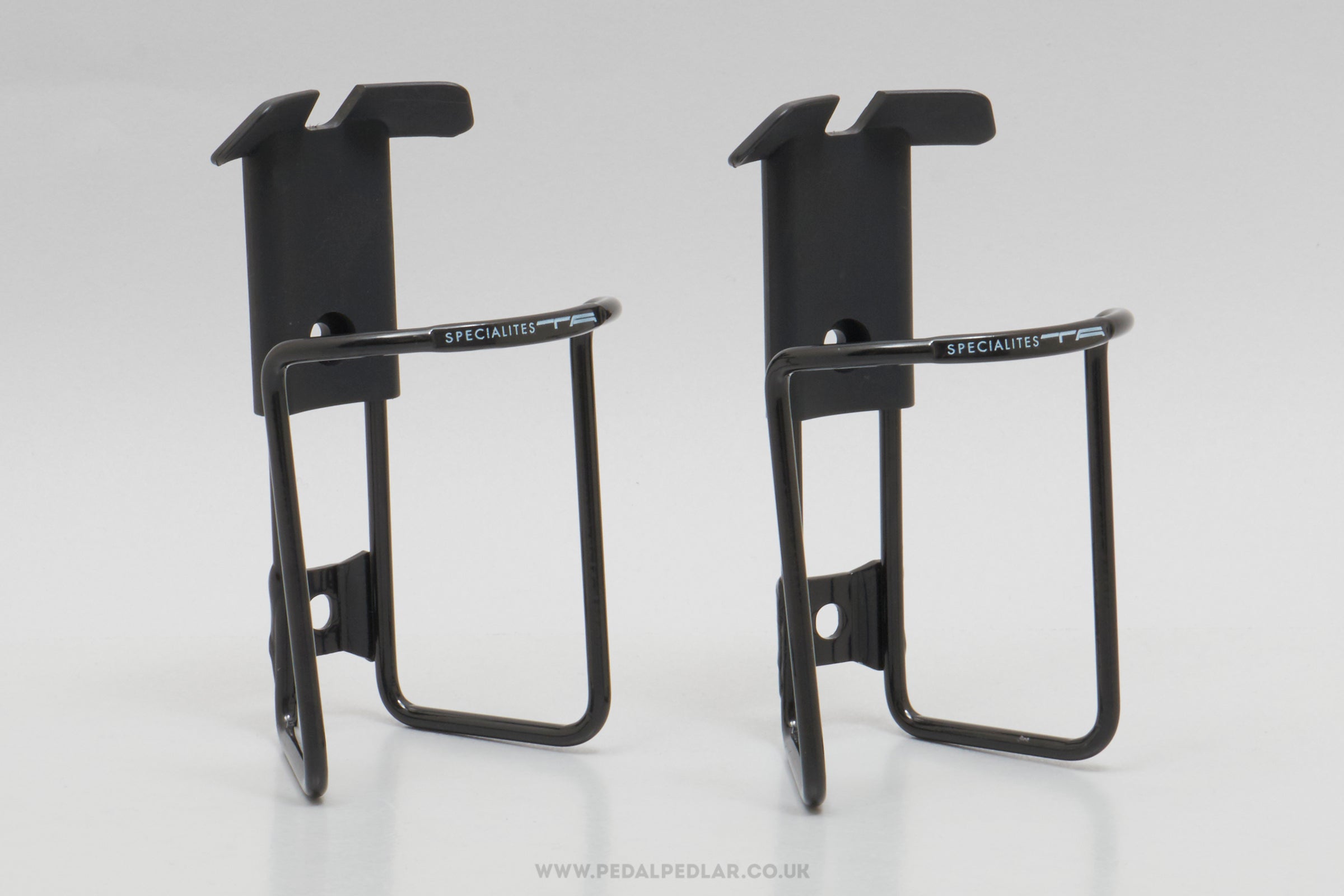


Specialites T.A. Sierra NOS Classic Black Bottle Cages
£30.00
✓ Original pair of bottle cages - produced in the 1990s
✓ New old stock! Still unused after all these years
✓ Worldwide shipping
Specialites T.A. Sierra water bottle cages (or bidon holders if you prefer), hailing from France and in production during the 1990s (yet still new & unused after all this time!). Made from aluminium/plastic and weighing in at 116 grams (the weight and price displayed are for a pair of cages). The perfect finishing touch for your classic bike, but great for bikes of the non-classic variety too!
OVERVIEW
Production Era - 1990s
Country - French
Material - Aluminium / Plastic
Weight - 116 g
Stock Code - D-CAG-P23C
*New old stock items may have marks from storage over the years, and as we often have multiples they can vary from piece to piece, but they are always genuine new & unused items.
TECHNICAL INFO
Cage Fixing - Frame Fit (Braze-On)
Colour* - Black
Bottle Fit - Standard
*The colour description is just a guide, please check the photos too as we make sure these are as close to the true colour as possible.
-
▼SHIPPING, TAXES & RETURNS
-
We've been safely sending orders around the world since 2010. Orders are carefully packed, sent with tracking & insurance, and normally collected around midday on Tuesdays and Fridays. Larger items may occasionally require an extra day or two to prepare.
We accept returns, please notify us within 14 days and ensure the item arrives back with us no later than 30 days after the order was received.
EU orders under €150 (excluding shipping) - import VAT and the new €3 customs duty are paid as part of your order, so there's nothing further to pay on delivery.
EU orders over €150 (excluding shipping) - import fees are payable to the carrier before delivery, with nothing collected at checkout.
USA orders - import fees are collected at checkout for all orders to the USA, so there won’t be any surprise charges when your order arrives.
Other international orders - local import fees may apply and are not collected by us. Please check your country's import rules before purchasing.
-
▼HELP SECTION
-
Cage Fixing - most bottle cages will be designed to fix to the frame, although some rare older ones mount to the handlebars and/or stem. If your frame doesn't have any bottle cage braze-ons to fix to you'll need clamp-on bottle cages.
Bottle Fit - almost all cycling bottles measure between 70 - 75 mm in diameter so this is the standard bottle cage size, the only rather rare exceptions are some old Elite bottles that require a 66 mm cage, the more recent oversized ones and of course the funny shaped aero ones that only accept the bottle they were made for.


Specialites T.A. Sierra NOS Classic Green Bottle Cage
£18.00 £20.00
✓ Original bottle cage - produced in the 1990s
✓ New old stock! Still unused after all these years
✓ Worldwide shipping
Specialites T.A. Sierra water bottle cage (or bidon holder if you prefer), hailing from France and in production during the 1990s (yet still new & unused after all this time!). The perfect finishing touch for your classic bike, but great for bikes of the non-classic variety too of course!
OVERVIEW
Production Era - 1990s
Country - French
Material - Aluminium/Plastic
Weight - 64 g
Stock Code - D-CAG143C
*New old stock items may have marks from storage over the years, and as we often have multiples they can vary from piece to piece, but they are always genuine new & unused items.
TECHNICAL INFO
Cage Fixing - Frame Fit (Braze-On)
Colour* - Green
Bottle Size - 75 mm (Standard)
*The colour description is just a guide, please check the photos to get a good idea of the colour too, as we make sure these are as close to the true colour as possible.
-
▼SHIPPING, TAXES & RETURNS
-
We've been safely sending orders around the world since 2010. Orders are carefully packed, sent with tracking & insurance, and normally collected around midday on Tuesdays and Fridays. Larger items may occasionally require an extra day or two to prepare.
We accept returns, please notify us within 14 days and ensure the item arrives back with us no later than 30 days after the order was received.
EU orders under €150 (excluding shipping) - import VAT and the new €3 customs duty are paid as part of your order, so there's nothing further to pay on delivery.
EU orders over €150 (excluding shipping) - import fees are payable to the carrier before delivery, with nothing collected at checkout.
USA orders - import fees are collected at checkout for all orders to the USA, so there won’t be any surprise charges when your order arrives.
Other international orders - local import fees may apply and are not collected by us. Please check your country's import rules before purchasing.
-
▼HELP SECTION
-
Cage Fixing - most bottle cages will be designed to fix to the frame, although some rare older ones mount to the handlebars and/or stem. If your frame doesn't have any bottle cage braze-ons to fix to you'll need a clamp-on bottle cage.
Bottle Size - almost all cycling bottles measure just under 75 mm in diameter so this is the standard bottle cage size, the only rather rare exceptions are some old Elite bottles that require a 66 mm cage, the more recent oversized ones and of course the funny shaped aero ones that only accept the bottle they were made for.


Specialites T.A. Sierra NOS Classic Green Bottle Cage
£15.00 £20.00
✓ Original bottle cage - produced in the 1990s
✓ New old stock! Still unused after all these years
✓ Worldwide shipping
Specialites T.A. Sierra water bottle cage (or bidon holder if you prefer), hailing from France and in production during the 1990s (yet still new & unused after all this time!). The perfect finishing touch for your classic bike, but great for bikes of the non-classic variety too of course!
OVERVIEW
Production Era - 1990s
Country - French
Material - Aluminium/Plastic
Weight - 53 g
Stock Code - D-CAG148C
*New old stock items may have marks from storage over the years, and as we often have multiples they can vary from piece to piece, but they are always genuine new & unused items.
TECHNICAL INFO
Cage Fixing - Frame Fit (Braze-On)
Colour* - Green
Bottle Size - 75 mm (Standard)
*The colour description is just a guide, please check the photos to get a good idea of the colour too, as we make sure these are as close to the true colour as possible.
-
▼SHIPPING, TAXES & RETURNS
-
We've been safely sending orders around the world since 2010. Orders are carefully packed, sent with tracking & insurance, and normally collected around midday on Tuesdays and Fridays. Larger items may occasionally require an extra day or two to prepare.
We accept returns, please notify us within 14 days and ensure the item arrives back with us no later than 30 days after the order was received.
EU orders under €150 (excluding shipping) - import VAT and the new €3 customs duty are paid as part of your order, so there's nothing further to pay on delivery.
EU orders over €150 (excluding shipping) - import fees are payable to the carrier before delivery, with nothing collected at checkout.
USA orders - import fees are collected at checkout for all orders to the USA, so there won’t be any surprise charges when your order arrives.
Other international orders - local import fees may apply and are not collected by us. Please check your country's import rules before purchasing.
-
▼HELP SECTION
-
Cage Fixing - most bottle cages will be designed to fix to the frame, although some rare older ones mount to the handlebars and/or stem. If your frame doesn't have any bottle cage braze-ons to fix to you'll need a clamp-on bottle cage.
Bottle Size - almost all cycling bottles measure just under 75 mm in diameter so this is the standard bottle cage size, the only rather rare exceptions are some old Elite bottles that require a 66 mm cage, the more recent oversized ones and of course the funny shaped aero ones that only accept the bottle they were made for.
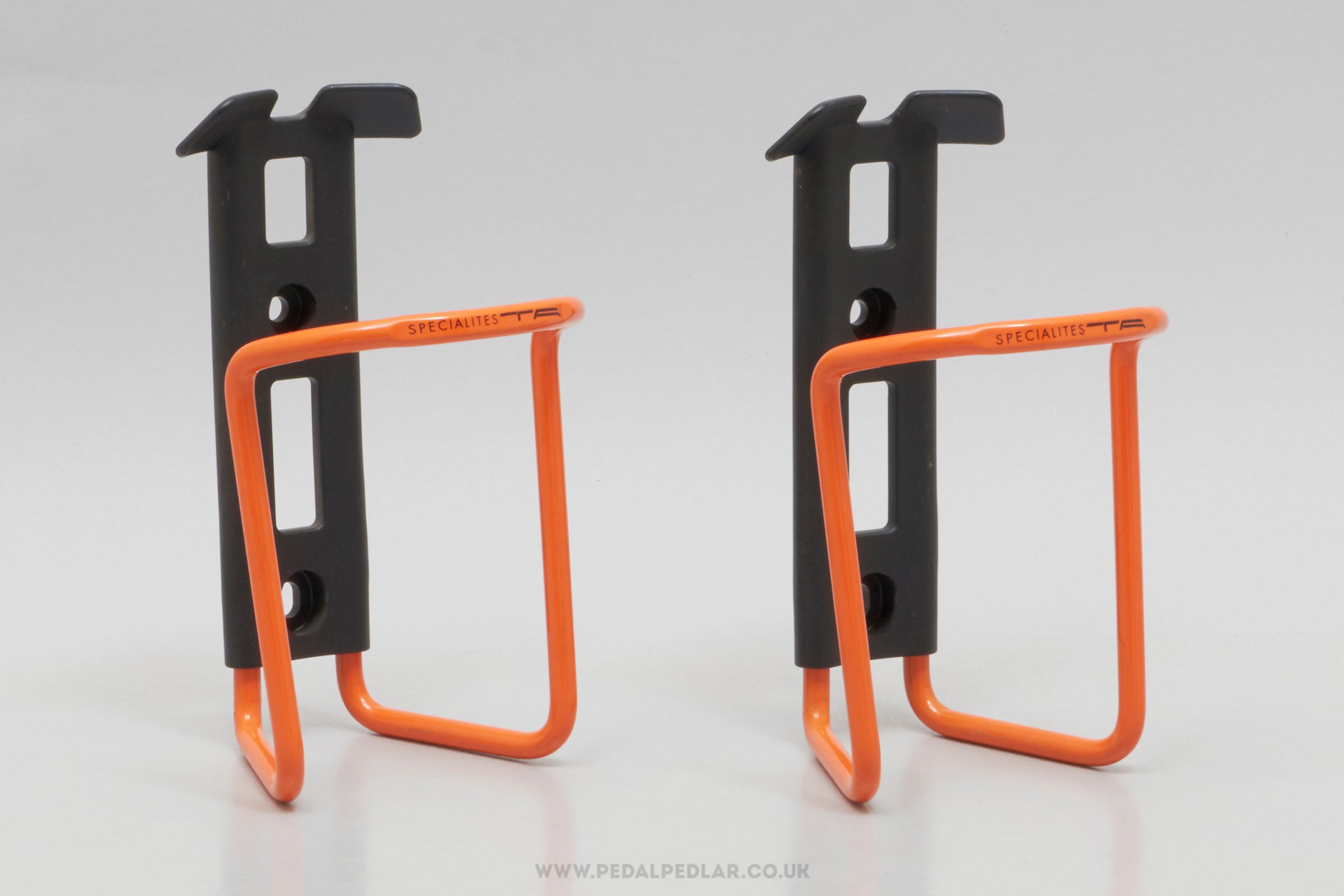


Specialites T.A. Sierra NOS Classic Orange Bottle Cages
£29.75 £35.00
✓ Original pair of bottle cages - produced in the 1990s
✓ New old stock! Still unused after all these years
✓ Worldwide shipping
Specialites T.A. Sierra water bottle cages (or bidon holders if you prefer), hailing from France and in production during the 1990s (yet still new & unused after all this time!). Made from aluminium/plastic and weighing in at 128 grams (the weight and price displayed are for a pair of cages). The perfect finishing touch for your classic bike, but great for bikes of the non-classic variety too!
OVERVIEW
Condition Notes - Some storage marks
Production Era - 1990s
Country - French
Material - Aluminium / Plastic
Weight - 128 g
Stock Code - D-CAG-P9C
*New old stock items may have marks from storage over the years, and as we often have multiples they can vary from piece to piece, but they are always genuine new & unused items.
TECHNICAL INFO
Cage Fixing - Frame Fit (Braze-On)
Colour* - Orange
Bottle Fit - Standard
*The colour description is just a guide, please check the photos too as we make sure these are as close to the true colour as possible.
-
▼SHIPPING, TAXES & RETURNS
-
We've been safely sending orders around the world since 2010. Orders are carefully packed, sent with tracking & insurance, and normally collected around midday on Tuesdays and Fridays. Larger items may occasionally require an extra day or two to prepare.
We accept returns, please notify us within 14 days and ensure the item arrives back with us no later than 30 days after the order was received.
EU orders under €150 (excluding shipping) - import VAT and the new €3 customs duty are paid as part of your order, so there's nothing further to pay on delivery.
EU orders over €150 (excluding shipping) - import fees are payable to the carrier before delivery, with nothing collected at checkout.
USA orders - import fees are collected at checkout for all orders to the USA, so there won’t be any surprise charges when your order arrives.
Other international orders - local import fees may apply and are not collected by us. Please check your country's import rules before purchasing.
-
▼HELP SECTION
-
Cage Fixing - most bottle cages will be designed to fix to the frame, although some rare older ones mount to the handlebars and/or stem. If your frame doesn't have any bottle cage braze-ons to fix to you'll need clamp-on bottle cages.
Bottle Fit - almost all cycling bottles measure between 70 - 75 mm in diameter so this is the standard bottle cage size, the only rather rare exceptions are some old Elite bottles that require a 66 mm cage, the more recent oversized ones and of course the funny shaped aero ones that only accept the bottle they were made for.


Specialites T.A. Sierra NOS Classic Purple Bottle Cage
£15.00 £20.00
✓ Original bottle cage - produced in the 1990s
✓ New old stock! Still unused after all these years
✓ Worldwide shipping
Specialites T.A. Sierra water bottle cage (or bidon holder if you prefer), hailing from France and in production during the 1990s (yet still new & unused after all this time!). The perfect finishing touch for your classic bike, but great for bikes of the non-classic variety too of course!
OVERVIEW
Production Era - 1990s
Country - French
Material - Aluminium/Plastic
Weight - 64 g
Stock Code - D-CAG142C
*New old stock items may have marks from storage over the years, and as we often have multiples they can vary from piece to piece, but they are always genuine new & unused items.
TECHNICAL INFO
Cage Fixing - Frame Fit (Braze-On)
Colour* - Purple
Bottle Size - 75 mm (Standard)
*The colour description is just a guide, please check the photos to get a good idea of the colour too, as we make sure these are as close to the true colour as possible.
-
▼SHIPPING, TAXES & RETURNS
-
We've been safely sending orders around the world since 2010. Orders are carefully packed, sent with tracking & insurance, and normally collected around midday on Tuesdays and Fridays. Larger items may occasionally require an extra day or two to prepare.
We accept returns, please notify us within 14 days and ensure the item arrives back with us no later than 30 days after the order was received.
EU orders under €150 (excluding shipping) - import VAT and the new €3 customs duty are paid as part of your order, so there's nothing further to pay on delivery.
EU orders over €150 (excluding shipping) - import fees are payable to the carrier before delivery, with nothing collected at checkout.
USA orders - import fees are collected at checkout for all orders to the USA, so there won’t be any surprise charges when your order arrives.
Other international orders - local import fees may apply and are not collected by us. Please check your country's import rules before purchasing.
-
▼HELP SECTION
-
Cage Fixing - most bottle cages will be designed to fix to the frame, although some rare older ones mount to the handlebars and/or stem. If your frame doesn't have any bottle cage braze-ons to fix to you'll need a clamp-on bottle cage.
Bottle Size - almost all cycling bottles measure just under 75 mm in diameter so this is the standard bottle cage size, the only rather rare exceptions are some old Elite bottles that require a 66 mm cage, the more recent oversized ones and of course the funny shaped aero ones that only accept the bottle they were made for.
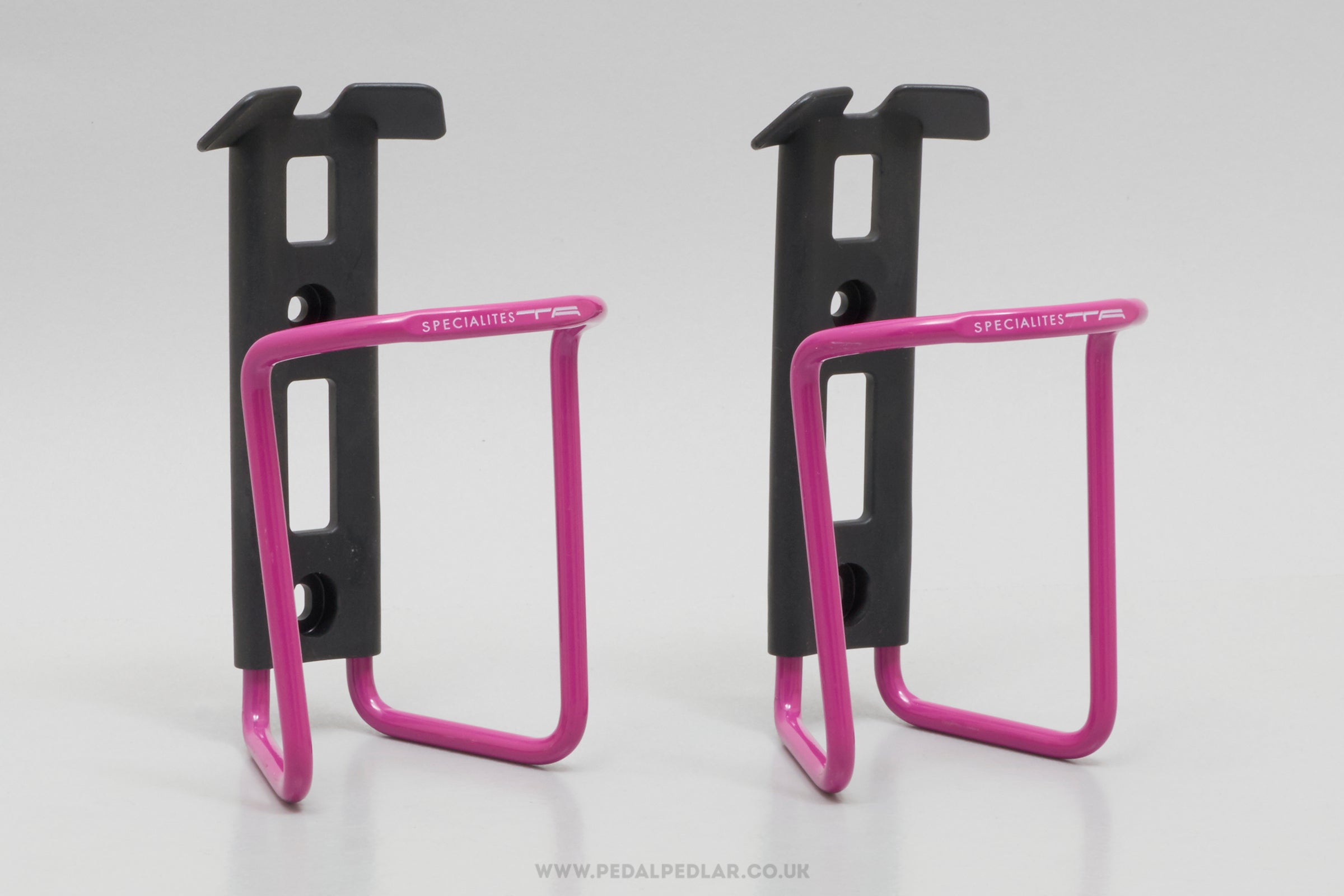


Specialites T.A. Sierra NOS Classic Purple Bottle Cages
£29.75 £35.00
✓ Original pair of bottle cages - produced in the 1990s
✓ New old stock! Still unused after all these years
✓ Worldwide shipping
Specialites T.A. Sierra water bottle cages (or bidon holders if you prefer), hailing from France and in production during the 1990s (yet still new & unused after all this time!). Made from aluminium/plastic and weighing in at 128 grams (the weight and price displayed are for a pair of cages). The perfect finishing touch for your classic bike, but great for bikes of the non-classic variety too!
OVERVIEW
Production Era - 1990s
Country - French
Material - Aluminium / Plastic
Weight - 128 g
Stock Code - D-CAG-P8C
*New old stock items may have marks from storage over the years, and as we often have multiples they can vary from piece to piece, but they are always genuine new & unused items.
TECHNICAL INFO
Cage Fixing - Frame Fit (Braze-On)
Colour* - Purple
Bottle Fit - Standard
*The colour description is just a guide, please check the photos too as we make sure these are as close to the true colour as possible.
-
▼SHIPPING, TAXES & RETURNS
-
We've been safely sending orders around the world since 2010. Orders are carefully packed, sent with tracking & insurance, and normally collected around midday on Tuesdays and Fridays. Larger items may occasionally require an extra day or two to prepare.
We accept returns, please notify us within 14 days and ensure the item arrives back with us no later than 30 days after the order was received.
EU orders under €150 (excluding shipping) - import VAT and the new €3 customs duty are paid as part of your order, so there's nothing further to pay on delivery.
EU orders over €150 (excluding shipping) - import fees are payable to the carrier before delivery, with nothing collected at checkout.
USA orders - import fees are collected at checkout for all orders to the USA, so there won’t be any surprise charges when your order arrives.
Other international orders - local import fees may apply and are not collected by us. Please check your country's import rules before purchasing.
-
▼HELP SECTION
-
Cage Fixing - most bottle cages will be designed to fix to the frame, although some rare older ones mount to the handlebars and/or stem. If your frame doesn't have any bottle cage braze-ons to fix to you'll need clamp-on bottle cages.
Bottle Fit - almost all cycling bottles measure between 70 - 75 mm in diameter so this is the standard bottle cage size, the only rather rare exceptions are some old Elite bottles that require a 66 mm cage, the more recent oversized ones and of course the funny shaped aero ones that only accept the bottle they were made for.


Specialites T.A. Sierra NOS Classic Red Bottle Cage
£15.00 £20.00
✓ Original bottle cage - produced in the 1990s
✓ New old stock! Still unused after all these years
✓ Worldwide shipping
Specialites T.A. Sierra water bottle cage (or bidon holder if you prefer), hailing from France and in production during the 1990s (yet still new & unused after all this time!). The perfect finishing touch for your classic bike, but great for bikes of the non-classic variety too of course!
OVERVIEW
Production Era - 1990s
Country - French
Material - Aluminium/Plastic
Weight - 64 g
Stock Code - D-CAG141C
*New old stock items may have marks from storage over the years, and as we often have multiples they can vary from piece to piece, but they are always genuine new & unused items.
TECHNICAL INFO
Cage Fixing - Frame Fit (Braze-On)
Colour* - Red
Bottle Size - 75 mm (Standard)
*The colour description is just a guide, please check the photos to get a good idea of the colour too, as we make sure these are as close to the true colour as possible.
-
▼SHIPPING, TAXES & RETURNS
-
We've been safely sending orders around the world since 2010. Orders are carefully packed, sent with tracking & insurance, and normally collected around midday on Tuesdays and Fridays. Larger items may occasionally require an extra day or two to prepare.
We accept returns, please notify us within 14 days and ensure the item arrives back with us no later than 30 days after the order was received.
EU orders under €150 (excluding shipping) - import VAT and the new €3 customs duty are paid as part of your order, so there's nothing further to pay on delivery.
EU orders over €150 (excluding shipping) - import fees are payable to the carrier before delivery, with nothing collected at checkout.
USA orders - import fees are collected at checkout for all orders to the USA, so there won’t be any surprise charges when your order arrives.
Other international orders - local import fees may apply and are not collected by us. Please check your country's import rules before purchasing.
-
▼HELP SECTION
-
Cage Fixing - most bottle cages will be designed to fix to the frame, although some rare older ones mount to the handlebars and/or stem. If your frame doesn't have any bottle cage braze-ons to fix to you'll need a clamp-on bottle cage.
Bottle Size - almost all cycling bottles measure just under 75 mm in diameter so this is the standard bottle cage size, the only rather rare exceptions are some old Elite bottles that require a 66 mm cage, the more recent oversized ones and of course the funny shaped aero ones that only accept the bottle they were made for.
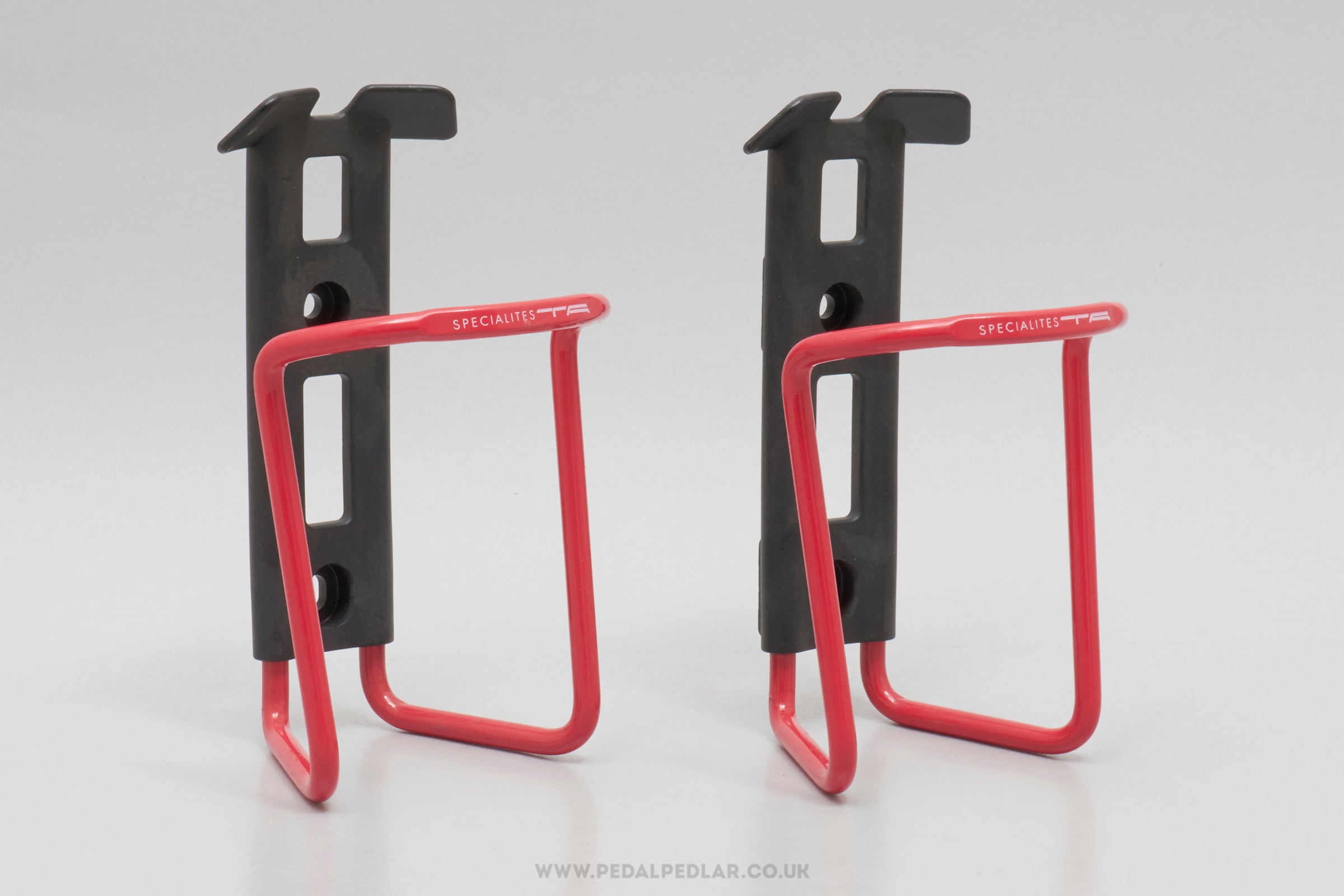


Specialites T.A. Sierra NOS Classic Red Bottle Cages
£29.75 £35.00
✓ Original pair of bottle cages - produced in the 1990s
✓ New old stock! Still unused after all these years
✓ Worldwide shipping
Specialites T.A. Sierra water bottle cages (or bidon holders if you prefer), hailing from France and in production during the 1990s (yet still new & unused after all this time!). Made from aluminium/plastic and weighing in at 128 grams (the weight and price displayed are for a pair of cages). The perfect finishing touch for your classic bike, but great for bikes of the non-classic variety too!
OVERVIEW
Production Era - 1990s
Country - French
Material - Aluminium / Plastic
Weight - 128 g
Stock Code - D-CAG-P6C
*New old stock items may have marks from storage over the years, and as we often have multiples they can vary from piece to piece, but they are always genuine new & unused items.
TECHNICAL INFO
Cage Fixing - Frame Fit (Braze-On)
Colour* - Red
Bottle Fit - Standard
*The colour description is just a guide, please check the photos too as we make sure these are as close to the true colour as possible.
-
▼SHIPPING, TAXES & RETURNS
-
We've been safely sending orders around the world since 2010. Orders are carefully packed, sent with tracking & insurance, and normally collected around midday on Tuesdays and Fridays. Larger items may occasionally require an extra day or two to prepare.
We accept returns, please notify us within 14 days and ensure the item arrives back with us no later than 30 days after the order was received.
EU orders under €150 (excluding shipping) - import VAT and the new €3 customs duty are paid as part of your order, so there's nothing further to pay on delivery.
EU orders over €150 (excluding shipping) - import fees are payable to the carrier before delivery, with nothing collected at checkout.
USA orders - import fees are collected at checkout for all orders to the USA, so there won’t be any surprise charges when your order arrives.
Other international orders - local import fees may apply and are not collected by us. Please check your country's import rules before purchasing.
-
▼HELP SECTION
-
Cage Fixing - most bottle cages will be designed to fix to the frame, although some rare older ones mount to the handlebars and/or stem. If your frame doesn't have any bottle cage braze-ons to fix to you'll need clamp-on bottle cages.
Bottle Fit - almost all cycling bottles measure between 70 - 75 mm in diameter so this is the standard bottle cage size, the only rather rare exceptions are some old Elite bottles that require a 66 mm cage, the more recent oversized ones and of course the funny shaped aero ones that only accept the bottle they were made for.


Specialites T.A. Sierra NOS Classic White Bottle Cage
£15.00 £20.00
✓ Original bottle cage - produced in the 1990s
✓ New old stock! Still unused after all these years
✓ Worldwide shipping
Specialites T.A. Sierra water bottle cage (or bidon holder if you prefer), hailing from France and in production during the 1990s (yet still new & unused after all this time!). The perfect finishing touch for your classic bike, but great for bikes of the non-classic variety too of course!
OVERVIEW
Production Era - 1990s
Country - French
Material - Aluminium/Plastic
Weight - 66 g
Stock Code - D-CAG129C
*New old stock items may have marks from storage over the years, and as we often have multiples they can vary from piece to piece, but they are always genuine new & unused items.
TECHNICAL INFO
Cage Fixing - Frame Fit (Braze-On)
Colour* - White
Bottle Size - 75 mm (Standard)
*The colour description is just a guide, please check the photos to get a good idea of the colour too, as we make sure these are as close to the true colour as possible.
-
▼SHIPPING, TAXES & RETURNS
-
We've been safely sending orders around the world since 2010. Orders are carefully packed, sent with tracking & insurance, and normally collected around midday on Tuesdays and Fridays. Larger items may occasionally require an extra day or two to prepare.
We accept returns, please notify us within 14 days and ensure the item arrives back with us no later than 30 days after the order was received.
EU orders under €150 (excluding shipping) - import VAT and the new €3 customs duty are paid as part of your order, so there's nothing further to pay on delivery.
EU orders over €150 (excluding shipping) - import fees are payable to the carrier before delivery, with nothing collected at checkout.
USA orders - import fees are collected at checkout for all orders to the USA, so there won’t be any surprise charges when your order arrives.
Other international orders - local import fees may apply and are not collected by us. Please check your country's import rules before purchasing.
-
▼HELP SECTION
-
Cage Fixing - most bottle cages will be designed to fix to the frame, although some rare older ones mount to the handlebars and/or stem. If your frame doesn't have any bottle cage braze-ons to fix to you'll need a clamp-on bottle cage.
Bottle Size - almost all cycling bottles measure just under 75 mm in diameter so this is the standard bottle cage size, the only rather rare exceptions are some old Elite bottles that require a 66 mm cage, the more recent oversized ones and of course the funny shaped aero ones that only accept the bottle they were made for.
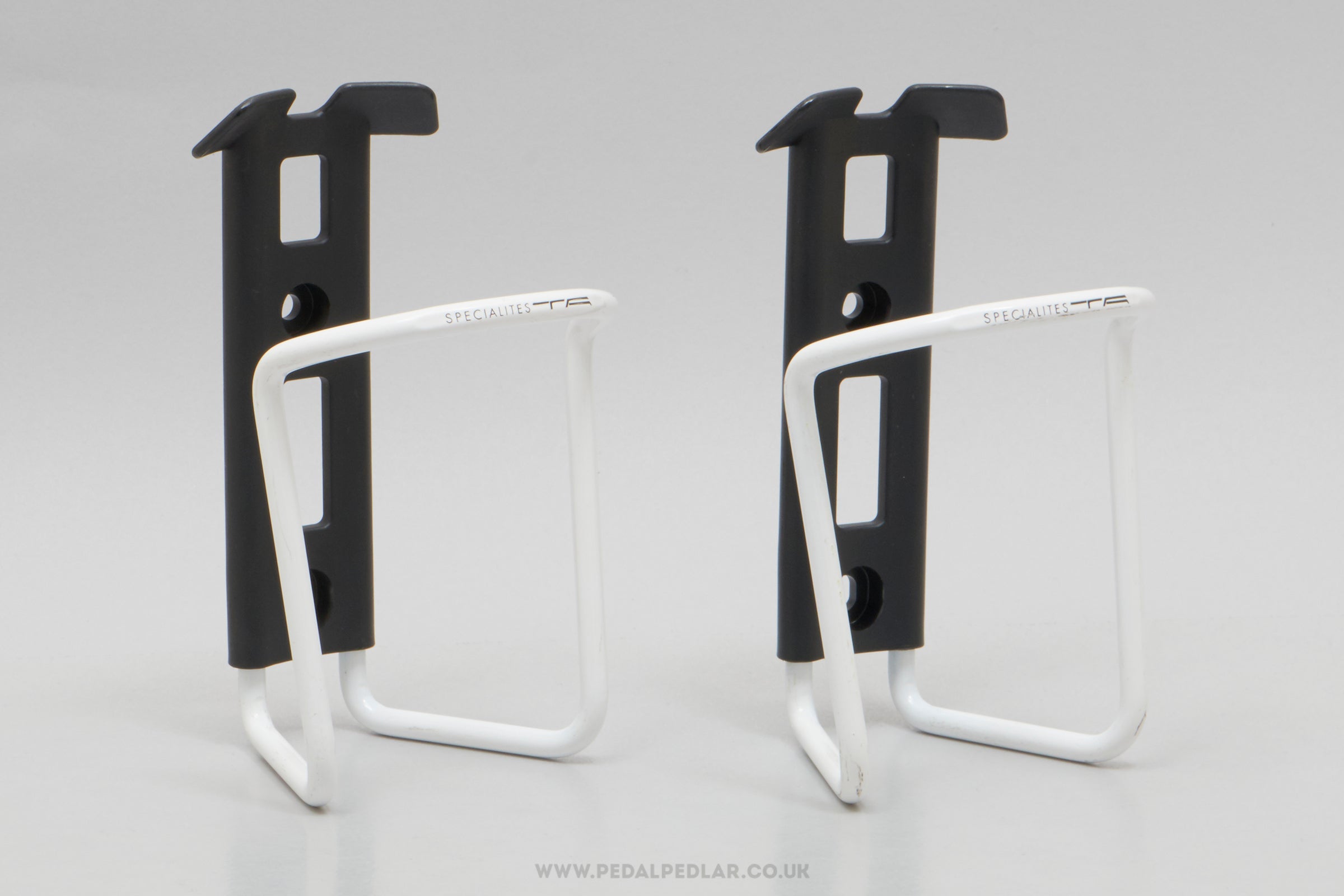


Specialites T.A. Sierra NOS Classic White Bottle Cages
£29.75 £35.00
✓ Original pair of bottle cages - produced in the 1990s
✓ New old stock! Still unused after all these years
✓ Worldwide shipping
Specialites T.A. Sierra water bottle cages (or bidon holders if you prefer), hailing from France and in production during the 1990s (yet still new & unused after all this time!). Made from aluminium/plastic and weighing in at 132 grams (the weight and price displayed are for a pair of cages). The perfect finishing touch for your classic bike, but great for bikes of the non-classic variety too!
OVERVIEW
Condition Notes - Some storage marks
Production Era - 1990s
Country - French
Material - Aluminium / Plastic
Weight - 132 g
Stock Code - D-CAG-P10C
*New old stock items may have marks from storage over the years, and as we often have multiples they can vary from piece to piece, but they are always genuine new & unused items.
TECHNICAL INFO
Cage Fixing - Frame Fit (Braze-On)
Colour* - White
Bottle Fit - Standard
*The colour description is just a guide, please check the photos too as we make sure these are as close to the true colour as possible.
-
▼SHIPPING, TAXES & RETURNS
-
We've been safely sending orders around the world since 2010. Orders are carefully packed, sent with tracking & insurance, and normally collected around midday on Tuesdays and Fridays. Larger items may occasionally require an extra day or two to prepare.
We accept returns, please notify us within 14 days and ensure the item arrives back with us no later than 30 days after the order was received.
EU orders under €150 (excluding shipping) - import VAT and the new €3 customs duty are paid as part of your order, so there's nothing further to pay on delivery.
EU orders over €150 (excluding shipping) - import fees are payable to the carrier before delivery, with nothing collected at checkout.
USA orders - import fees are collected at checkout for all orders to the USA, so there won’t be any surprise charges when your order arrives.
Other international orders - local import fees may apply and are not collected by us. Please check your country's import rules before purchasing.
-
▼HELP SECTION
-
Cage Fixing - most bottle cages will be designed to fix to the frame, although some rare older ones mount to the handlebars and/or stem. If your frame doesn't have any bottle cage braze-ons to fix to you'll need clamp-on bottle cages.
Bottle Fit - almost all cycling bottles measure between 70 - 75 mm in diameter so this is the standard bottle cage size, the only rather rare exceptions are some old Elite bottles that require a 66 mm cage, the more recent oversized ones and of course the funny shaped aero ones that only accept the bottle they were made for.


Specialites T.A. Team Fagor / MBK NOS Vintage 500 ml Water Bottle
£26.25 £35.00
✓ Original water bottle - produced in the 1980s
✓ New old stock! Still unused after all these years
✓ Suitable for historic cycling events such as L'Eroica
✓ Worldwide shipping
Specialites T.A. Team Fagor / MBK water bottle, hailing from France and in production during the 1980s (yet still new & unused after all this time!). The perfect finishing touch for your vintage bike, but great for bikes of the non-vintage variety too of course!
If you're taking part in L'Eroica or a similar vintage event, this is of the correct era, so rest assured the pre-1987 police won't lock you up for having the wrong water bottle!
OVERVIEW
Production Era - 1980s
Country - French
Material - Plastic
Weight - 67 g
Stock Code - D-BOT32V
*New old stock items may have marks from storage over the years, and as we often have multiples they can vary from piece to piece, but they are always genuine new & unused items.
TECHNICAL INFO
Capacity - 500 ml
Bottle Width - 75 mm
-
▼SHIPPING, TAXES & RETURNS
-
We've been safely sending orders around the world since 2010. Orders are carefully packed, sent with tracking & insurance, and normally collected around midday on Tuesdays and Fridays. Larger items may occasionally require an extra day or two to prepare.
We accept returns, please notify us within 14 days and ensure the item arrives back with us no later than 30 days after the order was received.
EU orders under €150 (excluding shipping) - import VAT and the new €3 customs duty are paid as part of your order, so there's nothing further to pay on delivery.
EU orders over €150 (excluding shipping) - import fees are payable to the carrier before delivery, with nothing collected at checkout.
USA orders - import fees are collected at checkout for all orders to the USA, so there won’t be any surprise charges when your order arrives.
Other international orders - local import fees may apply and are not collected by us. Please check your country's import rules before purchasing.
-
▼HELP SECTION
-
Capacity - 500ml used to be the standard sized bottle, but the taller modern versions tend to be 750ml.
Bottle width - almost all bottle cages take a 75 mm bottle width, the only rather rare exceptions are some old Elite cages that take a 66 mm bottle (and of course the funny shaped aero ones).


Specialites T.A. Team Fagor Electromenager NOS Vintage 500 ml Water Bottle
£22.50 £30.00
✓ Original water bottle - produced in the 1980s
✓ New old stock! Still unused after all these years
✓ Suitable for historic cycling events such as L'Eroica
✓ Worldwide shipping
Specialites T.A. Team Fagor Electromenager water bottle, hailing from France and in production during the 1980s (yet still new & unused after all this time!). The perfect finishing touch for your vintage bike, but great for bikes of the non-vintage variety too of course!
If you're taking part in L'Eroica or a similar vintage event, this is of the correct era, so rest assured the pre-1987 police won't lock you up for having the wrong water bottle!
OVERVIEW
Production Era - 1980s
Country - French
Material - Plastic
Weight - 69 g
Stock Code - D-BOT26V
*New old stock items may have marks from storage over the years, and as we often have multiples they can vary from piece to piece, but they are always genuine new & unused items.
TECHNICAL INFO
Capacity - 500 ml
Bottle Width - 75 mm
-
▼SHIPPING, TAXES & RETURNS
-
We've been safely sending orders around the world since 2010. Orders are carefully packed, sent with tracking & insurance, and normally collected around midday on Tuesdays and Fridays. Larger items may occasionally require an extra day or two to prepare.
We accept returns, please notify us within 14 days and ensure the item arrives back with us no later than 30 days after the order was received.
EU orders under €150 (excluding shipping) - import VAT and the new €3 customs duty are paid as part of your order, so there's nothing further to pay on delivery.
EU orders over €150 (excluding shipping) - import fees are payable to the carrier before delivery, with nothing collected at checkout.
USA orders - import fees are collected at checkout for all orders to the USA, so there won’t be any surprise charges when your order arrives.
Other international orders - local import fees may apply and are not collected by us. Please check your country's import rules before purchasing.
-
▼HELP SECTION
-
Capacity - 500ml used to be the standard sized bottle, but the taller modern versions tend to be 750ml.
Bottle width - almost all bottle cages take a 75 mm bottle width, the only rather rare exceptions are some old Elite cages that take a 66 mm bottle (and of course the funny shaped aero ones).


Specialites TA Cyclotourist (CY205) Vintage 52T 50.4 / 74 BCD Outer Chainring
£21.25 £25.00
✓ Original part - in production from the 1950s to the 1980s
✓ Suitable for historic cycling events such as L'Eroica
✓ Professionally checked & cleaned
✓ Worldwide shipping
Specialites TA Cyclotourist chainring, hailing from France and in production from the 1950s to the 1980s. Made from aluminium and weighing in at 144 grams. A fine choice for keeping your vintage bike authentic, but also great for any other compatible bike too.
If you're taking part in L'Eroica, Anjou Velo, Velo Retro or another similar vintage cycling event, this is fully compliant - so rest assured, the pre-1987 police won't lock you up for having the wrong chainring!
The chainring's been carefully cleaned, thoroughly checked by one of our mechanics and graded as good condition, but do take a good look at the detailed photos so you can see the cosmetic condition before you buy.OVERVIEW
Model ID - CY205
Production Era - 1950s - 1980s
Country - French
Material - Aluminium
Weight - 144 g
Stock Code - U-CRO12V
TECHNICAL INFO
Tooth Count - 52
Between Adjacent Bolt Holes - 29.6 mm
BCD - 50.4 / 74 BCD
Chainset Type - Double
Bolt Count - 5-Bolt / 6-Bolt
Chain Width - 3/32"
Intended Speed - 5 Speed, 6 Speed
-
▼SHIPPING, TAXES & RETURNS
-
We've been safely sending orders around the world since 2010. Orders are carefully packed, sent with tracking & insurance, and normally collected around midday on Tuesdays and Fridays. Larger items may occasionally require an extra day or two to prepare.
We accept returns, please notify us within 14 days and ensure the item arrives back with us no later than 30 days after the order was received.
EU orders under €150 (excluding shipping) - import VAT and the new €3 customs duty are paid as part of your order, so there's nothing further to pay on delivery.
EU orders over €150 (excluding shipping) - import fees are payable to the carrier before delivery, with nothing collected at checkout.
USA orders - import fees are collected at checkout for all orders to the USA, so there won’t be any surprise charges when your order arrives.
Other international orders - local import fees may apply and are not collected by us. Please check your country's import rules before purchasing.


Specialized 5500 NOS Classic Size EU 38 Leather / Road Cycling Shoes
£45.00 £60.00
✓ Original classic cycling shoes - 1990s style!
✓ New old stock! Still unused after all these years
✓ Worldwide shipping
Specialized 5500 cycling shoes in size EU 38, likely made in the 1990s given the style (yet still new & unused after all this time!). An excellent choice for wearing on your classic bike (or any occasion you fancy of course), and also a responsible alternative to buying brand new cycling kit!
OVERVIEW
Condition - New Old Stock*
Production Era - 1990s
Country - American
Stock Code - D-SH25C
*New old stock items may have marks from storage over the years, and as we often have multiples they can vary from piece to piece, but they are always genuine new & unused items.
**Most cycling shoes use European sizing but some brands do have conversion charts available. A good rule of thumb, especially with older European shoes is go for a size up as they often come up small. We also provide the length & width, check the help section to see how we measure these.
DETAIL & MEASUREMENTS
Colour* - Black / Grey / Blue
Upper Material - Leather / Synthetic
Sole Material - Plastic
Shoe Type - Road
Fastening Type - Velcro
Cleat Type - Slotted / Clipless Road (2 / 3 Bolt)
Length (Heel to Toe) - 24 cm
Width (At Widest Part) - 7.5 cm
*The colour description is just a guide, please check the photos to get a good idea of the colour too, as we make sure these are as close to the true colour as possible.
-
▼SHIPPING, TAXES & RETURNS
-
We've been safely sending orders around the world since 2010. Orders are carefully packed, sent with tracking & insurance, and normally collected around midday on Tuesdays and Fridays. Larger items may occasionally require an extra day or two to prepare.
We accept returns, please notify us within 14 days and ensure the item arrives back with us no later than 30 days after the order was received.
EU orders under €150 (excluding shipping) - import VAT and the new €3 customs duty are paid as part of your order, so there's nothing further to pay on delivery.
EU orders over €150 (excluding shipping) - import fees are payable to the carrier before delivery, with nothing collected at checkout.
USA orders - import fees are collected at checkout for all orders to the USA, so there won’t be any surprise charges when your order arrives.
Other international orders - local import fees may apply and are not collected by us. Please check your country's import rules before purchasing.
-
▼HELP SECTION
-
Cleat Type - slotted' cleats fit onto traditional pedal cages and the foot is secured with toe clips and straps, various fixings types exist and some are brand specific. Most cleats for clipless road pedals fit the 3 bolt fixing invented by Look in the 80s, the exceptions being the 4 bolt fixing for Time's TBT system (and later Speedplay), and the Podio specific fixings for Merckx shoes. Mountain bike (SPD type) cleats have a standard 2 bolt fixing, and some shoes are even designed to take more than one type of cleat!
Length (Heel to Toe) - measured from the very back of the heel to the front of the toes at their furthest points. We find this measurement useful if you have a similar shape shoe to compare to, and although there will be variation in design, when combined with the width it can be helpful in determining whether the shoes will be a close fit or not.
Width (At Widest Part) - measured across the metatarsal at the widest part of the shoe, on the outside, not the inside.
If you require any further measurements please get in touch.


Specialized 5500 NOS Classic Size EU 39 Leather / Road Cycling Shoes
£45.00 £60.00
✓ Original classic cycling shoes - 1990s style!
✓ New old stock! Still unused after all these years
✓ Worldwide shipping
Specialized 5500 cycling shoes in size EU 39, likely made in the 1990s given the style (yet still new & unused after all this time!). An excellent choice for wearing on your classic bike (or any occasion you fancy of course), and also a great alternative to buying brand new cycling kit!
OVERVIEW
Condition - New Old Stock*
Production Era - 1990s
Country - American
Stock Code - D-SH24C
*New old stock items may have marks from storage over the years, and as we often have multiples they can vary from piece to piece, but they are always genuine new & unused items.
**Most cycling shoes use European sizing but some brands do have conversion charts available. A good rule of thumb, especially with older European shoes is go for a size up as they often come up small. We also provide the length & width, check the help section to see how we measure these.
DETAIL & MEASUREMENTS
Colour* - Black / Grey / Blue
Upper Material - Leather / Synthetic
Sole Material - Plastic
Shoe Type - Road
Fastening Type - Velcro
Cleat Type - Slotted / Clipless Road (2 / 3 Bolt)
Length (Heel to Toe) - 25 cm
Width (At Widest Part) - 8 cm
*The colour description is just a guide, please check the photos to get a good idea of the colour too, as we make sure these are as close to the true colour as possible.
-
▼SHIPPING, TAXES & RETURNS
-
We've been safely sending orders around the world since 2010. Orders are carefully packed, sent with tracking & insurance, and normally collected around midday on Tuesdays and Fridays. Larger items may occasionally require an extra day or two to prepare.
We accept returns, please notify us within 14 days and ensure the item arrives back with us no later than 30 days after the order was received.
EU orders under €150 (excluding shipping) - import VAT and the new €3 customs duty are paid as part of your order, so there's nothing further to pay on delivery.
EU orders over €150 (excluding shipping) - import fees are payable to the carrier before delivery, with nothing collected at checkout.
USA orders - import fees are collected at checkout for all orders to the USA, so there won’t be any surprise charges when your order arrives.
Other international orders - local import fees may apply and are not collected by us. Please check your country's import rules before purchasing.
-
▼HELP SECTION
-
Cleat Type - slotted' cleats fit onto traditional pedal cages and the foot is secured with toe clips and straps, various fixings types exist and some are brand specific. Most cleats for clipless road pedals fit the 3 bolt fixing invented by Look in the 80s, the exceptions being the 4 bolt fixing for Time's TBT system (and later Speedplay), and the Podio specific fixings for Merckx shoes. Mountain bike (SPD type) cleats have a standard 2 bolt fixing, and some shoes are even designed to take more than one type of cleat!
Length (Heel to Toe) - measured from the very back of the heel to the front of the toes at their furthest points. We find this measurement useful if you have a similar shape shoe to compare to, and although there will be variation in design, when combined with the width it can be helpful in determining whether the shoes will be a close fit or not.
Width (At Widest Part) - measured across the metatarsal at the widest part of the shoe, on the outside, not the inside.
If you require any further measurements please get in touch.


Specialized F6 107-68 NOS Vintage 107.5 mm Bottom Bracket Axle
£28.50 £30.00
✓ Original part - produced in the 1980s
✓ New old stock! Still unused after all these years
✓ Suitable for historic cycling events such as L'Eroica
✓ Worldwide shipping
Specialized F6 bottom bracket axle (or BB spindle if you prefer), hailing from the United States and in production during the 1980s (yet still new & unused after all this time). Made from steel and weighing in at 138 grams. A fine choice for keeping your vintage bike authentic, but also great for any other compatible bike.
If you're taking part in L'Eroica or any other vintage event, this is fully compliant - so rest assured, the pre-1987 police won't lock you up for having the wrong axle!
OVERVIEW
Condition Notes - Some storage marks
Production Era - 1980s
Country - American
Material - Steel
Weight - 138 g
Stock Code - D-BB-AS9V
*New old stock items may have marks from storage over the years, and as we often have multiples they can vary from piece to piece, but they are always genuine new & unused items.
TECHNICAL INFO
Axle Type - Square Taper
Axle Markings - 107-68
Axle Length (D) - 107.5 mm
Axle Centre (B) - 50.5 mm
Axle Drive Side (C) - 28.5 mm
Axle Non-Drive Side (A) - 28.5 mm
Shell Width - 68 mm
NB: Check the help section to see how we take these measurements.
-
▼SHIPPING, TAXES & RETURNS
-
We've been safely sending orders around the world since 2010. Orders are carefully packed, sent with tracking & insurance, and normally collected around midday on Tuesdays and Fridays. Larger items may occasionally require an extra day or two to prepare.
We accept returns, please notify us within 14 days and ensure the item arrives back with us no later than 30 days after the order was received.
EU orders under €150 (excluding shipping) - import VAT and the new €3 customs duty are paid as part of your order, so there's nothing further to pay on delivery.
EU orders over €150 (excluding shipping) - import fees are payable to the carrier before delivery, with nothing collected at checkout.
USA orders - import fees are collected at checkout for all orders to the USA, so there won’t be any surprise charges when your order arrives.
Other international orders - local import fees may apply and are not collected by us. Please check your country's import rules before purchasing.
-
▼HELP SECTION
- We've provided reference below to illustrate how we take the measurements.
Axle Type - for square tapers, the ISO introduced a standard for European makers in the early 90s, JIS then did the same in Asia. Before then it was not so simple, and although there is a degree of interchangeability, the best way to make sure you have the right axle is to stick to the same brand from the same era, ideally the proprietary model.
Axle Length (D) - your crankset dictates the axle length you need and the recommendation should be used to avoid issues with chainline. If you're replacing an axle that works perfectly then this can be matched, otherwise you'll need to check the manufacturers spec, a good resource for older bikes is Velobase.
Centre (B) - measured from the outside of the 'shoulders' of the bearing races, as seen in the diagram.
Drive Side (C) - the right side (with any logos etc on the axle facing you), your right crank and chainrings will mount to this side.
Non-Drive Side (A) - the left side, where the left crank arm will be mounted.
Shell Width - the width of the bottom bracket shell the axle was designed to fit, measured at its widest point.


Specialized K7 114.5-68 Vintage 114.5 mm Bottom Bracket Axle
£20.00
✓ Original part - produced in the 1980s
✓ Suitable for historic cycling events such as L'Eroica
✓ Professionally checked & cleaned
✓ Worldwide shipping
Specialized K7 bottom bracket axle (or BB spindle if you prefer), hailing from the United States and in production during the 1980s. Made from steel and weighing in at 150 grams. A fine choice for keeping your vintage bike authentic, but also great for any other compatible bike.
If you're taking part in L'Eroica or any other vintage event, this is fully compliant - so rest assured, the pre-1987 police won't lock you up for having the wrong axle!
The axle has been thoroughly checked, cleaned and graded as very good condition, but do take a good look at the detailed photos so you can see the cosmetic condition before you buy.OVERVIEW
Production Era - 1980s
Country - American
Material - Steel
Weight - 150 g
Stock Code - U-BB-AS8V
TECHNICAL INFO
Axle Type - Square Taper
Axle Markings - 114.5-68
Axle Length (D) - 114.5 mm
Axle Centre (B) - 48.5 mm
Axle Drive Side (C) - 34.5 mm
Axle Non-Drive Side (A) - 31.5 mm
Shell Width - 68 mm
NB: Check the help section to see how we take these measurements.
-
▼SHIPPING, TAXES & RETURNS
-
We've been safely sending orders around the world since 2010. Orders are carefully packed, sent with tracking & insurance, and normally collected around midday on Tuesdays and Fridays. Larger items may occasionally require an extra day or two to prepare.
We accept returns, please notify us within 14 days and ensure the item arrives back with us no later than 30 days after the order was received.
EU orders under €150 (excluding shipping) - import VAT and the new €3 customs duty are paid as part of your order, so there's nothing further to pay on delivery.
EU orders over €150 (excluding shipping) - import fees are payable to the carrier before delivery, with nothing collected at checkout.
USA orders - import fees are collected at checkout for all orders to the USA, so there won’t be any surprise charges when your order arrives.
Other international orders - local import fees may apply and are not collected by us. Please check your country's import rules before purchasing.
-
▼HELP SECTION
- We've provided reference below to illustrate how we take the measurements.
Axle Type - for square tapers, the ISO introduced a standard for European makers in the early 90s, JIS then did the same in Asia. Before then it was not so simple, and although there is a degree of interchangeability, the best way to make sure you have the right axle is to stick to the same brand from the same era, ideally the proprietary model.
Axle Length (D) - your crankset dictates the axle length you need and the recommendation should be used to avoid issues with chainline. If you're replacing an axle that works perfectly then this can be matched, otherwise you'll need to check the manufacturers spec, a good resource for older bikes is Velobase.
Centre (B) - measured from the outside of the 'shoulders' of the bearing races, as seen in the diagram.
Drive Side (C) - the right side (with any logos etc on the axle facing you), your right crank and chainrings will mount to this side.
Non-Drive Side (A) - the left side, where the left crank arm will be mounted.
Shell Width - the width of the bottom bracket shell the axle was designed to fit, measured at its widest point.